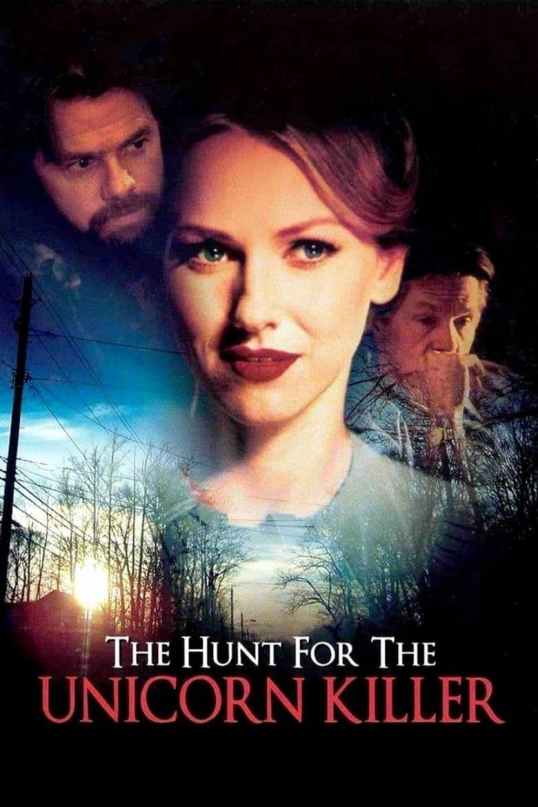
March True Crime: The Hunt For The Unicorn Killer (dir by William A. Graham)


Who started Earth Day?

There are a lot of names that get mentioned.  Some people give all the credit to U.S. Senator Gaylord Nelson of Wisconsin, who was  an environmentalist before it was trendy and who proposed a day-long “teach-in” in 1970.  (According to Norman Mailer, Hunter Thompson, and Gary Hart, Gaylord Nelson was also George McGovern’s personal pick for his running mate in 1972 but ultimately, Nelson didn’t get the spot because it was felt people would make fun of his first name.  Considering how things went with Thomas Eagleton, one imagines that McGovern probably ended up wishing he had the courage to go with his first instinct.)  A peace activist named John McConnell also proposed the idea of an Earth Day in 1969 but there’s some debate whether his proposed Earth Day became the actual Earth Day.  Like all things, many people have taken credit for the idea behind Earth Day.

Ira Einhorn was one of those people.  A prominent member of Pennsylvania’s counter-culture, Einhorn was a self-styled New Age environmentalist and he did speak at the first Earth Day event in Philadelphia.  Einhorn went on to become a prominent guru, providing his services to several corporations that were looking to shake off their stodgy image.  He led protests against nuclear energy.  He wrote articles about CIA duplicity.  He was, for a while, a popular figure and, due to his last name, he was nicknamed “The Unicorn.”  He always claimed that he was instrumental in starting Earth Day but the organizers behind the event have always been quick to say that he had little do with it.

It’s understandable that the people behind Earth Day would rather not be associated with Ira Einhorn.  Einhorn presented himself as being a quirky, fun-loving hippie but, in private, he was known for having both a violent temper and a misogynistic streak.  In 1977, Einhorn’s ex-girlfriend, Texas-born Holly Maddux, disappeared.  In 1979, her mummified remains were found in a box that Einhorn kept in his closet.  Arrested for her murder and defended in court by future U.S. Sen. Arlen Specter, Einhorn claimed that he was innocent and that he had no idea how Holly Maddux ended up in his closet.  (He suggested the CIA might be responsible.)  With the help of his wealthy friends, Einhorn fled the United States and ended up in Europe.  He lived in Europe for nearly 20 years until he was finally arrested in France.  Einhorn’s claim that he was being framed for his anti-nuclear advocacy found a sympathetic audience amongst certain members of the French intellectual community.  Eventually, though, Ira Einhorn was extradited to Pennsylvania.  He spent the rest of his life in prison, eventually dying in 2020.  To the end, he had his supporters despite the fact that he was clearly guilty.

Made for television in 1999, The Hunt For The Unicorn Killer tells the story of Ira (Kevin Anderson), Holly (a pre-Mulholland Drive Naomi Watts), and Holly’s father, Fred (Tom Skerritt).  It does a good job of telling the disturbing story of Ira Einhorn and it features good performances from its main stars.  Tom Skerritt especially does a good job as a father determined to get justice for his daughter.  The film shows how so many of Ira’s friends rationalized his actions, not wanting to admit that their nostalgia for the 60s and the counterculture was blinding them to the monster in their midst. It’s a portrait of how one evil man was able to take advantage of the idealism of others.

The Hunt For The Unicorn Killer‘s original running time was 163 minutes and it was aired over two nights.  It was later edited down to 90 minutes for syndication.  The uncut version is available on YouTube and that’s definitely the one to see.

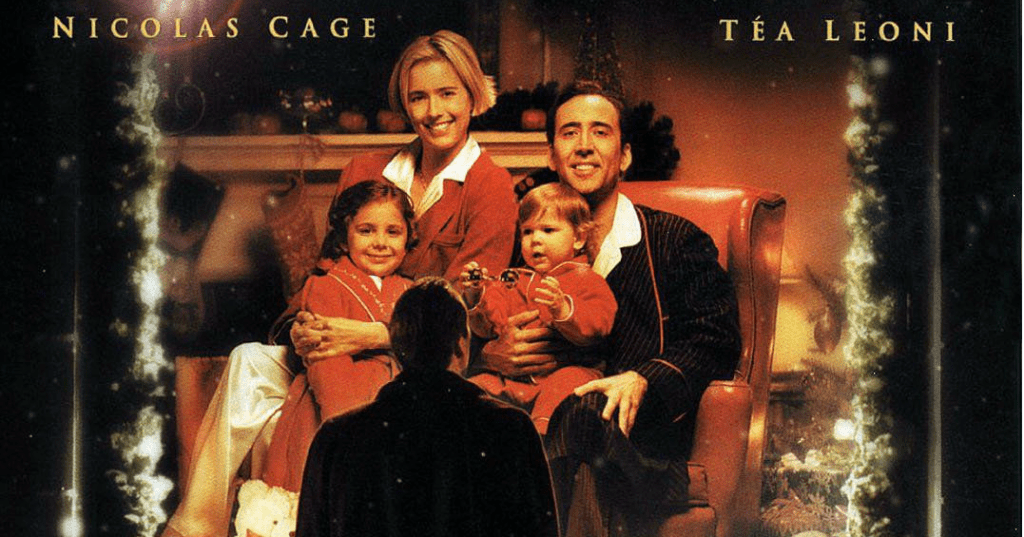
THE FAMILY MAN (2000) – Nicolas Cage gets a “glimpse” into a different life!


Nicolas Cage stars as Jack Campbell, a Wall Street hot shot, who puts his success in the business world above everything else in his life. We meet him on Christmas Eve as he’s trying to close a multi-billion dollar merger. He’s making everyone work late and even calls for a work session on Christmas Day. Jack’s administrative assistant gives him a phone message from his former girlfriend Kate (Tea Leoni), who he almost married about 15 years earlier. He’s surprised to hear from her, especially since he essentially chose his career over her all those years ago. That night as he stops at a grocery store on his way home, events transpire so that a desperate man named Cash (Dan Cheadle) pulls a gun on the clerk. Jack is able to use a calm demeanor and business sense to talk to Cash in a way that diffuses the situation and the two leave the store together. As they walk down the street, Jack tries to talk to Cash and help him. When Cash starts asking Jack about his life, Jack indicates that his life is great and he has everything he needs. Interestingly, this is where Cash mysteriously tells Jack that he’s going to do something for him, something he really needs…

The next morning, Christmas morning, Jack wakes up in a different home, he’s married to Kate, and they have two kids and a dog. He’s no longer an investment banker; now he’s a tire salesman. He no longer drives a Ferrari; now he’s drives a mini-van. In panic-mode, Jack runs out of the house as his in-laws arrive, fires up the mini-van, and drives to his office on Wall Street where nobody knows him, and they kick him out of the building. About that time, Cash pulls up in Jack’s Ferrari and tells him that he’s giving him the gift of a “glimpse” into what his life could have been if he had married Kate instead of focusing on himself and his career. So Jack heads back to try life in Jersey, wondering when the glimpse will come to an end. 

My wife and I are continuing to watch Christmas movies throughout the month of December to stay in the holiday spirit. THE FAMILY MAN is not necessarily a movie we watch every year, but I’m a fan of Nicolas Cage. I enjoy these types of films where a person sees what their lives could have been like if they had made different decisions at certain key points along the way. An easy comparison can be made to Frank Capra’s IT’S A WONDERFUL LIFE, which is my personal favorite Christmas movie, and it’s in my top 10 movies of all time. It’s not really an appropriate comparison though. These stories encounter their subjects in two very different places. In IT’S A WONDERFUL LIFE, George Bailey is at the end of his rope and thinking his family would have been better off if he had never been born. It takes Clarence to reveal just how important George has been to those he loves. In THE FAMILY MAN on the other hand, Jack Campbell is at the top of the world and standing at the precipice of his crowning achievement in his career. He believes his life is wonderful. Cash decides to teach him a lesson by offering a “glimpse” into a life that he could have had if he had chosen Kate and a family over his career. Would life with her be more fulfilling than all the money in the world? I think the sale is a lot easier for Clarence than Cash, and I also think that’s why I found the film to be less compelling. George Bailey’s decision was literally life with a family who dearly loves him, or death. Jack Campbell’s decision is if he wants a middle class life with a loving wife and two precious kids that he only just met, or if he wants to continue his prior life as the multi-millionaire mover and shaker with his pick of beautiful women.  It doesn’t help the film’s case either that Jack’s never really presented as being completely empty on the inside or unhappy, say, the way Bill Murray is in SCROOGED. While I personally enjoy the type of life that Jack is able to glimpse, his character’s specific choice is not as obvious, or earned, the way George Bailey’s is. 

Overall, as a man who wouldn’t trade my family for all the money in the world, I do appreciate what THE FAMILY MAN is going for. The execution doesn’t quite pull it off in a way that is completely satisfying, and ultimately explains why I don’t watch it every year as a holiday staple. 

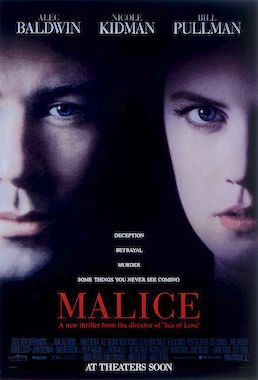
Insomnia File #48: Malice (dir by Harold Becker)


What’s an Insomnia File? You know how some times you just can’t get any sleep and, at about three in the morning, you’ll find yourself watching whatever you can find on cable or Netflix? This feature is all about those insomnia-inspired discoveries!

If you were having trouble getting to sleep last night around 12 midnight, you could have turned over to the Cinemax and watched the 1993 thriller, Malice.  And then you could have spent the next few hours trying to figure out what you just watched.

Seriously, there’s a lot going on in Malice.  The screenplay is credited to Aaron Sorkin and Scott Frank and while it has enough overly arch dialogue and untrustworthy women to plainly identify it as being a product of Sorkin’s imagination, it’s also filled with a mini-series worth of incidents and subplots and random characters.  This is also one of those films where no one can simply answer a question with a “yes” or a “no.”  Instead, it’s one of those movies where everyone gets a monologue, giving the proceedings a rather theatrical feel.  It’s the type of thing that David Mamet could have pulled off.  (Check out The Spanish Prisoner for proof.)  Harold Becker, however, was a far more conventionally-minded director and he often seems to be at a loss with what to do with all of the film’s Sorkinisms (and, to be fair, Frankisms as well).

The film starts out as a thriller, with a serial rapist stalking a college campus and Prof. Andy Safian (Bill Pullman) becoming an unlikely suspect.  Then it turns into a domestic drama as Andy and his wife, Tracy (Nicole Kidman), talk about starting a family.  Then Andy meets a brilliant surgeon named Jed Hill (Alec Baldwin) and the film turns into a roommate from Hell story after Jed moves in with them.  Then it becomes a medical drama after a mistake by Dr. Hill leaves Tracy unable to have children.  Then it returns briefly to the campus rapist story before then turning into a modern-day noir as Andy discovers that Tracy has secrets of her own.  (Whenever one watches a film written by Aaron Sorkin, you can practically hear him whispering, “Women are not to be trusted….” in the background.)  Even as you try to keep up with the plot, you find yourself distracted by all of the cameos.   George C. Scott glowers as Jed’s mentor.  Anne Bancroft acts the Hell out of her role as a drunken con artist.  Peter Gallagher is the lawyer you distrust because he’s Peter Gallagher.  Tobin Bell shows up as a handyman.  Gwynneth Paltrow, in one of her first roles, plays dead convincingly

It’s a big and busy and messy film and it too often mistakes being complicated for being clever.  Bill Pullman is a likable hero but you have to be willing to overlook that the script requires him to do some truly stupid things.  Nicole Kidman is always well-cast as a femme fatale but again, the script often lets her down.

Surprisingly enough, it’s Alec Baldwin who comes out of the film unscathed.  Watching Baldwin in this film, it’s hard to believe that he’s the same actor who has since become something of a bloated self-parody.  Yes, he’s playing an arrogant character (which is pretty much his trademark) but, in Malice, he actually brings a hint of subtlety and wit to his performance.  Baldwin does very little bellowing in the film, despite playing a role that one would think would naturally appeal to all of his bellowing instincts.  Malice is a mess but it’s nice to see the type of actor that Alec Baldwin once was.

Previous Insomnia Files:

  1. Story of Mankind
  2. Stag
  3. Love Is A Gun
  4. Nina Takes A Lover
  5. Black Ice
  6. Frogs For Snakes
  7. Fair Game
  8. From The Hip
  9. Born Killers
  10. Eye For An Eye
  11. Summer Catch
  12. Beyond the Law
  13. Spring Broke
  14. Promise
  15. George Wallace
  16. Kill The Messenger
  17. The Suburbans
  18. Only The Strong
  19. Great Expectations
  20. Casual Sex?
  21. Truth
  22. Insomina
  23. Death Do Us Part
  24. A Star is Born
  25. The Winning Season
  26. Rabbit Run
  27. Remember My Name
  28. The Arrangement
  29. Day of the Animals
  30. Still of The Night
  31. Arsenal
  32. Smooth Talk
  33. The Comedian
  34. The Minus Man
  35. Donnie Brasco
  36. Punchline
  37. Evita
  38. Six: The Mark Unleashed
  39. Disclosure
  40. The Spanish Prisoner
  41. Elektra
  42. Revenge
  43. Legend
  44. Cat Run
  45. The Pyramid
  46. Enter the Ninja
  47. Downhill

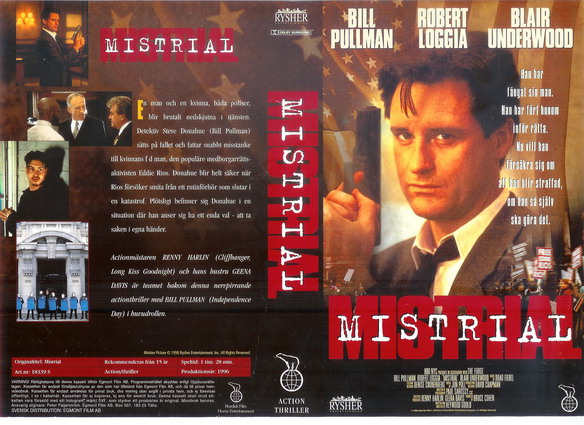
Mistrial (1996, directed by Heywood Gould)


When a NYPD cop and her partner are murdered, overworked and stressed-out Detective Steve Donohue (Bill Pullman) follows a trail of circumstantial evidence that leads him to the door of the cop’s ex-husband, a community activist named Eddie Rios (Jon Seda).  Donohue’s attempt to arrest Rios goes terribly wrong and results in a shootout that leaves Rios’s second wife and bother dead before the handcuffs are eventually slapped on his wrists.

Rios may be the one on trial but Donohue is now the one facing judgment.  With protesters lined up outside the courthouse and the city’s mayor (James Rebhorn) more interested in his own reelection than in the pursuit of justice, Donohue knows that the only way he’ll be vindicated is if Eddie Rios is convicted.  Unfortunately, that’s not what happens.  Rios’s sleazy attorney (played by Josef Sommer) gets most of the evidence tossed out of court on a technicality and it appears that Rios is going to walk free.  That’s when Donohue decides to take the court itself hostage, pulls out a gun, and demands that Rios immediately be put on trial for a second time, with the jury hearing all of the evidence that was originally thrown out of court.

Mistrial is an example of the good-cop-pushed-over-the-edge genre.  Up until a few years ago, this was a very popular genre.  Today, of course, it feels tone deaf and it’s a lot more difficult to sympathize with a cop, even a fictional one, complaining about being restricted by the constitution.  The main problem with Mistrial is that it’s established early on that Eddie Ramos is guilty so there’s no real tension as to whether Donohue is doing the right thing by demanding a second trial.  If there had been some ambiguity about whether or not Ramos was the murderer that Donohue claims he is, it would have made the film much more interesting and less predictable.  The other problem is that Bill Pullman is just too naturally earnest and clean-cut to be convincing as an overworked cop who has been pushed into doing something crazy.  Remembering back to the 90s, I think someone like Gary Sinise or William L. Petersen could have pulled off the role but Pullman’s just not right for it.

Robert Loggia has a few good moments as Pullman’s sympathetic captain.  This was the 2nd time that Pullman and Loggia co-starred together.  The first time was in Independence Day.  The 3rd time would be in Lost Highway, a film that’s as different from Mistrial as day is from night.

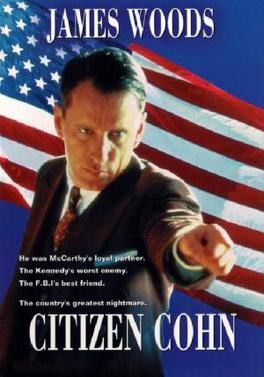
Citizen Cohn (1992, directed by Frank Pierson)


The year is 1986 and the powerful attorney Roy Cohn (James Woods) is dying.  The official story is that Cohn has liver cancer but the truth is that he’s dying of AIDS.  As he lies in his hospital bed, he thinks about his past and the events the led to him becoming one of the most feared and powerful men in America.  He is haunted by the ghosts of his many enemies, people like communist spy Ethel Rosenberg (Karen Ludwig) and his former colleague, Bobby Kennedy (David Marshall Grant).

Not surprisingly, a good deal of Cohn’s memories center around his association with Sen. Joseph McCarthy (Joe Don Baker), a charismatic alcoholic who, in the 50s, charged that he had a list with the names of communist spies deep within the government.  Cohn and Kennedy served as the counsels on McCarthy’s committees.  Cohn is with McCarthy from the beginning and he’s with him until the end of the senator’s career.  In fact, it’s Cohn’s own shadowy relationship with an army private that ultimately leads to McCarthy’s downfall.

Except for one aspect of the film, Citizen Cohn is one of the best films to ever be produced by HBO.  The film covers a lot of history in a little less than 2 hours and it does so in a way that is always interesting and easy to follow.  By including incidents from every phase of Cohn’s life, as opposed to just focusing on his time as McCarthy’, the film also shows how someone like Roy Cohn can become a behind-the-scenes power player despite the majority of the country having no idea who he is.  James Woods gives one of his best performances as the hyperactive and unapologetically corrupt Cohn while Joe Don Baker is perfect as the self-pitying Joseph McCarthy.

The problem with the film, and your mileage may vary on how big an issue this is, is that it almost presents Cohn’s final days — dying of AIDS in a lonely New York hospital room — as being some sort of deserved fate for everything that he did wrong in life.  For me, even in the case of someone like Roy Cohn, that’s a step too far and it comes very close to presenting AIDS as some sort of divine punishment (which, itself, comes dangerously close to mirroring the homophobic statements that were made — and still are being made — by anti-gay activists).  That may not have been the film’s intention but, with the flashback structure and all of his dead enemies materializing to taunt Cohn as he lies dying, it’s still a very valid interpretation.

Some of that is perhaps unavoidable.  Cohn, in both real life and the film, died largely unrepentant for anything he did during his life.  As the central character of a biopic, Cohn never has the type of big moment that you would hope for, where he would realize that it was wrong for him to destroy so many lives and show at least a hint of contrition for his past behaviors.  That Roy Cohn is even a compelling character is a testament to the talent of James Woods because it’s certainly not due to any sort of hidden goodness lurking underneath the surface of Cohn’s snarling personality.  The lack of apologies and regrets that made Cohn a powerhouse in real life also makes him an ultimately unsatisfying subject for a movie.

4 Film Reviews: Bridge To Silence, The Chocolate War, Kiss The Bride, Wedding Daze


Last week, I watched six films on This TV.

Which TV?  No, This TV!  It’s one of my favorite channels.  It’s not just that they show a lot of movies.  It’s also that they frequently show movies that are new to me.  For instance, last week, This TV introduced me to both Prison Planet and Cherry 2000.

Here are four other films, two good and two not so good, that This TV introduced to me last week.

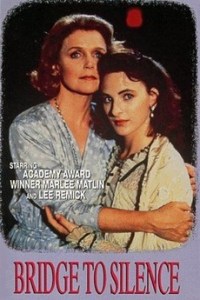
First up, we have 1989’s Bridge to Silence.

Directed by Karen Arthur, Bridge To Silence was a made-for-TV movie.  Lee Remick plays Marge Duffield, who has a strained relationship with her deaf daughter, Peggy (Marlee Matlin).  After Peggy’s husband is killed in a traffic accident, Peggy has a nervous breakdown.  Marge and her husband, Al (Josef Sommer) take care of Peggy’s daughter, Lisa, while Peggy is recovering.  However, even as Peggy gets better, Marge still doesn’t feel that she can raise her daughter so Marge files a lawsuit to be named Lisa’s legal guardian.  While all of this is going on, Peggy is starring in a college production of The Glass Menagerie and pursuing a tentative romance with the play’s director (Michael O’Keefe).

Bridge to Silence is one of those overwritten but heartfelt melodramas that just doesn’t work.  With the exception of Marlee Matlin, the cast struggles with the overwrought script.  (Michael O’Keefe, in particular, appears to be miserable.)  The film’s biggest mistake is that it relies too much on that production of The Glass Menagerie, which is Tennessee Williams’s worst play and tends to be annoying even when it’s merely used as a plot device.  There’s only so many times that you can hear the play’s director refer to Peggy as being “Blue Roses” before you just want rip your hair out.

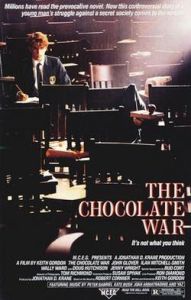
Far more enjoyable was 1988’s The Chocolate War.

Directed by Keith Gordon, The Chocolate War is a satirical look at conformity, popularity, rebellion, and chocolate at a Catholic boys school.  After the manipulative Brother Leon accidentally purchases too much chocolate for the school’s annual sale, he appeals to one of his students, Archie Costello (Wallace Langham), to help him make the money back.  Archie, who is just as manipulative as Leon, is the leader of a secret society known as the Vigils.  However, Archie and Leon’s attempt to manipulate the students runs into a roadblack when a new student, Jerry Renault (Illan Mitchell-Smith) refuses to sell any chocolates at all.  From there, things get progressively more complicated as Archie tries to break Jerry, Jerry continues to stand up for his freedom, and Leon … well, who knows what Leon is thinking?

The Chocolate War was an enjoyable and stylish film, one that featured a great soundtrack and a subtext about rebellion and conformity that still feels relevant.  John Glover and Wallace Langham both gave great performances as two master manipulators.

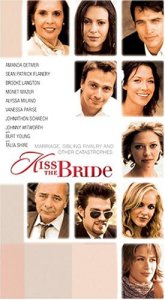
I also enjoyed the 2002 film, Kiss The Bride.

Kiss The Bride tells the story of a big Italian family, four sisters, and a wedding.  Everyone brings their own personal drama to the big day but ultimately, what matters is that family sticks together.  Directed by Vanessa Parise, Kiss The Bride featured believable and naturalistic performances from Amanda Detmer, Talia Shire, Burt Young, Brooke Langton, Monet Mazur, and Parise herself.

I have to admit that one reason why I liked this film is because it was about a big Italian family and it featured four sisters.  I’m the youngest of four sisters and, watching the film, I was reminded of my own big Irish-Italian family.  The movie just got everything right.

And then finally, there was 2006’s Wedding Daze.

Wedding Daze is a romantic “comedy.”  Anderson (Jason Biggs) asks his girlfriend to marry him, just to have her drop dead from shock.  Anderson’s best friend is afraid that Anderson will never get over his dead girlfriend and begs Anderson to not give up on love.  Anderson attempts to humor his friend by asking a complete stranger, a waitress named Katie (Isla Fisher), to marry him.  To everyone’s shock, Katie says yes.

From the get go, there are some obvious problems with this film’s problem.  Even if you accept that idea that Katie would say yes to Anderson, you also have to be willing to accept the idea that Anderson wouldn’t just say, “No, I was just joking.”  That said, the idea does have some comic potential.  You could imagine an actor like Cary Grant doing wonders with this premise in the 30s.  Unfortunately, Jason Biggs is no Cary Grant and the film’s director, comedian Michael Ian Black, is no Leo McCarey.  In the end, the entire film is such a misjudged failure that you can’t help but feel that Anderson’s ex was lucky to die before getting too involved in any of it.

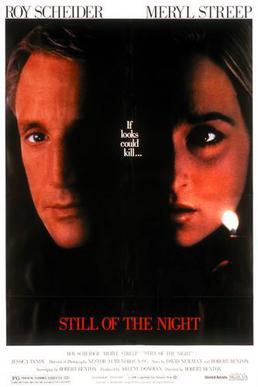
A Suspenseful Insomnia File #30: Still Of The Night (dir by Robert Benton)


What’s an Insomnia File? You know how some times you just can’t get any sleep and, at about three in the morning, you’ll find yourself watching whatever you can find on cable? This feature is all about those insomnia-inspired discoveries!

If last night, at 1:30 in the morning, you were having trouble getting to sleep, you could have turned on the TV, changed the channel to your local This TV station, and watched 1982’s Still Of The Night.

Still of the Night actually tells two stories.  The first story  deals with Dr. Sam Rice (Roy Scheider), a psychiatrist who is living a perfectly nice, mild-mannered, upper class existence in Manhattan.  His patients are rich and powerful and his sessions with them provide him with a view of the secrets of high society.

One of Sam’s main patients is George Bynum (Josef Sommer), who owns an auction house and who is a compulsive cheater.  George tells Sam that he’s haunted by strange nightmares and that he is also worried about a friend of his.  George says that this friend has murdered in the past and George fears that it’s going to happen again.  When George is murdered, Sam wonders if the murder was committed by that friend.  He also wonders if that friend could possibly have been one of George’s mistresses, the icy Brooke Reynolds (Meryl Streep).

The second story that Still of the Night tells is about our endless fascination with the films of Alfred Hitchcock.  Still of the Night is such an obvious homage to Hitchcock that it actually starts to get a little bit silly at times.  Almost every scene in the film feels like it was lifted from a previous Hitchcock film.  At one point, there’s even a bird attack!  (Add to that, Scheider’s mother is played by Jessica Tandy, who previously played Rod Taylor’s mother in The Birds.)  Meryl Streep is specifically costumed and made up to remind viewers of previous Hitchcock heroines, like Grace Kelly, Kim Novak, Eva Marie Saint, and Tippi Hedren.

Unfortunately, considering the talent involved, Still of the Night never really works as well as it should.  Both Scheider and Streep seem to be miscast in the lead roles.  If Still of the Night had been made in the 50s, one could easily imagine James Stewart and Grace Kelly playing Sam and Brooke and managing to make it all work through screen presence along.  However, Scheider and Streep both act up a storm in the lead roles, attacking their parts with the type of Actor Studios-gusto that seems totally out-of-place in an homage to Hitchcock.  Scheider is too aggressive an actor to play such a mild character.  As for Streep, she’s miscast as a noir-style femme fatale.  Streep’s acting technique is always too obviously calculated for her to be believable as an enigma.

That said, there were still some effective moments in Still of the Night.  The majority of the dream sequences were surprisingly well-done and effectively visualized.  I actually gasped with shock while watching one of the dreams, that’s how much I was drawn into those scenes.

According to Wikipedia, Meryl Streep has described Still of the Night as being her worst film.  I think she’s being way too hard on the movie.  It’s nothing special but it is an adequate way to kill some time.  Certainly, I’d rather watch Still of the Night than sit through Florence Foster Jenkins.

Previous Insomnia Files:

  1. Story of Mankind
  2. Stag
  3. Love Is A Gun
  4. Nina Takes A Lover
  5. Black Ice
  6. Frogs For Snakes
  7. Fair Game
  8. From The Hip
  9. Born Killers
  10. Eye For An Eye
  11. Summer Catch
  12. Beyond the Law
  13. Spring Broke
  14. Promise
  15. George Wallace
  16. Kill The Messenger
  17. The Suburbans
  18. Only The Strong
  19. Great Expectations
  20. Casual Sex?
  21. Truth
  22. Insomina
  23. Death Do Us Part
  24. A Star is Born
  25. The Winning Season
  26. Rabbit Run
  27. Remember My Name
  28. The Arrangement
  29. Day of the Animals

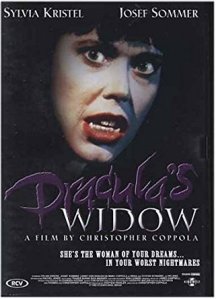
A Movie A Day #97: Dracula’s Widow (1988, directed by Chistopher Coppola)


Since we are looking at and reviewing each and every episode of Twin Peaks, every movie-a-day this month has a Twin Peaks connection.  Today’s entry, Dracula’s Widow, stars Lenny von Dohlen, who played reclusive shut-in Harold Smith on Twin Peaks.
Von Dohlen plays Raymond, the nerdy owner of a Los Angeles wax museum.  When he receives six antique chests from Romania, he does not realize that one of them contains, Vanessa (Sylvia Kristel).  Vanessa is a vampire and soon, she is killing the usual collection of perverts, muggers, and occultists.  She also bites Raymond and turns him into her Renfield.  Under her influence, Raymond even dumps his girlfriend, Jenny Harker (Rachel Jones).

However, Vanessa is not just a vampire.  Vanessa is the wife of Dracula, himself.  When she demands that Raymond take her to her husband, Raymond tells her that Dracula was killed nearly a hundred years ago by Prof. Van Helsing.  (How did Vanessa not already know this?)  Vanessa hunts down and kills Van Helsing’s grandson (Stefan Schnabel) but this brings both her and Raymond to the attention of Inspector Lannon (Josef Sommer).

In the 1990s, Dracula’s Widow was a late night HBO mainstay and it still has a cult following.  I could sit here and count out all the ways that Dracula’s Widow does not make any sense but I’ve got a deadline.  For all of this low-budget movie’s flaws, Dracula’s Widow is saved by the sexy presence of Sylvia Kristel and the atmosphere that can only be provided by neon lighting and a fog machine.  Josef Sommer’s hard-boiled narration, in which he refers to Los Angeles as being Tinsel Town, is another highlight.  As for Lenny von Dohlen, his performance as Raymond feels like a dry run for his turn as Harold Smith.

Dracula’s Widow was the directorial debut by Christopher Coppola, whose uncle Francis would later make Bram Stoker’s Dracula and whose brother, Nicolas Cage, ate a cockroach while making Vampire’s Kiss.

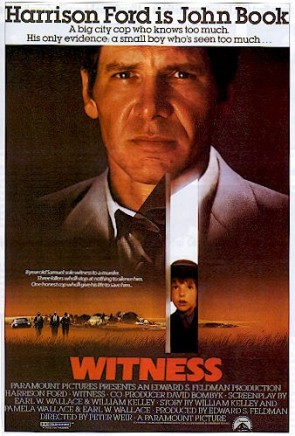
Embracing the Melodrama Part II #75: Witness (dir by Peter Weir)


Witness_movieLast night, I was lucky enough to watch Witness, a best picture nominee from 1985.

Taking place in Pennsylvania, Witness tells the story of what happens when an Amish widow named Rachel (Kelly McGillis) and her 8 year-old son Samuel (Lukas Haas) decide to take a trip to visit Rachel’s sister.  Traveling on an Amtrak train, Samuel is amazed by his first view of the world outside of the close-knit and insular Amish society.  However, Samuel’s excitement soon turns to horror when they arrive in Philadelphia and he witnesses a man being brutally murdered.

Detective John Book (Harrison Ford, who received his first and, to date, only Oscar nomination for this film) is assigned to the case and arranges for Rachel and Samuel to stay with his sister.  John soon discovers that the murder was committed by two crooked cops, McFee (Danny Glover, who is pure evil in this film) and Ferguson (Angus MacInnes).  John goes to his superior officer, Chief Schaefer (Josef Sommer) with his evidence.  Soon after, McFee attempts to kill and seriously wounds John.  John realizes that Schaefer must be corrupt as well.

Book manages to drive Rachel and Samuel back to their farm in Lancaster County but, after dropping them off, he passes out from blood loss.  Knowing that sending John to the hospital would reveal Rachel and Samuel’s location to Schaefer, Rachel’s father (Jan Rubes) reluctantly allows John to stay at the farm.

And so, while McFee, Ferguson, and Schaefer search for him, John temporarily pretends to be Amish.  He works in the fields.  He helps to build a barn.  He becomes something of a surrogate father to Samuel and he begins a forbidden flirtation with Rachel.

He also goes to town, where he watches as an idiotic local bullies the Amish, knowing that their religion forbids them from fighting back.  John responds by punching a bully, upsetting both the Amish and the a local store owner who yells that this will be terrible for the tourism.  In many ways, the scene is played for laughs and applause but there’s a very serious subtext here, as it would appear that the area’s main appeal to tourists is that you can humiliate the Amish without having to worry about any sort of retaliation.

While we, as viewers, definitely get some satisfaction from seeing John punch that jackass, it also allows Schaefer to discover where he and Rachel are hiding.  One morning, McFee, Ferguson, and Schaefer pull up outside the farm.  They get out of their car and, as the sun rises and with beautiful green fields on either side of them, the three men hold up their shotguns and start to walk down the road….

Witness may technically be a cop film but it’s actually so much more.  It’s a character study of a deeply cynical man who finds himself changed by simple and innocent surroundings.  It’s a love story, with Ford and McGillis illuminating the screen with their chemistry.  It’s a celebration of community, with the harshness of Philadelphia being contrasted with life among the Amish.  It’s a film full of beautiful images and it also features an excellent performance from Harrison Ford.

It’s a good film.  I’m glad that I witnessed Witness.