Review: The Hunted (dir. by William Friedkin)


“Once you are able to kill mentally, the physical part will be easy. The difficult part… is learning how to turn it off.” — L.T. Bonham

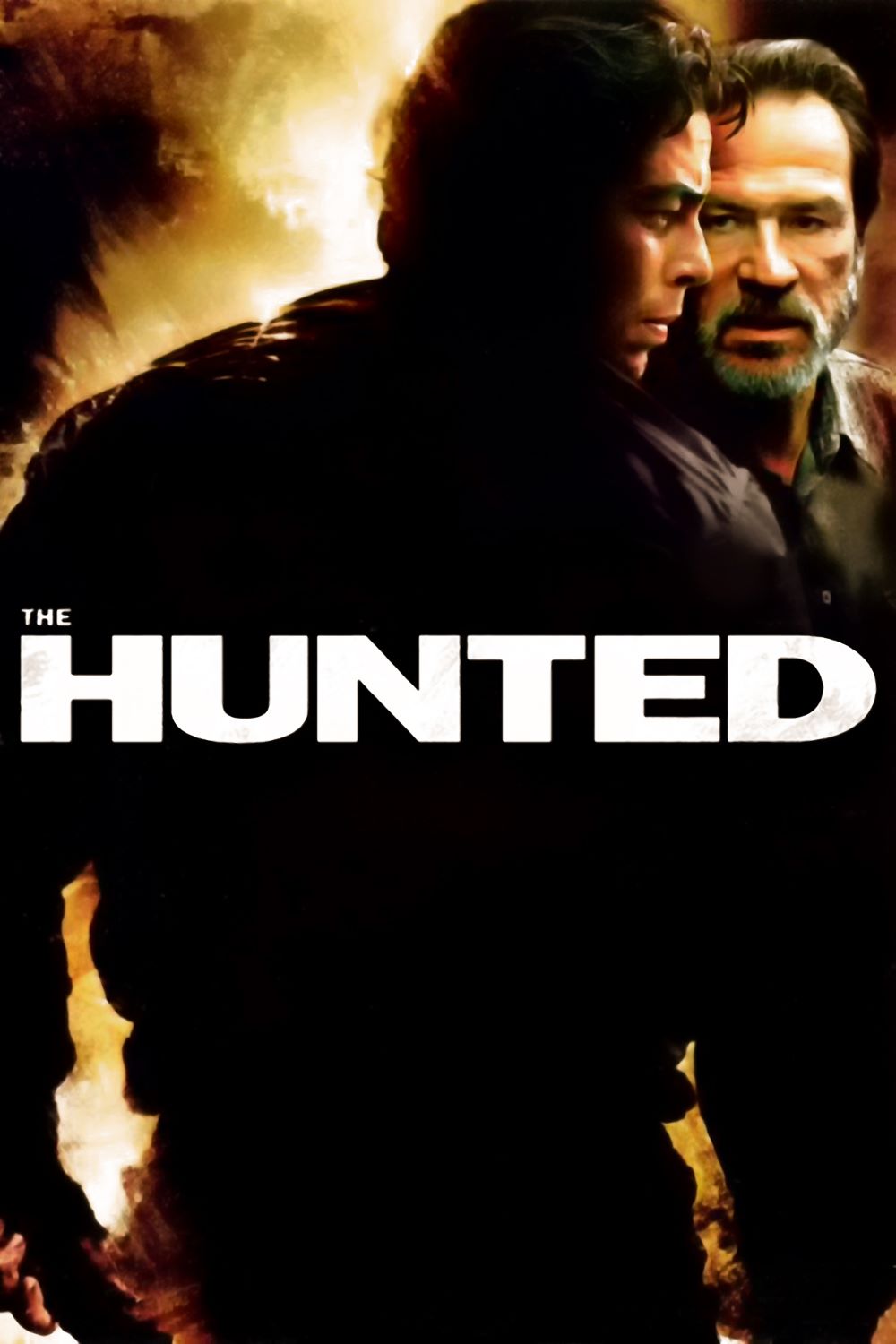
The Hunted (2003) is one of those films that feels like it slipped through the cracks of early 2000s cinema—a gritty, atmospheric thriller directed by William Friedkin, a filmmaker whose name alone should’ve guaranteed more attention. Friedkin, the man behind The French Connection and The Exorcist, has always had a knack for tension and raw, almost documentary-like realism, and The Hunted carries that same DNA. It’s not a perfect movie, but it’s a fascinating one, a slow-burn chase film that trades explosive set pieces for mood, character, and a kind of existential dread that lingers long after the credits roll.

The story follows L.T. Bonham, a former survival instructor played by Tommy Lee Jones, who’s called back to help the authorities when a series of brutal murders points to a former student of his, Aaron Hallam, played by Benicio del Toro. Hallam, a highly trained assassin, has gone rogue, and Bonham is the only one who can track him down. The premise is simple, almost minimalist: two men, one hunting the other, with the wilderness of the Pacific Northwest serving as their battleground. There’s no grand conspiracy, no world-ending stakes—just a personal, almost primal duel between mentor and protégé. The film’s strength lies in its refusal to overcomplicate things. It’s a character study disguised as a thriller, and it’s all the better for it.

What’s immediately striking about The Hunted is its pacing. Friedkin doesn’t rush. The film takes its time establishing Bonham’s world—a quiet, isolated life in the woods, where he trains soldiers in the art of survival and combat. There’s a sense of routine, of discipline, and when Hallam re-enters his life, it’s not with a bang but with a whisper. The first act is deliberate, almost meditative, as Bonham pieces together the clues and realizes the man he’s after isn’t just any killer, but someone he once shaped. This isn’t a film about action for action’s sake. It’s about the weight of violence, the cost of skill, and the thin line between hunter and hunted.

Benicio del Toro is the standout here. Hallam is a role that could’ve easily been reduced to a one-dimensional villain, but del Toro imbues him with a quiet, unsettling intensity. There’s a scene early on where Hallam, having just committed a particularly gruesome murder, calmly walks away from the crime scene, his face a mask of detached focus. It’s chilling not because he’s raging or unhinged, but because he’s so controlled. Hallam isn’t a monster in the traditional sense; he’s a man who’s been trained to kill and has embraced that role with terrifying efficiency. Del Toro plays him with a stillness that’s unnerving, his eyes always calculating, always three steps ahead. It’s a performance that relies more on presence than dialogue, and it’s one of his most underrated.

Tommy Lee Jones, on the other hand, is a different kind of compelling. Bonham is a man of few words, a hardened veteran who’s seen too much to be rattled by much. Jones, with his gravelly voice and weathered demeanor, sells the role of a man who’s spent a lifetime in the shadows. There’s a weariness to him, a sense that he’s not just chasing Hallam to stop the killings, but to confront his own past. The dynamic between the two is electric, even when they’re not in the same scene. Their eventual face-to-face encounters crackle with tension, not because of what they say, but because of what they don’t. These are two men who understand each other on a level that most people never will, and that mutual recognition makes their conflict all the more tragic.

Friedkin’s direction is, as always, masterful in its restraint. He’s never been one for flashy camerawork or overly stylized shots, and The Hunted is no exception. The cinematography is stark and functional, emphasizing the cold, unforgiving landscape of the Pacific Northwest. The forests, rivers, and small towns feel like characters in their own right, vast and indifferent to the human drama unfolding within them. There’s a scene where Bonham and a local sheriff, played by Connie Nielsen, track Hallam through the woods. The camera lingers on the trees, the mud, the rain—details that ground the film in a tangible, almost tactile reality. It’s not just a chase; it’s a test of endurance, both physical and psychological.

The film shares some striking thematic ground with First Blood, another story about soldiers haunted by what they’ve seen and done in war. Both films explore men who are not just racked with guilt but suffering from PTSD, their minds fractured by the horrors of combat. But where First Blood ultimately offered a glimmer of hope—that understanding and redemption might be possible—The Hunted takes a far bleaker view. Bonham and Hallam aren’t just damaged; they’re broken in ways that can’t be fixed. Hallam, in particular, represents the idea that some soldiers simply cannot come back from the brink of their experiences. There’s no catharsis for him, no moment of clarity or salvation. The film suggests that for some, the training and the trauma run too deep, and the only way out is through violence. It’s a brutal, unflinching perspective that sets The Hunted apart from more sentimental takes on the same themes.

The film’s action sequences, when they do arrive, are brutal and concise. There’s no shaky cam or rapid editing here—Friedkin lets the violence unfold in long, unflinching takes. A knife fight in a motel room is particularly memorable, not for its choreography, but for its rawness. It’s messy, desperate, and over in seconds. There’s no glorification, no slow-motion heroics. Just two men trying to kill each other in the most efficient way possible. It’s a far cry from the hyper-stylized action of the era, and it’s all the more effective for it.

Unfortunately, the film’s strengths are bogged down by its weaknesses, particularly in how it handles its secondary characters. The supporting cast, including Connie Nielsen as the sheriff, often feel thinly written, existing primarily as obstacles to delay the inevitable showdown between Bonham and Hallam. Their motivations and personalities are barely sketched out, making them feel more like narrative speed bumps than fully realized people. It’s frustrating because the film’s core dynamic is so compelling that these underdeveloped side characters only serve to slow down the momentum. And despite its brisk 90-plus minute runtime, The Hunted still manages to drag at times. The deliberate pacing that works so well in establishing atmosphere starts to feel indulgent when the story isn’t moving forward, leaving the audience waiting for the next meaningful interaction between its two leads.

If The Hunted has other weaknesses, it’s that it might be a little too restrained for some viewers. The slow burn won’t be for everyone, especially in an era where audiences have come to expect constant stimulation. The film demands patience, and those who aren’t willing to meet it on its terms might find it dull. There are also moments where the plot feels a bit thin, as if Friedkin and screenwriter Art Monterastelli were more interested in atmosphere than narrative complexity. But that’s also part of its charm. The Hunted isn’t trying to be a puzzle-box thriller or a high-octane spectacle. It’s a mood piece, a meditation on violence and the men who wield it.

The ending, without spoiling too much, is ambiguous in a way that feels true to the film’s themes. There’s no neat resolution, no easy answers. It’s a conclusion that lingers, forcing the audience to sit with the uncomfortable questions it raises. Is justice served? Is Hallam truly defeated, or is he just the first of many? The film doesn’t provide answers, and that’s to its credit. It’s more interested in the journey than the destination, in the hunt rather than the catch. While First Blood left room for healing, The Hunted closes the door on that possibility for some, reinforcing its bleak worldview.

In the grand scheme of Friedkin’s filmography, The Hunted might not rank alongside his most iconic works, but it’s a fascinating entry in his body of work. It’s a film that feels out of time, both in its style and its themes. Released in 2003, it arrived in a cinematic landscape dominated by CGI spectacle and franchise filmmaking, and it’s easy to see why it didn’t make a bigger splash at the time. But for those willing to seek it out, The Hunted is a hidden gem—a tense, thought-provoking thriller that rewards patience and close attention. It’s a film about the cost of violence, the weight of the past, and the thin line between the hunter and the hunted. And in an era where action movies often prioritize style over substance, its grounded, no-nonsense approach feels like a breath of fresh air.

Retro Television Review: Miami Vice 4.17 “Hell Hath No Fury”


Welcome to Retro Television Reviews, a feature where we review some of our favorite and least favorite shows of the past!  On Mondays, I will be reviewing Miami Vice, which ran on NBC from 1984 to 1989.  The entire show can be purchased on Prime!

This week, Trudy is once again the main character.  Fortunately, there’s no UFOs this time around.

Episode 4.17 “Hell Hath No Fury”

(Dir by Virgil W. Vogel, originally aired on March 11th, 1988)

Alan Beaks (Don Harvey), the scion of a prominent Florida family, has been released from prison after serving only a few years for raping a black school teacher named Ellen Mason (Carla Brothers).  Beaks claims that he’s reformed and, at the start of the episode, he appears on a talk show where the audience agrees that Alan Beaks is the perfect example of someone who has straightened out his life.

“I wouldn’t want it to happen to me,” one woman in the audience says, “but if it did, I would hope he would be as charming as Alan Beaks.”

Beaks now wants to make a public apology to Ellen.  However, she refuses to see him.  When she starts to get threatening phone calls, both she and her best friend Trudy are convinced that Beaks is the one calling.

Castillo, however, doesn’t want Trudy to have anything to do with Ellen or Beaks.  It’ll make the Vice Quad look bad, he says.  (Since when has Castillo ever used that type of logic?)  Still, when Ellen hires a hitman (John Finn) to kill Beaks, the Vice Squad finds itself involved.  No one on the Squad has any sympathy for Beaks and they don’t make much of an effort to protect him.  When a shootout leaves both Beaks and the hitman dead, Castillo tells the members of the Squad that they have failed and if they’re not going to full commit themselves to the job, they can transfer to another department.  Meanwhile, even with Beaks dead, Ellen is still getting phone calls, implying the Beaks was actually not her stalker.  The episode ends with a terrified Ellen listening as the caller threatens her….

Here’s my number one question about this episode: Why didn’t anyone trace the calls?  Ellen, the victim in a high-profile rape case, is getting calls from someone threatening to harm her.  That right there seems like the sort of thing that the police would normally investigate.  Trudy is Ellen’s best friend.  Trudy knows about the calls.  Trudy is a cop.  So, why didn’t the Vice Squad try to track down the caller?  If they could have proven that Beaks was the caller, Beaks would have gone back to prison.  If it turned out that someone else was the caller, that person would have gone to prison.  Beaks would still be free but at least Ellen wouldn’t be getting threatened every ten minutes.  In the past, that’s what would have happened on this show.  For some reason, this episode features everyone forgetting how to act like a cop.

In the end, this episode tried to deal with a lot of issues — tabloid journalism, rehabilitation, vigilante justice, racism, classism — but it ultimately felt like fan faction that was written by someone who really didn’t know much about the show or the characters.  (One would think that Gina, a rape survivor who gunned down her rapist during the first season, would have some thoughts on Ellen’s plan but instead, she spends the episode cheerfully exchanging one-liners with Switek.)  This was another Season 4 disappointment.

A Shock To The System (1990, directed by Jan Egleson)


Graham Marshall (Michael Caine) has spent years toiling away as an executive at an advertising firm and being nagged by his wife (Swoosie Kurtz), who claims that Graham doesn’t have enough of a killer instinct to get ahead.  When Graham is passed over for a promotion that he felt was promised to him, Graham starts to reconsider everything that he once believed.  While Graham is waiting for the train to take him home, he is approached by an obnoxious panhandler who always asks him for money.  That night, instead of ignoring the panhandler, Graham shoves him in front of the train.  When no one notices that Graham has murdered the panhandler, Graham decides to get revenge on everyone who he blames for the sorry state of his life.

With each murder, Graham rises higher in the company and he feels better about his life.  But each murder brings to Graham a new set of complications that he has to clean up.  Lt. Laker (Will Patton) thinks that Graham is responsible for all of the deaths that have recently occurred but he doesn’t have the evidence to charge him.  His murder spree brings him a chance of romantic redemption with Stella (Elizabeth McGovern) but soon, even she suspects that Graham might actually be a killer.  Luckily for him, Graham learns that he can get away with his crimes because the system is set up to protect men like him.

A Shock To The System is a pitch-black comedy that benefits from the casting of Michael Caine in the lead role.  Caine is one of the few actors who can make a resentful and bitter sociopath likable and he does that in A Shock To The System.  Graham starts out beaten down by the world and being passed over for younger executives like Bob Benham (Peter Reigert) but, by the end of the film, he’s become as ruthless a killer as Jack Carter.  Just as in Get Carter, A Shock To The System features Michael Caine making evil very compelling.

Cover-Up (1991, directed by Manny Coto)


After an overseas U.S. army base is bombed by terrorists, L.A. Times reporter Mike Anderson (Dolph Lundgren) is sent to Israel to get the story.  Before he became a reporter, Mike was a Marine and he has connections within the U.S. intelligence services.  Mike quickly figures out that CIA honcho Lou Jackson (Lou Gossett, Jr.) is covering something up about the bombing.  The terrorists who bombed the base have also stolen an experimental nerve gas.  Mike is ordered to stay out of the investigation but after Mike’s best friend, Jeff Cooper (John Finn), is blown up by a car bomb, Mike is determined to get justice.  He’s also determined to sleep with his dead best friend’s girlfriend (Lisa Berkley), who is also Mike’s ex.  It turns out that it’s a lot easier to betray a friend’s confidence than to stop terrorists from stealing nerve gas.

When it came to the second-tier action stars of the 90s, Jean-Claude Van Damme was the one who could actually do everything that he did on screen in real life, Steven Seagal was the one who never seemed to get the joke, and Dolph Lundgren was the one who could actually act.  Even in a film that was pure schlock, like Cover-Up, Lundgren usually gave a good performance.  Unfortunately, Lundgren’s performance couldn’t make up for Cover-Up‘s anemic action scenes and incoherent plot.  No one seems to be sure what they’re supposed to be doing in this movie.  Lou Gossett, Jr. survives by playing his role as being pissed off all the time.  Lundgren survives by playing Mike as being even more confused than Gossett.  There’s a weak car chase and a weak shower scene.  Mike really doesn’t waste any time when it comes to hooking up with his best friend’s girl.

Cover-Up was filmed on location in Israel and it does work as a travelogue.  Towards the end of the film, Lundgren runs through a mass of people who are reenacting the Twelve Stations of Christ.  The people were actually in Israel to celebrate Easter and no one informed them that they were about to become a part of a movie.  When Lundgren comes barreling through the crowd, their shock is authentic.  It’s the best part of the movie, even if it did lead to Lundgren being temporarily detained by security.  Fortunately, production was able to clear-up the misunderstanding and Lundgren was freed so that he could go on to star in Universal Soldier and reprise Ivan Drago in Creed II.  I’m glad the Lundgren survived filming but Cover-Up is otherwise forgettable.

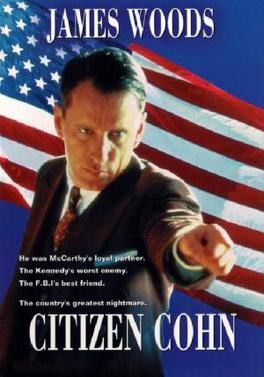
Citizen Cohn (1992, directed by Frank Pierson)


The year is 1986 and the powerful attorney Roy Cohn (James Woods) is dying.  The official story is that Cohn has liver cancer but the truth is that he’s dying of AIDS.  As he lies in his hospital bed, he thinks about his past and the events the led to him becoming one of the most feared and powerful men in America.  He is haunted by the ghosts of his many enemies, people like communist spy Ethel Rosenberg (Karen Ludwig) and his former colleague, Bobby Kennedy (David Marshall Grant).

Not surprisingly, a good deal of Cohn’s memories center around his association with Sen. Joseph McCarthy (Joe Don Baker), a charismatic alcoholic who, in the 50s, charged that he had a list with the names of communist spies deep within the government.  Cohn and Kennedy served as the counsels on McCarthy’s committees.  Cohn is with McCarthy from the beginning and he’s with him until the end of the senator’s career.  In fact, it’s Cohn’s own shadowy relationship with an army private that ultimately leads to McCarthy’s downfall.

Except for one aspect of the film, Citizen Cohn is one of the best films to ever be produced by HBO.  The film covers a lot of history in a little less than 2 hours and it does so in a way that is always interesting and easy to follow.  By including incidents from every phase of Cohn’s life, as opposed to just focusing on his time as McCarthy’, the film also shows how someone like Roy Cohn can become a behind-the-scenes power player despite the majority of the country having no idea who he is.  James Woods gives one of his best performances as the hyperactive and unapologetically corrupt Cohn while Joe Don Baker is perfect as the self-pitying Joseph McCarthy.

The problem with the film, and your mileage may vary on how big an issue this is, is that it almost presents Cohn’s final days — dying of AIDS in a lonely New York hospital room — as being some sort of deserved fate for everything that he did wrong in life.  For me, even in the case of someone like Roy Cohn, that’s a step too far and it comes very close to presenting AIDS as some sort of divine punishment (which, itself, comes dangerously close to mirroring the homophobic statements that were made — and still are being made — by anti-gay activists).  That may not have been the film’s intention but, with the flashback structure and all of his dead enemies materializing to taunt Cohn as he lies dying, it’s still a very valid interpretation.

Some of that is perhaps unavoidable.  Cohn, in both real life and the film, died largely unrepentant for anything he did during his life.  As the central character of a biopic, Cohn never has the type of big moment that you would hope for, where he would realize that it was wrong for him to destroy so many lives and show at least a hint of contrition for his past behaviors.  That Roy Cohn is even a compelling character is a testament to the talent of James Woods because it’s certainly not due to any sort of hidden goodness lurking underneath the surface of Cohn’s snarling personality.  The lack of apologies and regrets that made Cohn a powerhouse in real life also makes him an ultimately unsatisfying subject for a movie.

Back to School #51: Trojan War (dir by George Huang)


TrojanWar

The 1997 film Trojan War may be a bit obscure (and, in fact, I had never heard of it until I came across it On Demand two weeks ago) but it has earned a place in the Hollywood record books as one of the biggest box office bombs of all time.  Made on a $15,000,000 budget, Trojan War was released into one theater, played for one week, and made a total of $309.

But, as far as simple-minded teen sex comedies, are concerned, it’s not that bad.

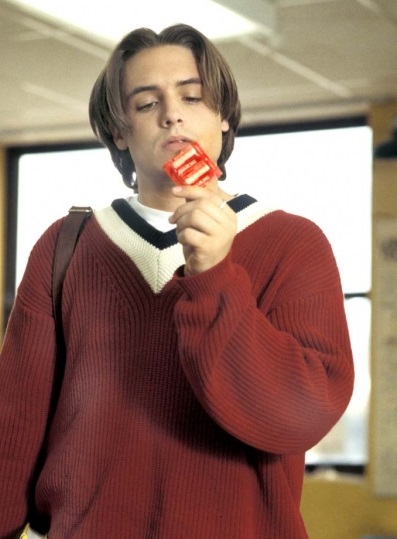
Brad Kimble (Will Friedle) is a nice but dorky high school student who, for years, has had a crush on an unattainable cheerleader, Brooke (Marley Shelton).  When Brad is invited over to Brooke’s house to tutor her in biology, he arrives just after Brooke has had a fight with her jock boyfriend, Kyle (Eric Balfour sans facial hair).  Soon, Brooke and Brad are making out.  Brooke asks Brad if he has a condom.  Of course, if Brad did have a condom, there wouldn’t be a movie.  The rest of the movie deals with Brad’s attempt to not only find a condom in California and but to also get back to Brooke.

(Apparently, in the 1990s, there was some sort of sudden condom shortage in California.  That’s all that I can guess after having seen Trojan War.)

Of course, that’s not as easy as it sounds.  Brad’s car (actually, it’s his dad’s car) gets stolen.  Brad ends up having a run in with a crazy homeless man (David Patrick Kelly) who — in a rather obvious shout out to Better Off Dead — wants two dollars. Brad gets chased by a crazy dog.  Brad has to deal with a cameo appearance by a crazy Kathy Griffin.  Brad runs into a crazy bus driver (played by Anthony Michael Hall).  Brad ends up being pursued by a crazy police officer (Lee Majors).  And since the film itself is a bit of an unacknowledged remake of Some Kind of Wonderful, Brad is also pursued by his not crazy best friend, Leah (Jennifer Love Hewitt, who I’ve always liked because we’re both Texas girls and I share her struggle).  Leah is in love with Brad and Brad is in love with Leah.  He’s just not smart enough to realize it.

And indeed, that’s the key to understanding the plot of Trojan War.  Brad is just not that smart.  This is one of those films where the great majority of Brad’s problems could have been avoided if Brad just wasn’t a moron.  Fortunately, Brad is played by Will Friedle who was always the best part of Boy Meets World and who displays the unique ability to make stupidity cute.  Friedle is so likable as Brad that you’re willing to forgive the film for a lot.

That doesn’t mean that Trojan War is necessarily a good movie.  It’s likable but it’s never really good.  For every joke that works, there’s one that doesn’t.  I could have really done without the extended sequence where Brad gets lost over on the bad side of town and the movie suddenly trots out every negative Latino stereotype imaginable.  But, when the movie just concentrates on Will Friedle and Jennifer Love Hewitt, it’s likable enough to waste 90 minutes on.

If nothing else, it’s certainly more entertaining than most movies that made less than 400 dollars at the box office.

ovszerhaboru_2