Trailer: The Monuments Men (Official)


The Monuments Men

The race for Awards Season film releases has begun to heat up with trailers for American Hustle and The Butler already showing some major front-runners for the major awards at the end of the year.

We now have another trailer release for a film that looks to join in on all the end of the year awards scramble. It’s the latest film from George Clooney (doing a trifect as writer, director and actor) which sports an impressive ensemble cast that includes Matt Damon, Cate Blanchett, John Goodman, Bill Murray, Jean Dujardin and Bob Balaban.

The Monuments Men is based on the true story of archivers, museum directors, art restorers turned soldiers tasked with saving the cultural and fine arts treasures stolen by Hitler’s Nazi forces during World War II. As the war begins to turn again the Nazi’s this group of unconventional soldiers must prevent these treasures from being destroyed as part of Hitler’s “scorched earth” policy when it comes to the cultures he has deemed unworthy.

The film itself is adapted from the book The Monuments Men: Allied Heroes, Nazi Thieves and the Greatest Treasure Hunt in History by Robert M. Edsel. There’s a camp out there who doesn’t look at Clooney’s work as anything but OScar-bait whenever they come around every other year, but there’s no denying that the man can direct and act. The question now is whether The Monuments Men will finally give Clooney that final push into getting his first Best Director Oscar.

The Monuments Men is set for a December 18, 2013 release date.

Film Review: Argo (dir. by Ben Affleck)


When I made out my list of my 26 favorite films of 2012, Argo came in at number 19,  I think that Argo is a likable, funny, and frequently exciting film.  Not only does it feature some of Ben Affleck’s best work as a director (though I still think Affleck has yet to top Gone, Baby, Gone) but also some of his best work as an actor.  If The Town left my skeptical about Affleck’s film-making talents, Argo made me a believer again.  That said, while I think that Argo is a good film, I don’t think it’s a great film but that opinion definitely places me in both the minority of filmgoers and, since my sister Erin considers Argo to be the best film of 2012, Bowmans as well.

Based on a true story, Argo takes place in 1979.  The Shah of Iran has been overthrown and the American embassy in Tehran is overrun by Islamic militants.  Over 50 Americans are taken hostage but six embassy workers manage to escape and end up hiding in the home of the Canadian ambassador (Victor Garber).  The U.S. State Department has to find a way to get the six of them out of Iran before the militants discover their existence.

It’s up to CIA agent Tony Mendez (played, of course, by Ben Affleck) to come up with a better plan than attempting to smuggle bicycles into Iran.  Mendez’s scheme is to team up with a Hollywood makeup artist (John Goodman) and a B-movie producer (Alan Arkin) and to convince the Iranian government that he and the 6 embassy workers are actually a film crew and that they’re in Iran not on a rescue-and-escape mission but instead to scout locations for a science fiction film called Argo.

Argo, for the most part, works.  As a director, Affleck manages to deftly juggle both comedy and suspense.  The scenes where Arkin and Goodman teach Affleck how to be a Hollywood phony are frequently hilarious, while the scenes in Iran are effectively tense and claustrophobic.  The film is full of little period details that ring true and I’m still shocked that Argo didn’t receive an Oscar nomination for either Best Costume Design or Best Production Design.  The wide lapels on Ben Affleck’s suits may not have been as flamboyant as the costumes in Les Miserables but, like the costumes in Les Mis, the very sight of them not only transported us to a different time but made that time plausible as well.

As you might expect from an actor-turned-director, Affleck gets good performances from his entire cast.  Goodman and Arkin are both sympathetic as recognizable Hollywood types and Bryan Cranston has a few good scenes as a fellow CIA agent.  While the 6 hostages are all pretty much interchangeable, they are still all well-cast and sympathetic.

That said, when I saw the film, it was hard to escape the feeling that the first half of the film (in which the embassy workers hid out at the Ambassador’s house while Affleck, Arkin, and Goodman worked on promoting their fake film) was dramatically more interesting and compelling than the far more conventional second half.  Once Affleck actually reaches Tehran, Argo becomes a rather predictable, if still well-made and exciting, movie.  Perhaps that’s why, as much as I enjoyed Argo, the film didn’t make as much of an impression of me as a film with a more challenging narrative would have.  Ultimately, Argo tells the true story of people in tremendous danger but the film itself feels very safe.

Argo is one of the most acclaimed films of 2012 and it’s been nominated for 7 Oscars, including Best Picture.  To just about everyone’s surprise, Ben Affleck was not nominated for best director.  While I personally would not have nominated either Argo or Affleck, the fact of the matter is that the reason Argo has received so much acclaim is because of Affleck’s work behind the camera.  Argo is such a director’s film that it’s next to impossible to argue that Argo‘s one of the best films of the year without also arguing that Affleck is one of the best directors of the year.  Hence, Affleck’s lack of a nomination does feel like a definite snub.  Even speaking as someone who was not as enthralled with Argo as much as everyone else, I would still have nominated Affleck long before I wasted a nomination on Benh Zeitlin for relying too much on a hand-held camera while filming Beasts of the Southern Wild.

While the Academy may have snubbed Affleck, the Hollywood Foreign Press Association did not.  Earlier this night, Affleck won the Golden Globe for best director and Argo won best picture.  (Though, I have to say, I find myself wondering if my friend Jason Tarwater was right when he suggested that the notorious starfuckers of the HFPA honored Argo mostly because they wanted to hang out with the film’s co-producer, George Clooney.)  Given the fact that it’s been over 20 years since a film won Best Picture without receiving a nomination for Best Director, Affleck and Clooney might just have to be happy with the universal acclaim.

6 More Films From 2012: 4:44: Last Day On Earth, First Position, Flight, The Paperboy, Red Tails, and The Trouble With Bliss


Continuing my desperate attempt to review all of the 2012 films that I’ve seen but haven’t gotten around to reviewing yet, here’s six more reviews.

1) 4:44: Last Day On Earth (dir. by Abel Ferrara)

Whether it’s because of the Mayan calendar or the fact the Obama got reelected, people seem to be obsessed with the end of the world right now and it’s been the subject of several recent films.  4:44: Last Day On Earth is one of the more low-key entries in this genre.

Willem DaFoe plays a New York-based actor who deals with the impending end of the world by meditating in his loft, having sex with his much younger girlfriend, and having awkward conversations on Skype with his daughter.  As opposed to the characters in several other end of the world films, DaFoe doesn’t use the situation as an excuse to go on a quest for true love.  Unlike 2012, there’s no talk of escaping the apocalypse.  Instead, the world is ending and DaFoe has no choice but to accept it.  From a cinematic point of view, DaFoe’s passivity can be frustrating (4:44 is a film that’s willing to be boring to make its point) but, at the same time, it does force a viewer like me to wonder how she would handle the end of the world in a way that a film like Seeking A Friend For The End Of The World does not.

One interesting thing that distinguishes 4:44 from other end-of-the-world films is that, in 4:44, the world ends specifically because of the actions of mankind.  Whereas films like Melancholia and Seeking A Friend For The End Of The World presented a random apocalypse, 4:44 presents the apocalypse as the fitting punishment for the sins of humanity.  While I could have done without the scenes of DaFoe listening to Al Gore droning on and on about global warming (because, seriously, Gore always sounds like the creepy community college professor who you know is having an affair with one of his students), this still adds an interesting element to the film.

4:44 requires a bit of tolerance and a lot of patience but it’s still a film that’s worthy of being seen.

2) First Position (dir. by Bess Kargman)

First Position is a documentary about ballet so, of course, you know that I loved it.  The film follows six young dancers as they prepare for the Youth American Grand Prix in New York City and it brought back a lot of memories (both good and bad) for me.  First Position captures both the beauty and the pain of both dance and life.

3) Flight (dir. by Robert Zemeckis)

In Flight, Denzel Washington plays a cocky and talented pilot who is also an alcoholic and a drug addict.  In a truly harrowing sequence, the plane that Washington is piloting goes into a nosedive over Atlanta.  After Washington manages to crash-land the plane with only a few fatalities, he finds himself hailed as both a hero and also under investigation.  Working with a union rep (Bruce Greenwood) and a slick attorney (Don Cheadle), Washington tries to cover up his mistakes while, at the same time, romancing a recovering heroin addict (Kelly Reilly).

Flight has a brilliant opening and a strong ending.  Unfortunately, the middle of the film tends to drag.  Flight also suffers from the fact that cinematic addicts are always more fun to watch when they’re under the influence as opposed to when they’re getting sober.  On the plus side, the film itself is well-acted and the cast is always fun to watch even when the rest of the film is getting bogged down.  Washington is brilliant in the lead role and John Goodman has a great cameo as the world’s most helpful drug dealer.

4) The Paperboy (dir by Lee Daniels)

In 1960s Florida, Hillary Van Wetter (an amazingly sleazy John Cusack) is on death row for the murder of a small town sheriff.  His girlfriend, the flamboyant Charlotte Bess (Nicole Kidman), convinces reporter Ward Jansen (Matthew McConaughey) to return to his hometown and investigate the case against Van Wetter.  With the help of his younger brother (Zac Efron) and an arrogant colleague (David Oyelowo), Ward works to get Van Wetter off of death row but it becomes obvious that all of the film’s characters are hiding secrets of their own.

The Paperboy has a few isolated moments where it achieves a certain pulp poetry but, for the most part, Lee Daniels’ follow-up to his Academy Award-winning Precious is a total and complete mess.  Unfortunately, it’s not even all that interesting of a mess.  Nicole Kidman’s vampish performance and her white trash femme fatale outfits are definitely the film’s highlight.  As for Zac Efron, he’s not much of an actor but he’s pipin’, boilin’ hot.  It’s just  too bad the character that he’s playing isn’t that interesting.

In the end, The Paperboy showcases everything that didn’t work about Precious and nothing that did.

5) Red Tails (dir. by Anthony Hemingway)

Red Tails was one of the first “major” releases of 2012 and it’s also one of the most forgettable.  The film, which was executive produced and reportedly co-directed by George Lucas, is based on the story of the Tuskegee Airmen, a group of African-Americans who served in the U.S. Air Force during World War II and who had to not only fight Nazis abroad but racial discrimination at home.  There’s undoubtedly an inspiring story to be told here but Red Tails is such a predictable and corny film that it feels as if Lucas and Hemingway essentially wasted the real life story of the Tuskegee Airmen on a painfully generic movie.

6) The Trouble With Bliss (dir. by Michael Knowles)

Morris Bliss (played by Michael C. Hall) is the type of guy who always seems to show up in quirky independent films.  He has no job, he has no money, and he lives in a tiny apartment with his father (Peter Fonda).  Since there’s nothing more attractive than a middle-aged guy with no future, he finds himself being pursued by an 18 year-old (Brie Larson), who also happens to be the daughter of a former high school classmate, and his married neighbor (played by Lucy Liu).

I have a weakness for quirky indie films but the nonstop quirkiness of The Trouble of With Bliss feels less like narrative imagination and more like total desperation.  Michael C. Hall’s a likable actor but he essentially turns Morris Bliss into Dexter Morgan and, as a result, I kept expected for the trouble with Bliss to turn out to be that he had about a few dozen bodies hidden away in a closet somewhere.

Now that would have been a quirky film!

By the way, here are the Satellite Award Nominations…


Moonrise

In even more Oscar season news, the International Press Association announced their nominations for the Satellite Awards yesterday.  Les Miserables led with 10 nominations.

If you’re like most people who don’t obsess over film awards then chances are that you’ve never heard of the International Press Association.  And that’s okay.  The main thing to know is that it’s Oscar season and that means that everyone’s giving out an award.  The Satellites are a lot like the Golden Globes, just with less credibility.  As far as serving as a precursor is concerned, a Satellite win can help a film maintain momentum but a loss doesn’t really hurt.

That said, for the past few years, I’ve always ended up agreeing more with the Satellite Nominations than with either the Oscars or the Golden Globes.  For instance, back in 2010, the Satellites nominated Noomi Rapace for her performance in the original (and the best) version of The Girl With The Dragon Tattoo.

BEST PICTURE
“Argo”
“Beasts Of The Southern Wild”
“Life Of Pi”
“Lincoln”
“Les Misérables”
“Moonrise Kingdom”
“The Sessions”
“Silver Linings Playbook”
“Skyfall”
“Zero Dark Thirty”

BEST DIRECTOR
Ben Affleck, “Argo”
Steven Spielberg, “Lincoln”
Kim Ki-duk, “Pieta“
Ben Lewin, “The Sessions”
David O. Russell, “Silver Linings Playbook”
Kathryn Bigelow, “Zero Dark Thirty”

BEST ACTRESS
Laura Birn, “Purge”
Jessica Chastain, “Zero Dark Thirty”
Emilie Dequenne, “Our Children”
Keira Knightley, “Anna Karenina”
Jennifer Lawrence, “Silver Linings Playbook”
Laura Linney, “Hyde Park On Hudson”
Emmanuelle Riva, “Amour”

BEST ACTOR
Bradley Cooper, “Silver Linings Playbook”
Daniel Day-Lewis, “Lincoln”
John Hawkes, “The Sessions”
Hugh Jackman, “Les Misérables”
Joaquin Phoenix, “The Master”
Omar Sy, “The Intouchables”
Denzel Washington, “Flight”

BEST SUPPORTING ACTRESS
Amy Adams, “The Master”
Samantha Barks, “Les Miserables“
Judi Dench, “Skyfall”
Helene Florent, “Café De Flore”
Anne Hathaway, “Les Misérables”
Helen Hunt, “The Sessions”

BEST SUPPORTING ACTOR
Javier Bardem, “Skyfall”
Robert De Niro, “Silver Linings Playbook”
John Goodman, “Flight”
Philip Seymour Hoffman, “The Master”
Tommy Lee Jones, “Lincoln”
Eddie Redmayne, “Les Misérables”

BEST ORIGINAL SCREENPLAY
John Gatins, “Flight”
Eric Toledano and Olivier Nakache, “The Intouchables”
Paul Thomas Anderson, “The Master”
Roman Coppola and Wes Anderson, “Moonrise Kingdom”
Kim Ki-duk, “Pieta”
Mark Boal, “Zero Dark Thirty”

BEST ADAPTED SCREENPLAY
Tom Stoppard, “Anna Karenina”
Chris Terrio, “Argo”
David Magee, “Life Of Pi”
Tony Kushner, “Lincoln”
Ben Lewin, “The Sessions”
David O. Russell, “Silver Linings Playbook”

BEST FOREIGN LANGUAGE FILM
“Amour” (Austria)
“Beyond The Hills” (Romania)
“Caesar Must Die” (Italy)
“The Intouchables” (France)
“Kon-Tiki” (Norway)
“Our Children” (Belgium)
“Pieta” (South Korea)
“A Royal Affair” (Denmark)
“War Witch” (Canada)

BEST ANIMATED OR MIXED-MEDIA FILM
“Brave”
“Frankenweenie”
“Ice Age 4: Continental Drift”
“Madagascar 3: Europe’s Most Wanted”
“Paranorman”
“Rise Of The Guardians”
“Wreck-It Ralph”

BEST DOCUMENTARY FEATURE
“Ai Weiwei: Never Sorry”
“The Central Park Five”
“Chasing Ice”
“The Gatekeepers”
“Marina Abramovic: The Artist Is Present”
“The Pruitt-Igoe Myth”
“Searching For Sugar Man”
“West Of Memphis”

BEST CINEMATOGRAPHY
Seamus McGarvey, “Anna Karenina”
Ben Richardson, “Beasts Of The Southern Wild”
Claudio Miranda, “Life Of Pi”
Janusz Kaminski, “Lincoln”
Mihai Malaimare, Jr., “The Master”
Roger Deakins, “Skyfall”

BEST PRODUCTION DESIGN
Sarah Greenwood, Niall Moroney, Thomas Brown, Nick Gottschalk and Tom Still, “Anna Karenina”
Nathan Crowley, Kevin Kavanaugh, James Hambidge and Naaman Marshall, “The Dark Knight Rises”
Rick Carter, Curt Beech, David Crank and Leslie McDonald, “Lincoln”
David Crank and Jack Fisk, “The Master”
Eve Stewart and Anna Lynch-Robinson, “Les Misérables”
Niels Sejer, “A Royal Affair”

BEST COSTUME DESIGN
Jacqueline Durran, “Anna Karenina”
Kym Barrett and Pierre-Yves Gayraud, “Cloud Atlas”
Christian Gasc and Valerie Ranchoux, “Farewell, My Queen”
Paco Delgado, “Les Misérables”
Manon Rasmussen, “A Royal Affair”
Colleen Atwood, “Snow White And The Huntsman”

BEST FILM EDITING
Alexander Berner, “Cloud Atlas”
Jeremiah O’Driscoll, “Flight”
Chris Dickens, “Les Misérables”
Lisa Bromwell, “The Sessions”
Jay Cassidy, “Silver Linings Playbook”
Dylan Tichenor, “Zero Dark Thirty”

BEST ORIGINAL SCORE
Dario Marianelli, “Anna Karenina”
Alexandre Desplat, “Argo”
Dan Romer and Benh Zeitlin, “Beasts Of The Southern Wild”
John Williams, “Lincoln”
Jonny Greenwood, “The Master”
Thomas Newman, “Skyfall”

BEST ORIGINAL SONG
“Learn Me Right,” “Brave”
“Fire In The Blood/Snake Song” “Lawless”
“Love Always Comes As A Surprise,” “Madagascar 3: Europe’s Most Wanted”
“Suddenly,” “Les Misérables”
“Still Alive,” “Paul Williams: Still Alive”
“Skyfall,” “Skyfall”

BEST SOUND (EDITING AND MIXING)
“Flight”
“Les Misérables”
“Snow White And The Huntsman”
“Kon-Tiki”
“Life Of Pi”
“Prometheus”

BEST VISUAL EFFECTS
“Cloud Atlas”
“The Dark Knight Rises”
“Flight”
“Life Of Pi”
“Prometheus”
“Skyfall”

The National Board of Review Honors Zero Dark Thirty


Oscar season continues!  Just a few hours ago, the National Board of Review announced their picks for the best of 2012.  Like the New York Film Critics Circle, the NBR named Zero Dark Thirty the best film of 2012 and Kathryn Bigelow best director.

I haven’t seen Zero Dark Thirty so I can’t judge whether it’s truly a great film or not.  However, to be perfectly honest, I sincerely hope that it doesn’t win every single critics’ award out there because, seriously, that would be sooooooooooo boring!  I mean, I know that all of you establishment film critics love to jump on the bandwagon but seriously, variety is the spice of life!

As much as I wish that the NBR had kept things interesting by choosing some out-of-nowhere pick for best picture, I am happy to see that they honored Bradley Cooper for his excellent work in Silver Linings Playbook.

Along with naming Zero Dark Thirty as best picture, the NBR also listed the 9 runner-ups.  It’s interesting to note that The Dark Knight Rises does not appear anywhere on that list.

On a personal note, I’ll be posting my own picks for the best of 2012 during the first week of January and, trust me, my picks are going to be a lot more interesting than anything you’re going to get from the National Board of Review.

BEST PICTURE
“Zero Dark Thirty”

BEST DIRECTOR
Kathryn Bigelow (“”Zero Dark Thirty””)

BEST ACTOR
Bradley Cooper (“Silver Linings Playbook”)

BEST ACTRESS
Jessica Chastain (“Zero Dark Thirty”)

BEST SUPPORTING ACTOR
Leonardo DiCaprio (“Django Unchained”)

BEST SUPPORTING ACTRESS
Ann Dowd (“Compliance”)

BEST ORIGINAL SCREENPLAY
Rian Johnson (“Looper”)

BEST ADAPTED SCREENPLAY
David O. Russell (“Silver Linings Playbook”)

BEST ENSEMBLE
“Les Miserables”

BEST ANIMATED FEATURE
“Wreck-It-Ralph”

BEST FOREIGN LANGUAGE FILM 
“Amour”

BEST DOCUMENTARY
“Searching for Sugar Man”

SPOTLIGHT AWARD
John Goodman

BREAKTHROUGH PERFORMANCES
Tom Holland (“The Impossible”)
Quvenzhane Wallis (“Beasts of the Southern Wild”)

DEBUT DIRECTOR
Benh Zeitlin (“Beasts of the Southern Wild”)

SPECIAL ACHIEVEMENT 
Ben Affleck (“Argo”)

FREEDOM OF EXPRESSION
“Central Park Five”
“Promised Land”


BEST PICTURE NOMINEES (alphabetical)
“Argo”
“Beasts of the Southern Wild”
“Django Unchained”
“Les Miserables”
“Lincoln”
“Looper”
“The Perks of Being a Wallflower”
“Promised Land”
“Silver Linings Playbook”

BEST FOREIGN LANGUAGE NOMINEES (alphabetical)
“Barbara”
“The Intouchables”
“The Kid with a Bike”
“No”
“War Witch”

BEST DOCUMENTARY NOMINEES (alphabetical)
“Al Weiwei”
“Detropia”
“The Gatekeepers”
“The Invisible War”
“Only the Young”

BEST INDEPENDENT FILMS (alphabetical)
“Arbitrage”
“Bernie”
“Compliance”
“End of Watch”
“Hello, I Must Be Going”
“Little Birds”
“Moonrise Kingdom”
“On the Road”
“Quartet”
“Sleepwalk with Me”

A Very Late Film Review: Extremely Loud and Incredibly Close (dir. by Stephen Daldry)


Earlier this month, I finally found the time to see Extremely Loud and Incredibly Close, the critically reviled “prestige” picture that was the center of a minor scandal when it received an Academy Award nomination for best picture back in January.

That nomination, by the way, is the only reason that I made a point of DVRing the film when I saw that it was going to be on HBO.  I had already been turned off by the film’s trailer and the subject matter (a little kid trying to make sense of 9-11 by wandering around New York with a mute old man) seemed like the sort of thing that could only have been made effective by a Roberto Rossellini or a Vittorio De Sica.  Say what you will about director Stephen Daldry (and I think that both Billy Elliott and The Reader are excellent films), he’s not an Italian neorealist.  Extremely Loud and Incredibly Close seemed like just the film to bring out his worst instincts as a filmmaker.

Having now finally seen the film, I am sorry to say that my initial instincts were correct.  Extremely Loud and Incredibly Close is the type of film that gives a bad name to good intentions.  This is the type of film that you watch and you know that you should be touched by the subject matter but it just all feels so forced, heavy-handed, and ultimately quite empty.

The film tells the story of Oskar (played by Thomas Horn), a brilliant child who is also a bit abrasive and neurotic.  At one point, Oskar says that he’s been tested for Asperger syndrome but that the tests were “inconclusive.”  What’s interesting about this is that in the book that this film is based on, the possibility that Oskar might be autistic is never stated or even hinted at.  Instead, he’s just an abrasive kid and, to be honest, the film’s decision to make Oskar autistic feels less like characterization and more like narrative laziness.  It’s hard not to feel that the filmmakers introduced autism as a way to avoid dealing with the fact that Oskar (especially as played by Thomas Horn) is perhaps one of the most abrasive and annoying characters in film history.

Oskar’s life falls apart when his father, Thomas (Tom Hanks), is killed on 9-11.  He obsessively listens to the final 6 messages that his father left on the family’s answering machine, even while he hides those messages from his mother (Sandra Bullock).

A year later, Oskar is exploring his father’s closet and finds a vase that has an envelope in it.  Inside the envelope is a key and written on the envelope is the word “Black.”  Convinced that the key is a final message from his father, Oskar looks up the address of every single person in New York whose last name is Black and sets about tracking each one of them down and demanding to know if they knew his father.  Eventually, he’s joined in his quest by a sad-eyed mute (Max Von Sydow) who lives with Oskar’s grandmother.

Extremely Loud and Incredibly Close is based on a novel and the film’s central idea — that Oskar’s quest is his way of trying to make some sort of sense out of the September 11th terrorist attacks — is one that works better as a literary metaphor than as an actual story.  While Oskar’s quest might seem poignant on paper, it becomes narcissistic and rather insensitive when seen on film.  You find yourself wondering why so many New Yorkers are willing to let this obnoxious and rather annoying little brat into the homes, especially when he usually responds to their hospitality by being rude and condescending.

(In the film’s defense, it does try to address that very issue at the end of the movie but it does so in a way that just doesn’t seem that plausible.)

Ultimately, the film feels like a rather crass exploitation of a true-life tragedy and it’s made even more offensive by Daldry’s heavy-handed approach to the material.  This is the type of material that needed more than a hint of realism and instead, Daldry seems to feel that it’s necessary to manipulate us into thinking that 9-11 was a national trauma (as if we didn’t already know that).  The all-star approach that Daldry takes to casting his story also serves to undermine the film’s message.  At moments when you should be wrapped up in the unfolding melodrama, you find yourself saying, “Hey, it’s John Goodman!  There’s Viola Davis!  Oh look!  Jeffrey Wright!”  Extremely Loud and Incredibly Close ultimately feels less like a film about a national trauma and more like a slick Towering Inferno-style disaster flick.

The film’s one saving grace is Max Von Sydow, who dominates this entire film without saying a word or even having that much screen time.  One wishes that Daldry had told his 9-11 story through Von Sydow’s sad eyes and just left the kid at home.

Film Review: ParaNorman (dir. by Sam Fell and Chris Butler)


I have to admit that I wasn’t expecting much from the new animated film ParaNorman.  As much as I love animated films, ParaNorman‘s trailer had never really captured my imagination.  (Or, at the very least, it hadn’t captured my imagination in the way that the trailers for Brave and Wreck-It Ralph did.)  For the most part, the only reason that ParaNorman was even on my radar was because it was advertised as being the latest film from the creators of Coraline and the only reason that Jeff and I ended up seeing this film last Friday instead of The Expendables 2 was because I had a slight headache and didn’t want to have to spend two hours listening to men yelling, guns firing, and bombs exploding.

In other words, I saw ParaNorman with low-to-no expectations and sometimes, that’s the perfect way to go to the movies because I absolutely loved ParaNorman.

ParaNorman tells the story of Norman (Kodi Smit-McPhee), a shy boy who has the ability to talk to the dead.  This talent comes in handy because Norman happens to live in the haunted New England town of Blithe Hollow. 

I fell in love with ParaNorman during the opening credits, in which we watch as Norman talks to the spirts of everyone from an unfortunte aviator to a squished dog, all the while simply trying to get to school on time.  In this short, wonderfully animated sequence, we learn everything that we need to know about Norman and the town of Blithe Hollow.  We learn that Norman is shy, he’s lonely, and he’s also one of the few people in the world nice enough to actually be polite to a pushy ghost demanding his attention.  As for the town of Blithe Hollow, it’s a memorably ugly creation, full of ominous buildings that seem to have sprung straight from a nightmare of German Expressionism. 

Blithe Hollow, we soon learn, is a town that’s haunted by a lot more than just a few restless spirits.  The town was founded by Puritans who, as the film begins, are mostly remembered for their witch hunts.  Centuries ago, the town founders burned a witch at the stake and that witch cursed the town.  While it wouldn’t be right for me to give away too many details of the plot, it turns out that the witch’s curse is very much real and, as a result of a several complications and mistakes on the part of both Norman and the citizens of Blithe Hollow, the town is soon overrun by zombies. 

In a twist that would make George Romero proud, the citizens of Blithe Hollow soon prove themselves to be a hundred times more monsterous and dangerous than the film’s actual monsters.  However, as only Norman can actually talk to the dead, he soon discovers that there’s more to the “zombie rampage” then meets the eye.  Soon, it becomes apparent that Norman’s the only one who can give the witch what she wants and save Blithe Hollow from the sins of the past.

Not surprisingly, there were a lot of children at the showing that Jeff and I attended and ParaNorman had enough silly moments to keep them entertained.  They seemed to enjoy the comedic relief provided by Norman’s fat and loyal friend Neil (voiced by Tucker Albrizzi).  That said, ParaNorman isn’t really a film for children.  It starts out slow and wisely devotes a good amount of time  to establishing the oppressive atmosphere of Blithe Hollow.  The film’s resolution comes not with the spectacle that we’ve been conditioned to expect from animated films but instead, the movie ends on a rather subdued, almost mournful note.  ParaNorman‘s humor is combined with a very real sense of melancholy and loss.  This is a film that can be enjoyed by kids but only truly understood by adults.

(If Dellamorte Dellamore is ever remade as an animated film, I expect the end result will look a lot like ParaNorman.)

 Don’t get me wrong, ParaNorman is a funny film that’s full of clever details and smart vocal performances. Along with Smit-McPhee and Albrizzi, the voice cast includes Anna Kendrick, Casey Affleck, John Goodman, Jeff Garlin, and Leslie Mann.  All of them deliver their lines with just the right combination of sincerity and melodrama.  However, the film is really stolen by Jodelle Ferland, who voices the condemned witch and who brought me to very real tears towards the end of the movie.

ParaNorman is hardly a perfect film but’s a nicely ambitious one and it has a good message about tolerance.  I wasn’t expecting much from it and I ended up adoring it.  Perhaps I should lower my expectations more often.

A Quickie With Lisa Marie: The Artist (dir. by Michel Hazanavicius)


I was concerned before I saw Michel Hazanavicius’s critically acclaimed, silent film The Artist.  This is the film that’s currently being touted as an Oscar front runner and has been acclaimed by critics the world over.  Whenever I see this type of acclaim, I usually end up disappointed in the actual film because hype that positive is very difficult to live up to.  (Case in point: The Descendants.)  However, having seen The Artist, I can now say that this is the rare film that actually is almost as good as the critics say it is.

Starting out in a highly stylized Hollywood in the 1920s, The Artist introduces us to silent film star George Valentin (played Jean Dujardin who shows the same charm and style that he used to ironic effect in the director’s previous OSS 117 films).  Valentin is the biggest star in the world and he is cheerfully dismissive of the idea of “talking” film.  However, once the age of the talkies begins, Valentin finds his star on the descent while his protegé, former extra Peppy Miller (Berenice Bejo), becomes a star in talking films.  Defiantly, Valentin continues to make silent films but is there anybody around still willing to watch them?  Obviously, the storyline of The Artist is a familiar one but the film is more about how Hazanavicius tells this story than the story itself.  The Artist is ultimately a triumph in pure and exuberant style.

At first, I have to admit that I was a little bit dubious about The Artist being a silent film.  It sounded rather ominously like a gimmick and I was worried that The Artist would turn out to be one of those films that I felt obligated to enjoy as opposed to actually enjoying.  Having seen the film, I can say that it is indeed a gimmick but it’s that rare gimmick that actually works extremely and genuinely well.  Director Hazanavicius both pays homage to the conventions of silent cinema while also contrasting them against the harsher reality of loneliness and depression. 

Much like the best of the old silent actors, both Dujardin and Bejo have amazingly expressive faces and they can say as much with their eyes as they could say with dialogue.  Familiar character actors like John Goodman, James Cromwell, and Malcolm McDowell are also perfectly cast and used throughout the film’s narrative.  Ultimately, however, the film is really stolen by Uggie, who plays Dujardin’s little dog and is just about the most talented canine I’ve ever seen on-screen.  Seriously, he was adorable (and I say this as someone who is terrified of dogs both big and small) and he gets a chance to shine in a compelling sequence where he desperately tries to save his master from a fire.  Seriously, Uggie gives such a great performance that I was surprised to discover that he wasn’t actually Andy Serkis under heavy CGI.

Technically, of course, The Artist isn’t really a silent film.  It has a very rich and expressive musical score and there are two scenes in which Hazanavicius allows a few sound effects to be heard.  Only towards the end of the film do we get to hear anybody speak and its truly jarring in the best way possible.  If nothing else, The Artist makes us realize how much we take for granted the blaring soundtracks of most films.  We’re so used to hearing things that we’ve forgotten how to listen.  Luckily, The Artist is here to remind us.

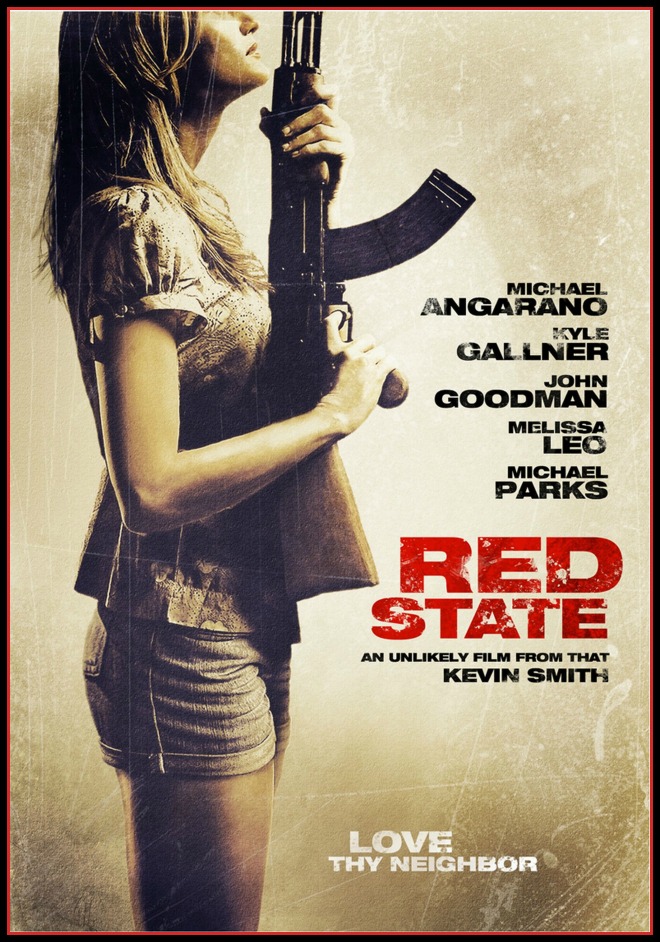
Horror Review: Red State (dir. by Kevin Smith)


Kevin Smith’s 2011 film was a major departure for him. It wasn’t the usual comedy (his last one being the very awful buddy-cop comedy, Cop Out) but instead his first foray into one of film’s earliest film genre: the horror film. Say what you want or feel about Kevin Smith (and there’s a huge range of people who either love the man or hate him like the second coming of the Antichrist) but when he decides to make a film he puts everything of himself on display and he wears his emotions on his sleeves when it comes to his films. It’s this aspect of Smith’s personality which has gained him such a loyal following, but has also earned him the scorn and, for some, hate of film bloggers who now constitute the bulk of film criticism in the digital age. This first horror film for Kevin Smith would be called Red State and it would be a film that would continue to expand the gulf between those who hate him and those who support him. Lost in this playground-like tiff was whether the film would be a return to form for Smith or just a continuation of some very bad films in the last half-decade.

Red State could almost be called a coming-of-age story since the film begins with three high school boys joining together to travel to a neighboring town where they  hope to engage in some sexual extracurricular activities. It’s also in this very town that we learn very early on in the film that the Five Points Church calls home. This church and it’s congregation has one Pastor Abin Cooper (Michael Parks) as it’s leader with it’s membership either related by blood to Cooper or by way of marriage. In this picture would arrive an ATF task force led by Special Agent Keenan (John Goodman) to investigate the illegal doings of Cooper and his flock. It’s between these two groups that the three teenage boys would find themselves in a horrific situation with their lives in the balance.

Let’s just say that this film had much potential in it’s plot and how it’s initially set-up. The character of Pastor Abin Cooper and his flock was definitely patterned after the Westboro Baptist Church led by Fred Phelps who’re infamous for picketing funerals of soldiers and for being outright homophobic in their teachings and ideology. The ATF group with Keenan in command looks to be set-up to represent the Federal government and it’s police agencies run amok in their attempt to fight terrorism since Sept. 11, 2001. Then Smith drops in three horny teenage boys in the mix and it sure must’ve read like a surefire story with horror and action.

What we get instead was a film which didn’t seem to know how to proceed with the initial set-up. The film began and played out like something similar to Hostel and films of a similar vein. Unsuspecting teens lured by sex to be made an example of by a group of people extreme in their passions and ideas. If the film had continued with just those two groups as the core of the film’s story then it could’ve made for a decent survival horror film, but the addition of the ATF task force and how they impacted the dynamics between the congregation and the teens unbalanced everything. Now what was suppose to be a horror film turned into an action-drama.

The performances by the cast was also inconsistent. This could be due to the weakness of the screenplay which tried too hard to push Cooper and his people as batshit crazy through overly long sermons. Sermons by Abin Cooper that was delivered by Michael Parks in convincing fashion at times and then mumbled incoherently at others. The three teens were also a problem in that they weren’t sympathetic by any means. Even knowing what awaited them didn’t lessen the fact that these three teens were obnoxious and vulgar to the point that we didn’t care if Cooper and his people tortured and killed them.

One would expect that the addition of John Goodman as the ATF special agent and Kevin Pollak as his assistant would at least bring some serious acting chops to the proceedings, but their characters were so thinly-written and their dialogue so forced that one couldn’t believe them as real characters. It’s a shame that the film’s overall screenplay couldn’t provide the necessary foundation for a cast that had a very good veteran ensemble which included Melissa Leo, James Parks and Stephen Root.

Red State really failed in the very thing that was suppose to make this film the beginning of a shift in Kevin Smith’s career. It failed as a horror film in the most general sense. There was never any true feeling of horror to be had throughout the film. Even the first death of an unnamed homosexual kidnapped by the congregation to be used as an example during one of Cooper’s sermons failed to elicit any form of horror. This was a film which had much potential for some horrific sequences but it never explored it. The film doesn’t even work as a thriller which would be the closest this film ever got to be. Even the ending of the film which tried to inject a semblance of the supernatural didn’t even work as it turned out to be a major bait-and-switch that didn’t come off as creative once it was explained.

Does the film justify some of the venom hurled at it from Kevin Smith’s detractors?

I would say no in that the film wasn’t the worst thing he has made by a long shot. It did have some moments that hinted at something special could’ve been made if someone else was involved or if the film had more time to be worked on. I do believe that if Red State was made by anyone else other than Kevin Smith it would be considered average to good. But having such a polarizing figure as it’s creator and marketer might have blinded some in actually watching this film with an open-mind.

Does this mean Red State was actually a good film?

I would say no with the reasoning I’ve mentioned above. But I will say that the film wasn’t dull or boring. As unnecessary as the ATF task force to the story as a whole their arrival and the subsequent reaction of the congregation to them made for some exciting few minutes. Even Michael Park’s performance was quite good despite some of his line deliveries coming off as incoherent mumblings.

If Red State was to be Kevin Smith’s attempt to try and move away from his history of making comedies then it was a failed one. While it was a failure I wouldn’t mind him going back to the genre to hone his skills in doing more horror. If Uwe Boll could continue making even worst materials then surely Smith could be given another chance to make another and fix the very things which he did wrong with Red State with another horror film project. One thing for sure he would not be lacking in actors wanting to work with him.

Quick Movie Review: Arachnophobia (dir. by Frank Marshall)


When I was a kid, my grandmother used to keep this clear shower curtain of a large black web, complete with a big red spider on it. It scared me so bad that I was actually more willing to brave the darkness of the basement bathroom than to have to deal with that monstrosity in the well-lit one. Between that, my brother’s EC comics and the original “The Fly” with Vincent Price, it’s how I developed Arachnophobia. It’s a fight or flight reflex that occurs when anything spider related appears. It seems fitting that as I’m writing this from a location that’s full of Black Widows, Arachnophobia is the topic for this review.

Arachnophobia marked the first directing attempt by Frank Marshall, long time producer of many of Steven Spielberg’s films. The film turned out to be a success when released, and manages to feature one the greatest Human vs. Tarantula battles ever filmed.

Although the film has some horror elements, it’s kind of hard to classify Arachnophobia as an actual horror film, despite the deaths that are in the film. There are some humorous moments (particularly from John Goodman), and the scares don’t come too often. For anyone who’s bothered by spiders, though, there are a number of jumpy moments that occur without being excessively gory. The story is a little misleading. It starts in Venezuela, South America, where a deadly tarantula manages to sneak its way on board a trip back to California. You’d think that from here, the Tarantula would end up finding another Tarantula, and thus pull a Kingdom of the Spiders with a whole town full of spiders. The writers, however, end up making a mistake in having a Tarantula mate with a common house spider, thus breeding dozens of other smaller spiders.

That’s like a Tiger trying to mate with a house cat. I’m not exactly sure if that’s even possible, but I’m getting off track. This actually ends up helping the story because now the town has to deal with all of these smaller spiders that are easy to hide around. I always considered that to be pretty effective.

Jeff Daniels character, Dr. Ross Jennings suffers from Arachnophobia in the worst way. Moving to the town of Canaima with his family, he trades the big city for a more relaxed, rural setting. Of course, it’s a happy ideal situation until various deaths start happening around town. Eventually, he and the authorities come to realize just how bad things really are. John Goodman’s character was an interesting touch as a funny exterminator, but really wasn’t used as much as he could have in this film. Then again, when he does tend to steal the scenes he’s in. Arachnophobia has a number of other supporting actors, but the film mainly belongs to Daniels, Goodman and the the spiders.

Chris Walas, who won an Oscar for his effects and make up work in The Fly helped to create some of the more mechanical spiders and close-ups when necessary. While you can tell where you’re dealing with real tarantulas and their synthetic counterparts, he did a great job in getting the fear factor out there, especially during the final standoff of the film. Without giving much away, the last 20 minutes of the movie are brilliant in that the final battle is much more than the simple “find it and squash it” scenario from Kingdom of the Spiders. It’s almost a violent chess match.

Arachnophobia is a treat. It may not be the best film about spiders in general, but if you do suffer from the condition or know someone who does, it definitely worth seeing, just to jump and squirm now and then. It’s much better than knowing there are real Black Widows to contend with.