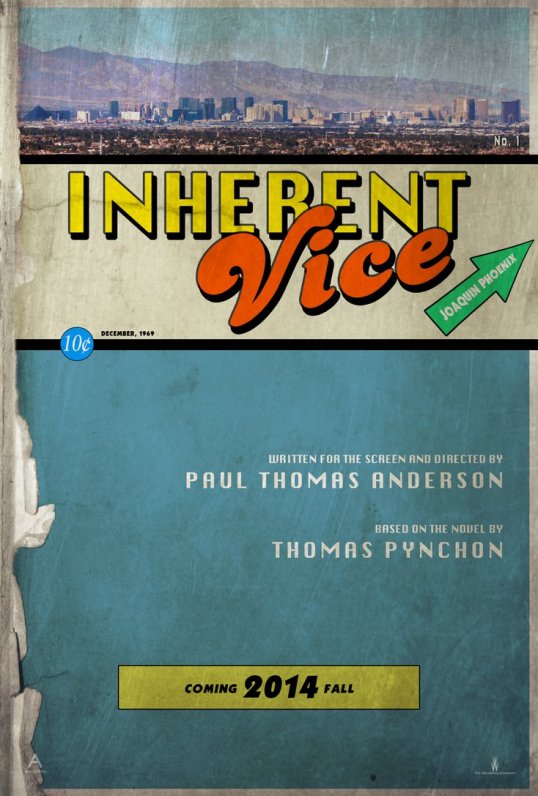
One of the best things about Paul Thomas Anderson’s latest film, Inherent Vice, is that Doc Sportello, the private detective played by Joaquin Phoenix, is a real stoner. He’s not one of those weekend smokers, who gets high on Saturday, brags about it on Sunday, and then spends the rest of the week interning at Vox. For the entire 2 hour and 20 minute running time of Inherent Vice, Doc is stoned. From the minute we first meet him to the end of the film, there is never one moment where Doc is not stoned. Most stoner comedies feature a scene where the main character shocks everyone by turning down a hit because he’s dealing with something so important that he has to “keep his mind straight.”
Not so with Doc!
And, in Doc’s case, it definitely helps him out. Inherent Vice tells a story that is so full of paranoia, conspiracy, and random connections that only a true stoner could follow it. Much like Doc, the film often seems to be moving in a haze but occasionally, out of nowhere, it will come up with a scene or a line of dialogue or a detail that is so sharp and precise that it will force you to reconsider everything that you had previously assumed.
To be honest, if you are one of the people who watched Inherent Vice this weekend and could actually follow the film’s plot, then you’ve got a leg up on me. (That said, I’ve still got pretty good legs so it all evens out.) But, that’s not necessarily a complaint. As befits a film based on a novel by Thomas Pynchon and directed by one of the most idiosyncratic filmmakers around, the twists and turns of Inherent Vice are deliberately meant to be obscure and confusing. Characters appear and then vanish. Clues are discovered and then forgotten. Connections are hinted at but then never confirmed. Inherent Vice ultimately serves a tribute to stoner’s paranoia and, as a result, the plot’s incoherence leads to a certain contact high.
The film takes place in California in the 1970s. Doc is both a hippie and a private detective. His current girlfriend (Reese Witherspoon) works for the district attorney’s office and doesn’t seem to like him much. His ex-girlfriend, Shasta (Katherine Waterston), reenters his life and asks him to help protect her new boyfriend, real estate developer Mickey Wolfman (Eric Roberts). Mickey has disappeared. Shasta disappears. As Doc investigates, he wanders through a psychedelic Los Angeles and deals with an ever growing collection of eccentrics.
For instance, there’s Hope Harlingen (Jena Malone), a former heroin addict who now runs a group that aims to promote “responsible drug use” among children. She believes that her husband, Coy (Owen Wilson), is dead but actually Coy is a government informant who keeps popping up in the strangest places.
There’s Rudy Blatnoyd (Martin Short), a decadent dentist who may or may not be responsible for all of the heroin entering California.
There’s Sauncho Smilax (Benicio Del Toro), Doc’s lawyer who specializes in maritime law.
There are Nazi bikers, new age doctors, a formerly blacklisted actor turned right-wing spokesman, a black revolutionary whose best friend was a member of the Aryan brotherhood, three FBI agents who keep picking their noses, the decadent rich, and, of course, the endlessly clean-cut and bullying officers of the LAPD.
And then there’s Detective “Big Foot” Bjornsen (Josh Brolin), a celebrity cop and occasional television extra who seems to admire Doc, except for when he’s trying to frame Doc for everything from murder to drug smuggling. Bjornsen is probably the most interesting character in the entire film and Brolin plays the character perfectly. His scenes with Phoenix crackle with a comedic energy that bring the film to life.
As for the movie itself, it’s not for everyone. A lot of very smart people are going to dislike it, much as many of them did with The Master.In some ways, Inherent Vice truly is an endurance test. Speaking as someone who enjoyed the film, even I occasionally found myself saying, “Okay, does everyone have to have a silly name?” Inherent Vice is a long, rambling, and occasionally frustrating film but, for me, it still worked because of the strong cast and Anderson’s attention to detail.
Unbroken is a film that seems to take place in an entirely different world from Inherent Vice but these two films do have one big thing in common. Both of them have been victims of the expectation game. Many of the same people who thought Unbroken would be a surefire Oscar nominee also assumed, sight unseen, that Inherent Vice would be right there with it. Much as how Unbroken has suffered for merely being good as opposed to great, Inherent Vice is also suffering for failing to live up to the expectations that were thrust upon it. Inherent Vice is not an awards movie. Instead, it’s a fascinatingly idiosyncratic film that was made by a director who has never shown much concern with playing up to the audience. While Unbroken is enough of a crowd pleaser to still have a shot at some Oscar glory, Inherent Vice is the type of film that will probably never get nominated. (I do have some hope that Brolin will get a supporting actor nomination but, even there, it appears likely that Brolin’s spot will be given to The Judge‘s Robert Duvall.)
Well, no matter! Flaws and all, Inherent Vice will be a film that people will still be debating and watching years from now.
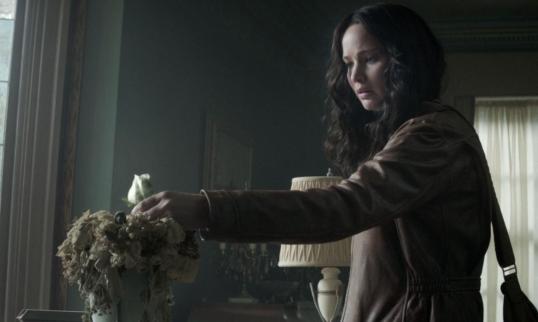
Of the three The Hunger Games films released so far, Mockingjay Part One is definitely the weakest. That does not, however, mean that it’s a bad film. It’s just that it doesn’t quite reach the grandeur of the first film, nor does it have the same political immediacy as the second one. However, there’s a lot of good things to be said about Mockingjay. Julianne Moore is perfectly cast as the charismatic but faintly sinister Alma Coin. Philip Seymour Hoffman’s performance reminds us of what a towering talent we lost earlier this year. Donald Sutherland continues to transform President Snow into a villain for the ages. Even though he’s only in the film for a few minutes, Stanley Tucci is perfectly vapid as Caesar Flickerman.
In fact, the only real problem with Mockingjay is that it’s so obviously a prologue to something bigger. Much as with The Maze Runner, we watch Mockingjay with the knowledge that it’s only part one and that the majority of the issues raised by the film will not be settled until next year. The film itself knows this as well and, as such, it lacks the immediacy and much of the excitement of the first two Hunger Games films.
But yet, with all those flaws in mind, Mockingjay still works and it’s largely because of Jennifer Lawrence’s performance as Katniss Everdeen. Whereas the first two Hunger Games films featured a Katniss who was always at the center of the action and always taking charge of any situation that she found herself in, Mockingjay features a Katniss who has far less control over her fate. (One of the neater ironies of the series is that Katniss was actually more independent as a prisoner of President Snow than as a “guest” of Alma Coin.) In Mockingjay, Katniss finds herself forced — with more than a little reluctance — to become the figurehead for the entire revolution and the film’s best moments are the ones in which others debate how to best “market” her. These scenes are all about how Katniss — who is now not only a celebrity but a political icon as well — deals with losing control over her own public image. Considering that Jennifer Lawrence’s rise to fame and acclaim occurred just as abruptly as Katniss’s, it’s probable that — even more so than in the previous films — the actress brought a lot of herself to the character.
So, yes, I would argue that Jennifer Lawrence does perhaps deserve some awards consideration for her performance in Mockingjay. However, she truly deserves it for the consistent quality of her performance throughout the entire Hunger Games franchise. From the very first film, Jennifer Lawrence’s performance has been iconic. Fiercely independent without giving into the usual cinematic clichés that come with that, Katniss Everdeen has provided an alternative role model for a generation of girls who, otherwise, might have only had the likes of Bella Swan to look up to.
If that’s not worthy of being honored, then I don’t know what is.
The arrival of a new Paul Thomas Anderson film seems to always be a time for excitement. P.T. Anderson’ films can never be called boring. They’re all entertaining on some level for even those who don’t quite get Anderson’s quirky-style of storytelling.
I’ve admired all of Anderson’s films. Have I liked all of them? Not really, but I can understand why many anticipate each and every new film he releases like it was the second coming.
I have no idea what’s going in just going by the trailer, but it does have a noir vibe going for it. Plus, it has Joaquin Phoenix and Josh Brolin.
Inherent Vice is set to premiere on October 4, 2014 during the New York Film Festival before going wide release on December 12, 2014.
For our latest entry in the 44 Days of Paranoia, we take a look at a film that might, at first, seem out-of-place in this series — The Hunger Games: Catching Fire.
Why is Catching Fire included in a series of films about conspiracy and paranoia? Because, even more than the first film, Catching Fire is a film with a political subtext. Beneath its franchise surface, Catching Fire is about how the government and media establishment manipulates its citizens and how, occasionally, the citizens are smart enough to manipulate them.
When reviewing Catching Fire, probably the first and most important question is how it compares to The Hunger Games. Is it that film’s equal, is it better, or is it worst? That’s not necessarily an easy question to answer because Catching Fire is a very different film from The Hunger Games.
One of the main reasons that I loved The Hunger Games is because, after a countless number of Twilight-style films that all featured teenage girls willingly sacrificing their independence for a boyfriend, The Hunger Games finally gave us a female protagonist who kicked ass and made no apologies for doing so. Katniss Everdeen was defined by her mind and her soul and not her relationship status. I loved The Hunger Games because, like Brave, it celebrated female strength and independence. While I have always been willing to defend the Twilight films for what they are, I would not want my niece or my future daughter to grow up to be Bella Swan. Katniss Everdeen, however, is a role model for both our times and our future. The Hunger Games was all about celebrating girl power and, for that reason, I loved it.
Katniss Everdeen is still a worthy and independent role model in Catching Fire but the film itself is far more political than The Hunger Games. Whereas The Hunger Games was all about establishing Katniss as a strong woman, Catching Fire is about how that strength can be used to challenge the status quo.
As the film opens, Katniss (played, of course, by Jennifer Lawrence, who I have such a girl crush on) and Peeta (Josh Hutcherson) have returned to District 12 after having “won” the 74th Hunger Games. Realizing that their act of defiance could lead to a full-scale revolution, President Snow (Donald Sutherland) attempts to co-opt their rebel image. He orders that Katniss and Peeta continue to pretend to be in love so that, during their Victory Tour, the citizens of the other districts will be convinced that Katniss’s actions were the result of love and not of defiance.
This is actually a very interesting premise and definitely that shows a lot more sophistication than what we, as filmgoers, have been conditioned to expect from a movie based on YA fiction. While thousands of films have depicted love as a form of political rebellion, Catching Fire is unique in suggesting that love (or the appearance of love) can also be used to maintain political suppression.
During the Victory Tour, both Katniss and Peeta balk at having to play the roles that Snow has assigned them. While at District 11, Katniss pays tribute to Rue and then watches in horror as Snow’s “peacekeepers” executes a man who dared to hold up the three-finger salute. Trying to avoid further violence, Katniss agrees to become engaged to Peeta.
Snow, however, realizes that, as long as Katniss is alive, she’ll be a threat to him. He announces a special all-star edition of The Hunger Games, in which all the tributes will be past winners. Since Katniss is the only female tribute from District 12 to have ever survived the Hunger Games, she knows that she’s going to have to compete for a second time. When Haymitch (Woody Harrelson) is selected to be the male tribue, Peeta immediately volunteers to go in his place.
The first hour of Catching Fire, which deals with the media and political manipulation surrounding the Victory Tour, is brilliant. The second half, which features Katniss and Peeta competing in their second Hunger Games, feels a bit familiar and rushed. It’s not that the second half of the film isn’t good. It’s just far more predictable.
But here’s what’s important — everything that worked about The Hunger Games works for Catching Fire. Josh Hutcherson seems a lot more confident here than he did in the first film, Donald Sutherland makes for a great villain, Stanly Tucci is a lot of fun as Caesar Flickerman (what a great name!), and the film is a visual feast. Among the new cast members, Jena Malone is perfectly cast as tribune Johanna Mason while Philip Seymour Hoffman is properly Philip Seymour Hoffmanish as the new director of the Hunger Games.
However, the film belongs to and works because of Jennifer Lawrence. Whether she’s playing Katniss or Mystique or Ree Dolly or Tiffany Maxwell or Rosalyn Rosenfeld, Jennifer Lawrence kicks ass.
For today’s entry in the 44 Days of Paranoia, I want to take a quick look at a very good movie from the year 2000 that not many seem to know about, Cheaters.
During my senior year of high school, I always wore a short skirt on any day that I had a test in my algebra class.
Why?
Because I was a cheater.
Back when I was still a student, I always struggled when it came to my math classes. It wasn’t that I couldn’t do the work as much as it was that the work just bored me. Whenever my teacher was talking about square roots and x+y and all the rest, I was usually busy daydreaming about anything other than what I was supposed to be learning.
Fortunately, my sister Erin had been one year ahead of me in high school and had saved all of her old tests and quizzes. Since we both had the same algebra teacher, I started using her old tests as a study guide. It quickly became obvious that our teacher was simply reusing the same tests from year-to-year. While the order of the problems might occasionally change, the solutions remained the same.
Every test day, I would wear a skirt and, right before class, I would write the answers on my thigh. If the teacher walked by my desk while I was taking the test, I would just pull down on my skirt. Fortunately, the teacher was a male so even if he did suspect that I was cheating, it’s not like he could tell me to lift up my skirt or, for that matter, even get caught trying to look down at my legs.
And that’s how I managed to pass algebra without ever paying attention to anything that was said in class. I know that I should probably feel guilty about cheating but, to be honest, I don’t. If I had it to do all over again, I would do the exact same thing.
Perhaps that’s why I related to the character of Jolie Fitch in Cheaters.
Jolie (played by Jena Malone) is a junior at Chicago’s Steinmetz High. Jolie is one of the only students at Steinmetz to be more interested in academics than athletics. She also idolizes English teacher Jerry Plecki (Jeff Daniels). When Steinmetz’s buffoonish principal (Paul Sorvino) forces Jerry to take the unwanted job of coaching the school’s Academic Decathlon team, Jolie volunteers to help Plecki recruit an unlikely team of misfits and outsiders.
At the regional competition, the Steinmetz team just barely qualifies to move onto the state competition. However, no one on the team feels that they have a shot at beating the team from the far wealthier Whitney Young Magnet High School. As quickly becomes obvious, Whitney Young specifically goes out of their way to recruit the smartest students they can find and, as a result, they have won the state competition for five years straight.
Angered over the smugly elitist attitude of Whitney Young’s coach, Plecki obsessively pushes his team to study and prepare. However, with the state competition quickly approaching, the Steinmetz Team comes into possession of a copy of the test for the state finals. Obsessed with defeating Whitney Young, Plecki suggests that the students cheat. After being pressured by both Plecki and Jolie, the rest of the team agrees to do so.
When Steinmetz subsequently wins state, the Whitney Young coach immediately demands an investigation into how Steinmetz could have possibly made such a dramatic improvement in just the period of a few months.
However, the rest of Chicago is charmed by the story of how the Steinmetz team came out of nowhere to win and Plecki and his students become celebrities. However, when one spiteful student threatens to reveal the secret, both Plecki and his team are forced to scramble to cover up their cheating and prevent the truth from being exposed.
Cheaters is based on a true story, though I can’t tell you for sure how closely the filmmakers stuck to the facts of the case. (If you look at the film’s imdb page, you’ll find a lot of negative comments left by a lot of angry students from Whitney Young). However, what I can say is that Cheaters felt true. By that, I mean that Cheaters captured both the importance of competition in high school and the fact that, when you’re a teenager, everything is a drama and, as a result, it’s a lot easier to justify things that, as an adult, you would refuse to ever consider.
When I was high school, I was involved with both the Drama Club and Speech and Debate and watching Cheaters brought back a lot of memories. Cheaters gets all of the small details right — everything from the combination of exhaustion and exhilaration that comes from competing at an all-day tournament to the awkward attempts of “mature” adults to understand why winning is so important when you’re in high school.
Cheaters is also blessed with some excellent performances. As Whitney Young’s smug coach, Robert Joy is properly loathsome. Paul Sorvino brings some much-needed comic relief to the film and the scene where he awkwardly dances to the theme from Rocky is priceless.
The film, however, is truly dominated by Jena Malone and Jeff Daniels. As the film’s nominal protagonists, Malone and Daniels both give wonderfully nuanced performances. When the film starts, you find yourself rooting for both of them because not only are they likable performers but their characters seem so sincere in their desire to win. However, as the film progresses, we start to see the small chinks in their armor. We see how obsessed Jolie is with protecting Plecki. Meanwhile, Plecki goes from being an almost idealized teacher to being something of a megalomaniac. By the end of the film, we realize that we know far less about Jerry Plecki then we thought we did. Jeff Daniels gives a performance that forces us to draw our own conclusions about Plecki and his motivations.
Some people might question reviewing a film like Cheaters in a series about conspiracy-themed films. However, though it may not be as obvious as with a film like Three Days Of The Condor or JFK, Cheaters is a conspiracy film. Beyond the conspiracy to win the Academic Decathlon by cheating, Cheaters is about the much more subtle conspiracy that will always cause students who go to schools like Steinmetz to be viewed as being less important than the students at a school like Whitney Young. Cheaters is a film about a conspiracy, the conspiracy of cultural and economic elitism.
It’s a conspiracy that, Cheaters suggests, leaves many people with only two options: surrender or cheat.
The next installment in The Hunger Games series, Catching Fire, looks to return later this year with a new director taking over the reins. Gary Ross began the series as director of the first film and the film enjoyed massive success and very positive reception from the critics-at-large. So, it was surprising news that Ross wouldn’t be returning to continue the series and instead Lionsgate replacing him with Francis Lawrence (Constantine, I Am Legend).
This sequel brings back everyone who survived the first film and adds some new faces in the cast such as Philip Seymour Hoffman, Toby Jones, Jena Malone and Jeffrey Wright.
The Hunger Games: Catching Fire is set for a November 22, 2013 release date.
So, for the past few days, I’ve been happily hopping around my section of the Shattered Lens Bunker and do you know why?
Because it’s awards season, that’s why! With the conclusion of the 2011-2012 TV season, Emmy ballots have been mailed and votes are being cast and, come July, we’ll know which shows and performers have been nominated for the 2012 Emmys.
Before that happens, however, I would like to play a little game called “What if Lisa Was Solely Responsible For Picking the Nominees.” Here’s how it works — I looked over and studied the complete list of the shows and performances that have been submitted this year for Emmy consideration. And then, from that list, I picked my personal nominees.
Below are my personal nominations in the major Emmy categories. Again, note that these are not necessarily the shows and performers that I believe will be nominated. Instead, these are the shows and performers that I would nominate if I was solely responsible for picking the nominees.
There have always been films through the years which will garner extreme reactions from its audiences. These reactions will always take two sides on the film. People who see these films will either love them or they will hate them. There is to be little to no middle ground reaction when it comes to these films. In 2009, we had James Cameron’s epic scifi Avatar which had two sets of fans. Those who loved it to the point that it transcended simple fandom into something these people thought as important. Then there were the vocal minority who absolutely hated the film. Whether both fans were right in their opinions was (and continues) to be irrelevent. All that mattered to these people was that they’re right and the other side was wrong.
2011 is entering it’s second season and a film finally arrived which seem to have elicited the same sort of reaction from people who have seen it. Sure, there’s some who saw it merely as entertainment and left it at that, but there’s a growing rift between those who loved the film and those who hated it. The film which seem to have caused this is the action-fantasy film Sucker Punch.
To say that Zack Snyder’s latest visual extravaganza would create discussion amongst filmgoers would be an undertstatement. Sucker Punch has arrived to much genre fandom fanfare. This was a film that seemed to take genres from all corners like scifi, fantasy, anime and manga and mashed them all up into something new and serving it up to the legion of fans who love those very things. Zack Snyder has made his reputation as a filmmaker as a visual artist. His entire filmography from the Dawn of the Dead remake all the way up to his adaptation of the Alan Moore graphic novel Watchmen have all been very strong visually. His grasp of narrative structure continues to grow and improve but it’s always been his handling of dialogue which has tripped him up.
Sucker Punch is a tale within a tale about a young woman we come to know as Baby Doll (played with an almost angelic quality by Emily Browning). The film opens up with the curtain rising on a theater stage and we soon become witness to a dialogue-free opening sequence of the events which transpired to bring Baby Doll to the Lennox House mental institution. This entire opening sequence is a great example of Snyder as a master of creating a montage of striking visuals sans dialogue with only music to break the silence. It helped that the music chosen to accompany this scene was a haunting rendition by Emily Browning herself of the Eurythmics’ “Sweet Dreams (Are Made of These)”. Just like in Watchmen‘s own intro title sequence, Snyder was able to convey the beginnings of the story without the need for dialogue and do it so well that we as an audience understand fully all that’s transpiring on the screen.
Once this prologue ends we move onto the main setting of the film where Baby Doll gets put into the care of the Lennox House’s resident boogeyman in the form of Blue as played with slimy charm and panache by one Oscar Isaac (last scene chewing up the English countryside in Ridley Scott’s Robin Hood). The audience sees what Baby Doll sees as Blue gives her the tour of the facilities which finally ends at the “Theater” where all the female patients act out their problems and fears through the guidance and help of Doctor Gorski (played by the lovely and return Snyder performer, Carla Gugino).
The first 15 minutes of this film was pretty much a basic set-up of what Snyder will use as his blueprint for the rest of the film. All the different levels of fantasy Baby Doll will imagine and inhabit throughout the film is rooted deeply in this initial sequence of events which begins the film. The clues as to who the story is truely about could be found in this intro if one was paying attention to the film instead of being distracted and mesmerized by the visuals Snyder crafts to start the film. While it won’t become apparent until the reveal at the climactic events of the film. Once all are the cards were revealed, so to speak, the beginning of the film begins to make sense. From the curtain rising, the silent film-like scene to begin and the narration to open things up, all those give a hint to what the answer to the question the film’s narrative really asks: “Is what we’re seeing truly real or is it all just fantasy?”
Sucker Punch becomes a sort of a trip down the rabbit hole a la Alice In Wonderland once the film establishes Baby Doll’s predicament upon arriving at the Lennox House (she’s to be lobotomized in 5 days). The film moves from the gray and depressing confines of the Lennox House to the fantasy world centered on a burlesque establishment where Baby Doll is an orphan sold by a decadent priest (the form her stepfather takes in this fantasy) to Blue, the proprietor of this house of ill repute where orphaned young women become burlesque dancers and worst to the clientele. It is in this place we meet the rest of the gang Baby Doll will befriend to help her try to escape the place and thus avoif the “High Roller” who will come to collect her in 5 days.
The film shares something similar with Christopher Nolan’s Inception in that both films deal with different levels of reality or fantasy (depends on how one sees the different worlds shown in both films). Where Nolan’s ideas seem more rooted in what he would consider as more grounded to reality as much as possible Snyder goes the other way and takes the leashes off of Baby Doll’s imagination. This third level Baby Doll goes to as she begins her dance to distract the men of the burlesque house is her mind unfettered and where she’s not helpless but has power not just to protect herself but do so better than the men who inhabit this fantasy world of steampunk zombie soldiers, orcs, dragons, alien robot machines and many other scifi and fantasy tropes which define geek culture through the decades.
If there’s one reason to watch this film it would be just to bear witness to Snyder letting his imagination as a visual filmmaker take over. Some people may not like this and want a strong, structured narrative to balance out the visuals. I, too, would’ve liked to have seen something stronger in terms of story and plot, but there are just instances when the visuals are so striking and wildly imaginative that one just marvels at the scenes unfolding on the screen. If any, Snyder as a visual artist helps prop up the weakness in the story. Snyder would’ve served this film better if he went even further and turned Sucker Punch into an avant-garde silent film of the digital age. That beginning in the film just unfolded so strongly despite no dialogue that the rest of the film could’ve been done in the same manner and be the better for it.
Which brings me to what was the film’s near fatal flaw. A flaw that many of the film’s detractors have taken as the rallying cry to denounce the film as horrible and Snyder as a hack. The interesting thing is that these same people were also the ones who had been praising of Snyder prior to this film. Even those who begrudgingly gave Snyder his props for having some semblance of talent because of the very handling of the visuals that he has now have become much more vocal about how they always knew Snyder was never that good.
I would say that Snyder is not the second coming of Ridley Scott as some of his supporters have anointed him or is he a hack filmmaker who is all flash and no substance. I think he’s somewhere in the middle and still finding his true voice as a filmmaker. I’ve always seen Snyder as being weak when it comes to handling the slower scenes of dialogue and most visual filmmakers tend to be the same when starting out. The dialogue seem to get in the way of what they really want to do and tell the story through striking visual sequences. They’re like painters who don’t need words to convey the emotions they wish to convey. Sucker Punch I believe suffered from Snyder trying to combine his strength on the visual side of the equation with his handling of story through the dialogue which he still hasn’t mastered. If someone else had written, or at the very least, fixed and strengthened the script, I do believe that the film wouldn’t be getting so ripped and trounced by those who had been so excited to seeing one of Snyder’s personal projects.
The performances by the cast ranged from good to just being there. There really wasn’t anyone in particular who performed badly. Everyone from Emily Browning to Oscar Isaac all the way to Abbie Cornish did well enough with the material they were given. Oscar Isaac as both Blue in the insane asylum and as the pimp in the burlesque house did particularly well playing up the fun role of the villain in Baby Doll’s different levels of reality/fantasy. Of the ladies in the film I must point out the performance of Jena Malone and Abbie Cornish as sisters in the second level. While we only get a glimpse of Cornish’s Sweet Pea character in the Lennox House, once in the burlesque setting she becomes the anchor by which the rest of the women in the cast held onto. Jena Malone as the younger sister Rocket who still dreamed hopes of escape was a nice complement to Sweet Pea.
So, we have a film in Sucker Punch which seem to have strength on one side of the filmmaking equation and a major weakness on another. This is the kind of film that I would, in the past, have dismissed as another attempt by Hollywood to pander to the geek crowd with its mash-up of different scifi and fantasy imagery. But this time around I actually enjoyed the film both in a visual sense and how Snyder was able to play with the audience’s personal observations about the themes his film is trying to explore. It’s these very themes which have split audiences into two camps. While the gender politics and stereotypes people have brought up in discussing this film have made for some lively debate I refrain from adding my views on it in this review. I think I’m not well-qualified to debate such discussions.
For me, Sucker Punch succeeds more than it fails because Snyder didn’t play it safe with how he wanted to make his film. He was able to tell the film’s story through the different visual styles for each world the cast played in and did it quite well. While most of the time I wouldn’t give a film a pass for a weak narrative and average dialogue with this film I felt like the experience one gets from experiencing the visual canvas Snyder continued to paint with from beginning to end was enough to balance out the negative. It’s really a film that one must experience for themselves and make their decision on that experience instead of listening to other’s opinions (both good and bad) about the film. One may end up hating the film like some, but then again they may end up like me and forgive Snyder for trying to reach for the sun and failing to do so, but at least tried to with panache instead of playing it safe.
Last Friday, I went and saw Zack Snyder’s new film Sucker Punch with my sister Erin and a group of our friends. Sucker Punch was a film that I had been looking forward to seeing for a while and not even all of the scathingly negative reviews that I read before leaving for the theater could dampen my enthusiasm. Somehow, I knew I would love this film (despite the fact that Zack Snyder is, usually, one of my least favorite directors). And you know what? I did love it.
The plot has been criticized for being both overly complicated and not being complicated enough and I actually think that a case can be made for either one of those complaints. The film opens in the 1950s. Teenage Babydoll (Emily Browning) is sent to a mental asylum by her evil father. Her father has made a deal with an orderly named Blue (Oscar Isaac) to have Babydoll lobotomized. (By the way, this was actually a pretty common thing back in the 50s. I shudder to think what would have been done to me if I had been born five decades earlier.) As Babydoll waits for her lobotomy (scheduled to occur at the end of her first week as a patient), she is subjected to the therapy of Dr. Gorski (Carla Gugino) who plays music and encourages her (all female) patients to find peace by controlling their fantasies.
Suddenly, we’re in a fantasy (just who exactly is having the fantasy is one of the film’s mysteries that’s never really explained but is actually kinda fun to debate). In the fantasy, the insane asylum is actually a brothel/dance hall that is owned by Blue. Gorski is a choreographer. The patients are now all lingerie-clad dancers/prostitutes. Babydoll is the latest girl to be put into service in the brothel and she is being held over for “the High Roller” who is expected to show up in five days.
(The fact that the movie explicitly compares forced lobotomy to rape is one of the many interesting facts that the majority of negative reviews have chosen to ignore.)
Babydoll soon discovers that 1) she’s such a good dancer that when she does dance, men can only watch in stunned silence and 2) whenever she does dance, she finds herself transported into a fantasy world where, along with getting advice from the Wise Old Man (Scott Glenn), she also battles (and defeats) everything from giant Samurai to dead Nazis who have been reanimated by “steam power” to a dragon. These battle scenes, as odd as they are, are actually pretty exciting. Say what you will, Snyder knows how to direct a battle scene and Browning and the rest of the almost entirely female cast all seem to be having a blast getting to do the type of things that usually, only boys are allowed to do.
Anyway, as a result of her fantasies, Babydoll comes up with a plan to escape the brothel. She quickly recruits four other girls into her plan — Amber (Jamie Chung), Blondie (Vanessa Hudgens), the free-spirited (and really, really cool) Rocket (Jena Malone) and finally Rocket’s older sister, the world-weary Sweatpea (Abbie Cornish). In order to escape, they need to steal four different items. While Babydoll distracts their captors by dancing (and therefore going into one of her battle fantasies), the others steal whatever is needed. And everything works out just fine. Until it doesn’t….
Sucker Punch is a glorious mess of a movie and, perhaps because I’m a glorious mess myself, I loved it. In fact, it’s probably my favorite film of 2011 so far. In this regard, I know I’m going against the majority but so what? Throughout history, if one thing has always been consistent, it is that the majority sucks. Yes, Sucker Punch is a deeply flawed film that runs on for at least half-an-hour too long. And yes, I think it can be argued quite convincingly that this film is ultimately a happy accident, a film that’s strength comes not from directorial design but instead as the result of a few random elements that resonate in the subconscious. But no matter — happy accident or not, I loved Sucker Punch and I’m not ashamed to admit it.
Hmmm…that’s a familiar pose.
Let’s start with a few obvious points. As even those who hate this film seem to be admitting, it’s visually stunning. The battle scenes are kinetic and exciting, the film’s over-the-top production design (a mix of German Expressionism, 50s film noir, Bob Fosse choreography and old Zack Snyder films) is always a blast to look at, and the soundtrack kicks ass. Like other films in the so-called “Girls with Guns” genre, Sucker Punch allows its actresses to be something other than just scenery or helpless damsels.
Interestingly enough, for a film that takes place mostly in the world of fantasy, there’s no attempt to really make this film’s version of “reality” come across as anything other than an elaborate fantasy as well. The film’s opening scenes are played out in slow-motion and the film’s asylum (which, like most movie asylums, appears to have been borrowed from The Cabinet of Dr. Caligari) is so gray that the film might as well be in black-and-white. Blue and Babydoll’s father hold a melodramatic conference while standing directly behind Babydoll, their three heads filling the screen like flashes of manic paranoia. As such, the film — at times — becomes a fantasy taking place in a fantasy taking place in a fantasy. It takes a while for the viewer to get used to this and, at times, it can seem like there’s really nothing to give the film any sort of grounding. However, for me, the opening sequences are not meant to be “real” as much as they serve as a reflection for the way that the real world can imprison anyone but women in particular. As women, we know what its like to look up and suddenly realize that our entire world has somehow become gray and cold without our knowledge. Throughout history, when everything else has been taken away from us, fantasy has been our escape and salvation, our imagination being the one of those precious things that our fathers, our husbands, and our bosses would never be able to deny us.
One problem I did have with the film is that, for all the talk about how Babydoll’s dancing is essential to the escape plan, we never actually see her dance. Instead, we see Browning start to sway a little, her eyes cast down and then suddenly, we’re transported into a fantasy involving zombie Nazis or giant samurai. Once this fantasy mission has been completed, we’re suddenly back in the brothel where we see Babydoll ending her dance while her audience applauds.
To a large extent, I actually agree with Snyder’s approach here because I know, for me much as with the characters in this film, dance always presented an escape from the grayness of being. When I was dancing, I was literally living a fantasy and this seems to be the case with Babydoll as well. However, from simply a cinematic point of view, the constant talk of the importance of Babydoll’s dance leads the audience to naturally expect that they’ll get to see at least a little bit of the dance in question. When you don’t, it’s hard not to feel as if you’ve been teased. (I have to admit, as well, that all this dance talk got my competitive streak going as well. As I whispered to Erin, “They should see me dance.” “It’s a movie, Lisa Marie, not a challenge.” Erin replied.) Snyder, as a director, certainly probably has a strong enough visual sense that he could have found a way to make any dance that Emily Browning came up with look impressive and other worldly.
Oscar Isaac
As Arleigh has pointed out on both twitter and this site, Zack Snyder is a director who concentrates almost all of his effort on producing memorable visuals. That’s how he tells his stories and gets the whatever response he wants from his audience. Characters and dialogue are often kept simple so that they don’t get in the way of his visuals. Typically, I hate films like this and I’m hardly a fan of Snyder’s previous work. However, it didn’t bother me so much here, perhaps because I could relate to the overall theme of feeling trapped and needing an escape. (More on that later.) As with previous Snyder films, the performances here are mostly in service of the visuals. The actors don’t so much perform as much as they just pose against the stunning backdrops. As such, Emily Browning, Vanessa Hudgens, and Jamie Chung don’t really get much of a chance to make an individual impression. Playing sisters, Abbie Cornish and Jena Malone don’t have a lot to work with but they both are strong enough personalities that they manage to bring some life to their characters beyond simply serving as figures on a landscape.
(I should also mention — and Arleigh had the same reaction — that Cornish and Malone and their character’s relationship reminded me a lot of my relationship with my older sister, Erin — especially all the times that Rocket attempted to keep things fun and interesting just to be told, by Sweetpea, that she wasn’t being boring enough. I definitely related to that. Erin, for her part, says that she related to all the scenes where Sweatpea nearly got killed “because her bratty, little sister did something stupid that made absolutely no sense.”)
Abbie Cornish and Jena Malone (or Erin and Lisa) In Sucker Punch
I also have to mention Oscar Isaac and Carla Gugino, both of whom seem to understand just how far they can go with their characters without descending to the level of camp. Gugino — after this film, Sin City , and Watchmen — has got to be the Queen of digital filmmaking. She’s also the closest thing that American film has to an old school femme fatale right now. As well, as I told Erin as we watched the film, I can only hope that my tits look that good when I’m 60 years old. And speaking of looking good, Oscar Isaac certainly does look good here. Even when he has dark circles under his eyes and sports a glowering scowl, I would still throw Isaac on the ground and lick his face. Plus, he and Gugino contribute a great performance of Love Is The Drug which plays over the end credits.
Finally, Scott Glenn — looking a lot like the late David Carradine — plays the “Wise Old Man” who pops up as a father figure of sorts in Babydoll’s fantasies. Glenn does okay with his role though I wish his character had been a bit more clear. To be honest, simply from the point of view of empowerment, I kinda wish his character had been known as the “Wise Woman” and had been played by Cate Blanchett.
One huge issue that seems to be coming up a lot when people talk about Sucker Punch is the issue of “empowerment.” Does this film, which indulges in a massive schoolgirl fetish even while portraying girls kicking ass, empower or degrade women? Well, first off, I would suggest that the question itself is an inappropriate one because to argue that a film is either “empowering” or “degrading” and nothing else is basically the same as arguing that all women are going to have the exact same response to what they see regardless of their own life experiences or personal outlook. Quite frankly, because of some of my own personal experiences, I find the infamous, much-maligned 1970s rape/revenge film I Spit On Your Grave to be very empowering and I’m not alone in that regard. At the same time, I also know many very intelligent, very strong women who would consider that film to be anything other than empowering. It’s simply a matter of perspective.
I think the same can be said about Sucker Punch. To me, Sucker Punch was a very empowering film and, honestly, that’s the main reason that I loved it even with its flaws. First off, I think that any film in which women are allowed to do something other than stand around and panic until they’re rescued by a man, is going to be empowering because, far too often, we are taught that waiting for the right man to arrive is the only option available to us. As well, the main theme of Sucker Punch was the theme of escape, whether that escape was physical or mental. While I won’t presume to speak for all women, I can say that for many of us, escape is the usually the root of all fantasy and, at least to some extent, the ultimate goal. As I watched Sucker Punch on Friday night, it seemed to me that, for far too many of us, life is a series of prisons and asylums in which the walls are constructed out of the harsh judgments of patriarchal society. We allow ourselves to become trapped by the need to be a mother or a wife or a nurturer or a seductress or a whatever it is that society says a good woman has to be on any given day. The women in Sucker Punch are imprisoned because they’ve gone against the expectations of society and now, whether being lobotomized or sacrificing their bodies in the fantasy brothel, they are allowing their role and personality to be defined by men. Therefore, when Babydoll and her crew fight for their freedom, we can relate to them because that’s what we have to do every day of our lives.
My Dream Is Yours
But, the argument goes, how this be considered to be empowering when all the female images in the film are so hyper-sexualized? And it’s true that even when the film is supposed to be portraying reality, the camera does linger over the bodies of the actresses. In the brothel sequences, the film often looks like an outtake for some anime-inspired Victoria’s Secret fashion show. (Seriously, this film has a major lingerie fetish but you know what? So do I. Lingerie is fashion poetry and when I’m wearing something pretty, I feel like a poem.) Finally, there’s the image of Babydoll fighting her enemies and dodging explosions while flashing her underwear to the viewer. Many have argued that this is a degrading image, that it encourages male viewers to leer and to ogle.
Well, the fact of the matter is that this film was directed by a man and often times it is obvious that we’re watching the action through a male gaze. But, so what? Just as I believe that women should not be ashamed of their sexuality, I don’t see why men should be expected not to look. (Looking is not the problem. It’s the assumption that the right to look also gives one the right to judge.) And ultimately, I would argue, that being sexy is empowering because society, with its fucked up view of human sexuality in general, is so quick to tell us that the ideal woman is unaware of her sexuality or, at the very least, she should either hide it behind a facade of demure humility or else flaunt it to such an extent as to suggest that it’s all actually a sign of some deeper neurosis. What is rarely given as an option is the idea that we might want to show off a little just as a matter of pride. Men are applauded for showing off their muscles yet we are still expected to blush if we show a little cleavage. Being sexy is not degrading. What’s degrading are the conditions that society has attempted to impose on the right to be sexy. To me, it’s very empowering to see strong, independent women standing up for themselves and looking good while doing it.
Sexual Empowerment
And therefore, for me, Sucker Punch was a very empowering film. It’s entirely possible that this empowerment could be the result of a happy accident and that Snyder had no idea he was actually making a film that celebrated third wave feminism. In fact, I’m sure that’s probably the case.
Even with as much as I enjoyed Sucker Punch, I’m still not really sold on Zack Snyder as a director When his films work, they almost work despite his directorial flourishes than because of them. The slow-mo action thingee was kinda fun at first but now, everyone’s doing it and it’s hard to see why it was so exciting in the first place. Add to that, whenever I hear his name mentioned, I think about the Zach was on both seasons of Paradise Hotel and who, at one point, did this priceless drunken monologue about how he was apparently descended from lawyers. Seriously, he was such a tool. Well, why take my word for it? Here’s a clip of Zach that I found on YouTube…
But anyway, what about Zack Snyder? As I’ve mentioned earlier, there’s a lot of people right now who are gleefully hating on Sucker Punch in general and Zack Snyder in specific. What’s really odd is, to judge from twitter, a lot of these haters are people who previously loved Snyder’s more male-centric films. Which just goes to show what I’ve always said — men suck. Well, that and nothing breeds contempt quicker than success. The fact of the matter is that it was time, in the eyes many, for Snyder to take a fall. Personally, I think Zack Snyder could be a truly noteworthy director but his style — the slow-mo action and all that — is running the risk of becoming less a storytelling tool and more of a nervous tic.
In many ways, Sucker Punch is a happy accident, a film that works despite itself. I think that’s probably why so many male filmgoers are having such a negative reaction to it — in order to surrender to a happy accident, one has to surrender the illusion of control and men aren’t exactly good at that. (Of course, neither are most women but seriously, at least we’ll admit to being lost. I mean, goddamn, guys — if you don’t know where you are, you’re lost. Just deal with it.) I expect to have a lot of people disagree with me concerning my opinion of this film and I expect those same people will probably use Sucker Punch as some sort of code word for a “bad” or “disappointing” film from now until whenever David Fincher releases his Girl with The Dragon Tattoo remake. But I think, as time goes on, Sucker Punch will probably be one of the few Zack Snyder films to truly become a cult film. 300 will be forgotten but Sucker Punch will remain.
Still recovering from the SF Giants winning the 2010 World Series so my review of the pilot episode of The Walking Dead is still in need of completion. To show that I haven’t been slacking off on my postings (Lisa Marie’s really been on a posting tear these past couple days. So proud of her.) I decided that what better stopgap until the review is up than to post the newly released 2nd trailer for Zack Snyder’s upcoming fantasy film, Sucker Punch, that seems to be a who’s who of the industry’s hottest young actresses. It has Emily Browning, Abbie Cornish, Vanessa Hudgens, Jamie Chung and (one of Lisa Marie’s favorites) Jena Malone. To help chaperone this quintet of hotness are the mature stylings of Carla Gugino and Scott Glenn.
This latest trailer gives a bit more of the narrative to Sucker Punch, but even with that the visuals may be what brings in the audience. Snyder looks to be the king of the hyperstylized visuals in Hollywood today. Whether that translates into a well-made product is still being debated, but one can never accuse Snyder of not having the eye for the spectacular.
The trailer shows more action with dragons, anime-style mecha, samurai, Nazis and zombies. Interestingly enough the trailer skimps on the Moulin Rouge-type sequence the Comic-Con trailer showed. I’m sure those scenes will be in the final film, but Legendary Pictures look to be using the stylized action to sell the flick. I’m for it either way. If sex doesn’t sell then cool violence does in Hollywood.
I’m wondering how much Legendary Pictures ended up paying Led Zeppelin to use “When the Levee Breaks” to score this trailer. It has to be some major coinage which tells me that the studio has high-expectations about this film succeeding and raking in even more coinage.




 Through the Shattered Lens