On June 27th, 1976, four terrorists hijacked an Air France flight and diverted it to Entebbe Airport in Uganda. With the blessing of dictator Idi Amin and with the help of a deployment of Ugandan soldiers, the terrorists held all of the Israeli passengers hostage while allowing the non-Jewish passengers to leave. The terrorists issued the usual set of demands. The Israelis responded with Operation Thunderbolt, a daring July 4th raid on the airport that led to death of all the terrorists and the rescue of the hostages. Three hostages were killed in the firefight and a fourth — Dora Bloch — was subsequently murdered in a Ugandan hospital by Idi Amin’s secret police. Only one commando — Yonatan Netanyahu — was lost during the raid. His younger brother, Benjamin, would later become Prime Minister of Israel.
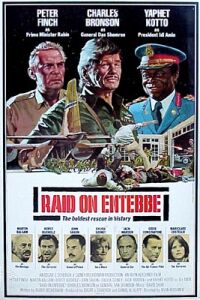
Raid on Entebbe, a docudrama about the operation, was originally produced for NBC though it subsequently received an overseas theatrical release as well. It’s an exciting tribute to the bravery of both the hostages and the commandos who rescued them. Director Irvin Kershner directs in a documentary fashion and gets good performances from a cast full of familiar faces. Charles Bronson, James Woods, Peter Finch, Martin Balsam, Stephen Macht, Horst Buchholz, Sylvia Sidney, Allan Arbus, Jack Warden, John Saxon, and Robert Loggia show up as politicians, commandos, terrorists, and hostages and all of them bring a sense of reality and humanity to their roles.
The film’s best performance comes from Yaphet Kotto, who plays Idi Amin as a strutting buffoon, quick to smile but always watching out for himself. In the film, Amin often pays unannounced visits to the airport, where he lies and tells the hostages that he is doing his best to broker an agreement between the terrorists and Israel. The hostages are forced to applaud Amin’s empty promises and Amin soaks it all up with a huge grin on his face. Forest Whitaker may have won the Oscar for Last King of Scotland but, for me, Yaphet Kotto will always be the definitive Idi Amin.
I’ve been using this October’s horrorthon as an excuse to rewatch and review the films of Dario Argento! Today we take a look at one of Argento’s best and most underrated films, 1980’s Inferno!
“There are mysterious parts in that book, but the only true mystery is that our very lives are governed by dead people.”
— Kazanian (Sacha Pitoeff) in Inferno
When 20th Century Fox released Dario Argento’s Suspiria in 1977, they weren’t expecting this Italian horror film to be a huge box office success. That it was caught them totally off guard. Though the studio executives may not have understood Italian horror, they did know that Suspiria made them a lot of money and they definitely wanted to make more of it.
As for Dario Argento, he followed up Suspiria by producing George Romero’s Dawnof the Dead. He also supervised the film’s European cut. (In Europe, Dawn of the Dead was known as Zombi, which explains why Lucio Fulci’s fake sequel was called Zombi2.) When Dawn of the Dead, like Suspiria before it, proved to be an unexpected box office hit, it probably seemed as if the Argento name was guaranteed money in the bank.
Hence, when Argento started production on a semi-sequel to Suspiria, 20th Century Fox agreed to co-finance. Though the majority of the film was shot on a sound stage in Rome, Argento was able to come to New York to do some location work, hence making this Argento’s first “American” film. The name of the movie was Inferno.
Sadly, Inferno proved to be a troubled production. Shortly after production began, Argento became seriously ill with hepatitis and reportedly, he had to direct some scenes while lying on his back while other sequences were done by the second unit.
As well, Argento had a strained relationship with 20th Century Fox. Argento wanted James Woods to star in Inferno but, when it turned out that Woods was tied up with David Cronenberg’s Videodrome, the studio insisted that Argento cast an actor named Leigh McCloskey instead. As a performer, James Woods is nervy, unpredictable, and compulsively watchable. Leigh McCloskey was none of those things.
Worst of all, as a result of a sudden management change at 20th Century Fox, Inferno was abandoned by its own distributor. The new studio executives didn’t know what to make of Inferno and, in America, the film only received an extremely limited release. The few reviews that the film received were largely negative. (Like most works of horror, Argento’s films are rarely critically appreciated when first released.) It’s only been over the past decade that Inferno has started to receive the exposure and acclaim that it deserves.
Argento has said that he dislikes Inferno, largely because watching it remind him of a very difficult time in his life. That’s unfortunate, because Inferno is one of his best films.
The Mother of Tears (Ania Pieroni) in Inferno
“Have you ever heard of the Three Sisters?”
“You mean those black singers?”
— Sara (Eleonora Giorgi) and Carlo (Gabriele Lavia) discuss mythology in Inferno
As I stated previously, Inferno is a semi-sequel to Suspiria. Whereas Suspiria dealt with an ancient witch known as the Mother of Sighs, Inferno deals with her younger sister, the Mother of Darkness. The Mother of Sighs lives underneath a German dance academy. The Mother of Darkness lives underneath a New York apartment building. The Mother of Sighs was a witch. The Mother of Darkness is an alchemist.
Beyond that and the fact that Alida Valli is in both films (though apparently playing different characters), there aren’t many references to Suspiria in Inferno. The tone of Inferno is very different from the tone of Suspiria. If Suspiria was perhaps Argento’s most straight-forward films, Inferno is one of his most twisted. It makes sense, of course. Suspiria is about magic but Inferno is about science. Suspiria casts a very Earthy spell while Inferno often feels like a scientific equation that cannot quite be solved.
The film deals with Mark Elliott (Leigh McCloskey), an American music student in Rome. After he gets a disturbing letter from his sister, Rose (Irene Miracle), a poet who lives alone in New York City, Mark heads back to the U.S. to check in on her. (That’s right — Mark and Rose are two more of Argento’s artistic protagonists.) However, when Mark arrives, he discovers that his sister is missing and it’s obvious that strange inhabitants of the building are trying to cover something up.
“May I ask a strange question?”
“How strange?”
— Sara (Eleonora Giorgi) and Mark Elliot (Leigh McCloskey) in Inferno
Even more than with some of Argento’s other films, the plot of Inferno isn’t particularly important. One reason why it’s easy to get annoyed with Mark is because he spends the entire film demanding to know where his sister is, despite the fact that those of us in the audience already know that she’s dead. Argento showed us her being murdered shortly before Mark’s arrival. Argento makes sure that we know but he never bothers to reveal the truth to Mark and one of the more curious aspects of the film is that Mark never discovers that his sister is dead. (By the end of the film, one assumes that he’s finally figured it out but even then, we don’t know for sure.) The fact of the matter is that Mark and his search for his sister are never really that important. Argento doesn’t particularly seem to care about Mark and he never really gives the viewer any reason to care either. (Of course, it doesn’t help that Mark is rather stiffly played by Leigh McCloskey.)
Instead, Argento approaches Inferno as a collection of increasingly surreal set pieces. Much as in Lucio Fuci’s Beyond trilogy, narrative logic is less important than creating a dream-like atmosphere. Often time, it’s left to the viewer to decide how everything fits together.
There are so many odd scenes that it’s hard to pick a favorite or to know where to even begin. Daria Nicolodi shows up as Elise Stallone Van Adler, a neurotic, pill-popping aristocrat who briefly helps Mark look for his sister. Eventually, she’s attacked by thousands of cats before being stabbed to death by one of Argento’s trademark black-gloved killers. After Elise’s death, her greedy butler makes plans to steal her money. Did the butler kill Elise? We’re never quite sure. Does the butler work for The Mother of Darkness or is he just being influenced by her evil aura? Again, we’re never sure. (By that same token, when the butler eventually turns up with eyes literally hanging out of their sockets, we’re never quite sure how he ended up in that condition. And yet, somehow, it makes a strange sort of sense that he would.)
Cats also feature into perhaps the film’s most famous scene. When the crippled and bitter book seller Kazanian (Sacha Pitoeff) attempts to drown a bag of feral cars in a Central Park pond, he is suddenly attacked by a pack of a carnivorous rats. A hot dog vendor hears Kazanian’s cries for help and rushes over. At first, the vendor appears to be a good Samaritan but suddenly, he’s holding a knife and stabbing Kazanian to death. Why did the rats attack in the first place? Is the hot dog vendor (who only appears in that one scene) a servant of the Mother of Darkness or is he just some random crazy person? And, in the end, does it matter? At times, Inferno seems to suggest that the real world is so insane that the Mother of Darkness is almost unnecessary.
Meanwhile, in Rome, Mark sits in class and reads a letter from his sister. When he looks up, he immediately sees that a beautiful young woman is looking straight at him. She’s petting a cat and staring at him with a piercing stare. (She is played Ania Pieroni, who later achieved a certain cult immortality by appearing as the enigmatic housekeeper in Lucio Fulci’s The House By The Cemetery.) The film later suggests that the woman is the third mother, the Mother of Tears, but why would she be in the classroom? Why would she be staring at Mark?
When Mark’s girlfriend, Sara (Eleonora Giorgi), does some research in a library, she finds a copy of a book about The Three Mothers and is promptly attacked by a mysterious figure. When she flees back to her apartment, she meets Carlo (Gabriele Lavia, who was also in Deep Red) who agrees to stay with her until Mark arrives. Is Carlo sincere or is he evil? Argento does eventually answer that question but he certainly keeps you guessing until he does.
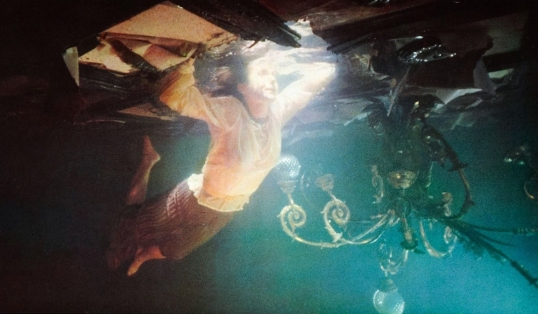
Finally, I have to mention the best and most haunting scene in the film. When Rose searches a cellar for a clue that she believes will lead her to the Mother of Darkness, she discovers a hole that leads to a flooded ballroom. When Rose drops her keys into the hole, she plunges into water and swims through the room. (The first time I saw this scene, I immediately said, “Don’t do that! You’re going to ruin your clothes!”) As Rose discovers, not only keys get lost in that flooded ballroom. There’s a dead body as well, one which floats into the scene from out of nowhere and then seems to be intent on following Rose through the entire room. It’s a sequence that is both beautiful and nightmarish. (It certainly does nothing to help me with my fear of drowning.)
In the end, Inferno is a dream of dark and disturbing things. Does the plot always make sense? Not necessarily. But that plot’s not important. The film’s surreal imagery and atmosphere of doom and paranoia casts a hypnotic spell over the viewer. Inferno is perhaps as close to a filmed nightmare as you’ll ever see.
“She writes poetry.”
“A pastime especially suited for women.”
— Mark and the Nurse (Veronica Lazar) in Inferno
Finally, no review of Inferno would be complete without discussing some of the people who worked behind-the-scenes.
Along with acting in the film, Daria Nicolodi also worked on the script. As is so often the case with Daria and Dario’s collaborations, there are conflicting reports of just how involved Nicolodi was with the final script. Daria has said that she would have demanded co-writing credit, if not for the fact that it had previously been such an ordeal to get credited for Suspiria. Others have claimed that, while Nicolodi offered up some ideas, the final script was almost all Argento’s creation.
(Comparing the films that Argento made with Nicolodi to the ones that he made without her leads me to side with Nicolodi.)
Working on the film as a production assistant was William Lustig, the famed exploitation film producer and director who would later become the CEO of Blue Underground. Reportedly, during filming, Lustig attempted to convince Nicolodi to star in a film that he was going to direct. Nicolodi’s co-star would have been legendary character actor Joe Spinell. Disgusted by the film’s script, Nicolodi refused the role and, as a result, Caroline Munro ended up playing the stalked fashion photographer in Lustig’s controversial Maniac.
Future director Michele Soavi worked on several of Argento’s films. I’ve always been under the impression that Soavi was a production assistant on Inferno but, when I rewatched the film, he wasn’t listed in the credits. Inferno is also not among his credits on the imdb. I guess the idea that one of my favorite Italian horror directors worked on one of my favorite Italian horror films was just wishful thinking on my part.
However, you know who is listed in the credits? Lamberto Bava! Bava, who would later direct the Argento-produced Demons, worked as an assistant director on Inferno. That leads us to perhaps the most famous member of Inferno’s crew…
Mario Bava!
Inferno was the final film for the father of Italian horror. As so often happens, there are conflicting reports of just how involved Bava was with the production. It is know that he worked on the special effects and that he directed some second unit work while Argento was bed ridden with hepatitis. Irene Miracle has said that almost all of her scenes were directed by Mario Bava and that she rarely saw Argento on set.
Mario Bava is often erroneously described as being Dario Argento’s mentor. That’s certainly what I tended to assume until I read Tim Lucas’s All The Colors of the Dark, the definitive biography on Mario Bava. Bava was certainly an influence and it’s certainly true that Argento appears to have had a better relationship with him than he did with Lucio Fulci. But the idea that a lot of Italian horror fans have — that Mario Bava was hanging out around the set of The Bird With The Crystal Plumage and offering Argento fatherly advice — does not appear to be at all true. (It’s a nice image, though.) With all that in mind, it’s still feels somewhat appropriate that Bava’s final work was done on one of the best (if most underappreciated) Italian horror films of all time.
“I do not know what price I shall have to pay for breaking what we alchemists call Silentium, the life experiences of our colleagues should warn us not to upset laymen by imposing our knowledge upon them.”
— The Three Mothers by E. Varelli, as quoted in Dario Argento’s Inferno
What’s an Insomnia File? You know how some times you just can’t get any sleep and, at about three in the morning, you’ll find yourself watching whatever you can find on cable? This feature is all about those insomnia-inspired discoveries!
If you were awake at midnight last night and if you were watching TCM, you would have seen a 1986 film called Promise.
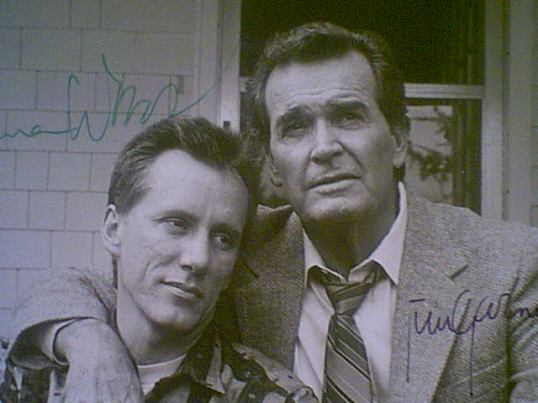
Promise stars James Garner as Bob Beuhler, who is one of those deceptively confident men who seems to have his entire life together. He’s made a nice little life for himself, buying and selling houses and he lives in a small town where everyone appears to know and respect him. If Promise were made today, Bob is the type of person who could probably have his own A&E reality show.
But then Bob’s mother dies and we learn of a promise that Bob made forty years ago. It turns out that Bob has a younger brother, named D.J. (James Woods). D.J. suffers from schizophrenia and he’s spent all of his life living with his mother. It quickly becomes apparent that the main driving force behind Bob’s success has been the need to prove that he’s nothing like D.J. When he doesn’t take his medication, D.J. is unpredictable and suffers from violent mood swings. Bob loves his brother but he’s also scared of him.
However, Bob made a promise and he’s going to try to honor it.
It turns out to be even more difficult than he expected. Sometimes, D.J. is calm and sweetly shy. Other times, he becomes violent. The rest of the town starts to gossip about Bob’s “crazy” brother. After one fight, Bob discovers that D.J. has become catatonic. When Bob calls an ambulance, everyone in the neighborhood lines up on Bob’s lawn to watch as D.J. is taken away.
Even though D.J. is eventually released from the hospital and returns home, Bob still is unsure of whether or not he can properly care for his brother. When they go on a trip to a cabin that they often visited as children, Bob is surprised to see how “normal” D.J. is acting. But how long will it last?
When I looked up Promise on the imdb, I was not surprised to discover that it was originally made for television. The fact that nobody in the film ever curses was a dead giveaway and the script occasionally threatens to turn into a PSA. But, with all that in mind, Promise is still a wonderfully effective and rather heartbreaking little movie. James Woods has the more showy role and does a great job with it’s the far more low-key James Garner who keeps the film grounded. Watching a film like Promise, you see that Garner was really a great actor.
Promise is a sad film but it’s definitely one worth watching.
So, as I mentioned earlier, I was in the mood for some late night horror and I decided to rewatch Dario Argento’s Three Mothers trilogy. I started watching Suspiria at midnight and, after that, I moved on to Argento’s 1980 follow-up, Inferno.
Having just finished watching Inferno, I now realize that it’s almost time for me to start getting ready for my day, which means that I may have to hold off on watching the third film in the trilogy, The Mother of Tears. That’s really quite frustrating because I think I may be the only person in the world who thinks that Mother of Tears is actually a good film.
Oh well! Such is life, right?
But before I hop in the shower and get dressed and all that good stuff, I did want to share a scene that I love from Inferno.
So, instead, I’ll share a scene that comes shortly after Irene’s famous swim. In the scene below, Irene’s brother, a music student who is played by a somewhat forgettable actor named Leigh McCloskey (reportedly, Argento wanted to cast a young James Woods in the role and he would have been awesome, too), is sitting in class and attempting to read a letter from his troubled sister.
And that’s when he finds himself being subtly menaced by the Mother of Tears.
The Mother of Tears is played by the beautiful Ania Pieroni, who lovers of Italian horror will immediately recognize as both the mysterious housekeeper in Lucio Fulci’s House By The Cemetery and the doomed shoplifter from Argento’s Tenebrae.
To me, this scene is Argento at his best. Not much happens in the scene. McCloskey attempts to read a letter and finds himself unnerved by Pieroni’s intense stare. And yet, it’s a scene that’s full of menace and atmosphere. It’s a scene that leaves the viewer with no doubt about the power of the Three Mothers.
Watch the scene below. And then, if you haven’t, be sure to watch Inferno because it’s a wonderful and underrated horror film, one that I would argue is even better than Suspiria. And, while you’re watching the scene and considering the wonders of Italian horror cinema, I’ll be busy getting ready for my Friday!
(Unless, of course, you’re reading this on a day other than today and at a time other than 4:35 am.)
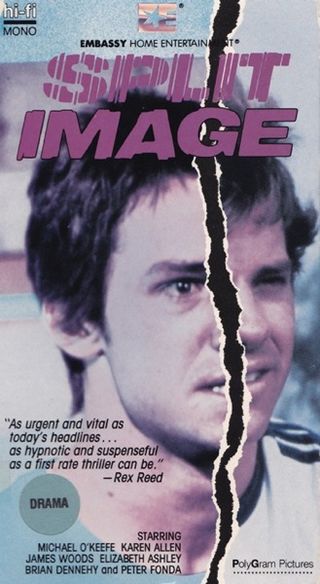
Unlike Desperate Lives, the 1982 melodrama Split Image is available to be viewed on YouTube. In fact, you can watch it below and I suggest that you do so. It’s a pretty good film and, apparently, it’s never been released on DVD or Blu-ray and it’ll probably never be available on Netflix either. So, if you’ve ever wanted to see Peter Fonda play a cult leader, your best bet is to watch the video below.
But before you watch the video, here’s a little information on Split Image, one of the best films that you’ve never heard of.
Essentially, the film follows the same plot as the Canadian film Ticket To Heaven.A college athlete (played by Michael O’Keefe) starts dating a girl (Karen Allen) who is a member of a sinister religious cult. Soon, O’Keefe is a brainwashed member of the cult and only answering to the name of Joshua. (The head of the cult is played, in an appropriately spaced-out manner, by Peter Fonda.) His parents (Brian Dennehy and Elizabeth Ashley) hire a cult deprogrammer (James Woods) to kidnap their son and break Fonda’s hold on him. However, it turns out that Woods’ methods are almost as psychologically destructive as Fonda’s manipulation.
Even if it’s not quite as memorably creepy as Ticket To Heaven, Split Image is still a well-made film, featuring excellent performances from Dennehy, Woods, O’Keefe, and Fonda. However, for me, the most interesting thing about Split Image is that it was largely filmed and set down here in Dallas. Just watch the scene where Woods and his men attempt to kidnap Michael O’Keefe. It was shot on the campus of Richland Community College, which is one of the places where I regularly go to run.
(Interestingly enough, 33 years after the release of Split Image, Richland still looks exactly the same!)
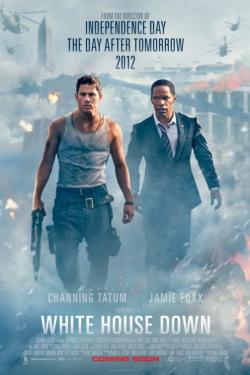
To say that the 2012 film White House Down is stupid is probably unnecessary. After all, the film was directed by Roland Emmerich and Emmerich specializes in making stupid films.
And, in many ways, White House Down is prototypical Emmerich film, a long and self-important collection of mayhem and heavy-handed pontification. In the case of this film, liberal President Sawyer (Jamie Foxx) is pushing for a treaty that will magically bring about world police. Naturally, a bunch of evil right-wingers (including characters played, somewhat inevitably, by James Woods and Richard Jenkins) don’t want world peace so they hire a bunch of mercenaries who attack the White House. It’s all a part of a plot to force Sawyer to launch a nuclear attack on Iran because … well, why not? Fortunately, aspiring secret service agent (and kick-ass combat veteran) John Cale (Channing Tatum) is there to work with the President and save the country.
And, since Emmerich is from the bigger is always better school of filmmaking, many familiar landmarks are blown up and it takes the film well over two hours to tell its simplistic story. To be honest, if your action movie can’t get the job done in under two hours, then you’re going to have problems. Once a viewer has spent two hours watching one movie, it’s inevitable that he or she will start to question the film’s logic. If the film’s clever enough, all lapses and inconsistencies can be forgiving. If the film is White House Down, it’s a lot less easy to be forgiving.
Of course, from a political point of view, Emmerich tries to have it both ways. For anti-government types like me, it’s always fun to watch Washington D.C. blow up. For those on the right, White House Down presents a situation that can only be solved by heroes with guns. And, of course, Democrats can view White House Down as wish fulfillment, an alternative timeline where Barack Obama actually is as sincere and effective as they wish him to be.
In fact, if anything saves White House Down, it’s the chemistry between Foxx and Tatum. Wisely, neither one of them appears to be taking the film that seriously and both of them seem to be having a lot of fun blowing things up. Channing Tatum, in particular, deserves some sort of award. How many bad films have been made tolerable by Tatum’s willingness to laugh at himself? I’ve lost count but White House Down definitely benefits from his presence. He and Foxx make Emmerich’s style of filmmaking as tolerable as it will ever be.
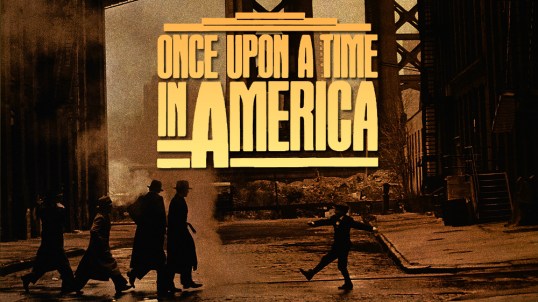
Before I start this review of Sergio Leone’s 1984 gangster epic, Once Upon A Time In America, I want to issue two warnings.
First off, this review is going to have spoilers. I’ve thought long and hard about it. Usually, I try to avoid giving out spoilers but, in this case, there’s no way I can write about this movie without giving away a few very important plot points. So, for those of you who don’t want to deal with spoilers, I’ll just say now that Once Upon A Time In America is a great film and it’s one that anyone who is serious about film must see.
Secondly, I’m not going to be able to do justice to this film. There’s too much to praise and too much going on in the film for one simple blog post to tell you everything that you need to know. Once Upon A Time In America is the type of film that books should be written about, not just mere blog posts. Any words that I type are not going to be able to match the experience of watching this film.
For instance, I can tell you that, much as he did with his classic Spaghetti westerns, Sergio Leone uses the conventions of a familiar genre to tell an epic story about what it means to be poor and to be rich in America. But you’ll never truly understand just how good a job Leone does until you actually see the film, with its haunting images of the poverty-stricken Jewish ghetto in 1920s New York and it’s surreal climax outside the mansion of a very rich and very corrupt man.
I can tell you that Ennio Morricone’s score is one of his best but you won’t truly know that until you hear it while gazing at Robert De Niro’s blissfully stoned face while the final credits roll up the screen.
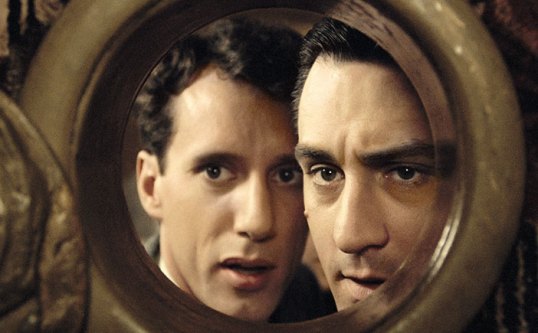
I can tell you that the film’s cast is amazing but you probably already guessed that when you saw that it featured Robert De Niro, James Woods, Treat Williams, Danny Aiello, Joe Pesci, Burt Young, Tuesday Weld, Elizabeth McGovern, and Jennifer Connelly. But, again, it’s only after you’ve seen the film that you truly understand just how perfectly cast it actually is. Given the politics of Hollywood and the fact that he’s unapologetically critical of Barack Obama, it’s entirely possible that James Woods might never appear in another major motion picture. A film like Once Upon A Time in America makes you realize what a loss that truly is.
So, if you haven’t seen it yet, I encourage you to see it. Order it off of Amazon. Do the one day shipping thing. Pay the extra money, the film is worth it.
Much like The Godfather, Part II (and Cloud Atlas, for that matter), Once Upon A Time In America tells several different stories at once, jumping back and forth from the past to the present and onto to the future.
The film’s “past” is 1920. Noodles (Scott Tiler) is a street kid who lives in New York’s ghetto. He makes a living by doing small jobs for a local gangster and occasionally mugging a drunk. He’s also the head of his own gang, made up of Patsy (Brian Bloom), Cockeye (Adrian Curry), and Dominic (Noah Moazezi). Despite his rough edges, Noodles has a crush on Deborah (Jennifer Connelly), a refined girl who practices ballet in the back of her family’s store. When Nooldes meets Max (Rusty Jacobs), the two of them become quick friends. However, their criminal activities are noticed by the demonic Bugsy (James Russo), who demands any money that they make.
The film’s “present” is 1932. Noodles (Robert De Niro) has spent twelve years in prison and, when he’s released, he discovers that some things have changed but some have remained the same. Max (James Woods), Cockeye (William Forsythe), and Patsy (James Hayden) are still criminals but they’ve prospered as bootleggers. Occasionally, they do jobs for a local gangster named Frankie (Joe Pesci) and sometimes, they just rob banks on their own. During one such robbery, they meet a sado-masochistic woman named Carol (Tuesday Weld), who quickly becomes Max’s girlfriend.
As for Noodles, he continues to love Deborah (Elizabeth McGovern). But, when he discovers that she’s leaving New York to pursue a career as an actress, he reveals his true nature and rapes her. It’s a devastating scene — both because all rape scenes are (or, at the very least, should be) devastating but also because it forces us to ask why we expected Noodles to somehow be better than the men who surround him. After spending nearly two hours telling ourselves that Noodles is somehow better than his friends and his activities, the movie shows us that he’s even worse. And, when we look back, we see that there was no reason for us to believe that Noodles was a good man. It’s just what we, as an audience, wanted to believe. After all, we all love the idea of the romanticized gangster, the dangerous man with a good heart who has been forced into a life of crime by his circumstances and who can be saved by love. In that scene, Once Upon A Time In America asks us why audiences continue to romanticize men like Noodles and Max.
As for the gang, they’re hired to serve as unofficial bodyguards for labor leader Jimmy O’Donnell (Treat Williams) and, in their way, help to found the modern American labor movement. (“I shed some blood for the cause,” Patsy says while showing off a huge bandage on his neck.) When fascistic police chief Aiello (Danny Aiello) needs to be taken down a notch, they kidnap his newborn son and hold him for ransom. (While pulling off this crime, they also manages to switch around all the babies and, as a result, poor babies go home with rich families and vice versa, neatly highlighting both the power of class and the randomness of fate.) However, the good times can’t last forever and, when prohibition is repealed, the increasingly unstable Max has to find a new way to make some money.
Finally, the film’s third storyline (the “future” storyline) takes place in 1967. Noodles has spent decades living under a false identity in Buffalo. When he gets a letter addressed to his real name, Noodles realizes that someone knows who he is. He returns to a much changed New York. Carol now lives in a retirement home. Deborah is an acclaimed Broadway actress. Jimmy O’Donnell is the most powerful union boss in America. Fat Moe’s Speakeasy is now Fat Moe’s Restaurant.
Once Noodles is back in town, he receives a briefcase full of money and a note that tells him that it’s an advanced payment for his next job. He also receives an invitation to a party that’s being held at the home of Christopher Bailey, the U.S. Secretary of Commerce.
Who is Secretary Bailey? He’s a shadowy and powerful figure and he’s also a man who is at the center of a political scandal that has turned violent. And, when Noodles eventually arrives at the party, he also discovers that Secretary Bailey is none other than his old friend Max.
How did a very Jewish gangster named Max transform himself into being the very WASPy U.S. Secretary of Commerce? That’s a story that the film declines to answer and it’s all the better for it. What doesn’t matter is how Max became Bailey. All that matters is that he did. And now, he has one final favor to ask Noodles.
(There’s a very popular theory that all of the 1967 scenes are actually meant to be a hallucination on Noodles’s part. And the 1967 scenes are surreal enough that they very well could be. Though you do have to wonder how Noodles in 1932 could hallucinate the Beatles song that is heard when he returns to New York in 1967.)
Once Upon A Time In America is an amazing film, an epic look at crime, business, and politics in America. It’s a film that left me with tears in my eyes and questions in my mind. The greatness of the film can not necessarily be put into words. Instead, it’s a film that everyone needs to see.
Much like Wes Anderson, Sofia Coppola seems to divide viewers and, in many ways, for the exact same reasons. You either get her films about upper class ennui or you don’t. Everyone seems to love Lost in Translation but viewers and critics seem to be far more polarized when it comes to rest of her films. It seems the people either love them or hate them. Well, you can count me among those who love her films. (Yes, even Somewhere.) To me, Sofia Coppola is one of the most consistently interesting filmmakers working today and the dismissive reaction that many (mostly male) critics have towards her films has little do with her talent and much more to do with her gender and her last name.
So there.
In The Virgin Suicides, Coppola tells the story of the five Lisbon sisters. They live in an upper middle class suburbs in the 1970s. Their parents — math teacher Ronald (James Woods) and his wife (Kathleen Turner) — are devoutly Catholic and very protective. The Lisbon sisters are rarely allowed to leave the house and, as a result, the neighborhood boys are obsessed with them. (Though the film centers on four unnamed boys, there’s only one narrator, voiced by Giovanni Ribisi, who continually refers to himself as being “we,” as if all four boys are telling the story in the same voice.) When the youngest Lisbon daughter commits suicide, Ronald and his wife become even more protective.
At the start of the school year, the oldest daughter, Lux (Kirsten Dunst), meets and starts to secretly date the wonderfully named Trip Fontaine (Josh Hartnett). Lux is even allowed to attend the homecoming dance with Trip but, after she breaks curfew, Mrs. Lisbon reacts by pulling Lux and her sisters out of school and basically making them prisoners in their own home.
(In one of the film’s best moments, we flash forward to see present day Trip talking about his date with Lux. Needless to say, Trip did not age well.)
With the Lisbon sisters even more isolated, the neighborhood boys become even more obsessed with them. One day, the boys get a note from the girls, asking for their help in escaping. The boys go to meet the girls, leading the film to its haunting conclusion…
Full of themes of sin, sexuality, repression guilt, redemption, and martyrdom, The Virgin Suicides is one of those films that you don’t have to be Catholic to appreciate but it probably helps. James Woods, Josh Hartnett, and Kirsten Dunst all give good performances while Sofia Coppola fills the movie with dream-like and sensual images, all designed to challenge the viewer’s perception of whether or not we’re watching reality or just the idealized memories of someone still struggling to comprehend a mystery from the past.
The Virgin Suicides is the perfect movie to end with the 90s on.
For our latest entry in the 44 Days of Paranoia, we take a look at Oliver Stone’s 1995 presidential biopic, Nixon.
Nixon tells the life story of our 37th President, Richard Nixon. The only President to ever resign in order to avoid being impeached, Nixon remains a controversial figure to this day. As portrayed in this film, Nixon (played by Anthony Hopkins) was an insecure, friendless child who was dominated by his ultra religious mother (Mary Steenburgen) and who lived in the shadow of his charismatic older brother (Tony Goldwyn). After he graduated college, Nixon married Pat (Joan Allen), entered politics, made a name for himself as an anti-communist, and eventually ended up winning the U.S. presidency. The film tells us that, regardless of his success, Nixon remained a paranoid and desperately lonely man who eventually allowed the sycophants on his staff (including James Woods) to break the law in an attempt to destroy enemies both real and imagined. Along the way, Nixon deals with a shady businessman (Larry Hagman), who expects to be rewarded for supporting Nixon’s political career, and has an odd confrontation with a young anti-war protester who has figured out that Nixon doesn’t have half the power that everyone assumes he does.
Considering that his last few films have been W., Wall Street: Money Never Sleeps, and Savages, I think it’s understandable that I’m often stunned to discover that, at one point in the distant past, Oliver Stone actually was a worthwhile director. JFK, for instance, is effective propaganda. Nixon, which feels a lot like an unofficial sequel to JFK, is a much messier film than JFK but — as opposed to something like Savages — it’s still watchable and occasionally even thought-provoking. Thanks to Hopkins’ performance and, it must be admitted, Stone’s surprisingly even-handed approach to the character, Nixon challenges our assumptions about one of the most infamous and villified figures in American history. It forces us to decide for ourselves whether Nixon was a monster or a victim of circumstances that spiraled out of his control. If you need proof of the effectiveness of the film’s approach, just compare Stone’s work on Nixon with his work on his next Presidential biography, the far less effective W.
(I should admit, however, that I’m a political history nerd and therefore, this film was specifically designed to appeal to me. For me, half the fun of Nixon was being able to go, “Oh, that’s supposed to be Nelson Rockefeller!”)
If I had to compare the experience of watching Nixon to anything, I would compare it to taking 10 capsules of Dexedrine and then staying up for five days straight without eating. The film zooms from scene-to-scene, switching film stocks almost at random while jumping in and out of time, and not worrying too much about establishing any sort of narrative consistency. Surprisingly nuanced domestic scenes between Anthony Hopkins and Joan Allen are followed by over-the-top scenes where Bob Hoskins lustily stares at a White House guard or Sam Waterston’s eyes briefly turn completely black as he discusses the existence of evil. When Nixon gives his acceptance speech to the Republican Convention, the Republican delegates are briefly replaced by images of a world on fire. Familiar actors wander through the film, most of them only popping up for a scene or two and then vanishing. The end result is a film that both engages and exhausts the viewer, a hallucinatory journey through Stone’s version of American history.
Casino, Martin Scorsese’s epic, Las Vegas-set film from 1995, is one of my favorite films of all time. It seems to show up on cable every other week and, whenever I see that it’s playing, I always make it a point to catch at least a few minutes.
Casino opens with veteran Las Vegas bookie Ace Rothstein (played by Robert De Niro) getting into a car. He starts the engine and the car explodes. The rest of the movie is an extended flashback as both Ace and his friend and eventual rival Nicky (Joe Pesci) explain how Ace went from being the most powerful man in Vegas to getting blown up in his car.
We are shown how Ace was originally sent to Vegas by a group of mobsters who are headquartered in the far less flamboyant town of Kansas City. Ace keeps an eye on the city for the bosses and, as long as the money keep coming in, they leave Ace alone to do whatever he wants. When Ace isn’t bribing government officials (including one particularly sleazy state senator who was reportedly based on future U.S. Sen. Harry Reid) and breaking the fingers of the unlucky gamblers who have been caught trying to cheat the casino, he’s busy falling in love with the beautiful prostitute Ginger (Sharon Stone, who was nominated for Best Actress for her work in this film). Though Ginger warns Ace that she doesn’t love him and is still hung up on her manipulative pimp Lester Diamond (James Woods, who is hilariously sleazy), Ginger and Ace still get married.
Everything’s perfect except for the fact that Ace’s old friend Nicky (Joe Pesci) has also moved to Vegas. As opposed to the calm and low-key Ace, Nicky has a violent temper and soon, he starts drawing unwanted attention to both himself and Ace. When Ace attempts to control Nicky, Nicky responds by turning on his friend and soon, the two of them are fighting an undeclared war for control of the city. Meanwhile, the bosses in Kansas City are starting to notice that less and less money is making its way back to them from Las Vegas…
There are so many things that I love about Casino that I don’t even know where to begin.
First off, I love the film’s glamour. I love the way that the film celebrates the glitz of Las Vegas, presenting it as an oasis of exuberant life sitting in the middle of a barren desert that, we’re told, is full of dead people. I love seeing the tacky yet stylish casinos. I love seeing the inside of Ace’s mansion. And Ginger’s clothes are just to die for!
I love that Scorsese’s signature visual style perfectly keeps up with and comments on the natural flamboyance of Las Vegas. Consider how the film starts, with the shadowy form of Ace Rothstein being tossed through the air and then descending back down to Earth. Consider the image of Ace standing in the middle of the desert and being submerged within a thick cloud of dust as Nicky’s car speeds away from him. Consider how Scorsese’s camera glides through the casino, letting us see both the people who cheat and the people who are watching them cheat. Consider Nicky standing outside of his jewelry stare and freezing the movement of the camera with his reptilian glare. Consider the scene of cocaine being snorted up a straw, seemingly filmed from inside the straw. Casino is a film full of the type of images that all directors promise but few ever actually deliver.
I love that Casino is built around a brilliant lead performance from Robert De Niro. De Niro gives a performance that mixes both tragedy and comedy. My favorite De Niro moment comes about halfway through the film, when Ace finds himself hosting a wonderfully tacky cable access show called Aces High. Ace interviews “celebrities” like Frankie Avalon, introduces the Ace Rothstein Dancers, and even finds the time to do some juggling. De Niro makes Ace into an endearing and awkward character in these scenes, a permanent outsider who has finally managed to become something of a star.
It’s easy to compare Casino to Scorsese’s other classic mix of gangster film and social satire, 1990’s Goodfellas. Both films feature De Niro, Pesci, and Frank Vincent. (In a nice piece of irony, Casino features Vincent getting a little revenge after being attacked twice by Joe Pesci in two different Scorsese films.) Both films are based on nonfiction books by Nicholas Pileggi. Both films feature nonstop music playing on the soundtrack. Both films feature multiple narrators who explain to us how the day-to-day operations of the Mafia are conducted. When Scorsese shows us Ace and Ginger’s wedding day, it feels almost like a scene-for-scene recreation of Henry Hill’s wedding in Goodfellas.
At the same time, there are a few key differences between Goodfellas and Casino. Whereas Goodfellas was all about being a low-level cog in the Mafia, Casino is about management. Casino is about the guys who the Goodfellas made rich. Goodfellas was about the drudgery of everyday life whereas Casino is about the glitz and the glamour promised by the fantasy world of Las Vegas. Whereas Goodfellas was almost obsessively anti-romantic, Casino is a gangster film with heart. No matter what else you might say about him as a character, Ace’s love for both Ginger and Las Vegas is real. On a similar note, when Nicky turns against Ace, it’s because his feelings have been hurt. In the end, Ace and Nicky come across like children who have, temporarily, been given the keys to the world’s biggest playground.
Casino is a glossy, flamboyant film that literally opens with a bang and ends on a note of melancholy and loss. Not only is Ace reduced to being an anonymous old man working out of a nondescript office but our last two views of Vegas are of the old casinos being dynamited and an army of overweight tourists emerging from the airport like the unstoppable zombies from Dawn of the Dead. This, then, is Scorsese’s view of the apocalypse. The world isn’t destroyed by a cataclysm but instead by an invasion of terminal middle American blandness.
 On June 27th, 1976, four terrorists hijacked an Air France flight and diverted it to Entebbe Airport in Uganda. With the blessing of dictator Idi Amin and with the help of a deployment of Ugandan soldiers, the terrorists held all of the Israeli passengers hostage while allowing the non-Jewish passengers to leave. The terrorists issued the usual set of demands. The Israelis responded with Operation Thunderbolt, a daring July 4th raid on the airport that led to death of all the terrorists and the rescue of the hostages. Three hostages were killed in the firefight and a fourth — Dora Bloch — was subsequently murdered in a Ugandan hospital by Idi Amin’s secret police. Only one commando — Yonatan Netanyahu — was lost during the raid. His younger brother, Benjamin, would later become Prime Minister of Israel.