“I keep seeing these people, all recognizing each other.” — Elizabeth Driscoll
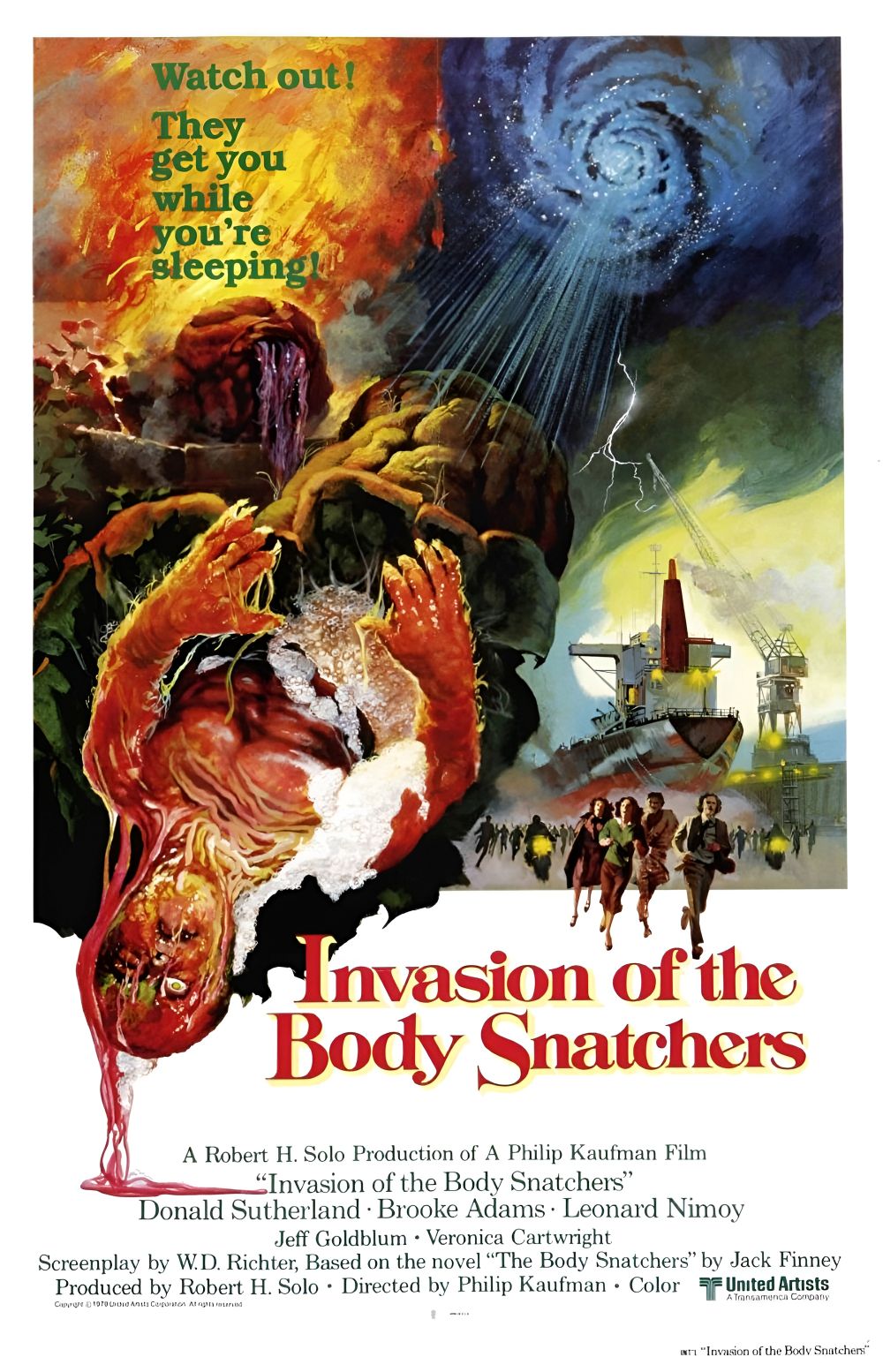
Most alien-invasion movies give you something obvious to fear: a flying saucer, a ruined skyline, a creature that clearly doesn’t belong here. Philip Kaufman’s Invasion of the Body Snatchers goes after something more uncomfortable. What happens when the person beside you looks perfectly normal, but you can’t shake the feeling that they’re gone? Released in 1978, this remake of Don Siegel’s 1956 film of the same name turns that question into a funny, disgusting, and increasingly desperate nightmare. Its greatest weapon isn’t an alien organism. It’s the possibility that being human is something you can lose while the rest of the world carries on as if nothing has happened.
That fear takes hold through Elizabeth Driscoll, played by Brooke Adams, who notices an unsettling change in her boyfriend. Nothing about his appearance explains it; he simply no longer seems like himself. Her colleague Matthew Bennell, a San Francisco health inspector played by Donald Sutherland, listens sympathetically but initially searches for a reasonable explanation. Unfortunately, reason has some catching up to do. Alien life forms are duplicating people while they sleep, leaving behind replacements who possess familiar faces but none of the emotional attachments. Adapted, like the original, from Jack Finney’s The Body Snatchers, the story turns an outrageous premise into a horribly intimate problem.
What’s especially effective is that Elizabeth’s concern resembles something people might ordinarily dismiss. Relationships change. Partners become distant. A person who once seemed attentive can suddenly appear distracted or cold. How do you explain that someone isn’t themselves when you have no physical evidence and can’t point to a single decisive incident? Adams makes that uncertainty convincing. Elizabeth isn’t immediately trying to prove an alien invasion; she’s trying to get someone to understand an experience she can barely describe. The science-fiction concept works because the emotional situation already makes sense. Before the movie asks us to believe in replacement bodies, it asks us to recognize the discomfort of feeling shut out by someone familiar.
Kaufman gets plenty of mileage out of the gap between noticing a problem and understanding it. Early scenes contain little disturbances that don’t immediately announce themselves as clues. Background figures behave strangely, conversations feel slightly off, and people seem to be moving according to instructions the main characters haven’t received. You begin watching the edges of the image, wondering who belongs there and who has already changed. That’s where the film’s paranoia takes root. Rather than simply telling us that Matthew and Elizabeth are frightened, Kaufman encourages us to adopt their increasingly suspicious way of looking at everyone. Watching becomes a form of anxious detective work.
The nice thing about this approach is that the film doesn’t need every suspicious detail to become a dramatic revelation. Sometimes a strange person is simply strange, and sometimes an awkward interaction remains unexplained. That uncertainty makes the environment feel less predictable than a straightforward series of planted clues would. We’re never comfortably ahead of the characters, checking off signs of an invasion we already understand. Instead, we share their problem of deciding what matters. Once the possibility of replacement enters the picture, practically any behavior can look incriminating. Someone is too calm, too hurried, too distracted, or too interested in what you’re doing. There’s no useful baseline anymore.
San Francisco is essential to that effect. A crowded city should offer anonymity and plenty of places to disappear, but here it gradually becomes a network of observers. Restaurants, offices, streets, and public facilities stop feeling neutral. Even asking for help becomes risky when there’s no reliable way to know who is answering. The shift from the earlier film’s small California community gives the remake a different kind of claustrophobia. There’s more room to run, yet fewer reasons to believe running will help. Kaufman makes a recognizable city feel like a trap without needing to empty its streets. The ordinary activity is what makes it oppressive: everybody seems to have somewhere to go, and you’re increasingly certain you don’t want to follow them.
That change also helps distinguish the remake’s concerns from those of the 1956 original. Siegel’s film sits within the Cold War and Red Scare atmosphere, its replacement story lending itself to fears of Communist infiltration as well as the pressures of McCarthyist conformity. Kaufman’s version leans more heavily into the conspiracy-minded mood of the 1970s. Suspicion reaches beyond dangerous outsiders to institutions, professional authority, and the mechanisms of everyday life. The frightening question isn’t just whether someone has infiltrated society. It’s whether society is already organized around keeping you confused. Discovering the truth doesn’t restore control; it reveals how little control the characters have.
The setting adds another bitter layer: this is San Francisco after the idealism of the 1960s counterculture has started wearing thin. A city associated with freedom, experimentation, and communal possibility becomes the backdrop for the destruction of individuality. The film catches something unsettling in the distance between the promise of personal liberation and the emotional isolation that can follow it. People have ways to discuss feelings, relationships, and self-improvement, but that vocabulary doesn’t necessarily help them connect. The invasion feels less like a complete break with their world than a horrible extension of tendencies already taking shape within it. The old dream of everyone coming together returns in a form nobody should want.
That doesn’t mean the movie is simply sneering at countercultural ideals or suggesting that conformity is inevitable. Its sympathies remain with affection, eccentricity, and the difficult business of caring about other people. What it distrusts is the substitution of smooth language for genuine feeling. There’s a difference between understanding someone and talking them out of their own experience, and the film keeps poking at that distinction. The invaders offer an existence without emotional conflict, but removing pain also means removing the attachments that make pain possible. It’s an awful bargain disguised as a sensible solution. From that angle, the invasion is selling a particularly extreme version of peace of mind.
Leonard Nimoy makes that idea especially sharp as psychiatrist and self-help celebrity David Kibner. He speaks with the confidence of someone accustomed to explaining other people to themselves, and his calm manner initially seems comforting. Before long, though, that reassurance starts to feel oppressive. When someone insists that your terror is merely a misunderstanding, how do you tell compassion from dismissal? Nimoy keeps that question alive without overplaying it. His composure becomes a source of tension precisely because it’s so controlled. In a movie full of people struggling to articulate their distress, he always seems to have an answer ready. Eventually, that feels less like wisdom than a reason to worry.
Against that polished certainty, Sutherland’s rumpled warmth is a major asset. Matthew seems intelligent and attentive rather than exceptionally brave, which makes his growing desperation convincing. He’s willing to listen, but he also needs time to abandon the explanations that usually make his world manageable. Sutherland lets him be funny and slightly awkward without turning him into a lovable collection of quirks. You believe he has a life outside the plot. That matters because the movie isn’t simply threatening his physical survival. It’s dismantling the ordinary habits, professional confidence, and personal connections that allow him to function.
His relationship with Elizabeth gives that dismantling an emotional center. Adams and Sutherland build their closeness through looks, conversations, and small gestures rather than big romantic speeches. There’s warmth between them, but also hesitation, as though they’re still working out what they’re allowed to acknowledge. The restraint makes the relationship feel vulnerable even before the invasion closes in. In a story about bodies surviving while personalities disappear, their chemistry provides something the special effects can’t: a sense of what replacement would erase. A duplicate could repeat the right words, but the movie has already shown us how much communication happens in the spaces around them.
Jeff Goldblum and Veronica Cartwright bring welcome friction as Jack and Nancy Bellicec. Goldblum’s nervous, argumentative manner keeps Jack from becoming a generic supporting character, while Cartwright makes Nancy’s alarm feel immediate and physically exhausting. Together, the central group is messy in recognizably human ways. They interrupt, disagree, misjudge situations, and occasionally get on each other’s nerves. Their humor isn’t a distraction from the horror; it establishes the untidy individuality the invaders would eliminate. The prospect of a world without conflict might sound attractive in theory, but spending time with these people makes its emotional cost clear. An easier existence would also be a much emptier one.
When the physical horror arrives, it gives that emptiness a nasty material form. Developing duplicates look wet, unfinished, and unpleasantly organic, turning an abstract fear of lost identity into something you can practically smell. There’s something especially upsetting about seeing a recognizable human shape emerge without the person who should belong to it. Kaufman knows when to stop suggesting and show us the evidence, and those moments hit harder because the surrounding suspense has been so controlled. The effects aren’t merely punctuation between chase scenes. They make replacement feel like a biological process that has no interest in whether its victims understand or consent.
Sleep is an equally effective threat because there’s no sustainable way to avoid it. A locked door might keep someone outside, but it can’t keep you awake forever. As exhaustion takes over, the characters’ bodies become unreliable allies, and the movie’s rhythm grows more desperate. Brief moments of rest carry their own suspense because relief and surrender begin to resemble each other. That’s one of the film’s cruelest moves: something comforting and necessary becomes the condition that makes you vulnerable. Survival requires constant vigilance, while ordinary human limits guarantee that vigilance will eventually fail.
The film’s relentless pressure can make its later passages feel deliberately exhausting. Once the invasion becomes undeniable, there’s less room for the social comedy and ambiguity that make the opening so engaging. But that narrowing feels purposeful rather than merely repetitive. The characters lose options, and the movie loses breathing room with them. Places that once seemed distinct start to feel like extensions of the same hostile environment. By then, the question isn’t whether they can explain what’s happening. It’s whether knowing makes any practical difference at all.
By the time Invasion of the Body Snatchers reaches its brutal conclusion, its opening uneasiness has become a way of life. Every familiar face demands scrutiny, and every moment of relief feels borrowed. The famous ending brings that uncertainty to a devastating point without needing to explain away its power. What stays with me, though, is how much warmth the film puts at risk before it gets there. Kaufman makes humanity look awkward, argumentative, affectionate, and vulnerable—hardly an efficient arrangement, but one worth defending. The replacements can reproduce a face and move through the routines of a life. The horror is everything they leave out.


