Horror Book Review: The Funhouse by Dean Koontz, writing as Owen West


In 1980, Dean Koontz was hired to write a novelization of The Funhouse. At the time, he was not yet a household name. He still regularly worked as an author-for-hire under a string of pseudonyms; for this book, he originally published as Owen West. While Tobe Hooper was in pre-production, Koontz was assigned to turn Larry Block’s screenplay into a fast, accessible novel. He was not particularly impressed by Block’s story, but he liked the idea of writing about a carnival. Production delays meant the novelization reached stores in late 1980, months before the film. It sold well at first. When the movie finally opened in 1981 and did disappointing business, the book’s sales collapsed. Years later, after Koontz had become a bestselling author in his own right, The Funhouse was reissued under his real name.

The first thing that stands out is how little the novel has in common with Hooper’s film. The movie, of which I am a fan, is a fairly straightforward, atmosphere-heavy slasher. Teenager Amy and her three friends hide in the funhouse after the carnival closes, witness a murder, and find themselves hunted by a carny and his son. Those elements are all present in Koontz’s book, but he adds a large amount of backstory, most of it centered on Amy’s alcoholic mother, Ellen.

In the novel, Ellen is the ex-wife of Conrad the carny. A runaway, she married him without realizing he was a Satanist who hoped she would give birth to the Antichrist. When their demonic infant attacked her, Ellen crushed the baby. Conrad swore revenge: he would let her go so he could hunt her down later and destroy whatever family she built. What plays as random bad luck in the film becomes something very different here. Over the years, Conrad and his second son, the deformed Gunther, take their carnival from town to town in search of Ellen and her new family. The other carnival workers are drawn as sympathetic figures, people on the margins who have formed a family of their own and have no idea how depraved Conrad and Gunther really are.

Family is the novel’s real subject. Ellen has remarried and has two children, Amy and Joey. In the film, Amy is a typically naïve final girl, and Joey is an annoying brat who sneaks out to the carnival. Ellen appears only briefly and makes little impression, though she is seen drinking as Amy leaves the house. In the book, Ellen hits Amy when her daughter says she is pregnant, then pays for the abortion because she fears Amy might give birth to the Antichrist. Joey is terrified of Ellen and runs away to the carnival because, like Ellen before him, he wants an escape from a dysfunctional home. The contrast between the carnies’ supportive found family and Amy and Joey’s abusive “respectable” household is easy to spot, but it still works.

Koontz’s eye for detail and his gift for vivid characterization lift The Funhouse above the usual horror novelization. The plot is occasionally stretched thin. Conrad’s revenge scheme never quite makes sense.  What if Ellen had stayed unmarried and never had another child? Even so, Koontz keeps the action moving and is smart enough to lean into the melodrama without apology. He even lands a surprisingly moving final scene.

This is a case of a novelization that diverges sharply from its source. I like both Hooper’s film and Koontz’s novel. They are both wonderfully macabre. The film is true to Hooper’s aesthetic. The novel is pure Koontz.

 

Book Review: “They’re Here….” Invasion of the Body Snatchers: A Tribute, edited by Kevin McCarthy and Ed Gorman


On Saturday night, I watched Piranha, which featured the great character actor Kevin McCarthy in a supporting role. This led to me remembering McCarthy’s iconic performance in the original Invasion of the Body Snatchers (as well as his cameo in the 70s version). And that led to me remembering a book that I found at Half-Price Books a few years ago.

First published in 1999, They’re Here is a tribute to Invasion of the Body Snatchers, featuring essays about the films and interviews with some of the people involved. For instance, Stephen King and Dean Koontz both write about how seeing the original film influenced their later approach to horror. Jon L. Breen, James Combs, and Fred Blosser write about Jack Finney, the author of the book that served as the basis for the film. Other essays take a look at the remakes that were directed by Philip L. Kaufman and Abel Ferrara. Ferrara is himself interviewed and is as outspoken as ever. Also interviewed is Dana Wynter, who co-starred in the original.

However, the majority of the book is taken up with a terrifically entertaining and informative interview with Kevin McCarthy himself. McCarthy not only talks about filming the original Invasion of the Body Snatchers but also his entire career, his friendship with Montgomery Clift, and his status as pop cultural icon. Sometimes it can be disillusioning to read or listen to an interview in which an icon turns out to be kind of boring (call it the Steven Soderbergh syndrome) but, fortunately, McCarthy comes across as being just as eccentric, intelligent, interesting, and downright lovable as you would hope he would be. Kevin McCarthy, who passed away in 2010 at the age of 96, was one of the great character actors and this interview shows that he was …. wait for it …. quite the character! (Sorry.) The interview is a great tribute not only to McCarthy’s most famous film but also the man himself.

Seriously, if you’re a Body Snatchers fan but just appreciate great character acting, order a copy of this book!

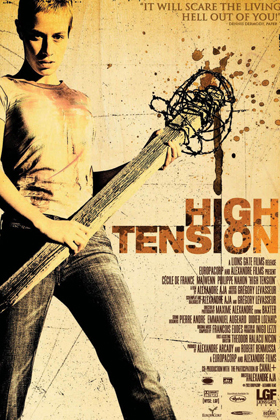
The TSL’s Daily Horror Grindhouse: High Tension (dir by Alexandre Aja)


ht

Oh God.

As I watched the end of High Tension, my immediate reaction was to storm out of my office, walk down the hallway, kick open the door to Arleigh’s mancave and yell at him for recommending this film to me.  But then, I realized that Arleigh never recommended that I watch High Tension.  He recommended La Horde and I got my French horror movies mixed up.

So, Arleigh is off the hook.  I have no one to blame but myself and the filmmakers.

Anyway, High Tension is one of those films that starts out well but then totally falls apart due to a big twist that doesn’t make any sense.  It’s also a pretty obvious rip-off of a Dean Koontz novel called Intensity.  Intensity is a really good book, by the way.  Perhaps not coincidentally, that awful twist that ruins High Tension is not present in Intensity.  That twist was the one original thing that was contributed to High Tension and it pretty much ruined the whole movie.

Anyway, in High Tension, Marie (Cecile de France) and Alex (Maiwenn) are law students and best friends.  Marie is spending the weekend with Alex’s family.  She meets Alex’s mom.  She meets Alex’s dad.  She walks around at night and smokes a cigarette and sits on a swing and briefly spies on Alex as she showers.  And then, during the night, a killer (Philippe Nahon) suddenly shows up, kills mom and dad, and kidnaps Alex!  Determined to save her friend’s life, Marie chases the killer across the French countryside.  For a while, she’s locked in the killer’s truck with Marie.  And then, later on, she’s in a car and she’s chasing the truck.  Because of the twist, it’s important to pay attention to the scenes where Marie is in a car and chasing the killer’s truck.  Because, honestly, I’m not sure how any of that was supposed to have actually happened…

See, I love a good twist.  I love a clever twist.  I love an implausible twist.  I love twists that are totally and completely over the top.  What I do not like is a totally and completely unfair twist, one that cheats by basically defying the laws of the physics.

What’s truly unfortunate is that the film works perfectly without the twist.  The twist is not necessary.  (For proof, just read Intensity.)  Up until the twist, the film is well-directed and suspenseful.  Cecile de France, Maiween, and Nahon all give excellent performances.  The film’s graphic violence may be excessive but it’s still undeniably effective.  The nightmare-inducing gore effects were provided by Giannetto De Rossi, who created some of the most effective zombie makeup of all time for Lucio Fulci’s Zombi 2.

I mean, there’s so much that works and then just hit that twist and you shout, “Dammit!”

It could have been so good.


Lisa Marie’s Ten Favorite Novels of 2012


Continuing my series on the best of 2012, I now present my 10 favorite novels of the previous year.  For a lot of reasons, I didn’t get to read quite as much as I wanted to over the past year.  My New Year’s resolution — well, one of them — is to do better in 2013.

Without further ado, here’s my list.  All 10 of the novels provided an entertaining, thought-provoking read over the past year and you should read them all.

1) The Great Escape by Susan Elizabeth Phillips

2) Gone Girl by Gillian Flynn

3) Bring Up The Bodies by Hilary Mantel

4) Into the Darkest Corner by Elizabeth Haynes

5) This Is How You Lose Her by Junot Diaz

6) The Book of Summers by Emylia Hall

7) The Fault In Our Stars by John Green

8) Odd Apocalypse by Dean Koontz

9) Blue Moon Bay by Lisa Wingate

10) On Demon Wings by Karina Halle

Coming up tomorrow, it’s the list that we’ve all been waiting for — my favorite 26 films of 2012!

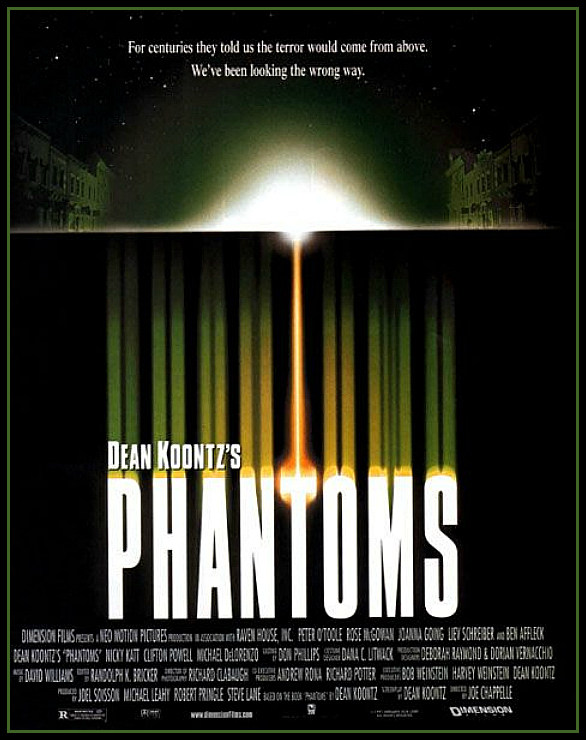
Quickie Review: Phantoms (dir. by Joe Chappelle)


If there was ever an actor in the last twenty years who has suffered ridicule regarding his body of work it would be Ben Affleck. Nevermind the fact that he has actually done very good work as an actor. People tend to view his acting work through some very bad film projects which the online film bloggers (and trolls) have lambasted year after year. One such film which has gained a cult following for all the reasons is the 1998 horror film Phantoms which was adapted from the Dean Koontz horror novel of the same name. This was a film which came out of nowhere and which no one really saw when it first hit the theaters. There’s a reason for this and the main reason for this being that the film was really awful though not without some entertaining bits.

Phantoms starred Ben Affleck in a role that really seemed more suited for an older actor. His Sheriff Hammond in the novel was much older and fit the backstory told in both novel and film that never truly fit Affleck’s youthful appearance and mannerism. He’s joined in this Joe Chappelle production by classically-trained veteran actor Peter O’Toole (who must’ve really needed the money to sign up for this film) in the role of Dr. Exposition dump aka Timothy Flyte who ends up explaining to the surviving cast of characters the very danger facing them in the abandoned town of Snowfield. Rounding out the cast is  Liev Schrieber as the creepy Deputy Stu Wargle who becomes a sort of plot device as the film moves forward. To add to this mix are Joanna Going and Rose McGowan as sisters who first discover that their town has just gone through a terrible event.

The novel this film was based on was pure scifi-horror pulp which stressed one’s suspension of disbelief, but was quite entertaining from beginning to end. Dean Koontz is like the generic fast-food version of Stephen King. This film adaptation borrows heavily from films such as Carpenter’s The Thing and the remake of The Blob. This wouldn’t have been a bad thing since the film’s story does bring into it an interesting concept of an ancient enemy which might or might not have been responsible for unexplained mass disappearances of people and animals throughout history going back to prehistoric times.

What Phantoms ends up doing which ruins the film as a whole was to rush through the narrative it was adapting it. The film pretty much goings through a checklist of all the major scenes in the novel, takes those scenes and truncates them to fit uncomfortably into a 90+ minute film. Some of these scenes could’ve been extended a few more minutes to add to a sense of grandiose to a film that needed it despite it’s B-movie foundation. One such scenes would be the arrival of a special Army unit designed to combat unexplained events, but the film treats this sequence from their arrival right up to their untimely demise in less than 15 minutes. I think in the hands of a much more capable filmmaker these scenes would’ve made the film much more entertaining.

Phantoms was a horror film that could’ve become a 90’s cult-classic if it had been given the proper time and effort from it’s producers, but seeing that it was the Weinsteins of Miramax and Dimension Films this final product was probably the best Joe Chappelle could’ve come up with. Weinsteins during the 1990’s were more concerned of pushing their Oscar-baiting film productions than actually giving time and effort to all their films. If there was any reason to see Phantoms it would be to see just why it kept being mentioned in Kevin Smith’s Jay and Silent Bob Strike Back. Other than that there’s really no reason to see it unless there’s nothing else on.