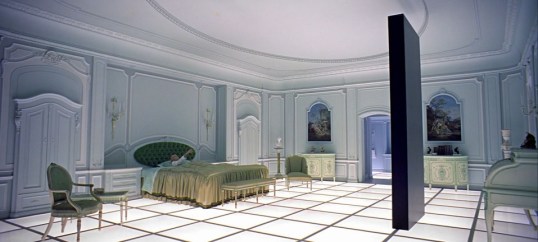
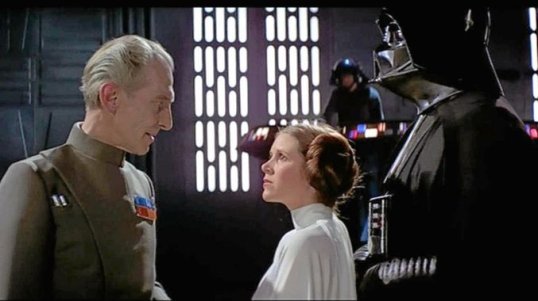
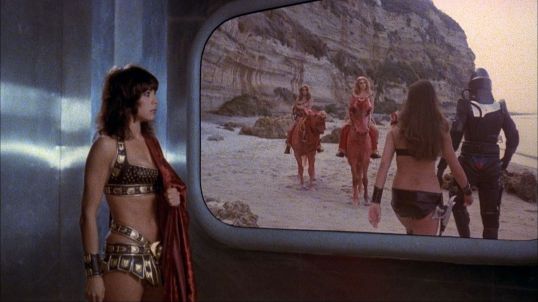
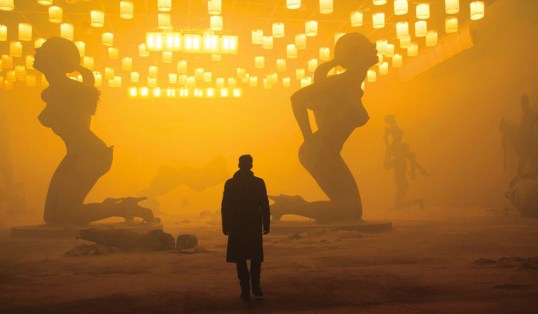
4 Shots From 4 Films is just what it says it is, 4 shots from 4 of our favorite films. As opposed to the reviews and recaps that we usually post, 4 Shots From 4 Films lets the visuals do the talking.
Today, in honor of National Science Fiction Day, it’s time for….
4 Shots From 4 Science Fiction Films
2001: A Space Odyssey (1968, dir by Stanley Kubrick, DP: Geoffrey Unsworth)
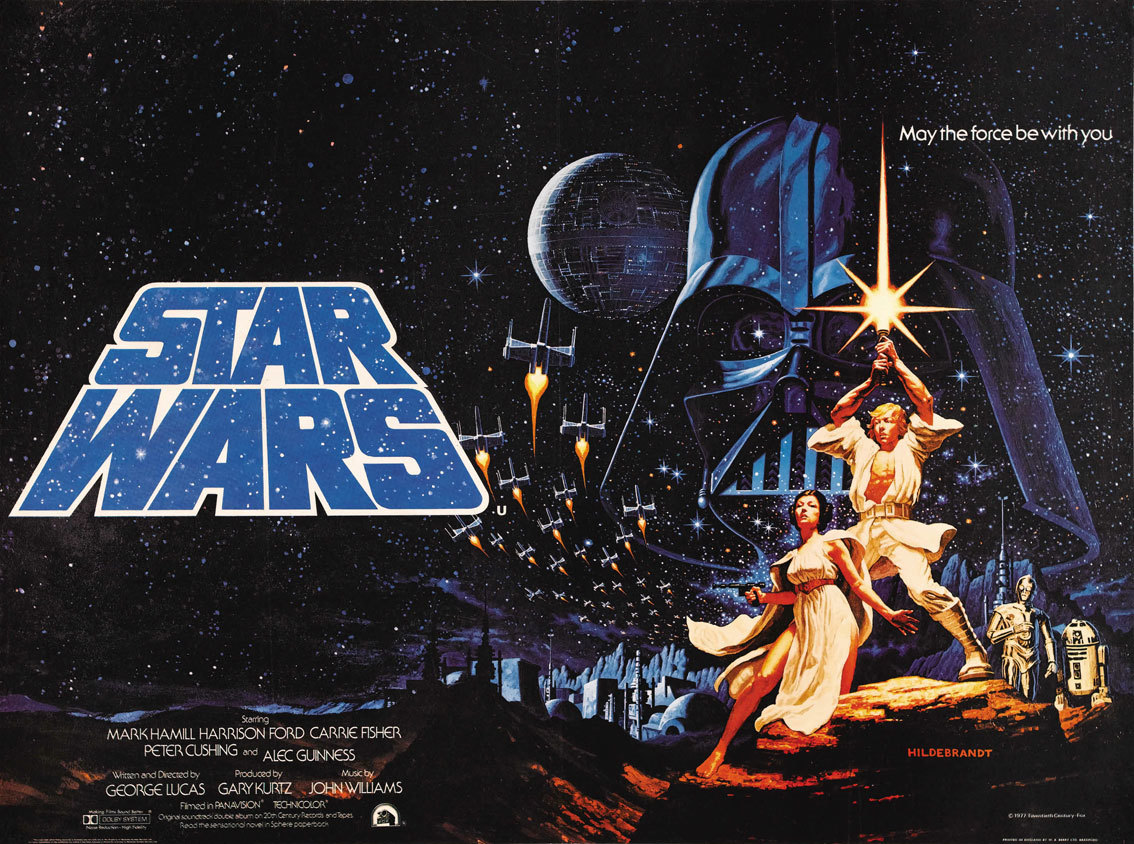
Star Wars Episode IV: A New Hope (1977, dir by George Lucas, DP: Gilbert Talyor)
Starcrash (1978, dir by Luigi Cozzi, DP: Paul Beeson and Roberto D’Ettorre Piazzoli)
Blade Runner 2049 (2017, dir by Denis Villeneuve, DP: Roger Deakins)
Can you imagine how things might have played out if Robert Englund had played Han Solo?
It’s not as far-fetched as it might sound. In his autobiography, Hollywood Monster: A Walk Down Elm Street with the Man of Your Dreams, Englund mentions that he was one of the many actor who, in 1975, auditioned for a role in the first Star Wars film. It’s often forgotten that, before he became famous as Freddy Krueger in A Nightmare In Elm Street,Englund was a busy character actor who had roles in several big studio productions in the 70s. He was definitely a part of the “new Hollywood” that included people like George Lucas, Steven Spielberg, and Jon Milius.
Though Englund doesn’t go into much detail, he does say that he read for the roles of both Han Solo and Luke Skywalker. At the time, Englund didn’t feel that he was right for either role and he went back to his apartment under the correct impression that he would not be cast. However, he did feel that his friend and then-roommate Mark Hamill would be a good pick for Luke Skywalker and Englund writes that he encouraged Hamill to try out for the role.
Would Mark Hamill have been cast if Robert Englund hadn’t told him about the audition? Probably. Given that Star Wars was Lucas’s follow-up to the very popular American Graffiti, it’s probable that every struggling young actor in Hollywood was hoping to audition. As well, Hamill was not totally unknown to George Lucas, having early read for a role in American Graffiti. Still, it’s nice to think that, long before he was cast as Freddy Krueger, Robert Englund may have played a role in casting one of the most successful films of all time.
What would Robert Englund have been like as Han Solo? He definitely would not have been as grouchy as Harrison Ford’s Han. Indeed, one of the striking things out about Englund’s pre-Nightmare career was how he was usually cast as friendly characters who were almost shy. Englund would have been friendlier and rather eccentric Han Solo but I think he would have been entertaining in his way.
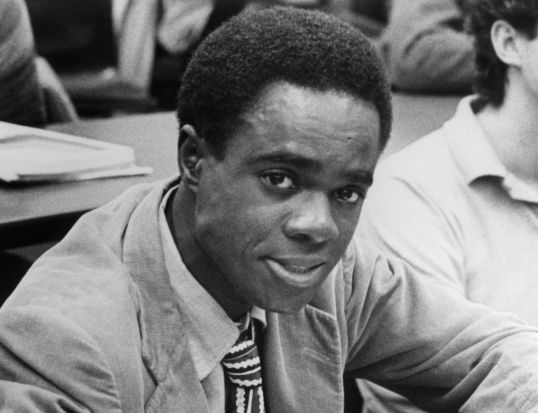
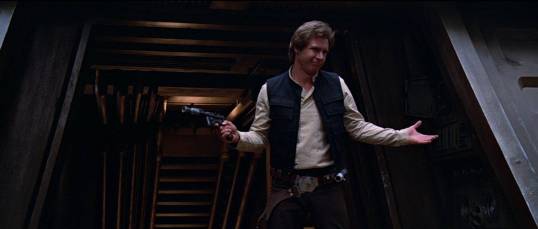
Because of the film’s success, it can be a bit difficult to know who was actually considered for a role in Star Wars. Lucas has said that he originally wanted to cast Black actor Glynn Turman as Han Solo but he feared audiences would not accept the possibility of an interracial romance between him and Leia, even in a galaxy far away. (Lucas’s regret over that decision is one of the things that led to the casting of Billy Dee Williams as Lando Calrissian.) The film’s IMDb trivia page insists that everyone from Al Pacino to Bill Murray to Marlon Brando to Chevy Chase was considered for the role of Han Solo and I have to say that this is a case where I doubt the accuracy of the IMDb. Harrison Ford, who had originally been hired only to read with people at the auditions, eventually got the role despite telling Lucas, about the script, “You can type this shit but you can’t say it.”
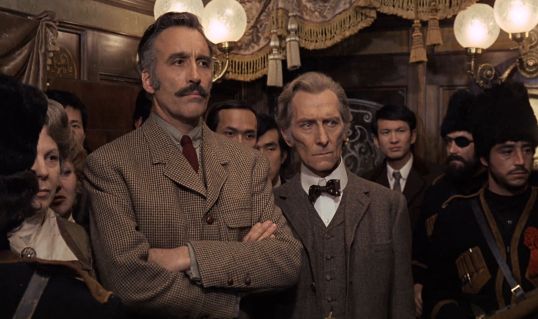
In several interviews, Christopher Lee expressed regret at having turned down the role of Grand Moff Tarkin, which was instead played by Lee’s best friend Peter Cushing. Interestingly enough, Cushing was also one of Lucas’s choices for Obi-Wan Kenobi so it’s easy to imagine a universe in which Star Wars reunited two Hammer films legends, along with setting box office records.
Famously, Lucas held joint-auditions with his friend Brian De Palma. De Palma was casting Carrieand just about everyone who read for one of the films also read for the other. Reportedly, William Katt came close to getting the role of Luke before instead being cast as Carrie’s doomed prom date. Amy Irving was also a strong contender for Leia, before instead ending up as Sue Snell in De Palma’s film. Some source that that Sissy Spacek also read for Leia, though I’ve also read that Spacek was not a part of the joint-auditions. That’s one thing about collecting trivia about classic films. It’s often hard to know what’s true and what’s just wishful thinking.
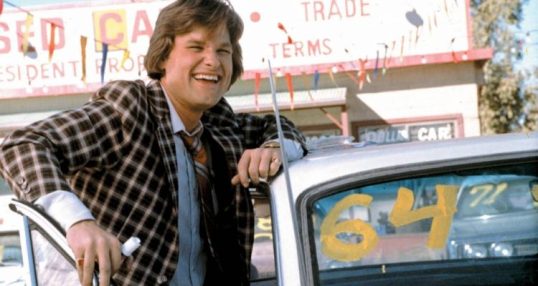
I should mention that another strong contender for Han Solo (and reportedly Luke as well) was Kurt Russell. It’s actually easy to imagine Kurt Russell as Han and, just as with Englund, it leads to an intriguing game of what if. Would Kurt Russell have gone on to have Harrison Ford’s career if he had been cast in Star Wars? Would Russell have gone to play Indiana Jones and Jack Ryan if he had been cast as Han Solo and would Harrison Ford have ended up helping the President to Escape from New York? Or is it just as possible that Star Wars have not worked without the chemistry of Harrison Ford, Carrie Fisher, and Mark Hamill? Would a Kurt Russell, Amy Irving, and William Katt version of Star Wars captured the imagination of audiences?
4 Or More Shots From 4 Or More Films is just what it says it is, 4 shots from 4 of our favorite films. As opposed to the reviews and recaps that we usually post, 4 Shots From 4 Films lets the visuals do the talking!
Today, we wish all of our readers a happy May The Fourth Be With You Day! It’s time for….
4 Shots From 4 Star Wars Films
Star Wars Episode IV: A New Hope (1977, dir by George Lucas, DP: Gilbert Talyor)
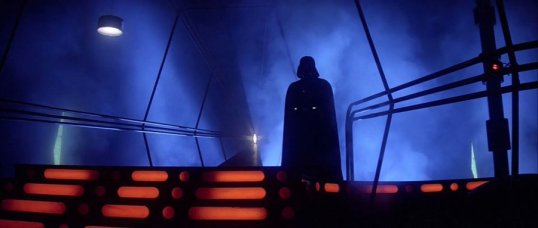
The Empire Strike Back (1980, dir by Irvin Kershner, DP: Peter Suschitzky)
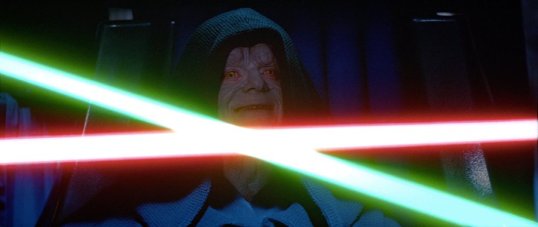
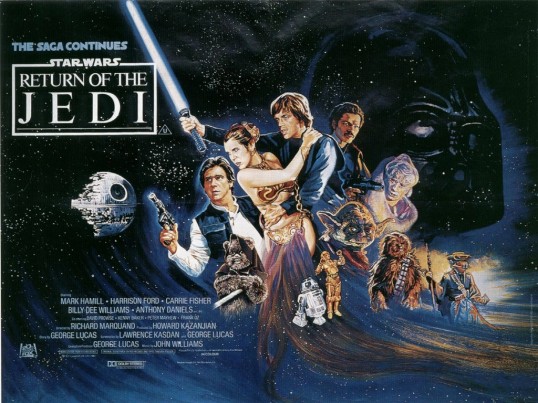
Return of the Jedi (1983, dir by Richard Marquand, DP: Alan Hume and Alec Mills)
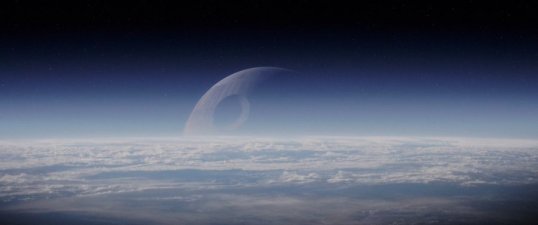
Rogue One (2016, dir by Gareth Edwards, DP: Greig Fraser)
4 or more Shots from 4 or more Films is just what it says it is, 4 shots from 4 of our favorite films. As opposed to the reviews and recaps that we usually post, 4 Shots from 4 Films lets the visuals do the talking!
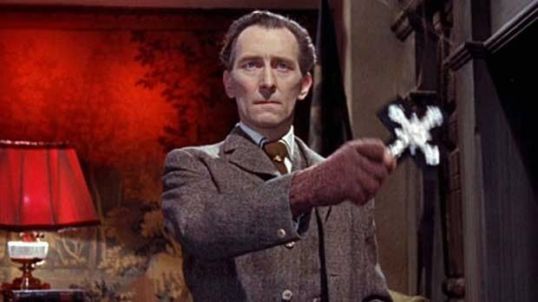
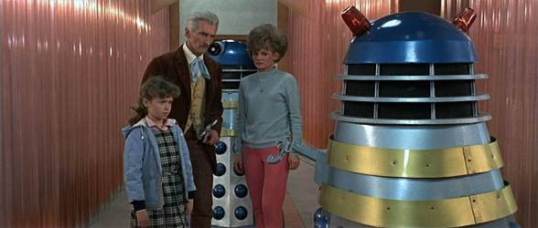
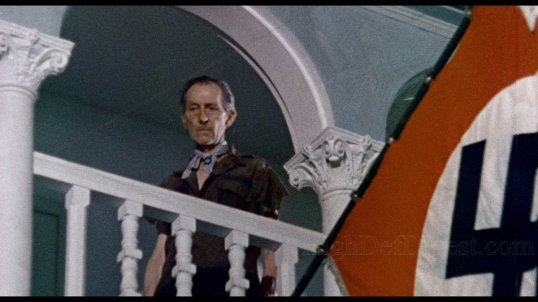
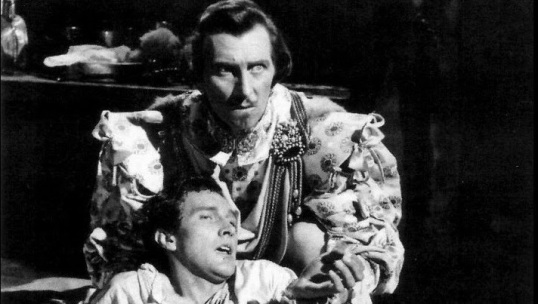
Today, the Shattered Lens pays tribute to Peter Cushing, one of the great actors and horror stars of the previous century. By most accounts, an old-fashioned gentleman who enjoyed gardening and a little painting, Peter Cushing went from the stage to films to television and back again and, along the way, appeared in some of the most popular and beloved films ever made. He was often cast as a rival to Christopher Lee. In real life, the two men were the closest of friends.
Here are….
6 Shots From 6 Peter Cushing Films
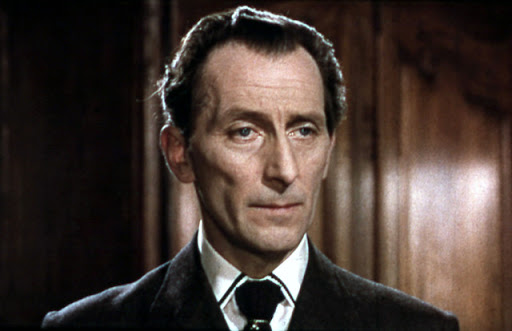
Hamlet (1948, dir by Laurence Olivier, DP: Desmond Dickinson)
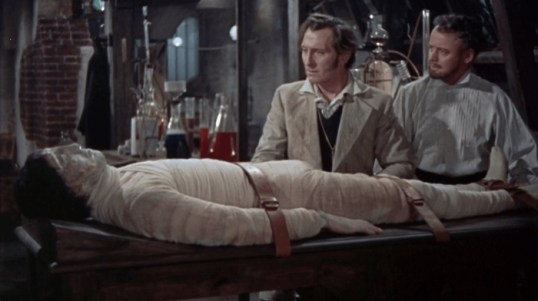
The Curse of Frankenstein (1957, dir by Terence Fisher, DP: Jack Asher)
Horror of Dracula (1958, dir by Terence Fisher, DP: Jack Asher)
Dr. Who and the Daleks (1965, dir by Gordon Flemyng, DP: Jack Wilcox)
Shock Waves (1977, dir by Ken Weiderhorn, DP: Reuben Trane)
Star Wars Episode IV: A New Hope (1977, dir by George Lucas, DP: Gilbert Talyor)
The name Gary Kurtz isn’t well known except among STAR WARS fans. Along with his partner George Lucas, Kurtz produced the first two films in the original trilogy, and had a lot to do with the franchise’s early success. Gary Kurtz passed away yesterday at age 78 of cancer, and as I looked back on his filmography, I found he was much more than just the “Star Wars” guy.
Monte Hellman’s “Ride in the Whirlwind” (1965)
Gary Kurtz, like many young tyros back in the 1960’s, was a graduate of what’s known as the Roger Corman School of Filmmaking. Getting his start as an assistant director on Monte Hellman’s 1965 Western RIDE IN THE WHIRLWIND, cowritten by and co-starring another Corman alum, Jack Nicholson , Kurtz worked in various capacities on such Corman-related films as VOYAGE TO THE PLANET OF PREHISTORIC WOMEN (production manager), BEACH BALL (camera operator, assistant director…
4 Shots from 4 Films is just what it says it is, 4 shots from 4 of our favorite films. As opposed to the reviews and recaps that we usually post, 4 Shots from 4 Films lets the visuals do the talking!
Today is Peter Cushing’s birthday! This edition of 4 Shots From 4 Films is dedicated to him, his memory, and his career!
It had to happen sooner or later so, with the new ROGUE ONE: A STAR WARS STORY being released tomorrow, I figure now is a good time to take a look at one of the biggest films of the 1970’s, STAR WARS (retitled A NEW HOPE for you revisionists, but to me it’s still just STAR WARS). I’m pretty sure everyone reading this post is familiar with the story, so rather than rehash the plot, I’m just going to dive right into some points of interest for classic film fans.
First off, the movie was originally imagined as a loving homage to serials like FLASH GORDON and BUCK ROGERS. Writer/director George Lucas originally intended to remake FLASH, but couldn’t obtain the rights, so he created his own space opera universe, cobbling bits and pieces from Edgar Rice Burroughs, Joseph Campbell, The Bible, and other sources, including the movies he grew up with and admired…
4 Shots From 4 Films is just what it says it is, 4 shots from 4 of our favorite films. As opposed to the reviews and recaps that we usually post, 4 Shots From 4 Films is all about letting the visuals do the talking.
Happy Birthday to the man with the imposing presence: James Earl Jones
When I first began this site on Christmas Eve of 2009 I had to thank the excitement I had for event films after seeing and experiencing James Cameron’s Avatar. It was an experience I hadn’t felt since the days of the Lord of the Rings trilogy and, even earlier than that, the original Star Wars trilogy. These were films that fired up one’s imagination, appreciation and love for film as entertainment and art. Some of these films would linger on longer in one’s mind than others, but that first viewing in their initial release would always imprint their effect on each viewer.
When George Lucas announced that he would be returning to that galaxy, far, far away with a trilogy of prequels almost 15 years since the world last saw Return of the Jedi premiere first the first time, the Star Wars fandom were giddy, excited and hyped beyond belief. The Star Wars films and the many spin-offs (novels, comic books, video games, etc.) which came about because of it only whetted the appetites of long-time Star Wars fans for more films detailing the adventures in the scifi universe created by George Lucas.
Yet, the prequels’ effect on these long-time fans would be the direct opposite of the effect the original trilogy had on the fandom. These three prequels (all directed and written by George Lucas himself) would do more than disappoint the fandom. It would create a schism between those who saw the original trilogy as the gateway to their fandom and those younger generation who never saw the original trilogy and had the prequels become their gateway to the fandom. Even to this day there would be some of the younger generation who truly believe that the prequels trump the original three films which began the franchise.
When news came down that Disney had bought Lucasfilm and everything which George Lucas had built and cultivated there was no chance in hell that there wouldn’t be another series of Star Wars despite the disaster which were the prequels. Lo and behold, it didn’t take long for Disney to greenlight the sequel to Return of the Jedi and have it set decades after the events of that film.
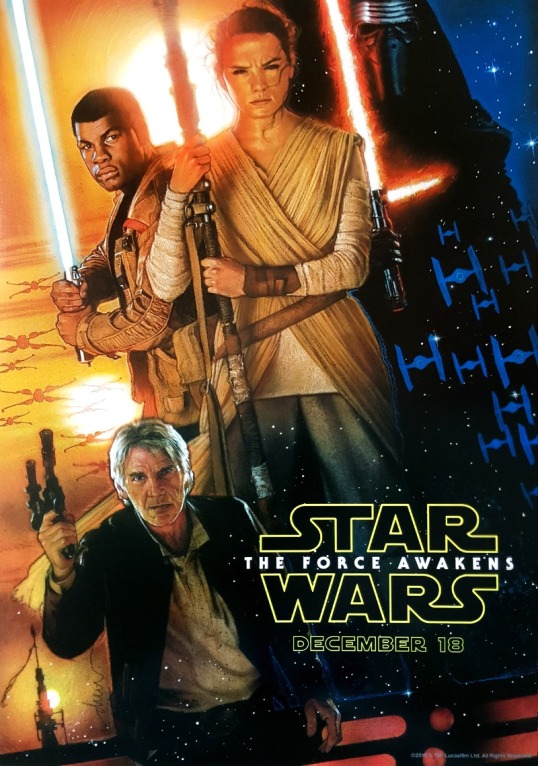
So, it is with Star Wars: The Force Awakens that the Star Wars fandom get to see whether their continued faith in the franchise was worth it or if they have been Charlie Brown’d once again and had the ball taken away at the very last second. It’s easy to say that Star Wars: The Force Awakens was great or it was awful. The true answer to whether this film succeeded in what it intended do was a bit more complicated.
Yet, if one was to look for an easy and simple answer then I’m happy to say that Star Wars: The Force Awakens was great. It had it’s moments of logic gap and plot holes, but as an overall finished product the film succeeded in course-correcting the franchise from the nadir it was at with the culmination of the prequels. It wouldn’t have taken much to surpass the very low bar set by those prequels, but The Force Awakens leapfrogged that bar and went even higher.
The film does begin thirty years after the events of Return of the Jedi and we find out with the now familiar episode intro crawl that Luke Skywalker has disappeared since those events and the galaxy has remained in turmoil with his absence. The Galactic Empire has been defeated, but in its place a new danger in the form of the genocidal First Order has arisen from the Empire’s remains. Opposing the First Order is a sort of galactic force supported in secret by the New Republic and led by General (not Princess) Leia Organa calling themselves the Resistance. It’s the conflict between these two factions and the search for Luke that forms the narrative base for The Force Awakens.
The film doesn’t linger too long in explaining the events which occurred in that 30-year gap between Return of the Jedi and The Force Awakens. It doesn’t need it as we’re quickly introduced to the series’ new characters in the form of Poe Dameron, the best pilot in the galaxy, who has been sent on a secret mission by Leia to find the clues as to her brother’s whereabouts. Next in line was Kylo Ren who becomes this film’s analogue to the Darth Vader figure of the original trilogy. Yet, the bulk of the film was told through the eyes of Finn and Rey. The former is First Order stormtrooper who has seen first-hand what the First Order truly stands for and not for the betterment of the galaxy. The latter is a young woman living life on the desert planet Jakku scavenging the graveyard of starship wreckage from a battle thirty year’s prior.
It’s through Rey and Finn that the audience learns through their adventures upon meeting up with each other on Jakku what has transpired since the Rebellion destroyed the second Death Star and killed Emperor Palpatine. To these two characters, the events from the original trilogy seem to have passed beyond the realm of history and become more like legends and myths to the younger generation. Through a combination of fear and awe, Ren and Finn get introduced to some of the original trilogies main characters (Leia, Han Solo, Chewbacca and even Admiral Ackbar). These are the stories they’ve been told of growing up come to life right in front of their eyes and their reaction mirrors those of the audience who haven’t seen these characters in anything new and relevant since the end of Return of the Jedi. The reaction alone to seeing Han Solo and Chewbacca alone seemed like the fandom’s collective cheer for the good that has been missing with the franchise for over 30 years now.
The Force Awakens is not a perfect by any stretch of the imagination. Like mentioned earlier, the film does suffer from some gaps in story logic and plot holes. As with most J.J. Abrams directed films he had a hand in writing the script and one could see where he sacrificed coherent storytelling beats for something that just pushed the story along the path he wanted the film to take. For those who have been steeped in Star Wars lore and backstory, this would be easily explained as the Force nudging, guiding and, if all else fails, pushing the characters onto the right path, but for the casual viewers it would come off as story beats of convenience.
As a story to bring back the faithful and lure in those still uninitiated to the franchise The Force Awakens straddles the line between nostalgia and trying to bring in something new to the proceedings.
Let’s begin with the former and just say it now that The Force Awakens does follow some major story beats directly from A New Hope (to a smaller effect from Empire Strikes Back and Return of the Jedi). One could almost say that this film was a sort of soft reboot of the original trilogy with how it lifted ideas from them and through some writing and directing recombination come up with something new, but still very familiar for hardcore and non-fans alike.
Does this decision to lean heavily on the original trilogy for ideas hurt the film? For some it might be a bit too distracting to recognize too many callbacks to those earlier films, but for most it’s a reminder of what the prequels lacked and that’s the sense of adventure and fun. There was never anything fun about the prequels. The Force Awakens brings it all back and for most viewers this is the course-correction the series has needed since the last images from Revenge of the Sith faded away from the silver-screen.
Even the new characters introduced in this latest film were an amalgamation of the main characters from the original trilogy. Where Abrams and Kasdan changed this up a bit was to go beyond just creating new analogues for the classic characters of Leia, Han, Luke, Chewie and R2D2. They opted to take all the qualities fans loved about those characters and mixed them all up to be used in the roles of Rey, Finn, Poe, Kylo Ren and BB8.
As the standout character in the film, Rey (played by find of the year Daisy Ridley) would bring back memories of not just the young and hopeful Luke from the original trilogy, but also some personal traits of Leia and Han. The same goes for Finn who at times reminded us of Han’s roguish charm to Luke’s naivete of his role in the larger world he has finally witnessed for the very first time. For the half-empty crowd this might look as lazy character development, but those who see the film with the half-full mindset would easily latch onto these new characters. Characters who now take on the responsibility of moving the franchise beyond the nostalgia of the original trilogy and erasure of the disappointment of the prequels to new adventures with the next two films.
So, is Star Wars: The Force Awakens worth returning back to the franchise after the prequels or is it too much of a rehash of the original three films? The answer to that is a definite yes despite some of it’s flaws. For some the very flaws some have pointed out (too many callbacks, sort of a reboot, etc.) was what made the film a fun time to be had. It’s a return to the comfort zone the fandom missed with the prequels.
Will the next two films in this new trilogy follow suit and just rely too much on nostalgia to continue trying to satisfy it’s massive audience? Or will Rian Johnson and Colin Trevorrow (director of Episode VIII and Episode IX, respectively) move into new territory with minimal callbacks to those earlier films? We as an audience will have to wait til 2017 and 2019 to find out. Until then enjoy what Abrams and Lucasfilm has accomplished with The Force Awakens. A film which has reinvigorated a film franchise that has seem some major lows, but one which also happens to be one hell of a fun ride from start to finish on it’s own merits.
P.S.: Some controversy has arisen since the film’s release concerning the character played by Daisy Ridley. Some have been very vocal about calling her Rey character as a sort of knee-jerk reaction to the accusation that the Star Wars films have lacked for a strong female lead. An argument that’s as misguided and misinformed as that of the films being whitewashed. The films in the franchise have always had strong female characters. The accusation that Rey as a character in The Force Awakens is such a “Mary Sue” (a female character written and created to be the best at everything, no flaws) ignore the details in the character’s development.
What’s sadder is that some of the very people (film critics and writers) who in the past have complained that major films (especially blockbusters) have been lacking in very strong female characters have been the very same who see Rey as a negative and a character too good. This despite the character following in the very same footsteps in how her predecessors have been written (Luke, Han, Anakin). It’s an argument that is sure to bring heated debate among fans and detractors, but one that takes away from the performance of Daisy Ridley who should be one of the many breakout stars to come out of Star Wars: The Force Awakens.
We’ve reviewed a lot of science fiction and we’ve got a lot more left to go. (Keep an eye out for my reviews of Starcrash and The Humanoid over the upcoming few days.) However, from the beginning, this month has always been centered around Star Wars. You may have heard that there’s a little movie called Star Wars: The Force Awakens and it’s opening this week. Apparently, a few people are excited about it. Since we love reviewing little known art films here at the Shattered Lens, we decided why not review all of the previous Star Wars films during the week leading up to the release of The Force Awakens? Jeff (a.k.a. the blogger known asJedadiah Leland) started us off by reviewing The Phantom Menace.Then Alexandre Rothier took a look at Attack of the Clones, followed by Jeff’s look at Revenge of the Sith.Leonard Wilson was the next to step up to the plate, reviewing both A New Hope and The Empire Strike Back.
And now, it’s my turn to add my thoughts to this project. It’s time to review the 1983 film, Return of the Jedi. And I have to admit that, when I first thought about what I wanted to say in this review, I was totally intimidated. Unlike my fellow writers here at the Shattered Lens, I’m hardly an expert when it comes to Star Wars. Don’t get me wrong — I know the basics. I know that Darth Vader is Luke’s father. I know that Han Solo flies the Millennium Falcon and that Princess Leia is in love with him. I know there’s an evil Empire and I know that there are rebels. I’m not a virgin when it comes to Star Wars but, at the same time, I’m definitely not as experienced (with Star Wars) as most of my friends and fellow movie bloggers.
“Dang, Lisa, get over it!”
So, late this afternoon, when I sat down to watch Return of the Jedi, it was with more than a little trepidation. My obvious panic and welling tears convinced Jeff to watch the movie with me and I was happy for that. He loves Star Wars so I knew he could explain to me what was going on.
Finally, we watched Return of the Jedi and I discovered that I was panicking over nothing. Return of the Jedi may be the third part of trilogy and I may not be an expert on the films that came before it. But, even with all that in mind, Return of the Jedi is not a difficult film to figure out. As opposed to the finales of Harry Potter, The Hobbit, and The Hunger Games, Return of the Jedi keeps things simple. A good guy has been kidnapped by a bad guy. The other good guys come to the rescue and then go to another planet so that they can fight an even bigger bad guy. It’s not complicated.
As I watched Return of the Jedi and realized that I was having absolutely no problem following the film’s plot, I also realized that the Star Wars films are such a huge part of our culture that, regardless of how many of them we’ve actually sat through, everyone has absorbed them by osmosis. Bits and pieces of it are everywhere, showing up in everything from TV sitcoms to political commentary. (Remember how everyone used to compare Dick Cheney to Darth Vader?) The Star Wars franchise is almost biblical in that respect. At the same time, the fact that everyone knows about these movies makes them a little difficult to review. You don’t so much watch a Star Wars film as you join in a universal experience. As a reviewer, you definitely find yourself wondering what you can add to a conversation that everyone else has already had.
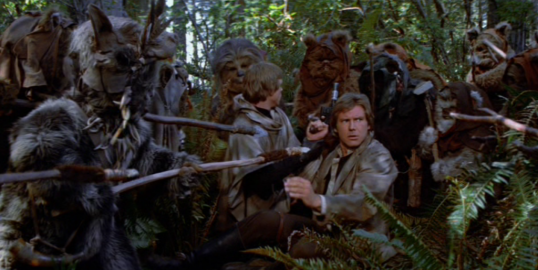
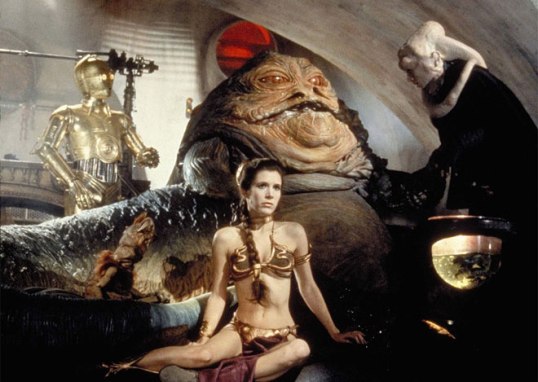
As a stand alone movie, Return of the Jedi is actually three separate films mixed together. The first film deals with Luke Skywalker (Mark Hamill) showing up at Jabba the Hutt’s palace and rescuing Han Solo (Harrison Ford), Princess Leia (Carrie Fisher), Chewbacca (Peter Mayhew), and two robots from being tossed into a creature called the Sarlacc, which is basically a giant vagina out in the middle of the desert. The second film deals with the rebels teaming up with a bunch of teddy bears and fighting the Empire on a jungle planet. And the third film features Luke and Darth Vader (body of David Prowse, voice of James Earl Jones, face of either Sebastian Shaw and Hayden Christensen, depending on which version of the film you’re watching) dealing with their family issues while the Emperor (Ian McDiarmid) cackles in the background. Some parts of the film work better than others. The end result is entertaining but definitely uneven.
Jedi‘s heart belongs to that third film, the one dealing with Luke and Darth Vader. I’ve read some pretty negative online comments about Mark Hamill’s performance in New Hope and Empire Strikes Back but, in Return of the Jedi, he brings an almost haunted intensity to the role of Luke. In theory, it’s easy to be snarky about all the talk about the “Dark Side of the Force,” but, when you look in Hamill’s eyes, you totally understand what everyone’s going on about. You see the fire and the anger but, even more importantly, you see the struggle between good and evil. There’s a very poignant sadness to the scenes where he and his father prepare to meet the Emperor.
And speaking of the Emperor, he is pure nightmare fuel! AGCK!
As for the other two films to found within Return of the Jedi, the jungles of Endor didn’t do much for me. Don’t get me wrong. I thought the action scenes were handled well and, unlike apparently everyone else in the world, I was not annoyed by the inclusion of the Ewoks, the killer teddy bears who helped to the Rebels to take down the Empire. I thought the Ewoks were cute and I actually got pretty upset when one of them was killed in battle. If I had been alive when Return of the Jedi had been released, I probably would have wanted a stuffed Ewok and, I imagine, that was the main reason they were included in the film. (I also imagine that’s the main reason why a lot of people can’t stand them.)
So, no, the Ewoks did not bother me. What did bother me was that under-construction Death Star floating out in the middle of space. It bothered me because I really couldn’t imagine any reason why — after the first Death Star was apparently such a colossal failure — the Empire would insist on trying to do the exact same thing all over again. This, along with the fact that they were rather easily defeated by a bunch of teddy bears, leads me to wonder whether the effectiveness of the Empire was just a little overrated. I mean, the Emperor was scary but otherwise, everyone involved with the Empire was pretty incompetent.
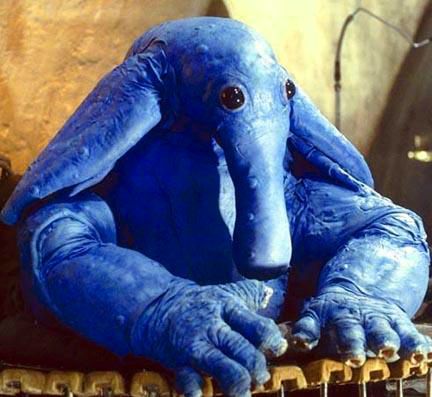
Far more impressive, as far as villains go, was Jabba the Hut. In fact, Jabba and his decadent entourage were so memorable and colorful and evil and icky that they pretty much overshadowed almost everything else in the film. I mean, Jabba even had a blue elephant playing music for him! And I know that I’m supposed to be critical of the film for putting Leia in that gold bikini but you know what? Leia may have been forced to wear a gold bikini but she never gave up her dignity or her defiance. And when it came time to take out Jabba, Leia used the tools of her oppression to do so, strangling him with his own chains. In that one scene, Leia proved herself to be a true rebel.
There’s a lot that’s good about Return of the Jedi but, as I said earlier, it’s definitely an uneven film. Richard Marquand’s direction is perhaps the epitome of workmanlike. It’s efficient and it’s dependable and there’s absolutely nothing surprising or particularly challenging about it.
It’s interesting to note that, before Richard Marquand was selected as director, the job was offered to both David Lynch and David Cronenberg, two directors who are all about surprising and challenging the audience. What would David Lynch’s Return of the Jedi been like? Well, here’s one possibility:
As for David Cronenberg’s Return of the Jedi, it might have looked something like this:
For better or worse, the world got Richard Marquand’s Return of the Jedi, which I imagine was pretty close to what George Lucas wanted the film to be.
As I sit here finishing up this review and wondering just why exactly I was so intimidated earlier (seriously, this turned out to be one the easiest reviews that I’ve ever written), I estimate that 75% of the people that I know are currently sitting in a theater and watching The Force Awakens. Keep an eye out for Arleigh’s review in the next few days!
And in closing, here’s that blue elephant that I mentioned earlier. Dance!