4 Shots From 4 Films is just what it says it is, 4 shots from 4 of our favorite films. As opposed to the reviews and recaps that we usually post, 4 Shots From 4 Films is all about letting the visuals do the talking.
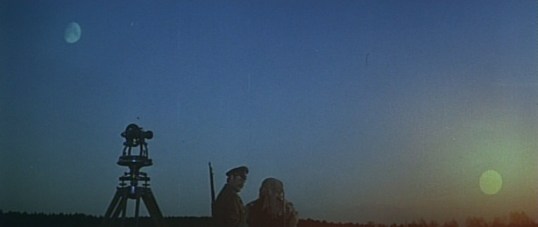
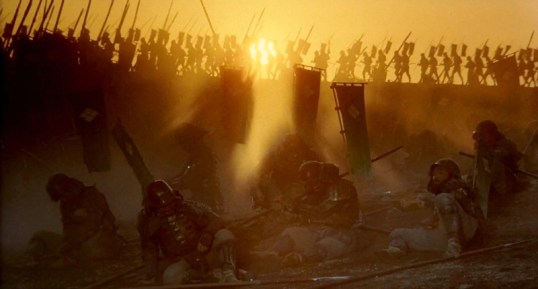
With the latest entry to the Star Wars franchise set to be released in just a few days I thought it was appropriate to share four particular scenes from one filmmaker who has been a huge influence on George Lucas’ vision for Star Wars. This filmmaker also became a huge influence on other master filmmakers such as John Ford, Steven Spielberg, Martin Scorsese, Francis Ford Coppola and Sidney Lumet just to name a few.
Many consider this filmmaker to be one of the greatest filmmakers who ever lived and in this humble individual’s opinion he was the greatest filmmaker who stood above all and whose storytelling and visual techniques would become part of the modern filmmaker’s toll bag.
Before I start, a quick apology. This isn’t a great review by any means. One, I rushed it. Two, In writing about a film that everyone knows, I found I had problem figuring out exactly what to say. What you’re getting here is a stream of consciousness. The Empire Strikes Back review will be better.
In anticipation of The Force Awakens, the Shattered Lens are taking on the other films in the Star Wars Saga. It’s next to impossible for anyone to avoid seeing anything related to the new film as the fever grows and we reach the December 18th release date.
There are a few movies where I wish I could’ve been there during their theatrical release. How great would it be to see audiences squirm during Ridley Scott’s Alien, Steven Spielberg’s Jaws or William Friedkin’s The Exorcist? I was a little too young to see the original Star Wars when it premiered in May of 1977, but I can’t imagine it wasn’t amazing. I wouldn’t be familiar with the films until 1980’s The Empire Strikes Back. That was the film I saw first. Then Star Wars on VHS and finally Return of the Jedi in the cinema when I was 9.
Still, I grew up knowing what Star Wars was before I could really read. Thanks to an older brother who was enthralled with the film at 7, there were Star Wars curtains in our room and Star Wars bedsheets/blankets. We had action figures and models to play with. Since LED’s in toys weren’t the norm, our lightsabers consisted of whiffle-bat plastic rods with cuts in them. Swing the sword a bit and you’d hear the “hum” of the blade. It was an awesome time.
Years later, when my little brother was born in the mid-1980’s, we kept him occupied with movies. Once he learned what Star Wars was, it was almost always the film he’d pick out to watch. I took him with me to catch all three of the Prequels during late night runs. We’d spend the wait with our own lightsabers, re-enacting Episode I fights or just talking about what we hoped we’d see. Earlier this year, during my last visit to my friends in Oregon, I was able to introduce a new generation to the magic of it all.
All of that is me, gushing over one of my favorite set of films. You have my sympathies.
So, how did a little sci-fi film in the late 70s manage to become such a pop culture beacon today? Was it the special effects, so ground breaking that we still use its techniques (such as the Green Screen)? Was it the sound design? The cast, perhaps, made up of a mix of relative unknowns and seasoned film veterans?
I’d argue that the film’s biggest success is the overall impact in the Motion Picture industry. Lucas and the production team were forced to make some innovations to get the vision they wanted. To that end, Industrial Light & Magic was created, and the effects studio pioneered special effects for years to come. Pixar wouldn’t have happened without Star Wars and ILM, since they were just a branch of the company that Lucas couldn’t quite find a use for, supposedly. The best comparison I can make for anyone unfamiliar with ILM is Weta Digital and the Lord of the Rings Trilogy. You know when you watched those three films, you were seeing effects that everyone would want to use down the road. That’s just my view. The ties to classic myths were also strong, as Lucas was heavily influenced by Joseph Campbell. Campbell’s Hero Journey is basically the template used for A New Hope (and for The Matrix by the Wachowski’s, if you watch them side by side). Ben Burtt would go on to win a special award for Sound Effects in the film. His work would eventually end up being the backbone of Skywalker Sound.
From a casting standpoint, most of the principals were relative unknowns at the time. Lucas worked with Harrison Ford on American Graffiti some years before. Mark Hamill was brought on board after auditioning at the behest of his friend, Robert Englund (which I found out during writing this). Carrie Fisher loved the script and was also cast as Princess Leia. For some added weight, Lucas managed to cast both Sir Alec Guinness and Peter Cushing. I’m still not entirely certain of how he pulled that off.
Star Wars (or A New Hope as I’ll refer to it) takes place 30 years after the events of Revenge of the Sith. The Galactic Empire is in control over everything, the Jedi are no more. It’s a near complete victory, save for the fact that the plans for the Empire’s greatest weapon were stolen. When a Star Destroyer intercepts a Rebel Cruiser with Princess Leia Organa (Carrie Fisher) on board, she’s captured for interrogation. This is, of course, after she sneaks the plans for the Death Star in her trust R2 Unit, R2-D2 (Kenny Baker). R2, along with his companion C-3PO (Anthony Daniels) manage to escape the Star Destroyer and land on the desert planet of Tatooine.
The Droids are discovered by Jawas and are then sold to Owen Lars, his wife Beru and their nephew, Luke Skywalker. Luke wants to join up with the Alliance and become a starfighter, but the family needs him on the farm. After stumbling on to the message the Princess hid in R2-D2, he looks for his old friend, Ben Kenobi (Alec Guinness), who turns out to be more than what he seems.
In order to get to the Princess, they need someone to get them there. This is where the coolest character in the entire series appears. For a price, Han Solo (Harrison Ford) and his buddy Chewbacca (Peter Mayhew) take Ben and Luke in their spaceship, the Millenium Falcon to search for her. They get captured by the Empire, practically stumble upon the princess and she rescues them by way of a garbage chute. They get the plans, escape the Death Star and collaborate on a rebel assault to destroy it before it can do more harm. That’s the bulk of it, though admittedly, I’m leaving a lot out. It’s a simple tale, but an effective one as well.
Overall, A New Hope is still the template for a lot of Sci-Fi films. Battles in space, a little bit of swashbuckling, and some humor here and there are all elements borrowed by many films and games since it was released. Some handle Sci-Fi better (Mass Effect, Dune) and others fail in comparison (Jupiter Ascending, anyone?), but most modern works pay some homage to Star Wars in a way.
Tomorrow, we take a look at The Empire Strikes Back, arguably the best story in the Star Wars saga.
The year 2005 was a dark time to be a fan of Star Wars.
The first two parts of the highly anticipated prequel trilogy had been released and had left fans feeling as if millions of voices had cried out in terror and suddenly been silenced. No sooner had fans started to recover from the trauma of The Phantom Menace then Attack of the Clones was unleashed and they were stunned to learn that a movie could be even more pointless than The Phantom Menace.
The summer of 2005 promised the release of Star Wars Episode III: The Revenge of the Sith. Fans were excited because they knew that Anakin Skywalker would finally be transformed into Darth Vader but they also knew that he would still be played by Hayden Christensen. Many of us who went to see the movie on its opening weekend did so with low expectations and mixed feelings.
“WAR!” the opening title crawl of Revenge of the Sith declared, as if it was trying to reassure those of us in the audience that it would not be another boring Star Wars prequel. There was nothing in the crawl about taxation or trade routes. Instead, it was all about how the Galactic Republic was at war with separatists and how Chancellor Palpatine was being held prisoner by General Grievous. After an exciting battle on Grievous’s flagship, Anakin not only rescued Palpatine but also decapitated Christopher Lee’s Count Dooku, despite the fact that Dooku had surrendered and was unarmed. That’s when those of us watching knew that Revenge of the Sith was not going to be like the other two prequels. Revenge of the Sith was going to be darker and edgier and not just for kids. A headless Count Dooku action figure would not be sold at your local toy store.
Looking back, it is easy to forget how relieved many of us were that Revenge of the Sith was not terrible. After the bitter disappointment of the first two prequels, we were happy that Jar Jar Binks only appeared during one shot towards the end of the film and he did not speak. We were happy that Ewan McGregor and Natalie Portman both finally got to give performances that justified casting actors of their caliber as Obi-Wan and Amidala. We were happy that, since Anakin and Amidala were secretly married between Attack of the Clones and Revenge of the Sith, we did not have to sit through any more scenes of them falling in love. Many of us had found Hayden Christensen’s performance to be petulant in Attack of the Clones and, intentionally or not, Revenge of the Sith seemed to validate our suspicions by having both Yoda and Mace Windu say the same thing about Anakin. After the embarrassment of Phantom Menace and Attack of the Clones, this was a prequel that we felt we could get behind.
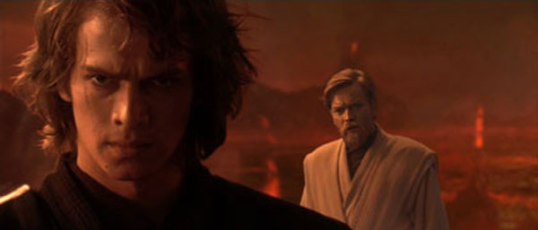
And we were really happy with the climatic battle between Obi-Wan and Anakin. After Anakin had gone over to the dark side, he and Obi-Wan dueled on a volcanic planet. “You were supposed to be the chosen one!” Obi-Wan shouted after chopping off Anakin’s legs. After being left to die by Obi-Wan, Anakin was rescued by Emperor Palpatine. It was only after being encased in that famous black armor that Palpatine told the new Darth Vader that Amidala had died. Darth Vader’s “Nooooooooo!” would go down in history.
At the end of the film, Jimmy Smits was seen giving an infant Luke to Owen and Beru Lars and Darth Vader and the Emperor were seen standing on the bridge of an imperial ship and looking out at the skeleton of the Death Star. For the first time since the prequels were first released, some of us applauded at the end of a Star Wars film.
When, ten years later, I rewatched Revenge of the Sith for the first time in a long while, my immediate impression was that it was nowhere close to being as good as I remembered. Without a doubt, it was still the best of the prequels but how much was that really saying? Of all the prequels, it came the closest to capturing the sense of awe and excitement that made the original trilogy (even Return of the Jedi) so entertaining but, at the same time, it still had many of the same flaws that afflicted Phantom Menace and Attack of the Clones. Hayden Christensen was as stiff and inexpressive as ever, as was George Lucas’s dialogue. (When Obi-Wan tells Anakin that Palpatine is evil, Anakin actually replies, “From my point of view, the Jedis are evil!” He shouts this in the middle of a light saber duel.) Even the movie’s most shocking moment, when Anakin murdered a group of children, was no longer effective because everyone in the movie insisted on calling the children “younglings.”
Throughout the entire prequel ordeal, George Lucas would insist that it was necessary to see all three of the prequels to really understand the story he was trying to tell and how it fit in with the original trilogy. However, of all the prequels, Revenge of the Sith is the only one that feels as if it adds anything to what we had already learned from watching the original trilogy. Nor is there anything to be gained from having seen the first two prequels before watching Revenge of the Sith for the first time. The main accomplishment of Revenge of the Sith was to prove that The Phantom Menace and Attack of the Clones were entirely unnecessary. (Revenge of the Sith actually works better if you have never seen Phantom Menace because there is no way that the Anakin played by Jake Lloyd could have grown up to be the Anakin played by Hayden Christensen.)
Why, when we originally watched Revenge of the Sith, did so many of us think that it was so much better than it actually was?
In the year 2005, we were just happy to have a Star Wars film that did not totally suck.
Attack of the Clones is, at least in my opinion, the worst Star Wars film ever made. Hands down. That is not to say it’s not mildly entertaining, but it demands a great deal of good will from its viewer to keep him from sneering at the movie constantly, especially if said viewer is a fan.
Christ, where do I even begin.
It’s important to note that Episode II is a transition movie. If that’s not clear enough, what I mean is that it’s a movie that exists to connect both the childish, yet potentially endearing Episode I, and the much darker and edgier Episode III. Episode II is somewhere inbetween these two moods, trying to make the transition smoother, disastrously so. It’s catastrophic in many levels, but mostly because of Hayden Christensen’s Anakin Skywalker. We’ll get there soon.
Episode II starts as a movie about politics. Now, I like fictional world politics as much as the next person. I honestly do. Especially in a space opera setting. But in Star Wars the politics are dull and barely explained. Padmé Amidala’s two terms as democratically elected Queen of Naboo (wait, what?) are now over, and she continues her career as a politician by becoming a senator. The story begins by trying to make it interesting that people are trying to kill Amidala, on what appears to be politically motivated crimes. We don’t get much context, except that she opposes some other senators. Palpatine, being the super trustworthy guy everyone always knew he was, assigns the Jedi Order to protect her, and finds that Obi-Wan is a suitable bodyguard for Padmé, considering their friendship way back in Episode I. Of course, Obi-Wan must take his apprentice, Anakin Skywalker, with him. And hilarity ensues.
Now, you’re probably familiar with whom Anakin is to become, and you probably know whose father he is, so this movie must establish one very important thing; an origin to the affection between future Lord Vader and an unwitting woman, so that we can learn whose womb was it that those guys from the original trilogy came from. Therefore, in addition to being about lackluster politics, this is a movie about love.
DAMN SON.
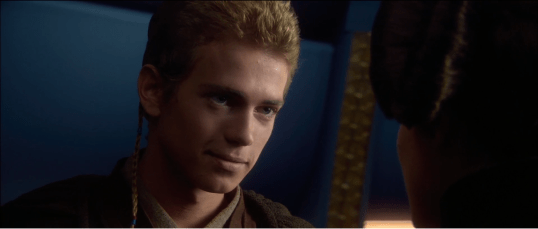
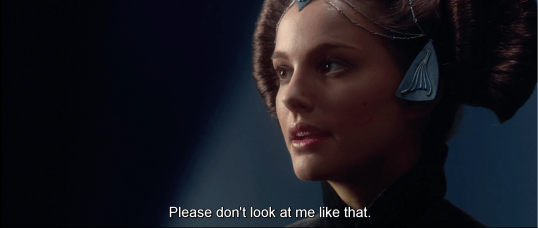
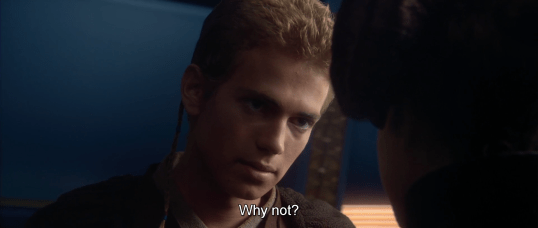
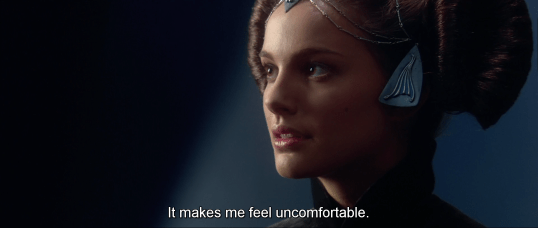
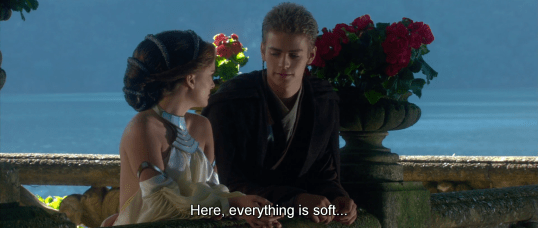
Now, I have to agree with Padmé. You can preach all you want about how you have a massive crush on Hayden Christensen’s mini braid, but that piercing sex offender gaze made me uncomfortable. Throughout the first act, Anakin goes from flirting with the poor woman to actively doing stuff very similar to sexual harassment. I mean, seriously, look at this lecherous, leering asshole.
Darth Vader has always been regarded as one of the greatest villains of cinema, but I never figured that he was also one of the sleaziest.
I wish this was the only problem with Anakin. Maybe it’s not Mr. Christensen’s acting, but the poor writing (though I suspect that, considering his absence in major movies this decade, his acting was definitely a factor). Young Skywalker is a very gifted Jedi, being immaculately conceived by midi-chlorians and all (I can’t stop laughing), and he is painfully aware of his skills, which he shows through an overpowering arrogance. Now, arrogance when done right can be charming, and perhaps that was the intention; to make Darth Vader a badass even as a teenager, a daredevil, someone who just barely succeeds, but does it with style. Anakin, however, comes across as impudent, annoying, and exceedingly stupid. It seems Anakin can’t go two scenes without doing something that would displease the Jedi council, and entirely aware of it too. ‘Cause that’s just how he rolls. James Dean from a galaxy far far away.
Second act comes. Anakin grows more and more adolescent and fascist. More politics happen. Then there are some cool action scenes that seem to save the film. Obi-Wan is written as barely having a personality, aside from comments that try to make it evident that he is growing older and grumpier, even though he can’t be much more than 30. Regardless, he is arguably the saving grace in the main cast, at the very least as far as really cool fights go. He pilots fighter ships, he fights with a lightsaber; the man sees some action. It’s almost depressing to see an actor of Ewan McGregor’s caliber being reduced to action hero and grumpy mentor to an angsty teenager.
Their dynamic is oddly reminiscent of Gran Torino
Jar Jar also appears. Fan favourite Jar Jar. I feel this is worth mentioning because in an extremely important scene he proposes (as stand-in senator for Amidala) to convey supreme power to Chancellor Palpatine. Yes, that Chancellor Palpatine, and I have to wonder why they couldn’t task this burden to an unnamed senator. Don’t people hate the poor gungan enough? It’s as if George Lucas is just fucking with his public to see how far they can go, at this point.
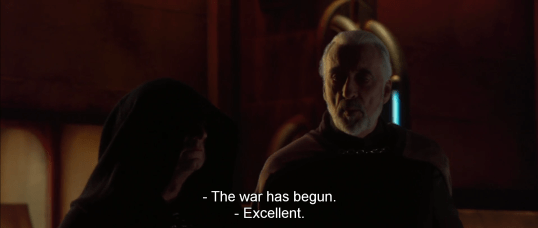
And then, in the third act, we are introduced to the big bad: Count Dooku, played by the late Sir Christopher Lee. You’d think that bringing this legend of acting might infer that this character is the highlight of the cast. Might have been. Dooku is a character full of potential. He’s obviously evil, but with just the right amount of idealism to seem more shades of grey than the cruel, pure black villains the series are accostumed to. But apparently all he does is some exposition, then pave the way for the epic arena fight scene that kind of defines this movie as a Star Wars film (perhaps one of the only things that defines this as a Star Wars film), some more exposition, a lightsaber duel (a really cool one, wrapping up the whole two things that make this a Star Wars film), and then he’s gone, apparently having started a war. The movie is over, without fully explaining why things escalated, and who exactly Count Dooku represents that the Republic is at war with.
WAR AGAINST WHOM???
I’m serious when I say this can be an entertaining movie. The fight scenes can be fun and you can laugh at what ridiculous situations the actors are subjected to. But it’s mostly incredibly dull. It’s a film that throws you into an extended torrent of politics you need to understand beforehand to appreciate, and that lead to Clone Wars, a pretty cool spin-off that most people never got to see and that might as well have been properly included as crucial to the continuity since it’s much better than this. As a standalone film, the story is a confusing, rushed mess even at two hours long. As a Star Wars film, Attack of the Clones makes it obvious that the series is not infallible. Horribly, gapingly, obviously not infallible.
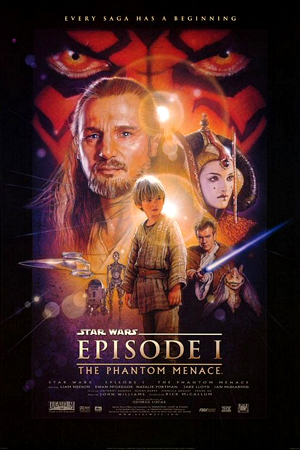
The time was May of 1999. The place was a movie theater in Baltimore, Maryland. The theater was packed with people waiting to see the most anticipated film of their lifetime. The film was The Phantom Menace, the first prequel to the original Star Wars trilogy. For two years, the people in the audience had followed every detail of the film’s production. Some of them had gone to showings of Meet Joe Black and Wing Commander, just so they could see the first trailers for the film.
Sitting out in that audience was one 16 year-old boy who, a few nights earlier, had been standing outside a Target at midnight so that he could be one of the first to buy Phantom Menace merchandise. He bought two Jar Jar Binks action figures because, even before Phantom Menace opened, he suspected Jar Jar would be the most controversial character.
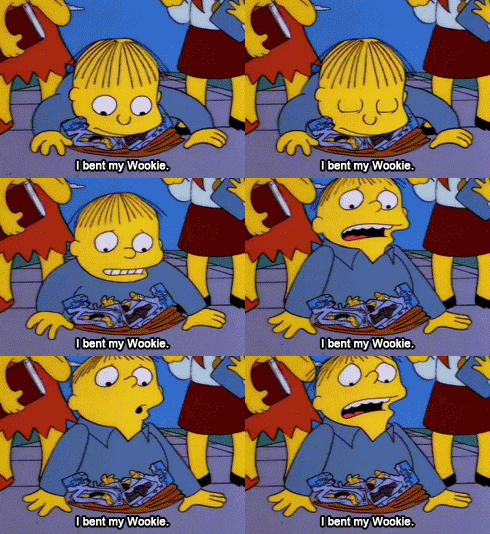
When the lights went down, the audience cheered. At the start of every trailer, someone in the dark theater shouted, “I bent my Wookie!” The audience laughed the first two times. By the fifth time, there were only a few pity titters.
Finally, it was time! The first few notes of John Williams’s Star Wars theme echoed through the theater. Again, the audience cheered as the familiar title crawl appeared on-screen.
The 16 year-old read the opening crawl and he started to get worried. What was all this talk about taxation? Trade routes? Trade Federation? Blockades? It seemed more appropriate for Star Trek or even Dune. Except for the mention of Jedis at the end of the crawl, it did not sound much like Star Wars.
Things started to look up as soon as Liam Neeson and Ewan McGregor made their first appearance as Qui-Gon and Obi-Wan. Obi-Wan’s first line was, “I have a bad feeling about this.” A few people in the audience clapped. “I bent my Wookie!” a familiar voice shouted. Nobody laughed.
When a hologram of Darth Sidious appeared and told the Trade Federation goons to kill Qui-Gon and Obi-Wan, everyone in the audience knew that Darth Sidious was Palaptine, the future Emperor, and the excitement was palpable. When Qui-Gon and Obi-Wan fought off the battle droids and escaped to the besieged planet of Naboo, the audience started to relax. Maybe this wouldn’t be as bad as the critics were saying.
Then Qui-Gon and Obi-Wan met Jar Jar Binks and the whole movie went to shit.
In the months leading up to the release of The Phantom Menace, everyone had heard about Jar Jar Binks and how he was a totally computer-generated character. Jar Jar Binks was the future of movie technology and, from the minute he first appeared, the future was fucking terrifying. Jar Jar was a Gungun, an amphibious creature who was characterized as being clumsy and cowardly. He shrieked in a high-pitched voice and spoke in an indescribable dialect. As much as the audience tried, there was no way to avoid or ignore Jar Jar Binks. He was not in the entire movie but he was at the center of every scene in which he did appear.
As Jar Jar led Obi-Wan and Qui-Gon to the underwater city of the Gunguns, a voice in the dark theater shouted out, “I bent my Wookie!”
“Shut the fuck up!” the 16 year-old snapped back.
The 16 year-old was not sure if anyone heard him but the voice was silent for the rest of the movie.
Sorry, Ralph.
No sooner had the audience recovered from their introduction to Jar Jar then they met young Anakin Skywalker. Anakin’s story was the whole reason that The Phantom Menace had been made. The audience knew that the prequels would show how Anakin Skywalker would grow up to the greatest and most evil badass in the universe, Darth Vader. But in Phantom Menace, he was just a 9 year-old slave on the planet of Tatooine, conceived by immaculate conception. Even before Phantom Menace was released, the word was out that Jake Lloyd, the child cast as young Anakin, was not exactly the best actor in the world. But even though they had been forewarned, the audience was not prepared for just how terrible little Jake Lloyd was in the role. There was no darkness to Jake Lloyd’s cutesy performance. There was no sadness or toughness. Jake Lloyd came across like the type of hyperactive child who would end up in the ensemble of a Christmas play, breaking character and waving to his parents during the Crucifixion. Not only could the audience not see him growing up to be Darth Vader but they could not imagine him as a slave living on an inhospitable desert planet.
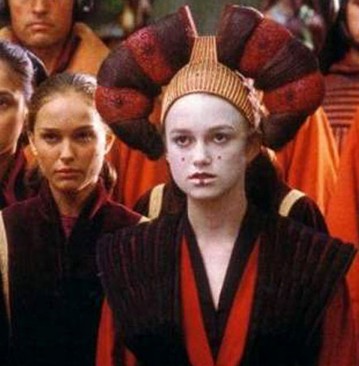
Qui-Gon, Obi-Wan, Jar Jar, Queen Padme (Keira Knightley), and Padme’s handmaid, Amidala (Natalie Portman) were stranded on Tatooine when they first met Anakin. Qui-Gon felt that Anakin was “the chosen one,” who would bring balance to the force. It was hard for the audience to believe him when they heard Anakin shout, “Yippe!”
For that 16 year-old who had stayed up past midnight to buy two Jar Jar Binks action figures, that “yippe” was the final straw. He had watched the original Star Wars trilogy on VHS tapes. He had gone to the re-releases. He loved Star Wars and he wanted to love The Phantom Menace. Instead, he felt so let down by the film that he could barely look at the screen.
The 16 year-old wondered why C3PO and R2D2 were in the film. Phantom Menace revealed that they were built by the future Darth Vader. R2D2 would even help Anakin in the film’s final battle. It made no sense. The 16 year-old wondered if anyone else in the audience was as confused as he was. He wondered why, if he could see that this made no sense, George Lucas could not understand the same thing.
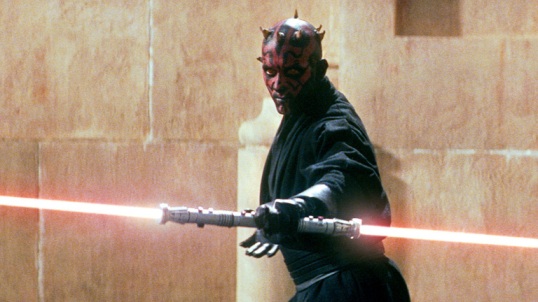
Anakin won a pod race and was allowed to leave Tatooine. The film’s action was moved to the Coruscant, a planet that was covered with one huge city. Samuel L. Jackson appeared as Mace Windu and, when he stared out at the audience, he seemed to be saying, “I fucking dare you to yell anything about bending your motherfucking Wookie!” There were scenes set in the galactic senate, presumably to appease everyone who wanted a meticulously detailed portrait of how a galactic Republic would be governed. Padme turned out to be a fake and Amidala was revealed as the real queen. There was a final battle between the forces of the Republic and the Trade Federation. Qui-Gon was killed in a duel with the evil Darth Maul (Ray Park) but Obi-Wan promised to train Anakin in the ways of the Jedi. Palpatine promised that he would be watching Anakin’s development.
And, of course, there was this:
For many in the audience who truly loved the original trilogy and who had spent the past two years scouring every corner of the Internet in search of news about The Phantom Menace, the midi-chlorians was the point that they give up on the movie. The Force added a hint of mysticism to the original trilogy. Because it was so mysterious and its origins so deliberately obscure, fans of Star Wars could imagine that The Force was inside of them as well as Luke and Darth Vader. “May the force be with you,” was more than just a catch phrase to those fans. It was a reminder that, even in a galaxy far far away, there was still mystery and faith. When Qui-Gon talked about midi-chlorians, fans realized that not only did they understand the appeal of Star Wars better than George Lucas but George Lucas did not even care why they loved his film. For those fans, the midi-chlorians not only ruined The Phantom Menace but cheapened the original trilogy as well. The Force was no longer special or mystical. Anakin might as well have just been bitten by a radioactive spider.
For the 16 year-old, it was somehow even worse that, before asking about the Force, Anakin apologized to Qui-Gon for causing so much trouble. Sitting out in the theater, he knew that the boy who would grow up to be Darth Vader would never yell “yippie!” and he would never apologize for causing any trouble.
At the end of the movie, the audience did not know how to react. The 16 year-old talked to his friends as they filed out of the theater. Everyone was in a state of denial. They knew that they had seen something very disappointing but, after all the excitement leading up to the release of The Phantom Menace, they did not want to admit how disappointed they really were with the actual movie. They talked about what did work. They talked about the pod race, which had been fun. They talked about the exciting light saber duel between Qui-Gon, Obi-Wan, and Darth Maul. Being teenage boys, they also talked about Natalie Portman and Keira Knightley.
They tried not to talk about Jar Jar Binks, beyond agreeing that he sucked. They tried not to talk about Jake Lloyd as Anakin. It was too painful to know that Star Wars had been reduced to Jar Jar Binks and Jake Lloyd. They did make fun of the “I bent my Wookie” guy. In the face of grave disillusionment, it was all that the 16 year-old and his friends could do.
Today, enough time has passed that it is easier to laugh about Jar Jar Binks and The Phantom Menace. Though the initial trauma may have faded into memory, it all came rushing back to me as soon as Lisa asked me if I would be willing to review The Phantom Menace for this site. I cautiously agreed and hoped that, since I already knew what I was getting myself into, The Phantom Menace would not be as disappointing the second time around.
It was a strange experience rewatching The Phantom Menace. While I remembered how bad the movie was, I’d forgotten how equally boring it was. Jar Jar Binks was even more annoying than I remembered and Jake Lloyd was even worse. Of the film’s best scenes, the pod race went on too long and the duel with Darth Maul was too short. For such a badass villain, Darth Maul was underused for much of the film, as if George Lucas did not understand that the kids he claimed to have made the film for would be far more interested in the dynamic Darth Maul than the histrionic Jar Jar Binks.
Emphasizing Jar Jar Binks over Darth Maul made as much sense as emphasizing the Ewoks at the expense of Boba Fett.
Worst of all, the entire movie felt even more pointless the second time around. When the prequels were first released, George Lucas always said that all three of them should be viewed in the context of the larger story that they were telling. But what do we really learn from The Phantom Menace or any of the prequels? Did anyone really want to know about how trade was regulated before the Empire? Did we really need to know the exact details of how Anakin became a Jedi? Watching The Phantom Menace, the answer is no.
I was especially surprised by how bad the CGI looked. When The Phantom Menace was first released, the CGI was often the only thing that was critically praised. Critics may have hated Jar Jar Binks as a character but they all agreed that it was impressive that a major character had been created by a computer. It is easy to forget just how big a deal was made about The Phantom Menace‘s special effects. At the time, we had yet to take it for granted that an entire movie could be made on a computer.
But seen today, the CGI not only seems cartoonish but, like the midi-chlorians, it feels like a betrayal of everything that made the original Star Wars special. The universe of New Hope and Empire Strikes Back felt lived in. It was imperfect and real. It was a universe where even the most fearsome storm trooper could accidentally bump his head on a doorway.
But the CGI-created universe of The Phantom Menace was too slick and too perfect. There was no chance for spontaneity or anything unexpected. The universe of the original Star Wars trilogy was one in which you could imagine living but the universe of The Phantom Menace seemed only to exist in the computers at Lucasfilm. With The Phantom Menace, George Lucas seemed to be reminding those who loved his films that the Star Wars universe belonged to him and him alone. Our imagination was no longer necessary.
As for that 16 year-old who first saw The Phantom Menace in that Baltimore theater, I still have those Jar Jar Binks action figures. I keep one of them on my desk at work and I enjoy the strange looks that it gets. If you push down its arms, Jar Jar sticks out his tongue.
It is Star Wars month as we move closer and closer to the release of the latest film in the Star Wars franchise. I chose a few weeks back a favorite scene from the very first Star Wars which came out in 1977. This favorite scene is the first of three that make up the three specific scenes I love from Star Wars: A New Hope.
This second favorite scene also shows up in the early part of the film. The first scene I chose showed the wow factor of the space battle and capture of the Rebel Alliance frigate and the introduction of one of filmdom’s greatest and most iconic villains in Darth Vader. This latest chosen scene introduces us to his polar opposite in the young Luke Skywalker on the planet Tatooine.
It’s a scene that focuses on the hope and dreams of a young man stuck in a place he knows he doesn’t belong. He believes that he’s meant to be doing something more important and we find out later on in the film that his feeling is correct. It helps that the scene was helped by the score of one John Williams whose musical track playing in the background — aptly titled “Binary Sunset” — gives it a sense of longing and a promise of a better future.
Today marks 30 more days before the release of the next chapter in the Star Wars saga. It’s been almost a dozen years since the prequels finally ended and the fandom was split between those who railed against it and those of the younger generation whose first entry into the Star Wars universe were the prequels instead of the original trilogy.
For those who grew up watching the original trilogy over and over throughout the years, the prospect of the franchise returning to it’s adventure roots instead of delving into the soap operatic backstory that made up the prequels was enough to create the massive swell of hype and anticipation for a film unheard of even in these current era of superhero tentpole blockbusters and massive sequels.
Star Wars: A New Hope was my gateway to the fandom and no scene helped usher me into becoming a devoted fan than the very first few minutes of the film as we see the message crawl to start then the massive bulk of the Imperial Star Destroyer chasing down a fleeing ship of much smaller size. Yet, the scene doesn’t end there. No, it continues inside where we finally get our first introduction to one of film’s most iconic villains to ever grace the silver screen.
The Imperial Star Destroyer opening was the hook and Darth Vader pulled one in.
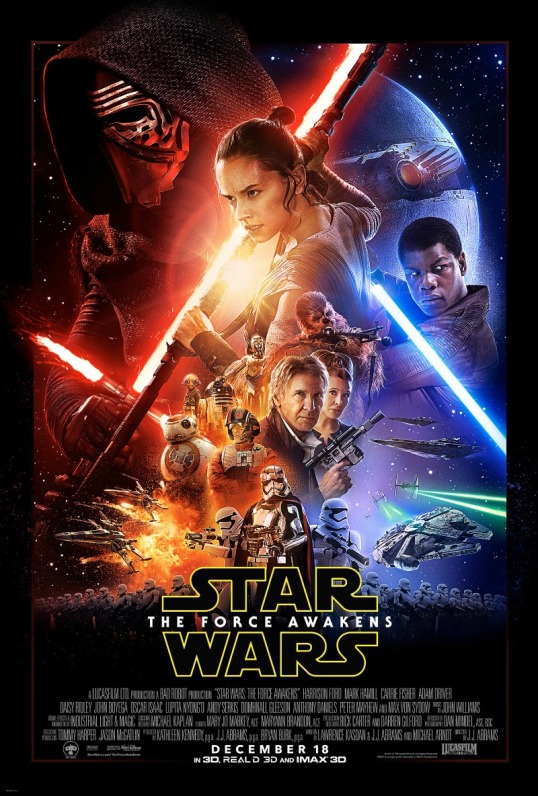
Just a couple weeks ago saw the release of the first and last official trailer for Star Wars: The Force Awakens. It was teasers before that one. The official trailer was suppose to keep the Star Wars fandom sated until December 18 (or earlier for those willing to brave the early advance screenings before midnight). It pushed all the right buttons to keep the fandom happy and wanting more.
Out of the blue, this morning saw Disney release without any fanfare a new trailer but one cut and edited for the Japanese market. It’s a trailer that includes scenes and images already seen in the previous official trailer and two earlier teasers, but also happened to include newer scenes (that still doesn’t spoil what the film will be all about) involving BB-8, Kylo Ren and more Princess Leia and Chewie.
So, it would seem that when Disney said that the trailer released a couple weeks ago would be the one and only trailer for the film it would seem they meant it would be the only domestic trailer. Sneaky, sneaky there Disney.
Plus, I rather prefer the Japanese trailer. Once again proves the Japanese gets the cool things.
It’s not hyperbole when I say that Star Wars: The Force Awakens broke the internet tonight. Fandango announced pre-sale of tickets early by accident which caused the massive Star Wars fandom to rush on-line to be able to buy tickets before they ran out for the early showing on December 17, 2015. Well, this hasn’t gone down well with many who thought the pre-sale orders were going to go up after the trailer debuts during halftime of Monday Night Football.
I was one such out-of-luck individuals, but I remembered my days of youth when pre-ordering tickets to such event films meant going to the theater itself and buying them in person. This I did and I’m blessed to have gotten all the tickets I need.
Thus, despite Star Wars: The Force Awakens breaking the internet it would seem doing things the old-school way still rewards those who still thinks in analog and not just digital.
Now, let’s watch the latest trailer for Star Wars: The Force Awakens over and over before it premieres on December 18, 2015.
I wanted to write about two gems today, but I don’t feel well. Today is as good a day as any to start this series of posts. I watch a lot of movies and I just can’t write full posts about each and every one. Instead, I am going to do little roundups like this from time to time. Here we go.
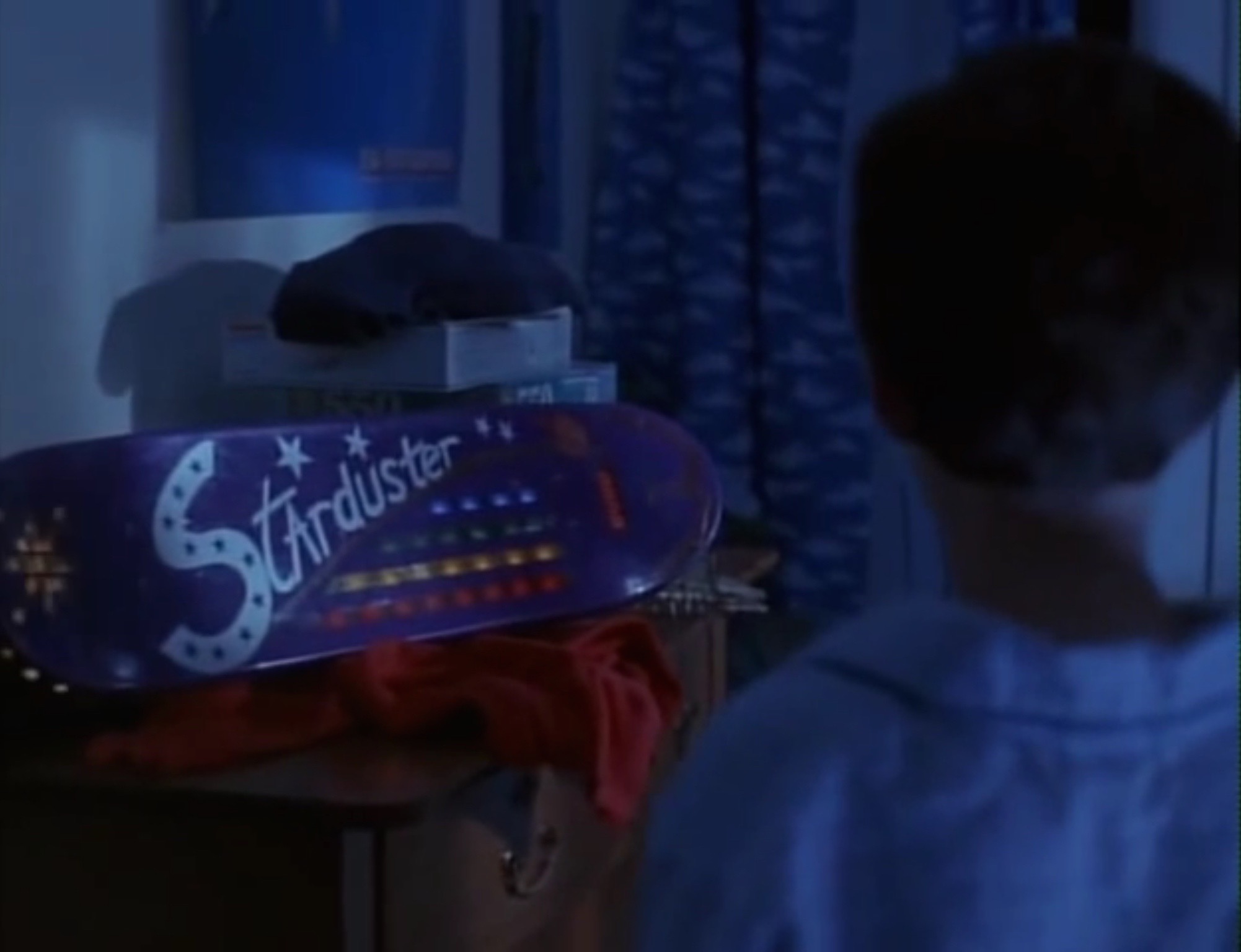
The Skateboard Kid (1993) – When I was a kid, a piece of wood on wheels could make you cool. Studios knew this, so many stupid skateboarding movies were made. This was one of them. But this one has a twist. Ready for this? The skateboard talks! And it flies! To make matters worse, Dom DeLuise voices the skateboard. Stay away! Watch the Francis movies instead.
The Skateboard Kid II (1995) – What do you do when a bad movie about a talking flying skateboard comes out? Make a sequel of course! But this one has two things different about it. One, the skateboard becomes possessed by Turhan Bey. Don’t recognize the name? He actually dated Lana Turner back in the day. Also, the movie was executively produced by Jim Wynorski. He made Chopping Mall back in the 80’s and the softcore porn film Sexually Bugged! in 2014. Haven’t seen the first one yet, but the second one stinks to high heaven. No wonder he directed it under the name Sam Pepperman. This Skateboard Kid is actually better than the first if you can believe that.
Time Barbarians (1990) – The movie starts in olden times. There’s a stupid warrior, a stupid amulet, stupid bad guys, and it takes an hour or so for all three to wind up in Los Angeles. It’s like waiting for Godzilla to appear in the 2014 version. Once they get there it gets as dumb as you think. He not only can block bullets with his sword, but bullets fired from an automatic weapon. That’s some fine work! Can you believe this actually came out before The Beastmaster did the same thing with it’s sequel?
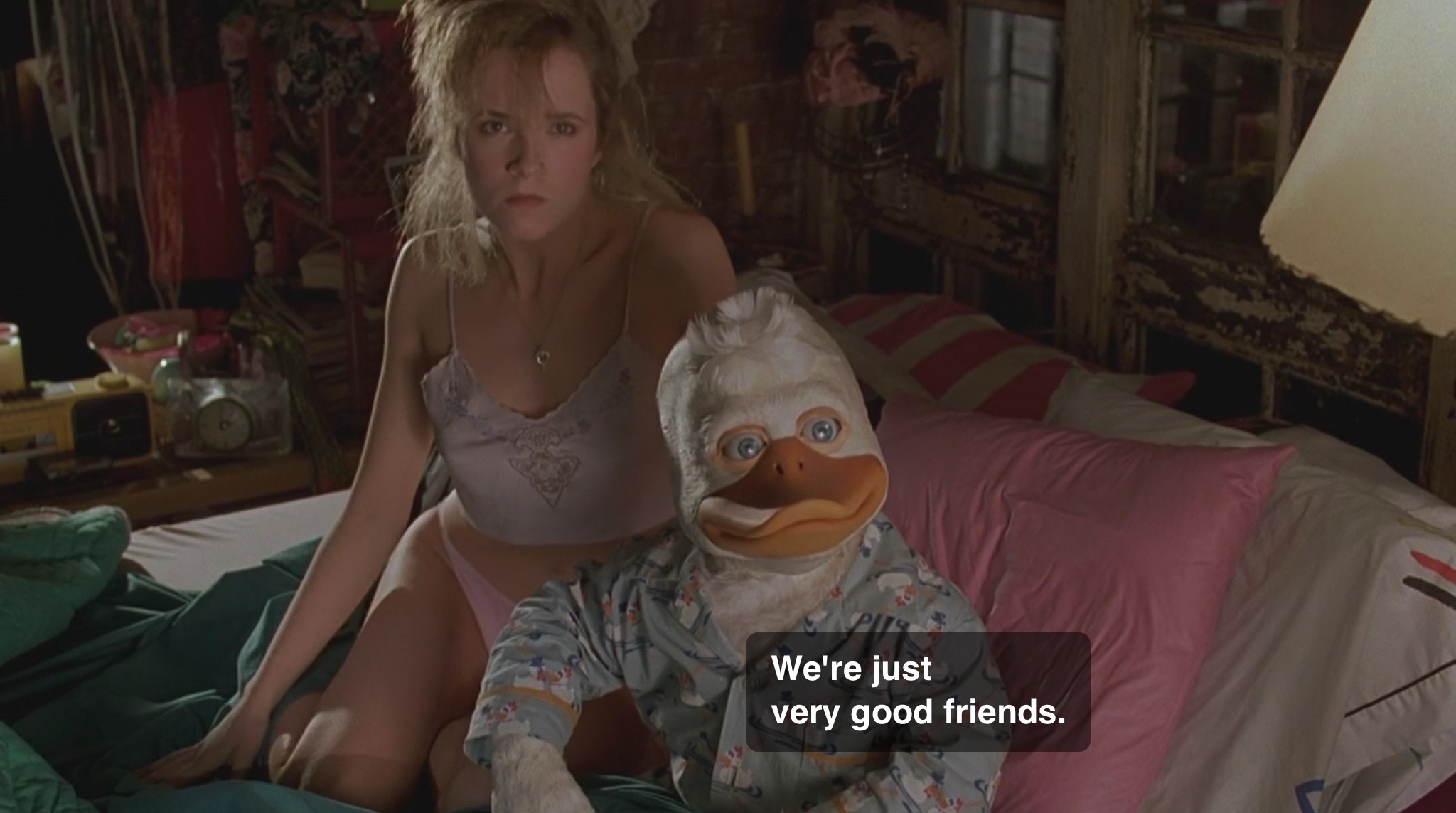
Howard The Duck (1986) – Yeah, I finally watched this movie. I don’t know why it has the reputation it does. Maybe people were not familiar with what a bad movie truly was at the time or they made the mistake of worshipping a director. I’m leaning more towards the second since you see people spend years trying to find ways to defend bad movies made by otherwise good directors. It’s not good, but it’s stupid campy fun. Harmless. The major issue with the film is that they tried to make it like E.T. in that it’s almost all about getting Howard back home. I think audiences would have preferred more of the wisecracking fun and much less of the child friendly material. Still, I enjoyed it more than Iron Man 2 & 3 so it’s a better Marvel movie than those and they have received praise.

 The year 2005 was a dark time to be a fan of Star Wars.

 A long time ago in a galaxy far, far away…