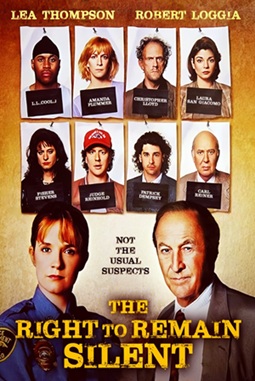
It’s one very busy night at a police station. Everyone who is brought in from off the streets has the right to remain silent but no one exercises it. Rookie cop Lea Thompson listens to everyone’s stories. LL Cool J is the documentarian who thought it would be smart to put on Klan robes and a hood and try to infiltrate a demonstration undercover. Patrick Dempsey is the drunk who killed a kid. Carl Reiner comes in and confesses to mercy killing his wife. Christopher Lloyd is homeless. Fisher Stevens is a trans streetwalker. Judge Reinhold, I don’t even know what he was supposed to be. Reinhold actually plays two characters in this film and he’s miscast in both roles. Amanda Plummer is a pizza delivery person who shoots someone in self-defense. No one asks for a lawyer. No one lies about what they did. Instead, they just talk and talk and talk and talk some more. Thompson listens while Robert Loggia, as the chief, growls about donuts.
The Right To Remain Silent is based on a play and that is its downfall. Instead of being a story about a rookie cop and her first night on the job, it’s just a collection of rambling stage monologues. Some of the actors, like Carl Reiner and Christopher Lloyd, do okay. Most of them still seem to be acting for the folks sitting in the back row. It ultimately doesn’t add up too much because the stories are too predictable to make much of an impression. Everyone in this film had the right to remain silent and I wish they had exercised it.
Asteroid City opens with black-and-white footage of Bryan Cranston, wearing a suit and speaking in the authoritative tones of someone who has made his living on television. Cranston informs us that we are about to see a televised production of a play by the famed but enigmatic playwright named Conrad Earp (Edward Norton).
The play, which is seen in stylized color, opens with Augie Steeback (Jason Schwartzman) driving his family through the desert. He is taking his son, Woodrow (Jake Ryan), to a Junior Stargazers convention that is being held at Asteroid City, a tiny town that is best-known for being the location of an impact crater. Along for the ride are Augie’s three daughters, who are all pretending to be witches. What Augie hasn’t told his children is that their mother has died, her cremated remains are in a Tupperware container, and that they will be moving in with their wealthy grandfather (Tom Hanks).
There’s not much to the town of Asteroid City. There’s a motel that’s managed by a man (Steve Carell) who sells land deeds out of a refurbished Coke machine. There’s a diner. There’s a group of helpful cowboys, led by the polite and helpful Montana (Rupert Friend). There’s a mechanic (Matt Dillon) who is called into duty when Augie’s car breaks down. The Junior Stargazer convention is the event of the year for Asteroid City. Young geniuses from all around the country have descended on the town and have brought their parents. One of them, Dinah (Grace Edwards), is the daughter of actress, Midge Campbell (Scarlett Johansson). When an alien (played, at one point in the film, by Jeff Goldblum) shows up and steals the town’s meteorite, General Gibson (Jeffrey Wright) declares a quarantine. Some people handle the lockdowns better than others. Augie takes pictures and thinks about his wife. Midge rehearses for her next role, one that is centered around her character dying. The genius children play a memory game that they realize will never end because they’re all geniuses. A teacher (Maya Hawke) tries to teach her students about the Milky Way, just to discover that the kids only want to talk about the alien. One of the fathers (Liev Schreiber) ends up with a useless plot of desert land and the death ray that his son recently invented.
Throughout it all, Bryan Cranston appears in black-and-white footage that gives us a look into what went on behind the scenes during the production of Asteroid City. The director (Adrien Brody) was a lech. The actor playing Augie struggled to understand what the play was about and who his character was meant to be while the actress (Margot Robie) hired to play his wife ended up in another play after her scenes were cut from Asteroid City. Only once does Bryan Cranston’s host appear in the color sections of Asteroid City, just to sheepishly admit that he’s not supposed to be there before ducking off camera.
Even if his name wasn’t in the opening credits, the viewer could probably easily guess that this is a Wes Anderson film. It features all of Anderson’s trademarks, all of the things that viewers will automatically love or hate depending on how they feel about Anderson’s quirky aesthetic. It’s a visually impressive, pop art-flavored, all-star comedy with an undercurrent of profound melancholy, one in which the fanciful strangeness of the alien’s “invasion” is compared and contrasted with the very real-life strangeness of how humans deal with life, loss, death, and uncertainty. Scenes of clever wordplay are mixed with scenes in which we see Augie still very much struggling to come to terms with the death of his wife and the actor Augie very much struggling to understand what is actually going on in his character’s head. As far as recent Anderson films go, Asteroid City is not quite as humanistic as Rushmore or Grand Budapest Hotel but, at the same time, it’s still more accessible than The French Dispatch.
If you’re not a fan of Anderson’s style, this film won’t convert you. That said, I am a fan of Anderson’s style and I absolutely loved Asteroid City. As with so many of Anderson’s films, the main focus is on how we try to deal with the uncertainties of life by trying to maintain an illusion of control over every aspect of our lives. Playwright Conrad Earp writes because that way he can have a world that follows his own rules. The actors follow a script that tells them how to react to everything that happens around them. In the play, the Junior Stargazers fall back on science while Augie’s father-in-law falls back on religion and Augie’s daughter convince themselves that spells will bring back or, at least, protect their mother. Even General Gibson falls back on his belief in the government and the military to deal with the sudden appearance by the alien. The alien is the unknowable and his arrival reminds everyone that life is unpredictable, regardless of how much you try to control your own story. Indeed, while the film takes place in the 50s and is full of comments about the Red Scare and atomic bomb testing, it’s hard not to see Asteroid City as being a commentary on the recent COVID lockdowns and the debate over whether people could ever go back to living the way that they did before the pandemic. Much as with the Coen Brothers’s similarly stylized A Serious Man, the ultimate message seems to be that the only way to deal with the unpredictability of life is to embrace it.
It’s also a very funny film, one that is full of small details that reward repeat viewing. If one focuses on the background characters, it quickly becomes apparent that there are actually several stories unfolding in the film and, much as with life, the viewer just has to be willing to look for them. (I particularly enjoyed the romance between The Teacher and Montana.) Jason Schwartzman is compelling as both Augie and the actor playing Augie and Scarlett Johansson plays both Midge and the actress playing Midge with the perfect amount of cool detachment. To the film’s credit, none of the character’s become caricatures. They remain individuals, regardless of how bizarre the film’s story may sometimes seem. Everyone gets a moment to reveal a little depth, from Jeffrey Wright’s sincere (if misplaced) faith in the lockdown policy to the moment when Tom Hanks’s previously unsympathetic father-in-law reveals that he’s as much in mourning as Augie. The all-star cast also includes Tilda Swinton, Liev Schrieber, Stephen Park, Willem DaFoe, Hong Chau, and Margot Robbie and all of them add to the film’s portrait of quirky but ultimately relatable humanity.
Again, with this film, it undoubtedly helps to already be familiar with and to like Wes Anderson’s way of doing things. If you’re not a fan of his film, this one probably won’t change your mind. That said, for those of us who do enjoy his style, this is Anderson at his best.
What’s an Insomnia File? You know how some times you just can’t get any sleep and, at about three in the morning, you’ll find yourself watching whatever you can find on cable or Netflix? This feature is all about those insomnia-inspired discoveries!
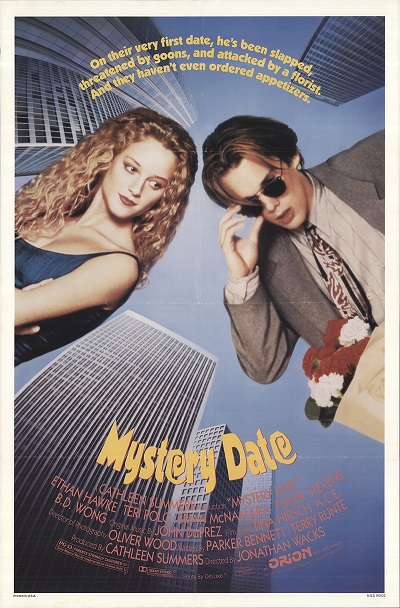
If you were having trouble getting to sleep last night, around one in the morning, you could have turned over to the HBO Family channel and watched the 1991 comedy, Mystery Date!
A young and extremely adorable Ethan Hawke plays Tom McHugh, a college student who is in love with Geena (Teri Polo), the housesitter next door. The only problem is that Tom is extremely shy and can’t even work up the nerve to ask Genna out. It sure would help if he was rich and charming like his older brother, Craig (Brian McNamara). Eventually, Craig helps his brother out. He gives Tom his credit card and his car so that Tom can take Geena out on a date. What an nice brother! Soon, Tom and Geena are hitting the town and having a great time. They even see Gwar perform which …. well, okay. That probably would not be my ideal first date but whatever.
Unfortunately, it turns out that Craig has gotten involved with some pretty bad things and, as a result, there are two dead bodies in the trunk of the car! Uh-oh, that could be awkward. Plus, the Chinese mafia (led by B.D. Wong) are determined to kill Tom because they think that he’s Craig. And finally, to top it all off, Tom has got a crazed flower delivery guy (played by Fisher Stevens) following him all over the city. Can Tom possibly survive the night and still get a second date!?
Mystery Date starts out nicely. Ethan Hawke is cute in a non-threatening sort of way. Teri Polo is likable. They seem like they would make a cute couple. You want things to work out for them. Unfortunately, once the date actually starts, the film gets frantic without getting any funnier. It becomes a case of the film just trying too hard and you feel as if the film is demanding that you laugh as opposed to offering up a reason to laugh. You watch the film and you don’t so much think about what you’re watching as you think about films like Risky Business and Better Off Dead, both of which told similar stories with a lot more energy and imagination. You have to kind of imagine that whenever Ethan Hawke gives one of his interviews where he talks about why he’s not interested in doing typical mainstream films, this is probably the type of movie that he was talking about. Among the many other things for which we have to thank Richard Linklater, he ensured that Ethan Hawke would never have to star in Mystery Date 2.
Among some horror fans, the 1981 film, The Burning, has long had a reputation for being one of the best of the many films to come out of the early 80s slasher boom.
I have to admit that the first time I saw it, my thought process went something like this: Oh great, more campers …. I can’t wait to see all of these people die …. God, these campers are annoying …. Thank God I never went to summer camp …. Wait, is that Jason Alexander …. when is the killer going to show up …. oh hey, that is Jason Alexander …. if I wanted to sit through a bunch of silly summer camp hijinks, I wouldn’t have gone searching for a horror film …. goddammit, was it really necessary for Jason Alexander to moon the camera …. wow, this movie is boring …. I don’t know who said this was scary but seriously …. oh God, now it’s turning into a movie about rafting …. I’ve about had it …. this movie is so bor–OH MY GOD WHAT THE HELL JUST HAPPENED! AGCK! THERE GO HIS FINGERS OH MY GOD….
Seriously, The Burning is a film that requires a bit of patience. You got to sit through a lot of silliness before you actually get to the horror but once you do …. oh my God! It’s intense. The killer in The Burning is Cropsy, a former groundskeeper who was set on fire by a bunch of campers years ago. Now, he’s everyone’s worst nightmare — a madman with gardening shears. It takes a while for Cropsy to really get into the spirit of things. In fact, for a good deal of The Burning, no one is even talking about Cropsy, which is always a mistake when you’re trying to make a movie about a killer in the woods. A young camper named Alfred (Brian Backer) keeps thinking that he see Cropsy sneaking around the camp but nobody believes him, largely because Cropsy doesn’t ever do anything to let people know that he’s back and ready to demonstrate how gardening tools can be used as an instrument of revenge.
However, once Cropsy actually gets going, he is terrifying! The Burning is a good example of the type of horror movie that was made before the Nightmare on Elm Street series introduced the idea that killers could not only talk but also tell a lot of corny jokes. Cropsy doesn’t speak. Crospy doesn’t joke. All Cropsy does is kill. What makes Cropsy especially disturbing is that — much like the killer in The Prowler — he seems to get a lot of joy out of killing as brutally as possible. He’s not Jason or Michael, killers who killed because that’s all they knew how to do. Cropsy plots and calculates and hides and is basically everyone’s campfire nightmare come to life.
Now, as I said before, it does take Cropsy a while to get started. And we do end up spending a lot of time watching campers do stupid things. Yes, Jason Alexander is one of the campers. He not only has hair but I think he’s supposed to be a teenager in this film. He was 21 when the film was shot and he looks like he’s about 35. He delivers his lines in such a way that it’s impossible not to think of The Burning as being a lost episode of Seinfeld where George Costanza goes camping. On the plus side, he does get some vaguely funny lines, which is more than his co-stars get.
Speaking of co-stars, keep an eye out for Holly Hunter. She was dating Jason Alexander at the time (as well as rooming with Frances McDormand) and she makes her film debut as one of the campers. She gets one line. “What if they don’t come back?” It’s a good question. What if they don’t? (Cue dramatic music!)
Anyway, The Burning is a slasher film that requires some patience but when it needs to be scary, it gets the job done. (The gore effects are by the one and only Tom Savini and yes, they are shocking and a bit disturbing. If you’ve ever wanted to know what losing four fingers at once would look like, this is the film for you.) It’s a bit too padded for its own good but Cropsy is an effective villain and the movie actually catches you by surprise regarding who survives and who doesn’t. Amazingly, there was never a sequel to The Burning. Personally, I don’t think it’s too late. I want to see Jason Alexander return to the camp and finish Cropsy off, once and for all!
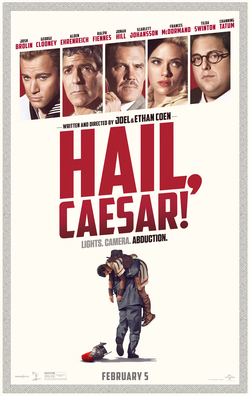
Sometimes, I wonder if I was the only filmgoer who actually enjoyed Hail, Caesar! when it was released in February.
Oh, don’t met wrong. I know that I’m being a bit overdramatic when I say that. It got some good reviews from the critics, though the praise was rather muted when compared to the reviews that traditionally greet the latest film from the Coen Brothers. I know more than a few people who have agreed with me that Hail, Caesar! was an entertaining lark of a film.
But I know a lot more people who absolutely hated Hail, Caesar! Of course, no film is going to please everyone and the Coen Brothers have always had a tendency to attempt to deliberately alienate their audience. But what has always struck me is the fact that the people who disliked Hail, Caesar seem to really, really dislike it. Talk to them and you get the feeling that they view Hail, Caesar as almost being some sort of a crime against both humanity and cinema.
Taking place in a stylized Hollywood in 1951, Hail, Caesar! tells the story of Eddie Mannix (Josh Brolin). Eddie is a shadowy figure. As head of production at Capitol Pictures, Eddie’s job is to keep the “bad” behavior of the stars from getting out into the press. (The press is represented by Tilda Swinton who, in a typical Coen Brothers twist, plays twin sisters who are rival gossip columnists. If the thought of that makes you smile, you are potentially a part of the right audience for Hail Caesar. If it makes you roll your eyes, you should probably avoid the film.) Eddie is the most powerful man in Hollywood and he will do anything to protect the image of the American film industry. He will lie. He will cheat. He will threaten. He is so ruthless and so good at his job that even Lockheed Martin is trying to hire him away from Capitol. And yet, at the same time, Eddie is also a family man and a Catholic who is so devout that he goes to confession on a nearly hourly basis.
(For all you non-Catholics out there, Pope Francis only goes to confession twice a month.)
Hail, Caesar! follows Eddie as he deals with a series of potential problems. Temperamental director Laurence Laurentz (Ralph Fiennes) is upset because he’s been forced to cast Hobie Doyle (Alden Ehrenreich, giving the film’s best performance), a good-natured but inarticulate cowboy star, in his sophisticated comedy. Synchronized swimmer DeeAnna Moran (Scarlett Johansoon) is not only pregnant but unmarried as well! (It’s the 50s, remember.)
However, the biggest crisis is that Baird Whitlock (George Clooney) has vanished from the set of his latest film. A mysterious group known as The Future has taken credit for kidnapping him. It’s not really much of a spoiler to reveal that The Future is a cell of communist scriptwriters and they are determined to convert the rather dumb Baird to the struggle. As opposed to most films about Hollywood in the 50s, the communist screenwriters are portrayed as being a bunch of self-righteous and rather cowardly nags, the majority of whom spend more time debating minutiae than actually trying to the overthrow capitalism. In many ways, Hail, Caesar is the anti-Trumbo.
As you might guess from the plot description, there’s a lot going on in Hail, Caesar but none of it really adds up too much. Nor is it supposed to. We’re encouraged to laugh at these frantic characters, as opposed to sympathize with them. Eddie Mannix and Hobie Doyle both emerge as heroes because they’re the only characters who remain calm and confident, regardless of what strangeness is happening onscreen. Eddie may be ruthless, the film tells us, but at least he gets results. Hobie may not be the smartest or most talented guy in Hollywood, we are told, but at least he doesn’t pretend to be anything other than who he is.
Hail, Caesar! is a bit of a lark, a celebration of style over substance. As far as Coen Brother films go, Hail, Caesar has more in common with Burn After Reading than No Country For Old Men.The film is largely an inside joke aimed at people who know the history of Hollywood, which is perhaps why some viewers reacted so negatively. Inside jokes are fun when you’re in on the joke. When you’re not in on it, though, they’re just annoying.
As for me, I thoroughly enjoyed Hail, Caesar! It may not be the Coens at their best but it’s a lot of fun and it appealed me as both a history nerd and a lover of old movies. The best parts of Hail, Caesar! are the scenes that parody the largely forgotten, big-budget studio productions of the 1950s. This is the rare film that acknowledges that not every film made before the 1960s was a masterpiece. The Coens love movies but that doesn’t keep them from getting a little bit snarky. For example, check out this production number featuring Channing Tatum:
What’s an Insomnia File? You know how some times you just can’t get any sleep and, at about three in the morning, you’ll find yourself watching whatever you can find on cable? This feature is all about those insomnia-inspired discoveries!
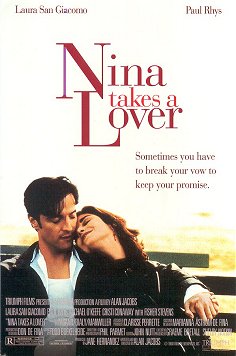
Last night, if you were having trouble getting to sleep at 2 in the morning, you could have turned over to Starz and watched Nina Takes A Lover, a movie from 1994.
Nina Takes A Lover is such a typical 90s Sundance film that it could have just as easily been called Independent Movie From 1994. Everything that we tend to associate with American independent cinema is present in this film. It’s a relationship drama with moments of quirky comedy. It’s set in the city and no, it doesn’t matter which city. It could be New York or it could be Seattle or it could be Los Angeles or San Francisco. The important thing is that it’s a city on one of the coasts, the type of city where people engage in witty banter while sharing an apple in the park or over cups of coffee at a cozy cafe that was probably replaced by a Starbucks after this film was released. This is the type of film where the characters tell their stories in flashback while being interviewed by a bespectacled journalist. Characters alternate between artificial small talk and sudden statements of portentous wisdom. Of course, all of quirky drama leads up to a sudden twist. I figured out the twist after watching about 10 minutes of the film. Maybe audiences in 1994 were a bit more surprised.
About the only thing that keeps Nina Takes A Lover from being the most stereotypical indie film ever made is the fact that there’s no quirky criminals and nobody spends any time talking about their favorite childhood TV shows. If Nina had only shot someone while taking a lover, this would have been the most indie film ever.
I imagine that I’ve probably made the film sound totally unbearable but I actually enjoyed Nina Takes A Lover. Once I realized and accepted that Nina Takes A Lover wasn’t exactly going to reinvent cinema, I discovered that it was actually a very likable film.
Nina is played by Laura San Giacomo, who owns a shoe store. Nina meets a man in the park. The man (Paul Rhys) has no name and is merely identified as being “Photographer.” (And, of course, he’s British because this is an independent film and, in the world of indie cinema, all ideal lovers are British.) Soon, Nina and Photographer are having a passionate and very physical affair. However, Nina explains that she’s married and her husband will be home in three weeks. Photographer says that he has a wife as well. As Nina and the Photographer talk about love, marriage, and sex, they also try to figure out what they should do when the three weeks are up.
And, of course, it all leads to a twist that you’ve probably already figured out but you know what? It doesn’t matter if the film is predictable because it’s just so likable. Laura San Giacomo and Paul Rhys both give likable performances, they have a lot of chemistry, and the sex scenes are well-done and genuinely erotic. The film may tell a familiar story but it tells it well.
Nina Takes A Lover is a good film to watch when you’ve got insomnia. It won’t put you to sleep but it will definitely make the hours of darkness a little more pleasant.