First released in the groovy and psychedelic year of 1970, The Dunwich Horror stars Sandra Dee as Nancy, an somewhat innocent grad student at Massachusetts’s Miskatonic University. When the mysterious Wilbur Wheatley (Dean Stockwell) comes to the university and asks to take a look at a very rare book called The Necronomicon, Nancy agrees. She does so even though there’s only one edition of The Necronomicon in existence and it’s supposed to be protected at all costs. Maybe it’s Wilbur’s hypnotic eyes that convince Nancy to allow him to see and manhandle the book. Prof. Henry Armitage (Ed Begley) is not happy to see Wilbur reading the book and he warns Nancy that the Wheatleys are no good.
Nancy still agrees to give Wilbur a ride back to his hometown of Dunwich. She finds herself enchanted by the mysterious Wilbur and she’s intrigued as to why so many people in the town seem to hate Wilbur and his father (Sam Jaffe). Soon, she is staying at Wilbur’s mansion and has apparently forgotten about actually returning to Miskatonic. She has fallen under Wilbur’s spell and it soon becomes clear that Wilbur has sinister plans of his own. It’s time to start chanting about the Old Ones and the eldritch powers while naked cultists run along the beach and Nancy writhes on an altar. We are in Lovecraft county!
Actually, it’s tempting to wonder just how exactly H.P. Lovecraft would have felt about this adaptation of his short story. On the one hand, it captures the chilly New England atmosphere of Lovecraft’s work and it features references to such Lovecraft mainstays as Miskatonic University, the Necronomicon, and the Old Ones. As was often the case with Lovecraft’s stories, the main characters are students and academics. At the same time, this is very much a film of the late 60s/early 70s. That means that there are random naked hippies, odd camera angles, and frequent use of the zoom lens. The film makes frequent use of solarization and other psychedelic effects that were all the rage in 1970. Lovecraft may have been an unconventional thinker but I’m still not sure he would have appreciated seeing his fearsome cult transformed into a bunch of body-painting hippies.
Really, the true pleasure of The Dunwich Horror is watching a very earnest Sandra Dee act opposite a very stoned Dean Stockwell. Stockwell was a charter member of the Hollywood counterculture, a friend of Dennis Hopper’s who had gone from being a top Hollywood child actor to playing hippie gurus in numerous AIP films. As for Sandra Dee, one gets the feeling that this film was an attempt to change her square image. When Wilbur tells Nancy that her nightmares sound like they’re sexual in origin and then explores her feelings about sex, Nancy replies, “I like sex,” and it’s obviously meant to be a moment that will make the audience say, “Hey, she’s one of us!” But Sandra Dee delivers the line so hesitantly that it actually has the opposite effect. Stockwell rather smoothely slips into the role of the eccentric Wilbur. Wilbur is meant to be an outsider and one gets the feeling that’s how Stockwell viewed himself in 1970. Sandra Dee, meanwhile, seems to be trying really hard to convince the viewer that she’s not the same actress who played Gidget and starred in A Summer Place, even though she clearly is. It creates an oddly fascinating chemistry between the two of them. Evil Wilbur actually comes across as being more honest than virtuous Nancy.
Executive produced by Roger Corman, The Dunwich Horror is an undeniably campy film but, if you’re a fan of the early 70s grindhouse and drive-in scene, it’s just silly enough to be entertaining. Even when the film itself descends into nonsense, Stockwell’s bizarre charisma keeps things watchable and there are a few memorable supporting performances. (Talia Shire has a small but memorable roll as a nurse.) It’s a film that stays true to the spirit of Lovecraft, despite all of the hippies.
First released in 1986 and still regularly watched and imitated, Blue Velvet is one of the most straight forward films that David Lynch ever made.
For all the talk about it being a strange and surreal vision of small town America, the plot of Blue Velvet is not difficult to follow. After his father has a stroke that leaves him confined to a hospital bed, Jeffrey Beaumont (Kyle MacLachlan) returns home from college. Lumberton appears to be a quiet and friendly little town, with pretty houses and manicured lawns and friendly people. Jeffrey, with his dark jacket and his expression of concern, appears a little out-of-step with the rest of the town. He’s been away, after all. One day, while walking through a field, Jeffrey discovers a rotting, severed ear. Jeffrey picks up the ear and takes it Detective Williams (George Dickerson). Detective Williams, who looks like he could have stepped straight out of an episode of Dragnet, is such a man of the innocent 1950s that his wife is even played by Hope Lange.
“Yes, that’s a human ear, alright,” Williams says, deadpan.
Blue Velvet (1986, dir by David Lynch, DP: Frederick Elmes)
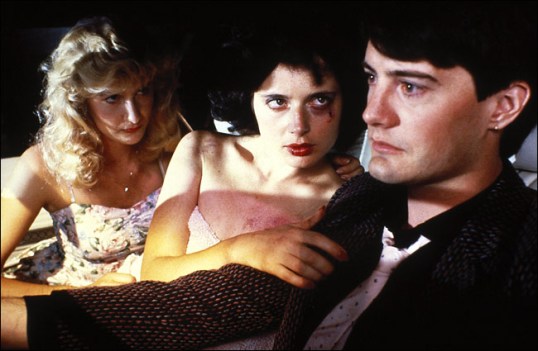
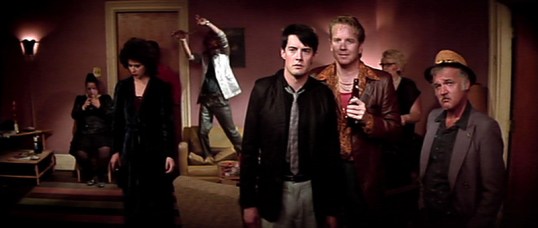
With the help of Detective Williams’s blonde and seemingly innocent daughter, Sandy (Laura Dern), Jeffrey launches his own investigation into why the ear was in the field. He discovers that Lumberton has a teeming criminal underworld, one that is full of men who are as savage as the ants that we saw, in close-up, fighting over that ear in the field. Jeffrey discovers that a singer named Dorothy (Isabella Rossellini) is being sexually blackmailed by a madman named Frank Booth (Dennis Hopper). When Dorothy discovers Jeffrey hiding in her closet (where he had been voyeuristically watching her and Frank), it leads to Jeffrey and Dorothy having a sadomasochistic relationship. “Hit me!” Dorothy demands and both the viewer and Jeffrey discover that he’s got his own darkness inside of him. “You’re like me,” Frank hisses at Jeffrey at one point and, if we’re to be honest, it almost feels like too obvious a line for an artist like David Lynch. Lynch once described the film as being “The Hardy Boys in Hell,” and the plot really is as straightforward as one of those teenage mystery books.
That said, Blue Velvet also features some of Lynch’s most memorable visuals, from the brilliant slow motion opening to the moment that the camera itself seems to descend into the ear, forcing us to consider just how fragile the human body actually is. The film goes from showcasing the green lawns and blue skies to Lumberton to tossing Jeffrey into the shadowy world of Dorothy’s apartment building and suddenly, the entire atmosphere changes and the town becomes very threatening. We find ourselves wondering if even Detective Williams can be trusted. That said, my favorite visual in the film is a simple one. Sandy and Jeffrey walk along a suburban street at night and the camera shows us the dark trees that rise above them, contrasting their eerie stillness to Sandy and Jeffrey’s youthful flirtation.
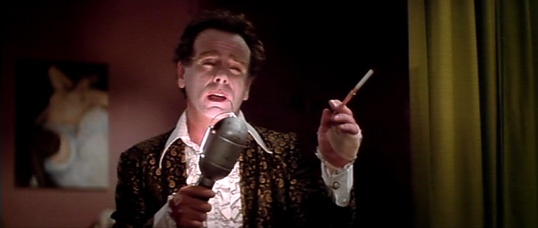
Dean Stockwell in Blue Velvet
Dean Stockwell shows up as Ben, an associate of Frank’s who lip-synchs to Roy Orbison’s In Dreams while Frank himself seems to have a fit of some sort beside him. In retrospect, Blue Velvet played a huge role in Dennis Hopper getting stereotyped as an out-of-control villain but that doesn’t make him any less terrifying as Frank Booth. Hopper, recently sober after decades of drug abuse and self-destructive behavior, summoned up his own demons to play Booth and he turns Frank into a true nightmare creature. Isabella Rossellini is heart-breaking as the fragile Dorothy. That said, the heart of the film belongs to Kyle MacLachlan and Laura Dern and both of them do a wonderful job of suggesting not only the darkness lurking in their characters but also their kindness as well. For all the talk about Lynch as a subversive artist, he was also someone who had a remarkable faith in humanity and that faith is found in both Jeffrey and Sandy. MacLachlan and Dern manage to sell moments that should have been awkward, like Sandy’s monologue about the returning birds or Jeffrey’s emotional lament questioning why people like Frank have to exist. Both Jeffrey and Sandy lose their innocence but not their hope for a better world.
BlueVelvet is a straight-forward mystery and a surreal dream but mostly it’s an ultimately hopeful portrait of humanity. The world is dark and full of secrets, the film says. But that doesn’t mean that it can’t be a beautiful place.
Blue Velvet (1986, dir by David Lynch, DP: Frederick Elmes)
Some people love money so much that they make their own.
In 1985’s To Live And Die In L.A., Williem DaFoe is magnetically evil as Rick Masters, a genius at counterfeiting who has gotten rich by selling other people fake money. The film features a lengthy sequence showing how Masters makes his money and the viewer really is left feeling as if they’ve just watched an artist at work. Masters has a talent and he’s a professional. He’s good at what he does. Unfortunately, he’s also a sociopath who is willing to kill just about anyone who he comes across. There have been a lot of movies made about sympathetic counterfeiters. They’re often portrayed as being quirky and rather likable individuals. This is not one of those films. DaFoe’s charisma makes it impossible to look away from Rick but he’s still not someone you would ever want to have to deal with for a prolonged period of time. One gets the feeling that Rick eventually kills everyone that he does business with.
Secret Service agents Richard Chance (William Petersen) and John Vukovich (John Pankow) are investigating Masters. They’re a classic crime movie partnership. Vukovich is youngish and, when we first meet him, goes by-the-book. Chance is a veteran member of the Secret Service, an impulsive loose cannon whose last partner was killed by Masters. Chance is now obsessed with taking Masters down and he’s willing to do whatever it takes. If that means threatening his lover and informant, the recently paroled Ruth (Darlanne Fluegel), so be it. If that means defying the lawyers (represented by Dean Stockwell), so be it. If that means committing crimes himself and nearly getting Vukovich killed in the process, so be it. At first, Vukovich is horrified by Chance’s techniques but, as the film progresses, Vukovich comes to embrace Chance’s philosophy of doing whatever it takes.
What sets To Live and Die in L.A. apart from some other films is that, even as it concludes, it leaves us uncertain as to whether or not Chance and Vukovich’s actions were really worth it. This is not a standard cops-vs-robbers film. This is a William Friedkin film and he brings the same moral ambiguity that distinguished The French Connection to this film’s portrait of the Secret Service. (When Chance isn’t chasing after a counterfeiter, he’s foiling an assassination attempt against the president.)
Like The French Connection, To Live and Die In L.A. features an pulse-pounding car chase, one that occurs as Chance and Vukovich make an escape from robbing a man who they believe to be a criminal. (The man turns out to have been an FBI agent.) This chase involves Chance and Vukovich driving the wrong way down a crowded freeway, desperately tying not to crash into any of the cars that are swerving out of the way. It’s such an exciting scene that it’s easy to forget that Chance and Vukovich are actually escaping from committing a crime. In The French Connection, Gene Hackman was chasing the man who tried to assassinate him. In To Love and Die In L.A., Chance is fleeing the consequences of his own actions.
To Live and Die In L.A. holds up well. DaFoe and Petersen both give charismatic performance but, for me, it really is John Pankow who carries the film. Vukovich’s transformation from being a straight-laced member of law enforcement to being a doppelganger of his partner is both exciting and a little disturbing, To Live and Die In L.A. is a crime film that leaves you wondering how far one can go battling the bad guys before becoming one of them.
1992’s The Player tells the story of Griffin Mill (Tim Robbins).
It’s not easy being Griffin Mill. From the outside, of course, it looks like he has the perfect life. He’s a studio executive with a nice house in Hollywood. He’s young. He’s up-and-coming. Some people, especially Griffin, suspect that he’ll be the president of the studio some day. By day, he sits in his office and listens to pitches from respected screenwriters like Buck Henry. (Henry has a great idea for The Graduate II!) During the afternoon, he might attends dailies and watch endless takes of actors like Scott Glenn and Lily Tomlin arguing with each other. Or he might go to lunch and take a minute to say hello to Burt Reynolds. (“Asshole,” Burt says as Griffin walks away.) At night, he might go to a nice party in a big mansion and mingle with actors who are both young and old. He might even run into and share some sharp words with Malcolm McDowell.
But Griffin’s life isn’t as easy as it seems. He’s constantly worried about his position in the studio, knowing that one box office failure could end his career. He fears that a new executive named Larry Levy (Peter Gallagher) is after his job. Two new screenwriters (Richard E. Grant and Dean Stockwell) keep bugging him to produce their downbeat, no-stars anti-capitol punishment film. His girlfriend (Cynthia Stevenson) wants to make good movies that mean something. Even worse, someone is sending Griffin threatening notes.
It doesn’t take long for Griffin to decide that the notes are coming from a screenwriter named Dave Kahane (Vincent D’Onofrio). Griffin’s attempt to arrange a meeting with Dave at a bar so that Griffin can offer him a production deal instead leads to Griffin murdering Dave in a parking lot. While the other writers in Hollywood mourn Dave’s death, Griffin starts a relationship with Dave’s artist girlfriend (Great Scacchi) and tried to hide his guilt from two investigating detectives (Whoopi Goldberg and Lyle Lovett). Worst of all, the notes keep coming. The writer, whomever they may be, is now not only threatening Griffin but also seems to know what Griffin did.
After spend more than a decade in the industry wilderness, Robert Altman made a critical and commercial comeback with The Player. It’s a satire of Hollywood but it’s also a celebration of the film industry, featuring 60 celebrities cameoing as themselves. Everyone, it seems, wanted to appear in a movie that portrayed studio execs as being sociopathic and screenwriters as being whiny and kind of annoying. The Player both loves and ridicules Hollywood and the often anonymous men who run the industry. Largely motivated by greed and self-preservation, Griffin may not love movies but he certainly loves controlling what the public sees. In the end, only one character in The Player sticks to her values and her ideals and, by the end of the movie, she’s out of a job. At the same time, Griffin has a social life that those in the audience can’t help but envy. He can’t step out of his office without running into someone famous.
The Player is one Altman’s most entertaining films, with the camera continually tracking from one location to another and giving as a vision of Hollywood that feels very much alive. Tim Robbins gives one of his best performances as Griffin Mill and Altman surrounds him with a great supporting cast. I especially liked Fred Ward as the studio’s head of security. With The Player, Altman mixes melodrama with a sharp and sometimes bizarre comedy, with dialogue so snappy that the film is as much a joy to listen to as to watch. That said, the real attraction of the film is spotting all of the celebrity cameos. (That and cheering when Bruce Willis saves Julia Roberts from certain death.) Altman was a director who often used his films to explore eccentric communities. With The Player, he opened up his own home.
First released in 1988, Tucker: The Man and His Dream is a biopic about Preston Tucker.
Tucker was an engineer in Detroit who went from designing vehicles for the Army during World War II to trying to launch his own car company. His ideas for an automobile don’t sound particularly radical today. He wanted every car to have seat belts. He wanted a windshield that popped out as a safety precaution. He want brake pads and he also wanted a car that looked sleek and aerodynamic, as opposed to the old boxy cars that were being pushed out be Detroit. He wanted a car that got good mileage and he wanted one that could be taken just about anywhere. Unfortunately, Tucker’s dreams were cut short when he was indicted for stock fraud, a prosecution that most people agree was a frame-up on behalf of the Big Three auto makers. Tucker was eventually acquitted but his car company went out of business. Of the 50 cars that Tucker did produce, 48 of them were still on the road and being driven forty years later.
The film stars Jeff Bridges as Preston Tucker, Joan Allen as his wife, Christian Slater and Corin Nemec as two of his sons, Lloyd Bridges as the senator who tried to take Tucker down, Martin Landau as Tucker’s business partner, and Dean Stockwell as Howard Hughes, who shows up for a few minutes to encourage Tucker to follow his dreams regardless of how much the government tries to stop him. One gets the feeling that the film was a personal one for director Francis Ford Coppola, a filmmaker who has pretty much spent his entire career fighting with studios while trying to bring his vision to the screen. Tucker fought for seat belts. Coppola fought for a mix of color and black-and-white in Rumble Fish. Tucker stood up for his business partner. Francis Ford Coppola stood up for Al Pacino when no one else could envision him as Michael Corleone. As is the case with many of Coppola’s films, Tucker: The Man And His Dream is a film that Coppola spent years trying to get made. It was the film that Coppola originally intended to be the follow-up to The Godfather, with Marlon Brando projected for the lead role of Tucker. After watching the Tucker, it’s hard not to feel that it worked out for the best that Coppola was not able to make the film in 1973. It’s impossible to imagine anyone other than Jeff Bridges in the role of Preston Tucker.
“Chase that tiger….chase that tiger….chase that tiger….” It’s a song that Tucker sings constantly throughout the film as the camera spins around him and how you react to Tucker: The Man And His Dream will largely depend on how tolerant you are of Coppola’s stylistic flourishes. Coppola directs the film as a combination of Disney fairy tale and film noir. The opening of the film, with Tucker running around in almost a manic state and excitedly telling everyone about his plans, is presented with vibrant colors and frequent smiles and an almost overwhelming air of cheerful optimism. As the film progresses and Tucker finds himself being targeted by both the government and the other auto companies, the film gets darker and the viewer starts to notice more and more shadows in the background. The moments of humor become less and less and there’s a heart-breaking moment where Martin Landau, in one of his best performances, reveals just how far the government will go to take down Tucker’s company. But, in the end, Tucker refuses to surrender and Jeff Bridges’s charming smile continues to fill the viewer with hope. The film becomes about more than just cars. It’s a film that celebrates all of the innovators who are willing to defy the establishment.
There’s a tendency to dismiss the majority of Coppola’s post-Apocalypse Now films. However, Tucker: The Man And His Dream is a later Coppola film that deserves to be remembered.
Welcome to Retro Television Reviews, a feature where we review some of our favorite and least favorite shows of the past! On Mondays, I will be reviewing Miami Vice, which ran on NBC from 1984 to 1989. The entire show can be purchased on Prime!
This week, a man from the past returns to haunt Castillo.
Episode 2.9 “Bushido”
(Dir by Edward James Olmos, originally aired on November 22nd, 1985)
This week’s episode opens with yet another intricately plotted drug bust going awry. This time, a dealer ends up dead, a DEA Agent ends up knocked out and tied up in a bathroom, and $50,000 goes missing. Watching the tapes of the bust, Castillo is shocked to spot a familiar face on the scene. Castillo says that Jack Gretsky (Dean Stockwell) was his partner when he was working for the CIA in Vietnam. Gretsky has long been thought dead but there he is, on tape and ruining Castillo’s bust.
Realizing that Gretsky was sending him a message, Castillo decides to deal with the situation personally. After visiting two CIA agents (Jerry Hardin and Tom Bower) who work out of an adult novelty shop, Castillo tracks Gretsky down to a Buddhist temple. The two of them talk. Gretsky reveals that he’s married to a Russian woman and that he has a son. He asks Castillo to watch over them if anything happens to him. The stoic Castillo agrees and then gives Gretsky a hug. Castillo says that he has to arrest Gretsky. Gretsky says he knows and then pulls a machine gun, forcing Castillo to kill him. The CIA agents are happy to no longer have to deal with Gretsky.
A day later, the coroner’s office calls Vice and says that Gretsky was terminally ill with cancer and probably only had a few days left to live. When Crockett and Tubbs go to tell Castillo, they find his badge and a note sitting in the office. Castillo is fulfilling Gretsky’s final wish and protecting his wife (Natasha Schneider) and his son, Marty (Robin Kaputsin). Castillo sees it as being a part of the samurai code by which he lives his life. Meanwhile, a rogue CIA agent named Surf (David Rasche, giving a wonderfully unhinged performance) is working with the KGB to track down Gretsky’s family.
Directed by Edward James Olmos, Bushido is a wonderfully odd episode. With a combination of skewed camera angles and deliberately eccentric performances from Dean Stockwell and David Rasche, this episode plays out with the relentless intensity of a fever dream. (The opening drug bust even features Zito burying himself in the sand and using a straw to breathe until its time to emerge and knock out one of the bad guys. It’s weird but it’s great.) Olmos contrasts Castillo’s trademark stoicism with the more verbose characters played by Stockwell and Rasche and, as a result, Castillo emerges as an honorable man who hides his emotions because he knows that’s the only way to survive in his world. To fall in love like Jack or to get cocky like Surf can only lead to one’s downfall.
After a few uneven episodes, Bushido is a nice reminder of what Miami Vice was capable of at its best.
Welcome to Retro Television Reviews, a feature where we review some of our favorite and least favorite shows of the past! On Sundays, I will be reviewing the made-for-television movies that used to be a primetime mainstay. Today’s film is 1971’s The Failing of Raymond! It can be viewed on YouTube!
Poor Raymond!
Played by a young Dean Stockwell, Raymond is patient at a mental hospital who blames everything that has gone wrong on his life on one failed test. During his senior year of high school, he got a 61 on an English test and, as a result, he not only only failed the class but he also wasn’t allowed to graduate. The test was administered by a substitute teacher named Mary Bloomquist (Jane Wyman), one who did not know that Raymond had a reputation for being a bit eccentric. When Raymond tried to ask her whether or not the final two questions were for extra credit, Mary refused to call on him because she was more preoccupied with her failed affair with another teacher (Dana Andrews). Raymond didn’t answer the final two questions, even though he believed that he had the correct answers. Now, locked away in a hospital, Raymond comes across an article announcing that beloved teacher Mary Bloomquist will soon be retiring and moving to England.
Seeking revenge, Raymond escapes from the hospital. While police Sgt. Manzek (Murray Hamilton) search for Raymond, Raymond returns to his old school. When he finds Mary in her classroom, Mary mistakes Raymond for a mover responding to a classified ad asking for help in getting all of her things packed up. Raymond may be a homicidal but he also craves direction and praise so he helps Mary with her packing. As he packs, Mary talks about her decision to retire and it turns out that she’s not quite the monster that Raymond imagined her to be. Mary is retiring because she feels that she has never made a difference as a teacher.
That said, Raymond is still determined to get his revenge. He wants Mary to give him the test a second time and to give him a passing grade. And if she doesn’t, he’s prepared to kill her. Unfortunately, despite claiming to have spent years studying the material, Raymond still thinks that Robert Browning wrote the Rhyme of the Ancient Mariner.…
As the old saying goes, you never know how much your actions might effect someone else’s life. Mary is a dedicated and well-meaning teacher who cares about her students but her decision to fail Raymond, made on a day when she was distracted by her own personal problems, is something that Raymond has never forgotten or forgiven. Mary can barely remember it happening but Raymond has based his entire life around that moment and, as the film progresses, it becomes clear that he’s incapable of understanding that the entire world doesn’t revolve around what happened to him during his senior year. On the one hand, Mary definitely should have answered Raymond’s question about whether or not the final two questions were multiple choice. On the other hand, Raymond has clearly been using the incident as an excuse to justify every mistake that he’s made sense. Ironically, Raymond’s quest for revenge gives Mary the chance to finally be the teacher that she truly wants to be.
It’s an intriguing premise. Unfortunately, like so many made-for-TV movies from the early 70s, The Failing of Raymond is occasionally a bit too stagey for its own good. Despite only being 73 minutes long, it never really develops any sort of narrative momentum. That said, Dean Stockwell gives a performance that makes clear why Alfred Hitchcock was planning on casting him as Norman Bates if Anthony Perkins somehow fell through. As played by Stockwell, Raymond is unfailingly polite and so obviously wounded that it’s impossible not to feel sympathy for him, even when he’s threatening to kill his former teacher. Jane Wyman, as well, gives a sympathetic performance as Mary, who, despite that one bad day with Raymond, really is the type of teacher we all wish we could have had.
This film was directed by Boris Sagal, who did several made-for-TV movies and also directed Charlton Heston in The Omega Man. His daughter, Katey Sagal, makes her film debut in a small role as one of Raymond’s fellow patients.
Sometimes, you see a film that is just so weird and incoherent that you can’t help but love it.
Of course, it also helps if the film has a once-in-a-lifetime cast of actors who you would never expect to see acting opposite each other.
For me, that’s certainly the case with 1990’s Backtrack. Directed by Dennis Hopper, Backtrack is a film about an artist (Jodie Foster, channeling Jenny Holzer) who witnesses a mob murder committed by Joe Pesci, Dean Stockwell, Tony Sirico, and John Turturro. An FBI agent played by Fred Ward suggests that the artist should go into the witness protection program but she doesn’t want to give up her life as a New York sophisticate who creates challenging LED displays and who can eat Sno Balls whenever she gets the craving for one. (Yes, this is a plot point.) Turturro and Sirico break into the artist’s apartment and kill her boyfriend, who is played by a wide-eyed Charlie Sheen. The artist puts on a blonde wig and goes on the run, eventually getting a job in advertising.
Realizing that his men can’t get the job done, mob boss Vincent Price decides to hire a legendary hitman played by Dennis Hopper (who also directed this film) to track down the artist. However, the hitman becomes fascinating with the artist’s work, finds pictures of her posing in black lingerie, and immediately falls in love with her. Not only does he wants to save her life but he wants her to wear the same lingerie exclusively for him. (Yes, this is a pretty big plot point.) At first, the artist refuses and views the hitman as being some sort of pathetic perv. But then she discovers that he’s covered her bed with Sno Balls….
Meanwhile, a young Catherine Keener shows up as the girlfriend of a trucker who briefly considers giving the artist a ride to Canada.
And then Bob Dylan shows up, handling a chainsaw.
And there’s Helena Kallianiotes, the outspoken hitch-hiker from Five Easy Pieces, yelling at Joe Pesci!
And there’s Dennis Hopper’s The Last Movie co-star, Julie Adams! And there’s Toni Basil! And there’s director Alex Cox!
Dennis Hopper not only starred in Backtrack but he also directed and it’s obvious that he placed a call into just about everyone he knew. In fact, one could argue that the only thing more shocking than Vincent Price showing up as a mob boss is that Peter Fonda, Karen Black, Elliott Gould, Robert Walker Jr., and Kris Kristofferson are nowhere to be found in the film. Hopper’s first cut of Backtrack was reportedly 3 hours long but the studio cut it down to 90 minutes, renamed it Catchfire, and Hopper insisted on being credited as Alan Smithee. Later, Hopper released a two-hour version with the Backtrack title and his directorial credit restored.
Regardless of which version you see, Backtrack is an odd film. It’s hardly the first film to be made about a hit man falling for his target. What distinguishes this film is just how bizarre a performance Dennis Hopper gives in the role of the hitman. It’s as if Hopper gave into every method instinct that he had and the end result was a mix of Blue Velvet‘s Frank Booth and the crazed photojournalist from ApocalypseNow. Jodie Foster’s cool intelligence makes her the ideal choice for a conceptual artist but it also makes it hard to believe that she would fall for a jittery hitman and, in her romantic scenes with Hopper, Foster often seems to be struggling to resist the temptation to roll her eyes. Somehow, their total lack of romantic chemistry becomes rather fascinating to work. They are two talented performers but each appears to be acting in a different movie. What’s interesting is that I think a movie just about Hopper’s spacey hitman would be interesting (and, if you’ve ever seen The American Friend, it’s hard not to feel that such a movie already exists) but I think a movie about just about Foster’s artist and her life in New York would be just as fascinating. Taken as individuals, the artist and the hitman are both compelling characters. Taken as a couple, they don’t belong anywhere near each other.
But let’s be honest. This is a film that most people will watch for the parade of character actors delivering quirky dialogue. Even if one takes Hopper and Foster out of this mix, this is an amazingly talented cast. One need only consider that John Turturro did Do The Right Thing before appearing in this film while Joe Pesci and Tony Sirico did Goodfellas immediately afterwards. This film features a once-in-a-lifetime cast, made up of actors who were apparently told to do whatever they felt like doing. Turturro plays up the comedy. Sirico plays his role with cool menace. Stockwell barely speaks above a whisper. Fred Ward plays the one sane man in a world of lunatics. Vincent Price delivers his line as if he’s appearing in one of Roger Corman’s Poe films and somehow, it makes sense that, in the world of Backfire, an Italian gangster would have a snarky, mid-Atlantic accent.
It’s an odd little film, an example of 80s filmmaking with a 70s sensibility. While it’s not touched with the lunatic genius that distinguished Hopper’s The Last Movie, Backtrack is still something that should be experienced at least once.
As some of our regular readers undoubtedly know, I am involved in a few weekly live tweets on Twitter and Mastodon. I host #FridayNightFlix every Friday, I co-host #ScarySocial on Saturday, and I am one of the five hosts of #MondayActionMovie! Every week, we get together. We watch a movie. We tweet our way through it.
Tonight, at 10 pm et, #FridayNightFlix has got 1990’s Backtrack, an enigmatic thriller starring Jodie Foster, Dean Stockwell, Joe Pesci, John Turturro, Vincent Price, Fred Ward, Charlie Sheen, Tony Sirico, Bob Dylan, and Dennis Hopper (who also directed).
If you want to join us this Friday, just hop onto twitter, start the movie at 10 pm et, and use the #FridayNightFlix hashtag! It’s a friendly group and welcoming of newcomers so don’t be shy.
Backtrack is available on Prime and Tubi! See you there!
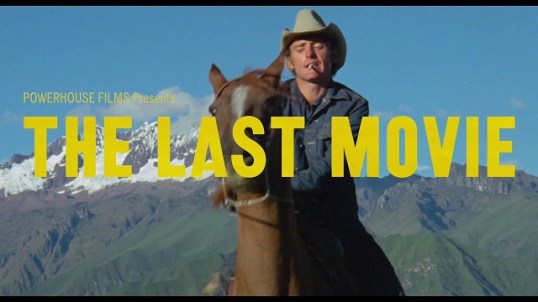
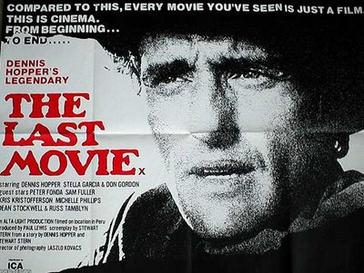
The story behind the making of 1971’s The Last Movie is legendary. It’s also a bit of a cautionary tale.
In 1969, Hollywood was stunned by the box office success of an independent, low-budget counter-culture film called Easy Rider. Easy Rider not only made a star out of Jack Nicholson but it was also the film that finally convinced the studios that the way to be relevant was not to continue to crank out big budget musical extravaganzas like Doctor Doolittle and Hello, Dolly! Instead, it was decided that the smart thing to do would be to hire young (or, at the very least, youngish) directors and basically just let them shoot whatever they wanted. The resulting films might not make much sense to the executives but, presumably, the kids would dig them and as long as the kids were paying money to see them, everyone would continue to get rich. Because Dennis Hopper had directed Easy Rider, he suddenly found himself very much in demand as a director.
Of course, almost everyone in Hollywood knew Dennis Hopper. Long before he became an icon of the counter-culture, Dennis Hopper had been a part of the studio system. John Wayne even referred to Hopper as being his “favorite communist.” Everyone knew that Dennis could be a bit arrogant. Everyone knew that Dennis was very much into drugs and that, as a result, he had a reputation for being a bit unstable. Everyone knew that Dennis Hopper deliberately cultivated an image of being a bit of a wild man and a revolutionary artist. But Dennis Hopper had just directed Easy Rider and Universal was willing to give Hopper some money to go down to Peru and direct his follow-up.
The Last Movie was a film that Hopper had been planning on making for a while. The film’s original script told the story of an aging and broken-down stuntman named Kansas who retires to Mexico and searches for a gold mine with a friend of his. Hopper first tried to get the film going in 1965, with Montgomery Clift in the lead role. After Clift died, Hopper tried to interest John Wayne in the starring role but, though Wayne enjoyed having Hopper in his films so that he could threaten to shoot him whenever Abbie Hoffman said something shocking, he had no interest in being directed by him. When Universal finally agreed to put up the money for the film, Hopper offered the lead role to Jack Nicholson. Nicholson turned it down and told Hopper that it was obvious that Dennis wanted to play the role himself. Dennis decided that he agreed with Nicholson and he cast himself as Kansas. Dennis also made the fateful decision to not only change the story’s setting to Peru but to also film on location.
Dennis and a group of friends flew down to Peru, which, at that time, was the cocaine capitol of the world. Drug use was rampant on the set, with Dennis reportedly being one of the main offenders. The cast and crew filmed during the day and partied at night and no one was particularly sure what the film was supposed to be about. Amazingly, Hopper finished filming on schedule and within budget but, much as he did with Easy Rider, he also overfilmed and ended up with 40 hours of footage. Not wanting to be bothered by the studios, Hopper edited the footage in his compound in Taos, New Mexico. Working slowly and continuing to consume a large amount of drugs and alcohol, Hopper still managed to put together a film that had a straightforward storyline. When Hopper showed his initial cut to filmmaker Alejandro Jodorowsky, the director of El Topo accused Hopper of being too conventional in his approach, which led to Hopper chopping up the film and reassembling it. Finally, after spending over a year working with the footage, Hopper turned in his final edit.
Universal had no idea what to make of the film that Hopper delivered to them. Still, they released it with the hope that the same crowd that loved Easy Rider would embrace The Last Movie. While the film did win an award at the Venice Film Festival, critics hated it and, even worse, audiences stayed away. The film’s reception was so overwhelmingly negative that Hopper found himself largely exiled from Hollywood, with only a few directors (like Francis Ford Coppola) willing to take the chance of working with him. It wasn’t until the 80s, when he finally got clean and sober, that Dennis Hopper was able to reestablish himself as a character actor and, ultimately, a beloved cultural institution.
But what about The Last Movie? Was is it really as bad as the critics claimed? Or was it, as some more recent reviewers have suggested, an unacknowledged masterpiece that was ahead of its time? I recently watched The Last Movie to find out for myself.
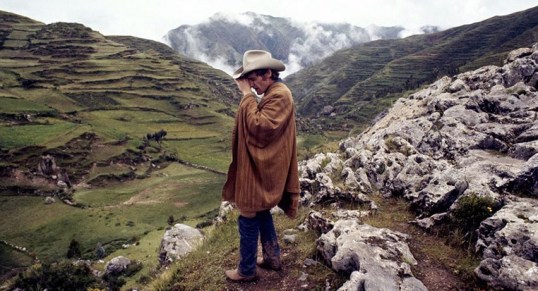
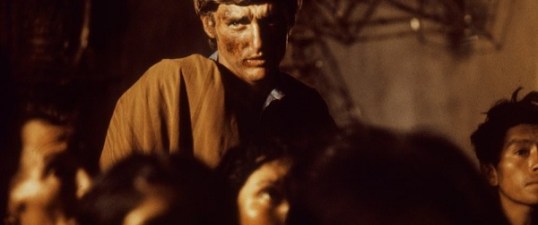
Despite its reputation, The Last Movie gets off to a pretty strong start. Samuel Fuller (playing himself) is directing a hilariously over-the-top and violent western in the mountains of Peru. Kansas (Dennis Hopper) is working as a stuntman. He’s fallen in love with a local sex worker named Maria (Stella Garcia). Kansas is meant to be an aging Hollywood veteran, someone who has broken a lot of bones and who carries a lot of aches as a result of his line of work. (One can see why Hopper initially imagined an actor like John Wayne in the role.) He knows that this is going to be his last job and, as we see over the first 25 minutes of the film, he feels alienated from the rest of the cast and crew. Admittedly, Hopper does appear to be a bit too young for the role. The ideal Kansas would have been someone like Ben Johnson, L.Q. Jones, or perhaps Warren Oates. But, still, Hopper does a good job of capturing Kansas’s mixed feelings about the western that’s being filmed around him.
A lot of familiar faces pop up in the film’s fictional western. Dean Stockwell plays an outlaw. Jim Mitchum, Russ Tamblyn and Kris Kristofferson plays his associates. Peter Fonda is the youthful sheriff. Michelle Phillips is the daughter of the town’s banker and apparently, she’s also the girlfriend of one of the outlaws. We watch as the actors pretend to shoot guns and kill each other while the cameras are rolling, just to get up off the ground once “Cut” is yelled. When a local Indian who has been cast as an extra grows upset at the violence, an assistant director explains to him that no one really dies while the cameras are rolling. When shooting wraps, the film company goes home but Kansas stays behind with Maria. One day, the local priest (Tomas Milian) warns Kansas that the local indigenous people have moved into the abandoned film set and are trying to shoot their own movie. Kansas discovers that they have built wooden cameras and wooden boom mics and that their chief is giving orders in the style of Sam Fuller. They’re also firing the guns that the Americans left behind.
The first part of the film works quite well. Hopper’s camera captures the beautiful and isolated Peruvian landscape. The violent western is a pitch perfect and affectionate parody of a generic studio film. Though Hopper is a bit too young for the role, he still does a good job of capturing Kansas’s alienation from his fellow Americans. Even more importantly, the first part of the film seems to have an identifiable theme. The American film crew invaded an isolated part of Peru and changed the culture of the natives without even realizing it. Now, they’ve left but the natives are still dealing with the after effects of the American “invasion.” It’s easy to see, within that part of the story, a critique of both American culture and American foreign policy.
The second part of the film is where things start to fall apart. Kansas meets an old friend named Neville (Don Gordon). Neville has discovered a gold mine in the Peruvian mountains. With Kansas as his partner, he tries to get a businessman named Harry Anderson (Roy Engel) to invest in it. Kansas and Neville try to impress Harry and his wife (Julie Adams, best-known for being stalked by The Creature From The Black Lagoon). Kansas and Neville take the Andersons to a brothel and, in the process, Kansas offends Maria. Kansas then paws Mrs. Anderson’s fur coat and mentions that human beings are covered in hair. For all of their efforts, Harry will not invest, no matter how desperately Neville begs him to reconsider.
The second part of the film drags, with many of the scenes being obviously improvised between Hopper, Gordon, Garcia, Engel, and Adams. Unfortunately, the improved conversations aren’t particularly interesting and they tend to go on forever. Usually a reliable character actor, Don Gordon ferociously chews the scenery as Neville and it doesn’t take long before one grows tired of listening to him yell. (Gordon was far more impressive in Hopper’s Out of the Blue.) With the use of improvisation and overlapping dialogue, the second half of the film tries to feel naturalistic but instead, it’s a migraine-inducing method exercise gone wrong. It’s also during the second part of the film that a “scene missing” title card flashes on the screen, an indication that the discipline that Hopper showed as a director during the beginning of the film is about to be abandoned.
Finally, the third part of the film — well, who knows? The final 25 minutes of the film is collection of random scenes, some of which may be connected and some of which may not. The natives have decided that the only way to properly end their “film” is to kill Kansas. Kansas is shot several times and rides away on his horse. Suddenly, Kansas is back at his home and Maria is taunting him for getting shot. Then, Kansas is riding his horse again. Then suddenly, Dennis Hopper and Tomas Milian are laughing at the camera. A script supervisor tries to get Dennis to look at the shooting schedule while Dennis drinks. This happens:
Milian points out that the blood on Hopper’s shirt is dry. Hopper looks at his shoulder, where Kansas was previously shot, and says that someone needs to add his scar before he can shoot the scene. Ah! So, now we’re acknowledging that it’s all just a movie. Thanks, Dennis! Suddenly, Dennis is Kansas again and he’s collapsing over and over again in the dust. He appears to be dead but no, now he’s Dennis again and he’s standing up and smiling at the camera. And now, he’s singing Hooray for Hollywood. And now, suddenly, Kansas and Neville are talking about The Treasure of the Sierra Madre and then….
Well, let’s just say that it goes on and on before finally ending with a scrawled title card.
It’s a disjointed mess and it’s all the more frustrating because the first 30 minutes of the film is actually pretty good. But then, Dennis apparently remembered that he was supposed to be the voice of the counter-culture and he gave into his most pretentious impulses. Of course, just because a film is a mess, that doesn’t mean that it can’t be entertaining. And again, the first part of the film is entertaining and third part of the film is weird enough that it’ll hold most people’s attention for at least a few minutes. But the middle section of the film is so slow and pointless that it pretty much brings down the entire film.
In the end, what is The Last Movie about? In The American Dreamer(a documentary that was filmed while Hopper was editing The Last Movie in New Mexico), Hopper spends a lot of time talking about revolution and taking over Hollywood but The Last Movie is hardly a revolutionary film. The film is at its most alive when it is focused on the shooting of its fictional western. For all the satirical pokes that The Last Movie takes at the studio system, it’s obvious that Hopper had a lot of affection for Old Hollywood and for directors like Sam Fuller. Kansas may say “Far out,” but he’s hardly a hippie. Even the film’s jumbled finale seems to be saying, “It’s all Hollywood magic!” In the end, the film’s call for a new style of cinema is defeated by its love for the old style of cinema.
Instead, I think The Last Movie works best when viewed as a portrait of paranoia. Hopper himself admitted that he was naturally paranoid and the heavy amount of drugs that he was doing in the 70s didn’t help. One reason why Hopper filmed in Peru and edited in New Mexico was so the studios couldn’t keep track of him and, while directing, he worried about being arrested by the Peruvian secret police. As an actor, Hopper plays Kansas as being someone who views the world with caution and untrusting eyes. He doesn’t trust the other members of the film crew. He loves Maria but he’s still convinced that she’s going to betray him. Even the natives ultimately try to destroy him and the script supervisor tries to get him to stick to the shooting schedule. The film works best as a disjoined portrait of one man’s paranoid and fatalistic world view.
The Last Movie pretty much ended the studio’s attempts to harness the counter-culture by giving money to self-described revolutionaries. The new wave of directors — like Spielberg and Lucas — may have shared Hopper’s then-politics but they weren’t looking to burn down the system. (Hopper himself later became a Republican.) The Last Movie may not have been the literal last movie but it was, for a while at least, the last of its kind.




 Through the Shattered Lens