Embracing the Melodrama #124: Maps to the Stars (dir by David Cronenberg)


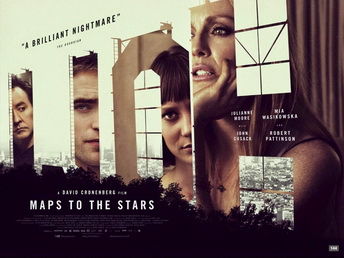
Maps_to_the_Stars_posterI have to admit that, for the most petty of reasons, I was dreading the 2014 release of David Cronenberg’s Maps to the Stars.  

This was despite the fact that I happen to be a big fan of just about everyone in the cast and David Cronenberg as a director.  (I still say that Cosmopolis is one of the best films of the decade and I don’t care who disagrees.)

My initial issue with Maps to the Stars — and again, I admit this is really petty — was that Sasha Stone, over the Awards Daily web site, was so damn fanatical about singing the film’s praises.  I have a theory that Sasha tends to overpraise certain films specifically so she can have an excuse to get angry and go off on a rant when they don’t receive any Oscar nominations.  Ever since Sasha went batshit crazy over The King’s Speech beating The Social Network, Awards Daily has pretty much gone from being a site about the Oscars to being a site about Sasha screaming in the wilderness like a biblical prophet (and not one of the interesting biblical prophets, like Elijah.  We’re talking about Haggai here.)  From what I had read about Maps To The Stars and judging from the response that it got at Cannes (where, despite mixed reviews, it did win an award when Julianne Moore was named best actress), this film seemed like the epitome of another deliberate lost cause.

Fortunately, the release date of Maps To The Stars was moved to 2015 and civilization was spared from having to deal with a thousand “If Cronenberg doesn’t get an Oscar, society is doomed!” rants.  Instead, we had to deal with a thousand “If Hillary Swank doesn’t win for The Homesman, society is doomed!” rants.

“Okay,” you’re saying, “that’s great Lisa.  Thank you for whatever all that was.  But what about the movie itself!?  Is it any good?”

Eh … I guess.

I mean, Maps to The Stars isn’t a bad movie.  It’s not bad at all.  It’s just maddeningly uneven.

One of my favorite up-and-coming stars, Mia Wasikowska, has a great role in it.  She plays a schizophrenic, named Agatha, who comes to Hollywood.  Agatha’s arms and the back of her neck are covered with burn scars and she is always taking pills.  She is also obsessed with a vile teen star named Benjie Weiss (Evan Bird).  There’s more to her obsession than you might originally think.

Benjie, meanwhile, has just gotten out of rehab and he is literally one of the worst characters ever.  The film does try to build up some sympathy for him by revealing just how fucked up his home life is.  His fragile mother (Olivia Williams) always seems to be on the verge of collapse.  His father (John Cusack) is a glib and shallow psychologist.  Benjie serves as a stand-in for every child star who has been destroyed by Hollywood.  Unfortunately, the film devotes so much time to Benjie being a monster that it never really allows us to see why Benjie’s a star in the first place.  Evan Bird gives such a boring, uninteresting, and flat performance that you never really buy the idea of Benjie could be a success.  (Say what you will about Justin Bieber, he does at least have a cute smile.  Evan Bird can’t even claim that.)

Agatha meets a lot of people in Hollywood, including a limo driver (Robert Pattinson) who is an aspiring screenwriter.  She eventually gets a job working for actress Havana Segrand (Julianne Moore).  Havana, herself the daughter of a legendary and self-destructive actress, is a monster but — unlike, Benjie — she’s a sympathetic monster.  She’s a talented actress who grew up in Hollywood and now, because she’s no longer in her 20s, is being discarded by Hollywood.  Havana is as much a victim as a victimizer.

Anyway, the film kinda wanders about.  Along with all the other stuff going on, the characters are regularly visited by ghosts.  Secrets are revealed.  Hearts are broken.  Lives are lost.  And yes, relevant points about Hollywood are made but … well, so what?   There’s nothing in Maps to the Stars that you couldn’t learn from rewatching Sunset Boulevard and Sunset Boulevard is a lot less pretentious.  Plus, William Holden was a much better actor than Evan Bird.

As for Cronenberg’s direction — well, Maps to the Stars is definitely David Cronenberg on autopilot.  It’s filled with identifiable Cronenberg touches.  The emphasis placed on Agatha’s scars, for instance, is trademark Cronenberg.  But still, Cronenberg’s direction often just seems to be going through the motions.  Unlike his work in the far more interesting and challenging Cosmopolis (not to mention Eastern Promises), Cronenberg doesn’t really seem to care that much about the story that he’s telling.

Maps to the Stars is worth watching for the performances of Julianne Moore and Mia Wasikowska.  Otherwise, it’s just another well-made but only occasionally interesting Hollywood melodrama.
Shattered Politics #49: The Dead Zone (dir by David Cronenberg)


The_Dead_Zone

So, it seems like every time that I write a review of any film based on a novel by Stephen King, I always have to start out by explaining that I think, while King’s success is undeniable, the fact that he’s overrated is also undeniable.  It’s a comment that I always make and then I have to deal with people going, “But, Lisa, everyone loves Stephen King!  He’s the most commercially successful author ever!  He’s a modern-day Charles Dickens!”

Bleh.

Make no mistake, I think that Stephen King is a talented writer.  However, I don’t think that he’s the greatest writer that has ever lived and that’s where I often come into conflict with King’s fans.  (Stephen King fans tend to be like religious fanatics when it comes to defending their belief.)  Having read both King’s earlier work and his more recent books, it’s hard for me not to feel that Stephen King has been growing steadily complacent.  There’s a certain self-importance to his prose and his plotting that, for me, is the literary equivalent of nails on chalk board.  If anyone is guilty of believing the most fawning praise of his biggest fans, it would appears to be Stephen King who, to judge from his twitter feed, appears to also believe that he’s our most important cultural critic as well.

(To be honest, I’d probably have more tolerance for King’s attempts at cultural and political criticism if he wasn’t so  predictable about it all.  Stephen King may write best sellers but that doesn’t mean he has anything interesting or unique to say about current events.)

Anyway, since I don’t feel like having to deal with all of that shit all over again, I’m not going to start this review by saying that I think Stephen King is overrated.  In fact … whoops.

Okay, so much for that plan.

Even I have to admit that The Dead Zone is one of Stephen King’s better books.  First off, it’s less than a 1,000 pages long.  Secondly, the hero isn’t a writer who spends all of his time whining about the political preferences of his neighbors.  Third, it deals with all of the “big” issues of faith, destiny, and morality but it does so in a far less heavy-handed manner than most of King’s books.

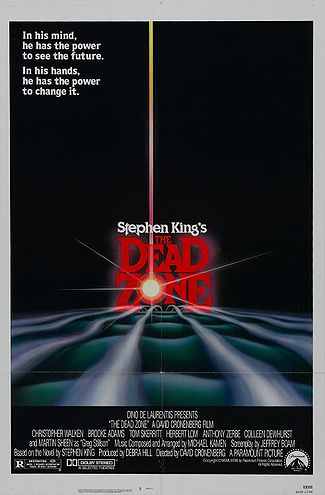
The Dead Zone is also the basis for one of the better films to be adapted from a Stephen King novel.  Directed by David Cronenberg and starring Christopher Walken, the film’s plot closely follows the novel.  Johnny Smith (Christopher Walken) is a high school teacher who, after a horrific car crash, spends five years in a coma.  When he finally wakes up, he discovers that his girlfriend, Sarah (Brooke Adams), has married another man.  His mother has become a religious fanatic.  And, perhaps most importantly, whenever Johnny touches anyone, there’s a good chance that he’ll see either the person’s past or a possible future.

Needless to say, Johnny struggles with how to deal with his new powers.  After he helps to catch a local serial killer, Johnny goes into seclusion.  However, when he discovers that Sarah is now volunteering for ambitious politician Greg Stillson (Martin Sheen), Johnny goes to a Stillson rally, shakes the man’s hand, and has a vision.  Johnny discovers that, if Stillson is elected to the senate, he’ll eventually become President and then he’ll destroy the world.

Much like The Shining, The Dead Zone benefits from being directed by a filmmaker who was both confident and strong enough to bring his own individual style to the material.  (Usually, when a King adaptation fails, it’s because it followed the source material too closely, as if the film’s producers were scared of upsetting any of King’s constant readers.)  Though the film’s plot may closely follow the novel, the movie itself is still definitely more of a product of David Cronenberg than Stephen King.  Whereas King’s novel devoted a good deal of time to Johnny and Sarah’s relationship, it’s treated as almost an afterthought in Cronenberg’s film.  Whereas King’s novel presented Johnny Smith as being an everyman sort of character, Cronenberg’s film gives us a Johnny who, from the start of the film, is a bit of an outsider even before he starts to see the future.  Whereas King put the reader straight into Johnny’s head, Cronenberg approach is a bit more detached and clinical.  Cronenberg’s Johnny is a bit more of an enigma than King’s version.

Fortunately, Cronenberg was fortunate enough to be able to cast Christopher Walken in the role of Johnny Smith.  King’s preference for the role was Bill Murray.  As odd as it may sound, you can actually imagine Bill Murray in the role when you read King’s book.  But, for Cronenberg’s more detached vision, Walken was the perfect choice.  People tend to spend so much time focusing on Christopher Walken’s quirky screen presence that there’s a tendency to forget that he’s actually a very talented actor as well.  He’s very likable and sympathetic as Johnny and brings a humanity and a sense of humor to the role, which provides a good balance to Cronenberg’s sense of detachment.

The Dead Zone is a good book and it was later turned into an occasionally good (and, just as often, not-so-good) television series.  However, the film is still the best.

Lisa Marie Picks The 50 Best Films of The Past 3 Years


Black-Swan_400

As of this month, I have been reviewing films here at the Shattered Lens for 3 years.  In honor of that anniversary, I thought I’d post my picks for the 50 best films that have been released in the U.S. since 2010.

Without further ado, here’s the list!

  1. Black Swan (directed by Darren Aronofsky)
  2. Exit Through The Gift Shop (directed by Banksy)
  3. Hanna (directed by Joe Wright)
  4. Fish Tank (directed by Andrea Arnold)
  5. Higher Ground (directed by Vera Farmiga)
  6. Shame (directed by Steve McQueen)
  7. Anna Karenina (directed by Joe Wright)
  8. The Cabin In The Woods (directed by Drew Goddard)
  9. 127 Hours (directed by Danny Boyle)
  10. Somewhere (directed by Sofia Coppola)
  11. Life of Pi (directed by Ang Lee)
  12. Hugo (directed by Martin Scorsese)
  13. Inception (directed by Christopher Nolan)
  14. Animal Kingdom (directed by David Michod)
  15. Winter’s Bone (directed by Debra Granik)
  16. The Artist (directed by Michel Hazanavicius)
  17. The Guard (directed by John Michael McDonagh)
  18. Bernie (directed by Richard Linklater)
  19. The King’s Speech (directed by Tom Hooper)
  20. Bridesmaids (directed by Paul Feig)
  21. Tinker, Tailor, Soldier, Spy (directed by Thomas Alfredson)
  22. Django Unchained (directed by Quentin Tarantino)
  23. Never Let Me Go (directed by Mark Romanek)
  24. Toy Story 3 (directed by Lee Unkrich)
  25. The Girl With the Dragon Tattoo (directed by Niels Arden Oplev)
  26. Young Adult (directed by Jason Reitman)
  27. Sucker Punch (directed by Zack Snyder)
  28. The Master (directed by Paul Thomas Anderson)
  29. Incendies (directed by Denis Villeneuve)
  30. Melancholia (directed by Lars Von Trier)
  31. Super (directed by James Gunn)
  32. Silver Linings Playbook (directed by David O. Russell)
  33. Scott Pilgrim Vs. The World (directed by Edgar Wright)
  34. The Last Exorcism (directed by Daniel Stamm)
  35. Skyfall (directed by Sam Mendes)
  36. Easy A (directed by Will Gluck)
  37. Harry Potter and the Deathly Hallows Parts 1 and 2 (directed by David Yates)
  38. The Avengers (directed by Joss Whedon)
  39. How To Train Your Dragon (directed by Chris Sanders and Dean DeBois)
  40. Win Win (directed by Thomas McCarthy)
  41. Les Miserables (directed by Tom Hooper)
  42. Take This Waltz (directed by Sarah Polley)
  43. Cave of Forgotten Dreams (directed by Werner Herzog)
  44. Rust and Bone (directed by Jacques Audiard)
  45. Cosmopolis (directed by David Cronenberg)
  46. Ruby Sparks (directed by Jonathan Dayton and Valarie Faris)
  47. Brave (directed by Mark Andrews and Brenda Chapman)
  48. Martha Marcy May Marlene (directed by Sean Durkin)
  49. Jane Eyre (directed by Cary Fukunaga)
  50. Damsels in Distress (directed by Whit Stillman)

Scenes I Love: Eastern Promises


EasternPromises

News that the sequel to Eastern Promises was one of the few pieces of news that really bummed me out when it made the rounds late 2012. The first film was one of my top ten for 2007 and consider it one of the better films about organized crime in the 21st century. A sequel to this film wasn’t needed, but most fans of the film wanted one just to see a furthering of the storyline between Viggo Mortensen’s character and that of Vincent Cassel’s character.

While the sequel may not be happening there’s still hope that it will get resuscitated in the future. Until that happens let’s take a look at what has to be one of the most realistic fight scenes on film. It’s the infamous (or famous depending on how you feel about the scene) Russian bath house scene near the end of the film. The scene sees Viggo Mortensen’s character of Nikolai Luzhin set upon by a couple of Chechen hitmen in the bath house where he proceeds to fight for his life in the most vulnerable fashion anyone can ever find themselves in.

Cronenberg has always been one of my favorite filmmakers and I continue to believe that his work body of work throughout his career puts him in the upper echelon, if not the elite level, of filmmakers living and working today. This fight scene has nothing glamorous about it. The cool factor that some attribute to the scene just emphasizes Cronenberg’s recent observation about the hypocrisy of those who denounce violence yet look at the violence he creates on film and call it art.

I consider this a scene I love just for the base simplicity of the scene itself. It’s primal and almost Darwinian in the lengths a person will go through to keep themselves alive for one second more. The scene also reminds me why Viggo Mortensen remains one of this era’s most underrated and greatest actors. Yes, it’s just a fight scene, but he gives so much into making it authentic that one could almost believe that his life was in danger and he did the fight for real (in fact Mortensen did injure himself so much during the several takes of the scene that his bruises afterwards became a problem for the make-up department who had to apply his vory v zakone tattoos every day).

Horror Scenes I Love: Scanners (by David Cronenberg)


[SPOILERS!!!!]

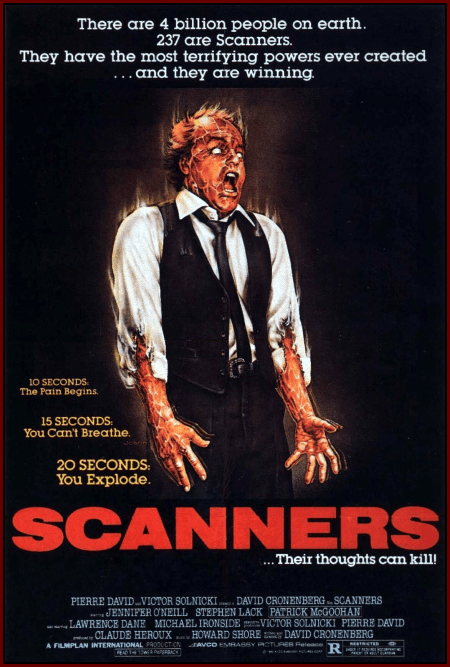
I’ve already shared a favorite scene from David Cronenberg’s landmark scifi/horror film Scanners over a year ago that saw a head explode. For October’s horror-themed month I picked another great scene from this film that always stuck with me long after I’ve finished watching the film each and every time.

The scene I’m talking about is the climactic showdown between Good Scanner Cameron and Evil Scanner Revok. This scene was filmed before the advent of CGI-effects and Cronenberg never had the sort of big-budgets to hire the top FX make-up artists to work on his films. Yet, Cronenberg ended up creating one of the best scenes ever put on film about two people fighting each other using their minds. We never see their mental abilities shooting off psychic blasts at each other but the performance by both Michael Ironside as Revok and Stephen Lack as Cameron was so believable that it made the scene work when it could’ve turned so cheesy and disastrous in the hands of a different filmmaker and other actors.

The battle ends but we’re left to believe the good guy lost and evil triumphs. This feeling pretty much plays out right up to the final scene before fade to black and even then we’re not sure if the final reveal is true or not. Either way there’s no better way to bookend the exploding head intro than with two psychic beings duking it out mentally with blood, spontaneous combustion and creepy white eyes added in for style.

6 Trailers That Came From Within


Hi there!  I hope everyone had a good weekend and that everyone took a few minutes to think about the true meaning of Labor Day (whatever that may be.)  Now that we’re all back and have returned to drudgery of everyday life, it seems like a perfect time for another edition of Lisa Marie’s Favorite Grindhouse and Exploitation Film Trailers!

1) They Came From Within (1975)

Seeing as I just recently saw Cosmopolis, it seems appropriate to start things off with this trailer for David Cronenberg’s Shivers or, as it was known here in the States, They Came From Within.

2) The Madmen of Mandoras (1963)

This film is also known as They Saved Hitler’s Brain.  It’s an odd little film.

3) Weekend With The Babysitter (1971)

Not to be confused with The Babysitter…

4) The Babysitter (1995)

Not to be confused with Weekend With The Babysitter…

5) Twisted Nerve (1968)

This looks tres creepy!

6) Son of Godzilla (1967)

Finally, did you know that Godzilla had a son?  Apparently, he did.

What do you think, Trailer Kitty?

Photograph by Erin Nicole Bowman

A Quickie With Lisa Marie: Cosmopolis (dir. by David Cronenberg)


“I wanted you to save me.” — Paul Giamatti in Cosmopolis

It’ll probably take the rest of the world a few years to realize this but David Cronenberg’s Cosmopolis is not only a good film but occasionally, it’s even a great film.  What it is not is an easy film.  Instead, this film is a throwback to the such Cronenberg films as Videodrome and eXistenZ, films that served to not only challenge the audience’s expectations but to occasionally attack them as well.

Plotwise, Cosmopolis is a day in the life of a 28 year-old billionaire named Eric Packer (played by Robert Pattinson, who gives an excellent performance that hints at the neurosis that boils underneath surface ennui).  Packer wants to get a haircut so he spends nearly the entire day sitting in the back of his stretch limo, being driven through an increasingly violent and disturbing New York.  Rarely leaving the safety of his limo, Packer has several chance meetings with his wife, who refuses to have sex with him, and picks up several other women who are willing to have sex with him.  He also finds the time to have a prostate exam and discuss (and discuss) the meaning of life with several of his cronies, all of whom seem to pop up in the back of his limousine without warning and who also seem to vanish once Packer tires of listening to them.  Along the way, Packer finds both himself and his limousine being targeted for destruction but he never changes his plans or his direction.  After all, he needs a haircut…

Many reviewers are treating Cosmopolis, with its portrayal of a man who has too much money and not enough humanity, as if it’s some sort of Occupy manifesto and, indeed, there are several scenes where Cosmpolis does seem to serve as a mouthpiece for the anti-capitalist Occupy ideology.  There are also several scenes where Cosmopolis plays as a very deliberate modern-day version of Jean-Luc Godard’s Marxist-themed, pro-revolution Weekend.  However, to simply call Cosmopolis a pro-Occupy film is  to offer up an interpretation that’s a bit too simplistic.  After all, when the Cosmopolis version of the Occupy protestors do make an appearance, they’re either rioting in the streets  (and getting nothing more than a bemused smirk from Packer) or else they’re being represented in the form of a shambling and somewhat pathetically bitter character played by Paul Giamatti.  When Giamatti accuses Packer of hurting other people with his lifestyle, Packer confidently replies, “Don’t pretend that you care about other people,” and it’s rather obvious that, in the troubled world of Cosmopolis, both the excesses of the 1% and the Occupy movement spring from the same poisoned well of narcissism and anger.  In Cosmopolis, neither of the competing ideologies are presented as being a solutions but instead, both are seen as signs that the world is beyond saving.

Ultimately, Cosmopolis is a return to themes that should be familiar to anyone who is familiar with Cronenberg’s work.  Like many Cronenberg protaganists, Eric Packer is a neurotic man who has attempted to make himself invulnerable to a messy and imperfect world and, in the process, he has surrendered his humanity.  While the world outside collapses, Packer is sealed off in his stretch limo.  Over the course of the day, it becomes increasingly obvious that he stays in the limo because that limousine is an environment that he can control.  It also becomes apparent that the sterility of his perfect limo has left his incapable of relating to or even understanding the world outside.  It’s only as the film progresses and Packer continually finds himself forced to exit the limousine that his true nature starts to come to the surface.  It’s only when, at the end of the film, Packer finds himself permanently separated from his limousine that the film can reach its apocalyptic ending.

Ever since it appeared at Cannes, Cosmopolis has been getting a lot of mixed reviews and it’ll probably never be the type of film that is embraced by the masses.  It’s too cold and clinical to be beloved by many filmgoers.

Well, that’s their loss.

In a year that’s been dominated by bland and safe movies, Cosmopolis is a film that dares to challenge the audience.  It’s a film that dares to say that all is not right with the world and that there might not be any easy or crowd-pleasing solutions.

Love it or hate it, we need (and deserve) films like Cosmopolis.

Catching Fire Has A Director


After two weeks of speculation, Catching Fire (the sequel to The Hunger Games) has a director and the winner is…

Francis Lawrence!

Francis Lawrence is known for directing music videos, Constantine, I Am Legend, and Water For Elephants.

I’ve never seen Constantine, I thought I am Legend was boring, and I enjoyed Water For Elephants but it’s hard not to feel that, after considering names like David Cronenberg, Alfonso Cuaron, Bennett Miller, and Duncan Jones, Lionsgate selected the most generic candidate in the mix.  

I’m sure that there will be a lot of people complaining about the selection but, to be honest, it’s not like Gary Ross was all that inspiring a director before Hunger Games.  In the end Catching Fire’s success is going to be more about Jennifer (as opposed to Francis) Lawrence.

Two weeks ago, we did a poll to see who you thought should direct Catching Fire and Hanna’s Joe Wright won a fairly easy victory.

Film Review: Jason X (dir. by Jim Isaac)


Last night, my friend Evelyn and I stayed up way too late and we watched the 10th film in the Friday the 13th franchise, 2002’s Jason X.  I was watching it for a second time because I’ve been reviewing the Friday the 13th films for this site.  Evelyn was watching it for the first time because she’s my BFF, we were having ourselves a girl’s night in, and she’s willing to watch anything with me because she has complete faith in my taste in movies .*

Anyway, after the end credits rolled, we both immediately agreed on one thing: Jason X sucks.  Seriously.

Jason X is yet another one of the Friday the 13th gimmick films.  This time the gimmick is (all together now): JASON.  IN.  SPAAAAAAAAACE!  However, before we get into space, the film opens in the “near future” of 2010.  Apparently, there is now some sort of underground, government controlled lab underneath Lake Crystal Lake and being held prisoner there is Jason Voorhees (played, for the last time, by Kane Hodder).  Apparently, the government has spent the last two years trying to figure out a way to kill the bound Jason but his cells keep regenerating. (No mention of demonic slugs for this film!)  Government scientist Rowan LaFontaine (Lexa Doig) wants to freeze Jason but another scientist, Dr. Wimmer, wants to use Jason as a weapon.  We know Dr. Wimmer is evil because he’s played by David Cronenberg.

Anyway, while Dr. Wimmer and Rowan are arguing about the ethics of exploiting an undead serial killer, Jason manages to escape and kills everyone in the underground lab except for Rowan.  She manages to freeze him in a cryogenic pod but gets frozen herself in the process.

Nearly 500 years later, Earth has been abandoned because Al Gore was right (yawn!) and the planet is now too polluted to live on.  Humanity had relocated to Another Earth.  However, students occasionally conduct field trips to the old Earth and one of those field trips comes across Jason and Rowan, still in deep freeze.  The students take the two of them back to their spaceship, thaw them out, and — needless to say — things don’t end well for the majority of them.

Jason X was made, of course, because Jason Vs. Freddy had spent the previous 9 years languishing in development Hell.  Jason X was New Line’s way of reminding people that they owned the Friday the 13th franchise and it certainly managed to do that, though it didn’t bring that many people to the theaters.  (Jason X is the second-lowest grossing film in the series.)  The reviews, at the time, were scathing and it’s easy to see why: the special effects looked incredibly cheap, everything about the film’s vision of the future (from the garish set design to the ugly costuming choices) felt tacky, and the acting was terrible.  Lisa Ryder, who played the perpetually cheerful robot KM 14, had a role that should have been actor-proof but she still managed to give a memorably bad performance, the worst moment being when she let out a weak-sounding “Yeah,” after it was incorrectly felt that she had killed Jason.)

The one exception: Kane Hodder.  In this unworthy little film, Hodder probably gives his best performance in the role of Jason.  Here, Jason is less an undead serial killer and more just an old man who is sick of kids wandering across his lawn.  He kills less because he’s evil and more because he’s just frustrated at being surrounded by so many stupid people.

And after watching Jason X, ever though you still can’t sympathize with him, it’s harder to blame him.

—-

* Evelyn has requested that I make it clear that the main reason she ended up watching Jason X with me was because she was “in the wrong place at the wrong time.”