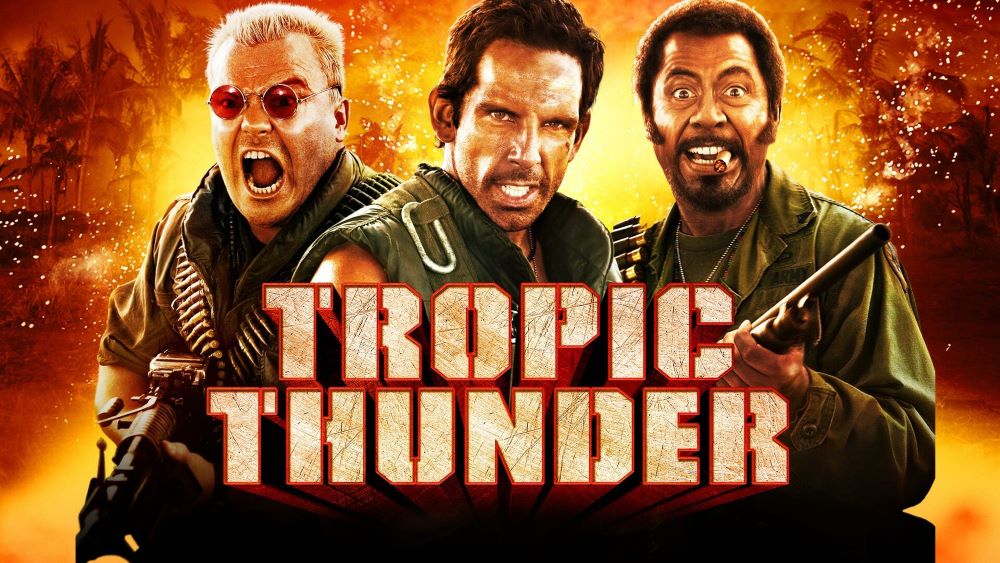
Review: Tropic Thunder (dir. by Ben Stiller)


“A nutless monkey can do your job.” — Les Grossman

Ben Stiller’s Tropic Thunder is a bold, chaotic comedy that dives headfirst into the wild world of Hollywood satire. The film, which Stiller directed, co-wrote, and starred in, feels like a high-energy roast of the movie industry itself, blending action, parody, and sharp commentary into one explosive package. The cast is stacked with familiar faces like Robert Downey Jr., Jack Black, Jay Baruchel, Brandon T. Jackson, and even Tom Cruise in a shockingly hilarious cameo, all committed to the film’s madcap, anything-goes spirit.

A distinctive touch that shows Tropic Thunder’s deep commitment to Hollywood satire is how it begins—not with a typical studio logo or title sequence—but with a series of fake movie trailers. These trailers parody different film genres and Hollywood clichés, setting an irreverent tone before the actual film even starts. The highlight is undoubtedly the “Oscar-bait” trailer for Satan’s Alley, a pitch-perfect send-up of self-serious, emotionally heavy dramas designed for awards season attention. By embedding these faux trailers, the film immerses viewers in its meta commentary and signals from the outset that it’s willing to mock and take apart the film industry at all levels.

This movie-within-a-movie begins with a group of egotistical actors trying to make a serious war film based on the fictional memoir of a Vietnam veteran. Their attempt at gritty realism falters under the weight of their own vanity and cluelessness, turning the set into a feverish comedy of errors. When the director dies and the actors are abandoned in a real jungle with actual dangers, the film blurs the lines between fantasy and reality, leading to a relentless cascade of absurd situations and insider jokes about Hollywood machinery.

Robert Downey Jr.’s portrayal of Kirk Lazarus, a method actor who undergoes extreme skin pigmentation surgery to play a Black character, is both provocative and hilarious. His performance skewers Hollywood’s past mistakes with race and casting, while his tense exchanges with Brandon T. Jackson’s Alpa Chino, who plays a genuinely Black rapper, provide sharp moments that balance discomfort with comedy. Downey Jr.’s “blackface” was a conscious satire of method acting and Hollywood egos, an attempt to ridicule extreme lengths actors go for acclaim rather than an endorsement of offensive practices. However, even at its release in 2008, it sparked conversations about the boundaries of comedy and racial sensitivity—an issue that would be even more controversial in 2025’s cultural climate.

Similarly, the film’s handling of ableist humor through the subplot of Simple Jack, a fictional movie starring Ben Stiller’s character as a person with intellectual disabilities, drew mixed reactions. While intended as a biting critique of Hollywood’s exploitation of disability for sympathy and awards, the portrayal nonetheless walked a tightrope that made some audience members uncomfortable. This nuanced but risky satire highlights how Tropic Thunder throws a wide net in exposing Hollywood’s many blind spots, yet its fearless approach also invites legitimate questions about respect and representation.

Jack Black delivers wild physical comedy as Jeff Portnoy, a drug-addled comedian losing control, offering a blend of slapstick and oddly sincere moments. Meanwhile, Tom Cruise steals the film with his iconic turn as Les Grossman, the balding, foul-mouthed studio exec whose explosive rants and dance moves have reached legendary status. Industry insiders often note that Grossman’s tempestuous persona seems inspired by real-life producer Scott Rudin, known for a similarly volatile temperament.

Much of the film’s humor targets Hollywood’s obsession with awards and ego, skewering Oscar-bait films, blockbuster excess, and ridiculous celebrity antics. The fake trailers highlight these themes, and Lazarus’s infamous line “Never go full retard, man!” takes aim at acting extremes motivated by prestige rather than authenticity. Stiller’s direction embraces loud, over-the-top action sequences that mimic classic Vietnam War movies but infuse them with cartoonish chaos, while the lush jungle serves as a satirical arena for exposing the actors’ incompetence.

While Tropic Thunder is gleefully offensive and hilarious, its treatment of race and disability sparked debate about where satire crosses lines. The film’s biting self-awareness and sharp commentary doesn’t always prevent discomfort, but it highlights the difficulty of balancing edgy humor with social consciousness in comedy. The film’s reception reveals how comedy evolves with cultural awareness; what passed as biting satire in 2008 would face even fiercer scrutiny in today’s more sensitive and politically aware environment.

From an entertainment standpoint, the movie delivers nonstop laughs, with rapid-fire jokes, strong chemistry among the cast, and sharp Hollywood references that keep fans engaged. Downey Jr.’s method acting antics, Black’s physical comedy, and Cruise’s outrageous studio boss combine into a relentless comedic assault. It’s not a film for those who prefer safe or sanitized humor, but for those who appreciate biting satire with reckless energy, it’s a must-watch.

Looking back, Tropic Thunder stands as a snapshot of a moment before social media and instantaneous backlash reshaped Hollywood comedy. Its controversial content might not get greenlit today, much like the boundary-pushers Blazing Saddles and Airplane! before it. Yet, as history shows, comedy will always find new ways to challenge sensibilities and push limits. Only time will tell what the next film is that dares to cross such lines again.

If you haven’t experienced Tropic Thunder, prepare for a relentlessly funny, sharply satirical comedy that skewers everything from celebrity egos to studio politics with savage wit and over-the-top energy.

Lisa Reviews An Oscar Nominee: Up in the Air (dir by Jason Reitman)


There’s a lot of film bloggers out there who have a natural aversion to anything that Jason Reitman is associated with.

And listen, I understand.  The fact of the matter is that Jason Reitman probably does owe a lot of his success to the fact that people in the industry know and like his father.  And it’s also true that Jason Reitman does tend to specializes in making films that you’re either going to love or you’re going to hate.  His films mix drama and comedy and sentiment and snark and sometimes, his refusal to come down firmly on the side of either one can feel like a bit of a cop out.  There’s a quirkiness to many of his films and sometimes, it can come across as being a bit cutesy.  And I’ll even go as far as to agree with those who say that it’s been a while since Reitman’s made a really good film.  The most common complaint I hear about Reitman is that his first four films (Thank You For Smoking, Juno, Up In The Air, and Young Adult) were okay and then he let his good reviews go to his head.  Of course, some people — okay, a lot of people — will tell you that, of those four films, Juno’s overrated.

I get all of that and I actually agree with some of those points.  Reitman is a director who sometimes seems to have lost his way after his early successes.  I think the closest that Reitman’s come to giving us a good film post-Young Adult was with Tully and even then, that felt more like a Diablo Cody film than a Jason Reitman film.

But, with all of that in mind, I still really like Jason Reitman’s early films and I think that he still has the potential to once again be an important and interesting filmmaker.  Thank You For Smoking and Juno are better than many give them credit for being.  Charlize Theron has never been better than she was in Young Adult.  Finally, this morning, I rewatched 2009’s Up In The Air for the first time in a long time and I was pleasantly surprised to see how well it holds up.

Up In The Air features George Clooney and Anna Kendrick.  Clooney plays Ryan Bingham, an obsessive traveler who boats about living a life without commitment.  Ryan works for a company that hires him out to fire people.  If your boss is too much of a pussy to tell you that you’ve been terminated to your face, he hires Ryan to do it for him.  Ryan specializes in trying to convince people that being fired is not a tragedy but an opportunity for a new beginning.  Ryan also has a side gig as a motivational speaker.  His speeches are largely about avoiding commitment and personal baggage.

Anna Kendrick plays Natalie Keener.  Natalie works for the same company as Ryan but, at the age of 23 and just out of college, she’s a lot less confident when it comes to destroying people’s livelihoods.  (“I’ve worked here for 17 years and I’m being fired by a 7th grader,” is one person’s response to being terminated by Natalie.)  Natalie has come up with a new plan where all firings will be done via Skype.  That way, the person doing the firing will never have to leave their office and won’t have to deal with the people they’ve fired one-on-one.  Ryan says he considers this proposal to be inhumane but mostly, he’s just worried that he’ll lose his traveling privileges if Natalie’s plan is instituted.

Ryan and Natalie travel the country.  Ryan teaches Natalie how to fire people and Natalie discovers that it’s not as easy to destroy someone’s life as she thought.  Everywhere they go, they deal with people who are facing economic uncertainty.  Ryan meets another frequent flyer, Alex (Vera Farmiga) and, after Alex reveals that she’s even less interested in commitment than Ryan, they begin an affair.  Ryan starts to fall in love with Alex and even invited her to attend his sister’s wedding with him.  However, Alex has a secret of her own.

One thing that I really like about Up in the Air is that Ryan and Natalie never end up sleeping together.  I remember, when I first saw the movie, I was convinced that it was going to happen.  After all, Ryan is handsome and charming and Natalie is attractive and, after her boyfriend dumps her, vulnerable.  I was cringing at the knowledge that there would eventually be some contrived scene where Natalie and Ryan end up getting drunk and then end up waking up in bed together and the end result would be Natalie going from being a well-rounded, multi-dimensional character to just being a plot device in Ryan’s journey to becoming a better man.  Well, there is a scene where Natalie and Ryan get drunk at the same time but it doesn’t lead to Natalie and Ryan becoming lovers and I respected Up in the Air for having enough respect for its characters to not do the convenient thing.

The other thing I liked about Up In The Air is that it’s one of the few films to make proper use of George Clooney’s deceptively smooth screen presence.  We all know that Clooney is handsome and charming but what makes him an appealing actor is that there’s always been hints that there’s a lot dorkiness and insecurity hiding underneath the suave facade.  Ryan may seem like he’s got it all together but, as the film progresses, you come to realize that he’s a lot more insecure and neurotic than he lets on.  All of his snarky comments have more to do with his own fear of failure than anything else.  Much as how the real life Clooney still sometimes seems as if he hasn’t fully gotten over being dismissed as just being another pretty face in the early days of his career, Ryan has never gotten over his dysfunctional childhood.  Instead of taking a risk on love, he instead obsesses on getting frequent flyer miles.  (At one point, Sam Elliott pops up out of nowhere and, in a scene that you could really only expect to find in a Jason Reitman film, gives Ryan a pep talk.)  There’s a sadness to Ryan, one that seems to come from deep inside of his soul.  Clooney does an excellent job of bringing that sadness to the surface while still giving a likable and compelling performance.

Up In The Air was released at a time when America was stuck in what seemed like a never-ending recession.  Despite the fact that the news media and the politicians were insisting that things were on the verge of getting better (or, at the very least, boasting that unemployed actors were no longer “job-locked,” whatever the Hell that meant), many people believed that their best days were officially behind them.  A lot of the contemporary reviews of the film focused on what it had to say about living in a time of economic uncertainty.  That was ten years ago and we’re now living in a strong economy but, even so, Up In The Air still resonates.  Reitman includes scenes in which people talk about what it was like to be fired.  The majority of these people were not actors but were instead people recruited from the local unemployment office and they were speaking about their own experiences.  The pain and resentment on their faces and in their voices is so palpable that it’s actually a bit jarring when J.K. Simmons and Zach Galifianakis show up, playing employees who are “terminated” by Ryan.  I guess I should admit that I’ve never actually been fired from a job but, after watching Up In The Air, it’s not something that I would ever want to experience.

Up In The Air holds up well.  Reitman’s direction is quirky but effective and he does a good job of mixing comedy in with the drama.  (Wisely, whenever he has to make a choice, he emphasizes the drama over the comedy, instead of trying to maintain some sort of mythical 50/50 balance between them.)  This film features one of George Clooney’s best performances and he has a really likable chemistry with Vera Farmiga.  Anna Kendrick also does a great job with a character who could have become a stereotype in less skilled hands.  Finally, along with Juno and The Gift, this film is one of the reasons why I always have a hard time watching Jason Bateman in any film or show where he’s cast as hero.  Bateman plays Ryan’s boss and the character is so smarmy (and Bateman does such a good job of playing him) that he’ll make your skin crawl.

It’s been a while since Up In The Air was first released and Jason Reitman’s career has had its ups and downs.  Still, regardless of whatever film Reitman makes next, Up In The Air remains a classic of the aughts.

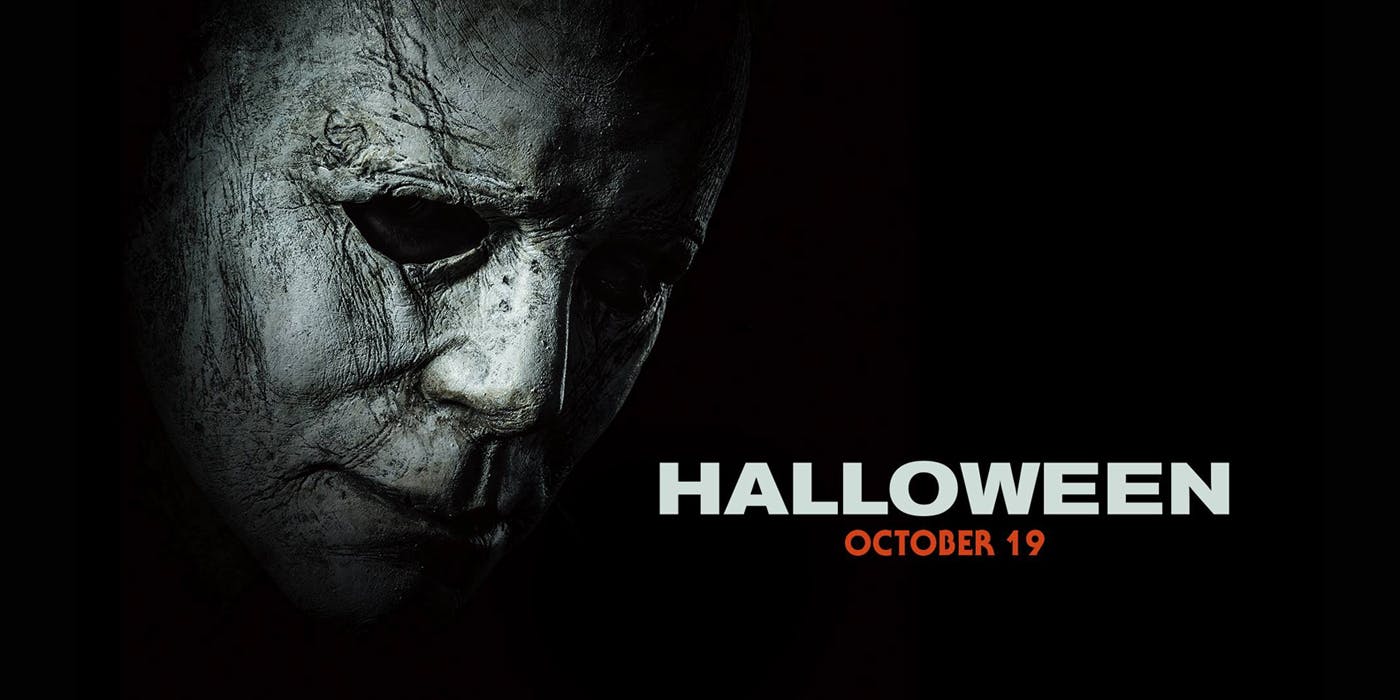
Trailer: Halloween


Halloween 2018

October 19, 2018. Keep that date in mind.

It’s the date for the latest entry to the Halloween franchise. It’s to be a sequel to the original film. It will also discard every other Halloween sequel ever made. So, for those who are so anti-remake/reboot this should alleviate any of those triggers.

David Gordon Green (who co-wrote this sequel with Danny McBride and Jeff Fradley) directs this sequel as a continuation of the events which happened with the original film. A follow-up that’s 40 years in the making, literally.

So, once again, remember October 19th and make sure to check this film out. I have a sneaking suspicion that it’ll be the true sequel to Carpenter’s classic.

Horror Film Review: Alien: Covenant (dir by Ridley Scott)


Why did Alien: Covenant fail?

It’s a legitimate question.  Alien itself is such an iconic horror film that, 38 years after it was first released, blatant rip-offs like Life are still being produced and, in many case, are still doing pretty well at the box office.  When John Hurt died earlier this year, he left behind a long and distinguished filmography but almost every obituary opened by discussing his role in Alien.  

Alien: Covenant received a good deal of pre-release publicity, mostly centering on the fact that Ridley Scott was not only the filming the latest installment of the franchise but that this was going to be a true Alien film, as opposed to a strange hybrid like Prometheus.  Personally, when I first saw the trailer, I thought it looked like something was a little off about it.  The spaceship looked way too clean and, for that matter, so did all the humans.  Whereas Alien and Aliens were all about sweaty, profane men and women stuck in dark and cramped locations, the humans in Alien: Covenant just looked too damn perky.  In at least one of the trailers, they were all smiling.  No one smiles in space, at least not in an Alien movie.  Still, everyone else seemed to be super excited about the trailer so I figured that maybe I was just being overly critical.

Then the movie came out.  It got some respectful but somewhat restrained reviews, though it did seem like quite a few critics were more interested in praising the longevity of the series as opposed to actually talking about the film itself.  At the box office, it performed a bit below expectations during the first week but then again, that’s pretty much been the story for almost every film that’s been released in 2017.  But then, during the second week, it plunged from being the number one movie in America to being the number four movie in America.  In the third week, it plunged again and, in the fourth week, it left first-run theaters and headed for the dollar cinemas.  When a widely anticipated film like that — especially one that is part of a historically popular franchise — heads to purgatory after only four weeks, the only thing you can blame is word of mouth.

Why did Alien: Covenant fail?

Well, there’s several reasons why this film failed to connect with audiences.

First off, the plot is rather familiar.  In the future, the crew of a spaceship picks up a radio transmission for a nearby planet and the captain (played, in this case, by Billy Crudup) sends down an expedition to investigate.  Of course, it turns out that the planet is full of facehuggers and xenomorphs and all the other stuff that audiences typically expect from an Alien film.  Also on the planet is David (Michael Fassbender), the replicant who is the sole survivor from Prometheus.  (Fassbender actually plays two roles in Covenant.  He also plays Walter, another replicant.  One is bad and one is good.)  Basically, Covenant takes the plots of Alien and Aliens and mashes them together.  But it never answers the question of why audiences wouldn’t be better off just watching the originals.

The humans themselves are rather blandly written and somewhat interchangeable.  There’s no one who is memorably quirky like Bill Paxton or Harry Dean Stanton.  Katherine Waterston makes for a bland substitute for both Sigourney Weaver and Noomi Rapace.  Usually, I like Danny McBride but he seems out of place in an Alien film.  Genuinely interesting actors, like James Franco, Amy Seimetz, and Carmen Ejogo, are all dispatched far too early.  Probably the best performance in the film comes from Michael Fassbender but, for anyone who has any knowledge of what usually happens with replicants in the Alien franchise, there’s no surprises to be found in either of his characters.

But ultimately, the main problem with Alien: Covenant is that it just wasn’t scary.  Some might say that this is due to the fact that we’re no longer shocked by the sight of aliens bursting out of people’s chests.  However, I recently watched Alien.  I watched it with the full knowledge that, as soon as John Hurt sat down to eat, that little bugger was going to burst out of his chest and that blood and bones were going to fly everywhere.  I also knew that Harry Dean Stanton was going to end up walking right underneath the alien.  I knew that Tom Skerritt’s radio was going to go dead.  I knew that the alien would be waiting for Sigourney Weaver in the escape pod.  I knew all of this and Alien still scared the Hell out of me, as it has every time that I’ve watched it.

And I also had the same reaction when I recently watched Aliens.  Yes, I knew that the space marines weren’t going to be able to fight the aliens.  I knew what was going to happen to Paul Reiser.  I knew that Bill Paxton was going to end up chanting, “Game over, man!”  I knew that aliens were going to be bursting off of chests all over the place.  I knew it was all going to happen and yet, turning out all the lights and watching Aliens still left me feeling shaken.

The difference between those two films and Alien: Covenant is that the first two films felt authentic.  The ships felt lived in.  The characters felt real.  Both films were full of rough edges and small details that invited you to try to look closer.  You could watch those films and imagine yourself on those ships and talking to those characters.  You got scared because you knew that there was no way you’d be one of the survivors.  Everyone pretends that they would be Sigourney Weaver but most of us know that, in reality, we’re going to be Veronica Cartwright, sobbing and useless.

Alien: Covenant, on the other hand, is a very slick movie.  Nothing about it feels real and there’s no real emotional impact when the aliens show up and start killing people.  You never feel as if you know the characters, beyond whatever feelings you may have toward the actors involved.  “Oh,” you say, “the alien just burst out of Billy Crudup’s chest.  Well, he’s got another movie coming out so he’ll be fine…”

For all of the technical skill that went into making it, Alien: Covenant has no soul.  And, for that reason, it’s never scary.  (Sadly, Life felt like a better Alien movie than Covenant did.)  Hopefully, if there is another Alien film, that soul will be rediscovered.

Playing Catch-Up: Sausage Party (dir by Conrad Vernon and Greg Tiernan)


Sausage Party opens with a scene that could have come straight for a heart-warming Pixar film.  It’s morning and, in a gigantic grocery store called Shopwell’s, all of the grocery items are excited about the start of a new day.  The hot dogs are singing.  The buns are harmonizing.  The produce is bragging about how fresh they are.  Everyone is hoping that this will be the day that they are selected to leave the aisles of Shopwell’s and that they’ll be taken to the Great Beyond.  At Shopwell’s, shoppers are viewed as being Gods and being selected by a God means…

…well, no one is quite sure what it means but everyone’s sure that it has to be something good.  Surely, the Great Beyond couldn’t be something terrible, right?  At least, that’s what everyone assumes until a previously purchased jar of Honey Mustard returns to the store and tells a hot dog named Frank (voiced by Seth Rogen, who also co-wrote the film) that the Great Beyond is a lie.  The Great Beyond is not a paradise.  Instead, it’s something terrible.  Before Honey Mustard can be persuaded to give more details, it leaps off the shelf, choosing suicide over being restocked.

What could it all mean?  Well, there’s not too much time to worry about that because, even as Honey Mustard is committing suicide, a customer is selecting both Frank and Frank’s girlfriend, a bun named Brenda (Kristin Wiig).  They’re going to the Great Beyond together!  Yay!  Except…

…calamity!  A shopping cart collision leads to both Frank and Brenda being thrown to the floor.  While their friends are taken to the Great Beyond, Frank and Brenda are left to wander the store.  It turns out that Shopwell’s really comes alive after the lights go down and the doors are locked.  All of the grocery items leave their shelves and have one big party.  Frank seeks answers about the Great Beyond from a bottle of liquor named Firewater (Bill Hader).  Firewater has all the answers but you need to be stoned to truly understand.  This is a Seth Rogen movie, after all.  Meanwhile…

…Frank’s friends, the ones who survived the earlier cart collision, are discovering that the Great Beyond is not what they thought it was…

I apologize for all the ellipses but Sausage Party is the kind of movie that warrants them.  This is a rambling, occasionally uneven, and often hilariously funny little movie.  (I know that there were allegations that the film’s animators were treated horribly.  That’s sad to hear, not least because they did a truly wonderful job.)  Sausage Party was perhaps the ultimate stoner film of 2016, a comedy with a deeply philosophical bent that plays out with a logic that feels both random and calculated at the same time.

(If you’ve ever had the three-in-the-morning conversation about “What if our entire universe is just a speck of dust in a bigger universe?”, you’ll immediately understand what Sausage Party is trying to say.)

It’s also an amazingly profane little movie but again, that’s a huge reason why it works.  Yes, a lot of the humor is juvenile and hit-and-miss.  (I cringed whenever the film’s nominal villain, a douche voiced by Nick Kroll, showed up.)  But for every joke that misses, there’s a joke that works perfectly.  Interestingly, for all the silliness that’s inherent in the idea of making a film about talking grocery items, there’s a strain a very real melancholy running through Sausage Party.  Sausage Party may be a dumb comedy but that doesn’t mean that it doesn’t have a lot on its mind.

Since it’s a Seth Rogen film, the cast is full of familiar voices.  Yes, James Franco can be heard.  So can Paul Rudd, Danny McBride, Salma Hayek, Edward Norton, Jonah Hill, and Craig Robinson.  They all sound great, bringing vibrant life to the film’s collection of consumables and condiments.

Sausage Party.  After watching it, it’s possible you’ll never eat another hot dog.

Cleaning Out the DVR Yet Again #37: The Sound and the Fury (dir by James Franco)


(Lisa recently discovered that she only has about 8 hours of space left on her DVR!  It turns out that she’s been recording movies from July and she just hasn’t gotten around to watching and reviewing them yet.  So, once again, Lisa is cleaning out her DVR!  She is going to try to watch and review 52 movies by the end of Thursday, December 8th!  Will she make it?  Keep checking the site to find out!)

the_sound_and_the_fury_2014_film

James Franco’s 2015 adaptation of William Faulkner’s classic novel, The Sound and The Fury, aired on Starz on November 2nd.

You know what?  Haters are going to hate but James Franco does more in an hour than most people do in a month.  Not only is James one of the most consistently interesting actors working today but he’s also a writer, a painter, a teacher, an activist, and a film director.

Indeed, it’s his work as a director that might be the most overlooked part of James’s prolific career.  Since making his directorial debut in 2006, with The Ape, James Franco has directed over 30 movies, television episodes, and short films.  As a director, James Franco has shown a talent for strong visuals and a willingness to take on difficult material.

For instance, can you imagine any other director who would have the guts to try to make a film out of The Sound and The Fury, the classic novel that may be the most unfilmable literary work this side of Finnegan’s Wake?

Told through the perspective of four related but very different characters, The Sound and The Fury details the fall of both the once mighty Compson family and the old South that the Compsons represent.  Benjy Compson is developmentally disabled and sees the world in a disjointed, nonlinear style.  Quinton Compson is fragile and sensitive and, while his section of the book starts in a fairly straight-forward enough manner, it quickly becomes nearly incoherent as Quinton’s mental state starts to deteriorate.  Jason Compson is cruel and evil but, because of his ruthless and self-centered personality, his section is the most straight-forward and the easiest to follow.  And finally, there’s Dilsey, the Compson family servant who is the only person to understand why the Compsons are in decline.  Faulkner utilized stream-of-consciousness throughout the entire novel, to such an extent that readers and critics are still debating just what exactly is happening and what Faulkner is actually saying.

In short, it takes courage to adapt a novel like The Sound and The Fury.  It takes even more courage when you’re an actor-turned-director who has his share of jealous haters.

Now, I should admit that James Franco was not the first director to attempt to make a film out of The Sound and The Fury.  In 1959, Martin Ritt made a version of the film, which reportedly did away with the nonlinear structure and centered the film around the straight-forward Jason.  (I haven’t seen the 1959 version.)  James Franco, on the other hand, not only adapts The Sound and The Fury but also adapts Faulkner’s style.

James Franco replicates the novel’s nonlinear structure and even takes on the role of Benjy himself.  It makes for a film that is occasionally frustrating and difficult to follow but which is also undeniably fascinating.  Filled with haunting images, James Franco’s The Sound and The Fury is a visual feast, one that perfectly captures the atmosphere of a decaying society.  The South, in this film, is trapped between the possibly imagined glories of the past and the harsh reality of the future.  There’s a dream-like intensity to the film.  It sticks with you.

As well, James Franco does an excellent job casting his film.  Tim Blake Nelson brings an enigmatic combination of grandeur and threat to the role of Mr. Compson and Jacob Loeb is haunting as the fragile Quentin.  Scott Haze dominates the film as the cruel Jason.  Though you never sympathize with Jason, you can understand how he became the man that he is.  Jason may not be a good man but, unlike the rest of the Compsons, you never doubt that he’s going to survive in one way or another.

James Franco took a big chance directing The Sound and The Fury and he succeeded.


Playing Catch-Up: Aloha (dir by Cameron Crowe)


Well, Christmas is over and soon 2015 will be over as well!  And our long time readers know what that means — its time for Lisa to desperately try to get caught up on reviewing all of the films that she’s seen this year!  After all, it will soon be time for me to post my “Best of” and “Worst of” lists and who knows?  Some of these films might make a list!

Anyway, with all that in mind, let’s take a quick look at Aloha!

Say what you will about Aloha as a movie, I would have loved to have been a part of the production.  Not only is the cast full of performers that I absolutely adore (Bradley Cooper, Emma Stone, John Krasinski, Bill Murray, Rachel McAdams, and Danny McBride, just to name a few) but the film itself was shot in Hawaii, which is one of the most beautiful places on Earth.  And let’s give director Cameron Crowe some credit for capturing some truly beautiful images of Hawaii.

As for the film itself, it’s a bit of a self-indulgent chore to sit through.  Aloha feels like a dozen different films, all mashed together and the end result is something of a mess.  Bradley Cooper is Brian Gilchrest, a defense contractor who is haunted by a mistake that he made while in Afghanistan.  (It’s the equivalent of Jerry Maguire writing that memo and Orlando Bloom making those shoes in Elizabethtown.)  Disillusioned and cynical, Brian is now working for a billionaire Carson Welch (Bill Murray), who wants to build his own private space center in Hawaii.  Brian’s job is to get the support of the native Hawaiians.

Brian’s Air Force liaison is Alison Ng (Emma Stone) and she’s as idealistic as Brian is cynical.  Brian and Alison are soon falling love but, at the same time, Brian has also reconnected with his ex-girlfriend, Tracy (Rachel McAdams).  Tracy is now married to Woody (John Krasinski), an Air Force captain who has difficulty expressing his feelings.  Tracy also has a 12 year-old daughter and Brian might be the father.

That may sound like enough for any movie to deal with but Aloha also wants to be a political satire as well as a relationship dramedy.  So, of course, there’s all sorts of ethical questions about the satellite that Carson wants to launch and, as a character, Carson is so incredibly inconsistent that you’re just happy that he’s being played by Bill Murray, one of the few actors who can make inconsistency charming.

Aloha is such a frustrating film, largely because of all the talent involved.  With that cast and all the beautiful scenery, it should have at least been an enjoyable lark.  Instead, it’s a huge and self-indulgent mess.

And, naturally enough, it features Alec Baldwin.  Baldwin always seems to show up in films like this and, as I watched him bellow his way through Aloha, I found myself wondering how Alec Baldwin can be so good in some films and so amazingly awful in others.  Baldwin’s a talented actor but, when a director allows him to go overboard, he can be difficult to watch.  In Aloha, Cameron Crowe lets Alec Baldwin go totally overboard.

When Aloha was first released, there was a lot of controversy over Emma Stone playing a character who supposed to be a quarter Chinese and a quarter Hawaiian.  At the time, Cameron Crowe stated that: “As far back as 2007, Captain Allison Ng was written to be a super-proud one-quarter Hawaiian who was frustrated that, by all outward appearances, she looked nothing like one. A half-Chinese father was meant to show the surprising mix of cultures often prevalent in Hawaii. Extremely proud of her unlikely heritage, she feels personally compelled to over-explain every chance she gets. The character was based on a real-life, red-headed local who did just that.”  That’s something that I — as a pale redhead who happens to be very proud of being a fourth Spanish — could relate to so it didn’t particularly bother me that Emma Stone was playing a character named Alison Ng.

Instead, what bothered me was that Alison Ng was never really allowed to emerge as an individual character with her own hopes, dreams, and ambitions.  Her character pretty much only existed to give Brian a reason to believe in life again.  Emma Stone’s a good actress but, as a film, Aloha lets her down.

Still, at least she got to spend sometime in Hawaii!

Trailer: This Is the End (Red Band)


ThisIsTheEnd

This Is the End looks to put a comedic touch on the end of the world genre as fictional versions of the cast as themselves try to survive all sort of disasters (from the trailer it looks like it may involve everything from volcanoes, lava, aliens and maybe raptors) while partying over at James Franco’s house.

I know for a fact that at least one person at this site will be seeing this because it has a certain Franco in it.

Looks like Emma Watson has definitely doing everything she can to prove to all Potter fans that she is now all grown up.

This Is the End is set for a June 12, 2013 release date.

My 2012 Emmy Nominations


So, for the past few days, I’ve been happily hopping around my section of the Shattered Lens Bunker and do you know why? 

Because it’s awards season, that’s why!  With the conclusion of the 2011-2012 TV season, Emmy ballots have been mailed and votes are being cast and, come July, we’ll know which shows and performers have been nominated for the 2012 Emmys. 

Before that happens, however, I would like to play a little game called “What if Lisa Was Solely Responsible For Picking the Nominees.”  Here’s how it works — I looked over and studied the complete list of the shows and performances that have been submitted this year for Emmy consideration.  And then, from that list, I picked my personal nominees.

(A complete list of every show and performer that’s been submitted for Emmy consideration can be found here.)

Below are my personal nominations in the major Emmy categories.  Again, note that these are not necessarily the shows and performers that I believe will be nominated.  Instead, these are the shows and performers that I would nominate if I was solely responsible for picking the nominees.

A complete list of my nominations in every single Emmy category can be found here.  (And yes, there’s a lot of Lifetime on the list.  There’s also a lot of Community.)

Best Comedy Series

Bored to Death (HBO)

Community (NBC)

Girls (HBO)

It’s Always Sunny In Philadelphia (FX)

Parks and Recreation (NBC)

Raising Hope (Fox)

Veep (HBO)

Best Drama Series

Boardwalk Empire (HBO)

Breaking Bad (AMC)

The Client List (Lifetime)

Downton Abbey (PBS)

Game of Thrones (HBO)

Homeland (Showtime)

Pan Am (ABC)

Ringer (The CW)

True Blood (HBO)

The Walking Dead (AMC)

Outstanding Miniseries or Movie

Blue-Eyed Butcher (Lifetime)

Cyberbully (ABC Family)

Drew Peterson: Untouchable (Lifetime)

Five (Lifetime)

Girl Fight (Lifetime)

Hatfields & McCoys (History Channel)

The Hour (BBC America)

Of Two Minds (Lifetime)

Outstanding Variety Series

Conan (TBS)

Fashion Police (E)

Key and Peele (Comedy Central)

The Soup (E)

Tosh .O (Comedy Central)

Outstanding Variety Special

Betty White’s 90th Birthday Party (NBC)

Celtic Women: Believe (PBS)

The Comedy Central Roast of Charlie Sheen (Comedy Central)

TV Land Awards (TV Land)

Wendy Liebman: Taller on TV (Showtime)

Outstanding Nonfiction Special

Bobby Fischer Against The World (HBO)

Catholicism: Amazed and Afraid (PBS)

Crime After Crime (OWN)

God Is The Bigger Elvis (HBO)

6 Days To Air: The Making of South Park (Comedy Central)

Outstanding Nonfiction Series

America in Primetime (PBS)

American Masters (PBS)

America’s Most Wanted (Lifetime)

Beyond Scared Straight (A&E)

Inside Story (Biography)

Outstanding Reality Program

Antiques Roadshow (PBS)

Dance Moms (Lifetime)

Kitchen Nightmares (Fox)

Scouted (E)

Storage Wars (A&E)

Outstanding Reality-Competition Program

The Amazing Race (CBS)

The Bachelor (ABC)

Big Brother (CBS)

The Celebrity Apprentice (NBC)

Hell’s Kitchen (Fox)

Project Runway (Lifetime)

So You Think You Can Dance (Fox)

Survivor (CBS)

Outstanding Lead Actor In A Comedy Series

Larry David in Curb Your Enthusiasm (HBO)

Johnny Galecki in The Big Bang Theory (CBS)

Danny McBride in Eastbound and Down (HBO)

Joel McHale in Community (NBC)

Lucas Neff in Raising Hope (Fox)

Jason Schwartzman in Bored To Death (HBO)

Outstanding Lead Actor In A Drama

Steve Buscemi in Boardwalk Empire (HBO)

Bryan Cranston in Breaking Bad (AMC)

Jeffrey Donavon in Burn Notice (USA)

Damian Lewis in Homeland (Showtime)

Andrew Lincoln in The Walking Dead (AMC)

Timothy Olyphant in Justified (FX)

Outstanding Lead Actor In A Miniseries or Movie

Idris Elba in Luther (BBC America)

Rob Lowe in Drew Peterson: Untouchable (Lifetime)

Steven Weber in Duke (Hallmark Movie Channel)

Dominic West in The Hour (BBC America)

Ben Whishaw in The Hour (BBC America)

Outstanding Lead Actress In A Comedy

Zooey Deschanel in New Girl (Fox)

Lena Dunham in Girls (HBO)

Tina Fey in 30 Rock  (NBC)

Julia Louis Dreyfuss in Veep (HBO)

Mary-Louis Parker in Weeds (Showtime)

Martha Plimpton in Raising Hope (Fox)

Outstanding Lead Actress in a Drama

Claire Danes in Homeland (Showtime)

Sarah Michelle Gellar in Ringer (The CW)

Jennifer Love Hewitt in The Client List (Lifetime)

Julianna Margulies in The Good Wife (CBS)

Elizabeth McGovern in Downton Abbey (PBS)

Anna Paquin in True Blood (HBO)

Outstanding Lead Actress In A Miniseries or Movie

Kristin Davis in Of Two Minds (Lifetime)

Anne Heche in Girl Fight (Lifetime)

Rose McGowan in The Pastor’s Wife (Lifetime)

Emily Osment in Cyberbully (ABC Family)

Sara Paxton in Blue Eyed Butcher (Lifetime)

Outstanding Supporting Actor In A Comedy Series

Charlie Day in It’s Always Sunny in Philadelphia (FX)

Danny DeVito in It’s Always Sunny In Philadelphia (FX)

Donald Glover in Community (NBC)

Nick Offerman in Parks and Recreation (NBC)

Danny Pudi in Community (NBC)

Matt Walsh in Veep (HBO)

Outstanding Supporting Actor In A Drama

Bruce Campbell in Burn Notice (USA)

Peter Dinklage in Game of Thrones (HBO)

Giancarlo Espositto in Breaking Bad (AMC)

Michael Pitt in Boardwalk Empire (HBO)

Michael Shannon in Boardwalk Empire (HBO)

Alexander Skarsgard in True Blood (HBO)

Outstanding Supporting Actor In A Miniseries or Movie

Powers Boothe in Hatfields and McCoys (History Channel)

Justin Bruening in Blue-Eyed Butcher (Lifetime)

Mark-Paul Gosselaar in Hide (TNT)

Sir Roger Moore in A Princess For Christmas (Hallmark Movie Channel)

Tony Shalhoub in Five (Lifetime)

Outstanding Supporting Actress In A Comedy

Alison Brie in Community (NBC)

Kristen Chenoweth in GCB (ABC)

Anna Chlumsky in Veep (HBO)

Gillian Jacobs in Community (NBC)

Cloris Leachman in Raising Hope (Fox)

Aubrey Plaza in Parks and Recreation (NBC)

Outstanding Supporting Actress in Drama

Christine Baranski in The Good Wife (CBS)

Kristen Bauer Von Straten in True Blood (HBO)

Kelly MacDonald in Boardwalk Empire (HBO)

Christina Ricci in Pan Am (ABC)

Sophia Turner in Game of Thrones (HBO)

Deborah Ann Woll in True Blood (HBO)

Supporting Actress In A Miniseries or Movie

Tammy Blanchard in Of Two Minds (Lifetime)

Kaley Cuoco in Drew Peterson: Untouchable (Lifetime)

Lisa Edelstein in Blue-Eyed Butcher (Lifetime)

Jessica Lange in American Horror Story (FX)

Jena Malone in Hatfields and McCoy (History Channel)

A Quickie Review: 30 Minutes or Less (dir. by Ruben Fleischer)


Earlier tonight, I went and saw the new comedy 30 Minutes or Less.  The film has, so far, gotten mixed reviews and the theater we saw it in was half-deserted.  The audience laughed quite a bit during the 1st half of the movie and a little less so during the second.  As soon as the credits started, everyone stood up and left.  This is not the type of film that inspires you to sit around and wait to see if there’s any extras at the end.  Still, despite that, it’s an enjoyable comedy that has enough laughs in it to justify the 83 minutes it takes to watch the entire film.

Danny McBride plays an aimless loser who, despite being in his mid-3os, still lives at home with his wealthy but hateful father (well-played by Fred Ward).  McBride spends his time blowing stuff up with his well-meaning but stupid best friend (Nick Swardson) and fantasizing about the day that his father will die and leave him his inheritance.  However, then McBride finds out about a hitman (Michael Pena) who is willing to kill Ward as long as McBride can pay him several thousand dollars.  So, McBride and Swardson kidnap a pizza deliveryman (Jesse Eisenberg) and strap a bomb to his chest.  They tell him that is he doesn’t rob a bank in the next 10 hours, the bomb will go off.  With the help of his best friend (Aziz Ansari), Eisenberg attempts to do just that.

The film’s humor comes not from the plot (which is based very loosely on a true story — more about that in a minute) but instead from the way these very ordinary characters attempt to deal with the situation they find themselves in.  All four of the major characters have little grasp on reality beyond what they’ve seen in other movies.  When Eisenberg and Aziz plot their bank robbery, it has less to do with logistics and everything to do with Point Break.  The film is perfectly cast and all of the actors have a real chemistry with each other.  You believe that McBride and Swardson are lifelong friends just as you buy that Aziz would go out of his way to help out Eisenberg. 

Much as he did with Zombieland, director Fleischer manages to maintain a nice balance between the comedic and the grotesque.  Unfortunately, also much like Zombieland, the film starts to run out of steam during the second half as the storyline becomes more centered on action than on comedy.  These characters who were previously only talking about being in an action film are suddenly thrust into an action film and everything starts to seem a little bit too familiar.  Still, 30 Minutes or Less is an enjoyable enough movie.  I just wish the end result had been a little less uneven.

Now, 30 Minutes or Less is based on a true story and this story wasn’t a comedy.  In 2003, a pizza deliveryman named Brian Douglas Wells robbed a bank in Erie, Pennsylvania.  He had a bomb around his neck.  Unlike the characters in this film, Wells was killed when the bomb went off and blew a softball-sized hole in his chest.  The police — who, in the moments before the fatal blast, basically just stood around with their tasers drawn while Wells begged for help — later accused Wells of being a part of the whole plot.  Which makes absolutely no sense but who am I to question Big Brother? 

Regardless of whether Wells was a victim or participant, that doesn’t change the fact that pizza delivery men are easy targets.  Just last year in Dallas, two kids with guns ordered a pizza and gave the address of a deserted warehouse.  They had to call many different pizza places before they found someone willing to deliver to that area of town.  When the pizza arrived, the kids gunned down the deliveryman.  When they were arrested, they said they had simply wanted to kill someone and they knew a pizza deliveryman was the only potential victim they’d be able to lure out to the middle of nowhere.  That’s hardly an isolated incident. 

Also, as is mentioned in this movie, whenever the pizza person takes 34 minutes to get to your house and then you go, “Duuuuuuude, the pizza’s free!” that means that the cost of your pizza is going to be taken out of the paycheck of a man who puts his life in danger every time he goes to work. 

So, what am I saying?  I’m saying don’t be an asshole and pay for your damn pizza!

And leave a good tip.