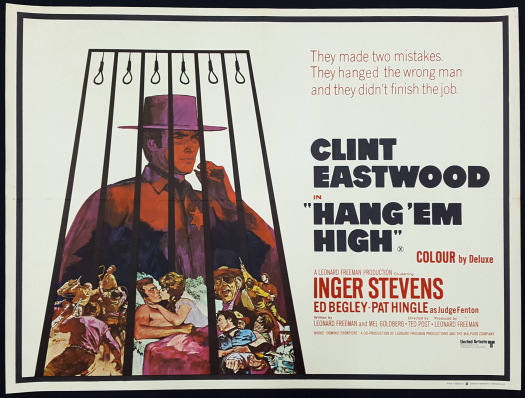
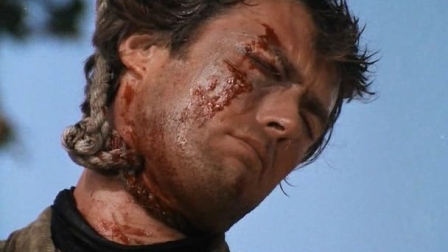
Well-Structured Destruction: Clint Eastwood in THE GAUNTLET (Warner Brothers 1977)


gary loggins's avatarcracked rear viewer

(First off, feast your eyes on the incredibly cool Frank Frazetta poster! Then read on… )

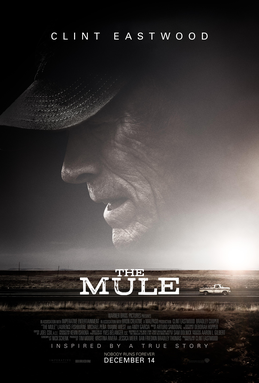
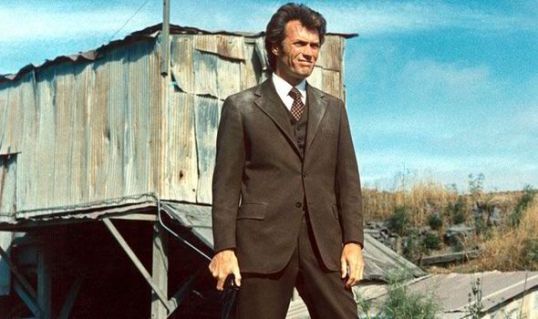
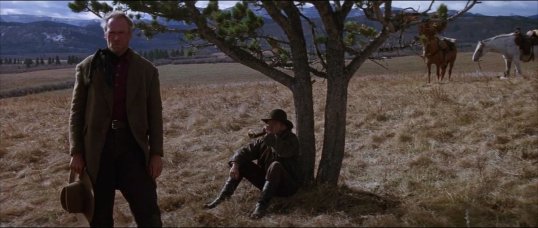
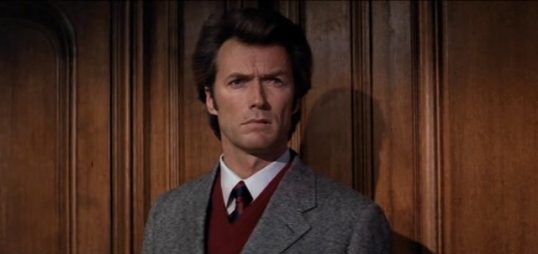
Clint Eastwood’s  directorial credits include some impressive films: THE OUTLAW JOSEY WALES, PALE RIDER, UNFORGIVEN, MYSTIC RIVER, MILLION DOLLAR BABY. While 1977’s THE GAUNTLET may not belong on that list, I feel it’s a very underrated movie deserving a second look. Clint and his lady love at the time Sondra Locke star in this character study of two damaged people disguised as an action comedy, essentially a chase film loaded with dark humor.

Clint plays Ben Shockley, an alcoholic Phoenix cop sent to Las Vegas to extradite Gus Mally, “a nothing witness in a nothing trial”. Gus turns out to be a woman, a hooker in fact, set to testify against a Phoenix mobster. Ben’s suspicions are roused when he learns Vegas oddsmakers are giving 50-1 they don’t make it to Phoenix alive, confirmed…

View original post 582 more words

Action in the Alps: WHERE EAGLES DARE (MGM 1969)


gary loggins's avatarcracked rear viewer

Alistair MacLean’s adventure novels, filled with muscular action and suspenseful plot twists, thrilled moviegoers of the 60’s and 70’s in such big budget hits as THE GUNS OF NAVARONE and ICE STATION ZEBRA. In his first foray into screenwriting, 1969’s WHERE EAGLES DARE,  he adapted his own work to the silver screen, resulting in one of the year’s biggest hits, aided by the box office clout of Richard Burton and Clint Eastwood . The film’s a bit long, running over two and a half hours, but action fans won’t mind. There’s enough derring-do, ace stunt work, explosions, and cliffhanging (literally!) to keep you riveted to the screen!

A lot of the credit goes to veteran stunt coordinator Yakima Canutt, in charge of all the action scenes as second unit director. Canutt staged some of the most exciting scenes in film history, from John Ford’s STAGECOACH to William Wyler’s BEN HUR, and certainly keeps things busy…

View original post 617 more words

A Movie A Day #203: Heartbreak Ridge (1986, directed by Clint Eastwood)


The year is 1983 and things are looking bad for the Second Marine Division of the U.S. Marine Corps.  The officers are almost all college graduates like Major Powers (Everett McGill) and Lt. Ring (Boyd Gaines), men who have never served in combat but who are convinced that they know what it means to be a Marine in the 80s.  Convinced that they will never have to actually fight in a war, the latest batch of recruits is growing soft and weak.  All of the slackers have been put in the Recon Platoon, where they are so undisciplined that they think that wannabe rock star Cpl. Jones (Mario Van Peebles) is a good Marine.  MARIO VAN PEEBLES!

They haven’t met Sgt. Highway yet.

Gunnery Sgt. Thomas Highway (Clint Eastwood) has seen combat, in both Korea and Vietnam.  He drinks too much.  He fights too much.  He has chased away his wife (Marsha Mason), despite his attempts to understand her by reading Cosmo and Ladies Home Journal.  Major Powers may think that Highway is a relic but Highway knows better than to worry about what a college boy thinks.  The Recon Platoon may think that they can defy him but that haven’t seen Highway throw a punch yet.  Everyone may think it’s a waste of time to learn how to fight but little do they know that America is about to invade Grenada.

Heartbreak Ridge is all about Clint Eastwood.  Without Clint Eastwood, it would just be another basic training film.  With Clint Eastwood, it is a minor masterpiece and a tribute to America’s fighting spirit.  In 1986, no one was better at glaring at a young punk or glowering at a clueless superior officer than Clint Eastwood.  Even the running joke of Highway reading women’s magazines works because it is impossible not to laugh at Clint Eastwood intently studying an issue of Cosmo.   Clint may have been 56 when he directed and starred in Heartbreak Ridge but he was still believable beating up men who were less than half his age.  (Mario Van Peebles thinks he’s going to be able to stand up to Clint Eastwood?  Get outta here!)  There is never any question that Highway is going to able to whip everyone into shape.  The only question is how many terse one-liners are going to be delivered in the process.   By the time Highway and his platoon reach Grenada, everyone is ready to watch Clint put the communists in their place and Clint does not disappoint.

Reportedly, the U.S. Marine Corps. initially supported Heartbreak Ridge but, in case of life imitating art, disowned the finished picture, feeling that the film’s portrayal of The Corps was inaccurate and the sergeant’s “training” methods were too old-fashioned to actually be effective.

Thomas Highway would disagree.

One final note: Bo Svenson has a small role as the man trying to steal Marsha Mason away from Clint.  If you have ever wanted to see Dirty Harry and Buford Pusser fight over the Goodbye Girl, here’s your chance.

A Movie A Day #95: The Return of Josey Wales (1986, directed by Michael Parks)


Four years before he played Jean Reanult on Twin Peaks, actor Michael Parks starred in and made his directorial debut with the obscure western, The Return of Josey Wales.

As is obvious from the title, The Return of Josey Wales is a sequel to the iconic Clint Eastwood western, The Outlaw Josey Wales.  In fact, The Return of Josey Wales was based on a novel that author Forrest Carter wrote after the initial success of Eastwood’s film.  Originally, Clint himself was going to direct and star in the sequel.  However, Eastwood withdrew from the project and it would be years before The Return of Josey Wales would eventually be made with a miniscule budget and given a very limited theatrical release.  By the time the film was released, it had long since been discovered that Forrest Carter, who had always portrayed himself as being a Cherokee shaman-turned-writer, was actually Asa Earl Carter, a former member of the Ku Klux Klan who had previously worked as a speech writer for arch segregationist, George Wallace.

Along with taking over from Eastwood as the film’s director, Michael Parks also took over the role of Josey Wales.  Having faked his death, Josey is now living on a small farm in Texas and going out of his way not to draw attention to himself.  One day, a man named Paco (Paco Vela) shows up and tells Josey that a corrupt Mexican policeman has killed one of Josey’s friends and locked another one up in prison.  It’s time for Josey to say goodbye to his new wife, jump on a horse, and head down to Mexico.

The Return of Josey Wales never escapes the shadow of The Outlaw Josey Wales, even though the two films have little in common.  As a director, Michael Parks is no Clint Eastwood and his reliance on stock footage reveals how little of a budget he had to work with.  As an actor, Parks gives a totally different performance from Clint Eastwood’s.  Clint’s Josey Wales was hardened and embittered by his experiences.  Michael Parks plays Josey more as an underestimated hick who is not afraid to use a gun if he has to.  There is a lot of Earl McGraw in this version of Josey Wales.  That does not mean that Michael Parks gives a bad performance.  In fact, his performance is the best thing in the film.

The Return of Josey Wales is for Western completists only.

(This review originally stated that Eastwood left the project after it was revealed that Forrest Carter was Asa Carter.  According to Dan T. Carter’s comment below, Eastwood actually left the sequel long before Forrest Carter’s actual identity was revealed.)

The Dollars Trilogy Pt 3: THE GOOD, THE BAD, & THE UGLY (United Artists 1966)


gary loggins's avatarcracked rear viewer

gbu1

THE GOOD, THE BAD, AND THE UGLY is the GONE WITH THE WIND of Spaghetti Westerns, Sergio Leone’s masterpiece, and definitely in my Top 5 Favorite Films. After turning the genre upside down with A FISTFUL OF DOLLARS and inside out with FOR A FEW DOLLARS MORE, Leone’s final entry in his triptych of films starring Clint Eastwood as The Man With No Name is an ambitious epic about greed, revenge, and the futility of war, told with a warped sense of humor and plenty of action. Besides Eastwood and FEW DOLLARS co-star Lee Van Cleef, Eli Wallach joins the cast in a performance that should have won the Oscar.

gbu2

We’re first introduced to Angel Eyes (Van Cleef), who’s one mean mutha. Sent to find information on the location of stolen Confederate gold, he kills his informant, then kills the man who hired him, and begins his search for “Bill Carson”. Meanwhile…

View original post 638 more words

The Dollars Trilogy Pt 2: FOR A FEW DOLLARS MORE (United Artists 1965)


gary loggins's avatarcracked rear viewer

faf1

After the huge international success of his A FISTFUL OF DOLLARS , Sergio Leone was red hot. Another Spaghetti Western was hastily written by Leone and Luciano Vincenzoni (and an uncredited assist from Sergio Donati), but FOR A FEW DOLLARS MORE is pure Leone, from the visual style to the bits of humor interspersed between the violence. Clint Eastwood returned as The Man With No Name, paired this time with veteran Western heavy Lee Van Cleef as the beady-eyed Colonel Mortimer.

faf2

Eastwood’s character (briefly referred to as ‘Manco”) is a fast-drawing bounty hunter. He’s interested in the $10,000 reward for escaped killer/outlaw Indio. Mortimer is also interested in Indio, but has another motive: a young Indio raped his sister, resulting in her suicide during the act. The two meet up in El Paso, where Indio plans to rob the bank’s estimated one million dollars, kept in a secret cabinet. Manco and Mortimer engage in pissing contest…

View original post 389 more words

The Dollars Trilogy Pt 1: A FISTFUL OF DOLLARS (United Artists 1964)


gary loggins's avatarcracked rear viewer

fist1

If the American Western film wasn’t completely dead in 1964, it was surely on life support. Television had saturated the market with weekly oaters to the point of overkill. John Wayne’s starring vehicles were still making money, but the rest of Hollywood’s big screen Westerns were mainly made to fill the bottom half of double feature bills, from Audie Murphy outings to the low budget, veteran laden films of producer A.C. Lyles.

Meanwhile in Italy, writer/director Sergio Leone was as tired of the sword & sandal films he was making as was his audience. He had a notion to revitalize the failing western genre by giving it a new, European perspective. Leone grew up on Hollywood westerns, and wanted to turn them on their ear by showing a more realistic, grittier version of the Old West. Searched high and low for an American name actor to star, Leone was turned down by the likes of Charles Bronson, James Coburn, and Rory Calhoun…

View original post 501 more words

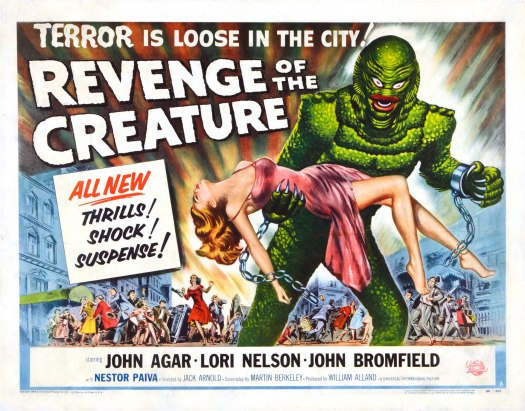
Horror On The Lens: Revenge of the Creature (dir by Jack Arnold)


For today’s horror on the lens, we present to you 1956’s Revenge of the Creature!

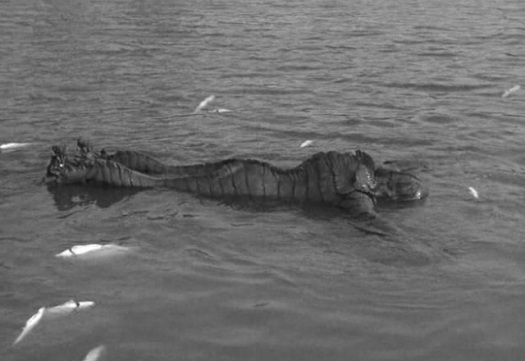
Revenge of the Creature was the first sequel to The Creature From The Black Lagoon.  It turns out that the Gil-Man didn’t actually die at the end of the last film.  Instead, he’s alive, he’s been captured, and he’s now being displayed in an aquarium.

Now, I’m going to be honest: Revenge of the Creature is not as a good as The Creature From The Black Lagoon.  But it’s still kind of fun in a silly 1950s monster movie sort of way.  And, if you keep your eyes open, you might spot a very young Clint Eastwood, playing a lab technician and sporting a truly impressive head of hair.

Enjoy!


Film Review: Sully (dir by Clint Eastwood)


sully_xxlg

The new film Sully is about several different things.

Most obviously, it’s about what has come to be known as the Miracle on the Hudson.  On January 15th, 2009, US Airways Flight 1549 had just departed from New York’s LaGuardia Airport when it was struck by a flock of geese.  (They say that it was specifically hit by Canadian Geese but I refuse to believe that Canada had anything to do with it.)  With both of the engines taken out and believing that he wouldn’t be able to get the plane back to either LaGuardia or an airport in New Jersey, the flight’s plot, Chelsey “Sully” Sullenberger (played by Tom Hanks) landed his plane on the Hudson River.  Not only did Sullenberger manage to execute a perfect water landing but he also did so without losing a single passenger.

I’m sure that we can all remember that image of that plane sitting on the river with passengers lined up on the wings.  We can also remember what a celebrity Sully became in the days following the landing.  At a time of national insecurity and cynicism, Sully reminded us that people are still capable of doing great things.  It also helped that Sully turned out to be a rather humble and self-effacing man.  He didn’t use his new-found fame to host a reality TV show or run for Congress, as many suggested he should.  Instead, he wrote a book, raised money for the National Suicide Prevention Lifeline, and appeared in two commercials for St. Jude Children’s Research Hospital.

Wisely, Sully opens after the Miracle on the Hudson, with Sully still struggling to come to terms with suddenly being a celebrity.  (That said, we do get to see the landing in flashbacks.  In fact, we get to see it twice and it’s harrowing.  The “Brace! Brace!” chant is pure nightmare fuel.)  Tom Hanks plays up Sully’s modesty and his discomfort with suddenly being a hero.  Even while the rest of the world celebrates his accomplishment, Sully struggles with self-doubt.  Did he make the right decision landing the plane on the Hudson or did he mistakenly endanger the lives of all the passengers and crew members?

A lot of people would probably say, “What does it matter?  As long as he succeeded, who cares if he actually had to do it?”  Well, it matters to Sully.  Some of it is a matter of professional pride.  And a lot of it is because the soulless bureaucrats at the National Transportation Safety Board are investigating Sully’s landing.  If it’s determined that he could have made it back to airport and that he unnecessarily endangered the lives of everyone on the plane, he could lose his job and his pension.  As we see in a few scenes with Sully’s wife (Laura Linney, who is somewhat underused), the Sullenbergers really need that pension.

That brings us to another thing that Sully is about.  It’s a celebration of not only individual heroism but individuality itself.  The NTSB claims that they have computer-generated recreations that prove Sully had enough time and fuel to return to an airport but, as Sully himself points out, the NTSB has ignored the human element in their recreations.  As a result of their obsession with regulation and procedure, the bureaucrats have forgotten that planes are not flown by computers but individuals who have to make split-second decisions.

That’s one of the things that I loved about Sully.  In this time when we’re constantly being told that our very future is dependent upon always trusting the bureaucrats and following their rules and regulations, Sully reminds us that the government is only as good as the people who work for it.  And, far too often, the people are smug and complacent morons.

(For the record, Sullenberger has said that the real-life hearings were not as confrontational as the ones depicted in the film.  However, even taking into account the dramatic license, the overall message still rings true.)

And finally, Sully is a film about what America has become in the wake of 9-11.  Just as in real-life, the film’s Sully suffers from PTSD in the days immediately following the Miracle on the Hudson.  Even while the rest of the world celebrates him, Sully has nightmares about what could have happened if he hadn’t made the landing.  When we watch as Sully’s plane collides with a New York skyscraper, it’s impossible not to be reminded of the horrible images of September 11th.  Not only does it drive home what was at stake when Sully made that landing but it also reminds us that, regardless of what some would want us to beg, there are still heroes in the world.  Not every story has to end in tragedy.  People are still capable of doing great things.  Heroism is not dead.  With tomorrow being the 15-year anniversary of the day when 3,000 people were murdered in New York, Pennsylvania, and D.C., it’s important to be reminded of that.

Sully is a powerful and crowd-pleasing film.  (The normally cynical audience at the Alamo Drafthouse broke into applause at the end of the movie.)  Director Clint Eastwood tells this story in a quick, no-nonsense style.  During this time of bloated running times, Sully clocks in at 97 minutes and it’s still a million times better than that 150-minute blockbuster you wasted your money on last week.  Toss in Tom Hanks at his best and you’ve got one of the best films of the year so far.

4 Shots From 4 Films: A Fistful of Dollars, The Outlaw Josey Wales, Tighrope, A Perfect World


4 Shots From 4 Films is just what it says it is, 4 shots from 4 of our favorite films. As opposed to the reviews and recaps that we usually post, 4 Shots From 4 Films is all about letting the visuals do the talking.

Happy birthday, Clint Eastwood!

4 Shots From 4 Films

A Fistful of Dollars (1964, directed by Sergio Leone)

A Fistful of Dollars (1964, dir by Sergio Leone)

The Outlaw Josey Wales (1976, dir by Clint Eastwood)

The Outlaw Josey Wales (1976, dir by Clint Eastwood)

Tightrope (1984, dir by Richard Tuggle and Clint Eastwood)

Tightrope (1984, dir by Richard Tuggle and Clint Eastwood)

A Perfect World (1993, dir by Clint Eastwood)

A Perfect World (1993, dir by Clint Eastwood)