4 Shots From 4 Films is just what it says it is, 4 shots from 4 of our favorite films. As opposed to the reviews and recaps that we usually post, 4 Shots From 4 Films is all about letting the visuals do the talking.
Happy birthday, Clint Eastwood!
4 Shots From 4 Clint Eastwood Films
A Fistful of Dollars (1964, dir by Sergio Leone)
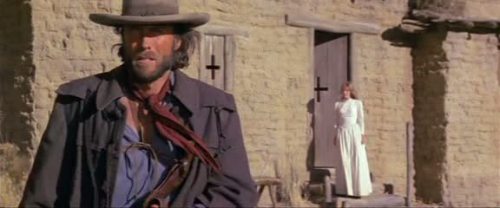
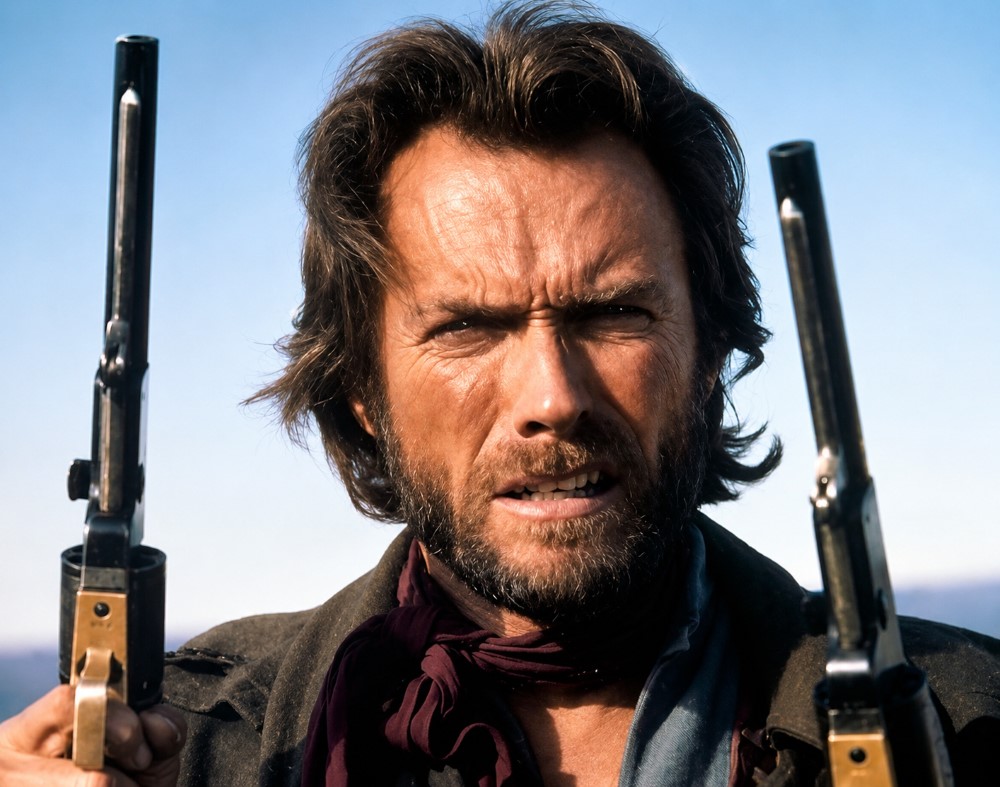
The Outlaw Josey Wales (1976, dir by Clint Eastwood)
Tightrope (1984, dir by Richard Tuggle and Clint Eastwood)
In the pantheon of American cinematic heroes, Josey Wales—the stoic, vengeance-driven farmer turned outlaw portrayed by Clint Eastwood in The Outlaw Josey Wales (1976)—stands as a uniquely compelling figure. Unlike the clean-cut, morally unambiguous heroes of classical Westerns, Wales is forged in the crucible of tragic loss. After Union raiders murder his wife and child and destroy his Missouri farm, Josey joins a Confederate guerrilla unit, only to watch his comrades massacred while trying to surrender. This backstory does not simply justify his violence; it transforms him into a melancholic ghost, a man who has already lost everything that once gave his life meaning. What makes him immediately charismatic is not his toughness, but his profound, wounded humanity—a man who rarely smiles, yet whose weary eyes carry the weight of a world that has betrayed him.
A second source of Josey’s charisma is his radical, almost spiritual independence. Throughout the film, he is hunted by Union soldiers, bounty hunters, and carpetbaggers, yet he refuses to bend to any authority. When a Union captain demands he “change his way of thinking,” Josey’s reply—“I reckon so”—is an empty promise spoken with a cigarette in his mouth and a pistol in his hand. He operates according to a private moral code rather than the law of the state. This rebellion against institutional power resonates deeply because Josey is not an anarchist or a nihilist; he is a man who has seen government-sanctioned terror and chooses instead to trust only his own judgment. In an era of disillusionment following Vietnam and Watergate, audiences embraced Wales as a hero who would never again place his faith in flags or orders.
Paradoxically, what makes Josey Wales most interesting is his quiet, reluctant capacity for community. Despite his vow of solitude, he accumulates a ragtag family: a Navajo elder named Lone Watie, a young Kansas woman seeking refuge, and even a grizzled old bear of a man. Josey never seeks followers—they gravitate toward him because they sense his integrity beneath the flinty exterior. In one of the film’s most touching sequences, he teaches a young, traumatized girl how to prepare food, his gruffness softening into something resembling paternal tenderness. This tension—between the lone avenger and the accidental patriarch—gives Josey a dramatic complexity that pure antiheroes lack. He wants to be left alone, but he cannot ignore suffering; he carries death on his hip, yet he plants seeds for the future.
Beyond his immediate charisma, Josey Wales established a template for the unglamorous, psychologically examined gunslinger that would define the next generation of Westerns and beyond. Unlike the mythic, invincible cowboys of John Ford’s era, Wales is tired, grieving, and physically fallible—his violence carries weight and consequence, not spectacle. This raw, de-glamorized portrait directly influenced Eastwood’s own Unforgiven (1992), where William Munny echoes Josey’s haunted past and reluctant violence, and Tombstone (1993), where Kurt Russell’s Wyatt Earp struggles with similar moral weariness beneath the badge. Most notably, the Red Dead Redemption video game series (2010–2018) owes an immense debt to Josey Wales: protagonist John Marston, a former outlaw dragged back into violence to protect his family, and Arthur Morgan, a dying gunslinger questioning his own loyalty and morality, both embody that same melancholic, code-driven solitude. Josey’s influence transformed the Western hero from a cartoon of virtue into a tragic figure wrestling with his own demons.
Josey Wales endures as a charismatic and interesting hero because he embodies a set of contradictions that feel authentically human: he is brutal yet gentle, solitary yet communal, vengeful yet merciful. He does not seek redemption through love or law, but through an unspoken understanding that some wounds can never heal—and yet life must go on. By the film’s end, when he faces his nemesis and chooses not to kill in cold blood, Josey completes an arc that is less about revenge fulfilled than about a man deciding that his future need not be defined by his past. And by rejecting the glamorous myth of the gunslinger, Josey Wales paved the way for a more honest, sorrowful vision of the Old West—one where heroes bleed, doubt, and sometimes simply walk away, leaving their spurs in the dust.
Towards the end of 1976’s The Outlaw Josey Wales, Josey (played by Clint Eastwood) says, “I guess we all died a little in that damned war.”
He’s referring to the American Civil War and the film leaves you with no doubt that Wales knew what he was talking about. A farmer living in Missouri, Josey Wales wasn’t involved in the Civil War until a group of guerillas, the Redlegs, raided his home and killed his family. Seeking vengeance, Wales joined the Bushwackers, a group of Confederate guerillas that were led by the infamous “Bloody Bill” Anderson. After Anderson’s death and the South’s surrender, Senator James H. Lane (Frank Schofield) offers amnesty to any of the Bushwackers willing to surrender and declare their loyalty to the United States. Fletcher (John Vernon), the leader of the surviving Bushwackers, thinks it’s a good idea and his men eventually agree to surrender.
Everyone except for Josey Wales.
Fletcher tells Josey that he’ll be an outlaw and that Lane will send his men to capture and execute him. “I reckon so,” Josey Wales replies. It’s not that Josey was particularly a fan of the Confederate cause. Instead, having lost his family and his home and having seen hundreds of men killed, Josey no longer cares. He’s got a death wish, something that becomes apparent when he later sneaks over to Lane’s camp and discovers that the leader of the Redlegs, Terrill (Bill McKinney), has been made a captain in the Union Army. The surrendering Bushwackers, with the exception of Fletcher and a young man named Jamie (Sam Bottoms), are gunned down as they swear allegiance to the United States. Joey springs into action, hijacking a Gatling gun and mowing down soldiers. It’s a suicidal move and Josey appears to be willing to die, until he sees that Jamie has been wounded. Josey and Jamie go on the run, pursued by soldiers and bounty hunters.
It sounds like the start of typical Clint Eastwood film and, make no mistake about it, The Outlaw Josey Wales features everything that most people have come to expect from Eastwood. Josey Wales is an expert shot, often firing two guns while charging forward on his horse. Josey has a way of words, explaining the purpose of getting “plain man dog mean” and telling a bounty hunter that there are better ways to make a living. The main difference, though, is that Josey is no longer seeking revenge. He’s lost his family and his home and he knows nothing is going to bring them back. He sought revenge during the Civil War and saw so many people killed that, much like Jimmy Stewart in Broken Arrow, he just wants to disappear from civilization.
The problem is that men like Lane and Terrill have no intention of letting Josey Wales disappear. The sociopathic Terrill sees it as almost being his God-given duty to kill Josey Wales and anyone else that he dislikes. The bounty hunters are also after Josey Wales. As Fletcher explains it, bounty hunting is the only way that many former soldiers can make money and feed their families. As Josey moves through the southwest, his legend grows. Every town that Josey stops in, he hears stories about the growing number of men that he has supposedly killed.
Josey also discovers that he can’t do it all alone. He soon finds himself as a part of a new family, a collection of misfits that don’t have a home in Senator Lane’s America. Lone Waite (Chief Dan George) is an elderly Cherokee man who suggests that Josey head for Mexico. Little Moonlight (Geraldine Keams) is a Navajo woman who Josey rescues from two bounty hunters. Sarah Turner (Paula Trueman) and her granddaughter, Laura Lee (Sondra Locke), are rescued from Comancheros. Josey negotiates the release of two of Sarah’s ranch hands and befriends Chief Ten Bears (Will Sampson) while doing so. Slowly, Josey comes out of his shell and starts to embrace life once again. Josey goes from searching for death to searching for peace.
It’s one of Eastwood’s best films, ending on a note of not violence but instead sad regret. It’s not only a portrait of a man learning to embrace life but it’s also a portrait of a country trying to figure out how to come back together after the bloody savagery of the Civil War. Some, like Fletcher and Josey, want to move on. Others, like Terrill, don’t have an identity beyond fighting and killing. Eastwood gives a good performance but, as a director, he gives every member of the cast a chance to shine. If you only know John Vernon as Dean Wormer from Animal House, his sad-eyed performance here will be a revelation.
Originally, The Outlaw Josey Wales was meant to be directed by Phillip L. Kaufman but Eastwood felt that Kaufman was taking too long to set up his shots and worrying about details that really didn’t matter. Reportedly, while Kaufman was away from the set, spending hours searching for a historically-correct beer bottle to be used in a bar scene, Eastwood directed the scene himself and then convinced producer Robert Daley to fire Kaufman and allow Eastwood to direct the film. (Kaufman also objected to the script’s anti-government subtext but seriously, that’s pretty much the subtext of every film that Eastwood has ever been involved with.) The DGA later instituted a rule that, on productions in which the director was fired, the replacement could not be a member of his crew or an actor in the cast but that was too late to help out Kaufman.
(Rumor has it that another reason Kaufman was fired was because he and Eastwood both “liked” Sondra Locke. This was the first of six films that Eastwood and Locke would do together.)
To be honest, I think it worked out in the film’s favor. It’s a little surprising that someone other than Eastwood was ever considered as director to be begin with, so perfectly does the story and the lead character fit with Eastwood’s persona. Eastwood captures both the beauty of the untouched land and also the bloody violence of combat. In many ways, this film almost feels like a prequel to Unforgiven. The Outlaw Josey Wales is Eastwood at his best.
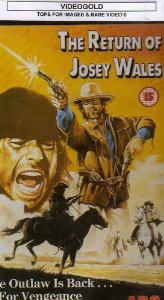
As is obvious from the title, The Return of Josey Wales is a sequel to the iconic Clint Eastwood western, The Outlaw Josey Wales. In fact, The Return of Josey Wales was based on a novel that author Forrest Carter wrote after the initial success of Eastwood’s film. Originally, Clint himself was going to direct and star in the sequel. However, Eastwood withdrew from the project and it would be years before The Return of Josey Wales would eventually be made with a miniscule budget and given a very limited theatrical release. By the time the film was released, it had long since been discovered that Forrest Carter, who had always portrayed himself as being a Cherokee shaman-turned-writer, was actually Asa Earl Carter, a former member of the Ku Klux Klan who had previously worked as a speech writer for arch segregationist, George Wallace.
Along with taking over from Eastwood as the film’s director, Michael Parks also took over the role of Josey Wales. Having faked his death, Josey is now living on a small farm in Texas and going out of his way not to draw attention to himself. One day, a man named Paco (Paco Vela) shows up and tells Josey that a corrupt Mexican policeman has killed one of Josey’s friends and locked another one up in prison. It’s time for Josey to say goodbye to his new wife, jump on a horse, and head down to Mexico.
The Return of Josey Wales never escapes the shadow of The Outlaw Josey Wales, even though the two films have little in common. As a director, Michael Parks is no Clint Eastwood and his reliance on stock footage reveals how little of a budget he had to work with. As an actor, Parks gives a totally different performance from Clint Eastwood’s. Clint’s Josey Wales was hardened and embittered by his experiences. Michael Parks plays Josey more as an underestimated hick who is not afraid to use a gun if he has to. There is a lot of Earl McGraw in this version of Josey Wales. That does not mean that Michael Parks gives a bad performance. In fact, his performance is the best thing in the film.
The Return of Josey Wales is for Western completists only.
(This review originally stated that Eastwood left the project after it was revealed that Forrest Carter was Asa Carter. According to Dan T. Carter’s comment below, Eastwood actually left the sequel long before Forrest Carter’s actual identity was revealed.)
4 Shots From 4 Films is just what it says it is, 4 shots from 4 of our favorite films. As opposed to the reviews and recaps that we usually post, 4 Shots From 4 Films is all about letting the visuals do the talking.
Happy birthday, Clint Eastwood!
4 Shots From 4 Films
A Fistful of Dollars (1964, dir by Sergio Leone)
The Outlaw Josey Wales (1976, dir by Clint Eastwood)
Tightrope (1984, dir by Richard Tuggle and Clint Eastwood)