Review: Rollercoaster (dir. by James Goldstone)


“If they pay me and if they do what I say, I’ll never bother them again.” — Young Man

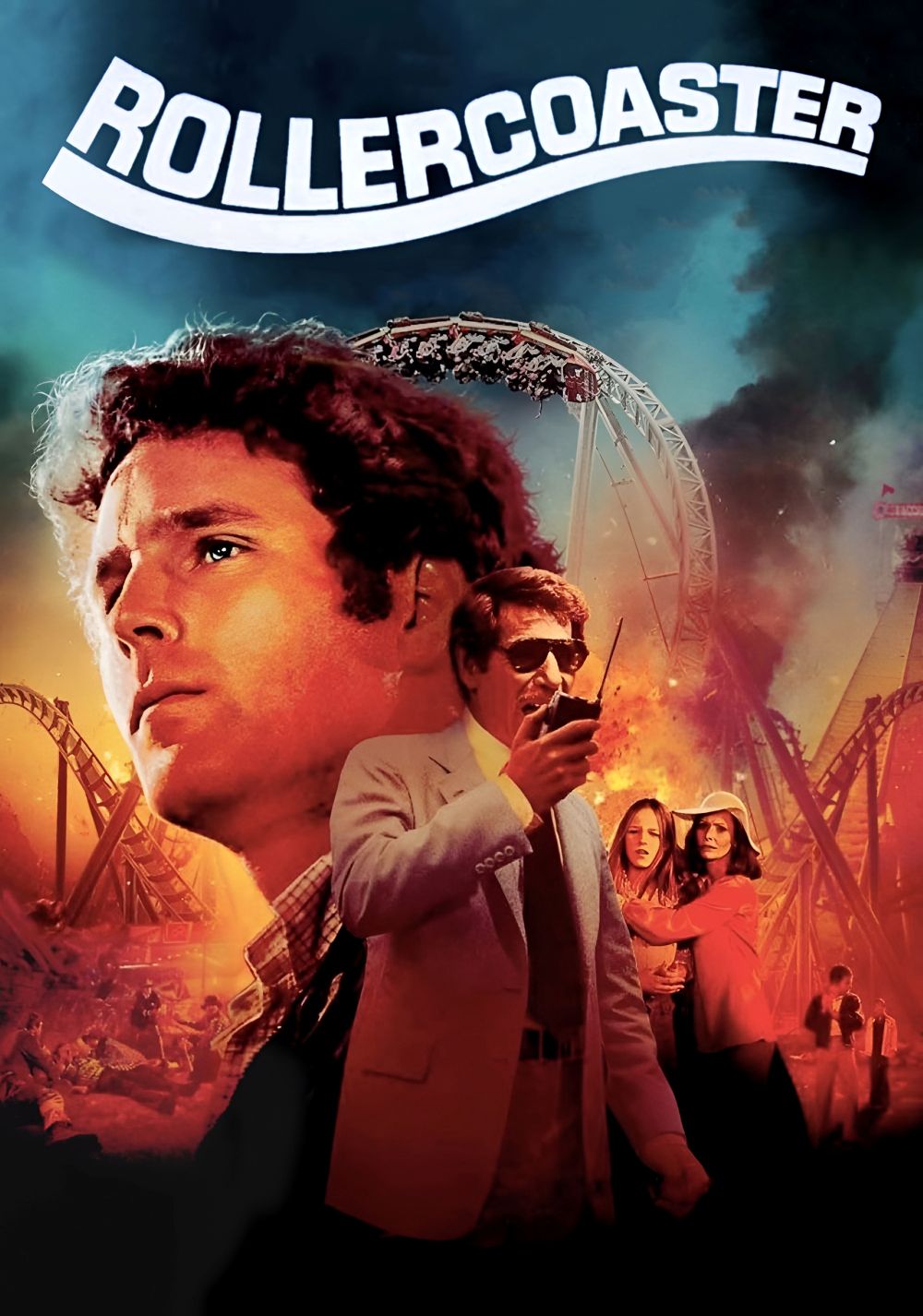
James Goldstone’s 1977 film Rollercoaster exists in a fascinating, albeit deeply flawed, space within the history of seventies disaster cinema. If you are a fan of retro 70s movies, specifically the whole Sensurround era where Hollywood was desperately trying to get people out of their living rooms and into theaters with seat-rumbling audio gimmicks, you have probably heard of this one. It has a genuinely neat, gritty vibe because it was actually shot on location at real amusement parks like Kings Island and Magic Mountain. You get this awesome, vintage, mid-century theme park atmosphere that you just cannot fake on a studio backlot. You can almost smell the cotton candy, the hot asphalt, and the stale beer. But once that initial wave of nostalgia wears off, you are left looking at what is actually on the screen, and honestly, Rollercoaster is not a great film. In fact, one could very easily say it is not even a good film. At its absolute best of times, it is a thoroughly average, middle-of-the-road thriller that feels more like a slightly elevated, padded-out television movie of the week than a major theatrical release.

The plot is about as standard as it gets for this era of disaster-adjacent cinema. A mysterious, young terrorist starts blowing up rollercoasters, not for any grand political manifesto, but simply to extort amusement park owners for millions of dollars. Enter our protagonist, Harry Calder, played by George Segal, who is a cynical safety inspector that just happens to survive the first derailment. Segal is basically just playing George Segal here—exasperated, a bit snarky, wearing a rumpled suit, and teaming up with an FBI agent played by Richard Widmark. The villain is played by a very young Timothy Bottoms, who is effectively creepy but given virtually zero backstory or motivation. He is just a blank-eyed psycho doing psycho things because the script needs an antagonist. The movie essentially just bounces from one park to another, with Segal walking around looking stressed while the FBI tries to figure out where the next bomb is hidden.

The pacing is arguably the film’s biggest sin. For a movie literally named Rollercoaster, it is shockingly lacking in momentum. Goldstone’s direction completely lacks the tight, pulse-pounding beats you would expect from a high-stakes thriller. There is so much filler here, so many scenes of Segal drinking coffee and staring at blueprints, and so much tedious FBI bureaucratic nonsense that it completely kills any tension. The romantic subplot feels entirely tacked on, and the climax fails to deliver the massive, explosive payoff you have been waiting for. If you judge Rollercoaster purely on its cinematic merits—the acting, the script, the direction—it is undeniably average, the kind of movie you leave on in the background while you fold laundry.

However, despite all of these glaring, undeniable flaws, Rollercoaster has a fascinating, almost prophetic legacy when you look back at the history of the thriller genre. It may not be remembered as a great movie, but it essentially built the exact template for an entire subgenre of cat-and-mouse thrillers that dominated the 90s. It practically invented the “specific-professional-against-a-psychopathic-mastermind” formula. Before Rollercoaster, thrillers were usually about spies, cops, or generic everymen. But this film introduced the idea of a highly specific, niche expert being forced into a one-on-one intellectual duel with a terrorist who targets them specifically because of their expertise. Think about how that exact template was endlessly copied and refined in the decades that followed. Look at In the Line of Fire, where Clint Eastwood plays a Secret Service agent hunted by a psycho played by John Malkovich. Or look at Blown Away, where Jeff Bridges is a bomb-defusing expert tormented by an Irish terrorist played by Tommy Lee Jones. Even The Bone Collector fits this mold perfectly, with Denzel Washington’s bedridden forensics expert being targeted by a serial killer who uses specific crime scenes just to test Washington’s intellect. All of these films drew direct DNA from Rollercoaster, using that exact same dynamic of a reluctant protagonist with a very particular set of skills being singled out by a psychopath who treats mass murder like a twisted, personalized game of chess. And if you want the absolute pinnacle of the “expert vs. bomb” trope, you have to look at Speed, which polished the cat-and-mouse dynamic perfected right here in Rollercoaster.

Because the original film was so hampered by 1970s filmmaking technology, it really makes you realize how easily this movie could be remade in this day and age. Back then, the actual destruction of the rides was limited by practical effects, clunky models, and standard camera angles that made the crashes feel somewhat static and safe. Today, technology in filmmaking has advanced to the point that the sheer scale, speed, and physical danger of the rides themselves really does become the focus of real danger. With modern CGI, drone cameras, and advanced practical rigging, you could put the audience right inside the front car of a 300-foot hyper-coaster as the tracks buckle and twist in slow motion. You could make the metal fatigue, the snapping cables, and the horrific physics of a derailment feel genuinely terrifying, turning the amusement park rides into massive, mechanical monsters rather than just static backdrop props for guys in suits to talk around.

Naturally, if Hollywood were to actually remake Rollercoaster today, you know exactly how it would look and who would star in it. It would undoubtedly star someone like Dwayne Johnson or Chris Pratt, a guy who can deliver a quip while looking concerned and holding a blueprint. They would inevitably give the safety inspector a tragic backstory, probably a dead wife or a kid they are estranged from, just to artificially raise the emotional stakes. And because it is a high-concept thriller that does not quite have the cultural weight of a massive comic book franchise, the remake would almost certainly be relegated to a streaming release. It would drop on a Friday on Netflix or Amazon Prime with a generic, algorithmically tested poster and a slick, forgettable title. It would be exactly the kind of mid-budget, mildly entertaining action flick you watch on a rainy Sunday afternoon before completely forgetting about it by Monday morning.

So, ultimately, how do you rate a movie like Rollercoaster? You just have to accept its extreme averageness and respect its ripple effect. It is clunky, the performances are uneven, and it is rarely as thrilling as its title promises. But it absolutely should not be written off entirely. It was the exact moment Hollywood realized that pitting highly specialized professionals against high-concept villains made for compelling, relatable drama. Without George Segal boredly walking around Magic Mountain, we probably do not get the overly dramatic, incredibly ridiculous, yet thoroughly entertaining 90s thriller boom, nor the slick, CGI-heavy streaming thrillers of today. Rollercoaster might just be a mediocre hill, but it is undeniably the hill that started the entire ride.
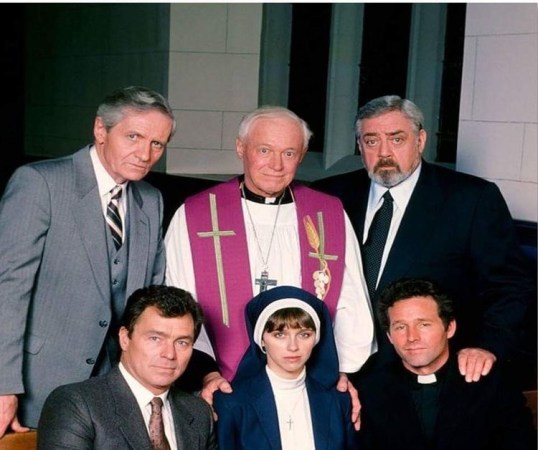
I Watched Perry Mason: The Case of the Notorious Nun (1986, Dir. by Ron Satlof)


In the second Perry Mason movie, Perry (Raymond Burr) defends Sister Margaret (Michele Greene), who has been accused of murdering Father Thomas O’Neil (Timothy Bottoms).  The D.A. (David Ogden Stiers) says that Sister Margaret was having an affair with Father O’Neil and she killed him when he tried to break it off.  However, the movie shows us that, just like in the last movie, Father O’Neil was actually killed by a hitman (Hagan Beggs).  Perry, Della (Barbara Hale), and Paul Drake, Jr. (William Katt) have to figure out who ordered the priest’s murder.

I enjoyed the Case of the Notorious Nun, even if it wasn’t as good as the previous film.  It was still entertaining and I loved watching Perry constantly give Paul a hard time about every little thing but this time, it was really obvious who the actual killer was.  Paul, of course, had romantic feelings for Sister Margaret but nothing came from them, other than a chaste kiss on the cheek.  Sorry, Paul.  You’re charming but you’re not that charming.

Father O’Neil was far more sympathetic than the previous movie’s victim.  Father O’Neil was trying to make the world a better place and his death with was a real tragedy.  That made it all the more satisfying when Perry was able to get his cross-examination confession.  There was an alarming scene early on in the movie where Perry checked into a hospital because he was feeling faint and I get the feeling that they framed the scene to make Raymond Burr look even heavier than he was.  (This movie justified Paul Drake doing all the leg work while Perry stayed at the office.)  But even if he moves a little slower than he used to, Perry Mason is still the best lawyer out there.

Retro Television Review: The American Short Story #17: The Greatest Man In The World


Welcome to Retro Television Reviews, a feature where we review some of our favorite and least favorite shows of the past!  On Saturdays, I will be reviewing The American Short Story, which ran semi-regularly on PBS in 1974 to 1981.  The entire show can be purchased on Prime and found on YouTube and Tubi.

This week, The American Short Story comes to a close.

Episode #17: The Greatest Man In The World

(Dir by Ralph Rosenbaum, originally aired in 1981)

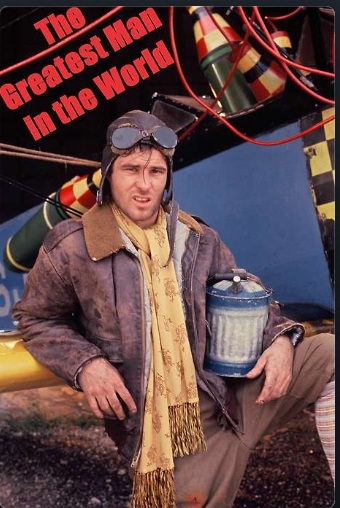
In this adaptation of a James Thurber short story, a country boy named Jack Smurch (Brad Davis) briefly becomes a celebrity when he breaks Charles Lindbergh’s record for flying nostop around the world.  Two reporters (Reed Birney and John McMartin) are assigned to write a glowing profile of him.  The U.S. Secretary of State (William Prince) wants to make him a symbol of America.  The only problem is that Smurch himself is a violent and dull-minded habitual criminal who can barely fly his plane and who almost crashes when he comes in for a landing at the end of his flight.  Before he took off in his plane, the only person who cared about Smurch was his girlfriend (Carol Kane).  Even Smurch’s own mother says that she hopes that he crashes and drowns.  But once he manages to land, Smurch becomes a hero.  As the saying goes, print the legend.

Smurch, unfortunately, isn’t smart enough to play along with the hero routine.  At a meeting with the Secretary of State and the President (who is implied to be FDR), Smurch proves to be so obnoxious that he’s tossed out of a window.  He plunges to his death but he dies an American hero.

The final episode of The American Short Story was also the best, a wonderfully dark satire on the media and our cultural need for heroes.  Brad Davis’s naturally obnoxious screen presence — the same presence that made audiences enjoy seeing him get tortured in Midnight Express — is put to good use here.  Jack Smurch is such a jerk that you really can’t blame anyone for tossing him out that window.  If nothing else, it got him to stop talking.

The American Short Story was, overall, an uneven series.  Too often, the episodes failed to really capture the tone and style that made the original stories so memorable.  That said, there were a few good episodes, like this one.  If nothing else, perhaps this series inspired people to read the original stories for themselves.  That would have been the best possible outcome.

Next week …. something new will premiere in the time slot!  What will it be?  I’ll give you a clue — it’s set on the beach but it’s not Pacific Blue.  Let’s just say that some people stand in the darkness….

Film Review: Bronco Billy (dir by Clint Eastwood)


In 1980’s Bronco Billy, Clint Eastwood plays Billy McCoy.

Billy is an aging cowboy, a trick-shooter who owns Bronco Billy’s Wild West, a traveling circus that has definitely seen better days.  Bronco Billy and his friends travel the country, going from small town to small town and putting on a show.  Billy is definitely the star and the highlight of each show is him shooting balloons and tossing a knife while his female assistant is strapped on a revolving disk.  Unfortunately, Billy’s latest assistant flinches and gets a knife in her leg.  Billy needs a new assistant and, wouldn’t you know it, Antoinette Lily (Sondra Locke) needs a job!

Antoinette is a runaway bride.  She married John Arlington (Geoffrey Lewis), not because she loved him but because she needed to get married by the time she turned 30 or she would lose her inheritance.  After the ceremony but before the wedding night, Antoinette fled.  The police assume that John murdered her and promptly arrest him.  John, suspecting that his wife is still alive, pleads insanity so that he can avoid the electric chair.

As Billy’s assistant, Antoinette challenges the way that Billy has always done the show, often to such an extent that you really have to wonder why she sticks around.  Since this is a Clint Eastwood film, there a bar brawl where Billy rescues her from being assaulted by a couple of rednecks.  Unfortunately, Antoinette’s arrival coincides with a string of accidents and other unfortunate incidents.  The other members of the show start to suspect that Antoinette might be bad luck.  Myself, I’m not superstitious and I don’t think that people can bring bad luck.  I think people make their own luck.  However, it’s hard to overlook the fact that Antoinette finds out that her husband is facing the death penalty due to her disappearance and her reaction is to basically shrug it off.  Sondra Locke gives a rather flat performance was Antoinette, suggesting none of the quirkiness necessary to make her anything more than a very childish and very self-centered person.  Antoinette is a role that demands the eccentricity of a young Sissy Spacek or Shelley Duvall or even Beverly D’Angelo, who did such a good job in Every Which Way But Loose.  Sondra Locke gives a boring performance and it drags down the film.

That said, there is a lot to like about Bronco Billy.  In many ways, this film feels like Clint Eastwood’s take on a Robert Altman film.  The plot is episodic and casual and the best scenes are the ones the emphasize the members of the circus as being a family of misfits.  (Indeed, one reason why Locke’s performance feels so jarringly wrong is because both she and Antoinette never seem to be interested in the other members of the show.)  Billy may be their leader and their main attraction but every member of the show plays a role in keeping Billy’s Wild West alive.  Scotman Crothers, Sam Bottoms, Bill McKinney, Dan Vadis, and Sierra Pecheur all give likable performances that bring the film’s world to life.  The film becomes about more than just the aging Billy trying to find his place in a changing world.  It’s a film about a group of people who have come together to form their own community and, by the end of the movie, it’s a community that you can’t help but love.  In many ways, this film features both Eastwood the director and Eastwood the actor at his gentlest and most humanistic.  Billy and his show bring the old west to a new America and, in the end, you’re happy they did.

Days of Paranoia: The Gauntlet (dir by Clint Eastwood)


In 1977’s The Gauntlet, Dirty Harry is sent….

Oh wait, sorry.  This is not a Dirty Harry movie.  It sure feels like a Dirty Harry movie but it’s not.  And really, the character that Clint Eastwood plays in this movie, Phoenix Detective Ben Shockley, is different from Dirty Harry Callahan.  Shockley is a cynical (and single) detective who does things his own way.  He’s got that in common with Callahan.  But Shockley is also an alcoholic and that’s something that Harry would never allow himself to become.  Harry may be unpredictable but he’s disciplined and he’s always in control.  The other big difference is that Shockley has a little more faith in his fellow cops than Harry does.  As a result, Shockley gets set-up in a trap that Harry would have seen coming from miles away.

Shockley is sent to Las Vegas to pick up a prostitute named Augustina and bring her back to Arizona.  Augustina — who goes by Gus — is played by Sondra Locke.  This was the second film that Eastwood and Locke made together.  As a result of preparing for today’s Eastwood marathon, I watched all of the Eastwood/Locke films.  The Gauntlet features Locke’s best performance opposite Eastwood.  (She was good in The Outlaw Josey Wales but her role was also fairly small and simple.)  As opposed to her later films, Locke actually has a good deal of romantic chemistry when Eastwood in this film and, even more importantly, she actually seems invested in the role.  She plays Gus as being a feisty asskicker.  It doesn’t matter that she’s in jail or that she’s handcuffed or that she’s been escorted to another state.  Gus isn’t going to let anyone tell her what to do.   It’s impossible not to root for both her and Shockley in this film.

Of course, it turns out that Shockley has been set up.  Phoenix Police Commissioner Blakelock (William Prince) and District Attorney John Feyderspiel (Michael Cavanaugh) both have their own reasons for not wanting Gus to make it to Phoenix and they’re both willing to sacrifice Shockley to get to her.  They assumed that Shockley, being an alcoholic, would be easy to defeat.  Did they not consider that, alcoholic or not, Ben Shockley is played by Clint Eastwood?  Every attempt that is made to stop him just makes Shockley all the more determined to get Gus to Phoenix.  The film becomes a particularly violent take on It Happened One Night, going as far as to have Gus and Shockley take over a bus on their way to Phoenix.

Ah, the bus.  The Gauntlet climaxes with a scene in which literally thousands of bullets are fired into a bus that Shockley and Gus are driving through Phoenix.  It’s an exciting sequence, one that’s so gloriously over-the-top that you can’t help but feel that Eastwood was poking fun at his own persona.  At the same time, the sequence also works as a commentary on the blind obedience necessary for an authoritarian to come to power.  The cops who have lined up to shoot at the bus open fire when they’re ordered to, without asking why a bus has to be riddled with bullets.  Eastwood manages to mix a healthy dose of paranoia with his satire.

Though the plot (much like the bus) is riddled with holes, The Gauntlet‘s an entertaining film.  Between Eastwood and Locke’s chemistry and the explosive action sequences, The Gauntlet is a film you can’t look away from.

Retro Television Review: 3 By Cheever 1.1 “The Sorrows of Gin” (dir by John Hofsiss)


Welcome to Retro Television Reviews, a feature where we review some of our favorite and least favorite shows of the past!  On Saturdays, I will be reviewing 3 By Cheever, which ran on PBS in 1979.  The entire show can be purchased on Prime and found on YouTube.

In 1979, PBS aired 3 By Cheever, three short films that were all based on stories by the American author, John Cheever.  The stories all took place in the same suburban milieu and featured characters in common.  The first episode was an adaptation of one of Cheever’s earlier stories, The Sorrows of Gin.

Episode 1.1 “The Sorrows of Gin”

(Dir by Jack Hofsiss, originally aired on October 24th, 1979)

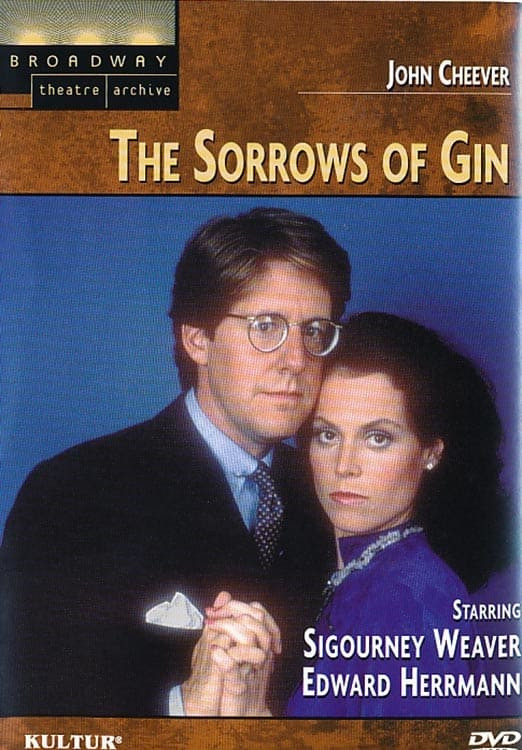
Taking place in the New England suburb of Shady Hill, The Sorrows of Gin deals with the Lawton family.  The Lawtons have got a nice house, lovely neighbors, and enough loyal servants that they don’t ever have to really worry about taking care of their eight year-old daughter, Amy (Mara Hobel).  Kip (Edward Herrmann) and Marcia Lawton (Sigourney Weaver) are youngish, successful, athletic (they play tennis, of course), and they’re also alcoholics.  They don’t realize they’re alcoholics and they’re both far more refined than the stereotypical image of the boozy drunk but they’re alcoholics nonetheless.

They’re also hypocrites.  When Amy’s babysitter, Rosemary (Eileen Heckart), comes to work with booze on her breath, Kip fires her.  Amy, realizing that the alcohol is causing her parents to fight, starts to secretly pour out all of the gin, a little at a time.  Kip and Marcia assume that the servants are sneaking drinks and they go on a firing rampage.  Amy finally decides to run away from home, just to be found by Kip who, at the very least, seems like he’s willing to try to be a better father and husband.

Wow, what a depressing story!  Cheever’s original short story, which was one of the first American stories to really explore suburban alcoholism, was written with a good deal of wit and social satire.  The PBS adaptation takes a far more literal approach.  It captures Cheever’s story but not his voice and, as a result, you kind of find yourself why you should care about any of these people.  Even taking alcohol out of the equation, Kip and Marcia are shallow, self-absorbed, and terrible parents.  Maybe Amy should run away.

On the plus side, the film does feature Edward Herrmann and Sigourney Weaver, both giving excellent performances as the Lawtons.  The same year in which this aired, Weaver also starred as Ripley in Alien and it is a bit odd to see Weaver playing someone who would probably never in a thousand years see that film.  That said, Weaver does a good job and is totally believable as the clueless Marcia.  Meanwhile, Edward Herrmann has just the right WASP-y style to play Kip Lawton.  One of the most effective things about this film is how Kip is just a goofy suburban husband until he thinks someone is drinking his gin.  Then, he becomes outraged.  This film ends with a hint of redemption for Kip, a suggestion that Kip has finally realized how much his drinking is upsetting his daughter.  But, honestly, Kip doesn’t really seem like he has it in him to change.  Hopefully, he’ll just stop firing people.

This was an uneven production.  The story wasn’t quite as shocking as perhaps it was when Cheever first wrote about the Lawtons.  But the performances of Herrmann and Weaver kept me watching.


Late Night Retro Television Reviews: Monsters 1.23 “Mannikins of Horror”


Welcome to Late Night Retro Television Reviews, a feature where we review some of our favorite and least favorite shows of the past! On Wednesdays, I will be reviewing Monsters, which aired in syndication from 1988 to 1991. The entire series is streaming on Tubi.

Uh-oh!  Here come the Mannikins of Horror!

Episode 1.23 “Mannikins of Horror”

(Dir by Ernest Farino, originally aired on May 20th, 1989)

In a dystopian future, a once renowned surgeon named Dr. Collin (William Prince) is a “patient” in a mental health facility that is more of a prison than a hospital.  Dr. Collin is obsessed with dying but he believes that he has found a way to transfer his soul into the very detailed, anatomically-correct clay figurines that he has made in his cell.

Dr. Jarris (Glynis Barber) thinks that Dr. Collin can be cured but the new head of the asylum, Dr. Starr (Brian Brophy), disagrees.  Starr believes that Collin is beyond saving and of no use to society.  And, in the future, those who do not have a use are euthanized.  Dr. Starr does not care that Dr. Collin once saved thousands of lives during the world’s most recent war.  He doesn’t care that Dr. Collin truly believes that he can make the world a better place through his research.  Dr. Starr has not time for imagination or speculation.  He is all about following procedure and observing protocol.  The arrogant Dr. Starr even takes away Dr. Collin’s figurines.

That’s a mistake because guess what?  Those figurines are alive!  And when Dr. Starr drinks a bit too much Vodka and passes out in his office, one of the figurines picks up a scalpel and stabs Dr. Starr in the eye, killing him.  When Dr. Jarris discover what has happened, she smashes the figurine’s head against Dr. Starr’s desk.  Dr. Collin screams in his cell as his face collapse in on itself, leaving behind a bloody mess.  Dr. Jarris huddles in a corner and starts to scream as the end credits roll.

YIKES!

Seriously, this was a really good episode.  The clay figurines were certainly creepy and the scene where they attacked Dr. Starr was so graphic that I’m a bit surprised the show was able to get away with it.  That said, what truly made this episode frightening was its portrayal of a society without compassion.  Dr. Starr, who is more of a bureaucrat than a doctor, has the power to decide who is useful to society and who is not.  And, if you’re deemed to not be useful, you’re marked for death.  It’s a harsh worldview and an example of cold pragmatism taken to its logical extreme.  It’s also feels like a pretty accurate representation of the attitude that many government and medical officials took during the COVID pandemic.  Just as many seemed to be gleeful about the idea of the pandemic wiping out those who they considered to be undesirable, Dr. Starr can barely suppress his joy in punishing Dr. Collin for not being properly compliant.  The little clay figures were scary but Dr. Starr was horrifying.

Monsters has been a fairly uneven show so far but Mannikins of Horror is a triumph.

Well-Structured Destruction: Clint Eastwood in THE GAUNTLET (Warner Brothers 1977)


gary loggins's avatarcracked rear viewer

(First off, feast your eyes on the incredibly cool Frank Frazetta poster! Then read on… )

Clint Eastwood’s  directorial credits include some impressive films: THE OUTLAW JOSEY WALES, PALE RIDER, UNFORGIVEN, MYSTIC RIVER, MILLION DOLLAR BABY. While 1977’s THE GAUNTLET may not belong on that list, I feel it’s a very underrated movie deserving a second look. Clint and his lady love at the time Sondra Locke star in this character study of two damaged people disguised as an action comedy, essentially a chase film loaded with dark humor.

Clint plays Ben Shockley, an alcoholic Phoenix cop sent to Las Vegas to extradite Gus Mally, “a nothing witness in a nothing trial”. Gus turns out to be a woman, a hooker in fact, set to testify against a Phoenix mobster. Ben’s suspicions are roused when he learns Vegas oddsmakers are giving 50-1 they don’t make it to Phoenix alive, confirmed…

View original post 582 more words

A Movie A Day #331: The Soldier (1982, directed by James Glickenhaus)


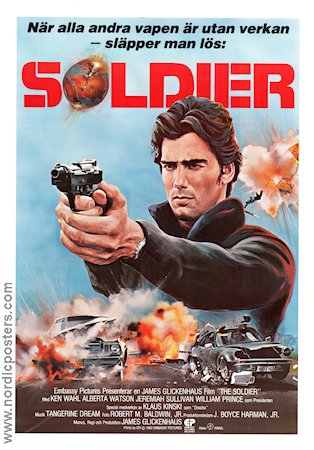
The Soldier is really only remembered for one scene.  The Soldier (Ken Wahl) is being chased, on skis, across the Austrian Alps by two KGB agents, who are also on skis.  The Soldier is in Austria to track down a KGB agent named Dracha (Klaus Kinski, who only has a few minutes of screen time and who is rumored to have turned down a role in Raiders of the Lost Ark so he could appear in this movie).  The Russians want the Soldier dead because they’re evil commies.  While being chased, the Soldier goes over a ski slope and, while in the air, executes a perfect 360° turn while firing a machine gun at the men behind him.  It’s pretty fucking cool.
The Soldier, who name is never revealed, works for the CIA.  He leads a team of special agents.  None of them get a name either, though one of them is played by the great Steve James.  When a shipment of Plutonium is hijacked so that it can be used it to contaminate half of the world’s supply of oil, The Soldier is assigned to figure out who is behind it.  Because terrorists are demanding that Israel withdraw from the West Bank, Mossad assigns an agent (Alberta Watson) to help out The Soldier.  She gets a name, Susan Goodman.  She sleeps with The Soldier because, she puts it, the world is about to end anyway.

The Soldier was obviously meant to be an American James Bond but Ken Wahl did not really have the screen charisma necessary to launch a franchise.  He is convincing in the action scenes but when he has to deliver his lines, he is as stiff as a board.  Fortunately, the majority of the movie is made up of action scenes.  From the minute this briskly paced movie starts, people are either getting shot or blown up.  Imagine a James Bond film where, instead of tricking the bad guys into explaining their plan, Bond just shot anyone who looked at him funny.  That’s The Soldier, a film that is mindless but entertaining.

Ken Wahl may have been stiff and Klaus Kinski may have been wasted but there are still some interesting faces in the cast.  Keep an eye out for William Prince as the President, Ron Harper as the director of the CIA, Zeljko Ivanek as a bombmaker, Jeffrey Jones as the assistant U.S. Secretary of Defense, and George Straight performing in a redneck bar.  Best of all, one of the Soldier’s men is played by Steve James, who will be recognized by any Cannon Films aficionado.

Surprisingly, The Solider is not a Cannon film.  It certainly feels like one.

A Movie A Day #209: Assassination (1987, directed by Peter R. Hunt)


Charles Bronson, man.

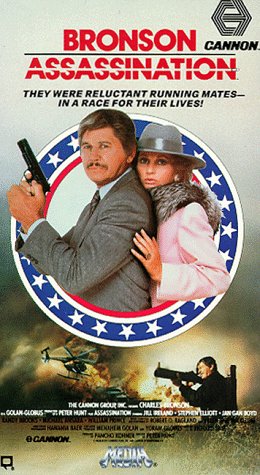
Long before Clint Eastwood starred in In The Line of Fire, Charles Bronson played an over the hill secret service agent in Assassination.  Having just returned to active service after a six month leave of absence, Jay Killian (Charles Bronson), thinks that he is going to be assigned back to the presidential detail.  Instead, he is given the job that no one wants.  Jay is assigned to protect the first lady, Lara Craig (Jill Ireland, Bronson’s real-life wife).

Lara is a handful.  Every one tells Killian that she is “even worse than Nancy.”  (This running joke probably played better in 1987.  If Assassination had been released ten years later, Lara would have been described as being “even worse than Hillary.”)  Lara does not like being told what she can and cannot do. When she refuses to follow Killian’s orders not to ride in a convertible, she ends up getting a black eye when a motorcycle crashes and Killian instinctively throws her to the floor.  Lara may not like Killian but when, she is targeted by a notorious terrorist (Erik Stern), she will have to learn to trust him.  Her life depends on it, especially when it becomes clear that the order to have her killed is coming from inside the White House.  It turns out that the President has been impotent for years.  That may not have troubled Lara before but now Killian is showing her that a real man looks like Charles Bronson.  A divorced president will never be reelected.  A widowed president, on the other hand…

Assassination was one of the last films that Bronson made for Cannon.  It’s never as wild as Murphy’s Law, Kinjite, or many of Bronson’s other Cannon films but it is always interesting to watch Bronson acting opposite of Ireland.  Bronson famously did not get along with many people but he loved Ireland and that was something that always came through in the 15 movies that they made together.  Whenever Bronson and Ireland acted opposite each other, Bronson actually seemed to be enjoying himself.  And while it may be subdued when compared to his other Cannon films, Assassination provides just enough scenes of Bronson being Bronson.

Who other than Bronson could tell his much younger girlfriend that, because of her, he might “die of terminal orgasm?”

Who other than Bronson could drive around a motorcycle with machine gun turrets and execute a jump that would put his old co-star Steve McQueen to shame?

Who other than Bronson could use a bazooka to kill one man and then smile about it?

Charles Bronson, man.  No offense to Bruce Willis, who will be trying to step into Bronson’s gigantic shoes with the upcoming Death Wish remake, but nobody did it better than Bronson.