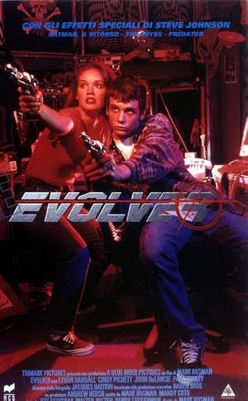
Evolver (1995, directed by Mark Rosman)


The year is 1995, and all the cool kids are going to the arcade and playing a virtual reality laser-tag game. Kyle Baxter (Ethan Embry) is one of the best laser-tag players in the country and is on the verge of winning a nationwide contest when he gets taken out by another player, a girl named Jamie (Cassidy Rae, who every teenage male in the ’90s had a crush on at some point). Kyle’s friend, Zach (Chace Quinn), uses his hacking skills to make it appear as if Kyle won anyway. Kyle’s prize is an Evolver, a robot that will allow Kyle and his friends to play the laser-tag game in real life. The only problem is that Evolver takes the idea of winning very seriously. Each time Evolver is defeated, it “evolves.” It learns from its mistakes. It uses new weapons. It refuses to stop until it can say, “Kill confirmed.”

Evolver is a mix of Child’s Play and The Terminator. Evolver eventually evolves to the point where it can say cheesy one-liners before killing someone. When someone tells it that the game is over, Evolver replies, “The game is not over.” The main problem with the film is that Evolver is such a bulky and awkward robot that it’s hard to believe it could actually defeat anyone. The people who are killed by Evolver usually fall victim because they’re too dumb to step aside when Evolver approaches them. The best thing about Evolver is that it does accurately represent how most people played video games in the ’90s. The first day, you would be really excited and you couldn’t wait to play every chance you got. By the third day, you were bored and ready to get back to doing whatever it was you were doing to begin with. Not all games were as exciting as Lee Carvallo’s Putting Challenge.

If the voice of Evolver sounds familiar, that’s because it was supplied by none other than William H. Macy. A year later, Macy would star in Fargo, and he would presumably never have to voice another angry robot again.

Beverly Hills Cop (1984, directed by Martin Best)


Two years after teaming with Nick Nolte in 48 Hrs., Eddie Murphy returned to the action genre in what remains he best-known action comedy, Beverly Hills Cop.

We all know the story.  Eddie Murphy is Axel Foley, a streetsmart detective in Detroit whose childhood friend, Mickey (James Russo), is murdered because of something that he saw while working as a security guard in Beverly Hills.  Axel plays by his own rules and gets results even as he gives his boss, Inspector Todd (Gil Hill), heartburn.  Todd refuses to allow Foley to investigate Mickey’s death so Axel puts in for some vacation time and catches the first plane to Beverly Hills.

In Beverly Hills, he meets up with another childhood friend, Jenny (Lisa Eilbacher).  Axel thinks that Mickey’s murder was ordered by a shady businessman named Victor Maitland (Steven Berkoff).  The Beverly Hills Police Department orders Axel to leave Maitland alone and to return to Detroit.  Axel won’t go until he gets justice for Mickey.  Lt. Bogomil (Ronny Cox) assigns Taggart (John Ashton) and Rosewood (Judge Reinhold) to follow Axel in Beverly Hills.

Like 48 Hrs., the story is serious but the comedy comes from how the well-drawn characters interact with each other and from seeing how Axel reacts to the strange and wealthy world of Beverly Hills.  Axel has the same reactions that we would have but, because he’s played by Eddie Murphy, he always has the perfect response to everything that he sees, whether it’s dealing with a snooty hotel clerk or with someone like Serge (Bronson Pichot), Jenny’s co-worker who speaks with an unidentifiable accent.  Even more so than in 48 Hrs or Trading Places, Murphy reveals himself to be a natural star here.  One reason why we like Axel is because he’s not just funny but he’s also the type of confident hero that we all wish we could be.  He’s not intimidated by Beverly Hills for a second.

It’s now impossible to picture anyone else in the role of Axel Foley but, when the film’s script was first being shopped around, it was originally offered to Sylvester Stallone, who said the story had potential but was missing something.  He rewrote the script and took out all of the humor, turning it into a grim and serious action film.  (It is rumored that Stallone later turned his version of the script into Cobra.)  Fortunately, Stallone eventually dropped out of Beverly Hills Cop so that he could co-star with Dolly Parton in Rhinestone.  Producers Don Simpson and Jerry Bruckheimer, then at the start of their producing careers, then offered the role to Eddie Murphy, who took Stallone’s script and added back all of the humor.  Murphy also ended up ad-libbing several of the film’s best one-liners, improvising the hotel lobby scene and the meeting with Serge on the spot.

Beverly Hills Cop was a huge success, cementing Murphy’s status as a star and proving that Murphy could carry a movie on his own.  The film still holds up, certainly better than any of the sequels that followed.  Even though Murphy was clearly the main attraction, the movie also gave actors like John Ashton, Judge Reinhold, Ronny Cox, Bronson Pinchot, and even Paul Reiser a chance to shine.  The villainous performances of Steven Berkoff and Jonathan Banks would serve as a model for countless bad guys through the 80s and 90s.  Beverly Hills Cop is a movie that makes you happy that Sylvester Stallone didn’t have a better sense of humor.