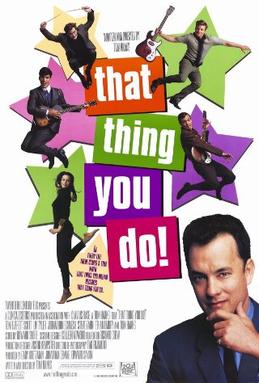
That Thing You Do! (1996, directed by Tom Hanks)


That Thing You Do! is the story of a one-hit wonder.

In 1964, an aspiring Jazz drummer named Guy (Tom Everett Scott) is a last minute addition to the a local band called the Oneders.  (It’s meant to sound like Wonders but almost everyone mispronounces it as O-Needers.)  The band’s egotistical leader, James (Jonathon Schaech) has written a slow ballad called That Thing You Do! but when Guy’s drumming causes the band to perform the song at a faster tempo, they end up with a local hit on their hands.  That local hit becomes a national hit when The Oneders are signed by Play-Tone Records.  First, Mr. White (Tom Hanks), their new manager, officially changes the name to The Wonders.  Secondly, he makes sure that every teen in America is dancing to That Thing You Do!  Third, he tells Guy to always wear sunglasses.  Fourth, he tells James that he will record and perform what Play-Tone tells him to.  Guitarist Lenny (Steven Zahn) and the unnamed Bass Player (Ethan Embry) are happy to be along for the ride but James chafes at his lack of artistic freedom.  Guy, meanwhile, falls for James’s girlfriend (Liv Tyler, at her loveliest) and dreams of meeting his idol, jazzman Del Paxton (Bill Cobbs).

That Thing You Do! was Tom Hanks’s directorial debut and, with its careful recreation of a bygone era and its collection of authentic sounding early 60s rock on the soundtrack, it was obviously a labor of love.  Considering the number of times that the song is played in the movie, it helps that it is a very good song.  That Thing You Do! is a catchy tune, one that you can’t help but tap your feet to.  At the same time, it also sounds like a one hit wonder.  It’s good but not so great as to make you expect much else from The Wonders.

Not surprisingly, Tom Hanks gets great performances from the entire ensemble cast.  Johnathon Schaech and Tom Everett Scott have never been better.  Liv Tyler is lovely and vulnerable as James’s unappreciated girlfriend.  Familiar faces like Peter Scolari, Kevin Pollak, Chris Isaak, and Clint Howard make welcome appearances.  Hanks himself is surprisingly intimidating as Mr. White.  When he says that the band will cover something the Play-Tone catalogue, it’s obvious that he’s not making a request.

The film is a tribute to being young and to loving music bit it’s also a study in the disillusionment of discovering that everything is ultimately a business.  James is frequently an arrogant jerk and he treats his girlfriend terribly but it’s hard not to sympathize with him when he says that he wants to do more than just cover songs from the Play-Tone catalogue.  To James and Guy, the Wonders are about self-expression and their love of music.  To Mr. White, the Wonders are just another band that came up with one catchy tune and who probably aren’t ever going to be heard from again.   That Thing You Do! pays tribute to all of the one-hit wonders out there, the bands who you forget about until you just happen to hear that one song on the radio or in a movie and suddenly, all the memories come flooding back.
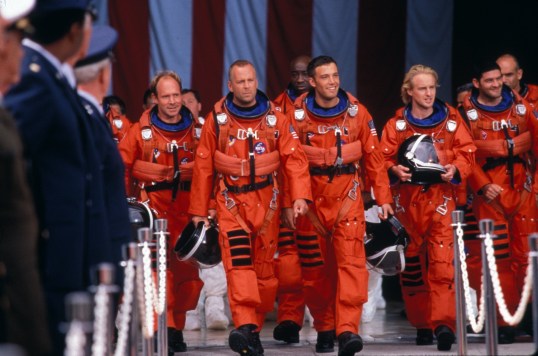

 

Guilty Pleasure No. 78: Armageddon (dir by Michael Bay)


Remember that time that Bruce Willis and a team of oil drillers saved all of humanity from a giant asteroid that was apparently the size of Texas?

Sure, you do!  Everyone remembers Armageddon!

1998’s Armageddon is a film that doesn’t get a lot of respect but which everyone remembers.  There’s been a lot of movies made about giant asteroids on a collision path with the Earth.  Ever since scientists announced that a collision with a comet or an asteroid probably killed the dinosaurs, there’s been a somewhat irrational fear that the same thing could happen to us.  Back in 1978, Sean Connery and Karl Malden tried to stop a Meteor (and failed).  In 1998, the same year that Armageddon came out, Morgan Freeman, Robert Duvall, and Elijah Wood tried to stop an asteroid from causing a Deep Impact (and failed).  Adam McKay made an entire film about everyone saying, “Don’t Look Up,” in an attempt to promote increased panic about climate change (and failed).  (“I’m so scared!” Leonardo DiCaprio shouted and audiences responded, “Oh, calm down.”)  And yet, it’s Armageddon — ridiculed by critics, endlessly parodied by other movies — that people use as their go-to source for commenting on the prospect of a mass extinction event.  Mostly because, in Armageddon, humanity didn’t fail.  Bruce Willis showed that asteroid who was boss!

Why do we love Armageddon?  A lot of it has to do with the cast.  Not only do you have Bruce Willis battling an asteroid but you’ve also got Steve Buscemi, Owen Wilson, Ben Affleck, Will Patton, Michael Clarke Duncan, Peter Stormare, William Fichtner, and a host of others working with him.  You’ve got Billy Bob Thornton working ground control.  You’ve got Liv Tyler, somehow managing to give a decent performance even while Ben Affleck attacks her with animal crackers.  It’s not just the cast is full of familiar and likable actors.  It’s that the members of the cast know exactly what type of film that they’re appearing in and they all give exactly the right type of performance for that film.  They deliver their lines with conviction while not making the mistake of taking themselves too seriously.  Bruce Willis announces that his crew will destroy that asteroid in return for never having to pay taxes again and he announces with just the slightest hint of a smirk, knowing that the audience is going to cheer that moment.

But really, the real reason why Armageddon has survived that test of time is because it’s just so utterly shameless.  Director Michael Bay will never be accused of being a subtle director but Bay instinctively understood that Armageddon was not a film that demanded subtlety.  Armageddon is a film that demands that constantly moving camera and all of those carefully composed scenes that were clearly made so they could be included in the trailer.  It’s a film about big moments and big emotions.  Unlike something like Deep Impact, it doesn’t get bogged down in trying to be better than it actually is.  Unlike Don’t Look Now, it doesn’t degenerate into a bunch of histrionic speeches.  Armageddon exists to make the audience cheer and it succeeds.  It takes guts to include a slow motion scene of a bunch of kids celebrating in front of a faded Kennedy For President poster but Bay is exactly the type of director who can pull that off.  Michael Bay’s style is not right for a lot of films.  But it was perfect for Armageddon.

As I sit here typing this, there are some people panicking because there’s speculation that a meteor is going approach the Earth in the 2030s.  It’ll probably miss us but who knows?  But you know what?  I’m not worried at all.  I’ve seen Armageddon.  So, on this International Earth Day, let’s remember the courageous men who saved this planet back in 1998.

Previous Guilty Pleasures

  1. Half-Baked
  2. Save The Last Dance
  3. Every Rose Has Its Thorns
  4. The Jeremy Kyle Show
  5. Invasion USA
  6. The Golden Child
  7. Final Destination 2
  8. Paparazzi
  9. The Principal
  10. The Substitute
  11. Terror In The Family
  12. Pandorum
  13. Lambada
  14. Fear
  15. Cocktail
  16. Keep Off The Grass
  17. Girls, Girls, Girls
  18. Class
  19. Tart
  20. King Kong vs. Godzilla
  21. Hawk the Slayer
  22. Battle Beyond the Stars
  23. Meridian
  24. Walk of Shame
  25. From Justin To Kelly
  26. Project Greenlight
  27. Sex Decoy: Love Stings
  28. Swimfan
  29. On the Line
  30. Wolfen
  31. Hail Caesar!
  32. It’s So Cold In The D
  33. In the Mix
  34. Healed By Grace
  35. Valley of the Dolls
  36. The Legend of Billie Jean
  37. Death Wish
  38. Shipping Wars
  39. Ghost Whisperer
  40. Parking Wars
  41. The Dead Are After Me
  42. Harper’s Island
  43. The Resurrection of Gavin Stone
  44. Paranormal State
  45. Utopia
  46. Bar Rescue
  47. The Powers of Matthew Star
  48. Spiker
  49. Heavenly Bodies
  50. Maid in Manhattan
  51. Rage and Honor
  52. Saved By The Bell 3. 21 “No Hope With Dope”
  53. Happy Gilmore
  54. Solarbabies
  55. The Dawn of Correction
  56. Once You Understand
  57. The Voyeurs 
  58. Robot Jox
  59. Teen Wolf
  60. The Running Man
  61. Double Dragon
  62. Backtrack
  63. Julie and Jack
  64. Karate Warrior
  65. Invaders From Mars
  66. Cloverfield
  67. Aerobicide 
  68. Blood Harvest
  69. Shocking Dark
  70. Face The Truth
  71. Submerged
  72. The Canyons
  73. Days of Thunder
  74. Van Helsing
  75. The Night Comes for Us
  76. Code of Silence
  77. Captain Ron

Horror Film Review: Godzilla (dir by Roland Emmerich)


There’s a giant lizard rampaging through New York, the result of a mutation that happened as a result of being exposed to radiation.  The military tries to stop the lizard but it turns out that stopping a giant lizard is not that easy.  Scientists try to understand the lizard and how it came to be a destructive giant.  The media breathlessly reports from the scene as two wisecracking cameramen do their best to record every second of the mayhem.  The reporters call this lizard …. GODZILLA!

But is it Godzilla?

No, it’s not.  Oh, it may be called Godzilla.  And the movie itself may be called Godzilla.  But the creature at the center of the 1998 American film Godzilla is definitely not Godzilla.

Godzilla was released with a great deal of fanfare in 1998, with commercials and toys and a lot of hype.  Diddy, back when he was still calling himself Puff Daddy, recorded a song for the soundtrack and upset thousands of Led Zeppelin fans like my Dad who found themselves having to deal with kids who thought Kashmir was called Follow Me.  (Diddy singing, “Follow me?”  AGCK!  How cringey is that!?)  But, like many of the film of Roland Emmerich, it’s been almost totally forgotten in the years since.

And why not?  It’s a forgettable film.  It’s the epitome of an assembly-line action blockbuster, the type of thing that Roland Emmerich is known for.  There’s comic relief, in the form of Hank Azaria.  There’s a nerdy scientist hero in the form of Matthew Broderick.  Broderick’s scientist has an ex-wife and yes, Godzilla’s invasion of New York gives them a chance to get back together.  There’s a mysterious Frenchman who is played, somewhat inevitably, by Jean Reno.  The Mayor of New York is a fat guy named Ebert (Michael Lerner) and he has an assistant named Gene (Lorry Goldman) and they get a lot of screentime because Emmerich wanted to make fun of two films critics who didn’t care much for his work.  In fact, the Mayor and his assistant get so much screentime that it distracts from the rest of the film.  Emmerich was directing a multi-million dollar reboot of a beloved franchise and he was more concerned with a petty feud.

He certainly wasn’t concerned with Godzilla.  Personally, I like the giant lizard and one of the only effective moments in the film is when the lizard discovers that its children have been killed by the military.  But that lizard is not Godzilla and the fact that Emmerich made a Godzilla film without Godzilla indicates that he didn’t really care about the monster or its fans.  This film has no love for its source material and that’s a shame.  The Godzilla films are fun!  And the fact that the majority of the ones made up until the release of this film looked kind of cheap and featured a Godzilla who was obviously a man in a rubber suit only added to the fun.  There’s not much fun to be found in this version of Godzilla.  The movie looks great without ever making much of an impression.

And you know what?  Having gotten this review out of the way, I’m ready to get back to reviewing the true Godzilla films.  They may not have cost as much as Emmerich’s film but they’ve got heart.

Previous Godzilla Reviews:

  1. Godzilla, King of the Monsters (1958)
  2. Godzilla Raids Again (1958)
  3. King Kong vs Godzilla (1962)
  4. Mothra vs. Godzilla (1964)
  5. Ghidorah: The Three-Headed Monster (1964)
  6. Invasion of the Astro-Monster (1965)
  7. Godzilla vs. The Sea Monster (1966)
  8. Son of Godzilla (1967)
  9. Destroy All Monsters (1968)
  10. All Monsters Attack (1969)
  11. Godzilla vs Hedorah (1971)
  12. Godzilla vs Gigan (1972)
  13. Godzilla vs Megalon (1973)
  14. Godzilla vs Mechagodzilla (1974)
  15. The Terror of Mechagodzilla (1975)
  16. Cozilla (1977)
  17. Godzilla 1985 (1985)
  18. Godzilla vs. Biollante (1989)
  19. Godzilla vs King Ghidorah (1992)
  20. Godzilla vs. Mothra (1992)
  21. Godzilla vs Mechagodzilla 2 (1994)
  22. Godzilla vs SpaceGodzilla (1994)
  23. Godzilla vs. Destoroyah (1995)
  24. Godzilla, Mothra, and King Ghidorah: Giant Monsters All-Out Attack (2001)
  25. Godzilla (2014)
  26. Godzilla: Planet of the Monsters (2017)
  27. Godzilla, King of the Monsters (2019)
  28. Godzilla vs Kong (2021)
  29. Godzilla Minus One (2023)

May Positivity: Grace Unplugged (dir by Brad J. Silverman)


The 2013 film, Grace Unplugged, is about Grace Trey (AJ Michalka) and her father, Johnny Trey (James Denton).  Back in the 80s, Johnny was a rock star who had one hit song and then basically wasted away with his career with drugs and alcohol.  Eventually, he got clean and turned his back on rock stardom.  Instead, he started writing and performing faith-based music.  Like her father, Grace is musically talented but, at the age of 18, she is chafing at the idea of living under his strict rules.  Though she plays in his band, she resents the fact that he won’t left her play the songs the way that she wants to.

One day, Johnny is visited by his former manager, Mossy Mostin (Kevin Pollack).  (Never trust anyone named Mossy.)  Mossy explains that, because it was performed by the winner of an Australian singing competition, Johnny’s one hit is suddenly popular again.  Mossy wants Johnny to start recording again.  “None of the religious stuff, obviously,” Mossy says.  Johnny turns Mossy down but Grace, looking for an escape, records her own version of her father’s song and sends it to Mossy.

After she ditches youth group so that she can go to a movie and subsequently gets yelled at about it by her father, Grace decides to leave home and go to Mossy.  Mossy offers to manage Grace.  He also tells Grace that he will be totally taking over her image.  Soon, Grace finds herself in a phony relationship with a vapid television star (Zane Holtz) and she’s told that she has to be willing to sex up her image if she’s going to be a star.  Johnny continually asks her to come back home.  Mossy continually pressures her to stop thinking and just listen to her management.

On the positive side, Grace Unplugged avoids the many of the cliches that one might normally expect to come along with a film like this.  Grace, for instance, doesn’t get hooked on pills or any other drugs.  At worse, she has too much to drink one night and then wakes up with a bad hangover.  Grace may often feel confused about what she wants to do with her career and she doesn’t appreciate her father’s strict ways but she never becomes self-destructive or strung out or any of the other things that usually happen in movies like this.  As well, Mossy is portrayed as being a bit insensitive but he’s not some sort of a mustache-twirling villain.  In fact, the film is smart enough to understand that Grace does have a point about her father.  Johnny is too over-protective and over-controlling, especially when it comes to her music.  He fears that she’ll make the same mistakes that he did but the viewers never have any doubt that she’s not going to.  Grace is often naïve and unsure of what she should do but she’s never portrayed as being weak and I appreciated that.

That said, the film ends on a bit of a heavy-handed note as it reveals itself to be yet another adaptation of the parable of the Prodigal Son.  The film’s script conspires to only leave Grace with two options, which is either abandon her family or abandon stardom.  In the end, the film’s conclusion feels just a little bit too simplistic.

Film Review: My Cousin Vinny (dir by Jonathan Lynn)


In the 1992 film, My Cousin Vinny, two college students from New York City, Bill Gambini (Ralph Macchio) and Stan Rothstein (Mitchell Whitfield), make the mistake of driving through Alabama.  The two students stop off at a convenience store.  When the clerk is subsequently shot dead during a robbery, Bill and Stan are arrested for the crime.  The viewers know they’re innocent.  Bill and Stan know they’re innocent.  But the entire state of Alabama seems to be determined to send Bill and Stan to prison for life.

Fortunately, Bill’s cousin, Vinny (Joe Pesci, star of Half Nelson), is a lawyer.  Unfortunately, he just recently passed the bar exam and he has yet to actually try a case.  Still, Vinny and his fiancée, Mona Lisa Vito (Marisa Tomei), come down to Alabama.  Vinny takes the case, lying to the judge (Fred Gwynne) about his qualification as a trial attorney.  Vinny is momentarily impressed when the prosecutor (Lane Smith) shares with him all of the files about the case.  “It’s called disclosure, dickhead!” Lisa snaps at him, revealing that she actually has more common sense than Vinny.  That becomes increasingly important as Vinny tries to keep Bill and Stan from spending the rest of their lives in prison.

To be honest, considering how much I complain about stereotypical portrayals of the South, I really shouldn’t like My Cousin Vinny as much as I do.  Almost every character in the film is a stereotype to some extent or another, from the farmers and rednecks who take the witness stand to Fred Gwynne’s no-nonsense judge who rules that Vinny is in contempt of court because he’s wearing a leather jacket.  Fortunately, though, the Southern stereotypes don’t bother me because both Vinny and Lisa are New York stereotypes.  Just as the judge and the townspeople seem to confirm every prejudice that someone like Vinny would have against the South, Vinny seems to be the epitome of everything that people in the South dislike about the North.  When Vinny first shows up on the scene, he’s loud and brash and obnoxious.  But, as the film progresses, Vinny reveals himself to not only be a better attorney than anyone was expecting but he also calms down and adjusts to the more relaxed pace of life in the country.  Just as Vinny reveals himself to be not as bad as everyone originally assumed, both the Judge and the prosecutor are also allowed to reveal some hidden depths.  Neither one is the cardboard authority figure that viewers might expect.  The Judge does sincerely want justice to be done and the prosecutor sincerely wants to keep the county safe, even if he is prosecuting two innocent men.  Just as Vinny learns not to be too quick to judge them, they learn not to be too quick to judge Vinny.  The end message is that everyone is innocent until proven guilty and deserves a fair hearing, whether in a court of law or just in the courts of public and private opinion.  It’s not a bad message.  In fact, it’s one that more than a few people could still stand to learn today.

Of course, the best thing about the film is Marisa Tomei, who not brings a lot of energy to the film but whose hair is amazing and whose clothes are to die for.  Tomei won an Oscar for her performance in My Cousin Vinny, a victory that was so controversial that there were unfounded rumors that presenter Jack Palance had read the wrong name by mistake.  (As we all learned a few years ago when Warren Beatty and Faye Dunaway actually did read the wrong winner, the accountants aren’t going to let anyone get away with that.)  Watching the film last night, it was obvious to me that Tomei deserved that Oscar because Lisa is the heart of the film.  Pesci, Gwynne, and Lane Smith are all give good performances but, without Marisa Tomei’s performance, My Cousin Vinny would ultimately just be another culture clash comedy.  A lesser actress would have just played Lisa as being a stereotype.  But Tomei turned Lisa into the most believable and sincere character in the film.  While Lisa won the case, Tomei saved the movie.

(And needless to say, I’m a fan of any movie that features a Lisa saving the day.)

My Cousin Vinny holds up as an enjoyable film.  Watch it the next time you’re losing faith in humanity.

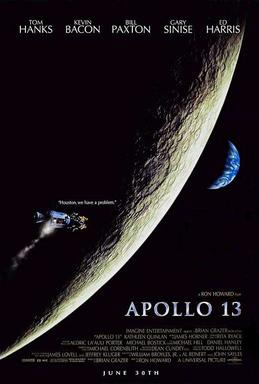
Lisa Reviews An Oscar Nominee: Apollo 13 (dir by Ron Howard)


Apollo_thirteen_movie

I just finished watching the TCM premiere of the 1995 Best Picture nominee, Apollo 13.  Of course, it wasn’t the first time I had seen it.  Apollo 13 is one of those films that always seems to be playing somewhere and why not?  It’s a good movie, telling a story that is all the more remarkable and inspiring for being true.  In 1970, the Apollo 13 flight to the moon was interrupted by a sudden explosion, stranding three astronauts in space.  Fighting a desperate battle against, NASA had to figure out how to bring them home.  Apollo 13 tells the story of that accident and that rescue.

There’s a scene that happens about halfway through Apollo 13.  The heavily damaged Apollo 13 spacecraft is orbiting the moon.  Originally the plan was for Apollo 13 to land on the moon but, following that explosion on the craft, those plans have been cancelled.  Inside the spacecraft, three astronauts can only stare down at the lunar surface below them.

As Commander Jim Lovell stares out the craft’s window, we suddenly see him fantasizing about what it would be like if the explosion hadn’t happened and if he actually could fulfill his dream of walking on the moon.  We watch as Lovell (and, while we know the character is Jim Lovell, we are also very much aware that he’s being played by beloved cinematic icon Tom Hanks) leaves his foot print on the lunar surface.  Lovell opens up his visor and, for a few seconds, stands there and takes in the with the vastness of space before him and making the scene all the more poignant is knowing that Tom Hanks, before he became an award-winning actor, wanted to be a astronaut just like Jim Lovell.  Then, suddenly, we snap back to the film’s reality.  Back inside the spacecraft, Lovell takes one final look at the moon and accepts that he will never get to walk upon its surface.  “I’d like to go home,” he announces.

It’s a totally earnest and unabashedly sentimental moment, one that epitomizes the film as a whole.  There is not a hint of cynicism to be found in Apollo 13.  Instead, it’s a big, old-fashioned epic, a story about a crisis and how a bunch of determined, no-nonsense professionals came together to save the day.  “Houston,” Lovell famously says at one point, “we have a problem.”  It’s a celebrated line but Apollo 13 is less about the problem and more about celebrating the men who, through their own ingenuity, solved that problem.

That Apollo 13 is a crowd-pleaser should come as no surprise.  It was directed by Ron Howard and I don’t know that Howard has ever directed a film that wasn’t designed to make audiences break into applause during the end credits.  When Howard fails, the results can be maudlin and heavy-handed.  But when he succeeds, as he does with Apollo 13, he proves that there’s nothing wrong with old-fashioned, inspirational entertainment.

Of course, since Apollo 13 is a Ron Howard film, that means that Clint Howard gets a small role.  In Apollo 13, Clint shows up as a bespectacled flight engineer.  When astronaut Jack Swiggert (Kevin Bacon) mentions having forgotten to pay his taxes before going into space, Clint says, “He shouldn’t joke about that, they’ll get him.”  It’s a great line and Clint does a great job delivering it.

Apollo 13 is usually thought of as being a Tom Hanks film but actually, it’s an ensemble piece.  Every role, from the smallest to the biggest, is perfectly cast.  Not surprisingly, Bacon, Bill Paxton, Gary Sinise, Kathleen Quinlan, and Ed Harris all turn in excellent performances.  But, even beyond the marquee names, Apollo 13 is full of memorable performances.  Watching it tonight, I especially noticed an actor named Loren Dean, who played a NASA engineer named John Aaron.  Dean didn’t get many lines but he was totally believable in his role.  You looked at him and you thought, “If I’m ever trapped in space, this is the guy who I want working to bring me home.”

Apollo 13 was nominated for best picture but it lost to Mel Gibson’s film Braveheart.  Personally, out of the nominees, I probably would have picked Sense and Sensibility but Apollo 13 more than deserved the nomination.

Playing Catch-Up With 6 Quickie Reviews: The Big Game, The Connection, Graduation Day, McFarland USA, Taken 3, and War Room


Here are 6 more reviews of 6 other films that I watched this year.  Why six?  Because Lisa doesn’t do odd numbers, that’s why.

The Big Game (dir by Jalmari Helander)

In The Big Game, Samuel L. Jackson plays the President of the United States and you would think that fact alone would make this film an instant classic.  Unfortunately, this film never really takes advantage of the inherent coolness of Samuel L. Jackson playing the leader of the free world.  When Air Force One is sabotaged and crashes in the wilderness of Finland, President Jackson has to rely on a young hunter (Onni Tommila) from a group of CIA agents disguised as terrorists.  Tommila does a pretty good job and the scenery looks great but at no point does Samuel L. Jackson says, “Check out this executive action, motherfucker,” and that’s a huge missed opportunity.  As for the rest of the film, it takes itself a bit too seriously and if you can’t figure out the big twist from the minute the movie starts, you obviously haven’t seen enough movies.

The Connection (dir by Cedric Jiminez)

Taking place over the 1970s, the French crime thriller tells the largely true story of the efforts of a French judge (played by Jean Dujardin) to take down a ruthless gangster (Gilles Lellouche) who is the head of one of the biggest drug cartels in the world.  The Connection run for a bit too long but, ultimately, it’s a stylish thriller that does a very good job of creating a world where literally no one can be trusted.  Dujardin, best known here in the States for his Oscar-winning role in The Artist, does a great job playing an honest man who is nearly driven to the point of insanity by the corruption all around him.

Graduation Day (dir by Chris Stokes)

Hey, it’s another found footage horror film!  Bleh!  Now, I should admit that this horror film — which is NOT a remake of that classic 1980s slasher — does have a fairly clever twist towards the end, that goes a long way towards explaining a lot of the inconsistencies that, up until that point, had pretty much dominated the film.  But, even with that in mind and admitting that Unfriended and Devil’s Due worked wonders with the concept, it’s still hard to feel any enthusiasm about yet another found footage horror film.

McFarland USA (dir by Niki Caro)

McFarland USA is an extremely predictable but likable movie.  Kevin Costner plays a former football coach who, while teaching at a mostly Latino high school, organizes a cross country team that goes on to win the state championship.  It’s based on a true story and, at the end of the film, all of the real people appear alongside the actors who played them.  There’s nothing about this film that will surprise you but it’s still fairly well-done.  Even Kevin Costner, who usually gets on my last nerve, gives a good performance.

Taken 3 (dir by Olivier Megaton)

Bryan Mills (Liam Neeson) is back and he’s killing even more people!  Fortunately, they’re all bad people but you really do have to wonder what type of dreams Bryan has whenever he goes to sleep.  In Taken 3, Bryan’s wife (Famke Janssen) has been murdered and Bryan has been framed.  He has to solve the case and kill the bad guys while staying one step ahead of the police (represented by a bored-looking Forest Whitaker).  Neeson does all of his usual Taken stuff — the intense phone conversation, the steely glare, and all the rest — but at this point, it has literally been parodied to death.  If you’re into watching Liam Neeson kill ugly people, Taken 3 will provide you with adequate entertainment but, for the most part, it’s but a shadow of the first Taken.

War Room (dir by Alex Kendrick)

I saw the War Room in Oklahoma.  It was being shown as part of a double feature with The Martian, of all things!  Anyway, this film is about an upper middle class family that hits rock bottom but they’re saved by the power of prayer!  Lots and lots of prayer!  Seriously, this film almost qualifies as “prayer porn.”  Anyway, the film was badly acted, badly written, incredibly heavy-handed, and ran on way too long but, on the plus side, it did eventually end.

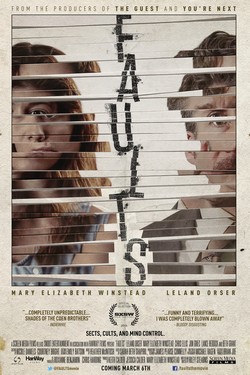
Film Review: Faults (dir by Riley Stearns)


Faults_(film)_POSTER

Faults is many things.

It’s a character study.  It’s a thriller.  It’s a deeply unsettling horror film.  It’s a darker-than-dark comedy that will make you laugh even while you’re glancing over your shoulder to make sure there are no strangers hiding in the shadows.  It’s a look at religion, faith, free will, and guilt.  It’s a declaration that a major talent — writer/director Riley Stearns — has arrived.  It’s an acting showcase for both Mary Elizabeth Winstead and Leland Orser.  It’s a film that found success on the festival circuit and then had an all-too brief theatrical release in March.  It’s also a film that’s currently available on Netflix.  Finally, it’s one of the best films of the year so far.

When we first meet professional cult deprogrammer Ansel Roth (Leland Orser), he is eating dinner in a hotel restaurant and desperately trying to convince his waiter that he has an agreement with management, guaranteeing him free meals while staying at the hotel.  After Ansel is kicked out of the restaurant, he then tries to convince the hotel manager that his room is supposed to be free as well.  The manager gives Ansel an hour to check out.

As quickly becomes apparent, Ansel is nearly broke and he’s living out of his car.  What little money he has, he makes from giving sparsely attended lecture where he literally begs people to pay fifteen dollars to get a copy of his latest book.  After his lectures, Ansel is willing to sign his new book at a cost of five dollars per signature.

(At one point, when someone asks Ansel to sign his previous book, Ansel abruptly explains that he no longer signs that book.  If you want his five dollar autograph, you have to first pay fifteen dollars to get his new book.)

At one point, Ansel was a minor celebrity with his own talk show but, after a girl he deprogrammed subsequently committed suicide, Ansel’s life fell apart.  His latest book is self-published and his former manager, the oddly polite Terry (Jon Gries), claims that Ansel owes him money.  Terry’s enforcer, Mick (the always intimidating Lance Reddick), is stalking Ansel from cheap motel to cheap motel.

However, things start to look up for Ansel when he’s approached by Paul (Chris Ellis) and Evelyn (Beth Grant).  They explain that their daughter, Claire (Mary Elizabeth Winstead), has joined a cult known as Faults and is a follower of a mysterious figure named Ira.  They ask Ansel to deprogram her.  Ansel agrees to do so and charges them $20,000.

After Ansel and two “assistants” literally grab Claire off the street, they take her to a cheap motel where, behind locked doors, Ansel starts to try to deprogram Claire.  However, from the start, Ansel discovers that it’s going to be more difficult than he realized.

For one thing, Claire remains calm throughout the whole kidnapping and, even when locked in the shabby motel room, is confident that she is about to “move on” and achieve a higher level of existence.  When Paul and Evelyn show up and try to talk to Claire, it turns out that they’re not quite the loving parents that they initially presented themselves as being.  Paul, in particular, reveals himself to have a fierce temper and he demands that Claire change into clothes that would be more appropriate for a teenager than for an adult.  When Ansel suggests that the overbearing Paul should back off, Paul replies that he “knows” what Ansel truly wants to do with Claire.

Secondly, even as Ansel tries to deprogram Claire, he still has to deal with Terry and Mick.  Neither one of them is particularly concerned about whether or not Ansel can pull Claire away from Faults.  Instead, Terry just wants his money.

And finally, even as Ansel tries to keep control of the situation, he is personally falling apart.  He finds himself having sudden nosebleeds.  At one point, his suit spontaneously combusts into flame.  (Believe it or not, there is a relatively plausible reason for why this happens but that doesn’t make it even less shocking.)  When Ansel falls asleep in the motel room, he subsequently wakes up in his car and has no memory of how he got there.

And through it all, Claire remains a seductive and manipulative enigma.  Sometimes she’s cold and in control.  Other times, she’s surprisingly vulnerable.  Ansel finds himself both attracted to and frightened of Claire.  Throughout the film, Ansel insists that he has “free will” but Claire forces him to reconsider that assumption.

Faults is a low-key and disturbing film that is distinguished by a very dark and cynical sense of humor.  Mary Elizabeth Winstead is amazing as the mysterious Claire while Leland Orser is wonderfully desperate and surprisingly sympathetic as Ansel.  When Faults first started, I was concerned that, since it largely takes place in one cramped motel room, the film would be too stagey to be effective.  But director Riley Stearns does amazing work with that one location and, as a result, Faults is one of those rare films that actually gets more intriguing the deeper you get into it.

Faults is currently available on Netflix and you should watch it.

Trailer: The Dark Knight Rises (Nokia Exclusive)


Marvel Studios’ The Avengers has been the runaway, blockbuster hit of 2012’s summer film season. The film has also become the film which detractors of Christopher Nolan’s third and final entry in his Dark Knight trilogy put up as the film to beat this summer. I like the fanboy enthusiasm that always comes out of the shadows whenever comic book films battle it out during the summer blockbuster season year in and year out, but I will say that instead of pitting the two mega-hits against each other fans of the comic book genre should embrace both because just around the corner will be the average to awful comic book films.

With just a month to go before the film’s release we get a new trailer (this one a Nokia Exclusive) for The Dark Knight Rises which looks to emphasis the action of the film where the previous trailers and teasers concentrated more on keeping the film’s story a secret. I’ve looked at these series’ of trailers and ads for the film like another of Nolan’s previous films with The Prestige. The first trailers and ads I see as the “The Pledge” from the film’s creators that hints at the grandiose event we’re going to be witness to. This latest trailer acts like “The Turn” as we see the magician performing the trick of this latest film giving the audience a bit more flash and pizzazz (maybe some misdirection as well to keep the story secret until the film’s release). For The Dark Knight Rises it will be on opening weekend when we finally see “The Prestige” that closes out (hopefully with critical-acclaim) Nolan’s turn as the caretaker of the Batman film franchise.

The Dark Knight Rises is set for a July 20, 2012 release date.