Film Review: Executive Decision (dir by Stuart Baird)


In 1996’s Executive Decision, terrorists hijack an airplane.  Their leader, Nagi Hassan (David Suchet) demands that the U.S. government not only give him and his men safe passage but that they also release Hassan’s commander, Jaffa (Andreas Katsulas).

In Washington D.C., it is decide to use a stealth plane to transport Col. Austin Travis (Steven Seagal) and his men into the passenger plane.  Accompanying them will be Dr. David Grant (Kurt Russell), a consultant for U.S. Intelligence.  Dr. Grant is the world’s leading expert on Hassan, even though neither he nor anyone else is even sure what Hassan looks like.  Travis distrusts Grant because he’s a civilian and also because he holds Grant responsible for a botched raid on a Russian safehouse in Italy.  Dr. Grant is going to have to prove himself to Col. Travis because Travis doesn’t have any time for people who can’t get the job done.  And Travis is determined to get on that plane and save all those passengers.

In other words, Travis is a typical Steven Seagal character and, for the first fourth of this movie, Seagal gives a typical Steven Seagal performance.  He delivers his line in his trademark intimidating whisper, he glares at everyone else in the film, and essentially comes across as being a total douchebag who can still handle himself in a fight..  However, when it’s time to board the airplane through a docking tunnel, something goes wrong.  Everyone — even nervous engineer Dennis Cahill (Oliver Platt) is able to slip through the stealth plane’s docking tunnel and get into the hijacked airplane cargo hold without being detected.  But the two planes are hit by severe turbulence.  Suddenly, it becomes apparent the one man is going to have to sacrifice his life and close the hatch before the docking tunnel decompresses.

David, already in the cargo hold, looks down at Austin in the tunnel.  “We’re not going to make it!”

“You are!” Austin replies before slamming the hatch shut and getting sucked out of the tunnel.  (There’s your Oscar Cheers Moment of 1996!)  After all that build-up, Steven Seagal exits the film early and now, it’s up to Kurt Russell and what’s left of Austin Travis’s men to somehow stop the terrorists.  Not only do they have to stop Hassan but they also have to do it before the Air Force — which has no way of knowing whether or not any of their men were able to get on the plane before the tunnel fell apart — shoots down the airliner.

(If the airplane looks familiar, that’s because Lost used the same stock footage whenever it flashed back to the plane crash that started the show.)

It’s actually a rather brilliant twist.  When this film came out, Seagal was still a film star.  He played characters who always got the job done and who were basically infallible.  He wasn’t a very good actor but he did manage to perfect an intimidating stare and that stare carried him through a lot of movies.  No one would have expected Seagal to die within the first 30 minutes of one of his movies and when Col. Travis, who the film has gone out of its way to portray as being the consummate warrior, is suddenly killed, there really is a moment where you find yourself wondering, “What are they going to do now?”  In just a matter of minutes, Executive Decision goes from being a predictable Steven Seagal action film to a genuinely exciting and clever Kurt Russell thriller.  For once, Russell is not playing a man of action.  He’s an analyst, a thinker.  And, to the film’s credit, he uses his mind more than his brawn to battle Hassan’s terrorists.  With excellent support from Halle Berry (as a flight attendant who discreetly helps out David and the soldiers), Oliver Platt, B.D. Wong, Whip Hubley,  David Suchet, Joe Morton, and even John Leguizamo (as Travis’s second-in-command), Executive Decision reveals itself to be an exciting and ultimately rewarding thrill ride.

And to think, all it took was sacrificing Steven Seagal.
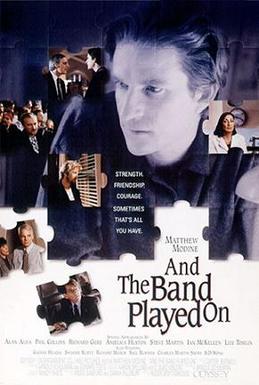
Film Review: And The Band Played On (dir by Roger Spottiswoode)


I live in a very cynical time.

That was one of my main thoughts as I watched 1993’s And The Band Played On.

Directed by Roger Spottiswoode and featuring an all-star cast, And The Band Played On deals with the early days of the AIDS epidemic.  It’s a film that features many different characters and storylines but holding it all together is the character of Dr. Don Francis (Matthew Modine), an epidemiologist who is haunted by what he witnessed during the Ebola epidemic in Africa and who fears that the same thing is going to happen in America unless the government gets serious about the mysterious ailment that is initially called “gay cancer” before then being known as “GRID” before finally being named AIDS.  Dr. Francis is outspoken and passionate about fighting disease.  He’s the type who has no fear of yelling if he feels that people aren’t taking his words seriously enough.  In his office, he keeps a track of the number of HIV infections on a whiteboard.  “Butchers’ Bill” is written across the top of the board.

Throughout the film, quite a few people are dismissive of Dr. Francis and his warnings.  But we, the audience, know that he’s right.  We know this because we know about AIDS and but the film also expects us to trust Dr. Francis because it’s specifically stated that he worked for the World Health Organization before joining the Center For Disease Control in Atlanta, Georgia.  As far as the film is concerned, that’s enough to establish his credentials.  Of course, today, after living through the excesses of the COVID pandemic and the attempts to censor anyone who suggested that it may have begun due to a lab leak as opposed to some random guy eating a bat, many people tend to view both the WHO and the CDC with a lot more distrust than they did when this film was made.  As I said, we live in a cynical time and people are now a lot less inclined to “trust” the experts.  To a large extent, the experts have only themselves to blame for that.  I consider myself to be a fairly pragmatic person but even I now find myself rolling my eyes whenever a new health advisory is issued.

This new sense of automatic distrust is, in many ways, unfortunate.  Because, as And The Band Played On demonstrates, the experts occasionally know what they’re talking about.  Throughout the film, people refuse to listen to the warnings coming from the experts and, as a result, many lives are lost.  The government refuses to take action while the search for a possible cure is hindered by a rivalry between international researchers.  Alan Alda gives one of the best performances in the film, playing a biomedical researcher who throws a fit when he discovers that Dr. Francis has been sharing information with French scientists.

It’s a big, sprawling film.  While Dr. Francis and his fellow researchers (played by Saul Rubinek, Glenne Headly, Richard Masur, Charles Martin Smith, Lily Tomlin, and Christian Clemenson) try to determine how exactly the disease is spread, gay activists like Bobbi Campbell (Donal Logue) and Bill Kraus (Ian McKellen) struggle to get the government and the media to take AIDS seriously.  Famous faces pop up in small rolls, occasionally to the film’s detriment.  Richard Gere, Steve Martin, Anjelica Huston, and even Phil Collins all give good performances but their fame also distracts the viewer from the film’s story.  There’s a sense of noblesse oblige to the celebrity cameos that detracts from their effectiveness.  All of them are out-acted by actor Lawrence Monoson, who may not have been a huge star (his two best-known films are The Last American Virgin and Friday the 13 — The Final Chapter) but who is still heart-breakingly effective as a young man who is dying of AIDS.

Based on a 600-page, non-fiction book by Randy Shilts, And The Band Played On is a flawed film but still undeniably effective and a valuable piece of history.  Director Roger Spottiswoode does a good job of bringing and holding the many different elements of the narrative together and Carter Burwell’s haunting score is appropriately mournful.  The film ends on a somber but touching note.  At its best, it’s a moving portrait of the end of one era and the beginning of another.

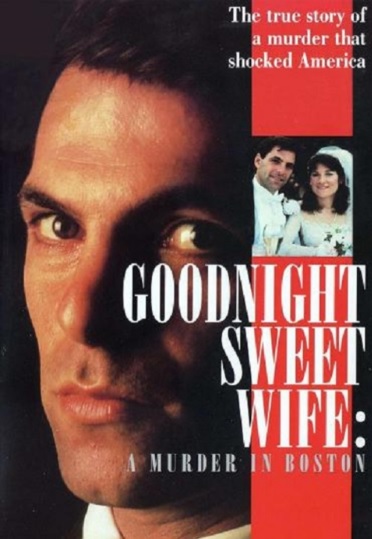
October True Crime: Goodnight Sweet Wife: A Murder In Boston (dir by Jerrold Freedman)


1990’s Goodnight Sweet Wife opens with a frantic 9-11 call.

A man named Charles Stuart (Ken Olin) calls the Boston Police Department and says that he and his pregnant wife have just been shot.  He says that he got lost while trying to drive home and that a black man got in the car, made Charles drive to a remote location, robbed Charles and his wife, and then shot them.  When the police finally manage to track Charles down, he’s nearly dead as a result of having been shot in the stomach.  Carol was shot in the head and is pronounced dead shortly after arriving at the hospital.  Her baby, named Christopher, is delivered via C-section but dies a few days later.

The city of Boston is outraged as the crime makes national news.  The story that thousands hear is that Charles Stuart, a hard-working and financially successful man who has never had any trouble with the police, took one wrong turn, ended up in a “bad” neighborhood, and lost his wife and his son as a result.  As Charles recovers in the hospital, the police make capturing his assailant their number one priority and soon, black men are being stopped and frisked in the streets.

With the entire world mourning the loss of Carol and Christopher Stuart, there are only a few people in Boston who are willing to take a careful look at Charles’s story.  There are quite a few inconsistencies in Charles’s story, not the least of which was his claim that he was shot in a nearly deserted area of town when the neighborhood is actually one of Boston’s busiest.  Some start to suspect that Charles killed his wife and then shot himself to make it look like a robbery and the fact that Charles nearly died from his wound is not proof that Charles was actually the victim but instead just a sign that Charles didn’t know where to shoot himself in order to not nearly die.  However, even with all of the inconsistencies in Charles’s story, the police still announce that they’ve arrested a man for the crime.  Charles even identifies the suspect, William Bennett, as being the murderer.

Of course, as is revealed in flashbacks, Charles Stuart is a murderer and he’s not a particularly clever one.  He’s the type of murderer who openly talked to people about how he was considering committing a murder.  He’s the type who roped his own brother into helping him fake the robbery.  Far from being the successful professional that he presented himself as being, Charles was mediocre broker who depended on his wife’s salary to finance his lifestyle.  With Carol pregnant and planning on quitting her job to be a full-time mother, Charles decided to kill her for the insurance and he also figured that he would be able to get away with it as long as he blamed the crime on a black man.

Tragically, it turned out that Charles Stuart was almost right.  In both the movie and in real life, Charles Stuart was believed because he didn’t look like what most people thought a criminal looked like.  He was a young, handsome, middle class white guy and because he couldn’t face the prospect of having to cut back financially, he killed his wife and his son and he nearly put an innocent black man in prison.  The film does a good job of depicting the consequences of both Stuart’s crime and the rush to judgment on the part of the police.  Ken Olin plays Charles Stuart as being outwardly friendly but empty on the inside, a cold sociopath who is incapable of truly caring about anyone but himself.  In real life, Stuart chose to jump into the Mystic River rather than face the consequences of his actions.  Stuart’s brother, who helped Charles fake the robbery and later turned Charles into the police, died in a homeless shelter 30 years later.  Carol’s family set up a scholarship fund in her name to aid students in Mission Hill, the neighborhood where Charles claimed he had been hijacked.  One of the scholarship’s first recipients was the daughter of William Bennett.

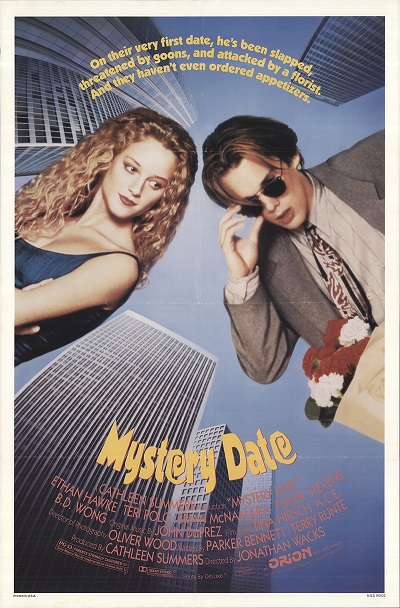
Insomnia File #49: Mystery Date (dir by Jonathan Wacks)


What’s an Insomnia File? You know how some times you just can’t get any sleep and, at about three in the morning, you’ll find yourself watching whatever you can find on cable or Netflix? This feature is all about those insomnia-inspired discoveries!

If you were having trouble getting to sleep last night, around one in the morning, you could have turned over to the HBO Family channel and watched the 1991 comedy, Mystery Date!

A young and extremely adorable Ethan Hawke plays Tom McHugh, a college student who is in love with Geena (Teri Polo), the housesitter next door. The only problem is that Tom is extremely shy and can’t even work up the nerve to ask Genna out. It sure would help if he was rich and charming like his older brother, Craig (Brian McNamara). Eventually, Craig helps his brother out. He gives Tom his credit card and his car so that Tom can take Geena out on a date. What an nice brother! Soon, Tom and Geena are hitting the town and having a great time. They even see Gwar perform which …. well, okay. That probably would not be my ideal first date but whatever.

Unfortunately, it turns out that Craig has gotten involved with some pretty bad things and, as a result, there are two dead bodies in the trunk of the car! Uh-oh, that could be awkward. Plus, the Chinese mafia (led by B.D. Wong) are determined to kill Tom because they think that he’s Craig. And finally, to top it all off, Tom has got a crazed flower delivery guy (played by Fisher Stevens) following him all over the city. Can Tom possibly survive the night and still get a second date!?

Mystery Date starts out nicely. Ethan Hawke is cute in a non-threatening sort of way. Teri Polo is likable. They seem like they would make a cute couple. You want things to work out for them. Unfortunately, once the date actually starts, the film gets frantic without getting any funnier. It becomes a case of the film just trying too hard and you feel as if the film is demanding that you laugh as opposed to offering up a reason to laugh. You watch the film and you don’t so much think about what you’re watching as you think about films like Risky Business and Better Off Dead, both of which told similar stories with a lot more energy and imagination. You have to kind of imagine that whenever Ethan Hawke gives one of his interviews where he talks about why he’s not interested in doing typical mainstream films, this is probably the type of movie that he was talking about. Among the many other things for which we have to thank Richard Linklater, he ensured that Ethan Hawke would never have to star in Mystery Date 2.

Previous Insomnia Files:

  1. Story of Mankind
  2. Stag
  3. Love Is A Gun
  4. Nina Takes A Lover
  5. Black Ice
  6. Frogs For Snakes
  7. Fair Game
  8. From The Hip
  9. Born Killers
  10. Eye For An Eye
  11. Summer Catch
  12. Beyond the Law
  13. Spring Broke
  14. Promise
  15. George Wallace
  16. Kill The Messenger
  17. The Suburbans
  18. Only The Strong
  19. Great Expectations
  20. Casual Sex?
  21. Truth
  22. Insomina
  23. Death Do Us Part
  24. A Star is Born
  25. The Winning Season
  26. Rabbit Run
  27. Remember My Name
  28. The Arrangement
  29. Day of the Animals
  30. Still of The Night
  31. Arsenal
  32. Smooth Talk
  33. The Comedian
  34. The Minus Man
  35. Donnie Brasco
  36. Punchline
  37. Evita
  38. Six: The Mark Unleashed
  39. Disclosure
  40. The Spanish Prisoner
  41. Elektra
  42. Revenge
  43. Legend
  44. Cat Run
  45. The Pyramid
  46. Enter the Ninja
  47. Downhill
  48. Malice

Jurassic World Adds To The Summer Action


JurassicWorld

Was there ever a need for a fourth film in the Jurassic Park franchise? For years many have tried to answer that and projects to get it up and running stalled for need of a director willing to sign on to a franchise that has been passed up by the superhero action tsunami that has hit pop culture.

It is now 2015 and we’re just months away from finally seeing the fruits of over a decade’s worth of labor to bring a fourth Jurassic Park film to the big screen. While it may still have Steven Spielberg attached as executive producer there’s no Joe Johnston anywhere near this fourth film. We have Carl Trevorrow taking the director’s chair with Chris Pratt and Bryce Dallas Howard taking on the lead roles.

Jurassic World is set to open it’s doors to the world on June 12, 2015 (took them long enough).

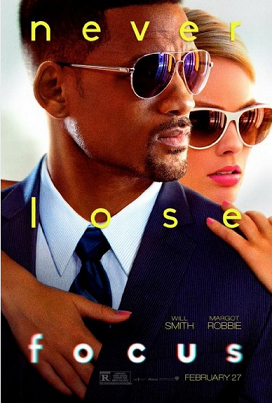
Film Review: Focus (dir by Glenn Ficara and John Requa)


2015_Focus_film_poster

The snow and ice finally melted today so, this afternoon, Jeff and I went down to the Alamo Drafthouse and we saw the just released Will Smith/Margot Robbie film, Focus.

You know how there’s some films that you see and you know that you had a good enough time while you were watching it and then, a few hours later, you realize that the movie itself is quickly fading from your memory?  It’s not that you just saw a bad movie as much as you just watched one that was not exceptionally good.  To a large extent, that sums up how I felt about Focus.  I watched it.  I was mildly entertained.  And I have a feeling that, 6 months from now, I’m going to come across this review and say something like, “Oh yeah, I guess I did see that movie.”  It gets the job done but it doesn’t do much else.

(I was actually tempted to start this review by saying that Focus was good for a “March movie” but then I remembered that last year, The Grand Budapest Hotel came out in March and proved that the date of release is no longer an excuse.)

In Focus, Will Smith plays Nicky Spurgeon.  Nicky’s nickname is Mellow but he didn’t get that nickname for the reason that you probably think he did.  (Though, rest assured, we do find out the exact reason why Nicky is called Mellow and yes, it does factor into the film’s final twist.)  Nicky is anything but mellow.  Instead, he’s a professional con artist who is always scheming, who always considers every detail, and who is always focused on getting what he wants.

The film is split into two parts and the first part is actually pretty good.  An inexperienced con artist named Jess (Margot Robbie) attempts to rob Nicky and gets a lecture as a result.  Nicky isn’t so much upset that Jess tried to con him as much as he, as a professional, is annoyed that Jess did such a bad job of it.  This leads to Nicky eventually becoming Jess’s mentor.  Nicky teaches Jess all the tools of the trade, introduces her to all the properly quirky members of his crew, and he even goes against his own advice (which is to never get close to anyone) when he and Jess become lovers.

The highlight of the first part of the film is a football game where Nicky and a compulsive gambler (B.D. Wong) end up making a series of increasingly ludicrous bets.  B.D. Wong gives such a memorably unhinged performance that he briefly made the entire film seem more interesting than it actually was.  In fact, as I look back over Focus, I find myself wishing that the entire film has just been about his character.

But, unfortunately, the film isn’t about B.D. Wong.  Instead, it’s about Nicky and Jess.  The second part of the film, which takes place three years after the first part, features Jess and Nicky as equals and it feels like almost an entirely different movie.  Whereas Smith and Robbie had a nice chemistry as teacher and student, that chemistry vanishes after the time jump.  Unfortunately, that’s not all that vanishes.  The film’s pace and playful sense of fun disappears as well.  If the first half of the film felt like an above average first episode of a quirky TV show, the second half felt like a long-running sitcom on which the show runner had been fired and suddenly replaced.  It was similar to what had come before but, ultimately, it felt very different.

Focus does end with a big twist but, long before it was revealed, Jeff and I both guessed what it was.  The problem is that we’ve seen so many movies about con artists that we know that all of them are destined to end with a big twist that reveals that there was another con going on that we didn’t know about.  It’s impossible to be surprised by the eventual twist because we all know that it’s coming.  For a “con movie” like Focus to work, it has to either be so cleverly written or so much fun to watch that we actually stop thinking about the inevitability of the upcoming twist.  But, since Focus is never as clever as it thinks it is, we instead spend our whole time thinking about the twist and, seeing as how you’re a clever and experience filmgoer, you probably won’t have much trouble predicting it.

But here’s the thing: I think it’s possible to be too critical of a film like Focus.  Focus may not be good but it does have it fun moments.  Will Smith could play Nicky in his sleep.  (And, to be honest, he occasionally seems to be doing just that.)  Margot Robbie looks like she belongs in an old film noir.  The settings are glamorous.  The clothes are to die for.  Ultimately, Focus is both moderately enjoyable and extremely forgettable.  If you don’t see it in a theater, you won’t regret it.  However, when it show up on cable in December, it’ll make for inoffensive background noise.