Happy Independence Day Eve! It’s the Third of July and here’s Ray Charles singing America The Beautiful on a 1972 episode of The Dick Cavett Show. Enjoy!
Happy Independence Day Eve! It’s the Third of July and here’s Ray Charles singing America The Beautiful on a 1972 episode of The Dick Cavett Show. Enjoy!

Tom Cruise is 64 years old today! He still doesn’t look a day over 36. Insert your own Dorian Gray joke here.
No matter what else you may want to say about Tom Cruise, you can’t deny that he’s one of the last of the genuine movie stars. He’s been a star in since the 80s, doing things onscreen that you could never imagine some of our younger actors even attempting. Juat four years agp, Top Gun: Maverick was unstoppable with audiences and critics. There were many reasons for Maverick‘s popularity but one cannot deny that a lot of it is the fact that Cruise just has that old-fashioned movie star charisma.
Today’s scene that I love comes from the first Top Gun. In this scene, Tom Cruise, Anthony Edwards, Val Kilmer, and Rick Rossovich play beach volleyball. The scene kind of comes out of nowhere and there are times when the whole thing comes close to self-parody. (Actually, if we’re going to be honest, it crosses the line into self-parody more than a few times.) But, Cruise and the much-missed Kilmer manage to save it, like the movie stars they are!
4 Or More Shots From 4 Or More Films is just what it says it is, 4 shots from 4 of our favorite films. As opposed to the reviews and recaps that we usually post, 4 Shots From 4 Films lets the visuals do the talking!
Today, the Shattered Lens wishes a happy 69th birthday to one of our favorite directors, Michele Soavi! In other words, it’s time for….
4 Shots from 4 Michele Soavi Films
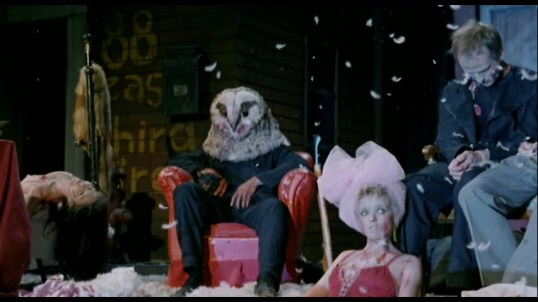
Stage Fright (1987, dir by Michele Soavi, DP: Renato Tafuri)
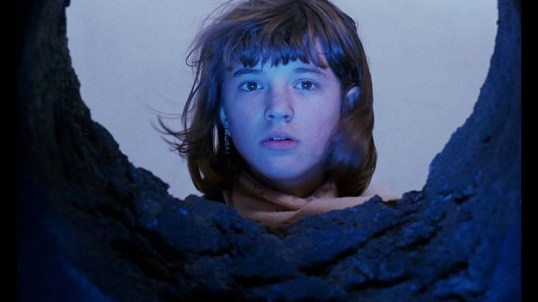
The Church (1989, dir by Michele Soavi, DP: Renato Tafuri)
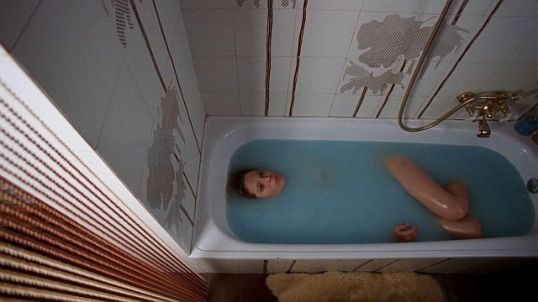
The Sect (1991, dir by Michele Soavi, DP: Raffaele Mertes)
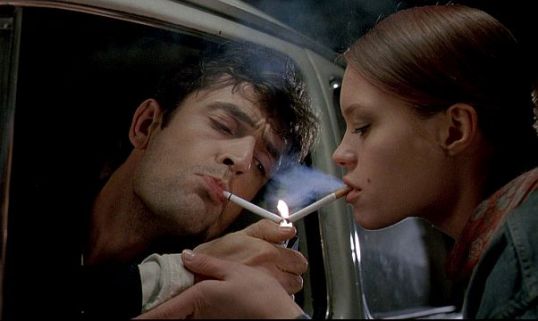
Dellamorte Dellamore (1994, dir by Michele Soavi, DP: Mauro Marchetti)
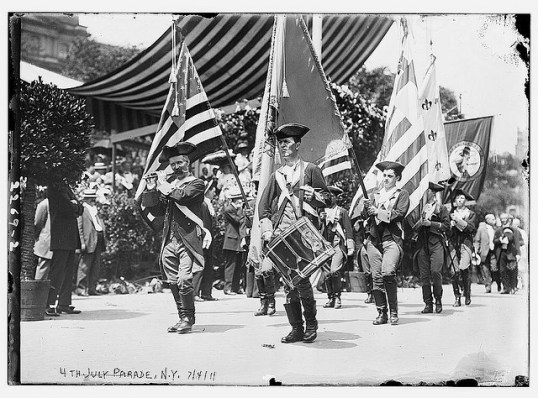
“America was not built on fear. It was built on courage, on imagination and an unbeatable determination to do the job at hand.”
— Harry S Truman
Happy Independence Day!
Okay, it’s not really Independence Day just yet. We’ve got one more day to go until the big celebration. For all the talk that we hear about how it’s no longer socially acceptable in some circles to be patriotic, I’m very excited for tomorrow and just about everyone who I know is as well. My family and I are up at the lake for the weekend and I’m looking forward to watching the fireworks light up the sky while being reflected in the water below.
Why am I so proud to be an American? A lot of it is because being an American means that I can share my opinions on a site like this without having worry about the police knocking on my door because someone got offended. Not everyone in the world has that freedom. I would also point out that, in the grand scheme of things, America has accomplished a lot in 250 years. Compare what we’ve done in our first 250 years to what Europe did in its first 250. And then starting chanting USA! USA!
Bye, Freddy
I was saddened this week to learn that Freddy, the German soccer fan who won the heart of the nation, shut down his twitter account because he was getting harassed by a small group of European communists and whiny yankees who refused to accept that he was actually having a good time in the U.S. I understand Freddy’s decision but I’ll miss his updates. It’s kind of sad how some people are so bitter that they cant just accept that someone else isn’t as sad and angry as they are.
That said, he apparently will be spending the 4th in Texas. I’m glad that he’ll be here experiencing a real Independence Day with everyone.
Big Brother Is Coming Back
I used to watch Big Brother religiously and I even blogged about it for another site. The new season starts on July 10th and I’m struggling to work up any enthusiasm for it. I haven’t even decided whether or not I’m even going to watch, much less write about it, this season. I’m not alone in that. Out of the large group of people that I used watch Big Brother with, only a handful still watch the show.
A lot of that is because the show itself has gotten too gimmicky and the houseguests are no longer as quirky or eccentric as they once were. I know quite a few people were turned off by Julie Chen Moonves’s decision to start pushing religion while also standing beside her husband even as he was credibly accused of sexually harassing and assaulting numerous women. I know I certainly cringe whenever Julie ends the show with, “Love one another.” It’s very performative and it feels very fake.
I probably will end up watching the show this season. But I probably won’t feel very good about it.
Last night, I tried….
….to get my family to watch Sgt. Pepper’s Lonely Hearts Club Band with me but most of them left the room while Donald Pleasence was singing I Want You. I get the feeling that I’m the only person in the world who likes that movie.
The 4th Is Calling Me
And I look forward to answering! Have a good and safe holiday! And remember, fireworks are cool but shooting them off at two in the morning is not!
Happy birthday, America!
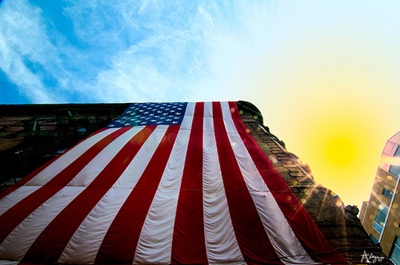
by Alaz Mal
I love my country.
What’s an Insomnia File? You know how some times you just can’t get any sleep and, at about three in the morning, you’ll find yourself watching whatever you can find on cable or streaming? This feature is all about those insomnia-inspired discoveries!
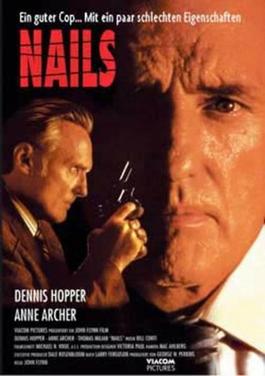
If you’re having trouble getting to sleep, you can always go over to YouTube and watch 1992’s Nails.
Dennis Hopper stars Harry “Nails” Nile, a cop who …. wait for it …. doesn’t go by the book! He’s just a few days away from retirement but before Nails turns in his badge and his gun, he has to track down the drug dealers responsible for the death of his partner (Earl Billings). His superior officer doesn’t like him. His wife (Anne Archer) doesn’t trust him. Both the cartel and a local political fixer want him taken down. But Nails isn’t going to give up. He’s going to solve the case and stop the bad guys and get revenge. And he’s going to do it …. wait for it …. HIS WAY!
As you can probably already guess, Nails features just about every cop cliche imaginable. Nails’s partner talks about how much he’s enjoying life right before he gets gunned down. Nails’s boss yells about how much Nails’s out-of-control antics are costing the city. There are car chases. There are foot chases. There are shoot-outs and one-liners. There’s even a moving van chase that features the sight of Dennis Hopper frantically running down the street. And, of course, Danny Trejo shows up in a small role. It’s predictable and mindless and kind of entertaining if that’s what you’re in the mood for.
The thing that sets this film apart — really, the only thing — is that Dennis Hopper gives such an over-the-top performance as Nails. He’s the type of cops who randomly yells at strangers, occasionally giggles, and has a habit of repeating back any threat that he happens to hear. When I watched the film, I originally thought a better title than Nails would be Method Cop because Hopper truly does seem to be going out of his way to bring the full weight of the Method onto the type of role that could have just as easily been played by Chuck Norris. However, as the film progressed, I realized that Hopper was basically giving the same performance that he gave in Blue Velvet, except he was now playing the good guy. What if Frank Booth was the hero? Nails answers the question.
Of course, once the film ended, I was reminded that Hopper’s villain in Speed was a former cop. Is it possible that Speed was actually a sequel to Nails?
As far as I’m concerned, it definitely was!
The world misses you, Dennis!
Previous Insomnia Files:
Metallica has never released an official music video for Don’t Tread On Me so, for our purposes, we’ll have to settle for this live performance. The band was performing in Kentucky when this video was filmed.
Don’t Tread On Me was originally included on 1991’s Metallica. When asked about the song, James Hetfield replied, “America, it’s a good fucking place.”
I couldn’t have said it better myself.
Enjoy!
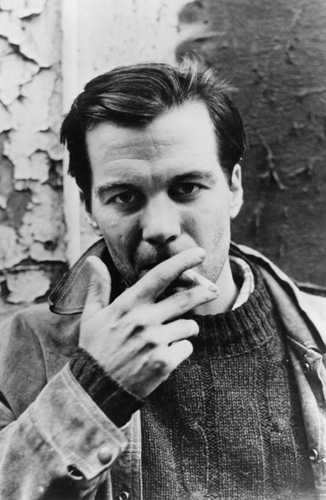
Few writers understood and celebrate America quite as brilliantly as Jack Kerouac.
The bottoms of my shoes
by Jack Kerouac
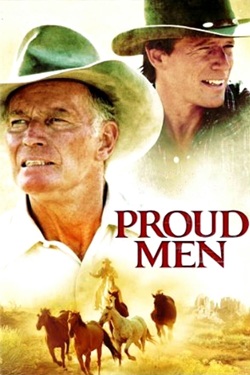 During the Vietnam War, Charley McLeod, Jr. (Peter Strauss) deserted from the U.S. Army. He has spent the last several years living in France with his wife Adrienne (Maria Mayenzet) but, when he learns that his father (Charlton Heston) is ill, Charley returns to the ranch where he grew up and tries to make peace with the old man before he dies. It’s not easy. Charley, Sr. never agreed with his son’s decision to desert and the local townspeople, including Charley’s former friend Brian (Alan Autry), view him as either being a coward or a traitor.
Proud Men was made for television and it’s clearly a product of a time when people were still coming to terms with both the war in Vietnam and the protests that surrounded it. Strauss isn’t the most convincing rancher that I’ve ever seen but, not surprisingly, Heston is totally believable as Charley’s old-fashioned father. Not much really happens in Proud Men. Charley, Jr. tries to prove himself by working on the ranch. Charley, Sr. holds back his emotions until the inevitable scene where he finally admits that he still loves his son. Probably the best performance comes from Alan Autry, whose character is written to be a bully but who also has a point when he point out that not everyone had the opportunity or the money necessary to just desert and start a new life in another country.
This is definitely a Dad film. It’s about working hard, doing what you have to do even when its difficult, and knowing how to throw a punch when someone in a bar disrespects your wife. It’s a minor film but I actually liked it. Heston may not have had the widest range as an actor but he was capable of very good work when he was cast in the right role, like he is here.

