Decades before he joins the X-Men, James “Logan” Howlett (Hugh Jackman) is just another mutant with retractable claws and a super-healing ability that essentially makes him immortal. With his half-brother Victor Creed (Liev Schreiber), Logan fights in wars throughout the centuries. When both Logan and Creed (who share Logan’s healing abilities) survive being executed by a firing squad, they are recruited by William Stryker (Danny Huston) to serve as members of Team X. Eventually, Logan tires of being an assassin and goes off on his own. However, both Stryker and Creed have plans for him and all the other mutants that they’ve captured or killed over the years. Several familiar characters appear—Scott Summers (Tim Pocock), Gambit (Taylor Kitsch), and the Blob (Kevin Durand) amongst others—but none of them have much of the personality that made them popular to comic book readers. (Just imagine including Gambit in an X-Men film but not Rogue.) Those who made it to the end of the film were given a Patrick Stewart cameo, albeit one that used CGI to de-age Stewart and make him look like an automaton.
With the majority of the X-Men either dead or cured at the end ofX-Men: The Last Stand, it only made sense to spin Hugh Jackman’s Wolverine off into his own series of films. Unfortunately, 20th Century Fox didn’t understand that the thing that made Wolverine so interesting as a character was that his past was shrouded in mystery. Their first Wolverine film revealed his origin and it turned out to be not that interesting. X2 had been filled with so many hints about Wolverine’s past that the origin story didn’t feel as if it was telling us anything that we hadn’t already figured out. Even the many fight scenes between Sabretooth and Wolverine felt dull because it was established that both of them were essentially immortal and impervious to pain.
Today, this movie is mostly remembered for featuring the first appearance of Wade Wilson, the mercenary who will eventually become Deadpool. There’s very little of Deadpool to be found in this film’s version of Wilson. He tells a few jokes before getting his lips sewn shut. Imagine introducing a character who is affectionately known as “the merc with a mouth” and then rendering him silent for the majority of the movie. In Deadpool 2, there’s a scene where Deadpool goes back in time and kills this earlier version of Wade Wilson (or Weapon XI as he’s called here). The audience I saw the film with cheered.
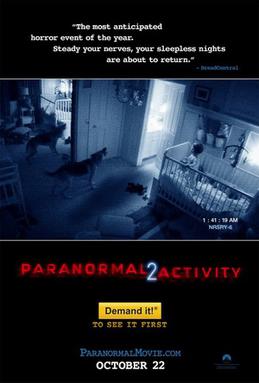
After a burglary, Kristi (Sprague Grayden) and her husband Daniel Rey (Brian Boland) install security cameras throughout their house. The cameras capture footage of Daniel firing the maid (Vivis Colombetti) for burning sage to ward off “evil spirits” and a visit from Kristi’s sister, Katie (Katie Featherston). They also capture doors opening and closing by themselves, a dog barking at nothing, and a possessed Kristi ominously staring at her newborn son, Hunter.
Paranormal Activity 2 begins a few weeks before the start of the first Paranormal Activity. By the end, the two movies have caught up with each other and the audience learns what Katie did after she killed Micah. The film also reveals what specifically led to the spirit going after Katie in the first place. (Daniel, you idiot.)
Considering that the sequel repeats the found-footage format and recreates many of the same scares from the first film, it’s surprising just how well it works. The stakes are a little bigger here, in that it’s established that the evil spirit is after baby Hunter. In the first film, nobody cared about Micah, but in this film we actually do care about Kristi, the baby, and Kristi’s stepdaughter, Ali (Molly Ephraim). We don’t care about Daniel because he’s a jerk. Kristi and Katie appear to have really bad judgment when it comes to picking a mate.
Lisa has already done an excellent job reviewing the third, fourth, and fifth films in this series. So I’ll be jumping forward to the sixth film tomorrow.
“It’s so easy to create a victim, young lady, so easy.” — Mademoiselle
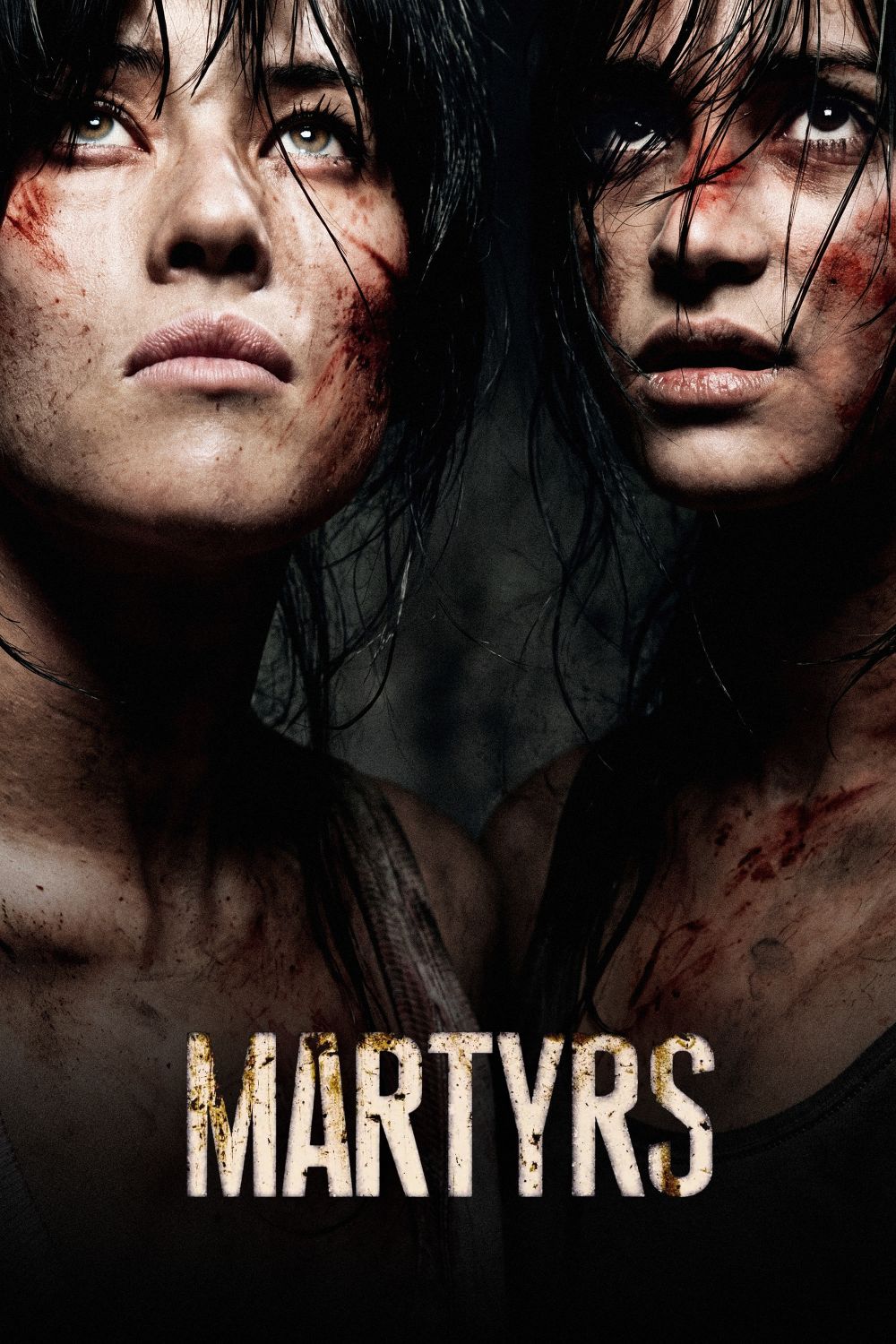
The scariest thing in Martyrs isn’t how much pain people can inflict, but how calmly they can explain why they’re doing it. Pascal Laugier’s 2008 French horror film begins with violence that feels desperate and chaotic, then gradually reveals something colder behind it. Anger gives way to procedure, and cruelty acquires the language of a higher purpose. That progression makes the film more disturbing than its reputation as an endurance test might suggest. The graphic brutality is impossible to ignore, but what lingers is the ease with which human suffering becomes somebody else’s project.
That makes Martyrs a particularly bleak entry in the New French Extremity, even though Laugier resisted the association. Emerging around the turn of the century, this loosely connected wave of filmmaking challenged audiences through confrontational violence, sexuality, and bodily vulnerability. Films like Trouble Every Day, Irréversible, High Tension, and Inside helped establish a cinema in which physical safety could disappear without warning. Martyrs shares that willingness to push past comfortable boundaries, but its most unsettling quality isn’t simply excess. It’s the suggestion that the people crossing those boundaries might regard themselves as thoughtful, disciplined, and entirely justified.
The tradition is still going strong today, although its influence is easier to trace than any fixed membership. Julia Ducournau’s Titane and Coralie Fargeat’s The Substance demonstrate the continuing appetite for French filmmaking that uses bodily destruction and transformation to explore larger anxieties. Neither is doing exactly what Laugier does, and their differences matter. Where those films find room for provocative humor or unexpected tenderness, Martyrs offers very little breathing space. Its approach is brutally direct: before asking what suffering might mean, it makes you confront the person who has to endure it.
The story initially centers on Lucie, who escapes horrific captivity as a child and grows into an adult still trapped by what happened to her. Played by Mylène Jampanoï, she believes she has located the people responsible, now living an apparently ordinary family life. Her friend Anna, played by Morjana Alaoui, becomes involved in the aftermath of Lucie’s attempt to confront them. At first, the setup suggests a revenge thriller, with the possibility that identifying and punishing the guilty might bring some kind of closure. Laugier quickly makes that expectation feel inadequate. The past isn’t something Lucie can simply shoot her way out of.
Jampanoï gives Lucie a frightening volatility without reducing her to a spectacle of instability. Her anger feels inseparable from terror, and every apparent assertion of control seems dangerously temporary. There’s nothing slick or triumphant about her. Even when she acts decisively, she looks like someone fighting an emergency that nobody else can fully see. That performance keeps the early violence from becoming satisfying payback. Lucie’s actions may have a target, but her suffering doesn’t have a clear endpoint. The film understands the difference between stopping an abuser and undoing what the abuse has already done.
Anna provides the emotional connection that keeps all this from becoming an abstract exercise in misery. Alaoui makes her loyalty feel affectionate, frightened, and occasionally overwhelmed rather than conveniently heroic. She wants to help Lucie, even when she can’t fully understand her or accept what she’s done. Their relationship gives the film something worth caring about before its larger machinery reveals itself. Anna’s instinct is to stay with someone in pain, not turn that pain into an explanation. That distinction becomes increasingly important as the film introduces people whose interest in suffering has nothing to do with compassion.
Laugier’s control of the changing narrative is one of the film’s biggest strengths. Each discovery reshapes what came before, moving the story from personal retaliation toward organized cruelty. These shifts could have felt like disconnected attempts to top the previous shock, but they follow a disturbing emotional logic. The further we move from Lucie’s frantic perspective, the more controlled the surrounding world becomes. Unfortunately, control doesn’t mean safety. The ordinary house becomes especially unsettling because its domestic spaces and hidden horrors belong to the same functioning environment. Nothing about comfort or respectability guarantees innocence.
The violence changes along with that perspective. Early attacks are abrupt and messy, shaped by panic, confusion, and immediate danger. Later, brutality becomes repetitive and procedural, stripped of anything resembling excitement. That’s where Martyrs becomes hardest to watch. Laugier doesn’t always offer the relief of a new development or a plausible escape route; sometimes he forces the audience to sit with the awful predictability of what comes next. The horror lies as much in routine as in injury. Someone’s worst imaginable experience can be another person’s ordinary assignment, carried out without any visible emotional investment.
Catherine Bégin’s Mademoiselle embodies that detachment. Her composure is more upsetting than a theatrical display of sadism would have been, because she treats the film’s atrocities as reasonable steps toward an important goal. Still, this is also where Martyrs becomes open to criticism. Its philosophical explanation can feel like an attempt to lend profundity to prolonged images of women being brutalized. Whether that framework deepens the experience or merely rationalizes it is a fair question. For me, the film works best when Mademoiselle’s reasoning exposes her moral emptiness, not when it seems to invite admiration for the supposed grandeur of her inquiry.
The ending leaves that inquiry unresolved, refusing to turn everything we’ve witnessed into a clear answer. Its ambiguity is effective because certainty has become such a destructive obsession throughout the film. Some viewers may find that withholding frustrating, especially after such an exhausting ordeal, but a tidy revelation would risk validating the people who engineered it. Martyrs remains an exceptional horror film precisely because its ideas don’t make its violence comfortable. Beneath the blood and philosophical speculation is a much simpler moral horror: people can become so convinced of the importance of their questions that they stop seeing the humanity of whoever they force to answer them.
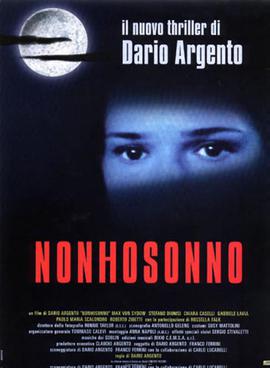
In Italy, a young boy named Giacomo Gallo can only hide under a bed as he witnesses his mother being stabbed to death by an English horn. He doesn’t see the murderer, who is believed to be a serial killer known as The Dwarf Killer due to his short stature. All he can remember for sure is the blood and a strange hissing sound. Detective Ulisse Moretti (Max von Sydow) promises Giacomo that he will capture the Dwarf Killer.
Twenty years later, Moretti is retired. He never caught the Dwarf Killer, whose killing spree ended just as abruptly as it began. However, when a sex worker named Angela (Barbara Lerici) is brutally murdered on a train, there is evidence that indicates the Dwarf Killer has returned. Moretti comes out of retirement, determined to close the one case that he never solved. Unfortunately, it’s going to be difficult because Moretti’s memory is failing. As he puts it at one point, there are times when he can’t even remember his late wife’s face. Moretti has forgotten much about the case, though as he investigates, it all starts to come back to him. Moretti finds himself working with the now grown-up Giacomo (Stefano Dionisi), who hopes to finally capture the man who killed his mother. And while Moretti may be struggling to remember the past and Giacomo still isn’t quite sure what he saw while hiding under the bed, it soon becomes clear that the killer remembers both of them.
After the disappointingly mean-spirited Phantom of the Opera, Sleepless was a return to form for Dario Argento. The film is a giallo and, in typical Argento fashion, the mystery involves not just the physical clues but also how people interpret and edit their own memories. The hiss that Giacomo heard turns out to be not what he originally believed. The killer also turns out to be something even more disturbing than what the police originally assumed. At the heart of the mystery is a rather morbid nursery verse, the sort of thing that can be either innocent or dangerous depending on how one interprets the words. Sleepless is a throwback to the type of films that made Mario Bava famous and also the type of films with which Argento started his directorial career. Max von Sydow’s Moretti is not just a detective. He’s also a symbol of an aging genre, a reminder of the clever mysteries that shed blood with style without ever losing their essential humanity.
Argento has often been criticized for not getting particularly complex performances from his actors. I don’t think that criticism is always fair. One need only see David Hemmings and Daria Nicolodi in Deep Red or Jessica Harper in Suspiria to see what Argento can do with the right cast. In Sleepless, Max von Sydow gives a strong performance as Moretti. In fact, it’s probably one of the best performances to have ever appeared in an Argento film. He plays Moretti as being a kindly man on a mission, someone who has seen the worst that the world has to offer but who hasn’t given up his soul. Von Sydow gives us someone who we truly care about, which makes the film’s set pieces (which are bloody even by Argento standards) all the more effective.
It’s become a bit of a cliché to claim that Argento went into a decline after Tenebrae. While it’s true that Argento’s post-Opera films have been uneven, Sleepless shows what he was still capable of producing.
I had not heard of TOO SCARED TO SCREAM when I came across it the other day on Tubi, but there were a few things that caught my interest. First, it had some cool artwork on the poster, which my fellow TSL contributor Erin has highlighted on the site before during Horror-Thon past. Next, I saw that one of the leads was Ian McShane. He’s been around for a long time, but I didn’t really discover his work until I got wrapped up in his excellent characterization of Al Swearengen in the HBO series DEADWOOD. This was a chance to fill in some of his back catalog. And probably one of the more interesting aspects of the film to me is the fact that it’s directed by the actor Tony Lo Bianco (THE HONEYMOON KILLERS, THE FRENCH CONNECTION, THE SEVEN-UPS). This is the only movie he would direct, so I needed to see it!
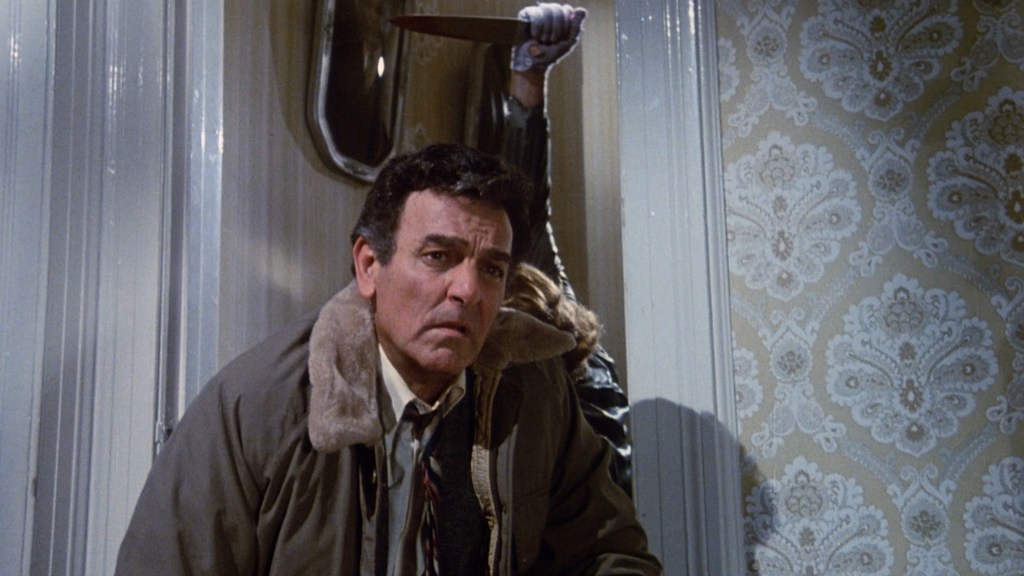
Lieutenant Alex Dinardo (Mike Connors) is investigating a series of knife murders at the upscale Royal Towers high-rise apartment building in New York City. One of the building’s doormen, the odd and theatrical Vincent Hardwick (Ian McShane), quickly becomes a person of interest. Dinardo brings in undercover cop Kate Bridges (Anne Archer) to help with the investigation, going so far as renting a room at the Royal Towers. As the victims continue piling up, the story gives us a variety of strange and suspicious characters, along with enough twists and turns to keep things moving.
I must admit that it’s been a blast discovering so many movies during this year’s Horror-Thon that have slipped past my radar over the years. Of course, sometimes you find a hidden gem, and other times you find a movie that seems to have fallen by the wayside for good reason. TOO SCARED TO SCREAM falls somewhere in between, but I’m glad I watched it. It has some interesting elements for sure, but it’s also a strange, oddball of a film. Its pacing is slow at times, and the opening credits theme song got my attention for all the wrong reasons. However, I did enjoy the combination of police procedural and slasher movie. Charles Bronson may have done it better around the same time in TEN TO MIDNIGHT, but there was still something nice about seeing veteran TV star Mike Connors (MANNIX) on the case. Another thing this had in common with the Bronson slasher is some impressive nudity! There’s a scene in a sauna that any red-blooded American male should enjoy!
And what a cast this movie has! I’ve mentioned before that one of the things I love most about movies is watching actors I enjoy. This is filled with so many familiar faces. Honestly, the show MANNIX was a little before my time, as I was only 2 when it ended its run, but I still enjoyed seeing Connors and being able to appreciate him really for the first time. My guess is that the character he plays here is a lot like Joe Mannix. Ian McShane seems to be having a lot of fun. His character is very strange, but the actor goes all in, and his performance gives the movie some personality. Anne Archer has always had that ability to portray tough and smart, and her character here has that in abundance. To those leads, you can add even more flavor with actors like Leon Isaac Kennedy (LONE WOLF MCQUADE), Maureen O’Sullivan (THE TALL T), Murray Hamilton (JAWS), Val Avery (LOVE AND BULLETS), and even John Heard (HOME ALONE), with each actor taking me back to memories of movies past.
One of the more interesting aspects of watching this film is that it feels very much like watching an 80’s television show until the clothes start coming off or the blood starts flowing. We see the murders, watch the matter-of-fact investigation, meet the suspects, and at the end the killer is revealed. I’m not very good at guessing who the killers are in movies, and I certainly would not have gotten this one. I’ll be honest, I’m not sure the ending would stand up to the scrutiny of a rewatch, but it actually made me smile in its absurdity.
TOO SCARED TO SCREAM isn’t a great movie, and there’s probably a legitimate reason that it’s not very well known or remembered these days. However, with its oddball mix of the 80s slasher film and TV police procedural, I still had a good time with it, especially when you consider the game cast of actors that pop up throughout the film. Part of our joy in movies comes from discovering them at the right time. I may or may not ever watch this one again, but this year, it was a fun part of my October.
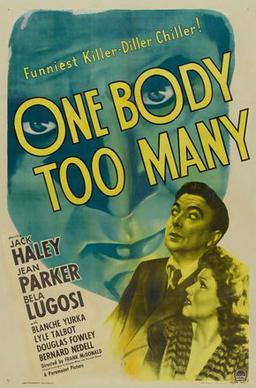
In 1944’s One Body Too Many, Jack Haley stars as Albert L. Tuttle. Tuttle is an insurance agent. He’s a rather mild-mannered one. In fact, people often have a hard time remembering his name. He’s called “Mr. Turtle.” He’s called “Mr. Title.” Patiently, he explains over and over again that his name is Tuttle. Looking to secure his job, Tuttle hopes to sell $200,000 in life insurance to an eccentric millionaire named Cyrus J. Rutherford.
What Tuttle doesn’t know is that Cyrus J. Rutherford has recently died. His entire greedy family and all of his servants have gathered at the Rutherford Mansion so that they can hear the reading of the will. In his will, Rutherford lays out all the reasons why he didn’t like his family or anyone who worked for him. He accuses the butler, Merkil (Bela Lugosi), of padding his expense account. He accuses his lawyer (Bernard Nedell) of always trying to take advantage of him. Rutherford writes that his last request is that his body be placed in a glass-domed vault so that the stars can forever shine down upon his face. He says that anyone who leaves the house before the glass vault is built will lose their inheritance. If the body is buried instead of in the vault, then Rutherford’s largest beneficiaries will instead become his smallest beneficiaries and vice versa. It’s a bit of an odd will, to be honest. I’m not particularly sure that it would stand up in court today, but in 1944, eccentric millionaires could pretty much do whatever they wanted. Myself, I have to applaud Rutherford for messing with everyone even after death. That takes determination.
When Tuttle shows up, the family mistakes him for a detective that has been sent to make sure that Rutherford’s body isn’t stolen before the glass dome is constructed. Tuttle, not picking up on how weird this all is, assumes that the family is just really excited about insurance. When Tuttle finds himself locked in with the dead body, he immediately demands to leave. However, since the real detective has failed to show up, Rutherford’s niece, Carol (Jean Parker), asks him to stay and guard the body. A good Tuttle appears on one of Tuttle’s shoulders while a bad Tuttle appears on the other. After listening to the debate, Tuttle decides to stay if only because Carol is attractive.
It’s going to be a long night, though. Not only does the body disappear, but it appears that there is a murderer in the house!
One Body Too Many is an amiable comedy, one that features a very 1940s mix of absurd dialogue and slapstick humor. Though Jack Haley, who is best-remembered for playing the Cowardly Lion in The Wizard of Oz, is the lead and a very likable one at that, the movie is pretty much stolen by Bela Lugosi. Lugosi’s later films tend to be a mixed bag, but One Body Too Many allows Lugosi to give a good and genuinely funny performance as a butler who is far more clever than anyone realizes. Lugosi’s snarky reactions make the film, and they’re a nice reminder that Lugosi was a far more talented actor than he’s often given credit for.
In December of 1872, a sailing ship called the Mary Celeste was found adrift and deserted in the Atlantic Ocean. When the ship left New York in October, it had a captain and a full crew. The captain’s wife was among the passengers sailing on the ship. When the Mary Celeste was discovered, not only was no one on board but there was no evidence as to where everyone had gone or what caused them to abandon the ship in the first place. The crew of the Mary Celeste appeared to have vanished into thin air and none of them were ever seen again.
As you might guess, this led to years of speculation about what happened. Some people blamed pirates. Some blamed food poisoning. Some blamed ghosts and sea monsters. More modern theorists have blamed UFOs.
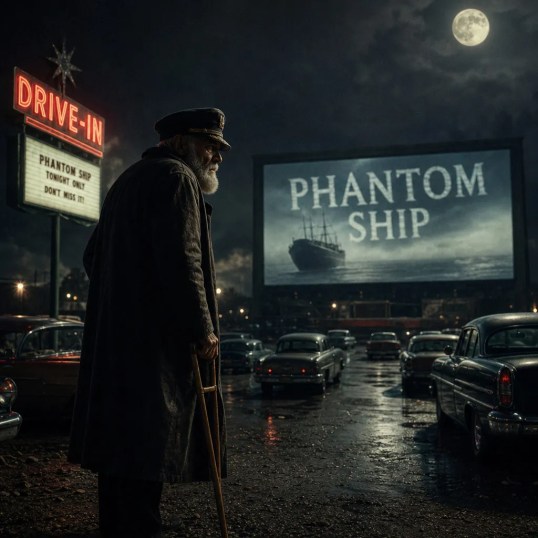
First released in 1935 and originally entitled The Mystery of the Mary Celeste, Phantom Ship offers up a theory of its own. It speculates about what happened during the final voyage of the Mary Celeste and why its crew vanished. One of the members of the crew is played by Bela Lugosi. Lugosi was still riding high from his starring role in Draculawhen he starred in Phantom Ship and, playing a veteran sailor who appears to be a bit unstable, Lugosi gives an enjoyably over the top performance. Admittedly, PhantomShip has its slow spots and, at times, it threatens to get bogged down in a subplot about the love triangle involving the Captain, his wife, and the Captain’s best friend. But Lugosi makes the film worth watching and, towards the end, there are some wonderfully atmospheric shots of the nearly deserted ship.
Along with being one Lugosi’s non-Dracula horror films, Phantom Ship is also well-known for being one of the first films to be produced by the British film company that would eventually become known as Hammer Pictures.
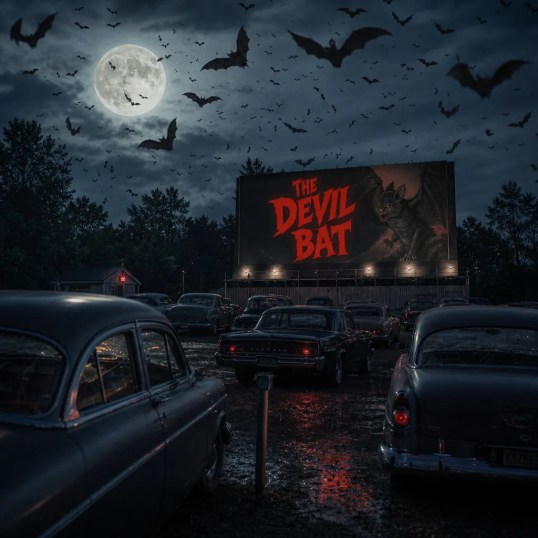
In the 1940 film, The Devil Bat, the owners of a company in the small town of Heathville are super-excited because they’re going to be given their head chemist, Dr. Paul Carruthers (Bela Lugosi), a bonus check of $5,000. However, since Carruthers’s inventions have made millions for the company, he is offended by the small check and decides that the best way to handle this would be to sue in court and demand fair compensation …. just kidding! Instead, Dr. Carruthers sends his army of giant bats to kill the families of his employers.
The Devil Bat was produced by Production Releasing Corporation, a poverty row studio that specialized in shooting quickly and cheaply. Going from Universal to PRC was technically a step down for Lugosi but The Devil Bat is actually an excellent showcase for Lugosi and he gives one of his better non-Dracula performances as the embittered Dr. Carruthers. Indeed, one can imagine that Lugosi, who played such a big role in putting Universal on the map, could relate to Carruthers and his bitterness over not being fairly rewarded for the work he did to make others wealthy.
Enjoy The Devil Bat, starring the great Bela Lugosi!
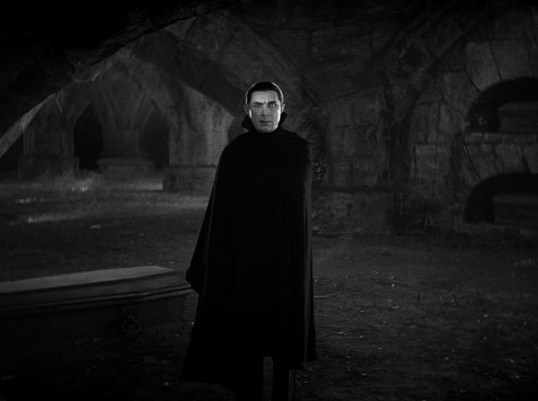
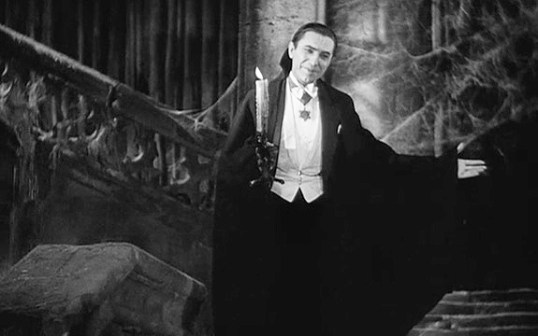
Dracula (1931, starring Bela Lugosi as the Count, Dir by Tod Browning, DP: Karl Freund)
On this day, 144 years ago, Bela Lugosi was born in what is now Romania. Lugosi began his career in his native country, appearing on stage. After serving as an infantryman in World War I, Lugosi moved into the movie industry and appeared in silent Hungarian films. The young Lugosi was an activist, involved in labor issues and trying to unionize the Hungarian film industry. When a new government came to power in Hungary in 1920, the politically-active Lugosi moved first to Germany and then eventually ended up in the United States. After a period of working as a merchant seaman, Lugosi returned to acting.
He first played Dracula on stage in New York City. In 1928, while touring in the role of Dracula, he moved out to California and quickly became a part of the Hollywood community. When Universal produced a film adaptation of Dracula in 1931, Lugosi was the obvious choice for the lead role. The film made Lugosi a star and it also typecast him. Lugosi never stopped acting, though the films varied widely in quality. By the end of his career, Lugosi was a member of the Ed Wood stock company. Even appearing in something like Bride of the Monster, Lugosi still made an impression.
In the scene below, from 1931’s Dracula, Lugosi suggests that Edward van Sloan’s Van Helsing should perhaps leave the country.
4 Shots From 4 Films is just what it says it is, 4 shots from 4 of our favorite films. As opposed to the reviews and recaps that we usually post, 4 Shots From 4 Films lets the visuals do the talking.
144 years ago on this date, Bela Lugosi was born in Hungary. Today, we honor his memory with….
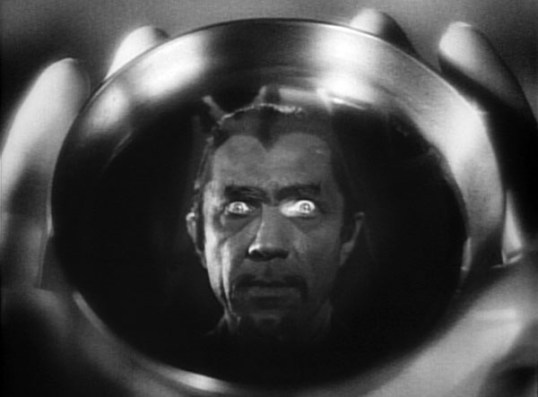
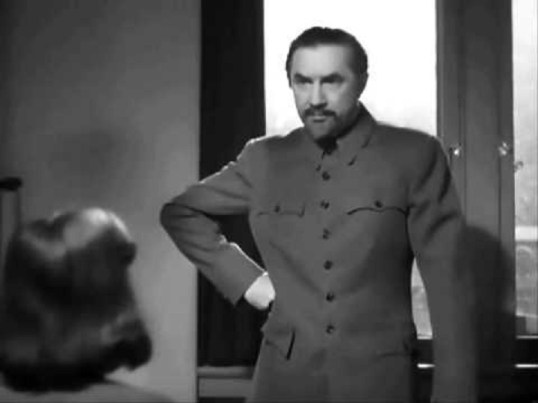
4 Shots From 4 Bela Lugosi Films
Dracula (1931, dir by Tod Browning, DP; Karl Freund)
White Zombie (1932, dir by Vincent Halperin, DP: Arthur Martinelli)
Ninotchka (1939, dir by Ernst Lubitsch, DP: William H. Daniels)
Bride of The Monster (1955, dir by Ed Wood, DP: Ted Allan and William H. Thompson)
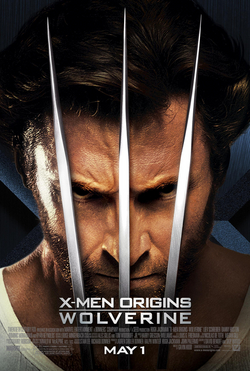 Decades before he joins the X-Men, James “Logan” Howlett (Hugh Jackman) is just another mutant with retractable claws and a super-healing ability that essentially makes him immortal. With his half-brother Victor Creed (Liev Schreiber), Logan fights in wars throughout the centuries. When both Logan and Creed (who share Logan’s healing abilities) survive being executed by a firing squad, they are recruited by William Stryker (Danny Huston) to serve as members of Team X. Eventually, Logan tires of being an assassin and goes off on his own. However, both Stryker and Creed have plans for him and all the other mutants that they’ve captured or killed over the years. Several familiar characters appear—Scott Summers (Tim Pocock), Gambit (Taylor Kitsch), and the Blob (Kevin Durand) amongst others—but none of them have much of the personality that made them popular to comic book readers. (Just imagine including Gambit in an X-Men film but not Rogue.) Those who made it to the end of the film were given a Patrick Stewart cameo, albeit one that used CGI to de-age Stewart and make him look like an automaton.