In honor of Fred Astaire’s birthday, here are two scenes featuring Fred and Cyd Charisse from the 1953 film, The Band Wagon!
In honor of Fred Astaire’s birthday, here are two scenes featuring Fred and Cyd Charisse from the 1953 film, The Band Wagon!

It was freaking awesome!
That, in a nutshell, is my main thought when it comes to Captain America: Civil War. It’s a movie that we spent a year anticipating. It’s a movie that we were continually assured would be great. And it’s a movie that, unlike Batman v Superman, actually lived up to all the hype. It’s also a movie that has already been reviewed here on the Shattered Lens. Check out Arleigh’s review by clicking here and be sure to check out Gary’s review as well.
So, what’s really left for me to say about Captain America: Civil War? Beyond, of course, that it was freaking awesome.
Of course, it’s hard to talk about Captain America: Civil War without also talking about Batman v Superman. Both films start with the same basic idea: the heroic activities of super heroes has led to cities being destroyed and innocent people dying. In Batman v. Superman, Batman takes it open himself to avenge the destruction of Metropolis and expose Superman as being the biggest false God since Baal. In Civil War, the United Nations announces that, from now on, all super hero activity has to be cleared with them. In Batman v. Superman, Batman and Superman are manipulated into fighting each other. In Captain America: Civil War, Captain America and Iron Man are manipulated into fighting each other. In Batman v Superman, Jesse Eisenberg plays a neurotic villain. In Captain America: Civil War, Daniel Bruhl plays a neurotic villain. Batman v Superman features more heroes than just Batman and Superman. Civil War features more heroes than just Captain America and Iron Man. Batman v Superman ends with a promise of more films to come. So does Civil War. Both films are huge and expensive star-filled spectacles and both of them are a part of a larger cinematic mythology. They both even have roughly the same running time. Of course, Batman v Superman seems even longer while Civil War is over far too quickly.

And yet, Civil War is a thousand times better than Batman v Superman. For all of its sound and fury, Batman v Superman is ultimately an empty shell. I left the film feeling not at all emotionally moved but definitely deafened by all the explosions and the yelling and the ranting and the pounding score. As I left the theater, the world sounded like it was underwater. Batman v Superman opens with the world exploding and the explosion continues for another two and a half hours. Civil War, on the other hand, takes its time. After the initial battle scene (which features a nice cameo from the great Frank Grillo), Civil War slows down. It explores its characters and their relationships and their motivations. The first hour of Civil War may be dominated by people debating but its compelling to watch because, after 8 years, the MCU and the characters within feel as alive as the world outside the theater.
In Batman v Superman, Henry Cavill and Ben Affleck appeared to be acting in separate films. That’s not a problem in Civil War. When you watch Chris Evans and Robert Downey, Jr., you believe that they are friends and, when they fight, you don’t just thrill at the action. You mourn the end of a friendship. If Batman v Superman‘s battle ultimately felt hollow, the final battle in Civil War leaves you wincing in pain.

Which is not to say that Civil War is not a fun movie. It’s the most genuinely fun film that I’ve seen so far this year. There’s a joy to the best films of the MCU, a joy that — with the exception of Gal Gadot’s cameo — was totally lacking from the somber and self-important mess that Batman v Superman. I have never heard an audience applaud more than they did while watching Civil War. The film may have been dominated by Evans and Downey but every citi of thzene MCU got a chance to shine. Scarlett Johansson, Paul Rudd, Sebastian Stan, Anthony Mackie, Don Cheadle, Jeremy Renner, Chadwick Boseman, Paul Bettany, and Elizabeth Olsen all proved their worth to this new cinematic mythology. After years of using Halloween to pay homage to Scarlett Johansson, I may have to go as Wanda Maximoff this year. After seeing Hollywood waste her off-center and damaged talent in films like Godzilla, it was good to see Elizabeth Olsen playing Wanda as if she could have been a cousin to her character from Martha Marcy Mae Marlene.

The audience saved their loudest and most enthusiastic cheers for Tom Holland, who claimed the role of Spiderman as his own and thankfully freed Andrew Garfield to go back to being the intriguing actor that we all remember from The Social Network and Never Let Me Go. Holland doesn’t have a large role in Civil War but he’s still well-served by the film and the script makes great use of the character and Holland’s energetic performance. As opposed to the super hero cameos in Batman v Superman, Spiderman’s appearance didn’t just feel like merely a teaser for a future film. He belonged in the story.

Of course, Civil War is dominated by the battle between Iron Man and Captain America and it says something about how successful the MCU has been that the battle feels less like a marketing gimmick and more like the natural result of what happens when two differing worldviews come into conflict. When Tony Stark sides with the UN, it makes sense. Ever since the very first Iron Man, Tony has been motivated by both guilt over making weapons and a fear that he doesn’t deserve his success. Of course Tony would side with the UN. Doing so not only allows him to alleviate his guilt but it also frees him of responsibility for any future actions that the Avengers may take. It makes just as much sense that Captain America would feel the exact opposite. His name is Captain America, not Captain United Nations. When the UN was founded, he was still frozen in a block of ice.

(Also interesting to note: Civil War was the first MCU film that I could follow without once having to ask my boyfriend for any background info on who all the characters were. The MCU has become such a part of our culture that we all know the characters, regardless of whether we have ever read a Marvel comic or not.)
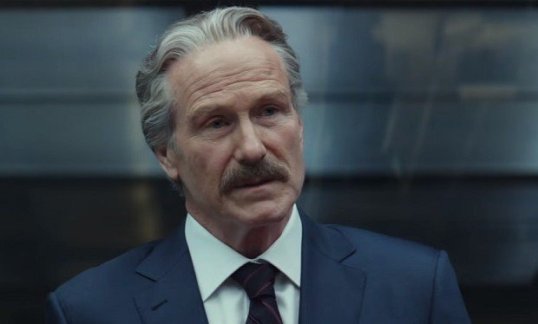
There is a nominal villain. Daniel Bruhl plays Zemo and his role is actually pretty small. That said, Zemo is definitely more interesting than the typical MCU villain (he’s certainly more memorable than Corey Stoll was in Ant-Man) and Bruhl does a good job playing him. (Watching Civil War, it was hard not to think about how much better SPECTRE would have been if Bruhl, as opposed to Christoph Waltz, had played Blofeld.) But, for me, the real villain of the film was the U.S. Secretary of State (played by William Hurt). The character represented everything that all good people hate about the power structure. William Hurt turned him into the epitome of unthinking and unreasonable authority.
After Civil War was released, Salon’s Amanda Marcotte (who, let’s just be honest, ceased to be interesting the minute that she sold out and briefly worked for John Edwards in 2007) complained that Captain America had become “a douchey Libertarian.” I would argue that 1) Captain America is definitely not douchey and 2) it’s his “libertarian” stance that makes him a hero. Captain America does not represent any institution or ideology and he doesn’t take orders from faceless bureaucrats. Captain America doesn’t need permission to do the right thing. As played by Chris Evans, there’s something undeniably poignant about Captain America attempting to cling onto his idealism and his belief in personal freedom in an increasingly complicated and totalitarian world. When told that he has a duty to become an anonymous, order-taking drone, Captain America says, “NO!”
(As a sidenote: If you want to see what the world expects Captain America to become, check out William Klein‘s Mr. Freedom.)
I know that some are claiming that Civil War is the best MCU film so far. I wouldn’t quite go that far. The film never quite reaches the lunatic heights of Guardians of the Galaxy nor does it match the subversive glee of Winter Soldier revealing that smug old Robert Redford is an agent of HYDRA. But, no matter! Captain America: Civil War is pretty freaking great!

Here are the other MCU reviews that have appeared here on the Shattered Lens:


I haven’t reviewed a new film here since last year’s BLACK MASS , but since all the characters in CAPTAIN AMERICA:CIVIL WAR are classics, I feel the movie fits right in with the bog’s theme. Plus, I simply love the Marvel Super Heroes! I grew up in the Marvel Age of Comics, devouring monthly issues of Spider-Man, Captain America, The Avengers, Fantastic Four, and the rest of the costumed cavorters. I had stacks and stacks of them, which I regrettably sold as a young man to finance a move to the bayous of Louisiana. But I remember them well, and how much fun the Marvel titles were.
Apparently, directors Anthony and Joe Russo, and screenwriters Christopher Markus remember too, because this movie is a whole lot of fun. Sure, there’s an underlying political theme here, the will of the collective vs the will of the individual. But it’s handled well through the…
View original post 514 more words

For this latest edition of Lisa Marie’s Favorite Grindhouse and Exploitation Film Trailers, I ordered the trailer kitties to go out and find 6 trailers for Mother’s Day! Let’s see what they found:
(And, as always, some of these trailers are definitely NSFW. So use caution…)
1 Mother’s Day (1980)
4 The Devil Within Her (1975)
5 Mommie Dearest (1981)
6 Psycho (1960)
What do you think, Trailer Kitty?

I agree, Trailer Kitty! Some of these movie may be too intense for impressionable kittens!

Finally, I’ve reached the last one of the Sal V. Miers late night cable movies currently available. This is the second best one after Bikini Model Mayhem (2016). Again, Miers politics are all over this one like they were in Bikini Model Mayhem. He also added some of his love for Old Hollywood into the mix. Let’s dig in.
After another one of those annoying title cards that I had to black box, we are introduced to one of our main characters and a guy who will disappear as fast as he did Bikini Model Mayhem.

That’s Officer Supansky on the right. He’s played by Robbie Carroll who needed to be convinced to support G.W. Bushwacker in Bikini Model Mayhem. On the left is Felicity who is played by Katie Morgan. You may remember her as playing the first robot we were introduced to in Bikini Model Mayhem and the warden in Bad Girls Behind Bars (2016). This film is much more of an ensemble cast movie than Bikini Model Mayhem or Bad Girls Behind Bars. He is not actually revealed to be a cop quite yet. He is here to hire her for a whopping $50. She doesn’t think that’s enough. I’m pretty sure what he does next would be considered entrapment. He strips butt naked. That apparently makes things totally different for her. Of course we can’t see that for no good reason except this is late night cable. In fact, just after she goes in with her mouth, it cuts to the outside of the building. Then it goes back inside for the standard game of hide the penis while the guy stays in a Zen like trance and either the girl goes over the top or tries to match his intensity. I believe this is the only time I’ve seen the male actors sweat, or at least appear to sweat. Once that business is over with he proves himself to be the dick they can show.
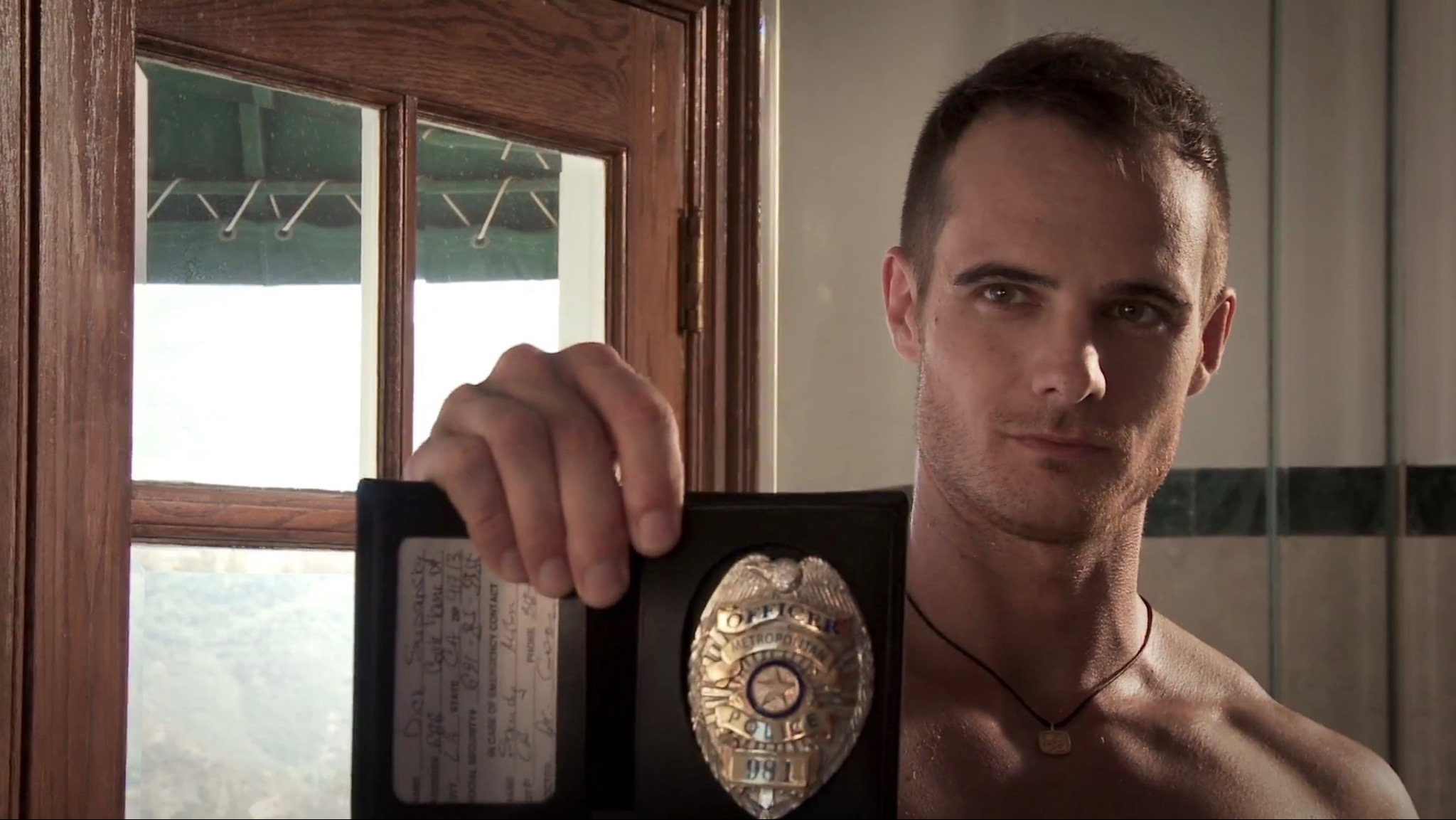
No seriously, his full name is Dick Supansky. Then I learn another interesting phrase from a Miers’ movie. According to her, he “got his ashes hauled.” I still prefer the burping of the worm joke from Bad Girls Behind Bars. He offers her an alternative to going to jail. She can go participate in a ridiculous plot so the movie can make a political statement instead of having to serve time. She of course takes his offer instead of jail because we already had that movie.
Before we get to find out what she is going to have to do, we are introduced to a character that honestly had me worried. I know having a character who has “cognitive disabilities” didn’t stop the movie Forrest Gump (1994) from him having sex. Regardless, it had me worried, but there’s a payoff to this.

That’s Charlie played by Brandon C. Greene. He works as the janitor at a science facility. In the end, it’s his film as he slowly but surely emerges from the background.

From right to left that’s easy to manipulate (Otto Bauer), harder to manipulate (Pristine Edge), and hardest to manipulate (Ryan McLane). Pristine Edge. I like that one. I also like that if you change Otto and Ryan to Jack and John, then you get Jack Bauer and John McLane.
Next we meet the two ladies who will be joining Felicity.

That’s Piper on the left played by Erika Jordan and Violet in the middle played by Dillion Harper. We find out that 18 months prior, the scientists made contact with aliens from Venus because of course they did. Also because of course they did, they want to use a mind transfer device to put three people from Venus in their bodies. Felicity is a little confused. Not as confused as Violet though since she thought the scientists meant they would baking cookies to host a party for the people from Venus. Felicity wonders why the three of them are ideal candidates. I mean she’s a hooker, Piper is a drug runner, and Violet jaywalked after she robbed a liquor store. The scientists explain the deal. First, they don’t have much choice. Two, the people from Venus insisted on attractive women. Felicity still thinks this is weird, but I know this would seal the deal for me.

That’s a face you can trust. However, they aren’t convinced yet. That’s when they leave the lab set of Bikini Model Mayhem to talk outside of what looks like a house painted blue. Let’s get the political commentary in here now. Felicity says it sounds scary, Violet says “they are scientists”, Felicity says “What does that have to do with anything?”, and Piper asks her if she is a Republican.
Time for Old Hollywood. Felicity says it all seems a little too Abbott and Costello Meet Frankenstein (1948). Violet says Freaky Friday. I think we can safely say she is referring to the Lindsay Lohan version considering Felicity responds with “there’s no accounting for taste.” It’s sad, but I haven’t seen either version or Abbott and Costello Meet Frankenstein. No, they don’t make the joke at the start of a sex scene about Who’s On First.
Anyhow, they decide to do it so Piper steps inside of a shower…

and emerges as Zorax. Felicity becomes Zonondor. Violet becomes Zimbabwe. The movie is on auto-pilot now. The three visitors from Venus are here to drain the scientists of their smarts via an orgasm, or the “little death” as they call it. They aren’t really worried about the male ones, which is why they insisted on attractive women to be their hosts. They didn’t know that “one of the greatest minds on Earth” could be female based on their “survey of Earth’s popular culture.” Zorax says this, to which Zonondor corrects her that this was true “at least, not up until the 1960’s.” Very true. We didn’t even get Space Mutiny till 1988 and the MST3K episode on it till 1997.
David Ryder: Listen, lady!
Lea Jansen: Doctor!
David Ryder: Doctor!
Crow: Doctor Lady!
Also, harder to manipulate must have been bisexual as all women in late night cable movies are because it just takes Zorax saying she saw a spider for her to be all over her. They are also bisexual presumedly because that stuff is much easier than playing hide the sausage from the camera. The hardest to manipulate is that way because he and hard to manipulate are an item. He eventually caves in and is turned into a blabbering idiot like his colleagues.

During all of this, Charlie has become more and more of a prominent character as he finds a pair of panties and notices these very smart people he works around are acting like children. He’s onto the visitors from Venus. He has a nice little conversation with the ladies. He explains that he knows he’s not the smartest person around. He knows he’s stuck taking care of the scientists since the universe of this movie stops at the edge of the set. They tell him smarts aren’t everything. He tells them that it’s still helpful. He’s also not 100% convinced that these visitors really are doing this for the greater good to prevent Earth from coming after Venus. He explains that the scientists could have done great things, but now they are helpless. Ultimately, he proposes that while he believes they could have focused their smarts on problems at home instead of space exploration, why not leave their smarts with him. The visitors had already made it clear that the smarts they got from the scientists were really of no use to them.

Of course his argument is solid and so is another part of him because that’s the only way the transfer is going to work.

With the ladies given their bodies back, they depart to leave Charlie to get to work. Oh, but before Felicity leaves, she actually offers her services to Charlie who says he already had that while she was out. Charlie decides to roll up his sleeves and get to work.

So, let’s say you strip out all of the sex from this movie. You have three white scientists who are interested in exploring space. Three women are given a chance to be a plot device instead of going to jail. One of which was arrested by a cop who took advantage of her because according to him: “I can.” Three visitors from Venus come to Earth because they believe these three white scientists are going to use their intelligence to ultimately attack them. They deliberately insist on attractive female bodies because they are convinced by Earth’s popular culture that the scientists can only be straight men. They drain the three scientists of their smarts. A lightly mentally handicapped black man figures them out. He convinces them to give him their smarts with the concession that he’ll focus on problems here on Earth. Interesting.
Then just like Bad Girls Behind Bars, we get a blooper reel. It’s far more complete though. The only part of it that is noteworthy is when you can hear Miers speaking. Miers says, “I’m rolling sound…unlike when I started in this business. Buster Keaton, he was, he was great.”

I couldn’t find that explicit quote doing a cursory Google search, but it certainly fits Keaton.
Here is how I rank the three Sal V. Miers movies currently available through the Cinemax/HBO apps:
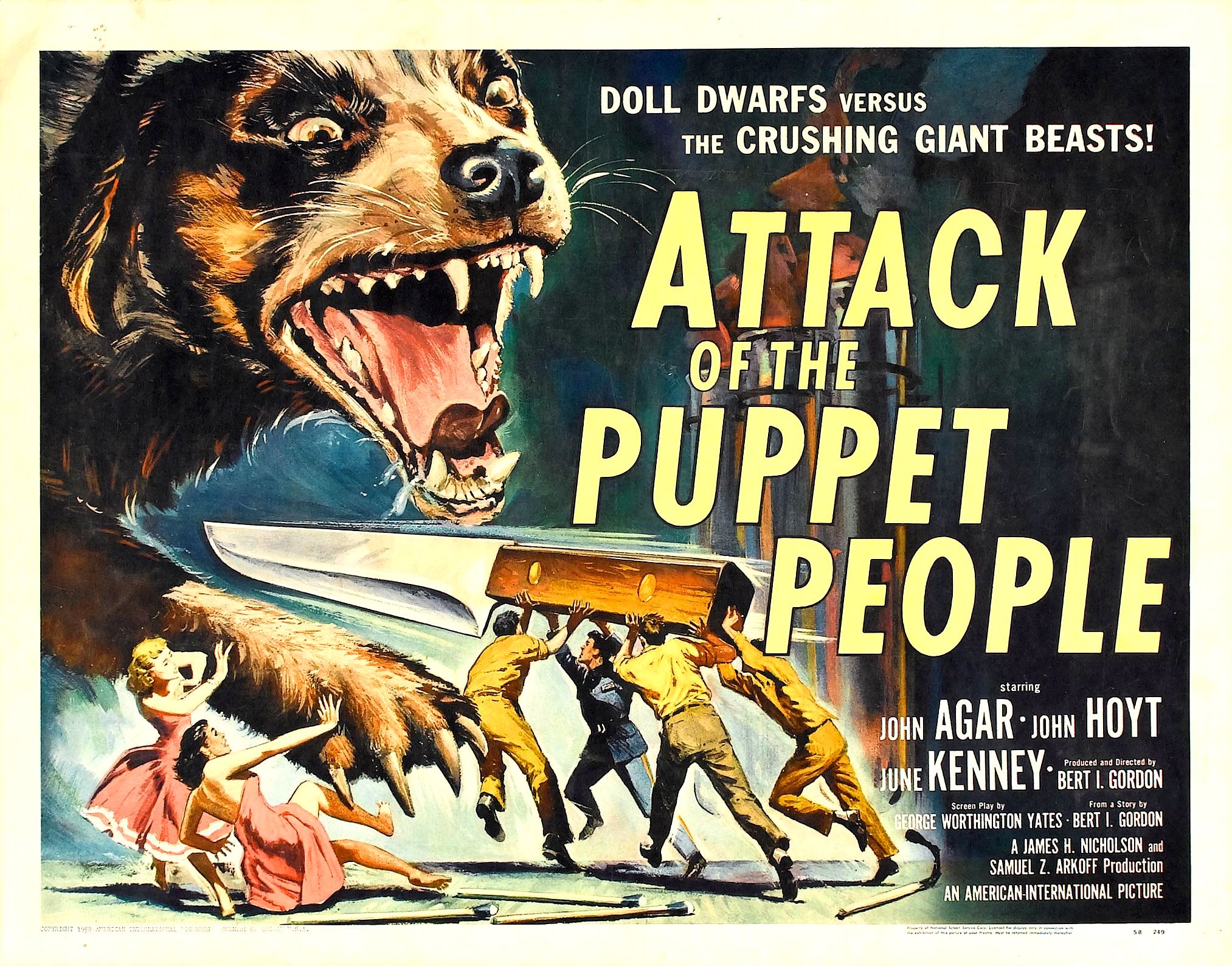
Oh boy. TCM is running a salute to AIP every Thursday this month. Now I’ll never get that DVR cleaned out! American International Pictures released some of my favorite films of the 50’s, 60’s, and 70’s, and TCM’s showing everything from Vincent Price/Roger Corman/Edgar Allan Poe horrors to outlaw biker flicks to Beach Party teen shenanigans. Expect to see lots of AIP posts in the near future, starting right now with 1958’s ATTACK OF THE PUPPET PEOPLE.
One of my earliest movie memories is watching this on the local “Four O’ Clock Movie Matinee” when I was about five years old. For some strange reason, it resonated with me. I haven’t seen it in years, and my recent re-viewing had me wondering just why it did. Maybe I was a strange kid! Anyway, ATTACK OF THE PUPPET PEOPLE was the brainchild of Mr. B.I.G. himself, producer/director/effects wizard Bert I. Gordon. Well, maybe…
View original post 640 more words
Here’s the 2nd trailer for Now You See Me 2, that sequel to that movie that’s on HBO every other day.
Captain America: The Winter Soldier wasn’t just a surprise hit for Marvel Studios and parent company Disney in 2014, it also showed the general public that there was more to Captain America than just a flag-waving symbol of America’s past glory. Captain America was a character that wasn’t the hip, wisecracking Tony Stark. He wasn’t the tortured soul in a monster’s body like Bruce Banner as the Hulk. He didn’t have the Shakespearean gravitas that was always lurking behind Thor and his complicated Asgardian family. No, Captain America was considered too straight-laced, blonde and blue-eyed goody two-shoes.
Captain America: The First Avenger focused on those very qualities. Steve Rogers was just a skinny, asthmatic young man from Brooklyn who wanted to do his part during World War II. It would be thanks to an experimental super-soldier serum that Steve Rogers’ body finally matched the inherent goodness and will to defend the little guy. For some, this initial introduction to Captain America was too hokey, but was entertaining enough. His next appearance in 2012’s game-changing superhero team-up The Avengers saw him be part tactician for a burgeoning superhero team and part comedy relief.
It would be with The Winter Soldier that the rest of the general public finally got to what comic book fans have known for years. This is a badass man, out of his time but always fighting the good fight and staying true to his convictions and principles. What was seen as hokey idealism became something of a beacon of selflessness and the moral center in a modern world that was steeped in shades of grey. It helped that writing team of Stephen McFeely and Christopher Markus (who wrote The First Avenger) finally found a pair of directors in the Russo Brothers (Anthony and Joe) who understood just what made Captain America relevant in this day and age of cynical anti-heroes.
It’s no surprise that the Russo Brothers were tasked with continuing the work they began in the Winter Soldier with McFeely and Markus with the film that would complete the Captain America trilogy in the Marvel Cinematic Universe. It would be quite a task in getting Captain America: Civil War off the ground and moving forward under all the weight of nearly every MCU superhero (minus Thor, Hulk and Nick Fury) in attendance and the introduction of two new ones to the universe.
Did the Anthony and Joe Russo pull off this massive undertaking? Or did they stumble to not just the huge cast and many storyline threads the way Joss Whedon did with the ambitious, but flawed The Avengers: Age of Ultron?
I’m happy to say that the Russo Brothers did better than succeed but may have just made the best film in the Marvel Cinematic Universe and proved that Marvel Studios head honcho Kevin Feige was correct in placing the brothers as the new captain of the massive thing called the Marvel Cinematic Universe as it enters Phase 3.
Captain America: Civil War is set just a year after the events of Age of Ultron where the Avengers barely defeated Tony Stark’s mad A.I. Ultron and it’s decision to wipe humanity from the planet. While the team did save the world from global extinction they also didn’t save everyone. there were still hundreds, if not, thousands of Sokovians who died during the battle. The same could be said for all the battles since the alien invasion over New York. The Avengers, led by Captain America, have saved the world from invading aliens, world-dominating terrorist group and killer A.I robots. Yet, the collateral damage caused by these battles have begun to weigh not just on some of the Avengers, but has made the governments of the world see the team as a sort of super-powered private military group who don’t obey international laws and borders. Yes, they’ve saved humanity many times from destruction, but at what cost.
It’s during a battle early in the film as Captain America and his team stop the theft of a biological weapon in the city of Lagos, Nigeria that collateral damage and deaths rear it’s head once more as Wanda Maximoff (aka the Scarlet Witch) accidentally allows a suicide bomb vest explode too close to a nearby high-rise causing the deaths of several aide workers from Wakanda.
It’s from this event that the world finally have reached a tipping point and want to put the team under U.N. control with Tony Stark agreeing to the plan to help assuage his guilt over the deaths caused by him creating Ultron. Some of the team understands that government oversight that the Sokovian Accords puts on the team is the right thing to do. While others, especially Captain America, think it’s best to leave the team to continue to be their own masters instead of beholden to a bureaucracy whose agenda may not be conducive to saving lives.
It’s a subject matter that was explored in some fashion in an earlier superhero mash-up but one that failed to stick the landing. Yet, even this battle of differing ideologies between Captain America and Iron Man only becomes part of the foundation to the true narrative for Civil War. It’s the friendship between Captain America and Bucky aka the Winter Soldier and how the former must try to prove the latter innocent of another terrorist attack the world thinks he’s responsible for. Those Avengers who signed the Accords must now bring in Bucky dead or alive while Captain America with the help of those who didn’t sign try to prove his innocence and find the true architect of the terrorist bombing.
Captain America: Civil War succeeds where the earlier superhero film failed because of the groundwork laid down by the 12 previous films released to make up the current Marvel Cinematic Universe. From Iron Man all the way up to Age of Ultron, these twelve films flesh out the backstory and characters that make up these heroes. We’ve gotten to know what motivates them to risk their lives for the greater good, but we also see glimpses of the inter-personal conflicts that looks to tear the team apart from within.
There’s not enough that could be said about the masterful work done by the Russo Brothers in juggling the personalities of twelve superheroes (two getting their initial introduction to the MCU) and giving them enough to do in the film to make them relevant to the proceedings instead of just becoming glorified cameos. The actors playing these characters have had many films to own the roles and each and everyone hits it out of the park. The stand out from the veterans in the ensemble cast still remains Chris Evans and Robert Downey, Jr as Captain America and Iron Man, respectively. Yet, it would be the arrival of the two new heroes into the mix with Chadwick Boseman as the newly-crowned king of the technologically-advanced nation of Wakanda, T’Challa and Tom Holland as the teenage chatterbox and dumpster diving tech genius Peter Parker aka Spider-Man.
Boseman as the Black Panther adds a certain level of gravitas and regal fury to the proceedings which balances the edge between serious to comedic. His Black Panther has his own agenda in getting involved in this intra-familial squabble. He has his own agenda and if it means siding with Iron Man against Captain and his team then he would do so if it succeeds in helping him finish his mission. It helps that he looks damn cool in what has to be the best superhero costume thought up by the designers in Marvel Studios.
It would be Tom Holland as the young Peter Parker and Spider-Man who steals the show whenever he’s on-screen. This is the Peter Parker and Spider-Man that comic book fans have been waiting for. While Tobey Maguire and Andrew Garfield succeeded in portraying some of the character’s personality, they could never fully capture what made Spider-Man such a favorite amongst comic book readers. This Spider-Man is geeky and not at all hip and cool, but with a sense of right and wrong that comes having great power means shouldering the responsibility to use it for good.
Captain America: Civil War, with its exploration of many profound ideas and themes, is still a superhero film and a tentpole blockbuster at that and audiences still want to see the action up on the big screen. Boy, does this film have action and enough of them to spare. The action scenes range from the grounded hand-to-hand fighting the Russo Brothers used to great effect in The Winter Soldier (this time around with the help from Chad Stahelski and David Leitch, directors of John Wick to provide 2nd Unit Directing help) up to the superhero battle that raises the bar on such things set at an evacuated airport in Leipzig, Germany.
This 6-on-6 tête-à-tête between friends and colleagues takes the climactic battles in both Avengers films and does them better. With each hero using their abilities to great effect in conjunction with their allies and against those they are fighting. There was never a time during this near on 20-minute action scene did it ever get confusing. Many filmmakers doing superhero (or just plain old action films) could learn a thing or two from how the Russo Brothers and 2nd Unit directors Spiros Razatos, Stahelski and Leitch choreographed and filmed all the action sequences in Civil War. It was near-perfect with only wishful thinking that Gareth Evans from The Raid films could’ve been asked to help out to make things perfect.
As huge and bombastic the film gets with this airport fight, it would be the final throw down between Captain America and Iron Man at the end of the film that we get the emotional heft the film needs to keep itself from becoming just another loud and explosive superhero film. This fight becomes personal and shows how fights between close friends become the most brutal and heartbreaking. Neither combatants are wrong about their stances in the fight, but they’re also wrong in not being able to think things through. These two alpha males who have a friendship full of respect but also combativeness throughout the years of the MCU that finally explodes into all-out war when a tragic secret from both Tony Stark’s and Bucky’s past come to light.
It’s a fight that has no winners and for a superhero film that is a major change from the usual narrative (especially within the MCU storytelling playbook). The film ends with the very team created to save the world from all threats even more unsure of their place in the ever-changing and ever-judging world. It’s a bold move by Marvel Studios to start their Phase 3 that would culminate in the battle to end all battles with the two Avengers: Infinity War films (soon to be retitled) which happen to be under the master-class guiding hands of the Russo Brothers in the directors’ chair and the writing duo Stephen McFeely and Christopher Markus.
In the end, Captain America: Civil War manages to capture not just what made comic books and films adapted from them fun and exhilarating, but also able to tackle some serious ideas and themes both existential and personal. It just goes to show that one doesn’t need to sacrifice one to have the other. One can have serious and dark but also be fun. It’s a balance that’s difficult to do, but when the people involved in creating such a story stick the landing then we a classic in the making. It bodes well for the rest of the films in Phase 3 to have such a great beginning, but also raises the bar for the other filmmakers following in the wake of what Anthony and Joe Russo have concocted. Let’s hope they are all up to the task.
How have I not shared a trailer for The Nice Guys yet?
Every time I see a movie at the Alamo Drafthouse, they show The Nice Guys trailer and I can just feel the excitement growing in the theater. Below, you can find both the red band trailer and the safe for work trailer!
The Nice Guys stars Russell Crowe and Ryan Gosling and was directed by Shane Black.
Full disclosure: Yes, there was an earlier version of this post where, for some reason, I referred to this movie as being The New Guys, instead of The Nice Guys. What can I say? It’s late, I haven’t had much sleep, and I’ve been celebrating Cinco de Mayo.
Still, it kind of reminds me of how, when the Alamo Drafthouse first opened down here in Richardson, the very first movie they screened was We Are The Millers. The Mayor of Richardson attended and, after the movie, she got on Facebook and wrote about how much she enjoyed “going to the Alamo and watching The Miller Family.”
Literally hundreds of Richardson film lovers left comments, all letting her know that she had lost their vote because she got the title of the film wrong.
Two years later, the mayor resigned.
Coincidence?
I think not!
Nicolas Cage and Tom Sizemore in the same film!? THIS IS GOING TO BE GREAT!
Or maybe not…


