Apparently, as I sit here in my underwear and glasses, the Earth is about as close to the moon as it will ever get. Because of that, the moon is huge out in the night sky. Or at least that’s what I’m hearing. It looks pretty normal to me but anyway, this is being referred to as being “Supermoon.” I’m not sure why. If I stood less than an inch from your face, would that suddenly make me Super Lisa?
Of course, a gigantic full moon would bring a werewolf film with it. This is one of the thousand or so biker films to come out in the late 60s and early 70s. These films were interesting mostly from the point of view of how they mixed other genres with the biker conventions. Werewolves on Wheels did it with lycanthrophy.
Actually, since it’s a supermoon, we better include two werewolf-themed trailers. This is for the Werewolf of Washington, starring Dean Stockwell. For some reason, I’ve actually got several copies of this on DVD (I think this is one of those films that somehow found its way into the public domain) but I’ve yet to actually sit down and watch it. I think my hesitation has to do with the fact that it appears to be a political satire and it was made in the 70s. That sounds like a combination for boredom, to be honest.
But before Jack Nicholson could become a hippie, he was a sinister gunman in Monte Hellman’s existential grindhouse western, The Shooting. The Shooting, which co-stars Warren Oates and Millie Perkins, is an unacknowledged classic and a movie that I’m going to have to review one of these days. Perkins, by the way, was married to none other than Dean Stockwell.
And then, 7 years later, Hellman, Oates, and Perkins reunited to make an odd little film called Cockfighter. This is another film I have to review though I also have to say that, as a former country girl who has actually seen a few cockfights, cockfighting is right up there with dogfighting as far as sickening sadism is concerned.*
And, of course, while some people in the south were going to cockfights, others were apparently getting killed by redneck lawmen in films like the ’74 classic, Macon County Line.
In honor of Supermoon, I’m going to include two extra trailers. Seriously, don’t ever doubt that Lisa loves you.
While rural audiences (probably made up of people I’m distantly related to) spent 1974 cheering police brutality and animal cruelty, urban grindhouse audiences were enjoying films like this one.
Finally, since we’re under a supermoon, here’s the trailer for Jesus Franco’s infamous (and frequently banned) slasher Bloody Moon. I haven’t seen Bloody Moon (copies aren’t that easy to find) but seriously, the involvement of Jesus Franco tells me all I probably need to know.**
—–
*If you’ve got a cock, use it to spread love, not hate.
** Well, we’ll see about that. I just ordered a copy off of Amazon.
No one will ever mistake the writer-director duo of Neveldine/Taylor (Mark Neveldine and Brian Taylor) as the next Coen Brothers, but they definitely have made their mark in creating entertaining films which some have called exploitative, pandering to the lowest common denominator and exercises in excess. Maybe these critics are right, but they also seem to view the films by these two filmmakers through the narrow-minded lens of their elistist and so-called cineaste sensibilities. They won’t be the next Coen Brothers but they’re way ahead of other so-called filmmaker duos such as The Spierig Brothers (Undead and the pretentious and awful Daybreakers) or The Strause Brothers (AvP: Requiem and the awful Skyline). They came onto the scene with their cult classic action thrillers Crank and it’s sequel, Crank: High Voltage.
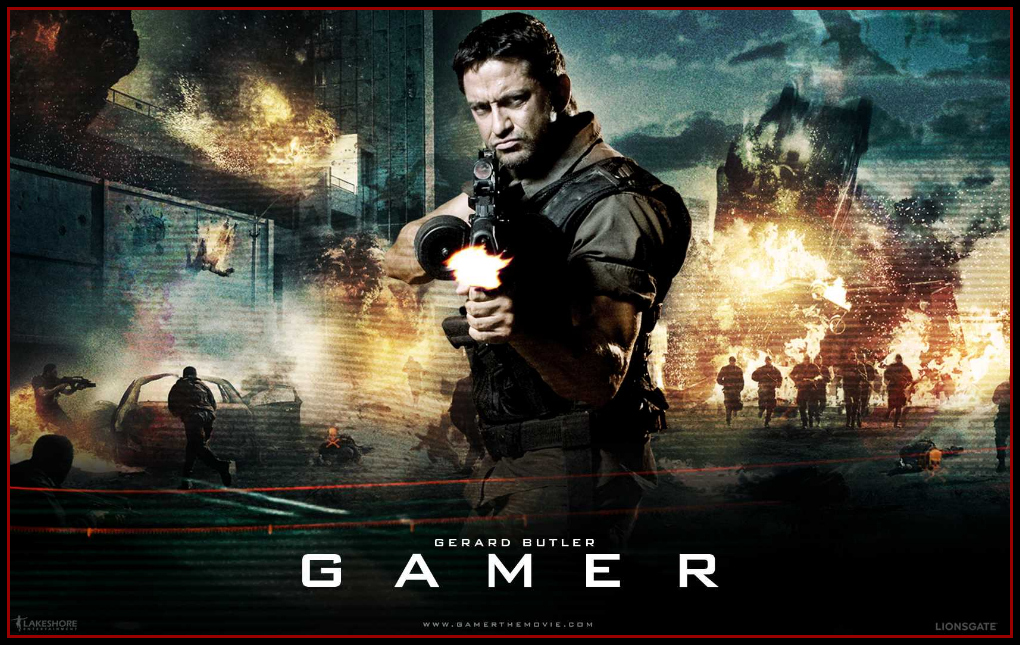
Their third film took the gaming influences so inherent in their first two films (which for all intents and purpose were video games that happened to be film) and went the next step. Gamer is all about a near-future world where two games with on-line social media foundations have become the rage of the entertainment world. One is a game called “Society” that looks to be the nightmare evolution of privacy advocates everywhere to the on-line virtual world Second Lifeand The Sims. It is the other game in this film which makes up the foundation of the film’s plot. “Slayers” takes the ultra-popular multiplayer on-line experiences of games such as Call of Duty and HALO to the next level by allowing gamers to actually control real people (inmates sentenced to death) to act as their avatars in a real-life battlefield arena with real weapons and real deaths.
These games which have become the obsession of hundreds of millions of people worldwide are the brainchild of the film’s antagonist. Michael C. Hall plays the creator of these games and his performance looks to combine the sociopathic charm of his Dexter character with that of Steve Jobs is the latter was openly honest about his douchebag tendencies. Playing his opposite is the character of Kable who happens to be the reigning champion of the game Slayers and who knows a secret that could tear down the billion-dollar empire created by Castle. Gerard Butler plays the desperate but very capable inmate Kable who just wants to survive past the final match and earn his freedom thus return to his wife and young daughter on the outside.
Gamer posits the question of how far are we willing to go to experience realism in our games and entertainment. With the game Society people pay to be able to control other people in a social setting (albeit in a controlled area). These so-called avatars will do anything and everything their real-life controllers tell them to do. In the film these avatars get paid to become virtual slaves and with most people signing up for the job being the socially desperate. Their situation is not so dissimilar from the condemned inmates who populate the game Slayers. The film hits the audience with a sledgehammer that these virtual entertainments have become popular worldwide because people have stopped looking at these “volunteers” as real people. Morality has been replaced by the need for instant gratification by way of these virtual on-line systems.
The film doesn’t make any apologies for the heavyhanded delivery of it’s message and also doesn’t skimp on the entertainment side of the equation. Neveldine/Taylor have shown that they have a certain flair for creating visual chaos and action on the screen. Their unique visual style does look like something out of a video game especially those from hyperrealistic shooters such as Call of Duty and its ilk. The filmmakers have always accomplished the high-quality visual look of their films despite the low to modest budget given to them by the studios they’re working for. Gamer is no exception and the film benefits from the decision by these two filmmakers to continue working with the Red One digital cameras thus allowing them to add in the visual effects right into the shot scenes the very same day of shooting.
It’s this very style of hi-tech guerrilla filmmaking which makes Neveldine/Taylor this current era’s Cormans. Unlike most low-budget filmmakers they don’t use the size of their budget to dictate how their films turn out visually, aurally and narratively. The first two this film succeeds in ways that makes an audience think the film was higher budgeted than it really was. The third would depend on the viewer whether the film succeeds or not. For those who seem intent on viewing every film as if they were made to be worthy of high awards and accolades would probably dismiss and hate this piece of exploitation cinema. Gamer succeeds in a narrative sense because it delivers on the promise of telling a story about a world where free will has been seconded to control in the need of a population in search of a the next virtual playground. It’s a heady premise that has been explored in past films such as the Matrix Trilogy and another film similar to this one which came out weeks later in Surrogates.
Gamer doesn’t have the philosophical and existential sermoning in combination with futuristic action sequences as the Wachowski Brothers’ trilogy, but it does have the same visceral action DNa as those three films and also more entertaining than the Bruce Willis vehicle Surrogates. This film will appeal to the very people who it condemns as sheep to the rising tide of on-line control in entertainment, but then that’s what all exploitation films tend to do best. Cater to the very people it uses as examples of what’s wrong in society and build an entertaining film around them and what they represent.
The film’s cast revolves around Gerard Butler and Michael C. Hall and the roles they play. Whether its Amber Valletta playing Kable’s desperate wife who has sold herself to become a controllable avatar in Society to try and earn enough to get her young daughter back or to Logan Lerman playing the role of Simon the gamer who controls Kable during the Slayer matches. They all do enough with their roles to keep their characters from becoming less than one-notes. Again, for some having a film with characters that are quite basic and one-note might make for a bad film, but when put into context of the story being told they’re quite good and needed to become motivators for Butler’s character.
In the end, Neveldine/Taylor have made a modern day exploitation and grindhouse film in Gamer without having to resort to the visual tricks used in the Rodriguez/Tarantino grindhouse homage film Grindhouse. A film doesn’t need to have film scratches, overexposed film stock, scratchy audio track or missing film reels to be grindhouse. It just have to espouse the very nature of the films which made up the kind of films which became prime example of grindhouse/exploitation cinema. Gamer won’t win any awards, but I suspect that more people who saw it were entertained by it’s blatant, in-your-face entertainment than would normally admit to it. It’s a film that has cult status and guilty pleasure written all over it.
Plus, this film is definitely worth at least a curiosity viewing if just to see the musical number performed by Michael C. Hall at the climactic sequence near the end of the film. I don’t think any film has ever combined gratuitous violence, musical dance numbers using bloodied death row inmates and Michael C. Hall singing Frank Sinatra’s “Ive Got You Under My Skin“. That sequence alone is worth a rental or Netflix Instant streaming.
When I first saw John Hillcoat’s film The Proposition I was literally shocked and dumbstruck with what I had just witnessed. As a long-time aficionado of the horror genre I could say that part of me has become desensitized to onscreen violence and nothing really shocks me. Even though I’ve seen films with more violence throughout its running time, The Proposition just had a heavy sense of despair, moral ambiguity, and a Miltonian feel throughout. The film felt like how it would be if one accepted an offer from one of the damned to stroll down to the Nine Circles of Hell. As much as I didn’t want to accept that offer the curiosity of what I might see won out. That’s how I was able to sit through the entirety of Hillcoat’s ultra-violent and nihilistic tale of lawless and amoral individuals in the untamed wilderness of 1880’s Australian Outback.
I must agree with several critics who have said The Proposition seemed to mirror another dark and violent tale. Hillcoat’s film shares so much the same themes and tone as Cormac McCarthy’s brutal novel, Blood Meridian, that one almost wondered if the film was adapted from McCarthy’s great novel. But similarities aside, Hillcoat and Nick Cave’s (director and writer respectively) film can clearly stand on its own two bloody legs.
The film begins with a bloody siege and shootout and we’re soon introduced to two of the three Burns’ brothers. We soon find out that both brothers, Charlie (played by Guy Pearce) and Mikey (played by Richard Wilson), are outlaws wanted for a multitude of heinous crimes with a recent one the senseless rape and murder of the Hopkins family. One Capt. Stanley (Ray Winstone) who acts as law in this particular area of the Outback also happens to be friends of the unfortunate Hopkins clan. When he finally apprehends the two brothers after the siege gives older brother Charlie a proposition. He’ll spare the younger brother’s life from the hangman’s noose if Charlie finds their older brother Arthur (played with Kurtz-like menace by Danny Huston) and kills the outlaw leader. The quest is set as Charlie accepts and sets out to find his elder brother. Whether Charlie will go through with killing his older brother Arthur is one thing the audience won’t find out until the final minutes of the film. Even though there’s no love-lost between Charlie and Arthur, there’s still the traditional bond of family that makes Charlie’s quest a complex one.
We realize early on that Charlie is very protective of his simpler, younger brother Mikey and would do anything to save his life. Guy Pearce does a great performance as the conflicted and brooding Charlie Burns. There’s a quiet intensity in Pearce’s performance. He’s pretty quiet through most of the film, but one could feel the palpable rage just roiling beneath his brooding countenance. Pearce’s Charlie is one who is only a trigger away from exploding into outright violence. Charlie is definitely a child and creation of the lawless Outback the film is set in.
Arthur Burns on the other hand comes in introduced as an almost warrior-poet (though in this story it would be more like a charismatic-sociopath) who would watch the sun set and spout poetry as easily as gun down an innocent or slice a man’s throat without missing beat. Danny Huston does a bravura performance as the charismatic and wholly amoral Arthur. His performance easily matches that of Pearce’s scene for scene. Another performance that I must point out as being very strong in the film is Ray Winstone as Capt. Stanley, the Ahab of the tale with his obsession to bring civilization to the lawless Outback and to bring Arthur Burns to ultimate justice even if it means dealing with the lesser evil that is Charlie Burns.
The Proposition will be talked about alot for its unflinching look at violence onscreen. Though there’s been films that have more violence per hour than Hillcoat’s film, but the extreme brutality of the killings, maimings and rape in The Proposition has such an air of realism to it that one cringes at every gunshot wound and knife slashing. Like Aronofsky’s Requiem for a Dream, this film’s scenes of violence makes one want to rush into the shower and cleanse off the dirt, grime and stink of the film. It’s in this unflinching and realistic portrayal of death and violence that the film shares alot with McCarthy’s Blood Meridian. The images are difficult to watch, but our curiosity makes us look through squinted eyes to see the full breadth of the violence. In time, just through the audiences acceptance of the oncreen violence do we soon become complicit in whats going on the screen.
It is a shame that The Proposition had such a limited release in the US. Even since it’s release on video it’s a film that still seems to be underappreciated. I think this film would’ve done as well as Eastwood’s Unforgiven in giving the audience a different, darker side of the Old West mythology (though its really the Australian Old West). John Hillcoat has crafted himself a brutal and nihilistic film that’s very hard to watch but also difficult to ignore. The Proposition is a film I highly recommend as it is the type of film that helps redefine a whole genre.
It’s St. Patrick Day! Now, I can’t speak for everyone but for me, this is the only holiday that matters. For one thing, it gives me a convenient excuse to show off some of my Irish Folk Dance moves. For another, it gives me an excuse to say things like, “I’m just a good Irish girl,” in the closest I can come to an Irish accent. (Admittedly, that’s not very close. My own accent tends to be kinda twangy and country.)
Oh! And there’s another great thing about St. Patrick’s Day. It gives me an excuse to wear green and I look really good in green. Today, I’m green from my eyeshadow to my underwear.
Anyway, with all that mind, it was pretty easy to pick today’s song of the day. One of my favorite films of 2007 was a wonderfully romantic and charmingly low-key Irish film called Once. The film’s soundtrack, which I’ve been listening to all day today, is one of my all-time favorites.
One of my favorite songs on that soundtrack — and my pick for song of the day — is When Your Mind’s Made Up, performed by the film’s stars Glen Hansard and Marketa Irglova. As actors, performers, and as a real-life couple (awwwwwww!)*, Hansard and Irglova have this amazing chemistry and it’s on display in the video posted below.
(By the way, can I be like really, really sappy here without everyone rolling their eyes and getting all “Gaggggggg!” on me? Sometimes, if I’m feeling really sentimental and silly, I think about how Jeff is like Glen Hansard and I’m like Marketa Irglova. And then I start singing another song from the movie — the Oscar-winning Falling Slowly. Or at least I sing a version of it because I have a hard time remembering lyrics.)
Happy St. Patrick’s Day!
——————-
*According to Wikipedia, Hansard and Irglova are apparently no longer a couple. 😦
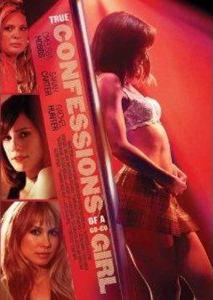
So, late, late last night, I was laying in bed, trying to get to sleep when I suddenly remembered that I had earlier recorded a movie called Confessions of a Go-Go Girl off of the Lifetime Movie Network. So I turned on the TV and I started watching, hoping that the movie would simply calm my racing mind and help me get to sleep. Instead, I found myself sitting up in bed for the next two hours, totally enraptured with this film.
After the first few minutes, I started to scream until my sister Erin woke up and rushed into my room. “What’s going on!?” she asked. “Erin,” I replied, “you have to watch this movie with me!” Erin stared at me for a few minutes before replying, “Oh my God, Lisa,” and then walking out of the room. So, after that, I started to call random friends, telling them about this movie. Unfortunately, most of them were already asleep since it was like 3 in the morning.
Anyway, long story short — I am really, really tired today! But enough about me. Let’s talk about Confessions of a Go-Go Girl.
Why Was I Watching It?
Okay, my friend Evelyn asked me this same question when I called her up last night at 3 in the morning and tried to convince her to come over and watch this with me. So, as I told her, “Oh. My. God. Are you like kidding me!? Confessions of a Go-Go Girl? How can you not watch it!?”
If I’ve learned anything, it’s that if “Confessions” appears in the title of a movie, there’s about a 75% chance that it’s going to be a lot of fun. And if that “Confessions” movie happens to be a Lifetime movie, than those chances increase to 99%.
Add to that, these aren’t just the confessions of a go-go dancer. No, they are the confessions of a go-go girl. In other words, the whole go-go thing isn’t just a job in this movie. It’s a lifestyle.
What’s It About?
It’s yet another Canadian film that’s found a home on the Lifetime Movie Network. In this one, Jane McCoy (played by Chelsea Hobbs) is a sweet and innocent aspiring actress who, in order to make some extra money, secretly takes a job as a “go-go dancer” at a sleazy bar. Under the influence of an older, cocaine-addicted dancer (played by Sarah Carter), Janet quickly starts a downward spiral of drugs, decadence, and alienation. As her new identity as a go-go girl starts to dominate her life, Jane soon finds herself growing distant from her wealthy family, her boring boyfriend, and her stridently scary drama teacher.
What Worked?
Oh my God, this is like the ultimate Lifetime movie. Over-the-top, melodramatic, awkwardly moralistic, and amazingly silly, Confessions of a Go-Go Girl is a camp masterpiece that simply has to be seen to be believed.
Nothing happens in this movie that you couldn’t predict within the first few minutes. The film’s genius is not that it does anything unexpected. Instead, it’s that it takes the expected to such an extreme. Listen, we all know, from the minute that Jane first dances, that she’s going to eventually end up becoming jaded and cynical. What we could never guess is that it’s pretty much going to happen right after the first dance. It’s kinda like one of those old anti-drug films where all it took was one puff off of a “marijuana cigarette.” One puff and you’re a giggling psycho. One dance and suddenly, your soul fades away. This is the type of film where we know that Jane has become a bad girl because she starts to part her hair down the middle and grow out her bangs.
Plus, as I’ve mentioned so many times before, I love to dance, I love to watch others dance, and if nothing else, this movie had a lot of dancing. Watching this movie, I was surprised to discover that sordid, Canadian go-go clubs apparently are capable of providing Broadway-style dance shows. I mean, I’m not big into strip clubs but, from my experience, most of them just seem to involve a runway, a pole, and a lot of plastic. I mean, it’s fun to grab onto that pole and spin around and go, “Wheeee!” but it’s not exactly exciting to watch (or, at least, it’s not for me). But in Canadian go-go clubs, the dance routines have elaborate costumes, ironic themes, and really impressive lighting. After watching this film, I realized that I really want to move up to Canada and become a go-go dancer. Seriously.
Eventually, Jane is approached by a rival go-go club promoter who tells her that he’s seen her perform and, “I remember you dancing in white panties.” This line highlights the fact that this film is obsessed with underwear. And that’s okay because, honestly, who isn’t? Watching this film reminded me of an ongoing debate that I have going with Erin concerning whether or not fancy, pretty, colorful lingerie more sexy than boring, blah, cotton, white underwear. This movie seemed, ultimately, to side with my sister in favor of the boring undies. Obviously, I disagree but the film still gave me a lot to think about. I don’t know, maybe I should start a poll or something. Do any of our male readers have an opinion on the underwear question? Please, use the comments section to let your voice be heard.
What Did Not Work?
When taken on its own terms, the entire film worked. If I’m secretly a kitty cat in human disguise than the Lifetime Movie Network is my catnip and that’s largely because of silly, over-the-top movies like this.
Actually, I do have one or two complaints. First off, the lead character is named Jane McCoy and oh my God, is that not just one of the most bleh names in history? Seriously, she should have been named Lisa Marie McCoy or something. Secondly, Jane’s boyfriend (played by Travis Milne) was soooo boring. I believe the character was named Eric but they might as have just named him “Plastic Man” because seriously, he had all the personality of one of the mannequins from those Old Navy commercials. To me, Eric’s character was defined by the moment when, as Jane went down on him, he said, “I don’t think I know you anymore.” Double bleh on him.
“OMG! Just like me!” Moments
Oh. My. God. There were so many of these moments that I don’t even know where to begin. I love dancing and I love having fun while I’m dancing so watching this film was kinda like peering in to my life in an alternative, Lifetime-based universe.
Lessons Learned
Apparently, I’m incapable of not relating everything I see to my own life. Also, I have absolutely no impulse control because I just ordered the 11 x 17 Confessions of a Go Go Girl movie poster off of Amazon.
The last couple years have seen the return of an old trend from the 50’s and and 60’s. Those decades were what one would call the Golden Age of alien invasion films and stories. We had alien invasion films both serious and comedic. They ranged from classics like The Day the Earth Stood Still and The Thing to the awful like Plan 9 From Outer Space and tons of titles I could barely put down. In 2009 we had an alien-themed film which one could call the return of the genre back to the forefront. District 9 by South African filmmaker Neil Blompkamp was universally hailed as one of the best scifi films of the decade and even got nominated for an Academy Best Picture.
Then there’s the other alien-invasion film from 2010 which covers the low-end of the equation. The Strause Brothers’ own Skyline was universally panned by critics and audiences alike. While some did enjoy the film for it’s “so bad, it’s good” quality (I use that term as loosely as redlight hooker). This film was everything that was opposite of District 9. While I did enjoy that film because it was bad I don’t look back at it too fondly.
The latest film in this alien-invasion resurgence is from another South African filmmaker and one whose body of work is mostly genre films of the low-budget variety. Jonathan Liebesman’s own entry into this scifi genre is Battle: Los Angeles and it lands smack dab between District 9 and Skyline in regards to overall execution. It’s a workman-like film which takes an epic alien invasion war and brings it down into the pavement. We see the film through the eyes of a rifle squad of Marines and that’s where the film really becomes a really fun experience.
Battle: Los Angeles begins in medias rea with the war between the unknown alien invaders already having made their initial surprise landings and the U.S. military making it’s countermoves. We learn from a hasty news conference held by a military commander that the alien forces have landed at over a dozen or so coastal cities around the world have begun to move inland. I was somewhat discouraged to find out that San Francisco didn’t even last half a day and was lost. With Los Angeles the last major coastal city on the west coast that still had a viable military presence we hear one of the film’s tagline in that they cannot lose Los Angeles.
After this brief intro we go back 24 hours before the battle begins to get the character introductions sorted out. We see the Marines who will make up the squad the audience will follow through the rest of the film get their brief time to get introduced with some basic backstory to give them some personality. The one which stood out from all the war film archetype characters was Aaron Eckhart’s grizzled and retiring Staff Sgt. Nantz. He becomes the anchor that holds all the players into a cohesive unit and who also keeps the film from spiraling out into Skyline territory. Some of the cookie-cutter characters we meet would be the commanding officer straight out of Officer Training School who has never seen combat but is eager to lead his men and sees the combat-experienced SSgt. Nantz as someone who might usurp his authority. We also get the Marine whose previous combat tour has left him psychologically damaged and tries to earn his mind back into fighting state. We even get the young Marine who everyone sees as the little brother and who also happens to be a virgin.
To say that the characters in Battle: Los Angeles looked like they came out of old-school World War 2 war film casting call would be an understatement. The film just gives these characters (outside of Eckhart’s veteran noncom) enough personality that we’re able to distinguish one jarhead from another. Characterization is not one of this film’s strong suit, but once the bullets and alien stuff begin to start flying the need to get more character moments from these individuals really go out the window and the audience just holds on as they follow this Marine rifle squad into combat with an enemy force better equipped.
The film borrows much from battle sequences from Ridley Scott’s Black Hawk Down and Spielberg’s Saving Private Ryan as director Liebesman opts to use a cinema verite style to give the audience a documentary, imbedded reporter look to the whole proceeding. The shaky cam look this filmmaking style uses may turn off some people, but the way the action sequences (which pretty much takes up close to 3/5’s of the film’s running time) were edited actually keeps the shaky cam from becoming too overwhelming. The film actually does a very good job of showing the confusing nature of battle, but also the fog of war for the grunts on the ground.
Before I get to what about this film really worked for me I will have to admit that the film’s screenplay is it’s biggest weakness. It’s a major weakness that for some viewers will sink the whole film no matter whatever bright points it might have. The film’s core story was actually pretty good. A story about an alien invasion told from the point of view of human soldiers on the ground trying to repel the invaders was a concept that hasn’t really been explored in this type of film. While that foundation for the film is strong the dialogue and how the characters were written left much to be desired. I put the onus on the flimsiness of most of the characters on the screenplay more than the characters themselves. Spielberg and Scott were able to use the very same war film character archetypes and make them work in their film, but that was possible due to much stronger screenplays.
In this film the dialogue’s very hokeyness doesn’t inspire as much as it makes for some wince inducing moments. I can’t say that all of the dialogue was bad. They’re no worse than most war films both good and bad. The dialogue just didn’t seem to have any energy to them and sounded as if it was still being read from an earlier and much rougher draft. I do believe that if the screenplay had been given a couple of doctoring by competent, veteran screenwriters the film would’ve benefitted greatly from it. Instead, the film ended up having to have a strong veteran actor in Aaron Eckhart deliver these average lines with enough conviction and gravitas to keep the film from becoming a parody of a war film. The fact that the film still manages to hold together despite the weaknesses in the screenplay is a testament to one actor performing the hell out of that script. I won’t even go into some people’s issues about the science or battle tactics in the film since I believe the film was consciously built to keep those vague. The film is not about the who or what about this invasion and why the aliens are here, but about that rifle squad from the 2/5 Marines.
Now, what really worked for me about this film is the battle itself. For a fan of both alien invasion and war films this one combined the two and succeeding in delivering what the filmmakers promised. Battle: Los Angeles gave a visceral look into the trials and tribulations of a squad of Marines as they do their part on the ground to fight off a much more advanced enemy. There’s a scene when the Marines are flying over Santa Monica on their way to their Forward Operation Base and we see a running battle on the gorund below between human defenders and the aliens who have moved up from the beach. Even the firefights Nantz and his squad were in once they entered the battle behind enemy lines looked to be influenced with the many battle footage of American forces conducting ground war in Iraq and Afghanistan.
The special effects both CGI and practical to make Los Angeles look like a wartorn urban battleground was done very well. The aliens and their machines were given a look that wasn’t sleek and shiny but utilitarian and efficient. Some have said that the design of the aliens and their machines looked lazy, but I actually believe that if the filmmakers had fallen back on traditional advanced futuristic designs that would have been lazy. These aliens looked like they were design with only one thing in mind and that was to wage war on a people.
The score to the film by Brian Tyler was good and serviceable as his own modern riff on the old-school World War 2 film score, but I thought what this film needed was a veteran composer who knows how to bring out the machismo, gung-ho and esprit de corps of the Marines the audience followed throughout the film. It’s a shame that film composer passed away several years ago because he definitely would’ve given Battle: Los Angeles the kind of score which would’ve elevated the film from a thrilling war film into an epic one.
In the end, Jonathan Liebesman’s first foray into a bigger budget production hit more than it miss though one of those misses many of it’s detractors have seen as a fatal flaw in the film. Battle: Los Angeles doesn’t reinvent the alien invasion film, but just takes a new angle on the whole proceedings. It’s a film that shows influences from better war films by better filmmakers, but also gives hints that this young South African filmmaker has shown glimpses of talent that could take him places that his compatriot Neil Blompkamp has reached with his own alien-themed film. Battle: Los Angeles is just an old-school war film dressed up with modern fatigues and arrived onto the screen with all the positives and negatives of those very same traditional war films people love and hate since film as entertainment was created. It’s not on the same level as District 9 but it is definitely heads and shoulders above the very laughable Skyline of 2010.
As an aside, while I was watching the film I was struck by how this film looked like a preview of what Blompkamp’s potential sequel to his District 9 would look if and when Christopher Johnson came back to Earth with an armada of very pissed off Prawns…and speaking of pissed off Prawn: pig cannon.
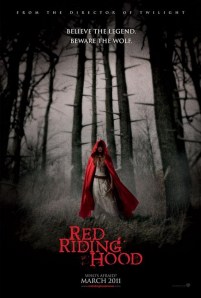
My problems with Red Riding Hood are more of a personal nature than anything else. I’m from a family that clashed old world values of women being blindly subserviant to the Man of the House vs. women being fiercely independent and only having a male in their lives to complement things. These elements were my luggage already brought to the table on seeing the film, but it shouldn’t damper one’s opinion on the film. If this review does this, it’s on me personally and not a reflection of the entire Shattered Lens.
Like Alice in Wonderland before it, Red Riding Hood takes the classic fairy tale and expands on it. While it does so, it doesn’t do it by much. What it has going for it is a nice visual style. Colors are vibrant and director Catherine Hardwicke really has an eye when it comes to forest landscapes (just as she did with Twilight). Mists cover the trees and capes billow in the wind, when it’s not concentrating on the town itself (which does look like a soundstage at times). In the end, however, it suffers from the same quasi teenage issues that Twilight had. I yawned a number of times. Granted, I understand that the movie may be targeted to a younger audience (and for them it may very well work), but even my audience groaned a little and they were target individuals.
Red Riding Hood is the story of Valerie (Amanda Seyfried), who lives in a small village that lives in fear of The Wolf, who has been known to sneak in and attack or kill citizens. To appease the wolf, the townspeople keep animals tied outside. As a child, she forms a bond with a young boy named Peter. Time passes, and we find young Valerie bethrothed to Henry (Max Irons) by way of her mother’s plans (played by Virginia Madsen). Peter (Shiloh Fernandez) still has feelings for Valerie, and this all quickly becomes another Bella / Jacob / Edward triangle. It’s not at the start a story of Valerie choosing her own road, but having to hear from everyone around her that this guy should be the one she marries or that one is the right guy for her. To me, personally, the film in the beginning pushes as much of a pro-“I need a man to survive” stance as Battle:LA does a Pro-Marine one. Is this a terrible thing? Not if that’s where your mindset is, no. Every time I saw them mention anything along the lines of hand and feet worship some guy just because “that’s how it is”, I had to remind myself that it’s just the time period the story takes place in (though I’m sure the audience heard me groan at least once). Again, that’s just me.
In the midst of all this, on being asked to run away with Peter, Valerie is alerted to her sister’s death from the wolf. The townfolk make a point of going after the wolf, and decide to head out the cave where they believe the beast lives. They return with proof of a victory and plan to host a party for the deed. The town priest (Lukas Haas, who somehow seems to less here than he did in Inception) reaches out for help in form of Solomon (Gary Oldman). Solomon, arriving with armed guards warns the townsfolk of the evil of werewolves and that he will hunt it down. The next few nights will be Blood Moon nights, meaning that if the wolf bites anyone during that time, they’ll become werewolves as well. The townsfolk, not buying into this, decide to have a wild party with sexy dancing. This results in a visit from the Wolf, who confronts Valerie and telepathically asks her to come away with it, or the town will be razed. It all kind of escalates from there.
Oldman, for his credit, was fun here and slightly over to the top. Oldman delivers his lines with flair, being far less subdued here than he was in The Book of Eli. For who better to hunt a wolf than Sirius Black himself, right?
And that’s part of the problem I found with Red Riding Hood. With the exception of Seyfried, the supporting cast is actually stronger than the main group of actors the story focuses on. Julie Christie plays Valerie’s grandmother, in a great turn, and as always Billy Burke (Drive Angry, Twilight) is supportive as Valerie’s father. He’s really one of the highlights of the film. As for Henry and Peter’s characters, the most I could think of with them were the Winchester brothers in Supernatural. They’re eye candy for the girls, though I should note that none of the girls in my audience were excited as they were when I saw The Twilight Saga: New Moon. There were lots of screaming for that one.
What does work is that the movie is reminiscient of The Beast Must Die. It is a mystery of who the wolf actually is, and both Valerie and the audience are given clues. That I actually enjoyed, and the third act of the film wasn’t too bad. The action is quick and to the point, but again, it all kind of feels like I could have seen this as a series on the CW. There wasn’t as much of a worry about who would fall at the hands of the wolf or what dangers would face Valerie so much as they actually looked cool when it occurred. Easily a Netflix pick.
As part of my mission to see every film ever nominated for best picture, I watched George Stevens’ A Place In The Sun this weekend. A Place in the Sun was released in 1951. It was a front-runner for best picture but in an upset, it lost to An American In Paris. (Another best picture loser that year: A Streetcar Named Desire.)
Montgomery Clift plays George Eastman, a poor man with a religious fanatic mother and a wealthy uncle. Looking to make his fortune (i.e., to find his “place in the sun), George gets a job working in his uncle’s factory and quickly starts a romance with one of his co-workers, the shy and insecure Alice (Shelley Winters). However, even as he and Alice settle down to a life of dreary romantic bliss, George discovers that the Eastman name also allows him to mingle with (if never truly belong to) high society. He meets the rich (and shallow) Angela Vickers (played by Elizabeth Taylor) and soon, he’s also romancing her. Neither Angela or Alice is aware of the other’s existence and for a while, George has the best of both the world he desires and the world in which he actually belongs. Eventually, George decides that he wants to marry Angela and become a part of her world. However, there’s a problem. Alice is pregnant and demanding that George marry her or else. The increasingly desperate George quickly decides that there’s only one way to get Alice out of his life…
A Place in the Sun was based very loosely on Theodore Dreiser’s 1925 novel, An American Tragedy. While the movie remains (more or less) faithful to the novel’s plot, director Stevens jettisons most of Dreiser’s heavy-handed Marxism and instead concentrates on the more melodramatic elements of the story. The end result is a glorious soap opera that is occasionally a bit tacky and heavy-handed but always watchable and entertaining.
Stevens is helped by the three lead performances. As Angela, a stunningly beautiful Elizabeth Taylor manages to be both calculating and clueless, seductive and innocent. As her counterpart, Shelley Winters gives a really brave performance as Alice. The film is structured that its impossible not to feel sorry for Alice. The genius of Winters performance is that she (and director Stevens) allowed Alice to become a real, flawed human being as opposed to just a symbol of victimization. However, the film is truly dominated by Montgomery Clift. Clift is in just about every scene and his own rather fragile persona translates wonderfully in the role of George. Was Montgomery Clift ever as handsome as he was in A Place In The Sun? He gives a perfect performance as the type of guy that every girl has known, the guy that we fell in love with not because of who he was but who we thought he could be. These are the guys who always end up breaking our hearts, they’re the ones who we still can’t help but think about years later, always wondering “why?”
Unlike a lot of older films, A Place in the Sun remains remarkably watchable and relevent today. Perhaps its most famous scene involves a capsized rowboat and oh my God, that scene freaked me out so much. Admittedly, a lot of that had to do with the fact that I have this morbid fear of drowning (and, like one of the characters in this film, I can’t swim) but director Stevens also does a great job building up the scene’s suspense. He makes brilliant use of sound especially, in much the same way that Francis Ford Coppola would later use that roaring train in The Godfather. Seriously, I watched that scene with my hands literally over my eyes, just taking an occasional peek until it was all over.
One last note — there’s an actor in this film who plays a detective. You’ll see him if you play the trailer at the top of the post. His big line is “You’re under arrest.” I have no idea who this actor was but he had one of the most authentic and memorable faces that I’ve ever seen in a movie, regardless of when the movie was made. He had the type of presence that reminded me why I love character actors.
Last night, as part of my continuing mission to see every film ever nominated for best picture, I watched Sidney Lumet’s Dog Day Afternoon. Dog Day Afternoon was released in 1975. Though nominated for best picture, it lost to One Flew Over the Cuckoo’s Nest.
In Dog Day Afternoon, Al Pacino plays Sonny, a nervous Viet Nam vet who, along with the dim-witted and possibly crazy Sal (John Cazale), attempts to rob a bank. Unfortunately for him, Sonny doesn’t really know what he’s doing and literally within minutes of him first drawing his gun, the bank is surrounded by cops. The robbery quickly descends into a hostage situation. As Pacino negotiates with a NYC police detective (Charles Durning), a crowd of onlookers gathers around the bank and starts to cheer with every defiant word that comes out of Sonny’s mouth. Sonny discovers he likes his new-found fame. In the film’s most famous scene, he stands outside the bank and leads the crowd in a chant of “Attica! Attica!” Eventually, Durning learns that Pacino’s motive for robbing the bank was to steal enough money for his suicidal lover (Chris Sarandon) to get a sex change operation. However, now that the robbery has failed, Pacino has a new plan. He demands a flight out of the country. Meanwhile, the hostages inside the bank start to form their own odd kinship with the two bank robbers and Durning finds himself being challenged by the F.B.I., who have a much more drastic plan for how to end the situation.
Dog Day Afternoon is a remarkable film, a dark comedy of desperation and human nature that, by the final scene, reaches a certain tragic grandeur. Sidney Lumet (who made his directorial debut in 1957 with 12 Angry Men and whose most recent film, Before the Devil Knows Your Dead, was released 51 years later) was one of the most important (if underrated) filmmakers of the 1970s and he proves it here. From the opening montage of New York City looking so wonderfully sordid at the height of the grindhouse era to Pacino’s bumbling initial attempt to rob the bank to the film’s violent and abrupt conclusion, Lumet captures your attention and, much like Al Pacino in this movie, he holds it hostage until the movie ends.
Dog Day Afternoon is probably one of the best acted films that I’ve ever seen. This is one of those films where every role — regardless of how large or how small — fills like an actual human being. By the end of the film, you feel as if you know the bank managers and the tellers almost as well as you know Pacino, Durning, Sarandon, and Cazale. Pacino is simply amazing here, giving a nervous, jittery performance as a character who manages to be both selfish and selfless at the same time. Durning, meanwhile, is hilarious as the frazzled detective who finds himself steadily overwhelmed by the circus around him. Much as you can’t help but root for Pacino no matter how self-absorbed he might act, you can’t help but sympathize with During, even if he is a member of the establishment. As Pacino’s transsexual lover, Sarandon plays his role with a fragile dignity that prevents the role from becoming a stereotype. However, for me, the film truly belongs to John Cazale who is both scary and oddly child-like as Sal. As seen below, Cazale improvised one of the best lines in the movie when he replies to Pacino’s question regarding to which country Cazale wants to make his escape.
Now, this is going to be difficult for me to admit but, as thrilling as it was to watch Pacino shout, “Attica! Attica!,” I honestly had no idea why that phrase was the one he chose to use to work up the crowd. In fact, if I had written this review right after seeing (or while watching) the film last night, I probably would have doubled embarrassed myself by claiming that Pacino was shouting “Ateka.” However, for once, I decided to be a responsible reviewer and I actually did some research as opposed to just going with my first conclusion. So, as a result of this film, I can now say that I know about the Attica Prison Riots of 1971.
But what’s truly significant about that “Attica” chant is that it’s the only part of this film (beyond a few fashion choices) that feels dated. As I watched the movie, it was easy for me to imagine myself jumping on twitter and seeing “#Attica” as a trending topic. We’ve all seen the famous “Attica!” scene in countless compilations but what’s often forgotten is how that sequence ends. When Pacino, obviously a bit star struck by all the attention, goes outside and start chanting a second time, he is suddenly tackled from behind by one of the bystanders who has decided to play hero. And as Pacino goes down to the ground, the same crowd that was previously cheering him now cheers for the new object of their affection. If nothing else, Dog Day Afternoon showed why sometimes we all need to escape to Wyoming.
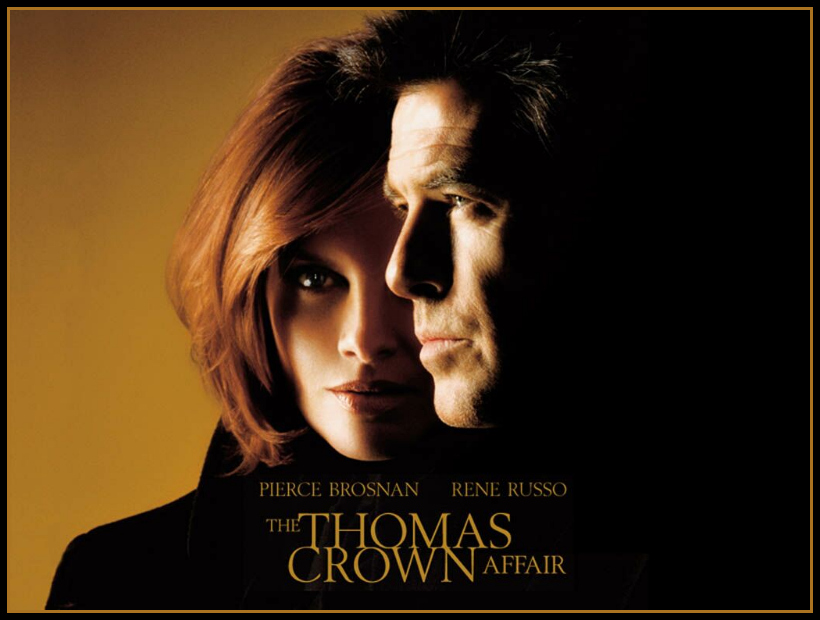
In 1968 there was a little caper film titled The Thomas Crown Affair starring the ever-cool Steve McQueen and a radiant Faye Dunaway. The film was considered hip, cool and sexy in its way during the late 60’s. It took 31 years, but a remake was finally made of this film but this time around starring Pierce Brosnan and Rene Russo in the roles originally played by McQueen and Dunaway. With some great direction from thriller and action filmmmaker John McTiernan, 1999’s The Thomas Crown Affair ends up being the exception to the rule of remakes of older films turning out lesser than the original. This modern and updated version of The Thomas Crown Affair actually surpasses the original McQueen production. McTiernan’s film ably combines humor, thrilling action set pieces, sexy chemistry between the leads and just a beautifully shot film.
Set in New York that never looked as good as shot by McTiernan and his crew, Pierce Brosnan stars and shines as the title character Thomas Crown. Thomas Crown is a suave, roguish and successful businessman who has everything a man could ask for: money, power and any woman he desires.
What does a man like Crown would ever want in life?
The film looks at this and shows that no amount of money in the world could replace the adrenaline rush and thrill of getting acquiring it. Crown does this by staging a complex and elaborate plan to steal a Monet (San Giorgio Maggiore at Dusk) from the NY Metropolitan Arts Museum and do so in the middle of the day. His plan goes off without a hitch and with none the wiser. This heist sequence was actually very fun to watch as McTiernan never lost command of the many threads being weaved to pull off Crown’s plan. McTiernan would one-up this with the climactic finish in the same museum but with a sequence I could only call as the anti-heist.
With the heist completed, the film soon introduces Crown’s foil in the form of Rene Russo as insurance investigator Catherine Banning. Ms. Russo never looked more beautiful, sensual and sexy as she did in this film. Her performance as the determined and crafty Banning more than holds up to Brosnan’s roguish and playful performance as Thomas Crown. From the moment she appears onscreen as the camera slowly pans up her silky-stocking leg and garters, Russo dominated the scene and pretty much commanded attention from everyone. This was especially true whenever she shared the screen with Denis Leary as police detective in charge of investigating the Monet heist. Leary’s always a strong performer in any film he’s in but was pretty much lost in the wake of Russo’s performance when both were on the screen.
The rest of the film was pretty much Crown and Banning trying to get into each others’ heads to find the one advantage that would give them an upper-hand in the “game” they’ve both decided to play. It’s hard to see who is chasing who in the film. Is Banning chasing Crown as her one and only suspect for the theft or is Crown playing her as part of a much more complicated scheme to spice his life. These questions swirl within the frame of the heist investigation and the growing relationship between the two strong-willed characters.
To say that Brosnan and Russo’s on-screen chemistry was strong would be a big understatement. The two pretty much sizzle when together. Whether it’s a playful, flirtation during a nice dinner out on the town to the two steamy dance numbers in the middle of the film. When Crown asks Banning if she wanted to dance or does she want to dance the temperature just went up by degrees. Their love scenes together shows that it could still be done with class and also have a sense of playfulness and fun. It also showed that young couples doing love scenes onscreen have nothing on the mature couple.
There’s not much else to say about McTiernan’s remake of the Thomas Crown Affair than to say that he took a good film, that showcased Steve McQueen’s coolness for everyone to see, and made a much more superior production in every sense. The direction was excellent and the cinematography was beautiful in every second shot. The cast performance was very strong with the two leads in Brosnan and Russo acting their hearts out on the screen. This film shows that remakes really are not bad ideas when put into capable hands. It would be nice to see how the sequel — tentatively titled The Topkapi Affair — to this film turns out with pretty much the same cast and crew returning. I, for one, will be there to see it when it comes out.