Film Review: The Adjustment Bureau (dir. by George Nolfi)


This weekend, I saw The Adjustment Bureau, a film that I’ve been looking forward to ever since I first saw the trailer back in November.

In The Adjustment Bureau, Matt Damon plays a New York politician who loses a race for the U.S. Senate and falls in love with Emily Blunt on the same night.  Inspired by some advice from Blunt, Damon gives a concession speech which, to me, sounds kinda whiney but apparently, the voters of New York find it to be amazingly compelling.  You should understand, of course, that this is a mainstream Hollywood version of the American political system.  What that means is that Damon’s character, of course, is a Democrat who would have won that election if not for the fact that apparently, a newspaper ran a photo of him mooning some people in college.  Now, seriously, consider that.  Not only does this movie start out by asking us to believe that a Democrat could lose a statewide election in New York but it also asks us to believe that he would lose for that reason.  Meanwhile, in the real world, Massachusetts (one of the few states more Democratic than New York) is electing a Republican who used to be a Playgirl centerfold to the Senate.  Anyway, the film continues to show its political sophistication by having Damon give a speech in which he says that political consultants have too much influence in the American political system and apparently, every voter in New York goes, “Oh my God!  He’s right!”  I don’t claim to be an expert on politics but seriously, all of the “political” scenes in this film just ring so amazingly false.

Anyway, Damon’s speech is apparently so amazing that his career is revived and soon, he’s being spoken of as a front-runner for the other senate seat (apparently, this film takes place in a world where New York would not only elect one Republican to the Senate but two).  In fact, some people are apparently talking him up as a future President.  But Damon doesn’t care about that.  All he cares about is winning the heart of Emily Blunt.

The Adjustment Bureau, however, has other ideas.  What is the Adjustment Bureau?  Well, the movie tries to keep it all ambiguous and mysterious but essentially, the members of the Adjustment Bureau are angels and the Chairman they answer to is God.  And God has already mapped out Matt Damon’s destiny and Emily Blunt is not meant to be a part of it.  (How Calvinistic.)  However, Damon insists on pursuing her until eventually, he finds himself being continually pursued by three members of the Adjustment Bureau — the blandly corporate John Slattery, sympathetic Anthony Mackie, and finally the cold and intimidating Terrence Stamp.  The whole thing finally culminates in an Inception-like chase through the streets of New York City with Damon insisting that he has free will and the Adjustment Bureau insisting that no, he does not.

What a frustrating film!  The plot is intriguing and potentially thought-provoking but the film doesn’t bother with following any of its themes to any sort of real conclusion.  In the end, all of the questions raised simply turn out to be an excuse to film Matt Damon being chased across various New York landmarks.  Don’t get me wrong.  I’m always more than happy to spend money to watch Matt Damon get chased.  He looks good running for his life.  But still, it’s hard not to look back at the movie and think, “After all that set-up, that’s it?”  The Adjustment Bureau is like Inception without that spinning dreidel.

Still, I enjoyed The Adjustment Bureau despite myself and I can’t exactly say that I’m proud of that.  With each of its vaguely New Agey themes and its rather simplistic emotional content, this is the type of film that invites me to be cynical.  However, I enjoyed the movie even if I did find myself rolling my eyes during some of the more “sincere” moments.  A lot of this had to do with the chemistry between Matt Damon and Emily Blunt.  They made a likable and cute couple.  As well, Mackie, Stamp, and especially Slattery were well-cast as members of the Adjustment Bureau.  Director George Nolfi comes up with a few striking images and, if nothing else, he knows how to film people being chased.  Then again, it may have just been the fact that I saw this film with a special someone and therefore, I didn’t feel like I had to be cynical.  I could just embrace all the emotional silliness in all of its simple-minded glory and as a result, I had a good time.

That said, I don’t think I’ll be seeing The Adjustment Bureau a second time or buying it on DVD.  Unlike 0ther guilty pleasures, I don’t imagine this is a film that’s going to hold up well on repeat viewings.

Film Review: The Private Life of Henry VIII (dir. by Alexander Korda)


This afternoon, as part of my mission to see every single film ever nominated for best picture, I watched Alexander Korda’s 1933 biopic The Private Life of Henry VIII.

Now, I have to admit that I’ve never been a big fan of the historical King Henry VIII as I have a hard time finding much sympathy for a man who beheads one wife, not to mention two of them.   I like to imagine that he met his end in much the same way that Joe Spinell meets his end at the end of Maniac, with all of his dead wives suddenly showing up and ripping off his head.  But, Henry is one of those larger-than-life historical figures that always seems to end up as the subject of movies, speculative fiction, and, of course, Showtime television series. 

The Private Life of Henry VIII is one of the better known recreation of Henry’s life on-screen.  For the most part, the film ignores Henry’s policies as king and instead is a darkly humorous recreation of his relationships with five of his six wives.  (His first marriage, to Catherine of Aragon, is ignored.)  The episodic film opens with the execution of Anne Boyelen (Merle Oberon).  This sequence establishes the film’s tone early and it’s actually a lot more cynical than we usually expect a film from 1933 to be.  In between shots of Boyelen waiting to meet her fate, we get extended scenes of two executioners — one French and one English — arguing about which nationality is better when it comes to chopping off heads.  Meanwhile, the members of Henry’s court spend their time whispering innuendo about Henry’s new wife, Jane Seymour (Wendy Barrie).  When Henry (played by Charles Laughton) finally shows up on the scene, he turns out to be a buffoon, a childish man who happens to control the destiny of England.  After Jane dies in childbirth, Henry marries Anne of Cleves (played by Laughton’s wife, Elsa Lanchester).  Anne, however, finds Henry to be repulsive and, in the film’s most obviously comedic segment, she goes out of her way to make herself as sexually unappealing as possible in order to convince Henry to give her a divorce.  (This, of course, led to the split between England and the Catholic Church but the film doesn’t dwell on that.  This is a comedy, not Man For All Seasons.)  After the divorce, Henry finally marries Catherine Howard (Binnie Barnes) who has spent the whole movie pursuing Henry.  For the first time in the movie, Henry is portrayed as being truly in love, unaware (at first) that Catherine only married him for his crown and is actually having an affair with Thomas Culpepper (Robert Donat). 

The Private Life of Henry VIII was not the first movie to be made about Henry VIII but it’s probably the most influential because of Charles Laughton’s Oscar-winning performance in the title role.  Laughton’s performance pretty much set the standard as far as future Henry’s were concerned.  His Henry is buffoonish womanizer who does everything to excess.  (This is the film that pretty much created the whole image of monarchs as men who don’t use forks, knives, or spoons.)  However, as over-the-top as Laughton’s performance may seem, it’s actually full of very subtle moments that suggest the actual human being lurking underneath all of the bluster.  It’s hard not to sympathize with Laughton’s Henry as he struggles to explain what sex is to Anne of Cleves or with his obvious pain when he discovers that he’s been betrayed by the only one of his wives that he actually loved.

(Of course, any similarity between Laughton’s Henry and the real-life Henry is probably a coincidence.)

The Private Life of Henry VIII was the first British film ever nominated for best picture and, perhaps because it wasn’t made by the Hollywood establishment, it hasn’t aged as terribly as most films from the 30s.  While the film does have its slow spots, the performances of Laughton, Oberon, and Lanchester still hold up well and some of the film’s dark comedy almost feel contemporary.  Oddly enough, this British film about English history lost to an American film about English history, Cavalcade. 

(I should mention that I haven’t seen Cavalcade so I can’t say whether it was a better film.  I’m going to have to see Cavalcade eventually but it’ll be later than sooner as the movie is only available as part of a DVD boxed set that costs close to 300 dollars.  Agck!)

Film Review: Rango (dir. by Gore Verbinski)


Rango is something of an anomaly.

It’s an animated feature that isn’t in 3D. It caters as much to adults as it does to kids, and doesn’t seem to try toMovie Poster for the Film "Rango" lower itself to be “shiny” in that way. There are a number of scary images that I think would frighten younger kids, but overall, the film is very well done. It’s a fantastic homage to the Wild West, though it does get a little weird at times. I’ll admit that I walked in expecting something like Tangled. It reminds me more of George Miller’s Happy Feet, in how serious at times the story gets. And it does all this under the Nickelodeon banner. Wow, this is a big jump from Spongebob and Rugrats.

It ironic and feels right that Gore Verbinski – who gave us the Budweiser Frogs commercial so long ago and The Mexican – takes on an animated tale. He teams up with his Pirates of the Caribbean stars Johnny Depp and Bill Nighy again, and the results are worth it. Depp brings a spark of funny weirdness to the character of Rango, and the film has a number of pop culture references (including one for Fear and Loathing in Las Vegas). The supporting cast is okay, Isla Fisher (Confessions of a Shopaholic) makes for a quirky female lead trying to hold on to her land and Abigail Breslin (Zombieland) didn’t seem like she was used enough. Ned Beatty and Nighy in particular are the other vocal standouts here, along with Harry Dean Stanton (Big Love) as the the head of a mole family of outlaws. Timothy Olyphant (Justified) has a great cameo as well.

Rango is a chameleon who wishes to be the star of his own story. After an accident leaves him stranded in the desert, he finds is way through the blistering sun to the tiny town of Dirt. The townspeople of Dirt are a diverse lot, and it all has a real Mos Eisley in Star Wars to it. The currency of the town is water, which is pretty hard to come by these days. When he’s asked who he is, Rango takes the moment to be the character he envisioned. After he amazes the town with a display that adds fuel to the fire, the townsfolk end up making him the Sheriff of Dirt and charge him with finding a solution to their money/water issues.

Visually, Rango is a feast for the eyes despite how ugly the main character is. Fur moves, whiskers twitch and the open desert looks wonderful (especially when riding). Sunsets are colorful and Industrial Light and Magic really did some interesting work here. Honestly, I wouldn’t mind seeing this in 3D, but it’s actually nice that it isn’t in that format. Musically speaking, Hans Zimmer’s score adds a nice touch to the film, especially during one key scene involving a chase. I ended up getting the score shortly after seeing the movie.

If Rango suffers from any problems, it would be that it slows down a little in the middle, as if it’s not entirely sure of where it wants to go at one point. It quickly picks up, but the lull may be a little much for younger viewers looking for cartoon action throughout the film. I don’t believe adults will mind this, though.

But what about the Kid Factor?

It’s a Nickelodeon film. It’s designed for kids, and my audience (made up of parents and kids) appeared to really love it. The lessons to learn are that you truly are the center of your own story and growth comes through dealing with struggles. You can’t have a Protagonist without an Antagonist, and a story has to have conflict for it to go anywhere. You can take your kids to see Rango, but Parental Guidance is suggested. There’s a nude top half of a Barbie doll, no biggie there. Nighy’s Rattlesnake Jack brought up a lot of murmurs and gasps from the kids in my audience, so that might be something to be concerned about. There’s also shooting – it is the Wild West, after all – so there are characters that will die. If that doesn’t bother you, then you’ll have tons of fun with Rango. It’s definitely worth seeing.

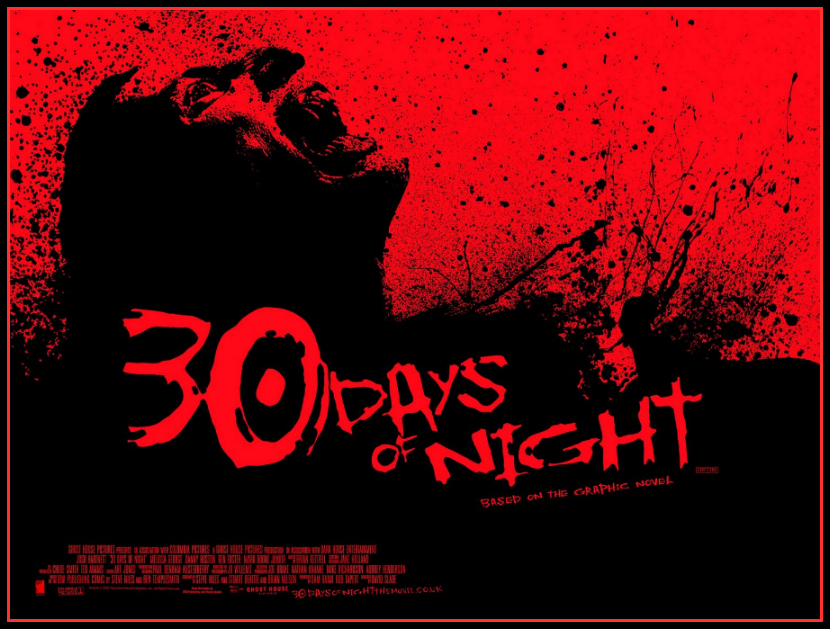
Quickie Review: 30 Days of Night (dir. by David Slade)


30 Days of Night is pretty much a siege movie with heavy elements of horror and gore. Siege movies always succeed and fail depending on whether the tension and dread built up from the beginning of the film suspends the audience’s disbelief. Siege films like The Thing and Romero’s Living Dead trilogy works well because right from the get-go we see the tension build not just on the location the cast are put in but within the besieged survivors as well. Survival becomes that much more difficult due to human frailties and an inability to work together bringing the whole group down. The monsters outside are bad enough, but sometimes it’s the survivors themselves who must share the blame.

David Slade’s (director of the excellent Hard Candy) movie does a very good job of bringing the initial tension and dread the comic brought to life in its first chapter. The story takes place in Barrow, Alaska which happens to be located within the Arctic Circle. This location allows it a very peculiar yearly event of having pitch-black night which lasts for a period of an entire month. The movie begins just as the town of Barrow prepares for this month-long prolonged night. Most of the town decide to move down south for the month where the night doesn’t last as long, but enough stay in Barrow to give it a semblance of life and activity.

The build-up of the characters in 30 Days of Night marks one of the weaknesses in the film. There’s barely much characterization in distinguishing one Barrow, Alaskan from another. The lack in character development from all the characters whether human or vampire doesn’t invest the film with anyone we want to see make it out through the night and into dawn. Even Danny Huston, a very underrated and overly capable actor in past films fails to elevate his lead vampire character Marlowe beyond it’s genre trappings. Known only as The Stranger in the credits, Ben Foster’s Renfield-like character edges between caricature and genuine creepiness in his performance. Foster knows he’s in a genre movie and has fun with the character. He’s the only one to truly take on his character and roll with it.

I now get to the subject of the vampires themselves. Most vampire movies seem enamored in portraying the vampire as some sort of seductive, fashion-obsessed, or in the case of the Anne Rice-type anachronistic in their dress, with an unnatural immortality they either live as hedonistically as possible or bemoan their cursed existence. Then there’s the more recent trend that Twilight has brought into the vampire mythology and it’s not good.  There’s never been a true portrayal of the vampire as a pure, hunger-driven monster with an appetite to match their status as one of folklore and legend’s top-tier boogeymen. Slade goes for speed and agility in his vampires instead of hypnotizing and mesmerizing their victims. The vampires in this movie owes much to the frenetic and over-amped infecteds of 28 Days Later.

The attack itself and the subsequent siege worked well enough in the early going. There were some great overhead shots of the town’s people losing it’s fight during the initial feeding frenzy as the camera shoots the scene high overhead. The only thing Slade had a misstep in terms of the siege itself was after those first couple of nights. The rest of the 30 days didn’t seem to show enough desperation on the faces and bodies of the last few survivors. Really, the only way the audience even knew a couple weeks have passed were the caption telling them how many days into the month-long night has passed. I think with some better editing and a better sense of structure in the middle section of the movie to show time actually progressing the movie would’ve been better on so many levels.

All in all, 30 Days of Night was just good enough to be a fun watch. The premise itself was original and put a new spin on the vampire genre that has rarely been tapped. The performances were pretty average with no one bringing the whole film down with a misstep performance or raising the bar with a great one. The final product had a chance to be something great, but just ends up being a good and original take on the vampire story with elements of Night of the Living Dead.

6 Trailers For Clint Jun Gamboa


As I type this, I am soooooooooooooooooooooooo ticked off.  I just finished watching Thursday’s episode of American Idol and I now know that Clint Jun Gamboa did not make the final 13.  Before trying out for this season of American Idol, Gamboa worked on the soundtrack for the infamous Tommy Wiseau film The Room.  That’s right, the man who wrote “Crazy” and “Baby You And Me,” will not be competing for a chance to be the next American Idol.  That’s just wrong.  What’s even worse is that they sent Gamboa on his way without ever once acknowledging The Room.  They could have at least given him a plastic spoon.

So, Clint Jun Gamboa, if you’re reading this, this latest edition of Lisa Marie’s Favorite Grindhouse and Exploitation Trailers is dedicated to you.  Le monde est chié, Gamboa. Bonne chance.

1) A Boy And His Dog (1975)

Because it’s for Clint, let’s start out with a trailer for a classic, 1975’s A Boy and His Dog.  Clint, if you’re feeling down — well, I don’t know you well enough to know if this movie will help or not.  It’s kinda one of those you either get or you don’t. 

2) Hi, Mom (1970)

Yes, I know.  The title makes it sound like a prequel to the Room.  “Oh hai, mom.”  Actually, it’s just a very early film from director Brian DePalma.  The movie also stars a very young and very unknown Robert De Niro.

3) The Harrad Experiment (1973)

This is one of those films that I’ve got on DVD but I need to rewatch it so I can review it.  I do remember that the DVD transfer was so bad that it actually started out with one of those “this is made from the best copy we could find — it’s not our fault!” messages. 

4) Two Thousand Maniacs (1964)

Yes, here is the trailer for the groundbreaking exploitation film from Herschel Gordon Lewis.  Clint, this blood feast is for you.

5) Shriek of the Mutilated (1974)

I’ve got this one on DVD though I haven’t managed to stay awake through the entire film yet.  But I just love that title.

6) Mad Doctor of Blood Island (1969)

Sadly enough, the Perfectly Sane, Kinda Boring Doctor of Blood Island was located just a block away but everyone was too busy with the mad doctor to notice.

Stay supple, Clint!

A Quickie With Lisa Marie: The Robe (dir. by Henry Koster)


As part of my mission to view every film — good or bad — ever nominated for best picture, I spent last night watching 1953’s The Robe (which was nominated for best picture but lost to From Here To Eternity.)  The Robe is an old school biblical epic, the type of film that used to regularly get nominated for best picture but which you don’t see much of anymore.  If you’re wondering why that genre hasn’t stood the test of time, I’d suggest watching The Robe.

Richard Burton stars as Marcellus, a womanizing Roman centurion who falls in love with young, pure noblewoman Diana (Jean Simmons).  Unfortunately, Diana is set to marry the decadent Caligula (Jay Robinson).  (Yes, that Caligula…)  Burton’s rivalry with Caligula leads to him being reassigned to Jerusalem where he not only witnesses the crucifixion but also wins Jesus’ robe in a dice game.  However, Marcellus soon finds himself being haunted by nightmares of the crucifixion and he discovers that he can’t even wear the robe without having a seizure.  His slave, Demetrius (played by musclebound Victor Mature) has secretly become a Christian and steals The Robe before disappearing into the Holy Land.  As Marcellus, who believes that only by destroying the robe can he free himself from his guilt, searches for Demetrius, he is reunited with Diana and, since this is an old school biblical epic, he also ends up converting as well.  Unfortunately, he does all this around the same time that Caligula becomes Emperor and (in this film if not in actual history) begins to persecute the early Christians.

The Robe was the first film to made in “Cinemascope” and, while that may have been an amazing development back in 1953, when watched today, it’s obvious how much of the film is really just made up of filler designed to show off the new process.  Again, it may have been amazing at the time but today, it just seems like a slow movie.  Even more importantly, The Robe itself is so reverent and respectful of its subject that it’s just not that interesting.  Speaking as a nonbeliever, I’ve still sometimes feel that a lot of contemporary films make it a point to ridicule Christians because they’re an easy target.  Unlike a certain other world-wide religion, most Christians aren’t going to blow you up just because you featured an image of Jesus in your movie.  However, movies like The Robe were not only extremely reverent and respectful but they went out their way to let you know how reverent and respectful they were being.  The result is a film that lack any hint of nuance or anything that might actually challenge the audience.  It’s like Avatar with Jesus. 

Since he’s best known for being an alcoholic and marrying Elizabeth Taylor, Richard Burton might seem like an odd choice to play an idealistic Christian martyr.  And, quite frankly, he is.  Throughout the film, he’s visibly uncomfortable and, quite frankly, he didn’t have the legs necessary to pull off the ancient Roman look either.  Jean Simmons is also stuck playing a stock character — the virtuous maiden.  As with a lot of the old school biblical epics, the lead characters are so boring that you can’t help but feel they had more fun as pagans.  Meanwhile, poor Victor Mature wanders through the film struggling to show anything resembling emotion.   I mean, he tries so hard that its impossible not to like him.  At the very least, The Robe proves that any film featuring Victor Mature will have some sort of camp value. 

(As I watched The Robe, I kept thinking about a comment that Groucho Marx supposedly made.  Apparently, he said he wouldn’t watch any movie starring Victor Mature because “I won’t watch any movie where the guy’s tits are bigger than the girl’s.”)

The Robe does feature some interesting supporting performances from several wonderful B-movie character actors.  Jay Robinson is obviously having the time of his life playing the Emperor Caligula.  Robinson’s version isn’t quite as effective as Malcolm McDowell’s but Robinson is a  lot more fun to watch.  Richard Boone is effectively slovenly in the role of Pilate and there’s a nice little throw-away scene where Pilate absent-mindedly washes his hands twice.  Meanwhile Ernest Thesiger (who played Dr. Pretorious in the Bride of Frankenstein) is an oddly benevolent Emperor Tiberius while Michael Rennie, the alien from the original The Day the Earth Stood Still, plays none other than St. Peter.  Even Jeff Morrow (from This Island Earth) has a small role.

Like most of the old school Hollywood biblical epics, The Robe seems pretty hokey when viewed today and I get the feeling it probably seemed hokey when it was first released back in 1953.  Still, I remember that my Grandma Meehan used to love to watch these movies whenever they would show up on television.  She would have deep theological debates with the images that flickered across the screen.   I can still remember spending multiple Easters listening to her argue with The Ten Commandments.  I don’t know if Grandma ever saw The Robe but I do know that she believed that the Holy Tunic was presently located in France and not at the Cathedral of Trier in Germany.  Seriously, you did not want to question her on this point. 

To be honest, watching this type of film is always an odd experience for me.  Up until recently, I described myself as a “fallen Catholic” and I always felt so proud of myself afterward.  I could spend hours telling you why I no longer believed in the faith of my childhood and I could get quite smug about it.  I guess I still can but, as of late, I’ve discovered that humility goes well with a lack of faith.  I’ve also been forced to admit that when you’re raised Catholic, you’re a Catholic for life regardless of whether you believe in the Holy Trinity or not.  If pressed, I guess I’d call myself “an agnostic Catholic.”  I’m the type of nonbeliever who still feels the need to go to confession after a long weekend.  It’s not so much that I doubt my doubt as much as I wish that I could still go back to a time in my life when I actually could have faith without feeling like I was in denial.  So, even as I openly scoff at these films, there’s always that small part of my heart that wants to embrace the film in all of its simplistic and hokey glory.

That said, it’s also true that The Robe is a lot easier to resist than a film like Pasolini’s The Gospel According to Saint Matthew or, for that matter, The Exorcist.

A Quickie With Lisa Marie: Crossfire (dir. by Edward Dmytryk)


I recently decided that I wanted to watch and review every single movie ever nominated for the Academy Award for best picture.  As part of that mission, I recently rewatched one of my favorite also-rans, 1947’s Crossfire.

Crossfire is a message movie disguised as a B detective flick.  A group of soldiers who have just returned from World War II decide to get together for a drink.  At the bar, they run into a civilian named Joseph Samuels (Sam Levine).  The soldiers end up going back to Samuels’s apartment and the next morning, Samuels is found dead.  Obviously, he was killed by one of the soldiers but which one.  Suspicion falls on the meek (and missing) Floyd Bowers (Steve Brodie) but police detective Finlay (Robert Young) and Sgt. Peter Keeley (Robert Mitchum) both (correctly) suspect that Samuels was actually murdered by the far more outspoken and imposing Montgomery (Robert Ryan).  It quickly becomes obvious that Montgomery is an anti-Semite who killed Samuels solely because he was Jewish.  However, neither Finlay or Keeley can prove it.  The film quickly becomes a darkly intense duel between these three men as Finlay and Keeley attempt to trick Montgomery into implicating himself while Montgomery attempts to further frame Bowers for the murder.

Before Crossfire, director Edward Dmytryk specialized in making low-budget “B” movies and he brings that noir, near-grindhouse sensibility to Crossfire.  As a result, Crossfire is a one of those rare “message” films that is actually entertaining.  Only a few times does the film start to feel preachy and luckily, Robert Mitchum is there being his usual cynical self.  If anyone could deflate the pompous nature of the mid-40s message movie, it was Robert Mitchum.  The film says, “Love one another.”  Mitchum replies, “Baby, I just don’t give a damn,” and he keeps things from getting too heavy-handed.  Mitchum is one of three Roberts to star in this film.  Robert Young plays the police inspector with just the right amount of world-weary indignation while Robert Ryan is a force of nature as the film’s brutal murderer.  Don’t get me wrong.  You can pretty much peg Ryan as a killer from the first minute he shows up on-screen.  If Mitchum and Young smartly underplay their roles, Ryan goes the exact opposite direction.  He’s an obvious brute but he’s also totally believable.  You look at his character and it’s not difficult to imagine him passing the collection plate at Westboro Baptist Church.  As well, Crossfire also features an excellent supporting term by one of my favorite noir actresses, the great and wonderful Gloria Grahame.  She plays Bowers’ married girlfriend and gives a compellingly, real performance that suggests that maybe Hollywood in the 40s wasn’t quite as clueless as we all like to assume.

Crossfire was nominated for Best Picture of 1947 but it lost to another film about anti-Semitism, Elia Kazan’s Gentleman’s Agreement.  (Oddly enough, both Kazan and Dmytryk would end up naming names during the McCarthy Era.)  Like Gentleman’s Agreement, Crossfire was based on a novel.  However, in the original novel, the victim was not Jewish but instead was gay.  However, back in the 1940s, the Hollywood Production Code specifically forbade any open depiction of homosexuality and so, the crime went from being motivated by homophobia to anti-Semitism.

Review: Drive Angry 3D (dir. by Patrick Lussier)


Every year there’s always a handful of films which gets little to no love from both critics and audiences. These are titles that for one reason or another get left by the wayside. Some say these films are awful. Some say they’re weren’t in the theaters long enough for people (or even critics) to notice. Yet, these films will get it’s vocal and ardent supporters and fans who sees through all the flaws and warts and find a rough gem that really entertains. One such film for 2011 is the supernatural-action film from filmmaker Patrick Lussier simply titled, Drive Angry 3D. Yes, it’s a 3D film and not one of those post-conversion deals but shot from start to finish in 3D.

Drive Angry 3D harkens back to the good, dirty era of grindhouse films. Films with simple storylines and even simpler dialogue. They were made on the cheap (though with a budget of 35-40million this film definitely not low-budget) and cramed full of everything that could be exploited to bring in the audience: sex, violence and lots of nudity. Lussier’s film definitely has all three in abundance. With Nicolas Cage headlining a cast of veteran genre actors and a spitfire of a female sidekick, Drive Angry 3D was a grindhouse film at its very core.

The story could’ve come from any number of revenge films of the 1970’s. Cage plays John Milton (I kid you not) who escapes Hell itself to seek vengeance on the Satanic cult and their leader Jonah King (Billy Burke sporting a slithery Southern accent that’s one step over excessive but oh so fun to hear) for killing his daughter and kidnapping his baby granddaughter. A baby to be sacrificed by Jonah King and his followers to usher in an era of Hell on Earth. Just going over that brief synopsis one could just imagine this film being made in the 1970’s with country rock playing in the background.

Along the way in his quest for vengeance and redemption, Milton comes across Piper (played with crackling gusto by the lovely Amber Heard in the shortest Daisy Dukes I’ve ever seen on film) who becomes his partner in his quest through some shared encounters which shows Piper not as a damsel-in-distress but a young woman who can kick ass as much as Milton does. The fact that she didn’t appear in any form of nakedness throughout the film was a sign that she wasn’t a woman to be messed with.

While it Milton and Piper going after King and his Satanic-cult inbreds wasn’t enough action for one film Lussier and screenwriter Todd Farmer (he also played the role of Piper’s philandering fiancee who gets knocked around a bit by almost everyone) decided to bring in the character of the Accountant (played with an almost childish glee by William Fichtner) who has followed Milton from Hell to bring him back and an item that was taken from Lucifer’s own stash of goodies. Watching the Accountant play someone not used to being human play-act as one definitely became some of the funnier scenes in the film. That’s also why this film was such a fun ride to sit through. Everyone in the cast seemed to be having a blast playing their characters to the hilt. Even David Morse in the role of a Webster as the aging sidekick of Milton’s before his trip to Hell looked to be into his role.

But enough of trying to explain the story and how the actors performed. Drive Angry 3D is all about action and action of every kind. This film oozed action from its very being. We had car chases with some of the most beautiful classic muscle cars in existence. We first get to witness Piper and her 1969 Dodge Charger 440 R/T then for the last third of the film twin 1971 Chevrolet Chevelle SS 454’s. This film is such a throwback to the car chase action films of the 70’s like Vanishing Point and Dirty Mary, Crazy Larry. It wasn’t just car chase action to be had and experienced. This film didn’t shy away from some very violent and up-close gunfights. One particular gunfight may just go down in history as one of the best as Cage’s character (still fully dressed) shoots it out with some of King’s thugs while having sex with the local waitress, smoking a cigar and a bottle of Jack Daniel’s in one hand. Milton was one multitasking badass.

This film was all about excess and it’s why it held such an appeal to those who have seen it and have raved about it. It didn’t pay homage to grindhouse, but ended up as being one of the very films it tried and succeeded to emulate. Forget the gloss veneer of the film. A film doesn’t have to be dated and cheap-looking to be grindhouse. Both Patrick Lussier and Todd Farmer wanted to make a badass film about a badass character doing badass shit and they succeeded.

Even the 3D used for this film actually worked. It helped that the crew actually used real 3D cameras to film every scene instead of doing post-conversion work of regular camera filmed scenes. Yes, there were scenes where things were made to come straight at the audience but it wasn’t so distracting as to ruin the experience. In fact, I would say that 3D added to this film’s appeal and fun. One reviewer had said that 3D should be reserved for use in films such as Drive Angry 3D. I won’t disagree.

Will this film be for everyone? I don’t think it is. Not everyone is ready for extreme excess of badassery from Cage, Heard and Fichtner.

Drive Angry 3D will be seen as a failure by those not involved in its production or by those who saw it and enjoyed it. There’s some truth in that, but I do think that this film succeeded in doing everything that was promised by its filmmakers and producers. It’s not an Oscar-baiting film or even one to be seen in the yearly film festivals and circuits. What this film has become was one hell of a ride that was all about kicking ass, taking names (screwing the local waitress while waiting for the ambush to come) and driving beautiful, fast cars. I do think that Lussier’s film looks like a cult-classic in the making as time passes and those who saw it while it was in the theaters should be proud to say that they saw it and liked it when most people couldn’t be bothered.

Now, where’s my pistol, cigar and bottle of Jack Daniels.

A Quickie With Lisa Marie: One Million Years B.C. (directed by Don Chaffey)


So, last night, I was talking Oscar fashion over on twitter and, at one point, I somehow ended up promising that if I was ever nominated for an Oscar, I would wear an outfit based the fur bikini that Raquel Welch wore in the 1966 film One Million Years B.C.  Well, everyone seemed to think that this was a pretty good idea on my part but it made me realize that I’ve never actually seen this movie.  As I was already planning on going to Fry’s to buy the Criterion edition of Fish Tank, I decided to buy One Million Years B.C. as well.  When I returned home, I kinda watched it.

I say “kinda” because One Million Years B.C. is probably one of the most draggy movies ever made and my mind wandered considerably whenever there wasn’t a dinosaur on-screen.  The movie opens with a really pompous sounding narrator who explains 1) that One Million Years B.C. was a long time ago and 2) not much else.  I mean, honestly, Mr. Narrator, I could have figured out we were dealing with prehistory just from the fact that there’s a bunch of dinosaurs wandering around.  Anyway, the movie itself is about a caveman (played by a nicely rugged actor named John Richardson) who is exiled from his own savage tribe but who eventually ends up with Raquel Welch’s tribe.  But then his new tribe gets sick of him and decides to exile him as well.  This time, Welch goes off with him and they eventually join Richardson’s old tribe which then goes to war with Welch’s old tribe and then finally, a volcano explodes.  Oh, and there’s a lot of dinosaurs wandering around as well.  On rare occasions, they attack the cave people but, for the most part, they just put out the same aloof vibe as my cat does right after he eats.

Most of the film’s dinosaurs were created through stop motion animation and they’re fun to watch.  However, for me, what truly made the film was a giant turtle that pops up about 30 minutes in.  It’s trying to make its way back to the ocean and, for its trouble, a bunch of little cave people insist on throwing spears at it.  But the turtle just kinda looks back at them and shrugs.  What a cool turtle!

There’s a certain type of viewer — and we all know the type — who will complain that One Million Years B.C. commits the sin of 1) having dinosaurs existing at the same time of cavemen and 2) having all the different dinosaurs living together at the exact same time.  And to those people, I think it’s high time that everyone just finally says, “Shut the fuck up.”  I mean, seriously, instead of nitpicking every little cinematic detail, why don’t you concentrate on losing some weight before you drop dead of a heart attack? 

Just a suggestion.

Oddly enough, this film has a weird connection to the James Bond film series in that, on the basis of their work here, both John Richardson (who also starred in Mario Bava’s classic Black Sunday) and Raquel Welch came close to being cast in On Her Majesty’s Secret Service.  However, the roles ended up going to George Lazenby and Diana Rigg instead.  (Welch was also nearly cast as a Bond girl in Diamonds are Forever.)   Though neither Welch nor Richardson ever became a part of the 007 franchise, Robert Brown (who plays Richardson’s father here) later played the role of M in a handful of Bond films.

Film Review: Black Demons (directed by Umberto Lenzi)


(Hi!  This is actually a review that I wrote a while ago for an anthology of B-movie reviews that a “friend” of mine was planning on self-publishing.  Much like this site, the book would be made up of different reviewers giving each film their own individual spin.  We were going to call it Dinner and a Cannibal Movie.  I came up with that title, by the way.  Unfortunately, the project was eventually abandoned but not before I’d written a handful of reviews.  Here’s one of the shorter ones, for Umberto Lenzi’s Black Demons.  Oh, and be warned: Because of the nature of the project it was written for, this review is full of spoilers.)

Black Demons.

My ex-roommate Kim and I have a long-standing argument concerning this film.  I claim that it’s an Umberto Lenzi zombie film that was made in 1991, long after Italian zombie cinema had run its course.  It is also my contention that we saw this movie in October of 2004.  Admittedly, we were performing our own private pagan ritual during most of the film’s 90-minute running time but we still paid enough attention to not be impressed by it.  Kim, on the other hand, argues that we never watched Black Demons and that, furthermore, there is no such film as Black Demons.  I suspect that a combination of her own rather prodigious liberal guilt and the film’s own utter banality has led her to repress the memory of it in much the same way as the protagonist of a Dario Argento thriller will often forget a key detail of a murder he has witnessed.

            Black Demons tells the story of five young people who find themselves on the bad end of some black magic.  For reasons that are never really made all that clear (largely because the entire cast has a bad habit of mumbling their dialogue), English Kevin is in Brazil with his American girlfriend, Jessica.  Tagging along with them is Jessica’s half-brother, a morose young man who is recovering from a nervous breakdown and who has the rather unfortunate name of Dick.  Along with having a vaguely incestuous relationship with Jessica (whether this was intentional on Lenzi’s part or just a case of bad acting is up for debate), Dick is also fascinated by black magic and has a tendency to wander off by himself a lot.  This leads to a lot of scenes of Kevin and Jessica repeatedly shouting, “Dick!  Dick!” as they search for him.  This provided both me and Kim a lot of giggly amusement if nothing else.

            Anyway, Dick attends a black magic ceremony that he records on audio tape and then proceeds to obsessively listen to whenever the movie needs an excuse to bring on a few zombies.  The morning after the ceremony, our threesome’s jeep breaks down out in the middle of nowhere.  Luckily, two hikers – Jose and his girlfriend, Sonya – come along and invite everyone to spend the night at Jose’s villa.  As luck would have it, there’s a big cemetery located right behind the villa and idiot Dick decides to play his little audio tape right in the middle of it. 

            (I think Kim may have exclaimed, “God, what a dick,” at this point but she denies it along with the movie itself.)

            Needless to say, this causes six zombies to rise from their graves and the usual hilarity follows.  It turns out that these zombies were, in life, African slaves who rebelled against their white masters and were put to death as a result.  Their eyes were plucked out as they died, though this doesn’t seem to keep them from being able to see once they come back to life.  It turns out that the mission of these six black zombies is to kill six white people to even the score.  Unfortunately, most of this is explained by Jose who has such an incredibly thick accent that it is next to impossible to understand a word he says.  Therefore, the plot may actually be a bit more complex than I realize.

            Though, I doubt it.

            As Kim and I immediately realized, the zombies need to kill six white people.  Yet there are only five white people in the film.  Whether this was a case of lazy writing or maybe an actor walked off the film at the last minute, I do not know.  However, Lenzi ingeniously handles this problem by killing an anonymous, never-seen white guy offscreen and then having our heroes hear about it on the radio.  Still, you have to wonder why these zombies, seeking vengeance for being slaves in their past life, would only feel the need to kill six white people.  Sure, it works out in the sense that there are six zombies and this way they only have to kill one person apiece.  But still, it seems like they’re letting the white race off a little bit easily here.  Indeed, if the solution to all of the world’s racial strife is simply to kill off the five, uninteresting losers in this film, then I have to side with the zombies on this one.

            Unfortunately, Kevin and Jessica aren’t willing to sacrifice themselves for world harmony and insist on surviving until the end of the movie.  Kevin eventually figures out that the zombies can be stopped by a well-thrown Molotov cocktail.  How exactly he figured this out isn’t really clear.  Perhaps he saw it in another, better zombie film.  (Like Lucio Fulci’s Zombie 2, for instance.  Unfortunately, beyond the Molotovs, the bad acting of the female lead, and a grisly fetish for showing eyeballs getting damaged, these two films have little in common.)  Kevin’s plan works though not before the tragic ends of Sonya, Jose, the phantom sixth white guy, and yes, even Dick.  Leaving behind a bunch of smoldering slaves, Jessica and Kevin flee the villa for a world still torn apart with racial strife and anger.  Thanks a lot, guys!

            Almost all good horror is to be found in subtext.  Such as, Dracula may be pretty intimidating with his fangs and his blood drinking and all, but it’s as a symbol of unbridled lust and secret fantasies that he’s been able to become and remain an icon for over a century.  And while Frankenstein might be frightening to look at, his true power comes from being a sign of what happens when man attempts to play God.  In an admittedly less literary vein, what else is a truly scary slasher but proof positive over how little control we truly have over our own future?  Strictly on paper, Black Demons should be a film awash in powerful subtext.  After all, these zombies wouldn’t even exist if they hadn’t been enslaved and treated like property by the ancestors of the film’s heroes.  In a world that is still struggling (and failing) to deal with the legacy of racism, a film in which a bunch of slaves come back to life and seek vengeance on only whites should have quite a bit to say.   Perhaps if Black Demons had been directed by Fulci or Deodato, it would have done just that.  However, this film was directed by Umberto Lenzi which means that it ends with Kevin assuring Jessica that their nightmare is over with the camera ominously (and, quite frankly, obscenely) pans over to a bunch of black children playing on the side of the road, basically equating those living children with a bunch of bloodthirsty, vengeful zombies on the basis of the color of their skin.  Whether Lenzi realized what he was doing or not, this one camera movement manages to be a hundred times more offensive than anything found in Cannibal Apocalypse.

Perhaps, in this case, Kim had the right idea.