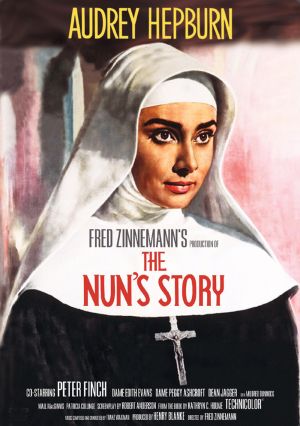
Lisa Watches An Oscar Nominee: The Nun’s Story (dir by Fred Zinnemann)


Nun_story

Happy Ash Wednesday!

So, earlier today, I got off work early so I could go to Noon Mass with my sister and we both got our ashes.  And I’m sure that will take some people by surprise because I’m not exactly the most faithful or devout of Catholics.  But what can I say?  I love the ornate ritual of it all.

And, as a part of my own personal ritual, I washed my forehead before I left the church.  Erin and I had a great vegetarian lunch at Cafe Brazil and then we came home and I turned on the TV and what should be finishing up on TCM but the 1959 best picture nominee, The Nun’s Story.  Fortunately, I had already set the DVR to record The Nun’s Story and so, on this most Catholic of days, I was able to watch this most Catholic of best picture nominees.

The Nun’s Story tells the story of Gaby (Audrey Hepburn), the daughter of a famous Belgian doctor (Dean Jagger).  At the start of the film, Gaby has entered a convent because she wants to become a missionary nursing sister in the Belgian Congo.  However, before Gaby can go to the Congo, she has to learn to give up her own rebellious streak and individual independence.  Taking the name Sister Luke, she excels at her medical training but, because it is felt that she is still too independently minded, she is not sent to the Congo but instead assigned to work in a mental hospital.  It’s there that her independent streak nearly gets her killed when she is fooled by a dangerous patient who claims to be the Archangel Gabriel.  It is only after she takes her final vows that Sister Luke is finally sent to the Congo and it is there that she’s forced to work with the abrasive agnostic Dr. Fortunati (Peter Finch).  Of course, as Sister Luke goes through her own spiritual struggles, the world inches closer and closer to the start of a second world war.  When war does break out, Sister Luke finds herself torn between her vow of obedience (which includes remaining political neutral) and the realities of living in a country that’s been occupied by the Nazis.

1959 was apparently a good year for religious films.  Not only did Ben-Hur win best picture, but The Nun’s Story also received 8 nominations.  Reportedly, The Nun’s Story was the most financially successful film to be released by Warner Bros, up to that point.  If Wikipedia is to be believed, it was also Audrey Hepburn’s personal favorite of the many movies that she made.

When seen today, probably the first thing that people notice about The Nun’s Story is that it’s extremely long and occasionally rather slow.  The film follows Gaby from the minute she enters the convent to the moment that she makes her final choice about whether to be obedient to herself or to her vows and, during that time, it examines every single detail of her life in glorious Technicolor.  A lot of emphasis is put on the rituals that Sister Luke goes through on her way to taking her final vows.  Now, if you’re like me, all of the rituals are fascinating to watch and produce a whole host of conflicting emotions.  Even as I found myself admiring Sister Luke’s dedication and her sacrifice, I still kept wondering — much as she did —  if it was all really worth giving up her independence.  But, I also have to admit that I found myself wondering if someone from a Protestant background would feel the same way.

To a certain extent, I really hate to say that you probably have to come from a Catholic background to truly enjoy any film.  But I certainly think that’s the case with The Nun’s Story.  But, even Protestants and skeptics will appreciate Audrey Hepburn’s wonderful lead performance.  She keeps this film grounded and makes her mostly internal conflict of faith compelling.  In a career that was full of great performance, this is one of Audrey’s best.

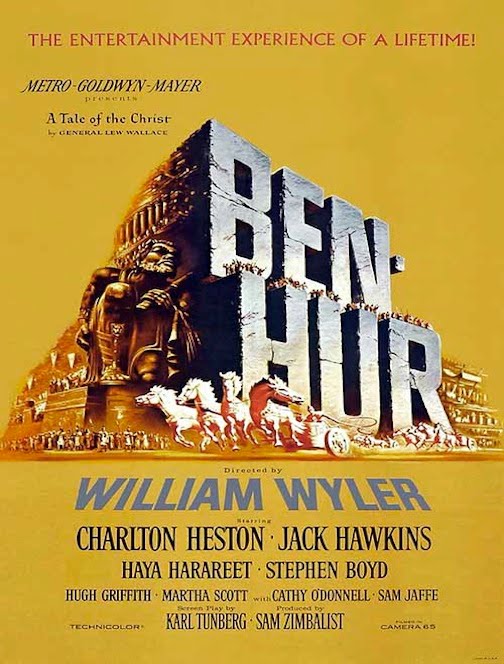
Lisa Watches An Oscar Winner: Ben-Hur (dir by William Wyler)


Ben-Hur

I’m actually kind of upset with myself because, at one point, I was planning on spending all of February watching TCM’s 31 Days of Oscars and reviewing all of the best picture nominees that showed up on the channel.  Unfortunately, I ended up getting busy with other things (like Shattered Politics, for instance) and it was only tonight that I finally got a chance to sit down and watch TCM.  Oh well, maybe next year! But for now, I’m just going to watch and review as much as I can before the month ends.

With that in mind, I just spent four hours watching the 1959 best picture winner Ben-Hur.

In many ways, Ben-Hur feels like a prototypical best picture winner.  It’s a big epic film that obviously cost a lot to produce and which features a larger-than-life star surrounded by a bunch of a memorable character actors.  It features two spectacular set pieces and some human drama that’s effective without being particularly challenging.  It’s a film that deals with big themes but does so in a rather safe way.  Perhaps not surprisingly, it’s a film that, today, is often dismissed as being old-fashioned and simplistic and yet it’s still a lot of fun to watch.

Opening with no less of an event than the birth of Jesus, Ben-Hur tells the story of Judah Ben-Hur (Charlton Heston), a wealthy Jewish aristocrat who, as a young man, was best friends with a Roman named Messala (Stephen Boyd).  When Messala is named as the new commander of the local Roman garrison, he is upset to discover that Ben-Hur is more loyal to his religion than to the Roman Empire.  Feeling personally rejected by his best friend (and perhaps more, as there are a lot of theories about the subtext of their relationship), Massala frames Ben-Hur for the attempted assassination of Judea’s governor.

Over the next 220 minutes, we watch as Ben-Hur goes from being a prisoner to a galley slave to the adopted son of a Roman general (Jack Hawkins) and finally one of the best chariot racers in ancient Rome.  Throughout it all, he remembers a mysterious man who once attempted to give him a sip of water.  Meanwhile, Ben-Hur’s family has been imprisoned and afflicted with leprosy.  Appropriately, for a film that opened with the Nativity, it ends with the Crucifixion, during which Ben-Hur’s struggle to save his family also comes to a climax.

Ben-Hur is undoubtedly flawed film.  (Among the film that were nominated for best picture of 1959, my favorite remains Anatomy of Murder.)  The film runs about an hour too long, some of the supporting actors give performances that are a bit too over-the-top, and the entire film is so reverential that in can be difficult for modern audiences, especially in this age of nonstop irony, to take it seriously.  In the lead role, Charlton Heston is always watchable and has a strong physical presence but you never quite believe that he’s the thinker that the script insists that he is.  There’s nothing subtle about Heston’s performance but, then again, there’s nothing subtle about the film itself.

And yet, if the film struggles to connect on a human level, Ben-Hur still works as a spectacle.  The gigantic sets and the ornate costumes are still impressive to look at.  The film’s two big action sequences — a shipwreck and the chariot race — are still exciting and thrilling to watch.  Ben-Hur may be dated but you can still watch it and understand why it was so popular with audiences in 1959 and, though I may not agree with a lot of the decisions, I can see why the Academy honored Ben-Hur with a record 11 Oscars.  It’s the type of spectacle that, in 1959, could only have been found on the big screen.  By honoring Ben-Hur, the Academy was honoring the relevance of the Hollywood establishment.

In the end, Ben-Hur may not hold up as well as some best picture winners but it’s still worth watching.

What Lisa Watched Last Night #113: Back to School Mom (dir by Christopher Erskin)


Last night, I watched the latest Lifetime original film, Back to School Mom.Back To School Mom

Why Was I Watching It?

Well, first off, it was the latest Lifetime film and I’m making it a point to see all of 2015’s Lifetime films.  However, I also watched it because the title — Back to School Mom — made the film sound like it would be something that would totally bring out my snarky side.

(Amazingly enough, it turned out I was wrong…)

What Was It About?

This is the type of movie that, had it been made in the 1950s, probably would have starred Lana Turner and Tab Hunter.  Mary Thomas (Kimberly Elise) is a singer who has performed all over the world but she’s haunted by the fact that, 21 years ago, she dropped out of college and abandoned her newborn son.  When Mary returns to school to finish up her degree, she is shocked to discover that her tutor, aspiring lawyer Noah (Denzel Whitaker), is also her son.  Without revealing the truth about how they’re related, Mary befriends Noah and is soon encouraging him to defy his father (Harry Lennix) and pursue a career in music.

What Worked?

To be honest, I was surprised by how well this movie worked.  Snarkable name aside, Back To School Mom turned out to be a very nice and very sweet movie.  Kimberly Elise was very sympathetic in the lead role and she had a lot of chemistry with the entire cast.  Denzel Whitaker’s multi-layered performance shows that he deserves to be a huge star.

What Did Not Work?

They probably could have come up with a better title but otherwise, the entire film worked.

“Oh my God!  Just like me!” Moments

None, but that’s okay.  Not every movie has to be about me.

Lessons Learned

Sometimes, you can’t judge a movie by its title.

Film Review: Fifty Shades of Grey (dir by Sam Taylor-Johnson)


FSG_31_5_Promo_BW_3F.indd

If there’s anything that’s obvious from looking over some of the reviews of Fifty Shades of Grey, it’s that only after you’ve read the book can you properly appreciate the film.

If you haven’t read the book, you’ll probably watch the film and dismiss it as being a draggy film that has some truly terrible dialogue and which features two actors who look good naked but who have absolutely no chemistry.  You might appreciate that fact that Dakota Jonson, at the very least, appears to be trying to give a good performance.  You might even acknowledge that director Sam Taylor-Johnson manages to capture a few pretty images.  You might even be happy that she resisted the temptation to cast her husband, Aaron Taylor-Johnson (a.k.a., the least interesting bankable actor working today), in the role of Christian Grey.  But, even with all of that, you’ll probably still probably watch the film and, even with its artfully composed and shot sex scenes, think to yourself, “That was two hours of my life that I’ll never get back.”

However, if you have read the book, then you will be capable of watching the film and understanding that, as flawed as it may be, 50 Shades of Grey probably should have been a thousand times worse.  It may seem weird to praise Sam Taylor-Johnson for managing to create a below average film but, considering her source material, below average is probably the best that could be hoped for.

Both the film and the book tell the same basic story.  Anastasia Steele (Dakota Johnson) is a 21 year-old English lit major.  We know that she’s intelligent because she knows the difference between Thomas Hardy the writer and Tom Hardy the actor.  We know that she’s innocent because, the first time that she interviews Christian Grey, she wears a sweater.

As for Christian Grey (Jamie Dornan), he’s a 28 year-old multibillionaire.  We are constantly assured that he’s the most interesting man in the world, despite the fact that he actually seems to be rather dull.  He likes Ana.  She likes him.  But Christian doesn’t do the relationship thing.  Instead, he explains, “I fuck.  Hard.”  (As opposed to doing so limp…)  He’s not interested in having a “vanilla” relationship with Ana.  Instead, he wants her to sign a contract in which she’ll agree to be his submissive.

That’s right — Christian claims to be into BDSM.  And, in order to prove that point, he has a red dungeon that’s full of stuff that he apparently picked up at a BDSM yard sale.  The dungeon’s red, of course.  In both the book and the film, a good deal of time is spent attempting to explain BDSM and, in both cases, you’re left with the feeling that Christian got most of his knowledge from reading Wikipedia.  In many ways, Christian comes across like someone who has never had a drink pretending to be drunk.  He tries really hard but … no.

Anyway, a lot of the film comes down to Christian trying to get Ana to sign a contract.  Ana agrees to give up her freedom.  When she asks what she gets in return, Christian replies, “Me.”  Which, if Christian was being played by Ryan Gosling or Michael Fassbender, might be an incentive.  But instead, he’s being played by Jamie Dornan who, quite frankly, looks embarrassed to be there.

Those who have read the book will be pleased to discover that Christian’s immortal line of “I’m fifty shades of fucked up!” has been included in the film.  Dornan delivers it like an actor who has given up and who can blame him?  To her credit, Dakota Johnson manages to keep a straight face.

Here’s the main problem.  Christian Grey is a stalker asshole.  He’s an obsessive control freak who is basically using the BDSM lifestyle as a way to cover up the fact that he’s a sociopath.  Though that was not author E.L. James’s intention when she wrote the book, that’s who Christian Grey ultimately turns out to be.  And that’s the way that Jamie Dornan plays the character.  It’s not that Dornan is a bad actor.  Just watch him in The Fall and you’ll see that Dornan is capable of giving a very good performance.  Instead, you just get the feeling that he looked at the 50 Shades script, saw that Christian was an impossible character to play sympathetically, and decided to give the most literal performance possible.  When you were reading the book, you could always imagine some redeeming features for Christian.  But, when you watch the movie, you’re forced to accept this very literal interpretation of the character and it quickly becomes apparent that the only reason why anyone would possible love Christian is because he’s rich.

Meanwhile, in the role of Ana, Dakota Johnson actually does a pretty good job.  Fortunately, the film jettisons Ana’s narration and we don’t have to hear any details about what her inner goddess is doing while being ordered around by Christian.  As a result, Johnson’s interpretation of Ana is far different from how the character was portrayed in the book.  Whereas the book’s Ana seems to be desperate to be loved by Christian, Johnson’s Ana often seems to be struggling to keep a straight face.  Whereas the book’s Ana took the whole contract thing very seriously, Johnson’s Ana always seems to be on the verge of rolling her eyes.  It gives the film an interesting subtext in that you never quite believe that Johnson’s Ana could be as intrigued by Christian Grey as both the book and the film insist that she is. Instead, she mostly seems to put up with him and his kinks because he buys her expensive gifts.

And, since Christian is such a jerk, you really don’t mind the possibility that Ana’s main motivation might be materialistic.

(Another great thing about Dakota Johnson is that she seems to be sincerely embarrassed whenever she has to tell anyone that her name is “Anastasia Steele.”)

Finally, a word about Sam Taylor-Johnson.  On the basis of Nowhere Boy, she’s a talented director and, as far as 50 Shades of Grey goes, I think she does the best that she could possibly do.  At the very least, she seems to realize that the film is a bit ludicrous and she wisely plays some of the book’s worst moments for subversive laughter.  Considering that 50 Shades of Grey is one of the worst books ever written (and, by that, I mean that the book’s prose is so clunky and overdone that it’s damn near unreadable), Sam Taylor-Johnson probably does deserve some credit for making a movie that’s only below average as opposed to disastrous.  At the very least, I hope that 50 Shades of Grey will not damage her career in the way that Twilight damaged the equally talented Catherine Hardwicke’s.

I forced my boyfriend to see it with my on Valentine’s and there were a lot of couples in the theater.  But, for all the talk of how 50 Shades of Grey launched a thousand fantasies, it’s not a particularly erotic film.  The sex scenes are well shot but, since Jamie and Dakota have no chemistry, they also feel very clinical and detached.  (Add to that, for a film that’s being identified as being a chick flick, the camera spent a lot more time lingering on Dakota’s naked body than on Jamie’s.)  All the sex that followed couples viewing 50 Shades on Saturday night had more to do with the romance of Valentine’s Day and the glory of being in love than with the film itself.

(That, of course, is one of the huge differences between 50 Shades of Grey and Magic Mike.)

50 Shades of Grey apparently made a lot of money this weekend and, if you’re reading this review, chances are that you’ve already seen the film.  So, I’ll just conclude by saying that the film is not as bad as most people were expecting.  It’s just not particularly any good either.  I’ll be looking forward to seeing what Dakota and Sam Taylor-Johnson do in the future but Christian Grey can just stay in his red room for all I care.

(And now that you’ve read the review, why not have some real fun and check out the Fifty Shades of Grey text generator!?  Click on refresh a few times and you’ll have an erotic best seller of your own, ready to be published and to make you rich!)
50 Shades of Obsession: The Boy Next Door and Bound


Happy Valentine’s Day!

Okay, I know.  It’s not Valentine’s Day yet.  But it will be soon.  50 Shades of Grey is opening tomorrow and I have a feeling that, come November, there will be hundreds of newborn babies being named Christian and Anastasia.  (And, in a few years, they’ll all have teenage babysitters named Bella…)

However, in case you can’t get into 50 Shades of Grey, here’s two other films that you could possibly watch on Valentine’s Day.  Much like 50 Shades, they both involve a woman having sex with a manipulative sociopath.  The Boy Next Door is still in theaters while Bound has just been released on video.

And they’re both reviewed below!
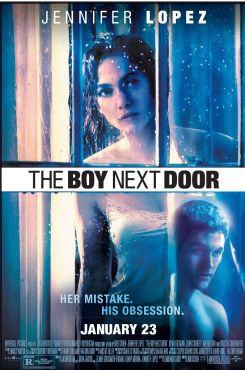
The-Boy-Next-Door-2015

The Boy Next Door, which was released towards the end of January, was the first film of 2015 that I was really excited about seeing.  That’s not because I thought that the film was going to be any good.  Instead, it was because I literally couldn’t watch any movie on Lifetime without seeing about a dozen commercials for The Boy Next Door.  The commercials promised a lot of cheap thrills and sordid melodrama.

Anyway, my BFF Evelyn and I saw The Boy Next Door on the weekend that it was first released and we had a great time watching it.  Though the film may start slow, it eventually becomes a minor triumph of so-bad-its-good filmmaking.  This is the type of film that you would normally expect to see going straight to cable but, somehow, it managed to get a theatrical release.  Making it all the more fun is the fact that it stars Jennifer Lopez, playing the type of role that you would normally expect to see Jennifer Love Hewitt or Elizabeth Berkley playing in a Lifetime movie.

Jennifer Lopez plays an AP English teacher who has recently separated from her adulterous husband (John Corbett).  When a teenage boy (Ryan Guzman) moves in next door and starts standing naked in front of his bedroom window, can you really be surprised that he and Lopez end up spending one night making torrid love?  Well, unfortunately, Guzman turns out to be a bit obsessive and, when the new school year begins, he suddenly shows up as one of Lopez’s students.  And you can probably guess what happens from there…

As directed by Rob Cohen, there’s really nothing surprising or interesting to be found in The Boy Next Door but we still had a lot of fun watching it, if just because it gave us an excuse to be snarky.  Ryan Guzman was undeniably hot and, wisely, Jennifer Lopez didn’t seem to be taking the film that seriously.  The great Kristin Chenoweth showed up as Lopez’s best friend and the film’s climax was appropriately over the top.

And, three weeks after seeing the film, Evelyn and I are still laughing about the scene where Guzman gives Lopez a gift, a copy of The Illiad.   Looking down at the book, J. Lo says, “Oh!  A first edition!”  Evelyn and I were just like, “Really?  So, that book’s from 760 B.C!?”  Seriously, did the character have a time machine?

Now, that would have made for an interesting movie!

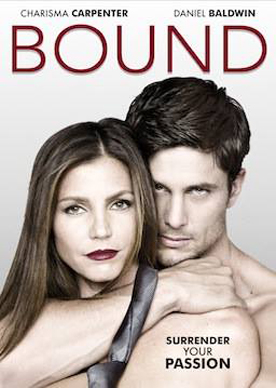
Bound

If, for some reason, you can’t find a theater showing 50 Shades of Grey this weekend, I would suggest instead watching the Asylum’s mockbuster version, Bound.  

(Personally, I would have titled the film 50 Shades of Charisma but anyway…)

In Bound, Charisma Carpenter plays Michelle, a real estate broker who has an unsatisfying sex life and who finds herself regularly being bullied by her boss (Daniel Baldwin).  However, Michelle then meets Ryan (Bryce Draper), who is young, handsome, rich, and very much into domination  He even has a red room in his mansion where…

Oh wait, does this sound familiar?

Okay, so Bound pretty much tells the same story as 50 Shades of Grey but there are a few significant differences.  A big one is that, as played by Carpenter, Michelle is a much stronger character than Anastasia Steele.  For one thing, she’s not an innocent and naive girl being introduced to sex for the first time by a charming sociopath.  Instead, she’s significantly older than Ryan, which also brings an interesting dynamic to the film.  Michelle’s not a virgin, she doesn’t say things like “jeez” or “oh my,” and she’s capable of getting aroused without obsessing about what her inner goddess is doing as a result.  And, while her relationship with Ryan does head in a similar direction as Anastasia’s relationship with Christian Grey, Michelle never seems weak as a result.  Instead, she’s experimenting and there’s no way you can’t root for her as you watch the movie.

(Ryan, meanwhile, is ultimately portrayed as being the type of manipulative sociopath that Christian Grey would be in real life.)

Perhaps my favorite part of the film was Michelle’s relationship with her teenage daughter, Dara (Morgan Oberender).  The two actresses play off each other well and, from the minute they first interacted, I believed that they could be mother and daughter.  They’re relationship felt real and, as a result, you cared about both of them and found yourself hoping that things would work out for the best.  And, as a result, it made one of the film’s final plot twists feel very immediate and real.

Bound is the type of film that will be (and has been) dismissed by a lot of mainstream critics but it deserves more consideration than it’s been given.

Shattered Politics #94: Persecuted (dir by Daniel Lusko)


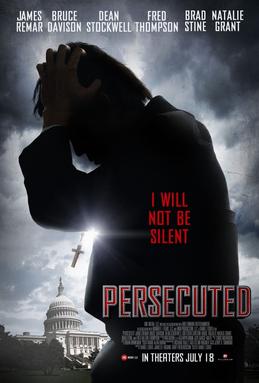
Persecuted-2014-poster

It may seem strange that I would choose to end my series of reviews of films that feature politics and politicians by reviewing Persecuted, an obscure film from 2014.  After all, Shattered Politics started out with D.W. Griffith’s Abraham Lincoln.  Over the past three weeks, I’ve reviewed everything from Mr. Smith Goes To Washington to The Phenix City Story to Dr. Strangelove to The Godfather to Nashville to Once Upon A Time In America to The Aviator.  I have been lucky enough to review some of the greatest films ever made.  And now, at the end of this series, I find myself reviewing Persecuted, a film that has a score of 0% over on Rotten Tomatoes.

Consider that for a moment.

As I sit here typing out this sentence, not a single critic has given Persecuted a good review.  And I will admit right now that I’m not going to be the first.  Persecuted is cheap-looking, heavy-handed, melodramatic, histrionic, foolish, silly, preachy, predictable, strident, and just about every other possible criticism that comes to mind.  If the film is redeemed by anything, it’s that it is full of good actors who do the best that they can with characters that are either seriously underwritten or ludicrously overwritten.

Persecuted takes place in the near future.  Sen. Donald Harrison (Bruce Davison) has written something called the Faith and Fairness Act, which would basically require churches to provide equal time to other religions and would make it illegal to suggest that only one religion has all the answers.  How exactly that would work, I’m not sure.  However, a big part of Harrison’s bill is that, in exchange for giving up any claim to having all the answers, churches will now get money from the federal government.  As a result, a lot of church leaders have sold out and announced their support for the bill.

However, evangelist John Luther (James Remar) refuses to support the bill.  As we’re told when Luther first appears, he’s a recovering alcoholic and drug addict who used to be a professional gambler.  But then he found faith and he’s now the most popular man in the country.  Or, at least, he is until he’s drugged by the government and framed for murdering a prostitute.

So now, Luther is on the run.  He has to evade capture, prove his innocence, and reveal the truth about Harrison and his shadowy backers.  Helping Luther out is his father, an Episcopalian priest who is played by former real-life Presidential candidate Fred Thompson.  (Thompson, incidentally, is a very good actor and brings a lot of conviction and authority to his role.)  Not helping Luther are the former leaders of his church, one of whom is played by character actor Dean Stockwell.

I’ll admit right now that, as familiar and talented as all four of them may be, James Remar, Bruce Davison, Fred Thompson, and Dean Stockwell are hardly big stars and you really can’t blame any of them for presumably taking a job strictly for the money.  That said, it’s still odd to see such good actors appearing in a film like Persecuted and they all deserve at least a little bit of credit for doing their best with the material that they had to work with.  However, my favorite performance came from Brad Stine, who plays glib preacher who betrays Luther.  Stine is just so sleazy and hyperactive that he’s a lot of fun to watch.

Now, while Persecuted is obviously a faith-based film, it’s plot actually has more in common with the paranoia movies of the 70s than it does with Left Behind.  John Luther is a guy who knows the truth and has been framed as a result and he spends nearly the entire film on the run.  If anything, this is a film that will probably appeal more to conspiracy theorists than to Christians.  But, judging from the film, the conspiracy that’s trying to destroy John Luther doesn’t appear to be very competent.  How else do you explain that John Luther — the most famous man in the world — manages to easily evade capture despite the fact that he spends most of the film wandering around in broad daylight with dried blood on his face.  At one point, he even calls his wife and has a conversation with her.  “Ah!” I thought, “this is where we’ll discover that the conspiracy is listening in on the conversation!”  But no, that didn’t happen.  In fact, his wife talked to him while, in the background, two cops searched their house.  “The police are looking for you,” the wife says but neither one of the police officers seems to hear her.  Apparently, it didn’t seem to occur to any of them that John Luther might call his wife.  For a paranoia film to work, you have to feel like the film’s hero is in constant danger and Persecuted never succeeded in doing that.  How can anyone be scared of a conspiracy that can’t even handle the basics?

Persecuted is not a good film but, in its own unfortunate way, it is a relevant one.  Much as how the first film I reviewed for Shattered Politics, D.W. Griffith’s Abraham Lincoln, told us a lot about America in the 1930s, Persecuted tells us a lot about how America is viewed by its citizens in the 21st Century.  Persecuted is a film that insists that our leaders can’t be trusted, that your friends will betray you if ordered to do so by those in authority, and that everything bad will come disguised as something good.  It’s not exactly an optimistic view of politics or America but then again, these are the times that we live in.  It’s been a long time since Billy Jack went to Washington.  It’s been even longer since Mr. Smith first showed up.

Now, instead, all we have is Bruce Davison telling us, “You thought you were bigger than the system and you’re not!”

And, on that note, Shattered Politics comes to an end!  I’ve had a lot of fun writing this series of 94 reviews and I hope that you’ve enjoyed reading them!  If there’s any conclusion that I think can be drawn from these 94 films, it’s that politicians will always betray you and politics will always depress you but movies will always be there to lift you back up.

If I had to choose between voting and watching a movie, I would pick a movie every time.  Fortunately enough, I live in a country where I am allowed to do both.

Shattered Politics #93: American Hustle (dir by David O. Russell)


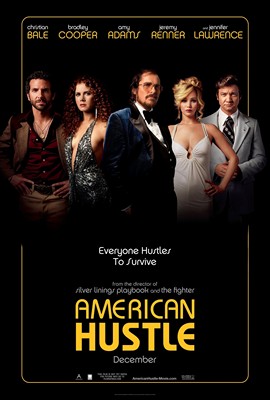
American_Hustle_2013_poster

“Some of this actually happened.”

— Opening Title of American Hustle (2013)

I have always been surprised by how much some people hate the 2013 best picture nominee, American Hustle.  Even two years after the film was first released, you’ll still find people whining that the film felt like David O. Russell’s attempt to remake Goodfellas (yes, I have actually seen more than a few people online making this idiotic claim) or claiming that the movie was overrated or that there wasn’t anyone in the film that they could root for.  While every film has its detractors, I’m always a little bit taken aback by just how passionately some people dislike this film.

Some of it, of course, is because the film that beat American Hustle for best picture was the universally acclaimed 12 Years A Slave.  As hard as it may seem to believe now, there were a lot of people who thought that American Hustle might actually beat 12 Years A Slave.  Strangely enough, a lot of online film bloggers tend to take a Manichaen approach to the Oscars, viewing each year’s race in terms of good and evil. The film that they want to win represents good and, therefore, every competing film must represent evil.  It’s a pretty stupid and immature way of looking at things but, then again, the stupid and immature approach has worked pretty well for Sasha Stone and Ryan Adams over at AwardsDaily.com so who am I to criticize?

Of course, I don’t think it’s a coincidence that the majority of American Hustle‘s most strident online critics have been male.  I imagine that they watched the film and, in Amy Adams and Jennifer Lawrence, they saw every unresolved crush of their adolescence.  When Amy Adams successfully fooled Christian Bale and Bradley Cooper, these critics saw themselves being fooled.  When Jennifer Lawrence called Bale a “sick son of a bitch,” these critics felt that they were being called a sick son of a bitch.  American Hustle is a film about men who don’t know how to talk to women and that probably struck a little too close to home for a lot of those online critics.

(I imagine that the majority of online American Hustle haters probably preferred Rooney Mara’s version of the Girl with the Dragon Tattoo to Noomi Rapace’s.)

Of course, the truth of the matter is that American Hustle was one of the best films of a very good year.  Of all the films nominated for best picture of 2013, American Hustle was my personal favorite.

Based, very loosely, on true story, American Hustle is a period piece.  It takes place in the late 70s, which of course means that we get a lot of great music, a scene in a disco, and clothes that are both somehow ludicrous and to die for at the same time.  It’s a glamorous film about glamorous people doing glamorous and not-so-glamorous things and how can you not love that?

Irving (Christian Bale, giving a brave performance) is a generally nice guy who also happens to be a con artist.  His unlikely partner is Sydney (Amy Adams), a former stripper turned Cosmo intern.  When Sydney is working with Irving, she takes on a totally different identity and tells people that she’s Lady Edith Greensly, a British aristocrat who has international banking connections.  When Sydney plays Edith, she speaks in a posh British accent and what’s interesting is that her accent is often (deliberately) inconsistent.  However, as Irving points out, it doesn’t matter whether her accent is a 100% convincing or not.  What’s important is that people want her to be Lady Edith Greensly and people will make excuses for almost anything as long as it confirms what they want to believe.

Eventually, Irving and Sydney are arrested by ambitious and highly strung FBI Agent Richie DiMaso (Bradley Cooper).  Richie, who spends a good deal of the film with curlers in his hair, lives with his mother and has a boring fiancée who he doesn’t seem to like very much.  (Richie is also briefly seen sniffing coke, which might explain a lot of his more extreme behavior.)  Richie wants to make a name for himself and he views Irving and Sydney as his way to do so.  He blackmails them into helping him set up and arrest crooked politicians and businessmen.  Richie also finds himself growing obsessed with Sydney, who he believes to be English even after she tells him that she isn’t.

All of this eventually leads to Irving and Richie setting up the Mayor of Camden, New Jersey, Carmine Polito (Jeremy Renner).  Polito, who may be corrupt but who also seems to sincerely care about helping the citizens of his town, wants to revitalize gambling in Atlantic City.  Irving and Richie introduce him to FBI agent Paco Hernandez (Michael Pena), who is disguised as Sheik Abdullah and who they claim is interested in investing in Carmine’s plans.  This, of course, leads to a meeting both with a local Mafia don (Robert De Niro) and with several politicians who agree to help out the Sheik out in exchange for money.

(And no, the film did not lie.  This is based on a true story, believe it or not.)

Complicating things is the fact that Irving himself comes to truly like the generous and big-hearted Carmine and how can you not?  When the film was first released, Jeremy Renner was a bit overshadowed by Bale, Cooper, Adams, and Jennifer Lawrence.  However, Renner gives the best performance in the film, playing Carmine with a disarming mix of innocence and shrewdness.  He’s the type of guy who is smart enough to walk out on the first meeting with the fake sheik’s associates but who is still naive enough that he can be charmed by Irving.  When the fake sheik gives Carmine an equally fake knife as a gift, the look of genuine honor on Carmine’s face is heart-breaking.

The other big complication is Irving’s wife, Rosalyn (Jennifer Lawrence).  Rosalyn is jealous, unstable, unpredictable, and, in her own way, one of the smarter people in the film.  She’s also a bit of pyromaniac and, when she accidentally blows up a new microwave, you’re really not surprised.  (And, when Rosalyn starts to obsessively clean the house while singing Live and Let Die at the top of her lungs, I felt like I was watching a blonde version of myself.)  When Rosalyn starts to have an affair of her own, it leads to American Hustle‘s satisfying and twisty conclusion.

(Again, a lot of the same online toadsuckers who irrationally hate American Hustle seem to hold a particular contempt to Jennifer Lawrence’s performance in this film, as if to acknowledge that Lawrence — as always — kicks ass would somehow be a betrayal of Lupita Nyong’o’s award-winning performance in 12 Years A Slave.)

Don’t listen to the haters.  American Hustle is a great film, a stylish and frequently funny look at politics, corruption, and the ways that people con themselves into believing what they want and need to be true.

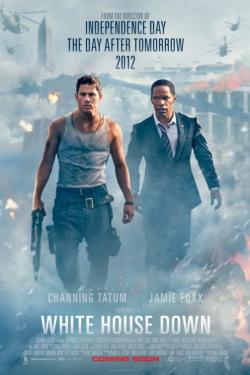
Shattered Politics #92: White House Down (dir by Roland Emmerich)


White_House_Down_poster_with_billing_block

To say that the 2012 film White House Down is stupid is probably unnecessary.  After all, the film was directed by Roland Emmerich and Emmerich specializes in making stupid films.

And, in many ways, White House Down is prototypical Emmerich film, a long and self-important collection of mayhem and heavy-handed pontification.  In the case of this film, liberal President Sawyer (Jamie Foxx) is pushing for a treaty that will magically bring about world police.  Naturally, a bunch of evil right-wingers (including characters played, somewhat inevitably, by James Woods and Richard Jenkins) don’t want world peace so they hire a bunch of mercenaries who attack the White House.  It’s all a part of a plot to force Sawyer to launch a nuclear attack on Iran because … well, why not?  Fortunately, aspiring secret service agent (and kick-ass combat veteran) John Cale (Channing Tatum) is there to work with the President and save the country.

And, since Emmerich is from the bigger is always better school of filmmaking, many familiar landmarks are blown up and it takes the film well over two hours to tell its simplistic story.  To be honest, if your action movie can’t get the job done in under two hours, then you’re going to have problems.  Once a viewer has spent two hours watching one movie, it’s inevitable that he or she will start to question the film’s logic.  If the film’s clever enough, all lapses and inconsistencies can be forgiving.  If the film is White House Down, it’s a lot less easy to be forgiving.

Of course, from a political point of view, Emmerich tries to have it both ways.  For anti-government types like me, it’s always fun to watch Washington D.C. blow up.  For those on the right, White House Down presents a situation that can only be solved by heroes with guns.  And, of course, Democrats can view White House Down as wish fulfillment, an alternative timeline where Barack Obama actually is as sincere and effective as they wish him to be.

In fact, if anything saves White House Down, it’s the chemistry between Foxx and Tatum.  Wisely, neither one of them appears to be taking the film that seriously and both of them seem to be having a lot of fun blowing things up.  Channing Tatum, in particular, deserves some sort of award.  How many bad films have been made tolerable by Tatum’s willingness to laugh at himself?  I’ve lost count but White House Down definitely benefits from his presence.  He and Foxx make Emmerich’s style of filmmaking as tolerable as it will ever be.

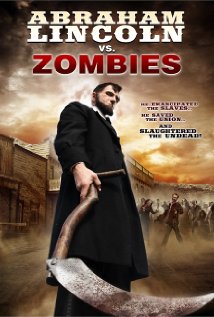
Shattered Politics #91: Abraham Lincoln vs. Zombies (dir by Richard Schenkman)


Abraham_Lincoln_vs._Zombies_(movie_poster)

Well, here we are!  Last month, I started the process of watching and reviewing 94 movies about politics and politicians.  I started Shattered Politics with D.W. Griffith’s 1930 film Abraham Lincoln and now, three weeks later, we’ve reached the final day of Shattered Politics.  We have four more films to review and what better way to start things off than by taking a look at yet another films about Abraham Lincoln.

Now, I’ve previously reviewed three films about Abraham Lincoln.  I’ve reviewed D.W. Griffith’s creaky 1930 version.  I’ve reviewed Henry Fonda as Young Mr. Lincoln.  And, of course, I’ve reviewed Daniel Day-Lewis in Steven Spielberg’s Lincoln.  And, on the very site, reviews of Abraham Lincoln: Vampire Hunter have been posted by both Arleigh and Ryan The Trash Film Guru.  (For the record, I’ve also reviewed The Lincoln Lawyer and The Conspirator. So there.)  That’s a lot of films about Abraham Lincoln and why not?  He’s our greatest President.  He freed the slaves, he won the Civil War, and, ultimately, he was the first President to be martyred by assassination.

However, when one considers all of those films about Abraham Lincoln, it’s hard not to notice that none of them featured zombies.  And, considering how much we love zombies here at the Shattered Lens, that has always struck me as being a major oversight.

So, thank God that, in 2012, the Asylum released a film called Abraham Lincoln vs. Zombies.

For that matter, thank God for the Asylum.  Mainstream critics and snarky blogger types love to criticize Asylum-produced films but you know what?  Nobody makes films quite like the Asylum.  Quite frankly, people who attack an Asylum film for having a low-budget or for being over the top are missing the point.  Asylum films are supposed to be fun.  They’re the type of films that are meant to be watched with a group of your closest and funniest friends.  At their best, Asylum films are movies that you laugh with as opposed to laughing at.

As far Abraham Lincoln vs. Zombies is concerned, everything you need to know about the film is right there in the title.  The film opens with young Abe Lincoln decapitating his zombified mother and then jumps forward several decades.  Abe Lincoln (played, with a lot of gravity and melancholy by the excellent Bill Oberst, Jr.) is now President.  When he discovers that a zombie outbreak has occurred at Fort Pulaski, Lincoln takes a break from writing the Gettysburg Address and leads a group of secret service men down to the fort.  With the help of Gen. Stonewall Jackson (Don McGraw), young Teddy Roosevelt (Canon Kuipers), future lawman Pat Garrett (Christopher Marrone), and a handsome, alcoholic Southern actor who is using the name John Wilkinson (Jason Vail), Lincoln kills a lot of zombies and even reunites with a former lover (Rhianna Van Helton).

And, seriously, you have to love a film that features Abraham Lincoln using a scythe to chop off the heads of the undead.  If you’re watching a film like this and you’re worrying about narrative logic or historical accuracy, then you may be taking life a little bit too seriously.  The title promises Abraham Lincoln and zombies.  And the film totally delivers.

And how can you not appreciate that?

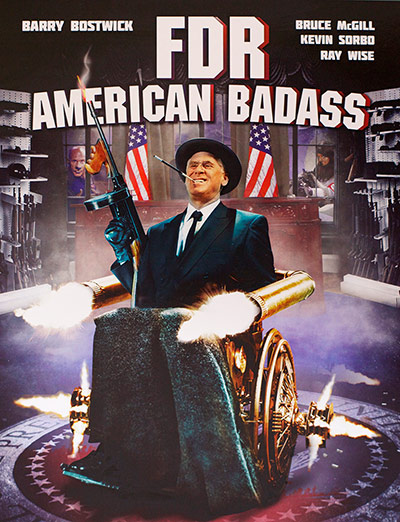
Shattered Politics #90: FDR: American Badass! (dir by Garrett Brawith)


FDR-American-Badass-movie-poster

So, as I was thinking about Hyde Park On Hudson, I started to ask myself: what would have made that movie better?  Obviously, the script could have been improved.  Bill Murray could have had some better lines.  Laura Linney could have been a bit less bland.  The direction could have been a bit more dynamic…

And of course, the film could have used a few more werewolves.  Maybe not a huge amount of werewolves because, after all, you do want to keep things plausible.  But, at the same time, a werewolf or two would have livened things up.

And then I thought about Sunrise at Campobello and I realized that film was also missing something.  Once again, the film could have used some werewolves.

“My God,” I thought, “aren’t there any filmmakers out there willing to combine Franklin Roosevelt with werewolves!?”

And then, I realized that there was!

The 2012 film FDR: American Badass! features Barry Bostwick in the role of Franklin D. Roosevelt.  At the start of the film, Roosevelt is the dynamic and athletic governor of New York.  However, while out jogging one day, Frank is attacked by a werewolf and ends up contracting polio as a result.  Recovering in the hospital, Roosevelt decides to run for President and kill werewolves.

Over the course of the film, he does just that.  And, when it turns out that the leaders of the Axis Powers are all werewolves as well, FDR single-handedly wins World War II.  Fortunately, with the help of Albert Einstein, FDR gets his wheelchair equipped with all the latest weaponry.

And did I mention that, as President, FDR smokes weed with Abraham Lincoln (Kevin Sorbo)?  Because he so totally does…

So, at this point, you’re probably already getting the feeling that FDR: American Badass! is kind of a weird film.  And it is.  But what makes the film better than you might think is the fact that it totally commits itself to making no sense.  FDR: American Badass! is full of scenes that are alternatively hilarious, disgusting, and offensive but it works because, unlike something like A Million Ways To Die In The West, FDR: American Badass! is at least creative in its stupidity.  Say what you will about the idea of FDR killing werewolves, the fact of the matter is that there’s only one film where you can actually see that happen.

So, should you see FDR: American Badass?

Go back and read the film’s title.

Did it make you roll your eyes and say, “Oh my God, that is so stupid?”  If so, you’ll probably have a similar reaction to the film itself.

On the other hand, did the title make you smile?  If so, you’ll probably find something to enjoy in this movie.

At the very least, FDR: American Badass! is better than Hyde Park on Hudson.