Lisa Reviews An Oscar Nominee: Bound for Glory (dir by Hal Ashby)


Bound_for_glory_Poster

One of my favorite online film reviewers is Mitch Lovell of the Video Vacuum.  The thing I like about Mitch is that he doesn’t worry about how many Oscars a film has been nominated for or whether or not a film’s politics are currently in fashion.  Unlike a lot of online reviewers, he doesn’t worry about whether or not he’s going against the “accepted” views of the critical establishment.  Instead, he’ll watch a film and tell you exactly how he felt about it.

For example, Mitch Lovell’s review of the otherwise critically acclaimed 1976 best picture nominee Bound for Glory can be summed up in three words: “boring as fuck.”  Every other online review that I’ve found for Bound for Glory offers up polite but rarely inspiring praise for this rather lengthy film about the folk singer Woody Guthrie.  Most of those reviews do acknowledge that the film moves at its own pace but we are told that we will be rewarded for being patient.  If the review was written after 2010, you can be sure that the reviewer will be sure to say that Bound for Glory reminds us of why labor unions are still important and need to be protected from the Tea Party.  (The idea apparently being that, if a film has the right politics, it doesn’t have to actually be all that interesting.)  It’s all rather predictable and that’s why we’re lucky to have reviewers like Mitch Lovell around.  Whether you agree with him or not, it’s good to have a reviewer who will go against the conventional wisdom.

I recently watched Bound for Glory as a part of TCM’s 31 Days of Oscars and, to a large extent, I have to agree with Mitch Lovell’s review.  This is a movie that is not only long but which moves slowly as well.  It’s not that the film has a deliberate pace.  It’s just slow!  (If you want to see a film that makes good use of a deliberate pace, check out Barry Lyndon.)  David Carradine plays Woody Guthrie, a sign painter who, during the Great Depression, abandons his family in Texas and, by hopping trains, makes his way to California.  He works with fruit pickers.  He tries to convince his fellow workers to form a union.  He gets beat up a lot.

And he plays his guitar.

If there’s anything that remains consistent about Bound for Glory, it’s that Woody is always playing his guitar and that every time he starts to play, something terrible either has happened or does happen.  There’s a huge dust storm.  Woody plays his guitar.  A fight breaks out at a union meeting.  Woody plays his guitar.  A bunch of hoboes on a train get beat up.  Woody plays his guitar.  Woody shows up at a textile mill and starts to play his guitar.  He gets beaten up by a bunch of thugs.  Woody impresses Pauline (Gail Strickland) by playing his guitar and soon, he’s cheating on his wife.  Woody partners up with another folk singer, Ozark Blue (Ronny Cox), and they get their own radio show where Woody plays guitar.  Woody promptly gets fired.

It quickly became apparent to me that Woody Guthrie’s guitar was cursed.  Whenever he played it, poor people ended up getting oppressed.

In many ways, Bound for Glory is a prototypical example of what it means to be an acclaimed-at-its-time-but-subsequently-forgotten best picture nominee.  It’s a big epic film that tells a fictionalized account of a real person’s life story.  Woody Guthrie is best known for writing This Land Is Your Land, which is a song that I mostly associate with pretentious super bowl commercials.  As Bound for Glory details, Woody was also a union organizer and political activist but what’s odd is that the film keeps the exact details of what he believed rather vague.  We’re given the general idea of what Woody believed but we’re not given any specifics.  As a result, Woody just comes across like another part-time social protestor as opposed to being a true political thinker (much less a revolutionary).

On a positive note, Bound for Glory is impressive to look at.  The film’s cinematographer was the famous Haskell Wexler (who also directed Medium Cool, a film that was as upfront about its politics as Bound for Glory is vague) and Wexler captures some hauntingly beautiful images of the American wilderness.  The scene where a gigantic wall of dust crashes down onto a small Texas town is especially memorable.

Otherwise, though, Bound for Glory is pretty much a snoozefest.  It was nominated for best picture of 1976 and, when you compare it to fellow nominees like All The President’s Men, Network, Taxi Driver, and even Rocky — Bound for Glory does feel a bit out of place.

Then when you consider some of the other films that came out in ’76 — Carrie,  Face to Face, The Front, God Told Me To, Logan’s Run, The Man Who Fell To Earth, Marathon Man, The Omen, The Outlaw Josey Wales, Lipstick, Robin and Marian, The Sailor Who Fell From Grace With The Sea, and The Town That Dreaded Sundown — the nomination of Bound for Glory feels like even more of a mistake.

Oh well.

Occasionally, the Academy gets it wrong.

Shocking, I know.
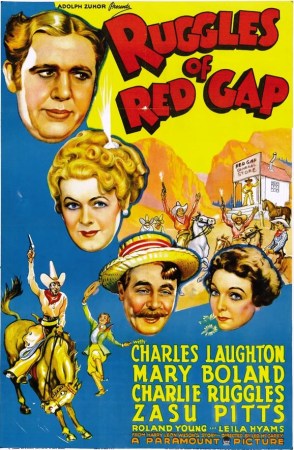
Lisa Watches An Oscar Nominee: Ruggles of Red Gap (dir by Leo McCarey)


Ruggles_of_red_gap

After watching Barry Lyndon, I decided to continue to explore my DVR by watching another film that was shown as a part of TCM’s 31 Days of Oscar.

First released way back in 1935, Ruggles of Red Gap was nominated for best picture but it lost to Mutiny of the Bounty.  Interestingly enough, both Ruggles and Bounty featured the great Charles Laughton.  In Bounty, Laughton played a tyrannical villain, Capt. Bligh.  In Ruggles, however, Laughton is the film’s hero, a gentle and comedic butler named Marmaduke Ruggles who, after having his contract gambled away in a poker game, finds himself living in the frontier town of Red Gap, Washington.

It’s also interesting to note that Ruggles of Red Gap is one of the few best picture nominees to receive absolutely no other nominations.  To a certain extent, it’s understandable.  Ruggles of Red Gap was made at a time when the Academy had less categories but still nominated ten films for best picture.  As a film, Ruggles mostly serves as a showcase for Charles Laughton but, that year, he received his best actor nomination for his work in Mutiny.  (At that time, there were no supporting categories.  Had there been, it’s likely that Laughton could have received a lead actor nomination for Ruggles and a supporting nomination for Bounty.)  The next time that someone complains that Selma only received two nominations, you remind them that’s one more than Ruggles of Red Gap received.

As for the film itself … well, for a modern audience, the film’s deliberate pace takes some getting used to.  The film’s best moments occur at the start.  Ruggles wakes up one morning to discover that his boss (Roland Young) lost him in a poker game.  Ruggles spends the day meeting and attempting to get used to his new employer, a nouveau riche cowboy named Egbert Floud (Charlie Ruggles).  The joke here, of course, is that Ruggles is stereotypically reserved and British while Egbert is loud, brash, and American.  Ruggles lives his life by the rules of the class system.  Egbert comes from a world where there is no class and everyone is equal.  Ruggles refuses to call Egbert by his first name.  Egbert gets Ruggles drunk.  The scenes of Egbert and Ruggles in Europe are a lot of fun, largely because the two actors were obviously having a lot of fun playing off each other and Laughton clearly relished getting to play comedy as opposed to villainy.

The second half of the film features Ruggles settling into life in Red Gap, Washington.  The citizens of Red Gap are, of course, all honest and hard-working folks who don’t have the slightest hint of pretension.  (Red Gap may have been in Washington but it was obviously nowhere close to Seattle.)  They welcome Ruggles into the community but they also mistake him for being a colonel and soon, everyone is under the impression that Ruggles himself is a war hero.  It’s an odd subplot, one that doesn’t seem to really be necessary to make the film’s point.

And that point, by the way, is that America is a land where everyone is equal and where butlers have the same rights as their employers.  Ruggles goes from being somewhat horrified by his new surrounding to being a proud American, an entrepreneur who is now capable of being his own man.  And it may sound corny and I’m sure all of my cynical friends are rolling their eyes but you know what?  Charles Laughton pulled it off.  As uneven as the film may sometimes be, Laughton’s sincere performance holds it all together.  He’s the main reason to watch Ruggles of Red Gap.

How proud of an American does Ruggles become?  He’s enough of an American that he can even recite the Gettysburg address!  Watch below!

Lisa Watches An Oscar Nominee: Barry Lyndon (dir by Stanley Kubrick)


Barry_Lyndon_A

“It was in the reign of George III that the aforesaid personages lived and quarreled; good or bad, handsome or ugly, rich or poor, they are all equal now.”

— Barry Lyndon (1975)

As I may have mentioned yesterday on this site, Texas has finally caught up with the rest of this frozen country.  Starting on Sunday night, it has finally been cold and wintry down in my part of the world!  For two days straight, schools have been closed and the streets have been covered in ice.  And, even though the temperature got slightly above freezing today, I have been told that I can expect to wake up tomorrow morning to a snowy wonderland.

And I hope that’s the case because I would love to stay home on Wednesday!  Ever since the 31 Days of Oscar began, I have recorded so many movies off of TCM that I am running dangerously close to running out of space on the DVR.  The best thing about being snowed (or iced) in is that it gives me an opportunity to watch some of those films.

For instance, I spent this afternoon watching the 1975 best picture nominee Barry Lyndon.  And when I say that I spent an afternoon, I mean that literally.  Clocking in at a little over 3 hours, Barry Lyndon is a film that’s so long that it even provides an intermission so the you can stand up and stretch your legs.

Seriously, I was really thankful for that intermission.

Which not to say that Barry Lyndon is a bad film.  Far from it!  It’s actually one of the best films to be included in this year’s 31 Days of Oscars.  While I may have no first hand knowledge of what it was like to live in the 1700s, I can now say that I definitely have a clue on account of the fact that I’ve seen Barry Lyndon.

Directed by the great Stanley Kubrick and based on a novel by William Makepeace Thackery, Barry Lyndon tells the story of a penniless Irishman Redmond Barry (Ryan O’Neal) who, following a duel with a wealthy British captain, is forced to flee from his home.  After being robbed by a highwayman, Barry joins the British army but, upon being sent to fight in Germany, discovers that he has no love for combat.  As such, Barry deserts but is then captured by and forced to enlist in the Prussian Army.  Once the war ends, Barry is order to spy on a professional gambler who the Prussians suspect might, himself, be a spy.  Barry and the gambler soon become partners and travel around Europe together.  However, Barry has decided that he now wants to marry into wealth and he gets that chance when he meets the Countess of Lyndon (Marisa Berensen), whose husband is dying.

And that’s when the intermission kicks in.

When we come back, Redmond Barry is now known as Barry Lyndon and appears to have everything that he’s ever wanted.  However, while Barry may have been naturally lucky when he was poor, the opposite is true once he’s rich.  Despite his new station in life, Barry is never truly accepted by his wife’s circle of friends.  Furthermore, his son, Bryan (David Morley) is injured while out riding a horse and Lady Lyndon has a nervous breakdown as a result.  Meanwhile, Barry’s stepson, Lord Bullington (Leon Vitali), hates him and spends most of his time plotting ways to get rid of his stepfather.

And, naturally enough, it all leads to one final duel in a barn, in which two men point guns while surrounded by the deafening sounds of hundreds of pigeons cooing.

I’m at something of a disadvantage when it comes to reviewing Barry Lyndon because I watched it on television and Barry Lyndon is one of those films that demands to be seen on a big screen.  For all of the dramatic moments and satirical asides (this film has a wonderfully snarky narrator), Barry Lyndon is ultimately most concerned with recreating the past as authentically as possible.  Watching this film, you really do feel as if you’ve traveled back to the 18th Century, where all of the rooms are lit by candle light and one’s station in life can be determined by the ornateness of his or her costume.

As I watched Barry Lyndon, I had to wonder — whatever happened to Ryan O’Neal?  I recently saw O’Neal in a film called The List and it was hard to believe that the terrible actor from that film was the same guy who starred in Barry Lyndon.  Kubrick may not have a reputation for being an actor’s director but Ryan O’Neal gives a great performance in Barry Lyndon.  (Compare O’Neal’s performance in the earlier Love Story to his performance here and you’ll see how good a job Kubrick did when it came to directing O’Neal.)  When we first meet Barry, he is an almost passive aggressive character, a cunning guy who has the patience necessary to wait for his opportunity to advance.  It’s only during the second half of the film that Barry becomes a truly sympathetic character, redeemed by both his love for his son and the fact that all of his enemies are even worse than him.  The strength of Ryan O’Neal’s performance can be found in the fact that Barry can be both amoral and sympathetic at the same time.

So, I’m glad that the streets were icy on Tuesday.  I’m thankful because it gave me a chance to watch Barry Lyndon.

And yes, I’m also very thankful for that intermission.

Three Films From Jeremiah Kipp: Berenice, Minions, and Painkiller


I recently had the chance to view three short horror films that were directed by Jeremiah Kipp.  Before I get into the specifics of each film, let me just say that I recommend all three of them.  As a director, Kipp does a good job of building and maintaining the proper atmosphere of dread that’s necessary for good horror (especially good short horror) to work.  If you’ve read my previous reviews on this site or over at Horrorcritic.com, you know that I am an unapologetic fan of surreal and dream-like horror and, needless to say, that’s what all three of the films below deliver.

berenice-bloody

“You and I have some unfinished business from back in the day.” — Berenice (2014)

The first film that I watched was Berenice, a 19-minute adaptation of a short story by Edgar Allan Poe.  Though the story has been updated so that it now takes place in present day New York, Berenice closely follows the original Poe short story.  Edward (Thomas Mendolia) is a mentally unstable man who seems to spend most of his time locked away in his room, where he obsessively tinkers with a light.

When his cousin, Berenice (Cheryl Koski), moves in with him and his parents, Edward is, at first, reluctant to get close to her.  However, he is slowly won over by the fact that Berenice is as much as an outsider as he is.  She is dying from an unknown illness and regularly suffers seizures.  While everyone else chooses to ignore Berenice, Edward grows closer and closer to her.  But, haunted by visions of her savagely biting off his lower lip, Edward cannot stop obsessing over her teeth…

Full of gloomy atmosphere, Berenice is an effectively morbid mood piece.  It can be appreciated as a literary adaptation but, even if you haven’t read Poe’s original short story, Berenice still works as a succession of increasingly surreal and disturbing images.  In many ways, Berenice can be positively compared to the work of the great French director, Jean Rollin.  A scene where Berenice and Edward visit a cemetery brings to mind a similar scene from Rollin’s Two Orphan Vampires.  And, in the role of Berenice, Cheryl Koski bares more than a passing resemblance to Francoise Blanchard, the star of Rollin’s The Living Dead Girl.  In the scenes were blood runs down her chin or she suddenly appears awkwardly walking naked down a dark hallway, Koski could be Blanchard’s twin.

Speaking of Cheryl Koski, she’s like a force of nature in this film.  Whether she’s somewhat desperately trying to get people to talk to her at a party or awkwardly flirting with Edward, or biting someone’s face off, Cheryl Koski gives an energetic, heartfelt, and even poignant performance.  Playing the far more repressed Edward, Thomas Mendolia deserves praise as well.  It’s not easy to make introversion compelling but he does it.

Berenice is part of a horror anthology called Creepers, which can be ordered from Creepersfilm.com

minions-long

“There’s a cruelty in your heart. Is it love or is it hate?” — The Minions

Speaking of dream-like, the next Kipp film that I watched was practically a filmed nightmare and I mean that in the best possible way.  The Minions opens with William (played by Lukas Hassel, who has a really handsome movie star look about him) standing in a dark room.  As he stares out a window, he has a conversation with an unseen woman.  Their dialogue is wonderfully cryptic.  We see flashbacks of William walking down the streets of Manhattan.  He meets two girls who appear to be drunk. He escorts them back to their apartment and he promises the drunker of the two a kiss when they reach her destination.  Needless to say, the girls are not quite what they seem and a kiss is more than just a kiss…

The Minions is only 11 minutes long but it’s an amazingly effective and atmospheric 11 minutes, full of creepy images and growing paranoia.  Looking over the notes that I took while watching the movie, I notice that I twice jotted down that The Minions has a “great soundtrack.”  That’s not just in reference to the music, though the film’s score is appropriate ominous.  Instead, I meant that The Minions is just a fascinating film to which to listen.  The music playing in the background, the footsteps of people walking through the city, the sound of constant (but never seen) traffic, and the melody of Lukas Hassel’s voice; they all combine to provide the perfect soundtrack for the film’s shadowy and haunting images.

It all adds up to a very haunting piece of moody atmosphere.

PLK1

“You’ll pay for this, won’t you?” “Someone will. Someone always does.” — Painkiller (2014)

The final Jeremiah Kipp short film that I watched was Painkiller, a wonderfully over-the-top look at pain and pleasure.

Two scientists (Kelly Rae LeGault and Berenice‘s Thomas Mendolia) are looking for a non-addictive way to treat the pain of being ill, a substitute for the drugs that — while they may relieve pain — are ultimately so addictive that they put the patient’s health at risk.  They engineer an organism (one that actually looks a bit like a miniature version of theTtingler from the classic Vincent Price film) that will attach itself to a patient’s nervous system.  The organism feeds on pain and releases endorphins while feeding.  LeGault volunteers to be the test subject and, in a scene that is full of Cronenberg-style sexual imagery, Mendolia inserts a gigantic hypodermic needle into her spine.

As they soon discover, the inserted organism works.  In fact, it works far too well.  LeGault soon becomes addicted to pain and when she doesn’t get it, she goes as far as to attack Mendolia with an iron.  (That scene made me go, “Agck!,” largely because it reminded me of when I was four and I accidentally grabbed an iron and burned my fingertips.)  Even a dominatrix, hired by Mendolia, fails to satiate LeGault’s need for pain.

However, a mysterious man in a suit (played by Jerry Janda) shows up and says that LeGault is exactly what he’s been looking for…

Now, I’m not going to tell you too much about the man in the suit because that would give away the film’s twist.  I’ll just say that Jerry Janda gives a really good and creepy performance here.  When, towards the end of film, he explains that somebody always pays, he does so with just the hint of a self-satisfied smirk, one that tells you everything that need to know about the character and how he views the world.

Along with playing that creepy man, Jerry Janda also wrote the script for Painkiller and what a script it is.  It neatly straddles the line between horror and parody, as does Kipp’s direction.  Ultimately, it’s a film that suggests that addiction is a part of human nature and that pleasure and pain need each other in order to survive.

Want to see Painkiller?  You can click here to buy or rent the film!

What Lisa Watched This Afternoon #114: Babysitter’s Black Book (dir by Lee Friedlander)


Earlier today, I watched last night’s Lifetime original movie, Babysitter’s Black Book!

babysitters-black-book-lifetime

Why Was I Watching It?

I love Lifetime movies about out-of-control teenagers.

What Was It About?

Ashley (Spencer Locke) wants to go to a good college and is terrified of getting stuck at a community college.  She’s even started a babysitting service in order to help pay for school.  However, she soon finds herself having an affair with one of her clients (Ryan McPartin).  Meanwhile, one of her employees has turned the babysitting service into a prostitution ring.

And while that may seem extreme to some, never underestimate the lengths people will go to avoid having to enroll in a community college…

What Worked?

Before I watched this film, I thought there was a very good chance that either Sugar Daddies or Back to School Mom would be the best Lifetime film of 2015.  But then I watched Babysitter’s Black Book and oh my God!  Babysitter’s Black Book is one of the best Lifetime films that I have ever seen.  How good was it?  It’s almost as good as Confessions of a Go Go Girl!

(And that’s pretty freaking good…)

Babysitter’s Black Book features everything that you could possibly want from a Lifetime film.  Melodrama, comedy, pretty clothes, sordid happenings in artfully decorated settings, and wonderfully over-the-top dialogue.  When Rachel tries to convince her friends to have sex for money, she very reasonably says, “Use it before you lose it.”  When Mark offers Ashley something to eat, he tells her, “Try it and you’ll never want to have another thing in your mouth.”  How can you not love this film?

The film was also remarkably well-directed and acted.  In the role of the greedily pragmatic Rachel, Angeline Appel stole every scene that she appeared in.  Another scene stealer was an actor named Jeff L. Williams.  Playing the role of the decadent Walker, Williams only appeared in a handful of scenes but he definitely made an impression.  The minute he smirked and said, “Let’s take some real pictures,” you just knew that bad things were going to happen.

This was exactly the type of film that we watch Lifetime to see.

What Did Not Work?

It all worked.  This was a perfect Lifetime movie.

“Oh my God!  Just like me!” Moments

Not that we ever would but, if for some reason we did decided to start a prostitution business, I would hope that my best friends and I would be as cheerful, giggly, and supportive about it as the girls in this film.  And I really do think we would be.  That’s one of the best things about Babysitter’s Black Book.  It’s a film that — much like Sofia Coppola’s Bling Ring — is honest about the fact that sometimes it’s fun to be bad.  (Especially when you’re still too sheltered and naive to understand the consequences…)

Babysitter’s Black Book perfectly captured the feeling of just how exhilarating and scary it can be to have your entire future in front of you.  Whenever Ashley dreaded the prospect of having to stay home and attend a community college, I found myself nodding and thinking, “Oh my God.  Just like me….”

Lessons Learned

Actions have consequences but it’s still fun to have money.

7_14

Lisa Watches An Oscar Nominee: The Sand Pebbles (dir by Robert Wise)


The_Sand_Pebbles_film_posterAfter watching Witness For The Prosecution, I continued TCM’s 31 Days of Oscar by watching the 1966 Best Picture nominee, The Sand Pebbles.

Considering that The Sand Pebbles is close to four hours long, it’s interesting how little there is to really say about it.  Taking place in 1926, The Sand Pebbles follows the crew of the USS San Pablo, a gunboat that patrols the Yangtze River in China.  The San Pablo is there to protect American business interests, which are in particular danger because China is caught up in a communist revolution.  For the most part, the crew of the San Pablo are portrayed as being lazy and racist.  They have little interest in understanding the culture of the people around them and they use Chinese laborer to do the work on the boat.

When Jake Holman (Steve McQueen) is transferred to the San Pablo, he upsets his fellow crewmen by insisting on working in the ship’s engine room himself, the fear being that if Holman is willing to work then the rest of them will be expected to work as well.  The ship’s commander, Lt. Collins (Richard Crenna), views Holman as being a threat to morale and starts to make plans to get Holman off of his boat.  But, first, the boat is going to have to get out of China…

The Sand Pebbles is an episodic film and some of those episodes are more interesting than others.  Typically, an episode will start out positively and then end with some sudden tragedy.  For instance, Holman trains one laborer (Mako) to be a boxer and then watches as he beats the most racist crewman on the ship.  However, just a few minutes later, the laborer is captured and savagely tortured by the communists and Holman is forced to perform a mercy killing.

In another subplot, Holman’s only friend, Frenchy (Richard Attenborough), marries a local prostitute (Emmanuelle Arsan, who would later write an autobiography that would serve as the basis for a very different type of film).  However, in order to see his wife, Frenchy has to continually swim to shore in the middle of the night.  Frenchy soon develops pneumonia and dies while his wife is dragged off and apparently executed.

And finally, Holman strikes up a romance with Shirley Eckert (Candice Bergen), an innocent missionary.  However, when her arrogant and naive boss, Jameson (Larry Gates), refuses to leave the country despite the revolution, the San Pablo is ordered to rescue them.  This, of course, leads to a final battle with the communists which leaves a good deal of the cast dead.

As I watched The Sand Pebbles, my main impression was that it was an extremely long movie.  The film’s climatic battle was exciting and Steve McQueen (not to be confused with the director of 12 Years A Slave and Shame) gave a good performance but otherwise, the film often seemed to drag.  While the movie’s theme of Americans struggling (and failing) to understand another country’s culture had a definite resonance, The Sand Pebbles did not seem to be quite sure what it truly wanted to say about it.

Let’s face it — over 500 films have been nominated for best picture.  And, while a good deal of them hold up surprisingly well and are still entertaining to watch, there’s also a handful like The Sand Pebbles, ambitious films that never quite reached their potential but were probably nominated because they seemed like the type of epic film that should be nominated.  Many of these films were nominated and a few even won.

However, in the case of The Sand Pebbles, a nomination would have to be enough.  That year, the Oscar for Best Picture was won by A Man For All Seasons.

Lisa Watches an Oscar Nominee: Witness for the Prosecution (dir by Billy Wilder)


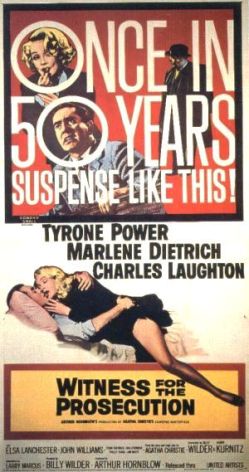
Movie_poster_for_-Witness_for_the_Prosecution-

Earlier today, I DVRed the 1957 best picture nominee, Witness for the Prosecution, off of TCM.  I watched the film as soon as I finished dinner and, having now seen Witness for the Prosecution, I am prepared to give you my professional and erudite review.

Okay, are you ready for it?  Here we go:

🙂 Oh my God, I freaking love this movie!!!!!!!!! 🙂

Witness for the Prosecution is many things.  It’s a courtroom drama.  It’s a domestic comedy.  It’s a twisty murder mystery.  It’s a showcase for three great performers.  It’s crowd pleaser that will make you think and, even if it does involve people killing each other, it will probably make you smile as well.  Don’t let that 1957 date fool you.  Witness For the Prosecution is a lot of fun.

Leonard Vole (Tyrone Power) is a somewhat sleazy man who has two claims to fame.  One is that he claims to be responsible for inventing the egg beater.  The other is that he’s been accused of murdering Mrs. French (Norma Varden), a wealthy widow who had recently named Leonard as the beneficiary of her will.  Everyone assumes that Leonard must have been having an affair with Mrs. French but Leonard claims that he’s innocent.

Suspecting that he is soon going to be arrested, Leonard hires Sir Wilfred Robarts (Charles Laughton) to serve as his attorney.  Though Sir Wilfred is recovering from a heart attack and has been ordered to not take on any more stressful criminal cases, he agrees to defend Leonard.  He proceeds to do just that, under the watchful eye of his nurse, the protective Mrs. Plimsoll (Elsa Lanchester).

(The testy relationship between Sir Wilfred and Mrs. Plimsoll provides the film with its comedic relief.  Laughton and Lanchester were married in real life and, watching the film, you can tell that they had a lot of fun acting opposite each other.)

Sir Wilfred is convinced that he can win acquittal for Leonard, especially since Leonard’s German wife, Christine (Marlene Dietrich), is willing to provide an alibi for him.  (In one of the film’s best moments, Sir Wilfred talks about how distraught Christine will be to discover that Leonard has been arrested just to then have the very calm and self-possessed Christine step into the room.)  However, to everyone’s shock, Christine is called as a witness for the prosecution.  She testifies that Leonard confessed the murder to her and that she only provided an alibi out of fear and love.

Things aren’t looking good for Leonard but then, a mysterious woman with a cockney accent contacts Sir Wilfred and reveals that Christine may have had reasons of her own for not giving Leonard an alibi…

Witness For The Prosecution ends with a voice over that says, “The management of this theater suggests that for the greater entertainment of your friends who have not yet seen the picture, you will not divulge, to anyone, the secret of the ending of Witness for the Prosecution.”  And I have to say that, when I heard that, it just made me love the film even more.  I had enjoyed the film so much and had so much fun following all the twists and the turns of the mystery that I found myself nodding in agreement.

“Sure, 58 year-old voice over,” I said, “I will not divulge the secret ending of Witness For The Prosecution.”

And I’m not going to!  Though, to be honest, you’ll probably guess the secret before it’s revealed.  It’s a plot twist that has been imitated by so many other courtroom dramas that it’s probably not as much of a mind-blower today as it may have been back in 1957.

But no matter!  Witness For The Prosecution is still a lot of fun.  Even if you figure out the mystery early, you can still watch the film and enjoy Laughton’s wonderfully theatrical performance.

Witness for the Prosecution was nominated for best picture and, interestingly enough, another theatrical courtroom drama — 12 Angry Men — was also nominated that year.  It’s interesting to compare the low-key drama of 12 Angry Men to the cheerful flamboyance of Witness For The Prosecution.  They are both great films about the law but each is told from a very different perspective.

Of course, in the end, both of these great films ended up losing to The Bridge On The River Kwai.

Lisa Watches An Oscar Winner: The French Connection (dir by William Friedkin)


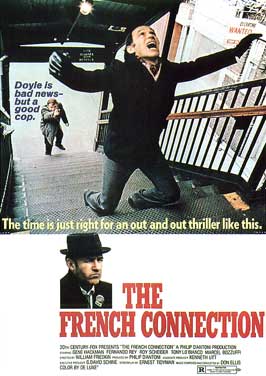
TheFrenchConnection

Earlier today, thanks to Netflix, I watched the 1971 best picture winner, The French Connection.

Based on a true incident, The French Connection is the story of two NYPD detectives, the reasonable and serious Buddy Russo (Roy Scheider) and his far more hyperactive partner, Popeye Doyle (Gene Hackman).  When we first see them, Doyle is dressed as Santa Claus and they’re both chasing a drug dealer through the streets of New York.  When they eventually catch up with the dealer, Russo plays good cop while Doyle plays batshit insane cop.  That’s a pattern that plays out repeatedly over the course of the film.  Russo suggests caution.  Doyle blindly fires his gun into the shadows.  Russo is sober.  Doyle is frequently drunk.  Russo is careful with his words.  Doyle is a casual racist who never seems to stop talking.  The one thing that Russo and Doyle seem to have in common is that they’re both obsessed with catching criminals.

The French Connection is also the story of Alain Charnier (Fernando Rey), a suave and always impeccably dressed French businessman.  Charnier has a plan to smuggle several millions of dollars of heroin into the United States by hiding it in a car that will be driven by an unsuspecting (and rather vacuous) French actor named Henri Devereaux (Frederic de Pasquale).  Working with Charnier is a low-level mafia associate named Sal Boca (Tony Lo Bianco) and a lawyer named Joel Weinstock (Harold Gray).

(Incidentally, Weinstock’s chemist is played by an actor named Patrick McDermott, who also played Susan Sarandon’s abusive hippie boyfriend in Joe.  The French Connection was McDermott’s third film and also his last.  I point this out because McDermott totally steals his one scene in The French Connection.  When one considers both his performance here and his work in Joe, it’s strange and unfortunate that McDermott’s cinematic career ended after just three films.  According to a comment left on the imdb, he later ran a health food store in Nebraska.)

When Doyle and Russo just happen to spy Sal hanging out with a group of mobsters at a local club, they decide (mostly on a whim) to investigate what Sal’s up to.  They notice that Sal drives a car that he shouldn’t be able to afford.  Will they discover how Sal is making his money and will they be able to stop Charnier from smuggling his heroin into the United States?

Well…let’s just say that The French Connection was made in 1971.  That’s right, this is one of those films where everything is ambiguous.  Neither Russo nor Doyle are traditional heroes.  Neither one of them is foolish enough to believe that their actions will make a difference.  Instead, they seem to view it all as a game, with Doyle and Russo as the win-at-any-cost good guys and the French as the bad guys.  And, indeed, it’s interesting to note that, when the police do make their move against Charnier, it’s the people who work for him who suffer the worst punishments.

I have to admit that, as a civil libertarian, Doyle is the type of cop who should make my skin crawl.  He’s an obsessive bigot, the type who runs into the shadows with his gun drawn and blindly firing.  When I watched The French Connection, a part of me wanted to get offended and say, “It’s none of your business why Sal has an expensive car!”  But I didn’t.  In fact, I was rooting for Doyle the whole time.  The French Connection is probably one of the best cast films of all time.  Hackman gives such a good performance that, while you can’t overlook Doyle’s flaws, you can accept them.  Meanwhile, Rey is so sleazy and smug in the role of Charnier that you really don’t care about his rights.  You just want to see him taken down.

(That said, if I ever got hold of a time machine and went back to New York in 1971, I’d rather be arrested by Russo than Doyle.  Doyle seems like he’d be the type to grope while frisking.)

Seen today, it’s a bit odd to think of The French Connection as being a best picture winner.  It has nothing to do with the film’s quality.  The film’s performances remain strong.  William Friedkin’s documentary-style direction is still compelling and he makes the decay of 1970s New York oddly beautiful.  Instead, it’s the fact that The French Connection essentially tells a very simple story that, when seen today, feels very familiar.  It’s a cop film and it includes every single cliché that we’ve come to associate with cop films.  (Russo and Doyle even have a supervisor who yells at them for not doing things by the book.)  But, what you have to realize is that the majority of those clichés were invented by The French Connection. If imitation is the sincerest form of flattery, then The French Connection is probably one of the most flattered film ever made.

And what better way to end this review than by sharing The French Connection‘s most influential scene?  In the scene below, Doyle chases a commuter train that happens to be carrying one of Charnier’s associates.

Apprecier le film!

Lisa Watches an Oscar Nominee: The Hustler (dir by Robert Rossen)


Hustler_1961_original_release_movie_posterFor my final Oscar-nominated film of the night, I watched the 1961 film The Hustler.

Filmed in harsh black-and-white and featuring characters who live on the fringes of conventional society, The Hustler is one of those films that’s so unremittingly bleak that it would probably be so depressing as to be unwatchable if not for the talented cast.  Paul Newman plays “Fast Eddie” Felson, a pool hustler who is talented but cocky, a guy who has the talent of a winner and the self-centered, self-pitying personality of a loser.  When we first meet Eddie, he and his manager, Charlie (Myron McCormick) have traveled all the way from Oakland to New York, all so Eddie can challenge and hopefully beat the legendary pool player Minnesota Fats (Jackie Gleason).  Eddie does get his chance to challenge Minnesota (or perhaps I should call him Mr. Fats?) and comes close to winning.  However, in the end, Eddie is too arrogant and impulsive and he ends up losing to Mr. Fats.

Defeated and humiliated, Eddie is hiding his meager possessions in a storage locker at the local bus station when he first meets Sarah Packard (Piper Laurie).  Sarah is an alcoholic and an aspiring writer.  She claims to be a part-time student but we never actually see her in class.  She walks with a pronounced limp and she has a habit of declaring the world to be “perverted, twisted, and crippled.”  Soon, she and Eddie are living together, two lost souls who support and destroy each other at the same time.  When Sarah attempts to write a short story about Eddie, Eddie responds by destroying the page and ordering her to never write about him again.  Charlie views Sarah as a destructive influence and decides that he doesn’t want to have anything else to do with Eddie.

However, Eddie soon finds a new manager.  Bert Gordon (a demonic George C. Scott) is a gambler who says that if Eddie sticks with him, Eddie will not only get rich but he’ll defeat Minnesota Fats as well.  At first, Eddie wants nothing to do with Bert but, when his own attempts at hustling lead to him getting his thumbs broken, Eddie has a change of heart.  Under Bert’s guidance, Eddie find success but he does so at the expense of what little decency that he had to begin with…

Eddie is an interesting character, one who most viewers will probably have mixed feelings about.  On the one hand, he’s a jerk.  He’s an arrogant, cocky jerk who thinks that he’s the best and who either uses or allows himself to be used by almost everyone that he meets.  Though he definitely ends up being exploited by Bert, Eddie knew what he was getting into when he made his deal with the devil.  Though he loves Sarah and she loves him, Eddie still treats her poorly.  There are just so many reasons to dislike Eddie Felson.

Except, of course, Eddie Felson is played by Paul Newman.

Seriously, it is possible to dislike a character played by Paul Newman?  As an actor, Newman was so charismatic and projected an innate goodness that came through even when he was playing a character who didn’t always do nice things.  As written, the character of Eddie spends the majority of the movie acting like a louse.  But, as played by Newman, Eddie becomes a wounded anti-hero, the bad boy that every girl dreams of somehow redeeming.

Ultimately, there are many reasons to see The Hustler.  Gleason and Laurie both give good performances.  George C. Scott, meanwhile, is like a force of nature.  Just listen to him as he shouts, “You owe me money!”  Director Robert Rossen finds an odd beauty in some of the sleaziest parts of New York City.  But, in the end, the main reason to see The Hustler is for Paul Newman’s amazing performance in the title role.  It’s a great performance that elevates the entire film.

I have to admit that I don’t know much about pool.  During my first college semester, I lived in a dorm that had a pool table in the front lobby.  There was always a large group of people gathered around that table, playing pool and generally looking like a bunch of hipster douchebags.  Sitting in the lobby meant having to listen to a constant soundtrack of balls clacking against each other, followed by people saying, “Such-and-such in the corner pocket” or whatever the Hell it is people say when they’re playing pool.  (To be honest, though I could hear the voices, I rarely listened to what they were actually saying.)  I don’t know if the people playing pool in the lobby were any good.  But, after seeing The Hustler, I can say that Eddie Felson would have beaten all of them.


Lisa Watches The Oscar Winners: The Apartment (dir by Billy Wilder)


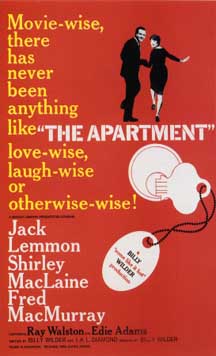
Apartment_60

After the Nun’s Story, I continued to experience TCM’s 31 Days of Oscar by watching the 1960 best picture winner, The Apartment.  The Apartment is unique among Oscar winners in that it’s one of the few comedies to win best picture.  (Though, in all honesty, it would probably be more appropriate to call The Apartment a dramedy.)  It was also, until the victory of The Artist, the last completely black-and-white film to win best picture.

(And, as long as we’re sharing trivia, it was also the first best picture winner to feature a character watching a previous best picture winner.  At the start of the film, Jack Lemmon deals with insomnia by watching Grand Hotel.)

The Apartment tells the story of C.C. “Bud” Baxter (Jack Lemmon), an anonymous officer worker who is determined to climb the corporate ladder despite not being very good at his job.  However, Baxter does have one advantage over his co-workers.  He’s single and therefore, his apartment has become the place to go for corporate executives who need a place where they can safely cheat on their wives.  Bud spends his day trying to coordinate who is going to be in his apartment and when.  Meanwhile, he spends his nights exiled from his own home and wandering around New York.  In fact, the only beneficial thing about this arrangement is that all of Bud’s supervisors have been giving him good evaluations in return for using his apartment.  (Well, that and Bud’s neighbor, played by Jack Kruschen, is convinced, based on the thinness of the apartment walls, that Bud must be a great lover.)

When Bud finally does get his promotion, it’s only because the personnel director, Jeff D. Sheldrake (an amazingly sleazy Fred MacMurray), wants to use Bud’s apartment.  Bud celebrates his promotion by finally working up the courage to ask out Fran (Shirley MacClaine), an elevator operator who works in the office.  What Bud doesn’t realize is that Fran is also the woman who Sheldrake wants to bring to the apartment….

Fran is convinced that Sheldrake is going to leave his wife for her.  What she doesn’t realize — and what Fred MacMurray’s performance makes disturbingly clear — is that Jeff Sheldrake is basically just a guy having a midlife crisis.  He’s the type of middle-aged guy that every woman has had to deal with at some point, the guy who pulls up next to you in a red convertible and stares at you from behind his sunglasses, attempting his best to entice you into helping him relive the youth that he never had.  When Fran eventually learns the truth about Sheldrake, it leads both to near tragedy and to Bud having to decide whether he wants to be a decent human being or if he wants to keep climbing the corporate ladder.

When one looks over a chronological list of all of the best picture winners, it’s a bit strange to see The Apartment listed in between Ben-Hur and West Side Story.  As opposed to those two grandly produced and vibrantly colorful films, The Apartment is a rather low-key film, one that devotes far more time to characterization than to spectacle.  And while both Ben-Hur and West Side Story are ultimately very idealistic films, The Apartment is about as cynical as a film can get.  The Apartment may be a comedy but the laughs come from a place of profound sadness.

Because it’s more interested in people than in spectacle, The Apartment holds up better than many past best picture winners.  We’ve all known someone like Bud.  We’ve all had to deal with men like Sheldrake.  And, in one way or another, we all know what it’s like to be someone like Fran.  The Apartment remains a truly poignant and relevant film.