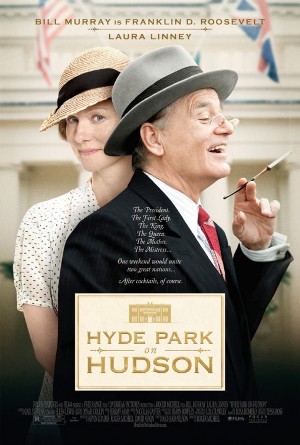
Shattered Politics #89: Hyde Park on Hudson (dir by Roger Michell)


Hyde_park_on_hudson_poster

Is there anything more frustrating than a film that should have been good but yet somehow turned out to be … well, to be rather awful?

Case in point: 2012’s Hyde Park On Hudson.  In this slow-moving and almost painfully old-fashioned film, Bill Murray plays President Franklin D. Roosevelt.  When the film opens in 1939, Roosevelt is being visited by his sixth cousin, Margaret (Laura Linney).  It’s been several years since Roosevelt and Margaret last saw each other.  Franklin’s mother (Elizabeth Wilson) thinks that Margaret’s company could cheer up her melancholy son.  So, FDR and Margaret go out for a drive and, sitting atop a nice green hill, Margaret gives him a hand job.

And it is the most stately and respectable hand job to ever be quaintly portrayed in an American film.

Anyway, the rest of the film deals with FDR’s affair with Margaret.  Eventually, Margaret discovers that FDR has many mistresses but, before she does that, she helps FDR to charm England’s King George VI (Samuel West).  In the days leading up to World War II, George and his wife (Olivia Colman) visit Roosevelt out at his Hyde Park estate.  As we all know from watching The King’s Speech, George is insecure about his stutter.  But, fortunately, FDR points out that, despite the fact that he’s in a wheelchair, people still view him as being a strong leader and therefore, people will view George in the same way, regardless of his stutter.

And, speaking as a former stutterer, I have to say that it’s amazing to witness how poorly Hyde Park On Hudson deals with subject matter that was so brilliantly handled in The King’s Speech.

When I first heard about Hyde Park On Hudson, I had high hopes for it.  After all, I love history.  I love royalty.  I love gossip and I love scandal.  And, really. FDR was one of our more gossip-worthy Presidents, a spoiled rich kid who could not reach his full potential until after he was struck down by polio and who regularly cheated on his wife while battling both the Great Depression and the Nazis.  FDR was a dynamic and controversial figure and none of that comes through in Hyde Park on Hudson.

(Seriously, Bill Murray is totally wasted in this film.  If you’re going to cast an iconic actor in an iconic role, at least give him some good dialogue.)

In the end, Hyde Park on Hudson fails because it’s just too respectful.  It’s a slow, visually unimaginative film that manages to make an exciting time feel dull.  FDR deserves better and so does Bill Murray.
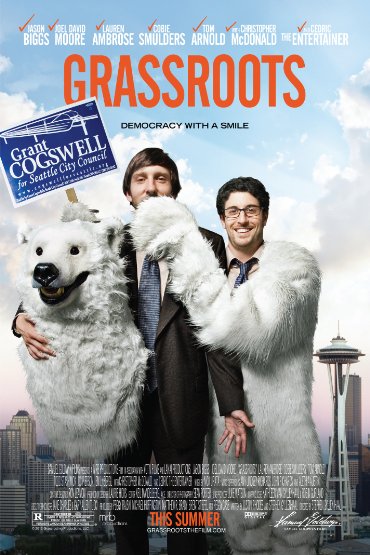
Shattered Politics #88: Grassroots (dir by Stephen Gyllenhaal)


Grassroots_2012Well, it’s nearly over.

For the past three weeks, I’ve been watching and reviewing 94 films about politics and politicians.  We started Shattered Politics by reviewing the 1930 film Abraham Lincoln and, 86 reviews later, we have finally reached 2012!  It’s hard to believe that, over just three weeks, I have reviewed that many films.  Some of those films have been good.  Some of them have been bad.  And, quite a few of them, have been somewhere in between.

The 2012 film Grassroots in one of those in between sort of films.  It’s based on a true story.  Phil Campbell (Jason Biggs) is a Seattle-based journalist who has just lost his job.  Unsure what to do with himself, Phil finds himself reluctantly dragged into the city council campaign of his friend, a music critic named Grant Cogswell (Joel David Moore).

Grant is running because he feels that the city council is not making proper use of the Seattle monorail.  Grant also appears to be a bit crazy, the type of guy who will spontaneously start to shout about everything that he views as being wrong with the world.  However, Grant is also very sincere in his desire to do the best for the people of Seattle and Phil agrees to manage his campaign.

And, as Grant continues to campaign and as the city’s political establishment goes out of its way to make it difficult for Grant or any other insurgent to run a legitimate campaign, he starts to pick up support and suddenly, it starts to look like he very well could win.

And then, the World Trade Center is attacked on September 11th and suddenly, the voters are a little bit less enthusiastic about handing the keys to the asylum over to one of the inmates…

Grassroots is a minor film but it’s definitely likable.  It took me a while to adjust to the film, largely because almost all of the characters are the type of stereotypical Seattle hipsters who would probably be used for violent comic relief in most other films.  (Don’t misunderstand, though — some of my best friends are hipsters … though they’ll never admit it.)  As well, the film trots out the familiar trope of having the campaign cause friction in Phil’s marriage and seriously, is there a more tired plot point than sudden marital friction?

But, ultimately, the film won me over because, much like Grant, it’s just so sincere in its love for Seattle and in its belief in grassroots politics.  It won’t challenge Milk for the title of being the most inspiring recent film about a city council election.  But, taken on its own terms, Grassroots is a likable movie that should inspire even more hipsters to run for public office.

Shattered Politics #87: The Ghost Writer (dir by Roman Polanski)


GhostwriterlargeIn the 2010 film The Ghost Writer, Ewan McGregor plays a character known as the Ghost. We never actually learn the name of his character and that’s perhaps appropriate.  The Ghost has made his living by being anonymous.  He’s a ghost writer.  He’s the guy who is hired to help inarticulate and occasionally illiterate celebrities write best-selling biographies.

The Ghost has been given a new assignment.  He is to ghost write the memoirs of former British Prime Minister Adam Lang (Pierce Brosnan).  Despite the fact that Adam is one of the most famous men in the world, the Ghost is not initially enthusiastic about working with him.

First off, there’s the fact that Adam and his wife, Ruth (Olivia Williams), are currently hiding out in America because America is one of the few countries that will not extradite him to be prosecuted for war crimes at the International Criminal Court.  It seems that Adam (much like Tony Blair) is a controversial figure because of some of the actions he may have authorized as a part of the war on terror.  Not only does the Ghost have political objections to working with Adam but he has to leave his London home and go to Massachusetts in order to do so.

Secondly, there’s the fact that, once the Ghost arrives in America, he discovers that — for such a controversial figure — Adam is actually rather boring and seems to have very little knowledge about anything that he did while he was prime minister.  Instead, he seems to be more interested in spending time with his mistress (Kim Cattrall, giving the film’s one bad performance).  Ruth seems to be the political (and smart) one in the marriage.

And finally, there’s the fact that the Ghost is actually the second writer to have worked with Adam.  The previous writer mysteriously drowned.  While that death was ruled to be an accident, the Ghost comes to suspect that it was murder and that the motive is hidden in the first writer’s manuscript…

The Ghost Writer is a favorite of mine, a smart and witty political thriller that features great performances from Ewan McGregor, Olivia Williams, and Pierce Brosnan.  Brosnan especially seems to be having a lot of fun sending up his dashing, James Bond image.  Roman Polanski directs at a fast pace and maintains a perfect atmosphere of growing paranoia throughout the entire film. In the end, The Ghost Writer proudly continues the tradition of such superior paranoia films as The Conversation, Three Days of the Condor, and the Parallax View.

Incidentally, I have a theory that Adam Lang was also the unseen Prime Minister who was featured in Into the Loop.  Watching The Ghost Writer, it’s hard not to feel that Adam really feel apart without Malcolm around to help him out.


Shattered Politics #86: Casino Jack (dir by George Hickenlooper)


Casino_JackI had two reactions to the 2010 film Casino Jack.

My first reaction was to think, “Wow, Kevin Spacey really can act!”  I mean, don’t get me wrong.  I knew that, especially when working with a director who is strong enough to curb his natural tendency to go overboard, Kevin Spacey was capable of giving a great performance.  However, Spacey is one of those actors who has such a unique look and style about him that I think sometimes we forget that he’s capable of doing more than just playing variations on Kevin Spacey.*

And it is true that, in the role of real-life Washington D.C. lobbyist Jack Abramoff, Kevin Spacey gave a performance that was full of the usual Spacey tricks.  By that, I mean we got the Spacey voice going from a purr to a roar in just a manner of seconds.  We got the Spacey glare, where he narrows his eyes and stares at whoever has offended him with an intensity that lets you know that something bad is about to happen.  We got that somewhat strained Kevin Spacey smile, the way facial expression that lets us know that we don’t want to know what’s going on behind that friendly facade.

But, even though Spacey was up to his usual tricks, all of those tricks still came together to create a unique character.  As I watched the film, I forgot that I was watching Kevin Spacey.  Instead, I really felt that I was watching and listening to one of the most powerful lobbyists in American history.

And, when Abramoff was eventually arrested and prosecuted for defrauding his clients, I couldn’t help but feel a little bit of sympathy for him.  Spacey plays the character with such a combination of hyperactive charm and righteous fury that you can’t help but be a little bit enthralled by him.  That’s not to say that Kevin Spacey turns Jack Abramoff into a sympathetic character.  (Indeed, as good as Spacey is, there are a few moments when his contempt for Abramoff comes through and his performance suddenly turns into a one-dimensional caricature.)  But what Spacey does do is show that Jack Abramoff was less an inhuman monster and more the logical product of Washington culture.  The only difference between Abramoff and everyone else in Washington is that Abramoff got caught.

But, at the same time, the move itself is never quite as interesting as Spacey’s lead performance. The movie’s main theme appears to be that Washington is corrupt and we’d do better if we curtailed the power of lobbyists but … well, do you really need a movie to tell you this?  I mean I’m pretty much apolitical and I knew that long before I saw Casino Jack!

Casino Jack: Good performance.  Boring message.  Bleh movie.

—

* This is better known as the Christopher Walken syndrome.

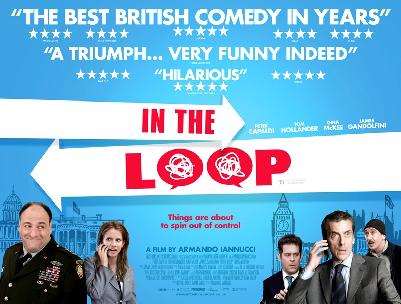
Shattered Politics #85: In the Loop (dir by Armando Iannucci)


In_the_Loop_poster

First released in 2009, In The Loop is one of the most brilliant political satires ever made.

The film opens in London, as a slightly ridiculous man named Toby (Chris Addison) starts his first day as the special assistant to the Secretary of State for International Development, Simon Foster (Tom Hollander).  And what a day to start!  Both the President of the United States and the British Prime Minister are eager to invade the Middle East and, during an interview the previous night, Simon accidentally announced that war was “unforseeable.”  This has led to people accidentally assuming that Simon is anti-war (Simon really doesn’t seem to have an opinion one way or the other) but it also means that the Prime Minister’s compulsively profane assistant, Malcolm Tucker (Peter Capaldi), is now running around the office and threatening people.

(I doubt that there’s any way that I can do justice to Capaldi’s performance here.  You simply have to see him.  He is a force of nature, a tornado of nonstop profanity and aggression.)

Not every government official in the U.S. is enthusiastic about going to war.  Both Assistant Secretary of State for Diplomacy Karen Clarke (Mimi Kennedy) and her former lover, Gen. George Miller (James Gandolfini) are opposed to the war.  Karen’s assistant, Liza (Anna Chlumsky), has even written a paper that explains why a war in the Middle East could not be won.  Karen hopes to use Simon as a spokesman to keep the British out of the war and, therefore, America as well.

(Toby, meanwhile, just wants to have sex with Liza.)

However, there are a few factors that complicate things.  First off, Malcolm is determined to make sure that the Prime Minister gets what he wants and if that means bullying and scaring everyone into supporting an unwinnable war, that’s exactly what he’s going to do.  Secondly, U.S. Assistant Secretary of State For Policy Linton Barwick (David Rasche) is eager enough to start a war that he’s actually started a secret committee to find a way to get into the war.  (The committee, of course, has been called the Committee For Future Planning.)  Third, and perhaps most importantly, Simon is an idiot.

Along with being both a satire of American-British relations (my favorite moment comes when a random American tourist tells Malcolm to stop cursing in public) and the lead-up to the Iraq War, In The Loop is also a devastating look at how government works.  In the Loop makes a good case that, for all the titles and the committee and the talk about doing what’s right, most government policy is the result of a combination of stupidity and needless aggression.  As played by Capaldi, Malcolm has no ideology or core beliefs.  He simply makes sure that the Prime Minister gets what he wants.

And if that means going to war, then Malcolm will do whatever it takes to push Britain into war.

Director Armando Iannucci is probably best known for creating two political comedies, the Thick of It and Veep.  And while I’ve never seen The Thick Of It, I absolutely love Veep.  From what I’ve read, all three projects share the same fictional universe.  (Capaldi’s Malcolm was the main character on The Thick Of It.)

Though, actually, I think it’s debatable just how fictional that universe is.  Ultimately, In The Loop is probably one of the most plausible satires that I’ve ever seen.

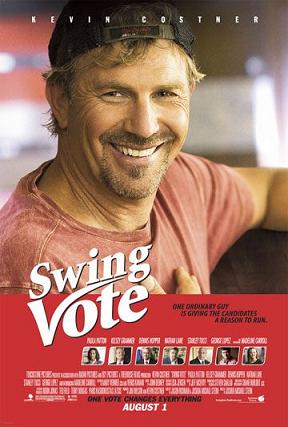
Shattered Politics #84: Swing Vote (dir by Joshua Michael Stern)


Swing_vote_08

Have you ever heard the old saying about how one vote can make all the difference?  I’ve always had to laugh whenever I hear that because I know that, every election, my sister Melissa is going to cancel out my ballot by voting the exact opposite of how I vote.  As a result, even though I’ve participated in almost every election since 2004, my vote has hardly ever really mattered.

(Then again, neither has my sister’s….)

But anyway, the idea of one vote making all of the difference is taken to its logical extreme in the 2008 comedy Swing Vote.  In Swing Vote, a presidential election comes down to who wins the state of New Mexico.  And who wins the state of New Mexico will be determined by just one vote.  You see, the popular vote in New Mexico is tied between the two candidates but it turns out that, due to a voting machine error, one man’s vote has not been counted.  And now, that man has ten days to recast his vote.

(Why does he have ten days?  Mostly because there would not be a movie if they just said, “Please cast your vote again…now!”)

Of course, the problem is that the guy never cast a vote in the first place.  Instead, his vote was cast by his daughter (Madeline Carroll), who basically committed an act of vote fraud and violated federal law.  But it’s cute because she’s super precocious and she just wants her Dad to stop being such a fuck-up.

Oh, did I mention that?

That’s right — the fate of America is in the hands of a complete and total fuck-up.  His name is Bud and he’s played by Kevin Costner.  He’s a rather stupid guy who has never been responsible a day in his life.  He’s also a former felon, which really should have made him ineligible to vote in the first place.  And, on top of that, he’s the type of alcoholic who promises his little girl that he’ll meet her at a scheduled place and time and then proceeds to get drunk inside.

OH MY GOD, WHAT A GREAT GUY!

But, we’re supposed to like Bud because he’s played by Kevin Costner and I really don’t get that logic.  I always find it odd that, every year, we hear about how Kevin Costner is going to be in a few dozen films and how they’re all going to be hits and he’s suddenly going to be a big star again.  I’m never quite sure why people are excited about this prospect.  Whenever I see Costner on-screen (which, admittedly, doesn’t happen that often), I’m always struck by the fact that, regardless of the role, he really does come across as being an asshole.  That really does seem to be his screen presence.  That’s certainly the case in Swing Vote.

And maybe that’s the point of the film.  Be sure to vote so that the fate of America doesn’t end up in the hands of Kevin Costner.

That said, I will say that Swing Vote deserves some credit for casting Kelsey Grammer as the President and Dennis Hopper as his opponent.  Personally, I probably would have voted to reelect Kesley but I think Dennis would have done a good job as well.

(By the way, if ever do find yourself watching Swing Vote, imagine how much funnier the film would have been if it ended with Costner casting his vote and then announcing, “I voted third party!”)


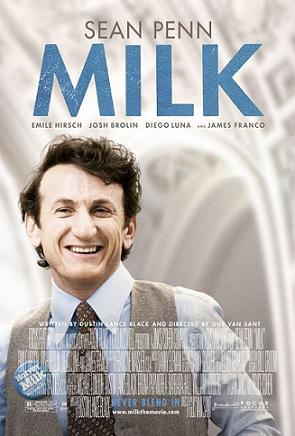
Shattered Politics #83: Milk (dir by Gus Van Sant)


Milkposter08

For the past three weeks, I have been in the process of reviewing, in chronological order, 94 films about politics and politicians.  It’s a little something that we call Shattered Politics.

And while I’ve had a lot of fun doing it, it does worry me a bit that I may have made the Shattered Lens into a far more cynical site to visit.  That’s largely because I don’t trust politicians or the government in general and, despite the fact that we started off with Abraham Lincoln and Mr. Smith Goes To Washington, the majority of the films that I’ve reviewed have reflected that fact.

So, in order to combat that cynicism, I’m going to recommend a film from 2008 that, despite being a biopic about a politician, is actually rather inspiring.  I am, of course, talking about the 2008 best picture nominee, Milk.

Milk tells the story of Harvey Milk who, in 1977, became the first openly gay man to be elected to a major public office.  Now, just consider that.  Up until 38 years ago, nobody who was openly gay had been elected to public office.  Nowadays, the idea of an out gay man or a lesbian running for public office is only shocking to a dwindling minority of homophobes.  Even down here Texas, which everyone up north always smugly assumes to be so intolerant, nobody is surprised when a gay or a lesbian not only runs for office but wins as well.  Sheriff Lupe Valdez has served as sheriff of Dallas Country for over ten years and, though she’s been controversial, none of that controversy has concerned her sexuality.  Meanwhile, Annise Parker has served three-terms as mayor of Houston, making Houston the biggest city in America to have an openly gay mayor.

However, before Lupe Valdez could be sheriff or Annise Parker could be mayor, Harvey Milk had to serve on the San Francisco Board of Supervisors.

Milk follows Harvey (Sean Penn, who won an Oscar for his performance) and his much younger boyfriend, Scott (James Franco) from the moment they first meet in New York to when they moved to San Francisco in 1970.  We see how Harvey first found fame as a neighborhood activist and how he challenged both the political and gay establishment of San Francisco in his campaigns for political office.  When he finally wins a seat on the Board of Supervisors, he does so at the cost of his relationship with Scott.  He enters into another relationship with the self-destructive Jack (Diego Luna), which ends tragically.

By winning office, Harvey becomes a spokesman for gays everywhere.  When a sinister state senator (Denis O’Hare) attempts to pass a bill that would forbid gays from teaching school, Harvey leads to opposition.  And, while Harvey’s career continues to rise, the career of another supervisor — Dan White (Josh Brolin) — plummets.

Elected at the same time as Harvey, Dan is an uptight former cop.  Though he and Harvey originally strike a somewhat awkward friendship (Harvey is the only supervisor to come to the christening of Dan’s child), Dan soon comes to resent Harvey.  (At one point, Harvey suggests that Dan might be closeted and Brolin’s tightly coiled performance certainly implies that Dan is repressing something.)  Eventually, Dan shoots and kills both the mayor (Victor Garber) and Harvey.

Though the film ends in violence and anger, it also ends with hope.  Though Harvey may be dead, the activists that he inspired are there to carry on.

Because the film was directed by a gay man, written by a gay man, and tells the story of a gay man, Milk is often dismissed, even by critics who liked it, as just being a gay film.  But, actually, it is a film that should inspire anyone who has ever felt like they’ve been pushed into the margins of our national culture.  By the film’s end, Harvey Milk has emerged as not just a gay hero but as a hero to anyone who has ever been told that their voice does not matter.  When Harvey says, repeatedly, “You’ve got to give them hope,” it’s hope for all of us.

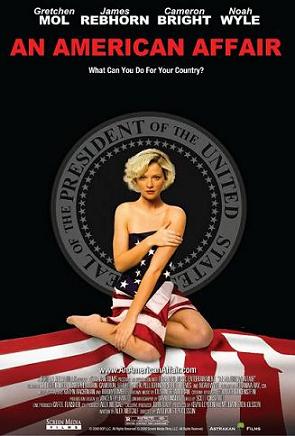
Shattered Politics #82: An American Affair (dir by William Olsson)


American_affair

Though the names may have been changed, the 2008 film An American Affair is clearly based on the true story of Mary Pinchot Meyer.

In the early 60s, Mary Pinchot Meyer was a celebrated member of the Washington D.C. social scene.  A talented painter, Meyer was also the ex-wife of CIA officer Cord Meyer and was an early proponent of LSD.  She also happened to the mistress of John F. Kennedy and reportedly use to smoke weed with him in the Oval Office.  It’s also been reported that she kept a diary, which mysteriously disappeared after Mary’s still unsolved murder in 1964.  Needless to say, many a JFK assassination conspiracy theory has featured Mary Pinchot Meyer as a supporting character.

In An American Affair, Meyer is renamed Catherine Caswell (Gretchen Mol) and she lives across the street from 13 year-old Adam Stafford (Cameron Bright).  While Catherine has secret meetings with the President and deals with her alcoholic ex-husband (played, quite well, by Mark Pellegrino), Adam watches from his bedroom window.  Eventually, Adam goes across the street and offers to work in Catherine’s garden.  Realizing that Adam has a crush on her, an amused Catherine agrees.  While the future of America is being determined all around him, Adam learns about life, love, and art from Catherine.

An American Affair is an odd mix of conspiracy film and coming-of-age dramedy but it actually work pretty well.  Gretchen Mol gives a good performance as the poignantly unstable Catherine and, despite the fact that Adam is kind of a creep at times, Cameron Bright manages to make the character sympathetic.  However, the film’s best performances come from James Rebhorn and Pellegrino, playing two menacing figures who always seem to hovering in the shadows.

An American Affair is a surprisingly good film.  I saw it on Netflix and so should you.

Shattered Politics #81: Charlie Wilson’s War (dir by Mike Nichols)


Charliewilsonwarposter

I hate to say it but Charlie Wilson’s War did not do much for me.

I hate to say that because this 2007 film is fairly well-acted, well-directed, and well-written (by Aaron Sorkin, whose scripts usually get on my last nerve).  And it deals with an important subject.  Taking place in the 80s, the film details how a Texas congressman (Tom Hanks), working with a profane CIA agent (Philip Seymour Hoffman) and an eccentric socialite (Julia Roberts), managed to create popular and political support for giving weapons to the Afghan rebels who were fighting the Soviet invasion of their country.  By doing so, Wilson helps to weaken the Soviet Union but, when his efforts to provide humanitarian aide to Afghanistan are less successful, he also contributes to the subsequent rise of the Taliban.

It should have been a film that I would normally rave about but … I don’t know.

I watched Charlie Wilson’s War.  I laughed at some of Tom Hanks’s facial reactions.  (Hanks is playing a womanizer here who may, or may not, have been high on cocaine when he first learned about the Soviet invasion of Afghanistan and it’s obvious that Hanks really enjoyed getting to play someone who wasn’t a traditionally upright hero.)  As I watched, I again considered what a loss we suffered when the brilliant Philip Seymour Hoffman died.  And, as I watched Julia Roberts, I again wonder why, despite the fact that she’s from Georgia, it is apparently impossible for Julia to sound authentically Southern.

(Of course, I’m sure some would argue that Julia wasn’t playing Southern here.  She was playing a Texan.  Well, I’m a Texan and I’ve never heard anyone down here sound like that.  Tom Hanks, meanwhile, actually managed to come up with a decent accent.  Wisely, he underplayed the accent, whereas I don’t think that Julia has ever underplayed anything in her life.)

And, at the end of Charlie Wilson’s War, I knew I had watched a good film but it was also a film that left me feeling curious detached.  To be honest, I almost think the film would have been better if Hoffman’s CIA agent had been the main character, as opposed to Hanks’s congressman.  Hoffman’s character, after all, is the one who nearly lost his job over his belief that the Afghan rebels should be armed.  All Hanks really has to worry about is whether or not he’s going to be indicted for using cocaine in Vegas.

However, I do think that Charlie Wilson’s War does deserve praise for one very specific reason.  Excluding the films made by native filmmakers like Richard Linklater and Wes Anderson, Charlie Wilson’s War is one of the few films that I’ve ever seen that actually portrays anyone from Texas in a positive light.  Even more shockingly, it’s a positive portrayal of a Texas politician!

(I know it must have been tempting to change history and pretend that Charlie Wilson was originally elected from somewhere up north…)

But, overall, Charlie Wilson’s War didn’t do much for me.  But, if you’re into military history and all that, you might enjoy the film more than I did.

(Plus, all you boys will probably enjoy Emily Blunt’s scenes….)

At the very least, you can watch it for Philip Seymour Hoffman.


What Lisa Watched Last Night #112: Megachurch Murder (dir by Darin Scott)


Earlier tonight, I watched the latest Lifetime original film, Megachurch Murder!

MCMWhy Was I Watching It?

First off, it was on Lifetime.  And secondly, I had read that the film was supposedly based on Hamlet!

What Was It About?

Something’s rotten in the state of Denmark … Denmark, Georgia that is.  Shortly after resisting the efforts of Michael Beach to expand his church, Pastor Malcolm Jamal-Warner dies under mysterious circumstances.  Soon, Beach is having an affair with the pastor’s widow (Tamala Jones) and the pastor’s daughter (Shanica Knowles) is convinced that there’s been a murder.  Complicating things: Knowles is dating Beach’s son, Romeo Miller.

What Worked?

To be honest, the best thing about Megachurch Murder were the tweets.  This is one of those films that seemed to bring out the best of twitter.

I appreciated that the film pretended to be based on Hamlet, even though the story itself had next to nothing in common with Shakespeare’s play.  That said, two youth group leaders did show up as the Megachurch Murder equivalents of Rosencrantz and Guildenstern.

Most of the actors seemed to just be going through the motions but Michael Beach did a good job in the role of Clay King.  He made for a great villain.

What Did Not Work?

All through the movie, whenever Hannah had to get away from it all, she always went to the exact same bridge.  At first, it was funny that she was always standing on that bridge.  But, after the 20th scene on that bridge, I started to wonder why nobody else in the town of Denmark ever seemed to use the bridge.  Finally, by the time that Clay was demanding to know where Hannah was, I found myself shouting at the TV, “She’s on the bridge!  She’s always on the damn bridge!”

Plus,  Romeo Miller … actually, to be honest, I think Romeo Miller could give a good performance if cast in the right role.  But, in this film, I kept expecting him to start talking about ICDC college.  Whenever he was comforting Hannah, I kept waiting for him to say, “You can major in criminal justice or homeland security…”

Finally, I was surprised to discover that, at the end of the film, people were still attending the church.  After three violent deaths, I’d probably change parishes.

“Oh my God!  Just like me!” Moments

To be honest, and no one is more shocked by this than me, this is probably the first Lifetime film that I’ve ever watched that featured absolutely no moments that made me go, “Oh my God!  Just like me!”  I guess it’s because I was raised Catholic and didn’t have to deal with any murders while I was growing up.

It is true that, much like Hannah, I did go through my rebellious phase and I would snap at any adult who tried to speak to me.  However, Hannah had an excuse.  She was dealing with her father’s murder whereas, in my case, I was just a brat.  So, it really doesn’t count as a “OMG!  Just like me!” moment.

Lessons Learned

Big church = murder.

Megachurch-Murder-Shanica-Knowles-and-Romeo-Miller