I was very disappointed in Unleashing Mr. Darcy. It was nothing like Hercules Unchained (1959) and it’s not based on the recently restored version of Jane Austen’s classic about prejudice against the undead. Instead the movie has a Hallmark Christian Grey, a woman who doesn’t seem to know how schools or dogs work, and overall is a film that could have been condensed into something shorter.
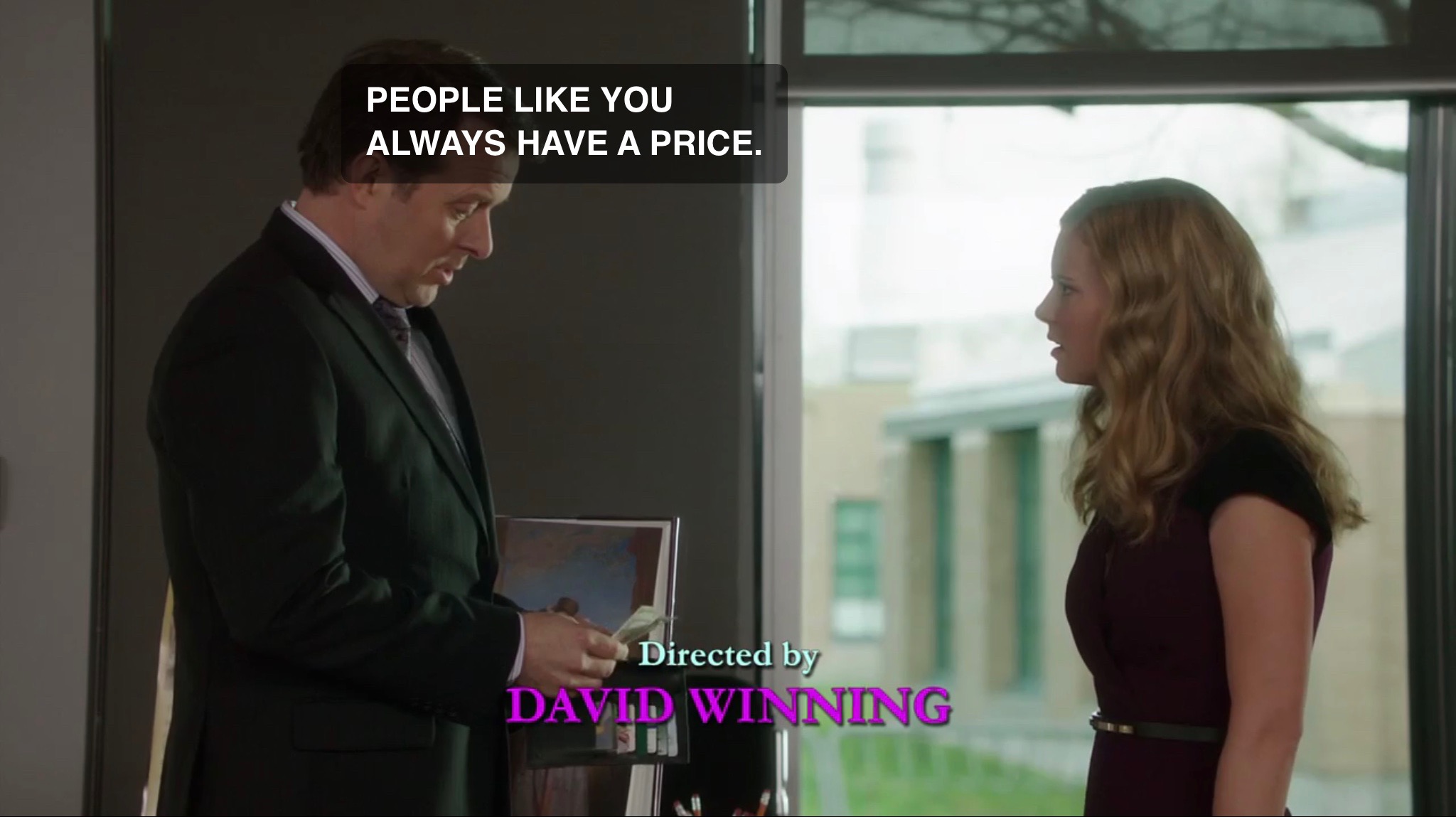
The movie begins in a classroom and we meet a teacher named Elizabeth Scott (Cindy Busby). After assigning the students their homework and dismissing class, she is approached by a parent who doesn’t like that she isn’t letting his son pass so he can play sports. You know, the standard stuff. However, I believe this is the first time I have seen the parent actually whip out cash and try to pay off the teacher on the spot.
Of course she turns down the money and he throws a hissy fit before storming off.
We go home with Elizabeth and find that she owns a cocker spaniel. I don’t recall if it’s now or later, but she will actually say that one of the things she likes about dogs is that they don’t manipulate you. I get the feeling screenwriter Teena Booth has never owned a dog in her life. I have owned dogs all my life and if there is one thing they are masters of, it’s manipulating you. If they want something from you then they will make sure you are going to give it to them. I mean where do you think the phrase “puppy dog eyes” comes from. Minor thing, but being a lifelong dog owner, I found it very funny.
Now Elizabeth goes to pay a visit to her sister Jenna played by Tammy Gillis who is looking good after being rescued by The Postables in Signed, Sealed, Delivered: The Impossible Dream. She takes her cocker along with her. Little personal side note. My first dog was a Cocker Spaniel named Jenny. That was 6 dogs ago so it’s been awhile. Despite having their fair share of flaws, dogs really are wonderful.
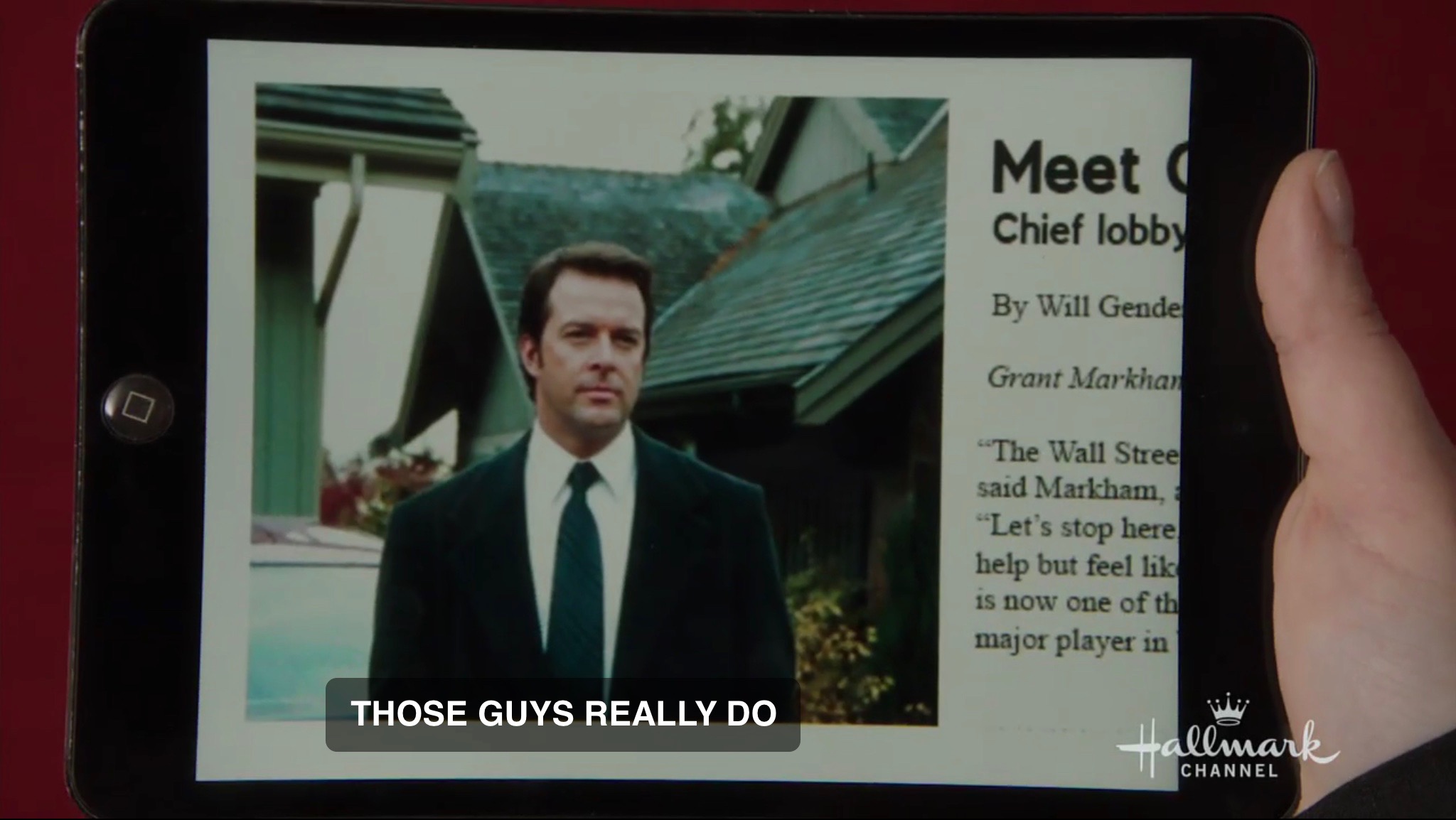
When I review Hallmark movies I often point out goofs or the interesting ways they fake computers and cellphones. I could mention that the shot on the iPad she now uses is very likely just a screenshot they took on a computer and imported onto the iPad, but that’s not what is notable here to me.
I wanna know what happened to this poor iPad. Look at that home button all turned at a weird angle. This thing looks like it took a brutal beating before being used in the movie. I would love to know the story behind this.
Anyways, the process to let her go from the school begins. She seems genuinely surprised that the school would automatically side with the father and the mother who is on the school board. This is what I meant when I said she doesn’t seem to know how schools work. I remember when a friend of mine’s son got in trouble because apparently his school project looked too phallic to them. She shouldn’t have been shocked at all that she was going to be let go. Of course it works out for the best because she now gets to take her dog to a dog show.
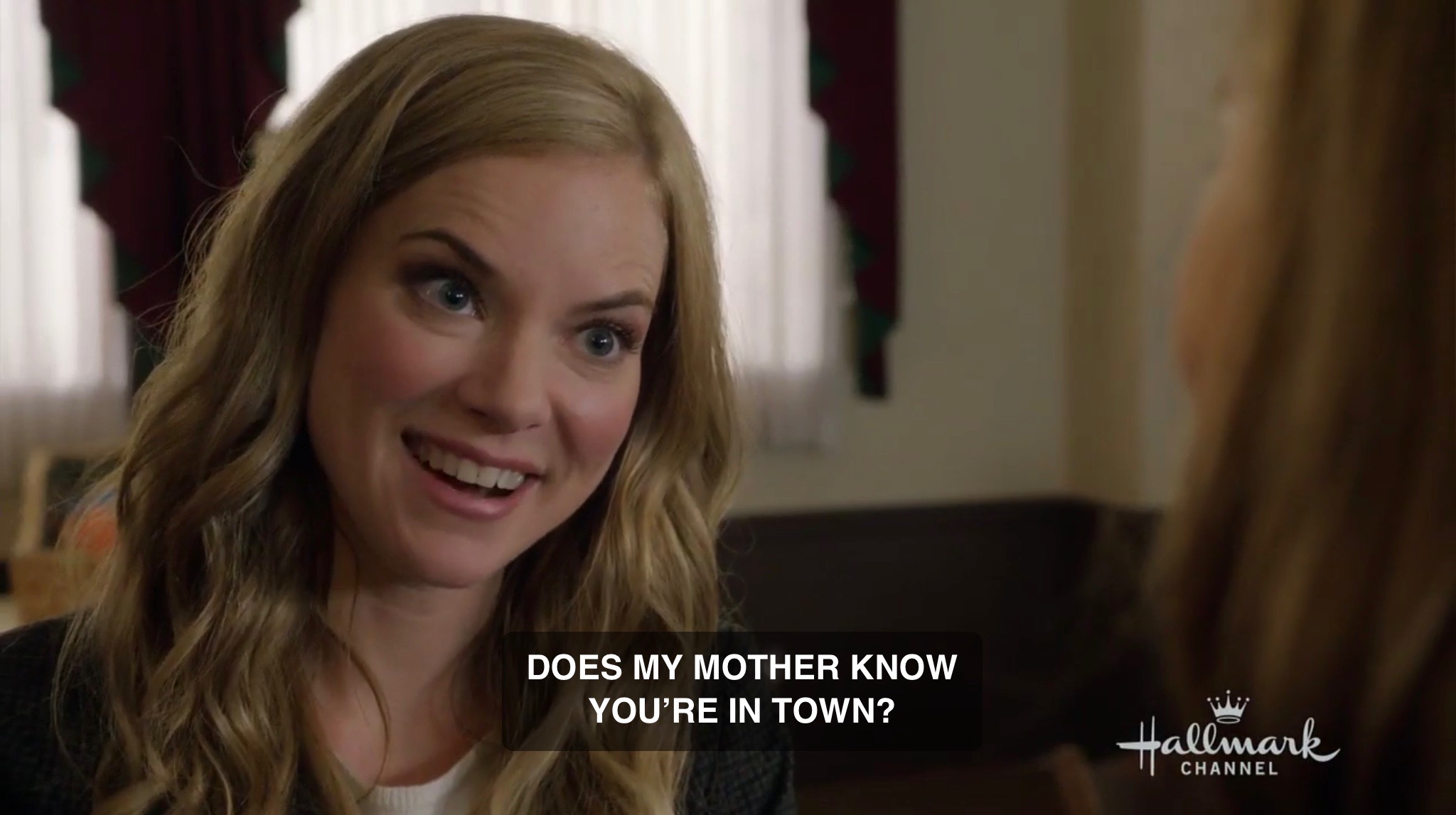
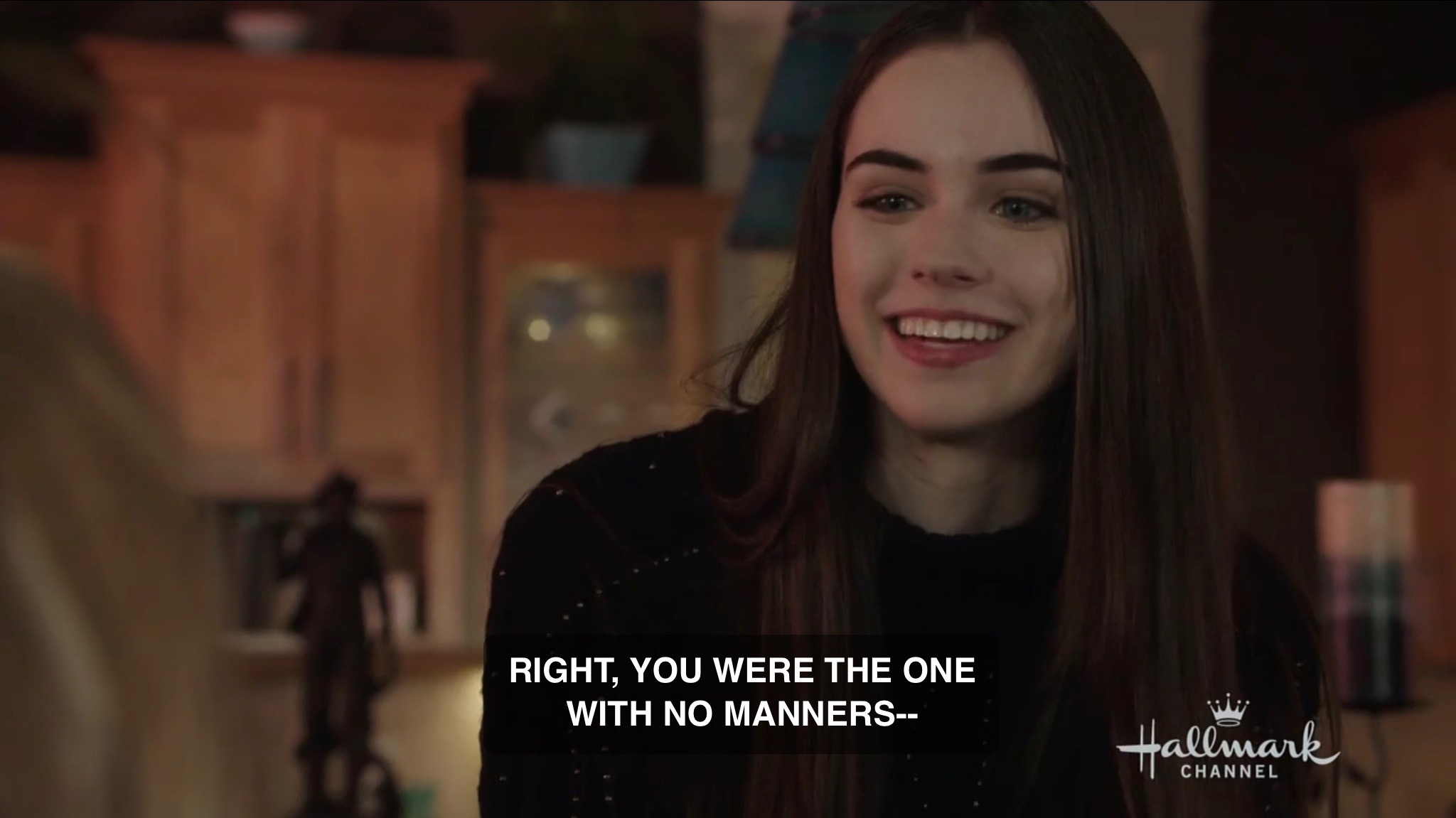
This is as good a time as any to point out that actress Cindy Busby might just be able to give Rachel Boston a run for her money in the funny facial expressions department on Hallmark.
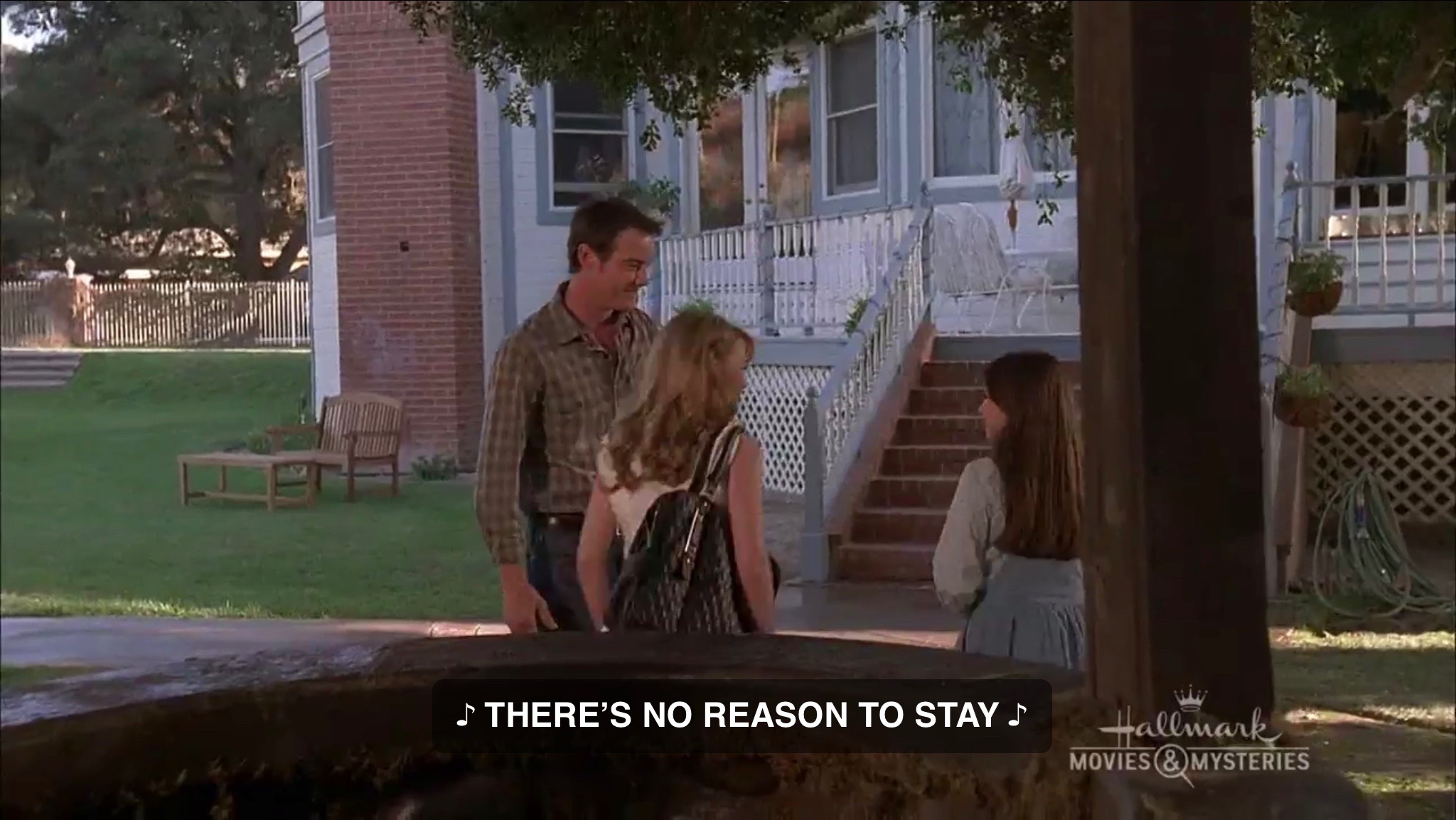
Can we see Mr. Darcy (Ryan Paevey) now?
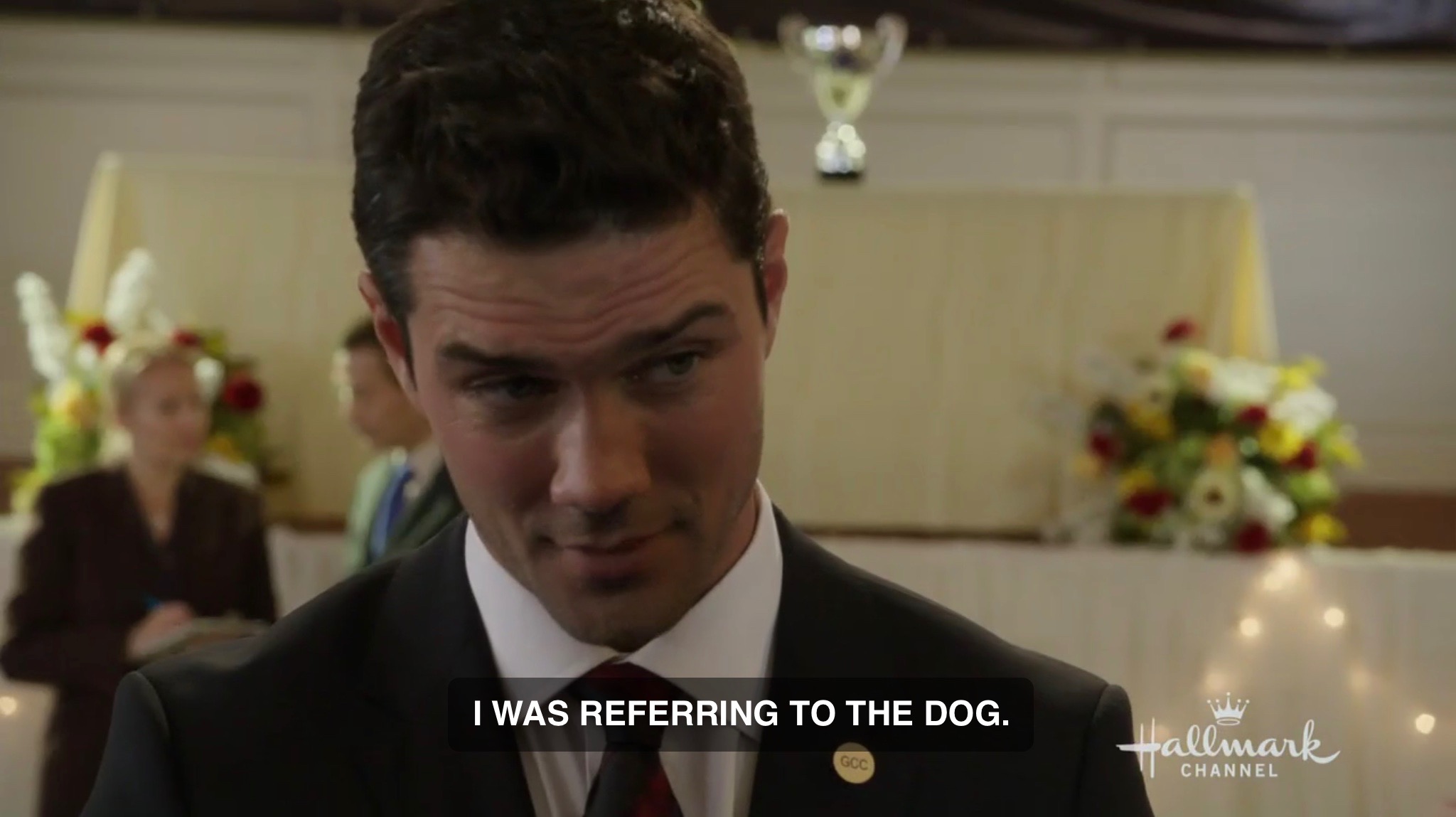
Actor Ryan Paevey really is a high point of this film. Seriously, the best comparison, in recent memory, I can make is to the character of Christian Grey from Fifty Shades Of Grey (2015). Just without the dark past and he doesn’t attach women to leashes and then judge them or anything. He’s rich and judges dogs. He is slightly aloof, but never really off putting. Confident, but not full of himself. He’s also quite attractive. He still feels like a real person though. Long story shot, I think Ryan Paevey did a really good job with the character.
She now is officially let go by the school and accusations that she tried to bribe the guy have even been raised. Now she decides to move to New York City to take up a job offer to be a handler in dog shows. Of course not to be outdone by Busby, Paevey shows that he too can make interesting faces.
She runs into him almost instantly when she steps out of the cab and we meet his dog.
In short order she is swept up into this upper crust family. She actually finds allies on almost every side except from the aunt and the woman she wants her nephew to marry.
I’m just going to refer to them as Prejudice and Prejudice, Jr. We also meet his kid sister named Zara who is played by Sarah Desjardins.
She’s grown since I saw her in Kiss At Pine Lake. She is an ally too and we will find out that after he and his sister lost their parents, he took care of her.
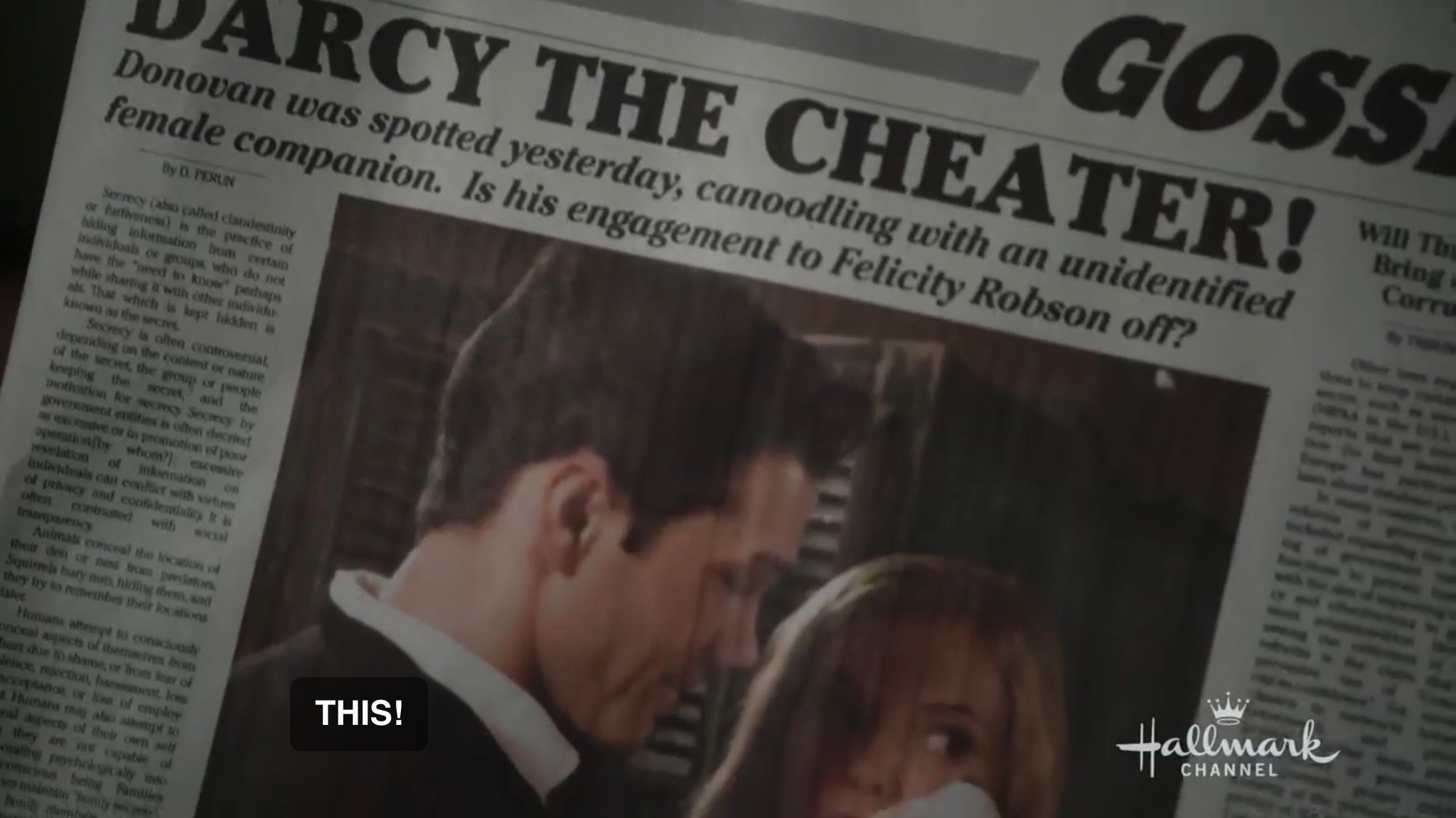
What follows is the typical story of a normal person introduced into a rich family who has already had plans for one of the younger family members. It plays out in the papers too.
And yes, the filler text they put in is still humorous to look at.
We keep getting to know Mr. Darcy better and she moves closer and closer to him. He’s very much his own man despite what Prejudice and Prejudice, Jr. would like to believe. In the end, it comes down to a party. The evil ones make a scene so he kisses her on the spot to make sure she, and those two understand where his feelings lie. Even Elizabeth’s sister notices that the kiss wasn’t just to brush off Prejudice and Prejudice, Jr.
This is when the movie takes an odd turn. Instead of her getting that, she seems to think she was just used. Then her sister overhears Mr. Darcy talking to a male member of the family. This is what they say.
[laughter]
Henry: Donny, I gotta tell you, that kiss that you laid on Jenna’s sister, that was the highlight of the night, my friend.
Mr. Darcy: Oh, the kiss…the kiss was to…the kiss was to shut Aunt Violet up.
Henry: The kiss was because you like the girl.
Mr. Darcy: Why would I like Elizabeth
Henry: [chuckling] Oh, why?
Mr. Darcy: Why would I like Elizabeth Scott? She’s over proud.
Henry: Beautiful
Mr. Darcy: and crass
Henry: intelligent, kills it in a ball gown. Brings you trophies, all those kinds of things.
Mr. Darcy: Yeah, yeah, all those—
Henry: You are absolutely fascinated by her, that’s a fact.
Mr. Darcy: [laughs]
Henry: Admit it.
Mr. Darcy: Mmm-hmm
Henry: [sighing]
The whole conversation is said with Henry speaking in a tone that says you know you like her, just admit it already.
Now the sister runs back to Elizabeth and has just flipped out. Elizabeth immediately flips out too and storms off in a cab. She tells him to not pretend Jenna misunderstood him even though it’s clear as day to anyone who isn’t nuts that she did. He then says he said some unflattering things. When? He tells her right out his feelings for her, but since he says “I’ve decided we belong together” that some how is even more reason to act like a nut job saying “you don’t get to decide who I belong with!” She will even tell her friend he had the nerve to tell her he’s in love with her. Oh, dear God! To give you an idea how crazy this all plays out, take a look at the beginning of The Cinema Snob review of My Baby Is Black! (1961) where he shows the trailer.
I know that Hallmark loves a last minute romantic speed bump, but this is ridiculous and baseless.
She gets an offer to come back and teach because they figured out the accusations were ridiculous and disproven when Mr. Darcy put some pressure on the people driving her out of a job. She turns them down, as she should. She quickly comes around, and they kiss at a dog show while the dog stares right into the camera.
You may or may not have noticed my review was somewhat sparse. It’s not just that I don’t feel well, but that the movie feels like that. It could have been tightened up into something shorter. It always seems to be under the impression that there is a grander plot line playing out with richer characters than are actually presented onscreen. Honestly, I don’t think I can recommend this one. It’s an okay 90 minutes or so, but it really isn’t worth your time.
Been a couple of months since I did my last Navy Film Review so lets hammer out a short one before dealing with Hallmark’s unleashing of a man named Mr. Darcy.
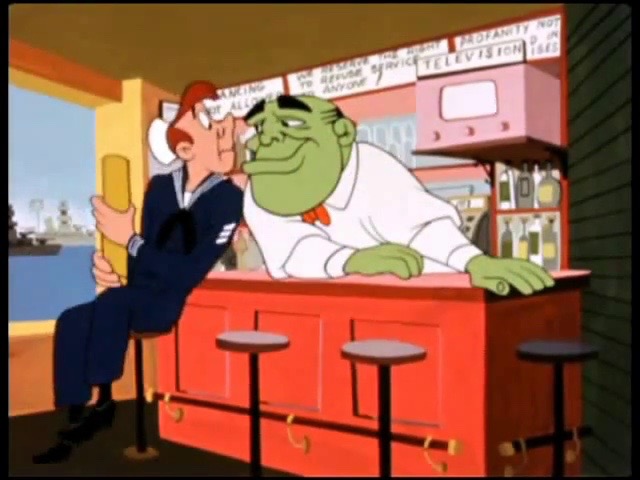
You may recall that last time we took a look at how to unnecessarily pad out your movie so that by the time the plot you promised happens it’s way too little too late. That being the Greek film Alice In The Navy. This time around we have a short from 1949 made by the United States Navy to try and get sailors to re-enlist after WWII. It’s got everything. Talking animals, green skinned bartenders, and tits. Unfortunately, there is no perky blonde running around in pretty outfits. That is one thing Alice In The Navy did have going for it.
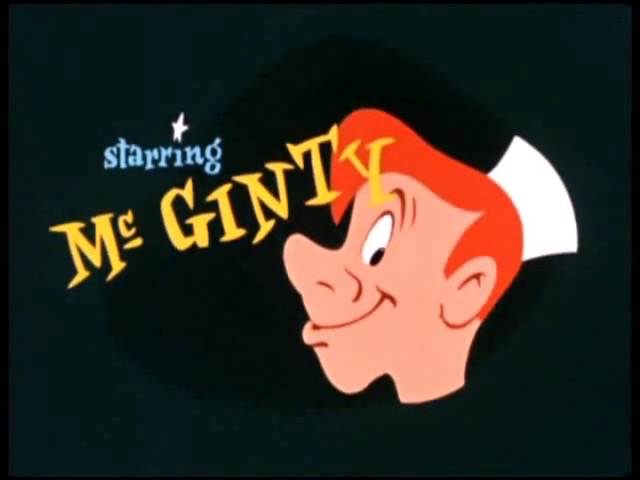
The movie starts off by telling me it is restricted before the fact that it’s a United States Navy Training Film. Then we meet one of the stars of the film. It’s McGinty!
No, not that McGinty. He was still tending bar in 1949. That joke is for you Gary. Our resident Hollywood Snob.
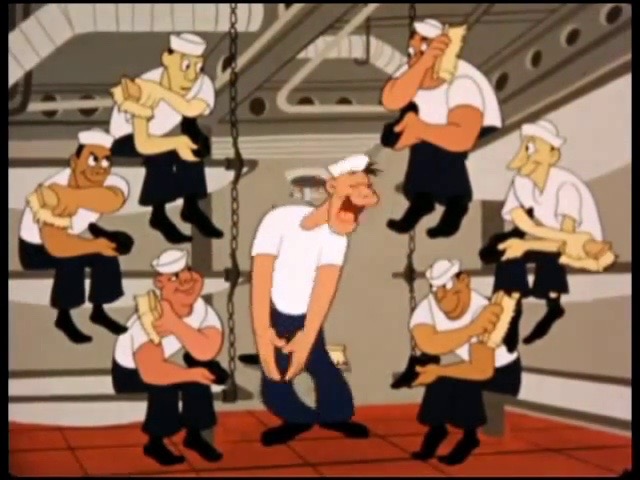
This is just plain old sailor McGinty. We start off by seeing that a sailing life looks rather fun. Although I’m pretty sure this singing sailor was on loan from the Greek navy.
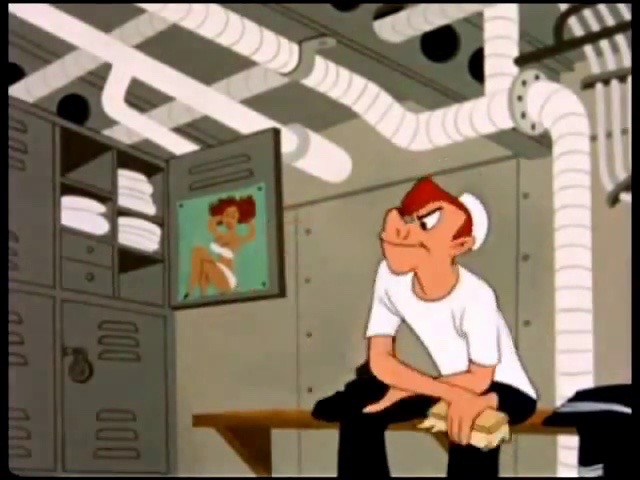
But McGinty is not happy like his fellow sailors.
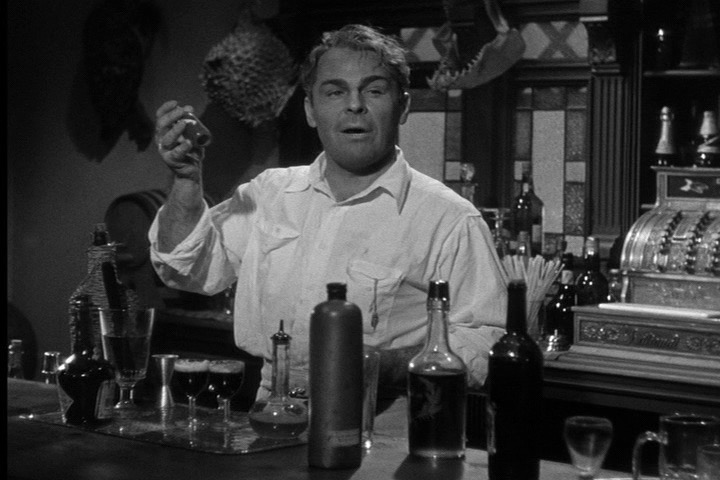
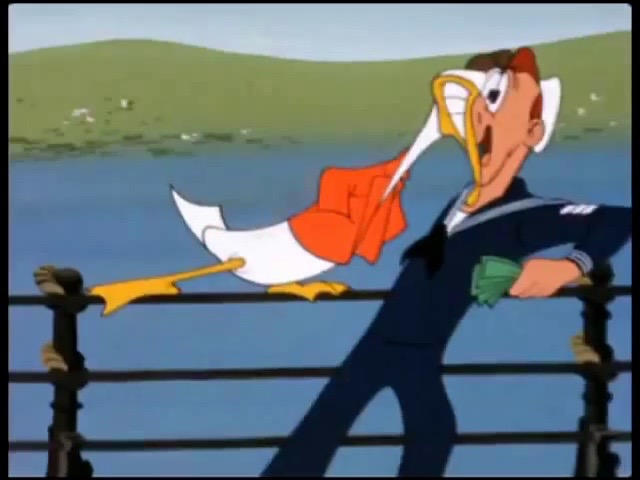
He wants to be a civilian and make some real dough. They only pay him “90 lousy bucks” in the navy. That’s when the talking seagull shows up of course to tell him he should put that money to good use and get drunk!
By the way, the seagull is voiced by veteran voice actor Daws Butler.
So it’s off to get drunk. That is after sneaking past some S.P. Then he orders a “double zombie and scotch chaser”, but oh no!
It’s either E~3 from E~3: The Extra Testicle (1985) or the Hare Krishna zombie from Dawn Of The Dead (1978). Take your pick.
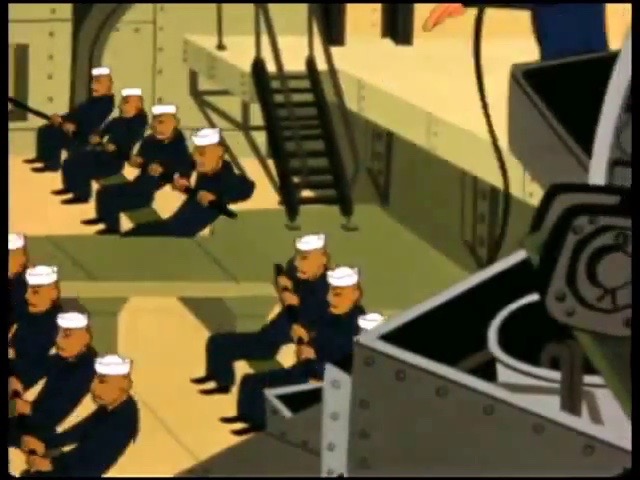
Now McGinty shares how it really is in the navy. By that I mean that he thinks it’s like being on a slave ship from Ben-Hur (1959) while a guy who sounds like Hitler whips you. Well, one minute you’re a drinking and complaining, then one of those damn dream sequences starts on you.
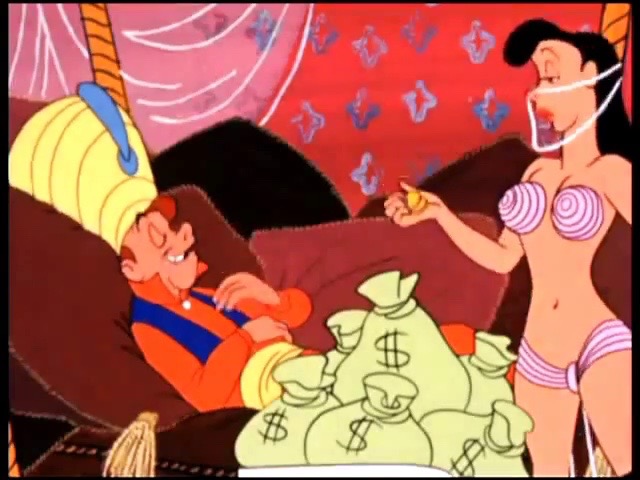
Hmmm… I see his problem. He should have joined the WAVES. I mean if Cary Grant could be a war bride and Donald O’Connor could join the WACS with a talking mule, then surely this guy could have pulled it off. Of course women were integrated into the regular navy by 1949 so actually I don’t see his problem here.
This is only a dream though, but he’s still in luck because the talking seagull shows up again to magically transport him to civilian life. This is when this recruitment video starts to lose me. The first thing we learn about civilian life is that you have to wake up for work.
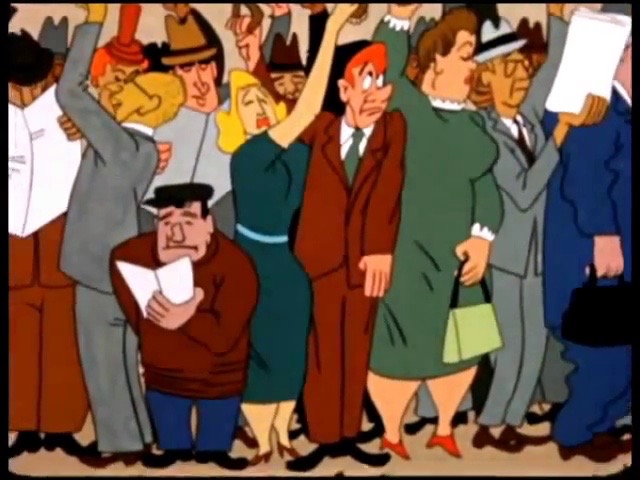
As we all know, the navy lets you sleep to your hearts content and simply wake up at any hour you please. He also has to shave because civilian life doesn’t approve of beards unlike the navy. The navy encourages them and later would require it’s female sailors to never shave their legs nor their armpits. All totally true bullshit. Then it’s off to work on a crowded bus.
Okay, I will give them this. Not everyone in the Navy served on a claustrophobic submarine such as in Das Boot (1981). Then he has to clock in because the navy doesn’t keep track of that sort of thing ever.
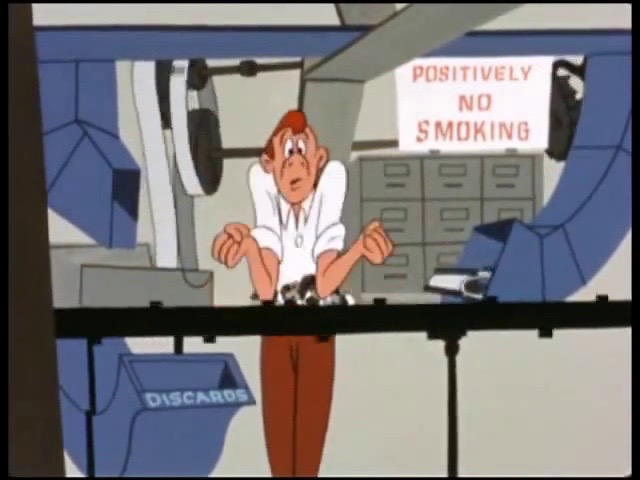
Now he has to work on an assembly line. Could be worse. Those could be chocolates like Lucy had to deal with. I like the “Positively No Smoking” sign. This part is clearly trying to evoke memories in the sailors watching it of adventures that aren’t like this while apparently also trying to remind them that the navy lets them smoke like chimneys I guess.
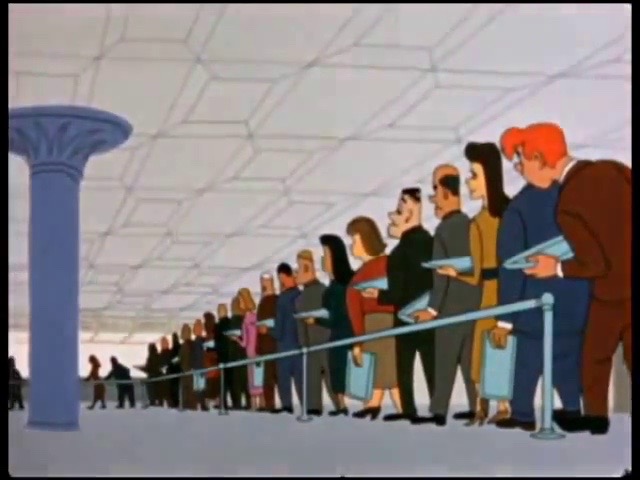
Then it’s off to the Cafeteria to wait in line. I’ve never served, but I seriously doubt that lines like this don’t exist on naval vessels.
Now it’s pay day! His paycheck is 300 bucks. Well that is till it’s put through the “Little Gem Deductor”.
Now he gets pulled into an insurance office to discover that it’s going to cost him to retire. Apparently, he could retire for free in the navy. How does that work? The only way that’s actually possible is if by retire they mean a bullet to the head. Regardless, now he has to go shopping.
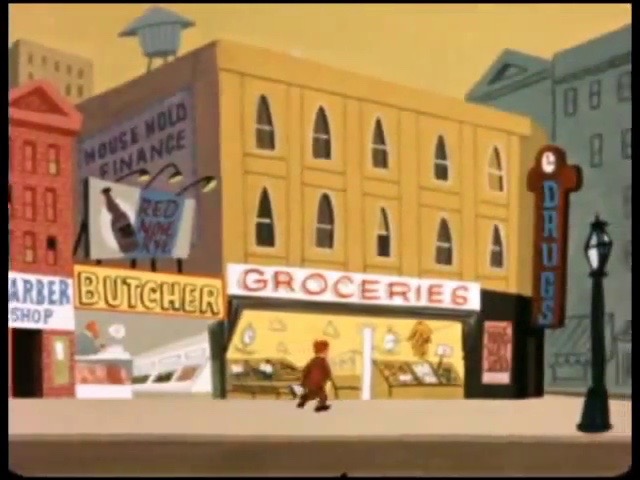
I like that he goes into all the shops except the one with the big sign that says “Drugs” on it.
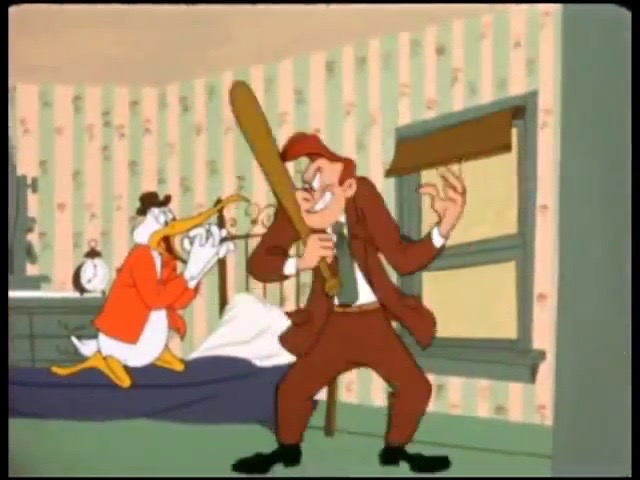
After paying rent, it’s back to his room to bitch about civilian life to the talking seagull. By that I mean he threatens to kill the seagull.
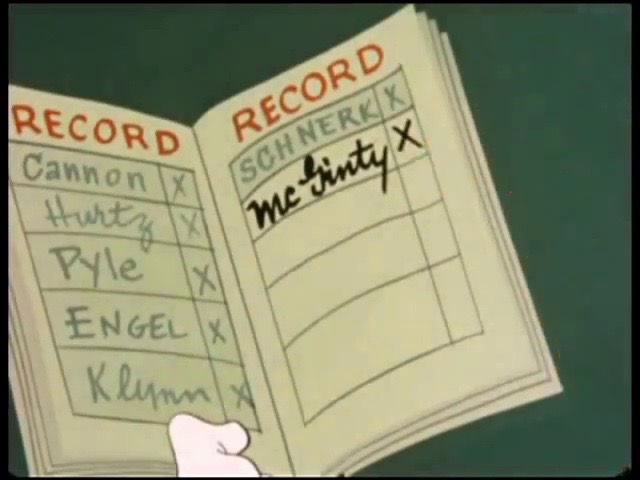
But in the dark, the seagull reminds him that he can just re-enlist within 90 days. That’s when the seagull checks off McGinty.
Now McGinty is back swabbing the deck when that damn seagull shows up again. That’s when the seagull drops the bomb on McGinty.
He works for the U.S. Navy! I always knew they were training talking seagulls in secret. Clearly, that’s why it said this video was “Restricted”.
And thus ends this short film with the message “Keep the Fleet to Keep the Peace”. I would love to know how successful this was. I know why they spend their time trying to make civilian life sound terrible because their audience was sailors who already knew how it actually was to serve in the navy at the time. However, notice that they make sure to show this guy being cast out of a family of sailors into a world where he is all alone. I would think that people who were in the navy because of the family and structure were probably already going to re-enlist. As for the one’s for whom family and structure were either not important or already in their civilian life, I can’t see this convincing any of them to stay. It just seems like a video that ultimately isn’t really for anyone. Still, it was fun to watch, and here it is if you want to see it yourself.
The Producers Guild of America, which is generally considered one of the most reliable of the Oscar precursors, announced it’s pick for the best film of the year earlier today. They had earlier nominated ten films and, out of those ten, they picked…
That’s right! The worst best picture nominee since Crash pulled off an upset victory and defeated both Spotlight and The Revenant. It now may even be the new front runner for best picture.
(Actually, if we’re going to be exact, The Big Short is just the 2nd worst best picture nominee since Crash. It’s easy to forget that Extremely Loud and Incredibly Close was actually nominated.)
As I made clear in my review, I didn’t think much of The Big Short but I do understand the film’s popularity. Appropriately enough for a film that’s been embraced by both Sasha Stone and Jeff Wells, it’s an angry and simplistic film and we live in an angry and simplistic time. Pretending to be complicated while actually saying nothing worked out well for Crash and it looks like it might pay off for The Big Short as well!
Congratulations to The Big Short on its undeserved victory!
It’s not often that I review two movies from two relatively different sources that are both by the same director, but that’s the case this time. David Jackson is also the director who brought the Halloweentown series to an end with Return To Halloweentown. This time he took on something much easier than ripping off Harry Potter with a miscast lead. It’s about a wishing well! Sort of.
The movie begins before the title card appears, and we meet Abby Jansen played by Jadin Gould. She will be your smiling one-dimensional little girl for the movie. I mean your Hallmark Bailee Madison stand-in for the movie. Then we cut to stock footage of New York City before we meet our leading lady named Cynthia Tamerline played by Jordan Ladd.
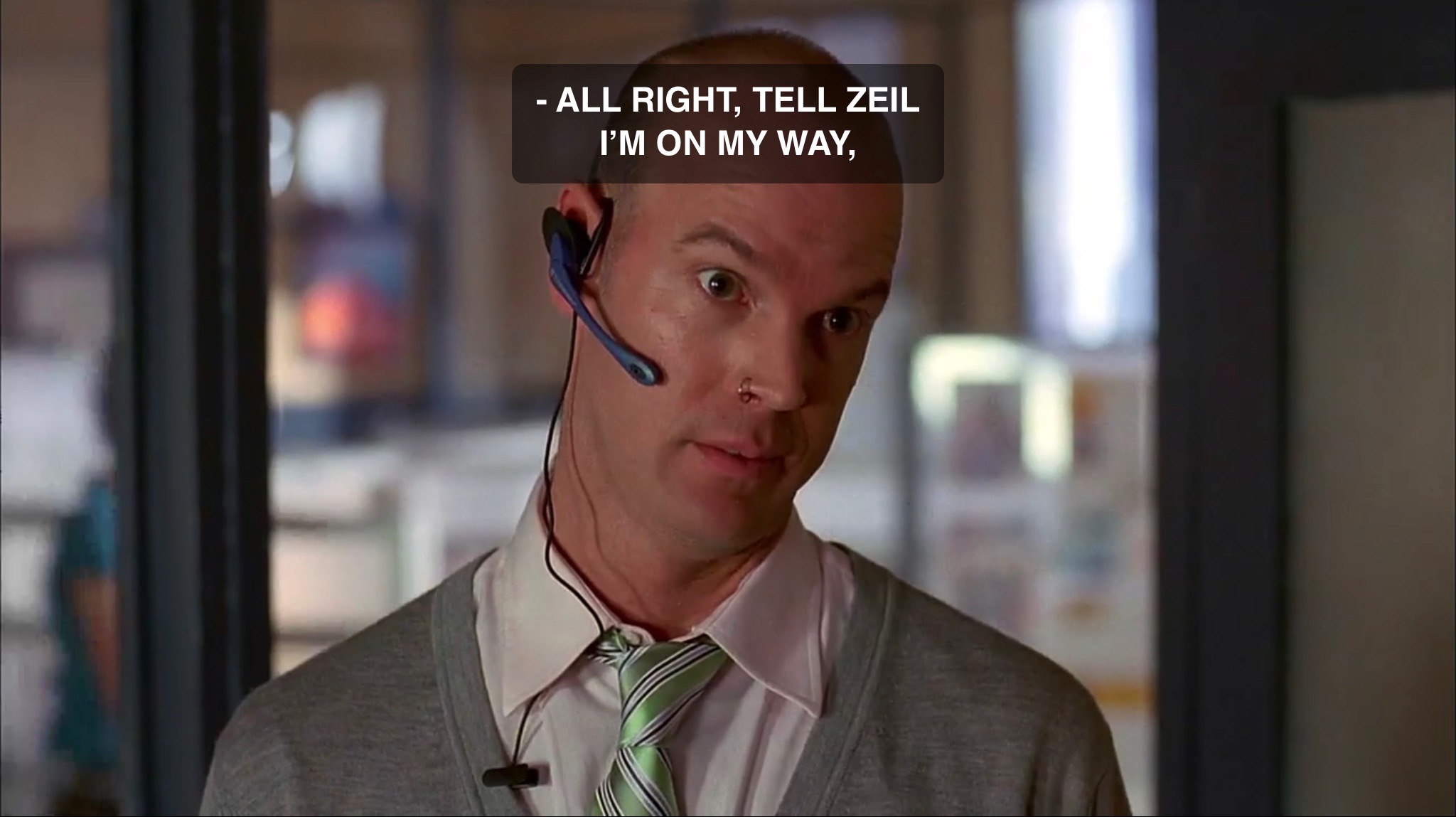
She works for Celeb magazine where not only is Charles Shaughnessy her boss, but her secretary is Lurch with a nose ring.
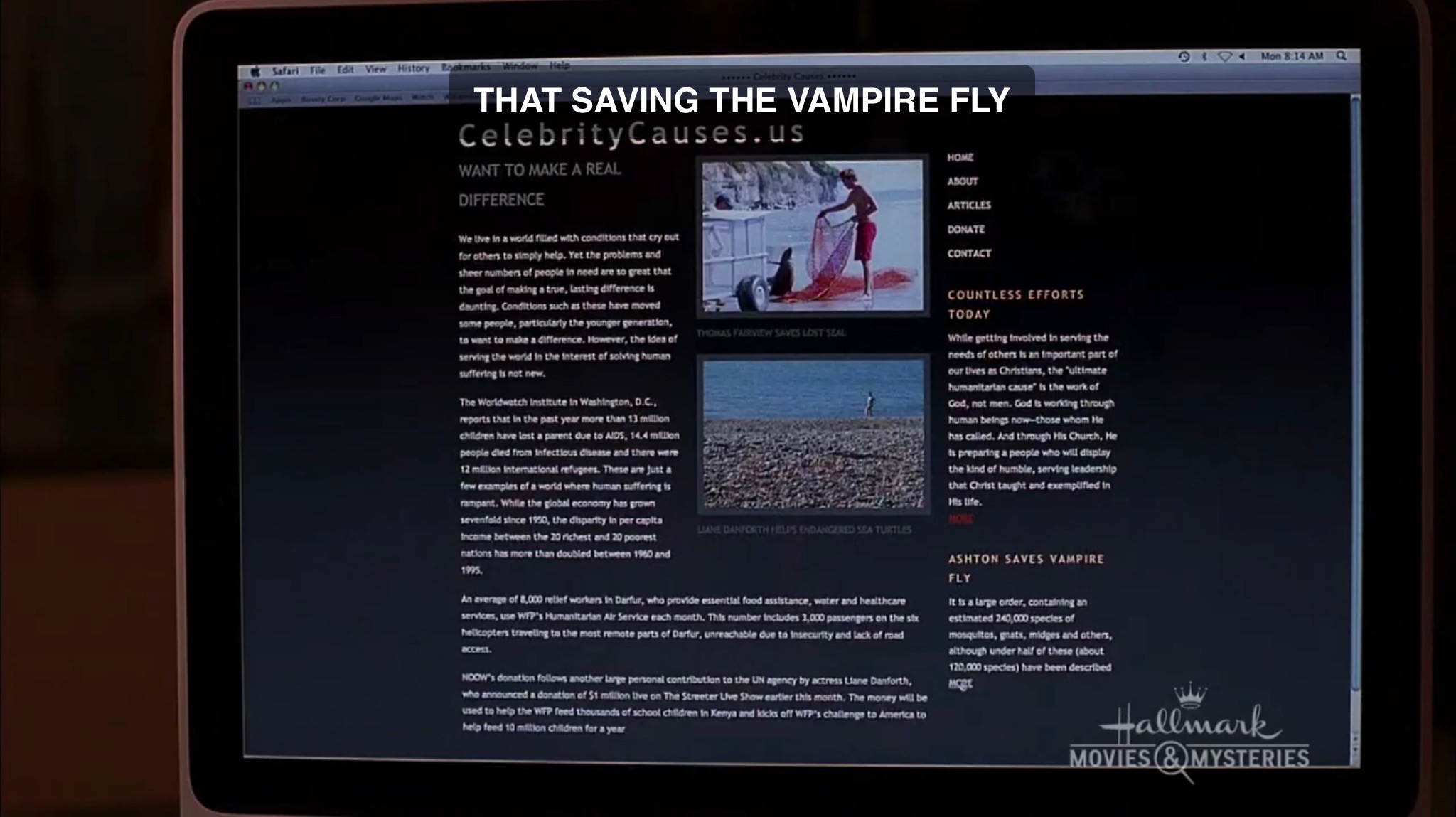
Obviously this movie needs to find an excuse to get Cynthia out with the country folk now. That’s why Shaughnessy calls her in and tells her either publish, perish, or become a nanny for my kids. He suggests that she write a story for one of his other magazines called Great Housekeeping. It’s for people who think Good Housekeeping just isn’t good enough. I thought she chose to write about a woman named Angela and her charity to save the vampire flies, but somehow that will cause her to end up in Slow Creek, Illinois to find a celebrity who may have visited their wishing well. But before that, she looks up Angela’s push to save the vampire fly on CelebrityCauses.us. No affiliation with CelebrityCauses.org. This one has Darcy from A Gift Of Miracles writing for it too.
Anyways, she’s off to Slow Creek, Illinois, which is the “Home of the Wishing Well.” Not just any wishing well, but the Wishing Well. That is till the 2011 Canadian film Wishing Well came out to give them some stiff competition for that title.
She arrives at the hotel where she is going to stay and finds that Ernest Borgnine runs the place. Cynthia is in town for a story that she can take back to Celeb magazine…I thought. Regardless, this is where I am obligated to say that these townsfolk are probably hiding a terrible secret about a Muslim American solider who died overseas and whose father was murdered in the town. I mean the movie has Borgnine, it’s a small town, and Cynthia’s last name is Tamerline which is close enough to Cass Timberlane played by Spencer Tracy in the movie of the same name. That meant while watching this movie, I immediately thought of the film Bad Day At Black Rock (1955) which had Tracy and Borgnine in it. Great movie by the way that I simply updated to a modern context. Here’s the trailer.
But onward with this movie now.
Annoying little girl tells us that wishes come true if you believe and make the right wish. Then we find out that not only is the hotel run by someone Retired and Extremely Dangerous, but that the diner is run by ‘Hot Lips’ O’Houlihan (Sally Kellerman).
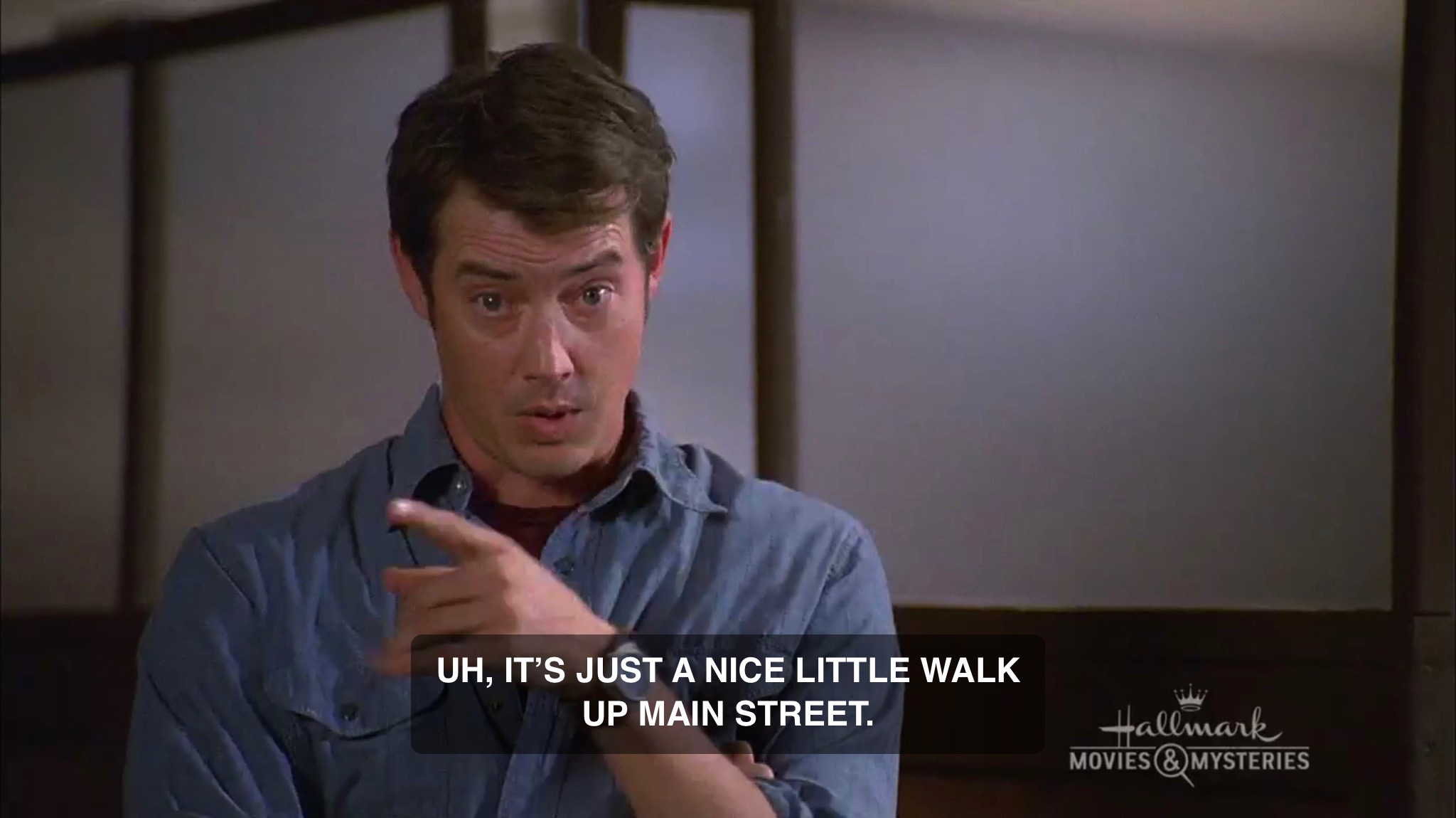
Now Cynthia visits the local paper and finds out that it’s run by the little girl’s dad played by Jason London.
So this is what happened to Eric Camden’s associate pastor’s twin brother.
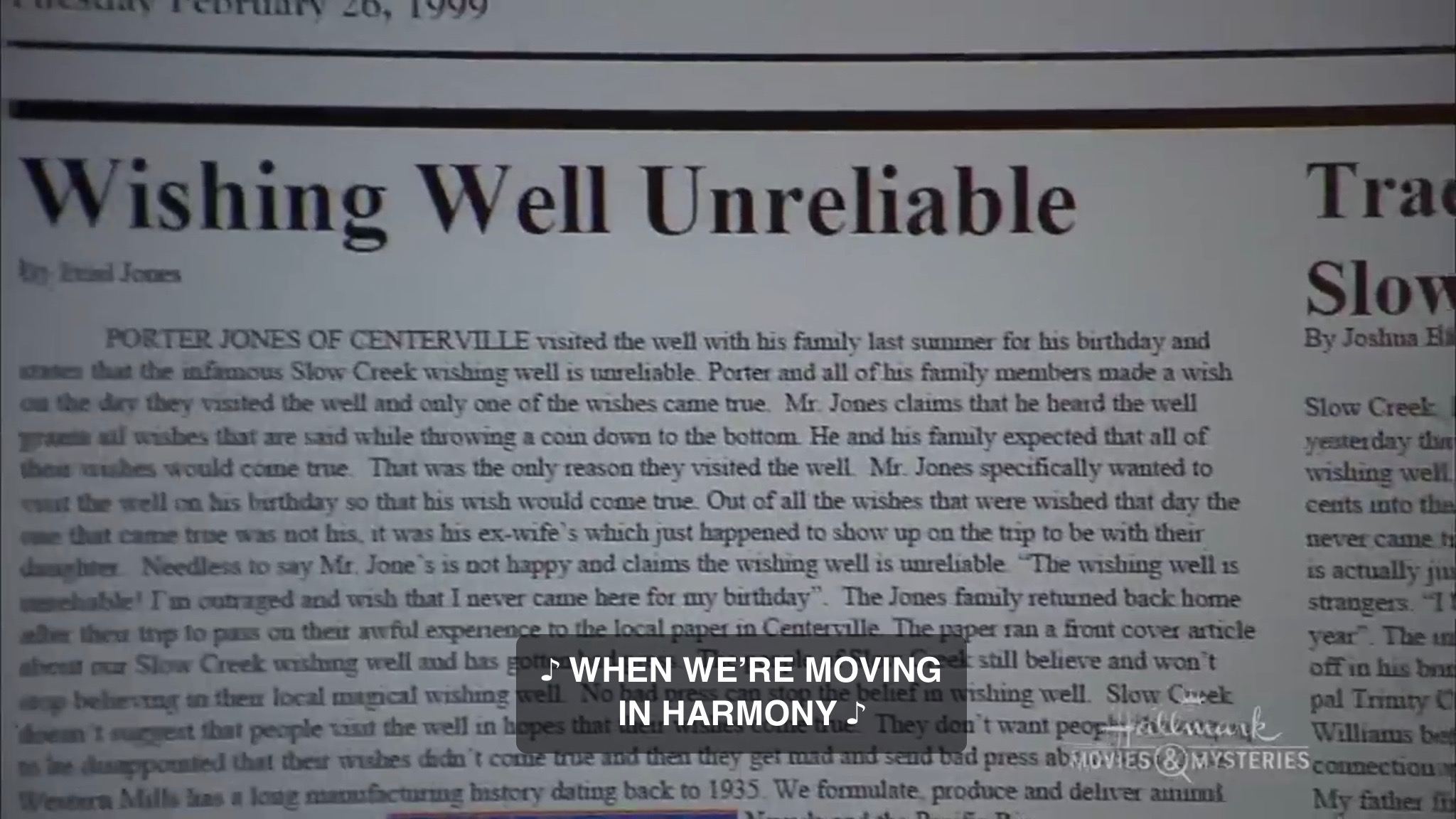
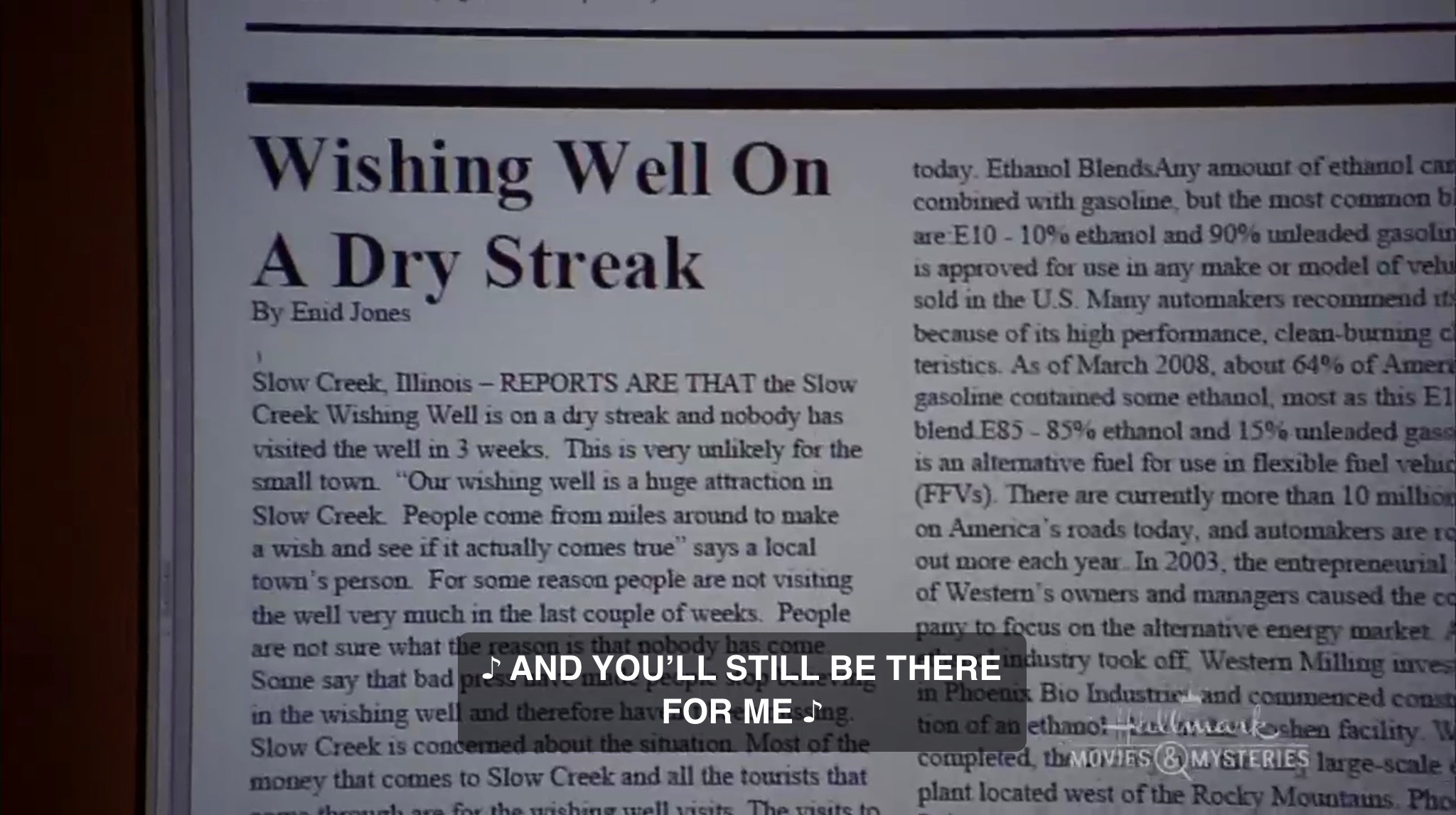
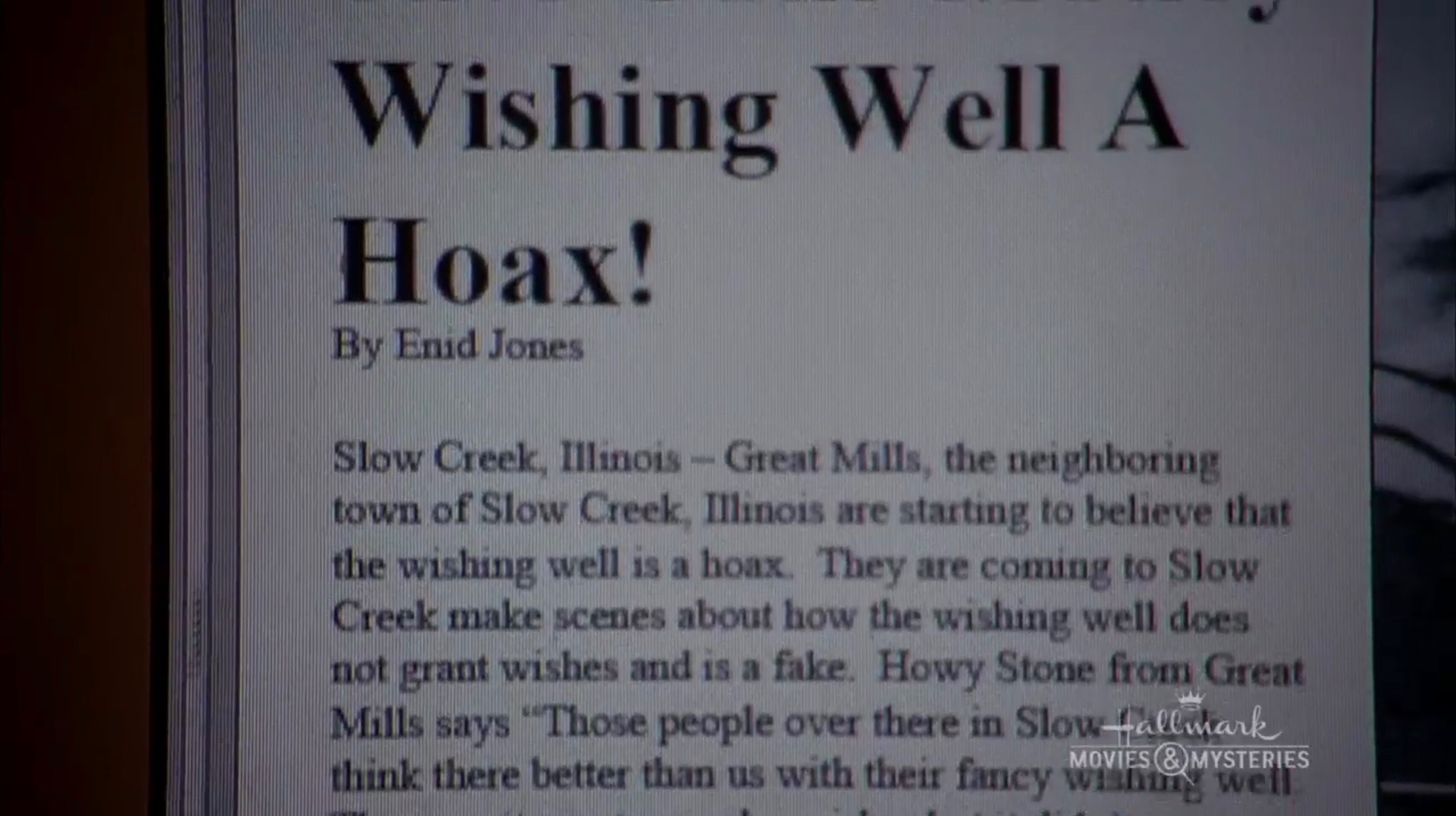
Cynthia starts to look into this wishing well of theirs. Turns out it was once a hot attraction, but then this happened.
Don’t you just hate it when your ex shows up and your wish doesn’t come true, but your ex’s does. Now writer Enid Jones had it out for the well.
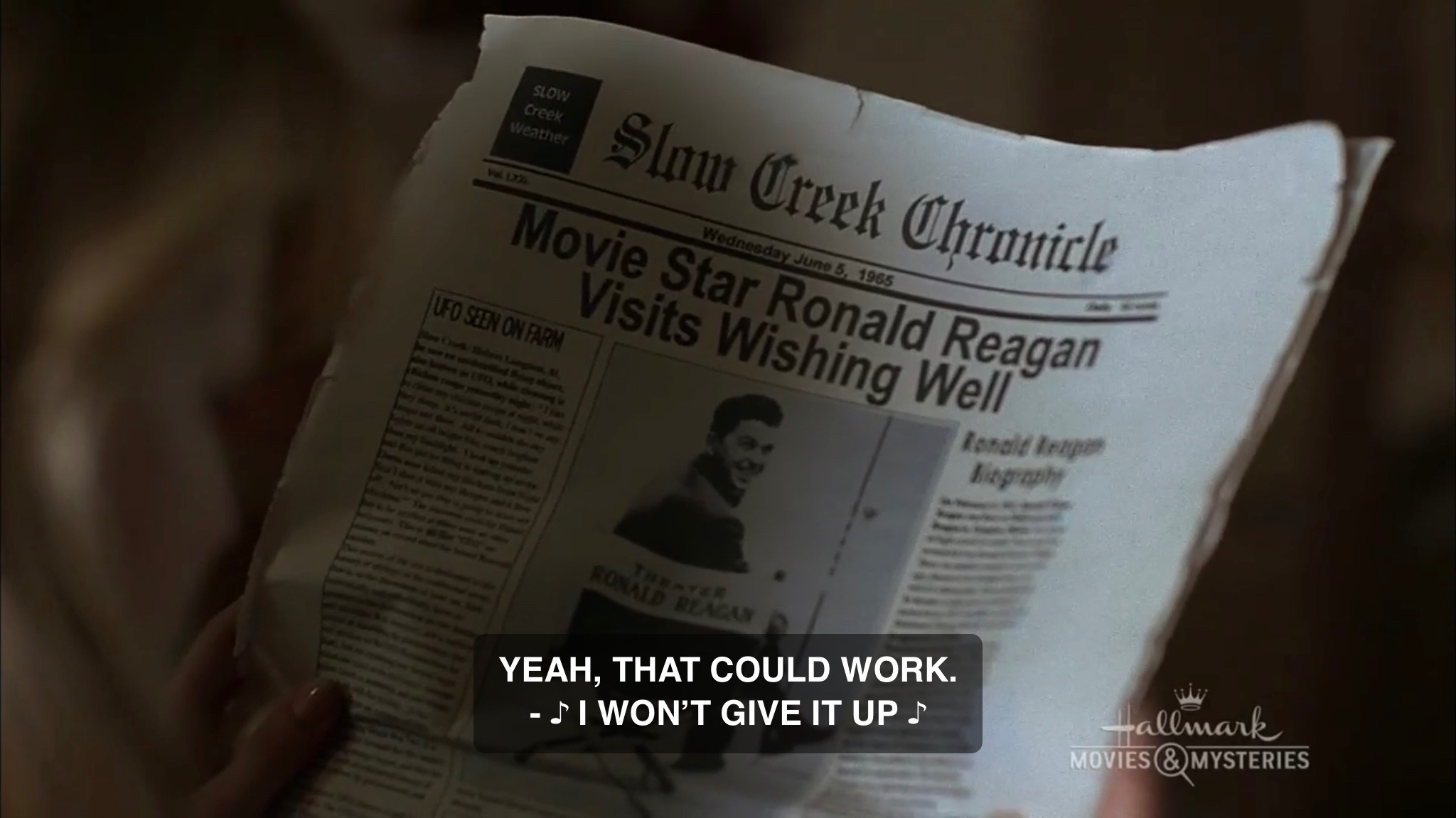
But this isn’t enough for her so she goes to dig in the archives. Long story short, Ronald Reagan once visited their well back in the 1960’s.
That and a UFO was seen on a farm in Slow Creek. Interesting! What else is interesting is that they didn’t pull this Reagan and a wishing well thing completely out of their ass. Reagan actually did visit a wishing well in Dublin, Ireland back in the 1980s. Hmmm…I guess that means I need to listen to some Irish music while I finish writing this review. Well, Dropkick Murphys (Flannigan’s Ball) is Irish enough for someone who is a quarter Irish and from the Bay Area.
Oh, and since Reagan was mentioned. I guess I need to break out Genesis’ Land Of Confusion as well.
More annoying girl, and then Cynthia wakes up the next day to find out that she is now in the Twilight Zone. She is just somebody who has been hired as a local reporter. She calls up people back in New York City, but they don’t know who she is. She doesn’t try to tell them anything personal that only she would know, but just keeps calling.
This is when you can say the film goes on autopilot. Cynthia becomes more of a fixture in the town and discovers just how important this paper is to its residents. The paper is in trouble and might be bought out soon. The little girl is still annoying. A guy dies and she writes his obituary. Another guy sets his house on fire trying to beat his record for how many of his collectible lighters he can have going at once. I’m not making that up. During the scene where he explains his little game and current record I said to my dad that he didn’t mention this is the third house he’s gone through playing this game. Then she is waking up in bed to a phone call telling her his place is burning down. Of course! She writes an article that moves people about the fire. Finally, the townsfolk watch a meteor storm.
Then this big city guy’s mustache shows up to buy the paper. It’s okay though because it turns out the guy who died left a huge amount of money to the paper in his will. I guess that’s better than the huge wad of cash in a can from Christmas Land.
Now just in case you thought you were finally getting this Twilight Zone like story, she wakes up on a plane back to New York City to receive praise for the story she wrote for the magazine. Yep, makes as much sense as you think it does. By that, I mean very little. She leaves her job at Celeb magazine and goes back to Slow Creek where smiley and her dad know who she is. Then it just ends abruptly.
That’s it! It’s quite lousy. Even my Dad said this was a stinker and he’s usually easy to please with these movies. No reason to waste your time with this. Go watch Bad Day At Black Rock instead.
Since I happened to catch her this way. I’m really sorry Jordan.
Now if you’ll excuse me, I need to throw a coin in a wishing well because I’m shipping up to Boston to find my wooden leg and I can use all the luck I can get.
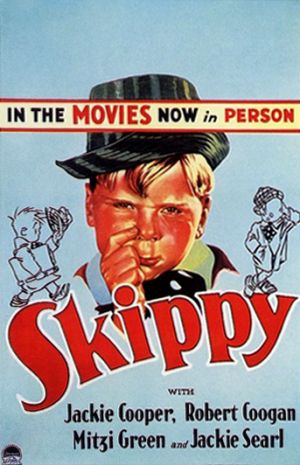
And I have to admit that for the first hour or so, I wasn’t sure if I’d actually be able to get all the way through Skippy. Skippy is very much a film of the early 30s and you never known how much you appreciate jump cuts, tracking shots, and even the occasional hand-held camera shot until you watch a movie that features none of them. It’s definitely a different style of story telling and I sometimes found myself struggling to adjust to it.
Add to that, Skippy was a film about children and, while the film’s star, 9 year-old Jackie Cooper, was a natural before the camera, the other child actors often seemed forced. There was a lot of overacting that, if nothing else, made me appreciate even more Jacob Tremblay’s subtle performance in Room.
There were a few things that I did appreciate about Skippy. As I’ve stated on the site before, I love history and Skippy was definitely a time capsule. The film follows 6 year-old Skippy (Jackie Cooper) as he leaves the safety of his upper class home and explores the poor side of the town and the film does a good job of contrasting Skippy’s sheltered home with the nearby neighborhood of Shantyown. It’s while wandering around Shantytown that Skippy meets and befriend Sooky (Robert Coogan). Skippy and Sooky accidentally break a windshield that belongs to the evil dogcatcher, Mr. Nubbins (Jack Rube Clifford). Mr. Nubbins retaliates by taking away Sooky’s dog and demanding that the boys pay him 3 dollars for the dog’s freedom. Though it’s a mighty struggle that involves many comedic schemes, the boys manage to raise the 3 dollars. Mr. Nubbins takes the money, says that he’s going to use the money to buy a new windshield, and that he’s going to kill the dog anyway. So, Skippy and Sooky have to raise three dollars more just to discover that Mr. Nubbins has already shot their dog.
As Sooky sobs, Skippy fights back tears and asks if they can at least have the dog’s body so they can give it a proper burial.
“It’s already been disposed of,” Mr. Nubbins snarls.
And, at this point, I was just sitting there and thinking, “What the HELL!?” Seriously, I can only imagine what it must have been like to be a child in 1931, watching this film (which was based on a comic strip that all the kids probably read every day), laughing at jokes that were probably quite funny back then, and then suddenly being smacked in the face by Mr. Nubbins announcing that not only was the dog dead but his body had been cremated. I can only imagine that amount of tears that were shed in those 1931 theaters!
(Making things even worse is the discovery that the town’s rules for dealing with stray dogs were written by none other than Skippy’s father.)
And as I thought more about it, it occurred to me that this is one thing that would never happen in a movie today. You don’t kill the dog, unless you want Keanu Reeves to show up and kill you.
Sooky breaks into tears as soon as he hears that his dog has been killed. Skippy manages to hold back until he gets home and then he breaks into sobs. (According to Jackie Cooper, director Norman Taurog threatened to kill the dog in real life unless Cooper gave him authentic tears.) Fortunately, all is eventually resolved by both Skippy and Sooky getting new dogs and Skippy’s dad beating up Mr. Nubbins. Yay!
Anyway, for the most part, Skippy is one of those films that will mostly be interesting to Oscar completists for me. However, I will always be stunned by the fact that, in the film, Mr. Nubbins actually killed that dog.
Now that’s just Oldboy (2003) crossed with The Lawnmower Man (1992).
With those two movie reference jokes out of the way, let’s talk about these four films before I completely forget them.
Man in Love (2014, dir. Dong-wook Han) – This was a whopper to start with. Let’s look at that poster.
“SHE becomes HIS reason to live”.
At least it’s honest and puts SHE and HIS in all caps.
“HIS FIRST YET LAST ROMANCE”
Yes, because I know that my first romance which occurred in my late 20’s back in 2012 began with me acting like a complete psychopath. Actually, it essentially began when I gave into being hit on for about 8 months or so. Then I largely screwed it up because it was my first, I didn’t know I was transgender, nor that I was a lesbian. There were of course issues on her end too, but I certainly didn’t help. I really should have seen Man in Love first, then that relationship would have lasted a lifetime. Okay, let me lay this out for you.
The movie begins and we are introduced to our main character who is a collection guy for a gangster. He is rather nuts and even drinks gasoline in order to pressure one guy. He then visits a hospital room where we meet our girl. She is there because her father is in a coma. He is there to make sure that she signs a contract to take on the debt her father acquired before ending up in the hospital. He’s rather brutal and makes her sign it. He now immediately begins to stalk her. He goes to his boss and convinces him to give him the contract so that he has control over her. He draws a picture on a piece of paper with boxes on it and tells her that every hour she spends with him will make him fill in one of them. When all the boxes are filled in, then the contract will be void. Now he visits a hooker to ask her if thinking constantly about a person means you’re in love with them. Okay, but it’s not like he’s going to try and have sex with her or insinuate himself into her relationship with her dad or anything, right? During one of these hours he tries to take her to a motel. She just walks away, but the camera pans up to make sure you know it’s a motel. Then he is caught reading to her father at the hospital. After going to bother the hooker some more, he tells her he doesn’t love her. At this point, her dad dies and he either sets up the funeral or just shows up and pretends to be a son-in-law. Either way, she apparently wants him now and they kiss shortly afterwards.
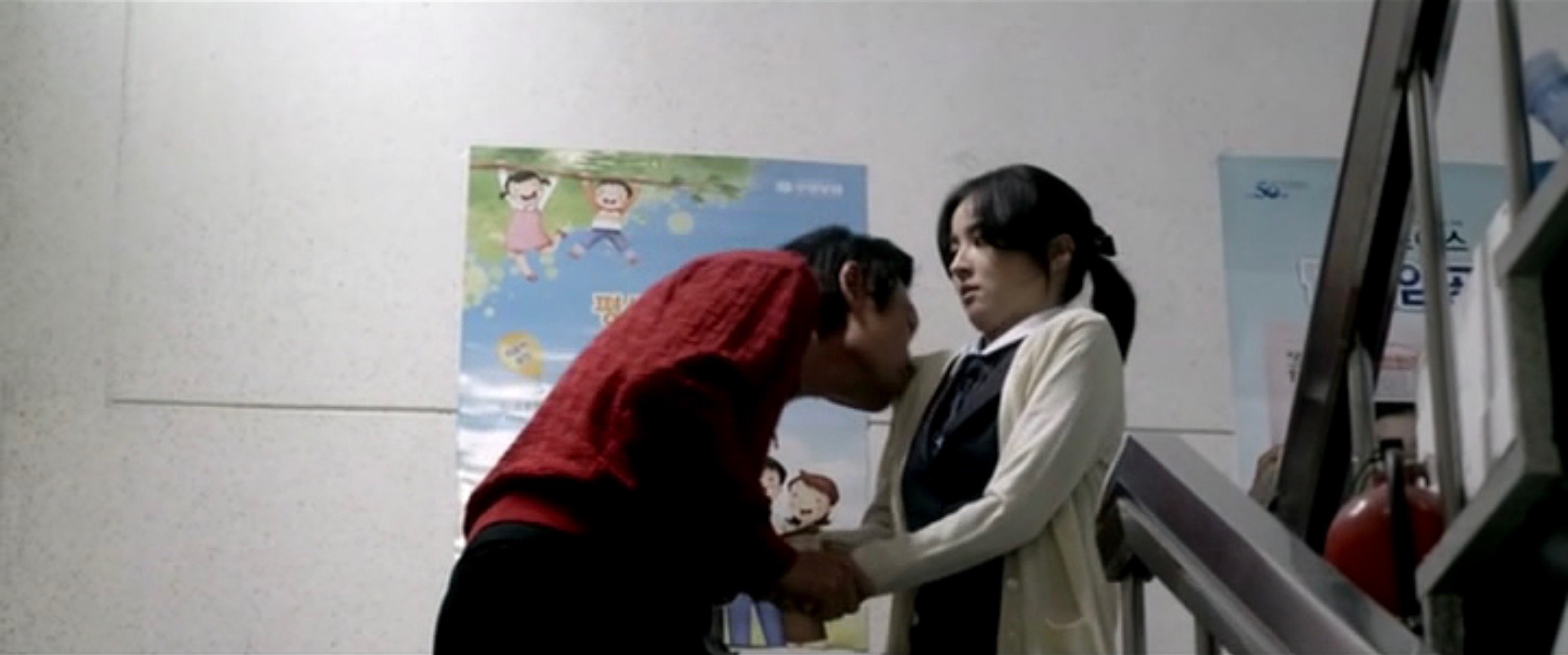
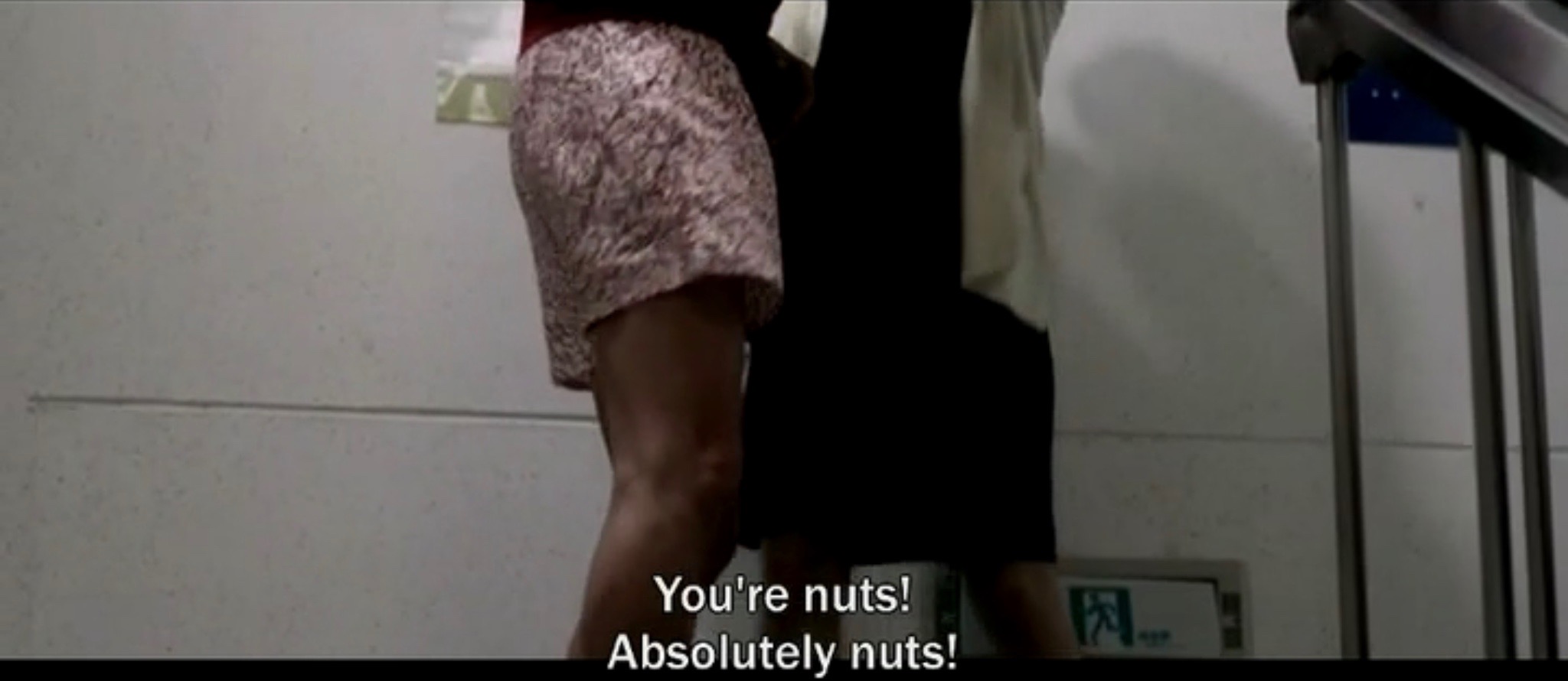
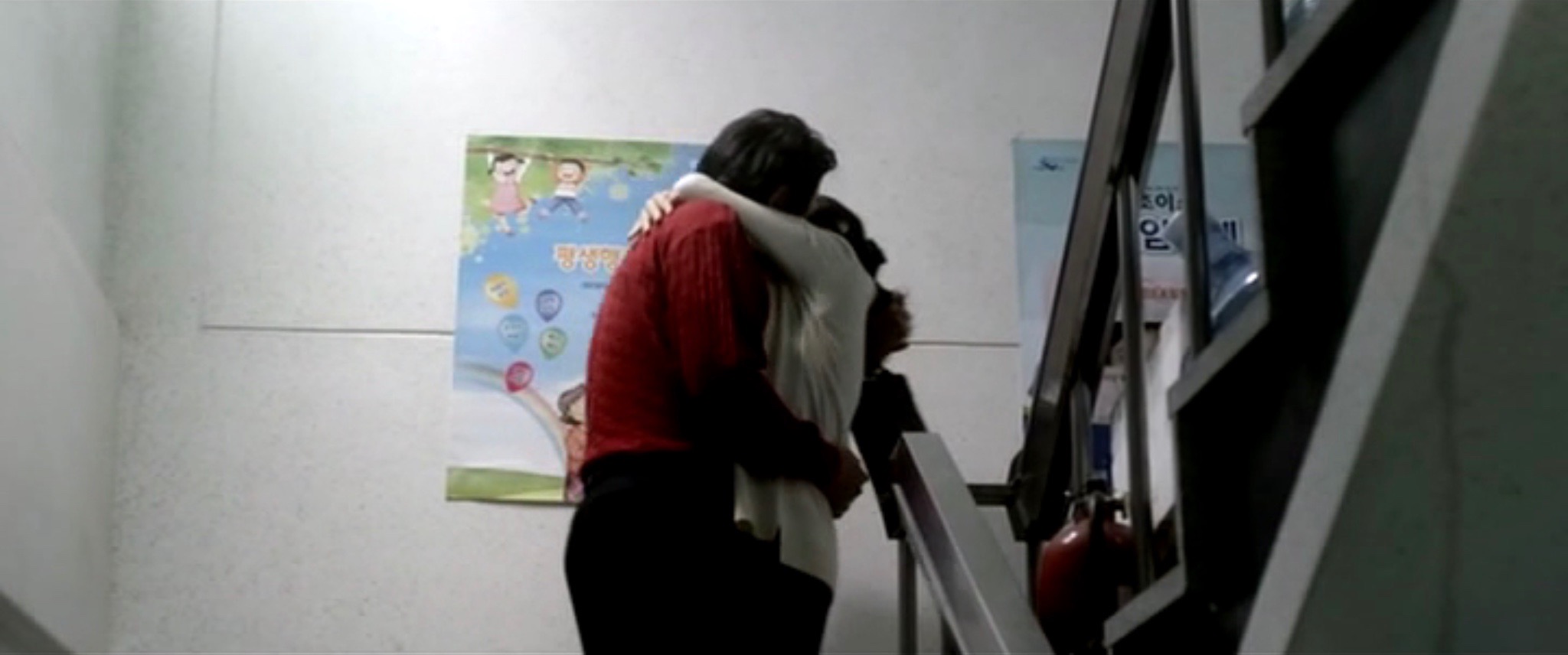
So he does what we would all do in his situation of course! He takes her to a stairwell and proceeds to try and sniff her.
She obviously thinks this is weird, but that’s not your cue to stop. Amp that up!
He drops trou and proceeds to try and dry hump her. LOVE!!!
They are together now. This is only about 45 minutes into a 2 hour movie! Let me attempt to lay out how they try to explain all this.
It cuts to two years later and he is in prison where he is released early because he has a terminal illness that will kill him soon which is why they can’t legally hold him apparently.
Oh, you actually thought there would be more to it? Nope! That’s really this movie’s excuse. He has a terminal illness that he doesn’t discover till two years later. The rest plays out like some tragic epic romance with him slipping away till he dies leaving her with his father crying on a bus.
Okay, here’s what I think they were trying to go for here. We meet a man who essentially was born into this lifestyle and like myself has lived such a solitary life that he is very confused about these emotions he is feeling so he acts on them the only way he knows how. Since his life is one of threats and coercion, he uses those thing to keep her in his life. Being such a shut-in emotionally he even does something as strange as sniff her and try to dry hump her in response to something as innocent as a kiss. He entered her life at a time when the most important man in her life was leaving here for good. As strange as it was, through all his crazy attempts to be with her, she can sense genuine feelings behind his actions and acts on her feelings during a vulnerable time in her life. He never really can break from violence both in terms of his life till now, but also in that socialization that would have allowed him to be “normal” was robbed from him. Finding out that he is going to die only drives him further along the downward spiral. In the end, he essentially dies alone, but tells his father to please watch over her.
I really feel that’s what they were going for here, but it doesn’t work. The linchpins in this storyline are his character knowing he had a terminal illness, the movie being far more obvious about his awkwardness that is hiding real feelings for her, and us believing that she would actually fall for him. The character doesn’t know he has a terminal illness until well after he is gotten her. This means the film expects you to project backwards two years in a sense as a partial explanation for his actions. The movie doesn’t make his lack of ability to exist in regular society clear enough for us to see anything but a crazy man doing crazy things that should cause her to run and not result in reward for him. There’s actually a scene with the police where the cop seems to take his side because the contract says she owes him money. Also, there is never a satisfactory explanation for why she falls for all this. Nor is this man ever really admonished for his actions at the beginning of this film.
Throughout this I couldn’t help but think of another film. That film being Joan Micklin Silver’s Chilly Scenes of Winter (1979). That movie covers similar territory, but so much better. It’s a personal favorite of mine. It features actor John Heard back when he was still on track to become a star, but largely wound up as that guy everyone remembers as the father from Home Alone (1990). It’s the story of a man who spends the entire film stalking and insinuating his way into the life of his ex-girlfriend Laura. We get a flashback to when they met at the beginning of the film. He doesn’t threaten her into a relationship. It is love at first sight for him, but he does what a lot of us would do when they notice somebody that catches their eye. They find a reasonable excuse to spend some time around them. You know, like a sane person does. In his case, he moves rather quickly. I won’t get into the details.
As for the stalking, which even involves him entering her house and completely embarrassing himself and her in front of her new man, is never condoned or rewarded. The film takes us through this man’s crisis of losing somebody he deeply cared for and just can’t let go of. We get it, understand, but never are asked to find his behavior acceptable. We also understand why she loved him and why she goes out of her way to try and let him down easy throughout the film. In the end, she doesn’t come back. The ending of the film has him coming around. It finally sinks in that “it’s over”. We see him at his desk when it’s time for work to end. “It’s not that doesn’t still hurt. It’s that you get used to it.” The last scene has him in a park where we see him make a mad sprint before stopping, turning, and freeze framing.
Chilly Scenes of Winter came into my life in the aftermath of losing my first and only romantic interest. I would say I went through a similar crisis and it took several years for it to truly stop being a daily fact of my existence that I lost someone who at least was very special to me. I believe that Man in Love is well meaning, but it never really gels properly. Using Chilly Scenes of Winter again, it originally was titled and released as Head over Heels and had her come back to him. It was changed in 1982 to have the appropriate ending that matched the book it was based on and the title was changed to match that of the book. Man in Love needed that kind of work, but the changes would be more systemic than a simple change of the ending.
Now that I have poured my heart out to you in a sense, let’s move onto three comedies!
My Ordinary Love Story (2014, dir. Kwon Lee) – I actually saw (500) Days of Summer (2009) in theaters back when it came out. I can’t say I ever thought it needed to be taken and add a really dark turn by having Joseph Gordon-Levitt turn out to be a killer. Seriously, it’s like an Italian Comedy in that sense. Don’t know what an Italian Comedy is? Despite it’s name it’s not called that because it’s a comedy made in Italy. They made those before this genre appeared and they made them after it disappeared. These were comedies that would always have something dark or something you would never think to incorporate into a comedy. I love these movies. Here’s an example of what I am talking about.
Seven Beauties (1975) has our lead wind up in a concentration camp during WWII starving trying to seduce the female commandant in order to survive at the end of the movie. He is taken in front of a bunch of his fellow prisoners and handed a gun to execute someone. The man begs him to shoot him because he can’t go on living. He does shoot him. In the end he makes it home alive to his sisters in Italy. He receives a hero’s return. Our lead looks right into the eyes of his love interest he left behind. He knows and tells her that it’s okay she had to prostitute herself while he was gone to survive. He wants to be married. He tells her:
“There isn’t much time to lose. I want children. Many children. 10. 20. It’s a matter of self defense. Many, and they must be very strong. Look at the crowds out there. In a few more years they’ll be murdering each other. Families slaughtered just for an apple. So we must see to it our family is large. That’ll be our defense. Understand?”
It ends with sad piano music, a sad look on his face, and the words “Yes, I’m alive”. I assure you this is a comedy. A very funny one at that. In fact, here it is if you want to watch it. Assuming it is still available. I can’t recommend it more strongly. Warning, it is dubbed into English.
Other prominent examples include Divorce, Italian Style (1961); Seduced and Abandoned (1964); The Birds, The Bees and the Italians (1966); Il Sorpasso (1962); and many others.
With that backstory out of the way, this movie begins and we are introduced to the quirky, totally not Zooey Deschanel, girl named Park Eun-jin. We get a very modern and hipster introduction to her and her previous six relationships. It’s all presented like you are in for a fun 21st century millennial romantic comedy. She obviously feels burned by all these failed romances and she is only in her late 20s. She winds up in the back of a cab with a man. He is rather quite and reserved, but they form a bond. He does seem a little weird, but it’s nothing we take too seriously as something that should be a big red flag for her.
After entering into a relationship with him, he actually largely disappears from the film as it focuses on her becoming more and more obsessed with trying to figure out if he is cheating on her. We figure it will maybe go that he will leave her because she truly has become damaged goods, will turn out to be clean and find this aspect of her enduring, or maybe something in between where he leaves her, but she comes around and returns to him. Nope! She winds up finding a body in a case in his trunk. That’s when the film takes a sudden turn in every sense.
We are now back to the cab ride where he had an odd comment about the driver. It turns out that a cab driver was in some way responsible for the death of his father. His mother was left alone and eventually wound up dead too. I believe she committed suicide or something after being taken advantage by one man after another as she tried to help them scrape by. He grew up with a deep hatred that led him to kill the cab driver and others who had done his mother wrong. But the body was a woman in his car. Turns out that the cab driver had a wife and he only saw his mother in her which eventually led him to kill her too. I guess this is one of those movies that I won’t spoil, but this dark turn has very dark consequences that in some way are a lesson to her not to let any series of bad experiences with men consume her because hatred can fester and transform you in ways you may never be able to return from.
I recommend this as interesting look at what I see as a South Korean version of Italian Comedy. Otherwise, I wouldn’t seek this out.
Marriage Blue (2013, dir. Ji-Yeong Hong) – Phew! With those rather serious films out of the way, we can just talk briefly about a bunch of romantic comedies tossed together with a countdown that appears on screen as the wedding dates for the couples approach. Seriously, that’s it! Next movie.
Just kidding. Let’s talk a little. I am terrible about keeping track of characters and this one introduces a bunch within the first five minutes of the movie. It’s very quick. I remember the older guy who is going to get married to a younger girl from Uzbekistan and has erectial disfunction. I remember the doctor treating him who stabs a guy just off center of his penis. I remember the girl with short hair who is hiding her true identity from her parents and finds any excuse to try and put off the wedding to a really nice quirky guy who loves the hell out of her. There is a baseball player in there somewhere. Oh, and the lady who goes on the tour which causes her to run into the author of a book she’s reading.
The plots are somewhat difficult to follow. Especially for me. It really gives you no time to stop and think. A film like this sinks or floats based on whether you like the characters or not. Largely, I did. The two I remember the most are the guy with erectial disfunction and the quirky guy who has a tacky sense of fashion and loves his rocking chair. The guy with erectial disfuntion never comes across as if he is just marrying a younger woman because she’s hot or anything. We also don’t get the impression that he wants to cure his inability to get it up for him. It comes across like he feels deeply guilty that if he can’t do that, then he won’t be able to live up to his end of the bargain that she more than does for him. Just like a Howard Hawks’ film, as soon as the two of them really trust each other, the problem disappears just like the plot in a Hawks film. The tacky guy just always comes across as someone that is perfect for her and is willing to bend over backwards to try and break through her exterior. An exterior that she ultimately sheds because she isn’t happy hiding her true self. I love when she tells her father. He doesn’t appear to have known in advance like parents in movies seem to when their child tells them they are gay. He is just surprised that she hasn’t brought it up till now, and is a little pissed off that her fiancee knew his own daughter better than him.
You all know how this kind of movie comes to a resolution. If this is your kind of thing, then this really is a perfectly decent entry into the genre.
Moonshine Girls (2015, dir. Kim Ki-Young) – The plot summary on Amazon Prime told me that it was about a girl who keeps showing up drunk at school because she is trying to perfect/rediscover her dead father’s rice wine recipe in order to save her family brewery. Interesting plot, eh?
Well, it does start off with us quickly getting introduced to our leading lady and she is drunk at school alright. We also discover that roaming schoolyard bitch squads are a universal thing. We also find that teenage boys fighting on the playground for no good reason are also a universal thing. Well, that’s not completely fair. The were negotiating who held claim to all the girls in the school and those negotiations fell through. So logically they had to start fighting. This is when we are introduced to a new teacher at the school. By introduced, I mean he tries to break up the fight and gets punched in the face several times till he is on the ground. There’s your setup. Oh, and some of the kids are involved with gangsters. Believe me, that’s a footnote in this movie. The gangsters are the reason why the brewery is in trouble, but it will barely come up in the movie. But you know what does come up a lot? This guy!
No, not the guy on the left. We’ll get to him. I mean the guy on the right. He is apparently from America (a naturalized Korean) as if you can tell from the fact that he couldn’t look more British if he tried. I buy the Korean on the left as being from America more than this guy. I had a British chemistry teacher in college. He was part of a teacher exchange program. This guy could be his long lost brother. Oh, and the actor plays him like a gay stereotype too. I get no impression that he’s supposed to be gay, but that this is how Americans are meant to be portrayed in this film. As weak, meek, and generally will run from actually doing anything useful.
Now for the guy on the left. He is the new teacher at the school. I believe he used to go there when he was a kid and it apparently was a rather prestigious school test score wise at the time. This guy is basically a cross between Mr. Miyagi and the unkillable worker from Aleksandr Dovzhenko’s Arsenal (1929). Yeah, this movie definitely has a propaganda feel to it. Wouldn’t get that from the plot summary, but it’s here.
He hooks up with the girls and winds up getting everyone involved in this noble pursuit this young lady and her two friends have. The movie even reminds us that rice wine is for more than getting wasted. Also, that it’s matter of pride. He goes into Miyagi mode when he trains everyone in martial arts by having them do something that totally is not wax on wax off or jacket on jacket off. Yeah, this guy is apparently a martial artist, rice wine expert, teacher, and a Korean nationalist all rolled into one. At least he’s entertaining. Unlike the British American guy.
There is only one part of this that actually offended me, and it could be the translation along with a bit of misinterpretation. There’s a scene where the girls have an older guy taste their rice wine to test it’s quality for them. He likes it, but he can tell that their “five grains” rice wine really is only 4 grains. Why? Because he can tell that one of the ingredients is not domestic. They never use the word foreign, but it makes me wonder. Was he referring to ingredients from just their region of Korea? Did he mean South Korea as a whole? The way the rest of the film is and that the lead teacher looks like he could be in communist propaganda as a proud communal farm worker, makes me think he meant South Korea as a whole. The speech the girl gives at the end doesn’t help.
I can’t really say this is bad. It’s just a little odd. I really am not 100% positive this is or isn’t propaganda. I guess check it out and tell me what you think. If you dare! Duh, duh, duh!
Oh, and if you are a gamer, you will notice that one of the guys has a hairdo similar to the kid in the game Quest 64. Good thing I wasn’t watching this with my neighbor who I forced to play and beat that game when I was a kid. It would have given him flashbacks. I know I was already having flashbacks to In The Name Of The King 2: Two Worlds (2011) because the Korean superman teacher wears a scarf in numerous scenes. In The Name Of The King 2: Two Worlds had Dolph Lundgren wearing a scarf that he never took off. One final thing, Dolph Lundgren is going to be in a sequel to Kindergarten Cop (1990). Yeah! Let that settle in.
I just finished watching the 1995 best picture nominee Sense and Sensibility on TCM and, despite the fact that I’ve watched it several times in the past, I’m glad that I took time to rewatch it. Sense and Sensibility is one of those very special films that you should rewatch every few months just to be reminded of how good it is. There’s no CGI in Sense and Sensibility. Instead, there’s just some very good writing, some excellent performances, and some lushly wonderful images of the English countryside, courtesy of director Ang Lee. It’s a deliberately paced film, one that proves the virtue of a subtle touch.
The film tells the story of the Dashwoods. As Mr. Dashwood (Tom Wilkinson) dies, he tells his son by his first wife, John (James Fleet), to take care of his second wife (Gemma Jones) and their three daughters, Elinor (Emma Thompson), Marianne (Kate Winslet), and Margaret (Emilie Francois). Naturally enough, John does the exact opposite and soon the Dashwood sisters are forced to leave their large estate and fend for themselves.
The film centers on the practical Elinor and the passionate Marianne. Elinor meets and falls in love with Edward (a surprisingly restrained Hugh Grant), an aspiring clergyman who is also John’s brother-in-law. Edward comes from a wealthy family but will be disinherited if he marries someone who has neither money nor social prominence. Marianne, meanwhile, has fallen in love with John Willoughby (Greg Wise), who is handsome, dashing, rich, and a bit of a cad. (Cad is such a cool word. People should start using it more.) Marianne is so in love with the unworthy Willoughby that she misses the fact that the kindly Col. Brandon (Alan Rickman) has also fallen in love with her.
Sense and Sensibility is based on a Jane Austen novel and, in its very British way, it’s a wonderfully romantic film. Tonight, when viewed in the shadow of the recent passing of Alan Rickman, the scenes featuring Col. Brandon were even more poignant than usual. His love for Marianne is perhaps the most pure and selfless love to be found in the entire film. There’s a scene where Col. Brandon is speaking to Elinor and Marianne, inviting them to his estate. Marianne ignores him until Brandon mentions that Willoughby is also inspected. Suddenly, Marianne looks up and smiles and Alan Rickman allows just a hint of pain to enter his voice. It’s a masterful performance.
But really, the reason why I love this film is because it’s about sisters. I am the youngest of four sisters and, whenever I see this film, it’s hard for me not to see the Bowman sisters in the Dashwood sisters. There is so much about Marianne that I relate to, from her passionate pursuit of “true love” to her artistic sensibility to her somewhat dangerous habit of wandering around in the middle of thunderstorm. You never doubt for a second that Emma Thompson and Kate Winslet could be related and this film always makes me appreciate my own sisters.
Sense and Sensibility was nominated for Best Picture of 1995 but it lost to a film that is its total opposite, Mel Gibson’s Braveheart.
After watching 911 Nightmare, I continued to clean out the DVR by watching I Have Your Children. I Have Your Children originally aired on Lifetime on January 1st. That’s right — this is the first Lifetime film of the year!
Anyway, I Have Your Children is a film about hostage negotiation and, after reading that, are you still awake? For whatever reasons, there have been hundreds of movies and TV shows about hostage negotiators and they’re usually pretty boring and predictable. Some crazy person takes a group of people hostage. The SWAT team surrounds him. A hostage negotiator who is haunted by a past failure shows up and does the whole, “Just talk to me” routine. The SWAT team just wants to shoot the guy and the negotiator does the whole, “You are putting the hostages in danger!” routine. Usually, it turns out that the guy holding the hostages is doing so because he was screwed over by a bank or health insurance company or maybe he lost all of his money due to a smarmy stockbroker. There’s usually a scene where the negotiator delivers food to the hostages.
Seriously, a hostage negotiator film just writes itself. Maybe that’s why there’s so many of them.
Anyway, at first glance, I Have Your Children seems like pretty much your standard hostage negotiator film. A guy named Calum stops taking his mediation and hijacks a school bus. It turns out that Calum’s mother is dying but she can’t get the treatment she needs because of the big horrible health insurance company! Calum is demanding a huge ransom, enough money to be able to pay for his mother’s treatment. One of the kidnapped kids is the daughter of a claims adjuster at the insurance company!
The SWAT Team just wants to rush in with guns blazing and if that means that all the hostages die, so be it. Fortunately, Amber Cross (Alaina Huffman) is there to negotiate with Calum. Amber, of course, has issues of her own. A hostage died during one of her previous negotiations. Her ex-husband is planning on marrying a younger woman. (It’s a Lifetime film, after all.) Her son is being bullied at school. Fortunately, Amber’s father-in-law happens to be the chief of police and he’s going to keep Amber employed, even if a snarky reporter and the fascistic SWAT Team leader continue to insist that she’s thoroughly incompetent…
However, towards the end of the film, there’s a big twist and it kind of makes up for how predictable the film has been up to that point. Obviously, I can’t really reveal the twist without spoiling the film but I will say that it was clever and fairly unexpected and it pretty much saved the entire film from being totally forgettable. So, if you happen to watch I Have Your Children, the best advice I can give is to stick with the movie and have some faith that it will eventually pay off!
Seriously, there’s nothing wrong with having a little faith.
It’s amazing how quickly a DVR can fill up. Just a few weeks ago, as December came to a close, I went through my DVR, watched a lot of Christmas movies, and cleared up about 30 hours of space. At the time, I was pretty proud of myself but now, a month later, I find myself once again in the same situation. I am running out of space.
In other words, it’s time to clean out the DVR yet again.
I got things started by watching 911 Nightmare, which premiered on the Lifetime Movie Network on January 10th. And let’s give credit where credit is due. That is a brilliant title, especially for a Lifetime film. It not only promises a nightmare (perhaps even a sexy nightmare) but it also promises so much danger that someone is going to have to call 911. A sexy nightmare and danger? How can I say no to that!?
(According to the imdb, this film was originally called Dispatch. 911 Nightmare is a clear improvement.)
Anyway, as for the rest of the film, it tells the story of Christine McCullers (Fiona Gubelmann). When we first meet Christine, she’s a cop and she’s carrying on a family tradition of law enforcement. However, when she gets cornered by a perp (that’s right, I said “perp” because I love to use that official police talk) in an alley, her partner gets a bullet in the head and Christine gets a bullet in the leg.
Now wearing a big ugly brace and moving with a pronounced limp. Christine is working as a 911 operator. One night, a call comes in. Christine answers.
“911,” she says.
“The boogeyman is here!” a little kid says.
Christine tells the kid to get some sleep and to stop playing pranks and she threatens to tell his parents what a bad son they have. She hangs up on the kid and, as a result, the kid’s best friend is murdered…
And I have to admit that this is where I kind of lost interest in 911 Nightmare. The rest of the film deals with Christine trying to solve the murder and we’re clearly supposed to feel sorry for her because everyone is blaming her for what happened but you know what? She deserves to be blamed because she messed up! The film goes out of its way to convince us that Christine made an understandable (if unfortunate) mistake but it never quite convinces us.
Perhaps it would have worked better if the kid had been attacked while he was on the phone with Christine and killed before the police arrived. And maybe then the police could try to blame Christine for their own failure (and certainly, they would point to her previous wounding in the line of duty as proof of her incompetence). Then you would really root for Christine.
But no. Christine is terrible at her job and it’s difficult to really root for a character who screws up that badly. There’s a scene where Christine views all of the mean comments that have been posted about her online and it was probably a bad sign, as far as the film’s effectiveness was concerned, that I agreed with almost every single comment.
Anyway, Christine does go on to investigate the murder and, since this is a Lifetime movie, she also gets a boyfriend during the course of her investigation. Good for her. Unfortunately, however, the film fell apart as soon as she told that kid to go back to sleep.
After I watched The Pride of the Yankees, it was time to watch For Whom The Bell Tolls on TCM. Based on the classic novel by Ernest Hemingway, the film version of For Whom The Bell Tolls was released in 1943 and, when I first started watching it, I was a little bit worried.
For, you see, For Whom The Bell Tolls is an extremely long film. It’s a film that takes its time. It’s also a very talky film and I have to admit that one reason I was worried was because the movie started at 11:30 and it was scheduled to last until 2:15 a.m. Oh my God, I wondered, as the film started to slowly play out before me, am I going to end up dozing off before this is finished?
Well, I need not have worried. Yes, For Whom The Bell Tolls does take a while to get started but it all pays off in the end. By the time the film concludes, you realize why it had to take its time and why we had to spend so much time listening to these characters talk about what they did in the past, why they’re doing what they’re doing in the present, and what they’re hoping for in the future.
Not that all of the characters have a future. At the start of the film, Robert Jordan (Gary Cooper) gets his palm read by Pilar (Katina Paxinou). Pilar refuses to tell him what she saw in his future but it’s not difficult to guess. Robert is on a suicide mission and everyone knows it. Even when he falls in love with the beautiful Maria (Ingrid Bergman), he does so with the knowledge that he’ll be dead in just a few days.
Robert is an idealistic American who, as the film opens, is in Spain. It’s the 1930s and Spain is embroiled in a civil war between fascists and guerrillas … well, if you’ve read Hemingway’s novel, you know that the guerrillas are communists. But this is a Hollywood film so, for the most part, we don’t hear much about ideology. But, then again, audiences in 1943 undoubtedly remembered the Spanish Civil War and understood that the guerrillas were fighting the forces of Gen. Francisco Franco. And, for audiences today, all that matters it that the guerrillas are trying to overthrow a government. Seriously, who doesn’t want to see the government overthrown?
(Full disclosure: My grandmother on my mother’s side came to this country from Spain and frequently insisted that Franco had not been that bad. At the time, not knowing one way or the other, I usually just smiled and nodded.)
Robert is fighting on the side of the guerrillas. In four days, a major offensive is going to be launched against the fascists and, in order to keep fascist forces from pursuing the guerrillas, Robert has been assigned to blow up a mountain bridge. Robert knows that he won’t survive this mission and, as he waits to die, he camps out with a small guerrilla band that is led by Pablo (Akim Tamiroff). At first, Pablo refuses to take part in a mission that he considers to be futile but he is overruled by his strong-willed wife, Pilar (Katina Paxinou).
Among Pablo’s group is the beautiful Maria (Ingrid Bergman), a young woman whose family was killed by the fascist forces. Robert and Maria fall in love, even as Robert prepares for his eventual death.
And then, finally, after two hours of screen time, Robert and the guerrillas head for that bridge and suddenly, we understand why the film took its time to reach this point. By the time Robert reaches the bridge, we’ve come to know and care about both him and the other guerrillas. And, as a result, we care about whether or not they survive. When the fascists launch their own counter attack, every death counts. We feel the loss of every casualty and we understand what they’re dying for. After two hours of talk, For Whom The Bell Tolls ends with a genuinely exciting and even moving action sequence. It all leads up to a final shot that will blow you away in more ways than one.
From Whom The Bell Tolls is a film that will reward those with the patience to stick with it and I’m glad that I turned out to be one of those people. It was nominated for Best Picture of 1943 but lost to another film about an anti-fascist who fought in Spain, Casablanca.