Under the direction of their leaders, Oz (Andrew “Dice” Cay) and his second-in-command, Ice (Roddy Piper), a diverse group of terrorists have taken the Miss Galaxy contest hostage. If they don’t receive a ransom of diamonds, they will kill the Miss Galaxy contestants, including the daughter of a powerful senator. What the terrorists didn’t count on was that the show would be hosted by actress and kick boxer Sharon Bell (Shannon Tweed). Now, it’s up to Sharon to sneak through a locked-down hotel, killing the terrorists one-by-one. Her only help comes from a battle-scarred but supportive security officer (Robert Davi) locked outside of the hotel.
No Contest is so much of a rip-off of Die Hard that it almost qualifies as a remake. (It is probably not a coincidence that Robert Davi appears in both movies.) Despite being such a blatant rip-off, No Contest is redeemed by the combination of Andrew “Dice” Clay’s Broolyn-accented villainy and a surprisingly convincing performance from Shannon Tweed. Toss in Roddy Piper and Robert Davi and the end result is one entertaining direct-to-video thriller.
Shannon Tweed’s best film? No contest. It’s No Contest.
The Fifty Shades of Grey trilogy is shaping up to be the cinematic equivalent of a twitter parody account.
That’s the conclusion that I reached today after my BFF Evelyn and I watched the second part of the trilogy, Fifty Shades Darker. Since we had both read the book, we weren’t shocked when Fifty Shades Darker turned out to be a bad movie. Hell, we weren’t surprised when Fifty Shades of Grey turned out to be bad, either. Each subsequent book was worst than the one that came before it so, when the film version of Fifty Shades Freer is released next year, it should be the worst of all.
Still, nothing could have prepared us for the amount of laugh-out-loud moments and odd details that were offered up in Fifty Shades Darker. Consider just a few:
Having broken up with Christian “I’m fifty shades of fucked up” Grey at the end of the previous film, Ana Steele (Dakota Johnson, doing penance in the hope of being sprung from Purgatory) is now working for a hip and trendy Seattle publishing company! How do we know that it’s hip and trendy? Well, it’s in Seattle and it’s called Seattle Independent Publishing! (As opposed to Seattle Corporate Press.) Her boss, Jack (Eric Hyde) leers at her in a style that basically screams, “Lifetime movie villain!” There’s a scene in which Ana tells her editors that they should be making more of an attempt to reach readers in the “18-24 demographic” and everyone reacts as if this is the first time that they’ve ever heard about this concept. You half expect someone to say, “18 to 24 year olds! WHY DIDN’T WE THINK OF THAT!?” Seriously, after seeing this, I’m going to send my resume to the Dallas Observer, along with a note that says, “18-24. Hire me for more info.”
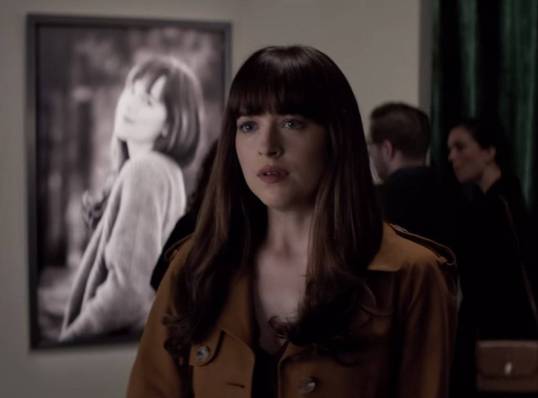
When Christian (poor Jamie Dornan, who I’m pretty sure was trying to blink out an S.O.S. signal at certain points in the film) and Ana first reunite, it’s to attend an art show. Ana’s artist friend has filled an entire gallery with photos of Ana, the majority of which resemble the “sexy” photos that Darcy posted to her MyRoom page in that very special episode of Degrassi. Christian buys all the pictures because he can’t handle the idea of anyone else having Ana on their wall. This obsessive and controlling act is just enough to apparently make Ana reconsider her decision to dump Christian because he was being too obsessive and controlling.
Christian eventually confesses to Ana that he’s only attracted to women who look like his mother and he punishes them because he’s angry with her. “Oh, Christian, your Oedipal complex is so sexy,” Ana coos. Okay, she doesn’t say that. I said that and then Evelyn said something that I can’t repeat. And then we laughed and laughed. Don’t get me wrong. I know that everyone has their issues and God knows, I’ve got a few myself. But the minute a guy tells me that he’s only dating me because I look like his mother, that’s the minute I leave.
When Christian tells Ana about his messed up childhood, Ana responds by drawing on his chest with lipstick. And I swear, that lipstick remains on his chest — without a smudge — for at least a few days. Every time we would catch a glimpse of those perfect lipstick markings on Christian’s chest, Evelyn and I would start laughing. I mean, drawing on your partner (or having your partner draw on you) can be fun but most people wash it off after a while.
(Incidentally, when the Scary Movie people get around to parodying this movie, you know that the lipstick scene is going to be recreated.)
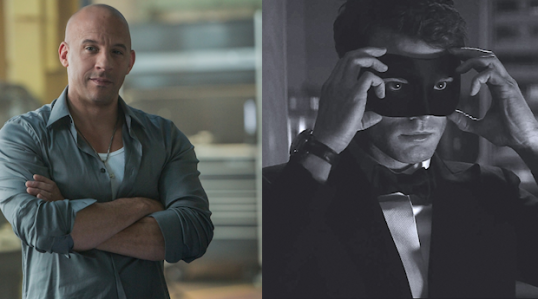
Christian’s childhood bedroom is decorated with a poster of Vin Diesel. When Christian is pouring out his heart, Vin Diesel is glowering in the background. It would have been neat if the poster had suddenly come to life. Perhaps Vin could have suddenly appeared in the bedroom and said, “Someday … BUT NOT TODAY!”
And I’m not even going to talk about the Ben Wa balls.
Anyway, there’s really not much of a plot in Fifty Shades Darker. Ana gets back together with Christian but says that she wants to have a “vanilla” relationship. Christian agrees but he still keeps doing controlling stuff, like buying Ana’s company and freezing her bank account. Ana gets mad. Ana breaks up with him. They get back together. This happens a few times. Christian tells Ana to stay away from a man. Ana gets upset but then the man tries to rape her which feels like the film’s way of putting her in her place for doubting Christian’s instincts when it comes to men. Kim Basinger pops up as the woman who introduced Christian to BDSM and tells Ana that Christian will never be happy in a vanilla relationship. Ana says that vanilla is her favorite ice cream. Here’s my thing: why can’t Ana come up with a more complimentary term than “vanilla” to describe her relationship goals? I mean, Ana’s clever. She came up with that whole 18-24 thing, after all.
There’s also a crazy woman (Bella Heathcote) who shows up occasionally. We know she’s crazy because she’s dressed like someone who lives in an abandoned subway tunnel. She occasionally grabs Ana and says, “I’m nobody!” Hmmm….I wonder what that’s about…
(Well, don’t wonder too much. There’s not a single mystery or question in Fifty Shades Darker that isn’t solved a scene or two after it’s raised.)
One of the redeeming things about Fifty Shades of Grey is that neither Dakota Johnson nor director Sam Taylor-Johnson seemed to be taking it all that seriously. Dakota would pause meaningfully before delivering the worst of her dialogue, a sign that even she couldn’t believe what she was about to say. Meanwhile, Sam Taylor-Johnson’s direction suggested that she found the story to be just as ludicrous and stupid as everyone else. However, Fifty Shades Darker is directed by James Foley. Foley is a veteran director, one who has been making films since before I was born. He does a workmanlike job and you can almost hear him shouting, “Now, where’s my paycheck!?” during certain scenes. Under Foley’s direction, there’s no winking at the audience. There’s no hints of subversion. Foley’s direction is very literal and more than a little dull. He was hired to direct a big-budget version of a Chanel No. 5 commercial and that’s exactly what he does.
The other big issue with Fifty Shades Darker is that Dakota Johnson and Jamie Dornan have very little romantic chemistry. They both look good naked but that’s about it. Jamie looks miserable to be there and Dakota seems to be trying to keep herself amused. The lack of chemistry was less of a problem in Fifty Shades of Grey. In that film, all that mattered was that Christian was rich and hot and Ana didn’t really haven’t anything better to do. But, in Fifty Shades Darker, we’re asked to believe that they’re actually deeply in love and … no, it just doesn’t work.
Evelyn and I laughed through the entire movie. In the past, we’ve gotten in trouble for doing this because we do have a tendency to get a little bit loud. However, nobody in the audience seemed to mind.
Anyway, Fifty Shades Freer will be coming out next year. Hopefully, someone will read this review and work my idea about the Vin Diesel cameo into the film.
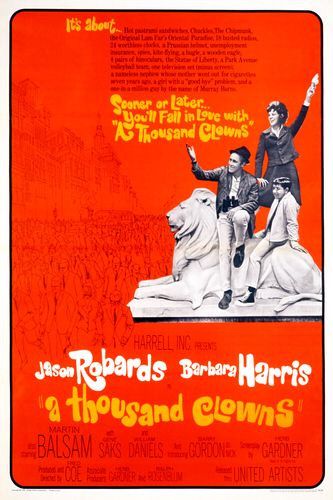
Well, no. No movie is as annoying as Extremely Loud and Incredibly Close. In fact, even if it didn’t particularly work for me, I can kind of understand why A Thousand Clowns was apparently a box office success in 1965. To be honest, part of my annoyance with the film comes from the fact that not only can I understand why other people would love it but I probably would have loved it if I had been alive to see it when it was first released. A Thousand Clowns isn’t an awful film but to say that it has not aged well is a bit of an understatement.
It tells the story of Murray Burns (Jason Robards). Murray lives in a cluttered New York apartment with his 12 year-old nephew, Nick (Barry Gordon). Seven years ago, Nick’s mother abandoned him with Murray. Murray views Nick as being his own son. Nick worships his Uncle Murray. Murray randomly sings Yes, Sir, That’s My Baby. Nick picks up on the habit and is soon wandering around and humming Yes, Sir, That’s My Baby. By the end of A Thousand Clowns you will be so freaking sick of hearing that song. (Fortunately, Murray never sings Send In The Clowns. The film dodged a bullet on that one.)
Murray’s a nonconformist, the type who starts his day by standing outside and mocking everyone who is getting ready to go to work. Murray used to have a job. He was a TV writer. He wrote jokes for a detestable entertainer known as Chuckles The Chipmunk (played by noted Broadway director Gene Saks). Five months ago, Murray quit his job. He’s now unemployed and proud of it. He swears that he will never again sacrifice his freedom for a paycheck. He raises Nick to take the same attitude towards life.
Two social workers, Albert (Williams Daniels) and Sandra (Barbara Harris), show up at Murray’s apartment. They say that unless Murray gets a job and proves that he’s a good guardian, Nick will be taken away from him. Murray explains that he’s a nonconformist and that he’s raising Nick to reject anything conventional. Albert is offended. Sandra is charmed. Soon, Sandra and Murray are going for bike rides through New York City. Murray sings Yes, Sir, That’s My Baby some more…
And it all sounds good but the film just didn’t work for me. First off, I’ve actually experienced what it’s like to grow up with a frequently unemployed father and, sorry, it’s not all studio apartments and cheerful trips to Central Park. Secondly, A Thousand Clown‘s message of carpe diem might have seemed groundbreaking in 1965 but today, it just seems like a cliché. I mean, everyone claims to be a nonconformist today.
Watching the film, it’s hard not to feel that it doesn’t really play fair. It’s easy for the film to always portray Murray as being enlightened when the only people who ever disagree with him are humorless strawmen. Albert is a self-righteous prig while Chuckles The Chipmunk is a heavy-handed caricature, the type of TV star who could only be created by a writer who is resentful that more people are watching TV than reading his latest masterpiece. Martin Balsam appears as Murray’s brother, Arnold, and gets a chance to defend his decision to lead a normal, conventional life. When it comes to the brothers, the film obviously want us to side with Murray but instead, you feel more sympathy for Arnold, largely because Martin Balsam was such an authoritative actor that your natural tendency is to assume that he must know what he’s talking about. It’s interesting to note that it was Balsam, as the voice of mainstream conformity, that won the film’s only Oscar.
Jason Robards was not even nominated, though his performance is often better than the material. He and Barbara Harris have a sweet chemistry, even though Harris is stuck playing a rather demeaning role. (When we first meet Sandra, she is dating Albert and assuming that he’s correct about anything. Then she falls for Murray and assumes that he is the one who is correct about everything. What the film never bothers to really explore is what Sandra herself thinks about anything.) But then you’ve got Barry Gordon, who, in the role of Nick, comes across as being a bratty know-it-all weirdo. Nick is so obnoxious that it undercuts the movie’s claim that Murray deserves to be his guardian.
Also not nominated, despite the film winning a best picture nomination, was the director, Fred Coe. (Nominated in his place were William Wyler for The Collector and Hiroshi Teshigahara for The Woman In The Dunes.) His omission is less surprising than that of Jason Robards. If you didn’t know that A Thousand Clowns was based on a stage play, you’d guess it after watching the first ten minutes of the film. Despite a few shots of Murray and Sandra in New York City, A Thousand Clowns never breaks free of its stage origins. Taking place on largely one set, it feels rather confining for a film meant to celebrate nonconformity.
As I said, I didn’t care much for A Thousand Clowns but I can understand why it was probably a hit with 1965 audiences. Murray’s a transitional figure, standing between the Beats and the Hippies. With America’s confidence shaken by the Kennedy assassination and growing social unrest, I’m sure a lot of people wanted to drop out of society just like Murray. To be honest, a lot of people feel like that right now. I just hope that, if you do decide to follow Murray’s example, you’ll sing something less annoying than Yes, Sir, That’s My Baby.
A Thousand Clowns was nominated for best picture but it lost to a film that Murray probably would have hated, The Sound of Music.
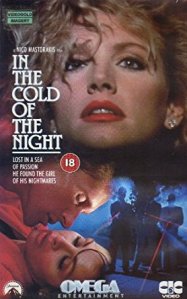
Scott Bruin (Jeff Lester) is a high fashion photographer who is haunted by nightmares in which he strangles a naked woman in the swimming pool. His nymphomaniac girlfriend, Lena (Shannon Tweed!), is surprisingly understanding when she wakes up to discover Scott strangling her but Scott is worried that he might be losing his mind. His psychiatrist (David Soul) is not much help. When Scott has a violent vision in the middle of photo shoot, he freaks out. “Hey, are you on drugs?” one of the models asks.
Then Scott meets Kimberly (Adrienne Sachs) and she looks exactly like the woman from his dreams. When she invites him to back to her house, the house looks exactly like the house from his nightmares. Is Scott going crazy or is he seeing the future? And how is Kimberly’s ex, a cold businessman named Ken Strom (Marc Singer), involved?
Does anyone remember this movie? In the 90s, this used to be on HBO and Cinemax all of the time. It’s a typical sex-fueled, nudity-filled direct-to-video thriller but Nico Mastorakis, a Greek director who has obviously learned a lot from Brian DePalma, gives the movie an enjoyably slick sheen. Neither Jeff Lester nor Adrienne Sachs gives a good performance and the plot feels like it was made up on the spot but fans of Shannon Tweed in her Skinemax heyday might enjoy it.
In the Cold of the Night also features Tippi Hedren, playing Kimberly’s mother. She only appears in one scene and freaks out when she sees some birds. The scene ends with Adrienne Sachs looking directly at the camera and saying, “Mother simply hates birds!”
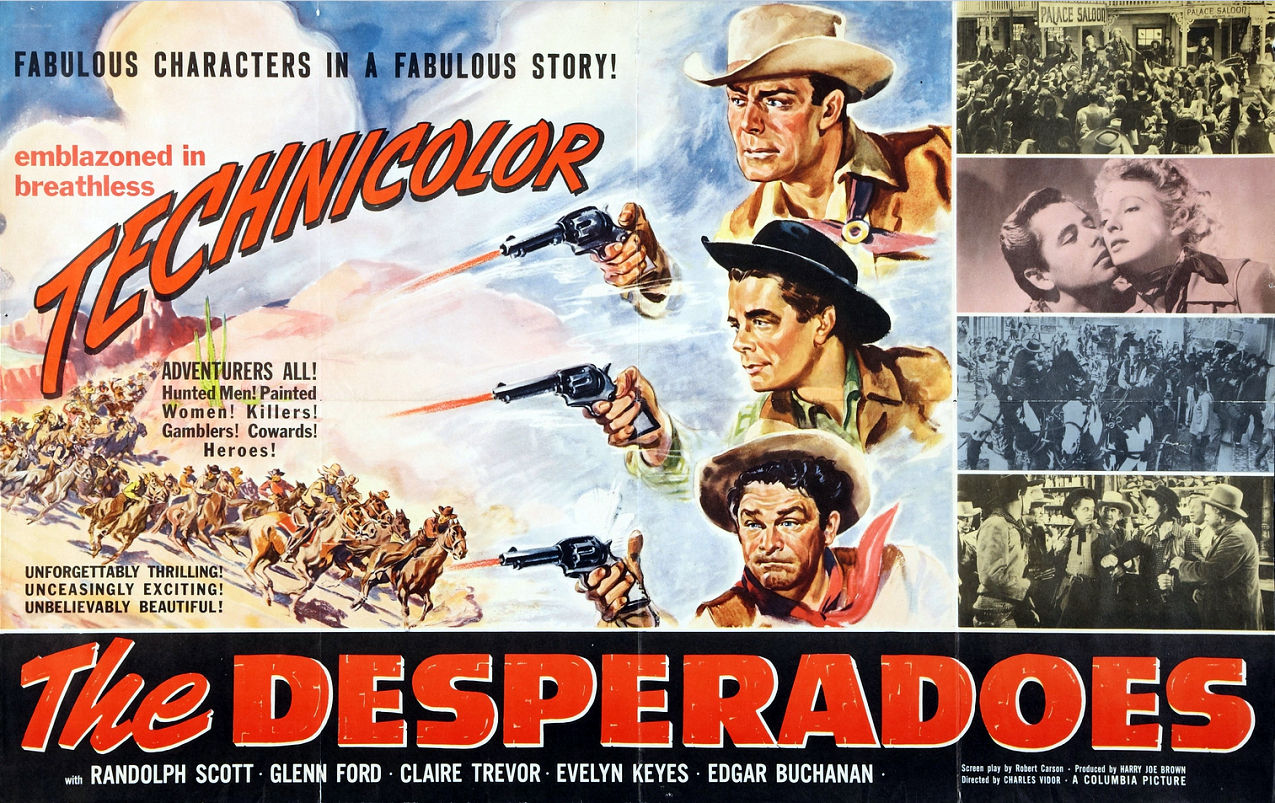
There’s a lot to like about THE DESPERADOES. Not that it’s anything groundbreaking; it’s your standard Western outing with all the standard clichés. you’ve got your two pals, one the sheriff (Randolph Scott ), the other an outlaw (Glenn Ford ). You’ve got your gambling hall dame (Claire Trevor ) and sweet young thing (Evelyn Keyes) vying for the good/bad guy’s attention. You’ve got your goofy comical sidekick (Guinn ‘Big Boy’ Williams). You’ve got your supposedly respectable heavy (Porter Hall ), a mean heavy (Bernard Nedell), and a heavy who has a change of heart (Edgar Buchanan). What makes this one different is the movie seems to know it’s clichéd, giving a nod and a wink to its audience as it merrily makes its way down that familiar dusty trail.
Based on a novel by pulp writer Max Brand (who also created the Dr. Kildare series), this was one of Columbia’s big releases of the year, and…
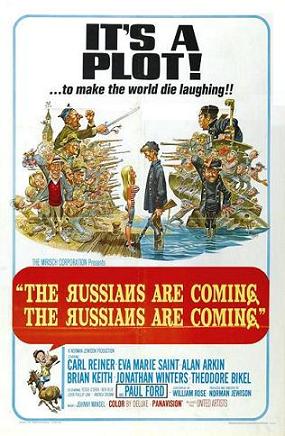
Earlier tonight, I watched a 1966 film called The Russians Are Coming, The Russians Are Coming.
It’s a cheerful comedy about what happens when the captain (played by Theodore Bikel) of a Russian submarine decides that he wants to take a look at the United States. Though he was only planning to look at America through a periscope, he accidentally runs the submarine into a sandbar sitting near Gloucester Island, which itself sits off the coast of Massachusetts. The captain sends a nine man landing party, led by Lt. Yuri Rozanov (a youngish Alan Arkin, making his film debut and receiving an Oscar nomination for his efforts), to the island. Their orders are simple. Yuri and his men are too either borrow or steal a boat that can be used to push the submarine off the sandbar. If they run into any locals, they are to claim to be Norwegian fisherman.
Needless to say, things that don’t quite go as planned. The first Americans that Yuri and his men meet are the family of Walt Whitaker (Carl Reiner), a vacationing playwright. Walt’s youngest son immediately identifies the Norwegian fisherman as being “Russians with submachine guns.” When Walt laughingly asks Yuri if he’s a “Russian with a submachine gun,” Yuri produces a submachine gun and promptly takes Walt, his wife (Eva Marie Saint), and his children hostage.
Yuri may be a Russian. He may officially be an enemy of America. But he’s actually a pretty nice guy. All he wants to do is find a boat, keep his men safe, and leave the island with as little drama as possible. However, the inhabitants of the island have other plans. As rumors spread that the Russians have landed, the eccentric and largely elderly population of Gloucester Island prepares for war. Even as Police Chief Mattocks (Brian Keith) and his bumbling assistant, Norman Jonas (Jonathan Winters), attempt to keep everyone calm, Fendall Hawkins (Paul Ford) is organizing a militia and trying to contact the U.S. Air Force.
Meanwhile, Walt’s babysitter, Allison (Andrea Dromm) finds herself falling in love with one of the Russians, the gentle Alexei Kolchin (John Phillip Law).
As I said at the start of this review, The Russians Are Coming, The Russians Are Coming is a cheerful comedy, one with a rather gentle political subtext, suggesting that the majority of international conflicts could be avoided if people got to know each other as people as opposed to judging them based on nationality or ideology. There’s a rather old-fashioned liberalism to it that probably seemed quite daring in 1966 but which feels rather quaint today. Sometimes, the comedy gets a bit broad and there were a few times that I found myself surprised that the film didn’t come with a laugh track. But overall, this is a well-acted and likable little movie.
As I watched The Russians Are Coming, The Russians Are Coming (and, as someone who is contractually obligated to use a certain number of words per review, allow me to say how much I enjoyed the length of that title), I found myself considering that the film would have seemed dated in 2013 but, with all the talk of Russian hacking in the election and everything else, it now feels a little bit more relevant. Not a day goes by when I don’t see someone on twitter announcing that the Russians are coming. Of course, if the film were released today, its optimistic ending would probably be denounced as an unacceptable compromise. Peaceful co-existence is no longer as trendy as it once was.
Another interesting thing to note about The Russians Are Coming, The Russians are Coming: though the film was written by William Rose (who also wrote another example of mild 1960s feelgood liberalism, Guess Who’s Coming To Dinner), it was based on a novel by Nathaniel Benchley. Benchley was the father of Peter Benchley, the author of Jaws. It’s easy to see the eccentrics of Gloucester Island as distant cousins of the inhabitants of Amity Island.
As previously stated, The Russians Are Coming, The Russians Are Coming was nominated for best picture but it lost to the far more weighty A Man For All Seasons.
Nick Devlin (Lee Marvin) is a veteran enforcer for the Chicago mob. His latest assignment has taken him out of the city and sent him to the farmlands of Kansas. Nick is the third enforcer to be sent to Kansas, all to collect a $500,000 debt from a local crime boss named Mary Ann (Gene Hackman). The first one ended up floating face down in the Missouri River. The second was chopped up into sausages at the local slaughterhouse. Nick might have better luck because he once had an affair with Mary Ann’s wife, Clarabelle (Angel Tompkins).
When Nick tracks down Mary Ann to demand the money, he discovers that Mary Ann and his brother Weenie (Gregory Walcott, best remembered for his starring role in Plan 9 From Outer Space) are running a white slavery ring. Kidnapping girls from a nearby orphanage, Mary Ann and Weenie keep them naked and doped up in a barn. One of the girls, Poppy (Sissy Spacek, in her film debut), looks up at Nick and says, “Help me.” Nick takes Poppy with him, claiming that he’s holding her for collateral until he gets the money.
The main attraction here is to see two iconic tough guys — Lee Marvin and Gene Hackman — fighting over Sissy Spacek, who is only slightly less spacey here than in her breakthrough role in Badlands. In Prime Cut, the ruthless Chicago mobster turns out to have more of a conscience than the rural good old boys who work for Mary Ann and Weenie. Nothing sums up Prime Cut better than the scene where Lee Marvin, wearing a black suit, and Sissy Spacek are pursued through a wheat field by a thrasher that’s being driven by a roly-poly farmer wearing overalls. Prime Cut is both an exciting crime film and a trenchant satire of both the American heartland and the type of gangster movies that made Lee Marvin famous.
It has been 17 years since Tom Hanks was last nominated for Best Actor.
When I discovered this fact, I was shocked because Tom Hanks is one of those actors who has a reputation for always getting nominated. We tend to think of him as almost being a male Meryl Streep, an actor who will be nominated simply for showing up. But, actually, the Academy last nominated Tom Hanks, for his performance in Cast Away, in the year 2000.
Hanks has given plenty of strong performances since then and he’s continued to appear in acclaimed and Oscar-nominated films. And you would think, considering his apparent popularity in Hollywood, Tom Hanks would have been nominated for everything from Charlie Wilson’s War to Bridge of Spies. But no.
Personally, I think Hanks should have been nominated this year for Sully. But you know what Hanks performance truly deserved some Oscar recognition?
Captain Phillips.
Playing the title role in this 2013 Best Picture nominee, Hanks gave perhaps the best performance of his career. That he was snubbed by the Academy is not only shocking but it’s actually a bit unforgivable. Perhaps Hanks was so good that the Academy took him for granted. Perhaps they thought that since both Hanks and Richard Phillips are decent, down-to-Earth guys, that Hanks was just playing himself. For whatever reason, Tom Hanks deserved, at the very least, a nomination.
Captain Phillips was based on a true story. This is another docudrama from director Paul Greengrass, filmed in his signature (and potentially nausea-inducing) handheld style. (Actually, if any aspiring director wants to understand how to effectively use the handheld style, Greengrass is the filmmaker to study.) In 2009, a four Somali pirates hijacked the Maersk Alabama and took its captain, Richard Phillips, hostage. Captain Phillips was eventually rescued by a group of Navy SEALS. Three of the pirates were killed while their leader, Muse (Barkhad Abdi), was captured and is currently serving a 33 year sentence in a federal penitentiary.
This was a huge news story in 2009 with the rescue being described as being the first major foreign policy victory for the new presidential administration. When Phillips was rescued, people took to the streets and the “USA! USA!” chant was heard. “That’s right,” the media and the government and the chanters seemed to be exclaiming in unison, “America’s back! We were abused and it’s never going to happen again!”
A lot of that jubilation was because, at the time, the term “Somali pirates” conjured up visions of cinematic villains who would be more at home in Mad Max: Fury Road than in the real world. The reality of the situation, of course, was that the “pirates,” whose deaths were celebrated as some sort of political victory for the government, were actually poverty-stricken Somali teenagers, the majority of which worked for warlords who remained (and still remain) safely hidden away.
One of the more interesting things about Captain Phillips is that it devotes almost as much time to the Somali pirates as it does to Phillips and his crew. Rather than presenting them as a nameless and personalityless threat, the film allows Muse and his men to emerge as individuals. Much as Phillips spends the movie trying to keep both himself and his crew safe, Muse spends much of the movie trying to keep an increasingly out-of-control situation stable. Both Phillips and Muse are in over their heads. Barkhad Abdi gives a smart and intimidating performance as Muse. The film never makes the mistake of excusing the actions of Muse or the other pirates but, at the same time, it does provide a more nuanced view of them than one would normally expect.
But really, this film totally belongs to Tom Hanks. Captain Phillips works because of Tom Hanks. It earned its best picture nomination on the strength of Hanks’s performance. As an actor, Hanks could have easily coasted on the good will that the audience would have already had for him but instead, he fully commits himself to playing not Tom Hanks but instead Captain Richard Phillips. The film’s final scene — in which Phillips goes into a state of shock and can’t stop talking — is a masterclass in great acting. How the Academy ignored it, I will never understand.
Captain Phillips was nominated for best picture of 2013. However, it lost to 12 Years a Slave.
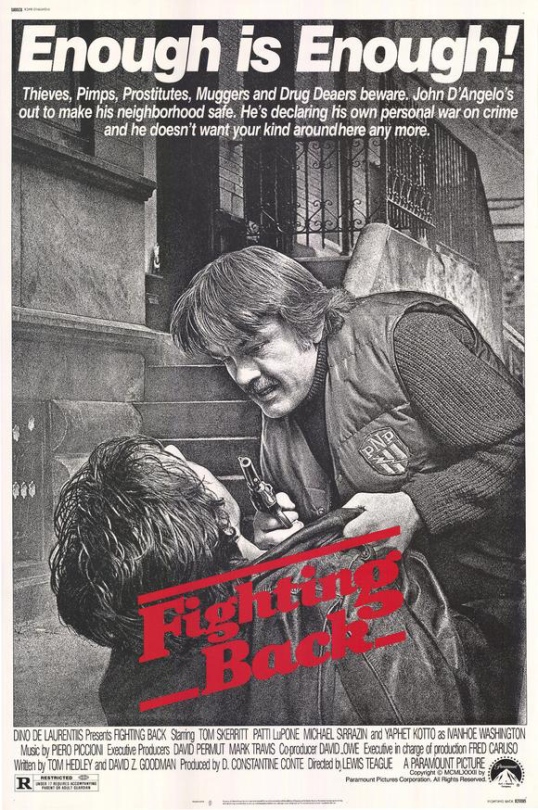
The time is 1982. The place is Hell on Earth, also known as Philadelphia. Crime is out of control and the police are powerless to stop it. When deli owner John D’Angelo (Tom Skerritt) and his wife, Lisa (Patti LuPone), confront a pimp named Eldorado (Pete Richardson), he rams his car into the back of their car, causing the pregnant Lisa to lose her unborn child. At almost the exact same time, John’s mother (Gina DeAngles) is mugged by two thugs who chop off her ring finger.
In the grand tradition of Charles Bronson, John decides to fight back. But he doesn’t go it alone. With his best friend, a police officer named Vince (Michael Sarrazin), John starts the People’s Neighborhood Patrol. The PNP is going to clean up Philadelphia, one street at a time. The media (represented by David Rasche) make John into a celebrity. The black community (represented by Yaphet Kotto) suspect that John and the PNP are guilty of racial discrimination. The Mafia wants to bring John over to their side. John runs for city council but he still has time to drop a grenade in a pimp’s car.
Fighting Back was one of the many urban vigiliante films to come out after the success of Death Wish. Fighting Back‘s producer, Dino De Laurentiis, also produced Death Wish but made the mistake of later selling the rights to Cannon. Fighting Back was not the box office success that either Death Wish or its sequels were, even though Fighting Back is actually the better movie. That’s because Fighting Back was directed by the underrated Lewis Teague. Teague does a good job of making Philadelphia look like a war zone and the scenes of vigilante justice are enjoyable but, overall, Teague takes a far more ambiguous approach to vigilantism than Michael Winner did when he directed Death Wish. As vile as Philadelphia criminals may be, John D’Angelo isn’t always that likable himself. When Kotto accuses John and the all-white PNP of being racially prejudiced, Teague suggests that he has a point. Tom Skerritt gives a good performance, playing John as a proud, blue collar guy who wants to do the right thing but gets seduced by his newfound celebrity.
Better acted than Death Wish and smarter than The Exterminator, Fighting Back is an underrated vigilante gem.
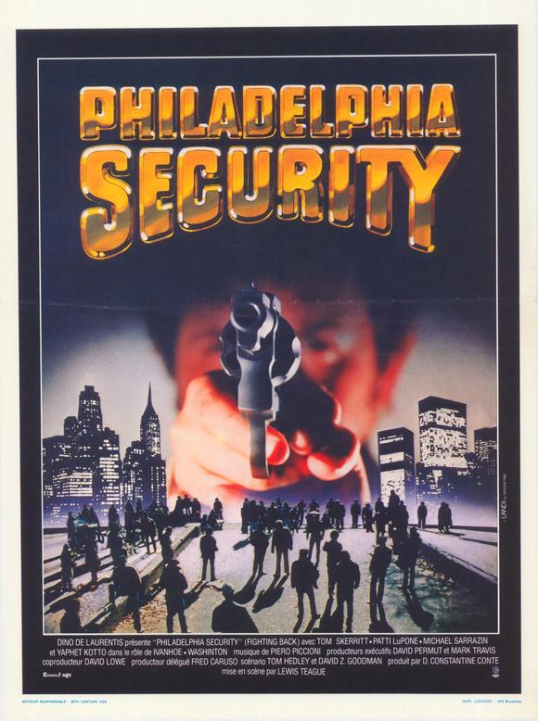
Fighting Back is also known as Philadelphia Security and Death Vengeance.
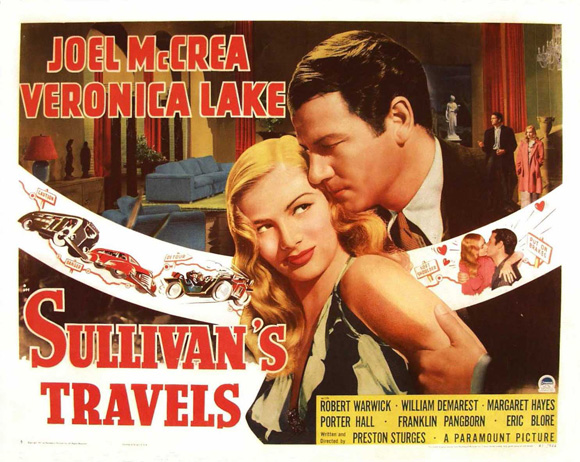
I’m no expert on Preston Sturges, having seen only two of his films, but after viewing SULLIVAN’S TRAVELS I now have a craving to see them all! This swift (and Swiftian) satire on Hollywood stars Joel McCrea as a successful slapstick comedy director yearning to make important, socially conscious films who gets more than he bargained for when he hits the road to discover what human misery and suffering is all about.
John L. “Sully” Sullivan sets his studio bosses on their collective ear when he tells them he wants to film an adaptation of ” O Brother, Where Art Thou?”, a serious novel by ‘Sinclair Beckstein’. The head honcho balks, wanting Sully to do another comedy, but Sully’s not dissuaded, deciding to see what life among the downtrodden is first-hand. He dresses in rags and sets out on his quest, followed by a gaggle of PR flacks in a bus. Somehow he…
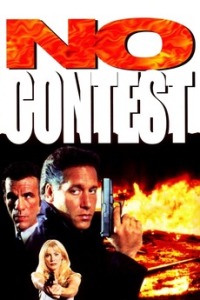 Under the direction of their leaders, Oz (Andrew “Dice” Cay) and his second-in-command, Ice (Roddy Piper), a diverse group of terrorists have taken the Miss Galaxy contest hostage. If they don’t receive a ransom of diamonds, they will kill the Miss Galaxy contestants, including the daughter of a powerful senator. What the terrorists didn’t count on was that the show would be hosted by actress and kick boxer Sharon Bell (Shannon Tweed). Now, it’s up to Sharon to sneak through a locked-down hotel, killing the terrorists one-by-one. Her only help comes from a battle-scarred but supportive security officer (Robert Davi) locked outside of the hotel.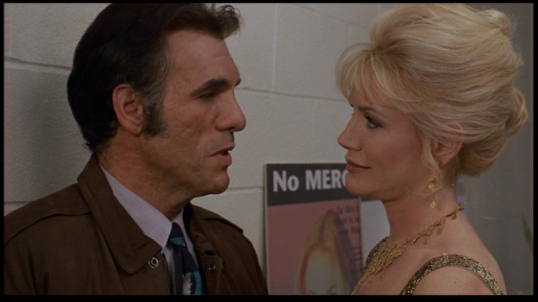


 Scott Bruin (Jeff Lester) is a high fashion photographer who is haunted by nightmares in which he strangles a naked woman in the swimming pool. His nymphomaniac girlfriend, Lena (Shannon Tweed!), is surprisingly understanding when she wakes up to discover Scott strangling her but Scott is worried that he might be losing his mind. His psychiatrist (David Soul) is not much help. When Scott has a violent vision in the middle of photo shoot, he freaks out. “Hey, are you on drugs?” one of the models asks.
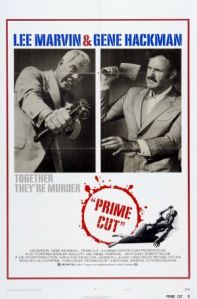 Nick Devlin (Lee Marvin) is a veteran enforcer for the Chicago mob. His latest assignment has taken him out of the city and sent him to the farmlands of Kansas. Nick is the third enforcer to be sent to Kansas, all to collect a $500,000 debt from a local crime boss named Mary Ann (Gene Hackman). The first one ended up floating face down in the Missouri River. The second was chopped up into sausages at the local slaughterhouse. Nick might have better luck because he once had an affair with Mary Ann’s wife, Clarabelle (Angel Tompkins).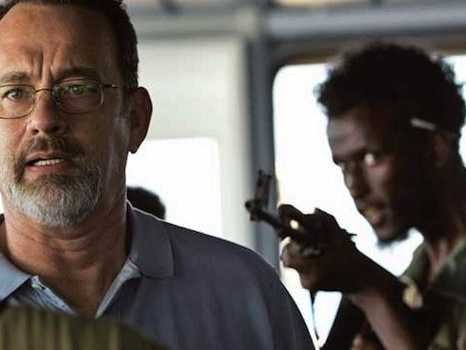
 Through the Shattered Lens