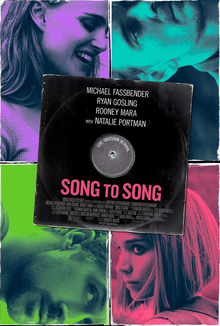
Film Review: Song to Song (dir by Terrence Malick)


You’re watching a movie called Song to Song.  It’s about beautiful people in a beautiful city.

In this case, the city is Austin, Texas.  The people are all involved in the Austin music scene and they’re played by actors like Ryan Gosling, Rooney Mara, Natalie Portman, Michael Fassbender, and Cate Blanchett.  A good deal of Song to Song was filmed at the Austin City Limits festival and several real-life musicians appear as themselves, though only Patti Smith is on screen long enough to make much of an impression.  To be honest, both the music and Austin are almost incidental to the film.  Though the movie was sold as an Austin film and it premiered at SXSW, it could have just as easily taken place in Ft. Worth.

The film is made up of short, deliberately obscure shots.  The camera never stops moving, floating over images of sunsets, sunrises, and oddly empty streets.  Because the film was shot with a wide-angle lens, you’re never not aware of the expanse around the characters.  At times, all of those beautiful film stars run the risk of become specks on the landscape, as if the film itself is taunting the characters for thinking that they are more important than nature.

Who are the characters?  It’s not always easy to say.  There are plenty of voice overs but it’s rare that anyone directly states what they’re thinking or who they are.  When the characters speak to each other, they mumble.  The dialogue is a mix of the banal and the portentous, a sure sign of a film that was largely shot without a script.  Eventually, you turn on the captioning so that you can at least understand what everyone’s muttering.

Michael Fassbender plays Cook.  Cook appears to be a music producer but he could just as easily be a businessman who enjoys hanging out with and manipulating aspiring stars.  People seem to know him but nobody seems to be particularly impressed by him.  Cook spends a lot of time standing in front of a pool.  Is it his pool?  Is it his house? It’s hard to say.  Cook is obsessed with control or maybe he isn’t.  Halfway through the film, Fassbender appears to turn into his character from Shame.

Ryan Gosling is BV.  BV appears to be a lyricist, though it’s never made clear what type of songs that he writes.  At one point, you think someone said that he had written a country song but you may have misheard.  BV appears to have an estranged relationship with his dying father.  BV may be a romantic or he may not.  He seems to fall in love easily but he spends just as much time staring at the sky soulfully and suggesting that he has a hard time with commitment.  BV appears to be Cook’s best friend but sometimes, he isn’t.  There’s a random scene where BV accuses Cook of cheating him.  It’s never brought up again.

Rooney Mara is Faye.  Faye contributes most of the voice overs and yet, oddly, you’re never sure who exactly she is.  She appears to be BV’s girlfriend and sometimes, she appears to be Cook’s girlfriend.  Sometimes, she’s in love and then, just as abruptly, she’s not.  She may be a singer or she may be a songwriter.  At one point, she appears to be interviewing Patty Smith so maybe she’s a music journalist.  The film is centered around her but it never makes clear who she is.

Natalie Portman is Rhonda.  Rhonda was a teacher but now she’s a waitress.  She might be religious or she might not.  She might be married to Cook or she might not.  Her mother (Holly Hunter) might be dying or she might not.

And there are other beautful people as well.  Cate Blanchett plays a character named Amanda.  Amanda has a relationship with one of the characters and then vanishes after four scenes.  There’s an intriguing sadness to Blanchett’s performance.  Since the first cut of Song to Song was 8 hours long, you can assume her backstory was left on the cutting room floor.  (And yet strangely, it works that we never know much about who Amanda is.)  Lykke Li shows up, presumably playing herself but maybe not.  Berenice Marlohe and Val Kilmer also have small roles, wandering in and out of the character’s lives.

There’s a lot of wandering in this movie.  The characters wander through their life, stopping only to kiss each other, caress each other, and occasionally stare soulfully into the distance.  The camera seems to wander from scene to scene, stopping to occasionally focus on random details.  Even the film’s timeline seems to wander, as you find yourself looking at Rooney Mara’s forever changing hair and using it as a roadmap in your attempt to understand the film’s story.

“I went through a period when I thought sex had to be violent,” Rooney Mara’s voice over breathlessly explains, “We thought we could just roll and tumble, live from song to song, kiss to kiss.”

As you watch Song to Song, you find yourself both intrigued and annoyed.  This is a Terrence Malick film, after all.  You love movies so, of course, you love Malick.  Even if his recent films have been flawed and self-indulgent, he is a true original.  You want to support him because he’s an artist but, as you watch Song to Song, the emphasis really does seem to be on self-indulgence.  The images are beautiful but the characters are so empty and the voice overs are so incredibly pretentious.  Should you be mad or should you be thankful that, in this time of cinematic blandness, there’s a director still willing to follow his own vision?

At times, Song to Song is brilliant.  There are images in Song to Song that are as beautiful as any that Malick has ever captured.  Sometimes, both the images and the characters are almost too beautiful.  The music business is tough and dirty but all of the images in Song to Song are clean and vibrant.

At times, Song to Song is incredibly annoying.  It’s hard not to suspect that the film would have worked better if Natalie Portman and Rooney Mara had switched roles.  Mara can be an outstanding actress with the right director (just check out her performance in Carol) but, in Song to Song, her natural blandness makes it difficult to take her seriously as whoever she’s supposed to be.  Portman has much less screen time and yet creates an unforgettable character.  Mara is in 75% of the film and yet never seems like an active participant.

At times, the film is annoyingly brilliant.  Malick’s self-indulgence can drive you mad while still leaving you impressed by his commitment to his vision.

And then, other times, the film is brilliantly annoying.  Many directors have mixed overly pretty images with pretentious voice overs but few do so with the panache of Terrence Malick.

Even fans of Terrence Malick, of which I certainly am one, will probably find Song to Song to be his weakest film.  Even compared to films like To The Wonder and Knight of Cups, Song to Song is a slow movie and there are moments that come dangerously close to self-parody.  Unlike Tree of Life, where everything eventually came together in enigmatic poignance, Song to Song often feels like less than the sum of its parts.  And yet, I can’t totally dismiss anything made by Terrence Malick.  Song to Song may be empty but it’s oh so pretty.
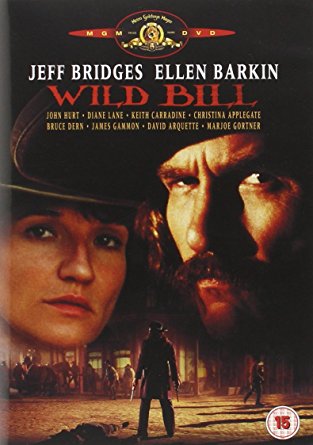
 

A Movie A Day #219: Wild Bill (1995, directed by Walter Hill)


The year is 1876 and the legendary Wild Bill Hickok (Jeff Bridges) sits in a saloon in Deadwood and thinks about his life (most of which is seen in high-resolution, black-and-white flashbacks).  Hickok was a renowned lawman and a sure shot, a man whose exploits made him famous across the west.  Thanks to his friend, Buffalo Bill Cody (Keith Carradine), he even appeared on the New York stage and reenacted some of his greatest gun battles.  Now, Hickok is aging.  He is 39 years old, an old man by the standards of his profession.  Though men like Charlie Prince (John Hurt) and California Joe (James Gammon) continue to spread his legend, Hickok is going blind and spends most of his time in a haze of opium and regret.
Hickok only has one true friend in Deadwood, Calamity Jane (Ellen Barkin).  He also has one true enemy, an aspiring gunslinger named Jack McCall (David Arquette).  McCall approaches Hickok and announces that he is going to kill him because of the way that Hickok treated his mother (played, in flashback, by Diane Lane).  Hickok does not do much to dissuade him.

Based on both a book and a play, Wild Bill is a talky and idiosyncratic Western from Walter Hill.  Hill is less interested in Hickok as a gunfighter than Hickok as an early celebrity.  There are gunfights but they only happen because, much like John Wayne in The Shootist, Hickok has become so famous that he cannot go anywhere without someone taking a shot at him.  Almost the entire final half of Wild Bill is set in that saloon, with Hickok and a gallery of character actors talking about the past and wondering about the future.

At times, Wild Bill gets bogged down with all the dialogue and philosophizing.  (To quote The Good, The Bad, and the Ugly: “When you have to shoot, shoot.  Don’t talk.”)  Luckily, the film is saved by an intriguing cast, led by Jeff Bridges.  In many ways, his performance was Wild Bill feels like an audition for his later performance in True Grit.  David Arquette is intensely weird as the jumpy Jack McCall and Ellen Barkin brings the film’s only underwritten role, Calamity Jane, to life.  Smaller roles are played by everyone from Bruce Dern to James Remar to Marjoe Gortner.

United Artist made the mistake of trying to sell Wild Bill as being a straight western, which led to confused audiences and a resounding flop at the box office.  Ironically, years after the release of Wild Bill, Walter Hill won an Emmy for directing the first episode of HBO’s Deadwood, an episode the featured Wild Bill cast member Keith Carradine in the role of Hickok.

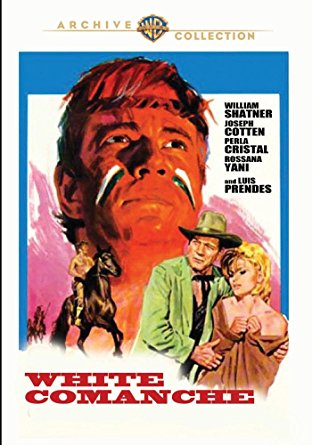
A Movie A Day #218: White Comanche (1967, directed by Jose Briz)


Johnny Moon (William Shatner) is a half-breed.  His father was white and his mother was a Comanche.  Johnny was raised Comanche but he now lives as a white man.  He is a good and law-abiding citizen but he has a problem.  Johnny has a twin brother named Notah (played, of course, by William Shatner) and, hooked on peyote, Notah keeps holding up stagecoaches, killing white men, and raping white women.  Sick and tired of people constantly trying to lynch him, Johnny contacts Notah and demands a final showdown.  At the same time, Johnny refuses to tell anyone about Notah’s existence so everyone still wants to kill Johnny.  The only person who realizes that Johnny and Notah are not the same is one of Notah’s victims, a showgirl named Kelly (Rosanna Yanni).  She sees that good Johnny has blue eyes while bad Notah has black eyes.
William Shatner has described White Comanche as being his worst film, which is saying something when you consider some of the movies that Shatner made between the cancellation of Star Trek and the release of Star Trek: The Motion Picture.  Still: William Shatner as twins, one of whom spends the entire movie tripping on peyote.  That sounds like it should be fun and it would be except that, for the first and only time in his career, Shatner actually gives a low-key performance.  When Shatner is playing Notah, he is the Shatner that we all know and love.  But when Shatner plays Johnny Moon, he tries to give a subtle and restrained performance and, unfortunately, the movie is about 75% Johnny.  That’s not what we pay money to see when we watch a William Shatner movie!

This one is for Shatner completists only.


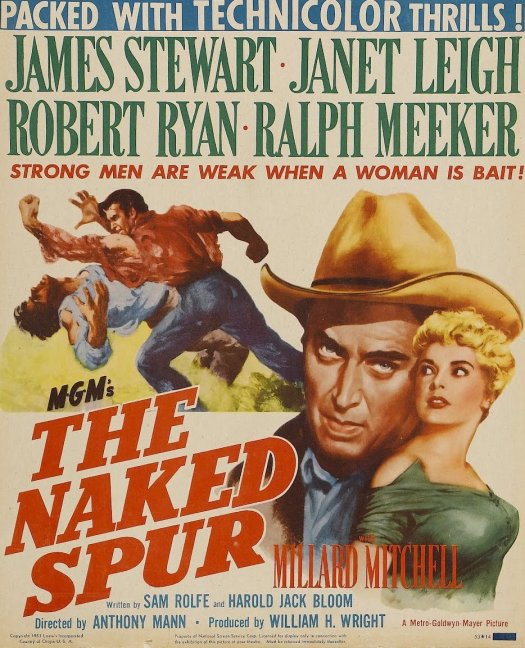
Rocky Mountain High: THE NAKED SPUR (MGM 1953)


gary loggins's avatarcracked rear viewer

(By sheer coincidence, this post coincides with the birthday of character actor Millard Mitchell (1903-1953), who plays Tate in the film. Happy birthday, Millard! This one’s for you!)  

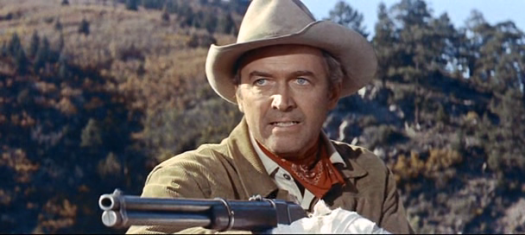
James Stewart and Anthony Mann  moved from Universal-International to MGM, and from black & white to Technicolor, for THE NAKED SPUR, the third of their quintet of Westerns together. The ensemble cast of five superb actors all get a chance to shine, collectively and individually, creating fully fleshed out characters against the natural beauty of the Colorado backdrop.

Bitter Howard Kemp, whose wife sold their ranch and ran off while he was serving in the war, is hunting down killer Ben Vandergroat for the $5,000 bounty in hopes of rebuilding his life. Along the trail he meets old prospector Jesse Tate and recently discharged (dishonorably) Lt. Roy Anderson. The trio manages to capture Vandergroat, but he’s not alone… he’s accompanied by pretty wildcat Lina…

View original post 484 more words

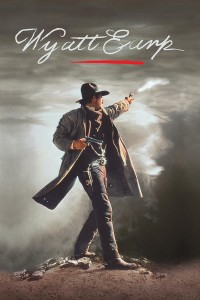
A Movie A Day #217: Wyatt Earp (1994, directed by Lawrence Kasdan)


Once upon a time, there were two movies about the legendary Western lawman (or outlaw, depending on who is telling the story) Wyatt Earp.  One came out in 1993 and the other came out in 1994.
The 1993 movie was called Tombstone.  That is the one that starred Kurt Russell was Wyatt, with Sam Elliott and Bill Paxton in the roles of his brothers and Val Kilmer playing Doc Holliday.  Tombstone deals with the circumstances that led to the Gunfight at the O.K. Corral.  “I’m your huckleberry,” Doc Holliday says right before his gunfight with Michael Biehn’s Johnny Ringo.  Tombstone is the movie that everyone remembers.

The 1994 movies was called Wyatt Earp.  This was a big budget extravaganza that was directed by Lawrence Kasdan and starred Kevin Costner as Wyatt.  Dennis Quaid played Doc Holliday and supporting roles were played by almost everyone who was an active SAG member in 1994.  If they were not in Tombstone, they were probably in Wyatt Earp.  Gene Hackman, Michael Madsen, Tom Sizemore, Jeff Fahey, Mark Harmon, Annabeth Gish, Gene Hackman, Bill Pullman, Isabella Rossellini, JoBeth Williams, Mare Winningham, and many others all appeared as supporting characters in the (very) long story of Wyatt Earp’s life.

Of course, Wyatt Earp features the famous Gunfight at the O.K. Corral but it also deals with every other chapter of Earp’s life, including his multiple marriages, his career as a buffalo hunter, and his time as a gold prospector.  With a three-hour running time, there is little about Wyatt Earp’s life that is not included.  Unfortunately, with the exception of his time in Tomstone, Wyatt Earp’s life was not that interesting.  Neither was Kevin Costner’s performance.  Costner tried to channel Gary Cooper in his performance but Cooper would have known better than to have starred in a slowly paced, three-hour movie.  The film is so centered around Costner and his all-American persona that, with the exception of Dennis Quaid, the impressive cast is wasted in glorified cameos.  Wyatt Earp the movie tries to be an elegy for the old west but neither Wyatt Earp as a character nor Kevin Costner’s performance was strong enough to carry such heavy symbolism.  A good western should never be boring and that is a rule that Wyatt Earp breaks from the minute that Costner delivers his first line.

Costner was originally cast in Tombstone, just to leave the project so he could produce his own Wyatt Earp film.  As a big, Oscar-winnng star, Costner went as far as to try to have production of Tombstone canceled.  Ironically, Tombstone turned out to be the film that everyone remember while Wyatt Earp is the film that most people want to forget.

A Movie A Day #216: America Undercover: Skinheads USA: Soldiers of the Race War (1993, directed by Shari Cookson)


In a shack in rural Alabama, a fat, middle-aged man named Bill Riccio watches a faded VHS tape with several teenage boys.  All of them have shaved heads.  Several of them have elaborate tattoos of swastikas and other racist symbols.  When asked, the majority of them say that they come from broken homes with alcoholic fathers and little hope for the future.  One of them says that he feels that Bill Riccio is his father.  All of them agree, with Riccio, that almost all of the country’s problems can be linked to an international conspiracy that they call ZOG (that stands for Zionist Occupational Government).  They have named their home “the War House.”
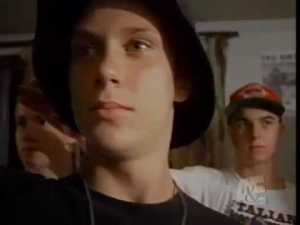
The movie that they are watching is Leni Riefenstahl’s The Triumph Of The Will.  They all agree that they are impressed with an extremely intense drummer boy.  They agree that he has his shit together.  When Adolf Hitler appears and starts to speak, one of the boys says that Bill Riccio reminds him of Hitler.  “Don’t compare me to that man,” Riccio says.  “I am not worthy.”

Skinheads USA was a part of HBO’s America Undercover documentary film series.  Camera crews followed Riccio and his Neo-Nazi followers around for months, following them as they drink beer, shout “white power!,” and forge an alliance with the local KKK.  When they go out on the streets to pass out racist flyers, people argue with them and call them ignorant.  The skinheads don’t give a shit.  Instead, they savor being despised.  It feeds into their persecution complex.

Skinheads USA is a portrait of pure evil.  Bill Riccio is a predator who peddles hate while his followers are young men who, poorly educated and with no real prospects for the future, fell through the cracks of society and were easily gathered up by the forces of hate.  Riccio provided them with both a home and scapegoats for all of their problems.  (Years later, one of Riccio’s followers, from a jail cell where he was serving time for murder, said that Riccio provided drugs and alcohol while also abusing the younger boys sexually, a charge that will not surprise anyone who has seen Skinheads USA.)   Towards the end of the documentary, when Riccio is arrested on weapons violations and sent to jail, his brainwashed followers are left directionless but no less dangerous.  The documentary ends with one of Riccio’s lieutenants trying to fire up the remaining skinheads and chanting, “Heil Bill Riccio!”

In the 90s, when Skinheads USA used to regularly play on HBO and A&E, it was easy to laugh off Riccio and his followers.  Today, we know better.  If you are wondering how the Richard B. Spencers and the David Dukes of the world continue to find followers, Skinheads USA is a good place to start.

Sail Away: John Wayne in John Ford’s THE LONG VOYAGE HOME (United Artists 1940)


gary loggins's avatarcracked rear viewer

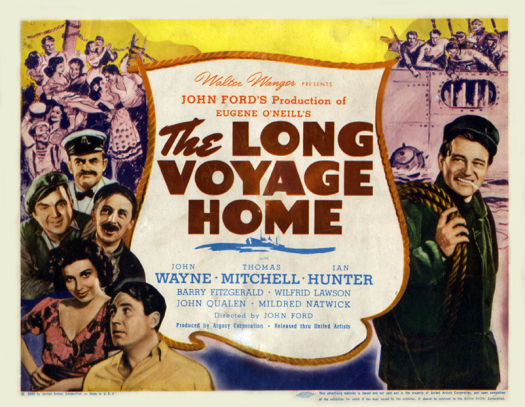
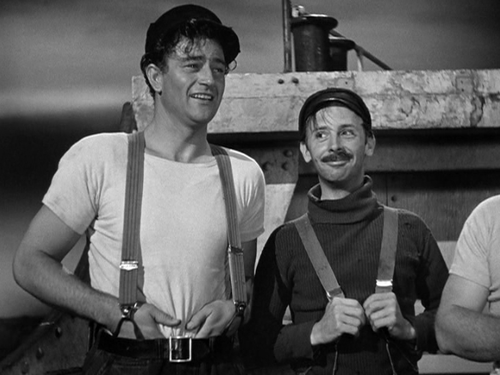
This is my third year participating in the TCM Summer Under the Stars blogathon hosted by Kristen at Journeys in Classic Film , and second entry spotlighting Big John Wayne . The Duke and director John Ford made eleven films together, from 1939’s STAGECOACH to 1963’s DONOVAN’S REEF.  Wayne’s role in the first as The Ringo Kid established him as a star presence to be reckoned with, and the iconic actor always gave credit to his mentor Ford for his screen success. I recently viewed their second collaboration, 1940’s THE LONG VOYAGE HOME, a complete departure for Wayne as a Swedish sailor on a tramp steamer, based on four short plays by Eugene O’Neill, and was amazed at both the actor’s performance and the technical brilliance of Ford and his cinematographer Gregg Toland  , the man behind the camera for Welles’ CITIZEN KANE.

THE LONG VOYAGE HOME is a seafaring saga…

View original post 674 more words

Clowntergeist: Preview, Review and Trailer


Sorry I have been “Clowning” it up a but with my last few reviews, but you know, Coulrophobia and all!


ok, seriously, my last movie review was about clowns; and now this one.

Clowntergeist 04

Let’s get the technicals out of the way:

Studio: High Octane Pictures

Director: Aaron Mirtes

Cast :  Tom Seidman, Burt Culver and Brittany Belland


Plot:

Emma, a college student with a crippling fear of clowns, must come face to face with her worst fear when an evil spirit in the body of a clown is summoned terrorizing the town she calls home. One by one Emma and her friends receive a balloon with the exact time and date of when it will appear to kill them written on it. After receiving her balloon, Emma realizes that she has two days left to live, and must fight against the clock to find a way to survive.


Review:

As much as this movie captured all the, shall I say tongue-in-cheek, plot lines. It did manage to scare me quiet a bit!

Now, please don’t read to much into the plot holes when you watch this movie. They are several to fall into. At times I am not sure this is meant to be a serious movie. But I was thoroughly entertained!


Would I recommend this movie?

On my horror scale:

3.25 out of 5. But factor the fun of it, I give it a 4!

Poster: 

clowntegeist


But, since it is time for IT (trailer via Lisa Marie Bowman)  to come out, no wonder I am getting so many clown movies to screen! And nightmares to sleep thru!


Should we watch the trailer for ‘Clowntergeist’ together? Yes we should!


Who wants to hold hands now!

Clowntergeist 02


Clowntergeist will be available on VOD on all your platforms September 12, 2017 And on DVD in October, just in time for Halloween!


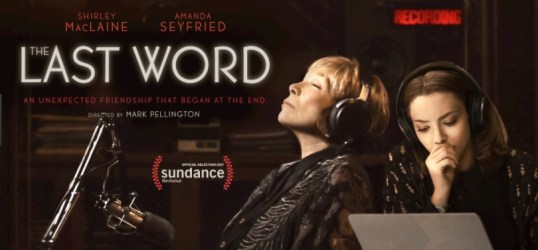
Film Review: The Last Word (dir by Mark Pellington)


So, I watched The Last Word tonight.

It’s a film that premiered, earlier this year, at Sundance and then it got a very brief theatrical run.  It was directed by Mark Pellington, who is one of those odd directors who, for some reason, I always assume is more talented than he is.  Seriously, when I saw this was directed by Mark Pellington, I actually got excited.  I was like, “Mark Pellington!?  He’s great!”  Then I realized that I wasn’t really sure who Mark Pellington was.  I looked him up on Wikipedia and I realized that I was mistaking him for actor Mark Pellegrino.  Mark Pellegrino played Jacob on Lost and is an outspoken Libertarian.  Mark Pellington is some guy who started out in music videos and then eventually moved up to directing pedestrian films.

Anyway, the film stars Shirley MacClaine as this annoying old busybody who demands that Amanda Seyfried write her obituary because MacClaine wants to know what people are going to say about her after she’s dead.  When Seyfried discovers that everyone hates MacClaine, she writes a boring and very short obit.  “Everyone hates you,” she helpfully explains.  So, MacClaine sets out to do some great things so that her obituary will have a little more spark.  She’s going to set a fire of quirkiness, she is!  Of course, this leads to MacClaine adopting a little black orphan, getting a job as a DJ at the local radio station (she plays boring adult contemporary music, of course.  No EDM), and helping Seyfriend get a boyfriend.

To be honest, this film would probably be a lot more bearable if it was a prequel to Bernie, because then you would at least know that you could look forward to Jack Black showing up with a hunting rifle and putting everyone out of their misery.  Unfortunately, that doesn’t happen.  Instead, this is another one of those movies where a cranky old tyrant teaches all of us young folks how to better appreciate life.

Y’see, Shirley MacClaine is playing an oldster so she has a sharp tongue and she’s always putting people in their place.  Because she had to struggle, we’re supposed to ignore the fact that she spends most of her time making everyone around her miserable.

Amanda Seyfried, on the other hand, is a millennial so she puts her feet on her boss’s desk and has no direction in her life.  Why, she just needs some annoying, elderly busybody to come into her life and make her listen to smooth jazz.  She might even get a hipster boyfriend out of the deal!  (Of course, her potential hipster boyfriend is a 2008-style hipster as opposed to a 2017-style hipster.)

Meanwhile, AnnJewel Lee Dixon (as the little girl that MacClaine adopts) is a plot device so she doesn’t do anything unless the script specifically needs her to humanize the other characters.  She gets to dance towards the end of the film.

Oh, and then there’s Anne Heche.  She plays MacClaine’s estranged daughter.  The reunion between her and MacClaine is so overwritten and overperformed that some viewers will probably be inspired to rip out their hair while watching it.

Hey, did I mention that there’s a scene where MacClaine does something quirky and all of the supporting characters break out into applause?  I think we’re supposed to clap to but I think most members of the audience will be too busy ripping out their hair by the handful.

Fortunately, I really love my hair so I resisted the temptation to start plucking strands out of my head while watching the film.  It wasn’t easy, though.  To be honest, the pain of plucking a strand of hair is nothing compared to the pain of watching the first fifteen minutes of this film and realizing that you already know every thing that’s going to happen.  By the time that the priest showed up and started to cry while talking about a time that MacClaine’s character had been rude to him, I imagine that viewers with less self-control were halfway bald.  But, as I said, I love my hair too much to take my frustration out on it.  Instead, I just kicked the coffee table a few times.  Now, my foot hurts.  Ow.

Seeing as how Shirley MacClaine is one of the last of the truly great actresses from Hollywood’s Golden Age and she actually does give a pretty good performance (when the script allows her), it’s a shame that the rest of the movie is such a let down.  Then again, this film is full of talented people who are let down by an overwritten script and Mark Pellington’s painfully obvious direction.  This is one of those films that tries to hard to be profound that it forgets the importance of being entertaining.

As I watched this movie, I took a glance at Mark Pellington’s filmography.  Did you know that he directed The Mothman Prophecies?  The Last Word really could have used a visit from the Mothman.  Seriously, this film was crying out for a scene of MacClaine putting Mothman in his place.  The fact that Mothman did not appear leads me to wonder what exactly this film was hiding.

Seriously, why are the people behind The Last Word protecting the Mothman?

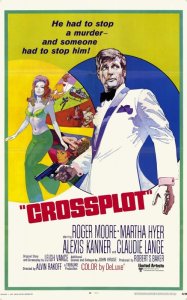
A Movie A Day #215: Crossplot (1969, directed by Alvin Rakoff)


In swinging London, Roger Moore is ordered by Bernard Lee to track down a model  who is connected to an international conspiracy.

If you think that sounds like a James Bond movie, you’re close.  In Crossplot, which was released four years before Roger Moore took over the role of 007 in Live and Let Die, Moore plays Gary Fenn and Bernard Lee is Mr. Chilmore.  Gary is a playboy and an advertising executive while Mr. Chilmore is his latest client.  Mr. Chilmore has ordered Gary to find a model who can serve as the new “Miss Swing,” but actually, the bad guys are using Gary to try track down a beautiful Hungarian named Marla Kugash (Claudie Lange).  Kugash, the ex-girlfriend of a radical political activist, has knowledge about a conspiracy to assassinate a visiting African president.  It leads to car chases, shoot outs, and a wedding that is ruined when Gary and Marla take refuge in a church.

Crossplot was an obvious attempt to cash in on the popularity of the James Bond films.  At the time that Crossplot came out, Moore was best known for playing The Saint on television.  Crossplot was the first film that Moore made after signing a three-movie contract with United Artists and, had the film been a success, Moore would have returned in the role of Gary Fenn and it is totally possible that he would not have been available to step into Sean Connery’s shoes when Connery announced that he was finished with the role of James Bond.

However, Crossplot was not a success and it is easy to see why.  The plot was overly convoluted and it’s emphasis on “swinging” London (complete with wacky hippies) probably made Crossplot seem dated before it was even released.  It is interesting today mostly as Moore’s “audition” for the role of Bond.  Moore gives a very Bondish performance, complete with arched eyebrows and one liners.  Moore is the best thing about the movie but it is also interesting to see Bernard Lee playing a character far less savory than M.  This was also one of the many 60s Bond rip-offs to feature the beautiful Claudie Lange.  Lange, who would have made a great Bond girl if she’d been given the opportunity, retired from acting in 1973, the same year that Moore appeared in Live and Let Die.