Embittered by the death of his wife, Samuel Peters (Edward Furlong) turns to voodoo in an attempt to bring her back to life. Kalfu (Corey Feldman), the lord of the underworld, agrees to close the gates of Hell and allow the dead to roam the Earth with Peters as the immortal zombie king.
Edward Furlong selling his soul to Corey Feldman might sound like the premise of an entertainingly bad movie but, unfortunately, nether Furlong nor Feldman have much screen time. As hard as it is believe, The Zombie King may be one of the first recent films that would have benefitted from more Corey Feldman and Edward Furlong. Instead, the two of them are basically just special guest stars with limited screen time.
Instead, the majority of the movie is about a group of humans trying to survive in a village that’s been invaded by zombies and quarantined by the government. The movie tries to balance horror with British humor in a style that tries way too hard to duplicate Simon Pegg’s success with Shaun of the Dead, right down to casting a Nick Frost look-alike as a quirky milkman named Munch.
Much ends up in a group led by a stoic mailman named Ed Wallace (George McCluskey), who says that delivering the mail in Northgate was just as dangerous as being a member of the SAS. The movie mixes scenes of zombie mayhem with scenes of Ed, Mulch, and the other survivors having very British arguments about how best to deal with the situation and whether it’s safer to head to a church or a pub. There are some amusing moments but there’s even more jokes that fall flat and Munch is never as funny as a character as the film seems to think he is.
Even with Edward Furlong welcoming the recently dead to “Hell on Earth” and Corey Feldman giving a surprisingly energetic performance as the lord of the underworld, The Zombie King never escapes the shadow of all the zombie comedies that came before it.
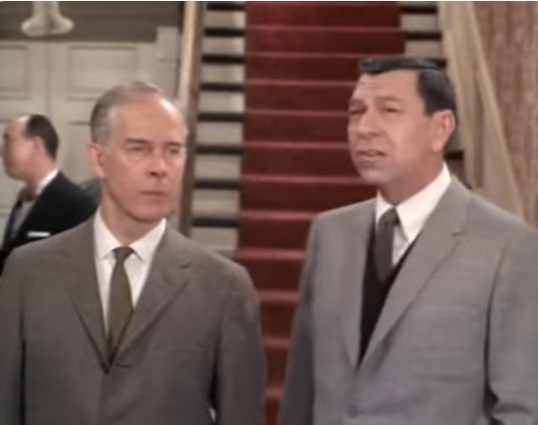
Welcome to Retro Television Reviews, a feature where we review some of our favorite and least favorite shows of the past! On Sundays, I will be reviewing the made-for-television movies that used to be a primetime mainstay. Today’s film is 1969’s Dragnet 1966! It can be viewed on YouTube!
“This is the city….”
So begins Dragnet, a television movie version of the classic cop show that was the Law & Order of it’s day. Dragnet began as a radio program in 1949 before making it’s way over to television in 1951. Each episode starred (and the majority were directed by) Jack Webb, who played a no-nonsense cop named Joe Friday. Friday narrated every episode, dropping trivia about the history of Los Angeles while also showing viewers how the cops went about catching criminals. Despite what is commonly believed, Joe Friday never said, “Just the facts, ma’m,” but he did investigate each case with the cool determination of a professional who kept his emotions under control. The majority of Dragnet’s episodes were based on actual cases that were worked by the LAPD, hence the opening declaration of, “The story you are about to see is true.”
On television, Dragnet originally ran from 1951 to 1959, during which time Dragnet also became the first television series to be adapted into a feature film. Jack Webb decided to relaunch Dragnet in 1966 and he produced a made-for-television movie that followed Friday and his latest partner, the far more talkative Bill Gannon (Harry Morgan), as they worked multiple cases over the course of one long weekend. The pilot movie did lead to a new show, one that lasted from 1967 to 1970 and which is today fondly remembered for scenes of Friday and Gannon debating the merits of the legal system with hippies. However, for whatever reason, the 1966 pilot movie was not actually aired until 1969.
The made-for-TV movie features Friday and Gannon searching not for LSD dealers and draft dodgers but instead for a crazed photographer (Vic Perrin) who hires women to pose for him and then ties them up and takes their picture right before her murders them. The photographer is based on real-life serial killer Harvey Glatman and Perrin is perfectly creepy in the role. Though Friday never loses his composure, his disgust at the photographer and his crimes is palpable and it adds an extra charge to the scene where, in the middle of a drenching rain storm, Friday tries to sneak up on the trailer where he believes the photographer is holding his latest victim. It’s actually a pretty exciting scene and definitely one that will take by surprise anyone who thinks of the 60s Dragnet as just being a campy exercise in establishment resentment.
Of course, catching a serial killer is not all that Friday and Gannon deal with. It’s a long weekend so Friday and Gannon end up investigating the murder of a French tourist and Friday helps a younger, black detective deal with a racist criminal. (The scene where Friday stands up to the racist was obviously meant to answer those who claimed the LAPD was a racist organization.) At the start of the film, Joe almost gets collared into working security for a visiting Russian diplomat and the Russian’s paranoid security team is contrasted to the level-headed and capable men of the LAPD. Some of these scenes are better than others. The French tourist subplot features some truly risible acting and the scene with the racist is well-intentioned but still feels a bit condescending in its portrayal of the black detective needing Friday to help him deal with the suspect. That said, I did enjoy listening to Bill Gannon talking about his plans for retirement and how working for the LAPD was destroying his teeth. Harry Morgan’s folksy humor was always the perfect counterpart to Jack Webb’s perpetually rational Friday.
Finally, I appreciated that the movie featured a scene with Friday and Gannon went undercover at a lonely hearts club. If you’ve watched the 1960s version of Dragnet, you know that, for all the times that Friday and Gannon went undercover, they never really put much effort into it. I mean, they didn’t ever bother to take off their jackets!
Though I was disappointed by the lack of hippies, Dragnet 1966 was still not only a good police procedural but also a fun time capsule of its era.
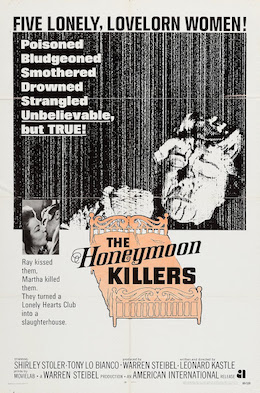
The 1970 film, The Honeymoon Killers, takes place in the late 40s. Martha Beck (Shirley Stoler) is an overweight nurse who lives in Alabama with her senile mother (Dortha Duckworth) and her best friend, Bunny (Doris Roberts). Knowing that Martha is lonely, Bunny signs Martha up for a “lonely hearts club,” which was basically the Tinder and Craig’s List of the pre-Internet age. Though Martha is initially reluctant, she soon starts to receive letters from a conman named Ray Fernandez (Tony Lo Bianco). Ray specializes in swindling the women who respond to his letters. After Ray travels to Alabama and tricks Martha into giving him a “loan,” Ray sends her a letter telling him that he can no longer correspond with her. Martha responds by getting Bunny to call Ray and tell him that she attempted suicide.
Recognizing Martha as a fellow con artist, Ray invites Martha to his home in New York. He shows her the pictures that he’s received from other women and reveals how he makes his money. Martha soon becomes Ray’s partner in crime, traveling across the country with Ray and meeting the women, most of whom are elderly, that Ray has corresponded with. Ray claims that his name is Charles Martin and that Martha is his sister. He also swears to Martha that he won’t sleep with any of the women while he’s swindling them. Even though Martha knows that Ray is a pathological liar, she chooses to believe him whenever he swears that he’s actually in love with her.
The first murder occurs when Martha realizes that one of Ray’s victims is determined to sleep with him. Martha gives her an overdose of sleeping pills and then Martha and Ray dump her on a bus, where she subsequently dies. More murders occur, usually due Martha and Ray making sloppy mistakes that reveal their actual plans to their victims. At first, Ray claims that he’s disgusted with killing and he says that Martha is the one who has to do it because she’s a nurse. But eventually, Ray shows his true colors.
When talking about The Honeymoon Killers, one has to start by mentioning that this film was nearly Martin Scorsese’s second feature film. (Fresh out of film school, Scorsese had previously turned a student film, Who’s That Knocking At My Door?, into his feature debut.) Scorsese was fired from the film because the film’s producers felt that he was taking too long to set up the shots and, according to Scorsese himself, he was only shooting master shots. That said, there are a few Scorsese-directed scenes to be found in The Honeymoon Killers and they’re pretty easy to spot. The film opens with a tracking shot of Shirley Stoler walking through her hospital and reprimanding two interns. I was not surprised to learn that was one of the Scorsese scenes. After Scorsese left the project, he was replaced by Leonard Kastle, who wrote the script. The Honeymoon Killers was both Kastle’s directorial debut and his swan song.
The film’s harsh and grainy black-and-white cinematography gives the film a documentary-style feel and while there are moments of dark humor, The Honeymoon Killers is overall a grim movie. It plays out like a creeping nightmare, one where the viewer knows that there’s something terrible waiting right around the corner. The bickering between Martha and Ray may occasionally inspire a chuckle, but there’s nothing funny about the murders and the film, to its credit, it totally on the side of Martha and Ray’s victims. Martha and Ray may look down upon them but the film itself portrays them as being lonely people who are struggling to adjust to a changing world. (In the role of the couple’s second victim, Mary Jane Highby is just heartbreaking.) Ray is a bit of ludicrous figure, with his swagger and his exagerated accent but he’s been able to get away with his crimes because people want him to be the charming gentleman that he claim to be. Even after Martha discovers who he really is, she still finds herself under the spell of Ray’s con.
Shirley Stoler and Tony Lo Bianco both give excellent performances as Martha and Ray, with Stoler especially doing a good job in the role of Martha. At first, it’s easy to feel sorry for Martha. At the start of the movie, she’s just as lonely as any of Ray’s victims. At the film progresses, Martha’s true self is revealed and yet, as soulless as she can be, her love for Ray is strangely sincere. As Ray, Tony Lo Bianco is all swagger and charm until he loses control of the situation and he reveals just how spineless he actually is.
The film presents Martha Beck and Ray Fernandez as a couple who became murderers after they found each other. In reality, it’s suspected that Ray Fernandez murdered at least one woman before he met Martha and it’s also been suggested that Martha killed a few patients while she was working as a nurse. Ray and Martha were both executed on the same day, going to electric chair on March 8th, 1951.
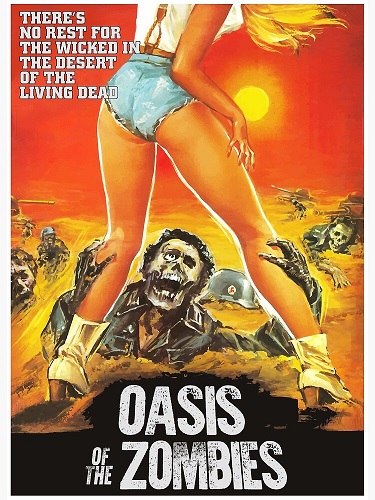
1982’s Oasis of the Zombies opens with two girls in a jeep who just happen to be driving through the middle of a desert in Africa. When they come across an oasis, they decided to stop so that they can walk around and allow the camera to focus on their rear ends as they explore the area while wearing short shorts. Unfortunately, it turns out that they’re not very good when it comes observing details because they totally miss the skulls and the pieces of metal that have been decorated with swastikas. One girl thinks that the oasis is creepy. The other wants to keep exploring. Decayed hands suddenly rise out of the ground and attack both of them.
(Oddly enough, the girls reminded me of myself and my BFF, Evelyn. I called Evelyn after I watched the movie and we both agreed that getting attacked by desert zombies is definitely something that will probably happen to us in the near future.)
After the two girls are zombied, the film cuts to an old man named Captain Blabert (Javier Maiza) telling another man named Kurt Meitzell (either Henri Lambert or Eduardo Fajardo, depending on which version of the film you see) about a shipment of Nazi gold that, for the past few decades, has been sitting in the middle of an oasis in the desert. Kurt kills Blabert and then heads off with his wife (Myriam Landson or Lina Romay, again depending on which version of the film you see) to track down the gold.
We then cut to London, where college student Robert Blabert (Manuel Gelin) receives not only a message informing him of the death of his father, Captain Blabert, but also a journal that leads to several flashbacks of Captain Blabert serving in Africa during World War II and getting involved with the Nazis and a sheik.
Eventually, Robert and several of his friends end up going to Morocco, where they randomly meet two filmmakers and everyone decides to head into the desert to search for the oasis and the gold. Fortunately, the oasis and the gold are both easy to find. However, the oasis is still defended by the Nazis who were assigned to transport the gold. Of course, the Nazis are all zombies now!
Oasis of the Zombies is a Jesus Franco film and, like many of his later films, it’s more than a little disjointed. The film’s scenes don’t always seem to follow any sort of conventional narrative logic. Instead, the scenes often feel as if they’ve been randomly assembled and the end result is a low-budget zombie film that plays out like a fragmented dream, one that seems to feature more stock footage than actual plot. Franco himself frequently seems as if he’s having trouble concentrating on just what exactly Oasis of the Zombies is supposed to be about. Random zoom shots are mixed in with shots of a spider building its web and, more than once, the action comes to a stop so the film can turn into an extended travelogue. As was so often the case with Franco’s later films, some of the shots are striking. There’s a shot of a man standing on a roof announcing the call to prayer that achieves a surreal grandeur and, as bad as the zombie makeup is, the shots of the living dead silhouetted in the desert are effective. But for every effective shot, there’s shots of people looking straight at the camera. Franco was director who could both frame a memorable shot and also be remarkably sloppy. As such, his aesthetic transcends conventional definitions of good and bad. Viewers either get him and his semi-improvised excursions into existential horror or they don’t.
Myself, I thought there were enough good shots in Oasis of the Zombies to make it worth watching. Certainly, it’s not comparable to Franco’s better films, like The Awful Dr. Orlof or Faceless. But it’s also not quite as bad as its online reputation might suggest. The zombies relentlessly emerging in the desert are creepy and, in its better moments, the film does capture the feeling of being stranded in the middle of nowhere. One could argue that the film actually does have a deeper meaning, with the Nazi zombies representing the fact that, for all of its defeats, the hate that fueled the Nazis is still alive and still dangerous. In the end, it’s a zombie flick, featuring less than impressive zombie makeup and some adequate gore and it’s undoubtedly a Jess Franco film. There’s no mistaking Franco’s vision for anyone else’s.
Finally, there are two versions of the film. The French-language version features Henri Lambert and Myriam Landson as Kurt and his wife. The Spanish-language version features Franco regulars Eduardo Fajardo and Lina Romay as the couple. Other than the scenes with Kurt, the two versions of Oasis of the Zombies are pretty much the same. As far as I know, the French-language version is the only one that is available in the States. That’s the one that I watched for this review.
1972’s Frogs opens with Pickett Smith (played by a youngish Sam Elliott) canoeing through the bayou, taking pictures of all of the local sights. Pickett is a nature photographer and someone who is very concerned about what pollution is doing to the local wildlife. Eventually, Pickett ends up meeting the Crocketts, the wealthy family that owns and lives on an isolated island. Wheelchair-bound family patriarch Jason Crockett (Ray Milland) is looking forward to celebrating the 4th of July. It’s a tradition and he goes all out, decorating the mansion with American flags and listening to patriotic music. The Crockett family always celebrates with Jason, though it quickly becomes apparent that Jason would be just as comfortable celebrating without any of them.
The last thing that Jason Crockett wants is some preachy environmentalist showing up at his mansion and ruining the 4th of July with a bunch of complaints about the pesticides that he’s been using to keep away the island’s wildlife. The only thing worse than having to deal with an environmentalist would be having to deal with an invasion of alligators, snakes, and frogs. Unfortunately, Jason is going to have to spend his holiday dealing with all of those things. Soon, the mansion is surrounded by frogs and servants and family members are showing up dead all over the place.
I’ve seen Frogs a handful of times. It’s one of those films that many of my friends seem to like much more than I do. I have to admit that, for whatever reason, I always find myself struggling to focus on the film. Some of that is because there are more than a few slow spots. But the main problem is that frogs really aren’t that menacing. Frogs are cute and kind of goofy-looking, much like Sam Elliott without his mustache. The alligators are certainly scary. And there’s an attack by a cottonmouth that makes me go, “Agck!” every time that I see it. But frogs just look cute when they start hopping around. Our cat gets excited whenever he sees a frog because he knows that he can put his paw on their back and make them jump. Frogs aren’t threatening but I suspect that’s probably the point of the film. Frogs is not a film that is meant to be taken too seriously and all of the close-ups of the frogs staring at Ray Milland, Sam Elliott, Joan Van Ark, and Adam Roarke are obviously meant to be more humorous than scary. By the end of the film, the frogs are hopping over American flags, like a group of rebellious amphibians that have decided to stage their own 1968 Democratic Convention.
The majority of the cast is adequate if not exactly outstanding, with most of them doing what they can to try to look terrified of a bunch of frogs. That said, the only one who really makes a strong impression is Ray Milland, who appears to relish the opportunity to play someone who dislikes literally everyone that he sees. As played by Milland, Jason is so honest about being a miserable old man that it’s hard not to like him. He doesn’t like humanity and he’s not going to pretend otherwise. One gets the feeling that, when this film was released, he was meant to represent the same establishment that got America into Vietnam. When viewed today, he comes across like the one person who would be smart enough to never get on social media.
Reportedly, this was one of Andy Warhol’s favorite films. I’m glad he enjoyed it.
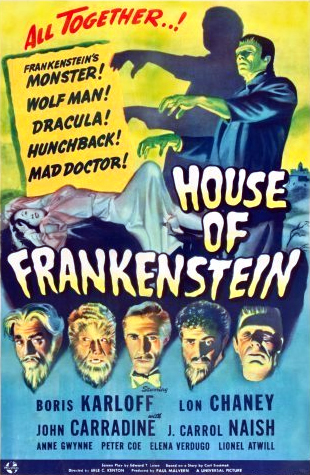
House of Frankenstein opens in a prison. Dr. Gustav Neimann (Boris Karloff), the bother of one of Baron Frankenstein’s assistants, has been convicted of robbing graves and attempting to carry on the Baron’s work. Dr. Neimann’s faithful assistant is the hunchback, Daniel (J. Carroll Naish). Daniel is loyal to Neimann because Neimann has promised to someday place Daniel’s brain in a stronger body.
When a sudden earthquake allows Neimann and Daniel to escape, they waste no time in getting revenge on Neimann’s enemies. First, they murder a traveling showman named Prof. Lampini (George Zucco) and steal both his identity and his mobile horror exhibit. Included in the exhibit is a coffin that Lampini claimed held the skeleton of Dracula. (There’s even a stake sticking out of the skeleton’s chest.) When Neimann returns to his original hometown, he removes the stake from the skeleton so that he might use it on the Burgomaster, Hussman (Sig Ruman). The skeleton transforms into Dracula (John Carradine). Because he is relieved to have been brought back to life, Dracula does not attack Neimann but instead agrees to help Neimann get revenge on Hussman in return for Neimann looking after his coffin. Dracula soon learns that he should have thought twice before trusting either Neimann or Daniel.
Neimann moves on, stopping off at Frankenstein’s village and recovering the bodies of both Frankenstein’s Monster (Glenn Strange) and Larry Talbot (Lon Chaney, Jr.) from the frozen chamber in which they were trapped at the end of Frankenstein Meets The Wolf Man. Revived from suspended animation, Larry immediately starts whining about how much his life sucks. (I love The Wolf Man but subsequent films turned Larry into the whiniest of the Universal monsters.) Neimann promises to put Larry’s brain in a new body if he helps to revive the Monster. Larry agrees. Meanwhile, Daniel falls in love with a gypsy girl named Ilonka (Elena Verdugo) while Ilonka falls in love with Larry. Daniel wants Neimann to put his brain in Larry’s body, Larry won’t stop whining about the approaching full moon, and the villagers are getting suspicious!
House of Frankenstein has never been a favorite of critics or horror historians and the film does have its share of flaws. For instance, though it would have been fun to see Bela Lugosi return to his signature role, John Carradine seems like ideal casting for Dracula. Unfortunately, Dracula is only in the film for about ten minutes and he comes to an end that really doesn’t feel worthy of a character of his stature. The film reduces Larry Talbot to just being a dumb lug who won’t stop feeling sorry for himself. Finally, Glenn Strange has the right physique for the Monster but, much as with John Carradine, he is underused.
That said, I still enjoyed House of Frankenstein. A lot of that is because of Boris Karloff, who brings a lot of sly humor to his performance as the mad scientist. (That said, Karloff himself later said that he did the role solely for the money and was bored with the whole thing.) J. Carroll Naish turns Daniel into a rather sympathetic henchman, one who is so desperate to be “normal” that he’s willfully blinded himself to the fact that Neiman really doesn’t care about anyone other than himself. (In many ways, he’s the equivalent of the hapless characters that Michael Ripper later played for Hammer Films.) Finally, Elena Verdugo brings a lot of life to the stock role of the dancing gypsy girl who falls in love with Larry Talbot despite the fact that Larry is kind of a dumb lug.
For a modern viewer, the main appeal of House of Frankenstein is that it is one of the original Universal horror films, even if it came out long after the first Dracula and Frankenstein films. As such, it has all the things that we associate with and love about those films. There’s a ruined castle. There’s angry villagers. The cast is full of Universal horror mainstays, including Lionel Atwell and Anne Gwynne. And, yes, the film features a mob descending on the castle with torches. Flaws and all, House of Frankenstein is an enjoyable time capsule. It’s a horror film from a far more innocent age and it’s one that remains a fun watch.
Welcome! Welcome! Welcome! Happy Horrorthon! It’s October!!! Yes, I passed my engineering classes last year; so, I will be working for Big Oil. Huh, my mother works for Big Pharma and I work for Big Oil – hmmm if only I could get my daughters into banking; then, we could finally bring about He Who Shall Sit At The Head of All Tables……BWAHAHAHAHAHA!!!
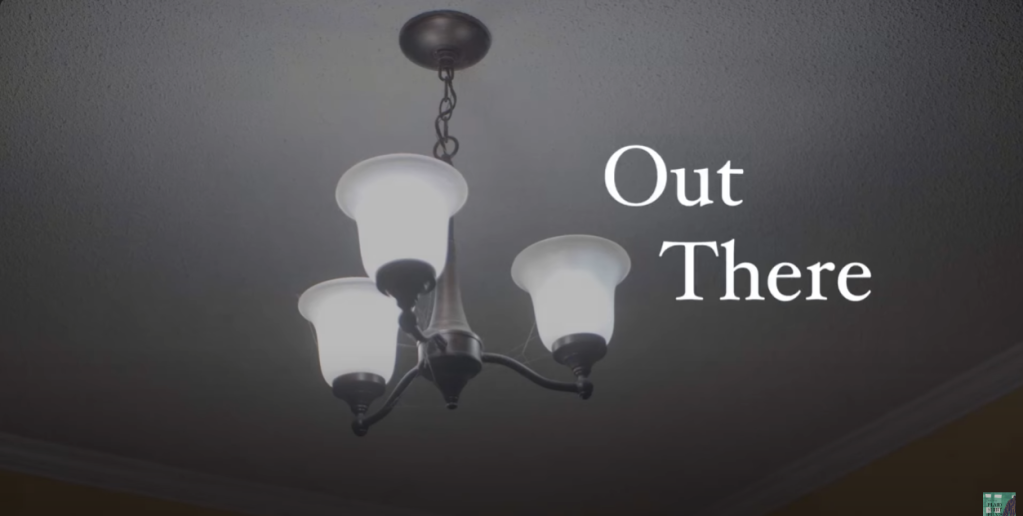
Sorry, I digress. I’m beginning this Horrorthon with a scathing review, but sometimes people just aren’t good at things. “Out There” is 4 minutes and 21 seconds long and I can’t write that everything Laila Iravani did was terrible because in the first 20 seconds there is a title card and everything was spelled correctly; so, there’s that. The other positive is that it was only over 4 minutes long. I had a mild COVID heart attack in 2021 and I think that the heart attack was about the same amount of time….maybe this film was even shorter than my heart attack? So, this film was briefer than that.
“Out There” was a story because there were characters, people, and I guess somethings happened. There were three or four bad actors who kind of could not go outside or the movie would skip. I really couldn’t write about the plot because I would have to do a lot of Laila Iravani’s work for her. Hold on, I’m really trying to be positive…the camera appeared to be on the whole time. There, I did it!
I can’t say that I’m sad after watching this because I love October and maybe like some other years this is the year of the crap short film. I think it’s Alex Magana creep because he makes terrible films and other people are like – “Hey, I’m bad at things too! I’m gonna make something terrible and Case will have to review and I HATE him already without knowing him because he likes art and this will be the opposite of that.” Laila Iravani you made me hurt a little, but only for 4 minutes and 21 seconds! So, Yay?
I got a note that Laila Iravani might not have made this terrible film. Laila, I’m glad that you did not do this. Supposedly, it’s in a film festival circuit going round and round and round. Hopefully, it will stay within the circuit and not spread to the greater world. It is really terrible. I’m not sure who made this terrible film, but maybe that’s sort of its mythos? Maybe, “Out There” is like one of the old ones such as Cthulhu- it has always been …. Waiting and once it finishes the film festival circuitry, it shall be released to the greater world and devour all of mankind????
Hi there and welcome to October! This is our favorite time of the year here at the Shattered Lens because October is our annual horrorthon! For the past several years (seriously, we’ve been doing this for a while), we have celebrated every October by reviewing and showing some of our favorite horror movies, shows, books, and music. That’s a tradition that I’m looking forward to helping to continue this year.
This year, we’re getting things started with a movie that has been called “the first American horror film.” In 1914, D.W. Griffith released The Avenging Conscience, a melodrama that was based on Edgar Allan Poe’s The Tell-Tale Heart and Annabel Lee. In this film, The Nephew (Henry B. Walthall) falls in love with the Sweetheart (Blanche Sweet). However, the Uncle (Spottiswoode Aiken) is opposed to the relationship, mostly because the Sweetheart is a “common” woman. Despite having been raised by the Uncle, the Nephew snaps and murders him. The Nephew then finds himself tortured not just by his own guilt and fear but also by vivid hallucinations. This is a film that invites us to come for the murder and stay for the reminder that “Thou Shalt Not Kill.”
Like a lot of the films of the silent era, it will require a bit of patience on the part of modern viewers. It takes a while to get going but the surreal imagery and Henry B. Walthall’s increasingly unhinged performance make it worth sticking with. If nothing else, the film’s historical significance makes it one worthy to be seen by all serious horror fans.
What’s an Insomnia File? You know how some times you just can’t get any sleep and, at about three in the morning, you’ll find yourself watching whatever you can find on cable or streaming? This feature is all about those insomnia-inspired discoveries!
If you were having trouble getting to sleep last night, you could have logged onto Tubi and watched James Nguyen’s Replica.
Filmed in 2005 but not released until 2018, Replica tells the story of Joe Thomas (James David Braddock), a computer chip salesman who has been in a bit of a funk ever since he received a new kidney. His sales are down. His pet bird is mocking him by chirping loudly. His morning drive is boring. (We know this because, for some reason, the film shows us almost every mundane moment of that commute.) He’s in danger of losing his job but then, while hanging out at the Golden Gate Bridge, he happens to spot Dr. Evelyn Tyler (Lana Dykstra) jogging by. Evelyn is the same doctor who performed Joe’s kidney transplant! Joe strikes up a conversation with her and soon, they’re dating!
(In this movie, dating means eating at a San Francisco theme restaurant, riding a carousel, and running along the beach before heading back home so that Evelyn can model a bikini for a slack-jawed Joe.)
Life is perfect! Joe’s in love and he’s even managed to sell a gigantic amount of computer chips to Evelyn’s boss, Dr. G (Rick Camp)! But then Evelyn is killed as the result of a very slow car collision. Joe is in mourning. Detective Le (David Nguyen) keeps popping up and suggesting that the car accident that took Evelyn’s life may not have been an accident at all. (“We found semen in the body,” Detective Le earnestly says while speaking to Evelyn’s boyfriend.) But then, one day, Joe happens to spot a woman who looks just like Evelyn, except for the fact that she has dark hair and tramp stamp that identifies her as not being Evelyn. Quicker than you can say Vertigo, Joe is trying to get his new girlfriend to wear a blonde wig and dress just like Evelyn!
Director James Nguyen is best known for directing the Birdemic films. Replica was actually filmed long before Birdemic but it shows that, even early in his career, Nguyen had his own definite aesthetic. Everything that made Birdemic so memorable — the terrible sound quality, the pointless shots of people driving, the nonstop references to Hitchcock, the falling-in-love montages that suggest that Nguyen has never actually been on a date, and the suggestion that we’re supposed to take this film seriously — is present in Replica. If Birdemic claimed to actually be about the dangers of harming the environment, Replica claims to be a film about the ethics of cloning. While Birdemic featured the characters going out to see An Inconvenient Truth, Replica opens with Joe watching Christopher Reeve advocate for stem cell research. Reeve is listed in the film’s credits, even though it’s obvious that Nguyen just taped an appearance that he made on a talk show. Tippi Hedren and Kim Novak are also credited, even though both are only featured in archival footage that shows up on Joe’s television.
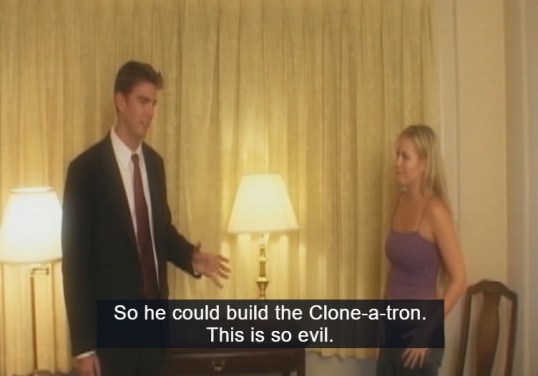
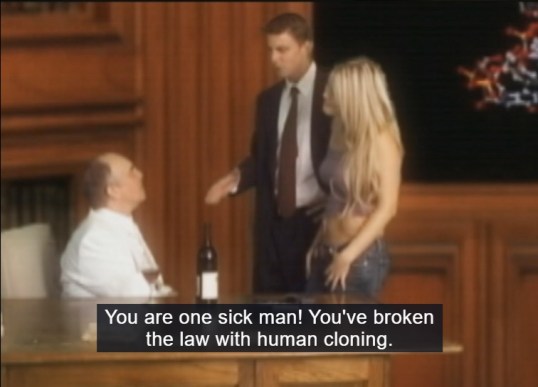
In typical Nguyen fashion, any attempt to say anything serious about cloning is negated by the fact that the film’s villain has invented something that he insists on calling “a clone-a-tron.” (That said, the actor playing Dr. G overacts to such an extent that it’s hard not to appreciate his effort to bring a little life to the movie.) The film comes out against cloning, despite the fact that Joe pretty much owes what little happiness he has to it. All in all, it’s a pretty stupid movie but it’s also short so there’s something to be said for that. In the end, for better or worse, this is a film that could have only been made by James Nguyen. If you got a good laugh out of Birdemic, prepare for more of the same with Replica.
“Oh, come on,” I said last week, “this is a perfectly fine film.”
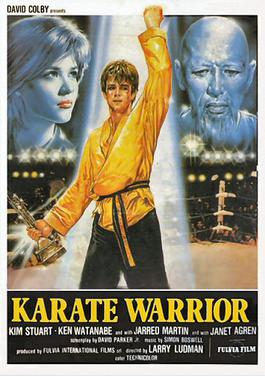
I was saying that because I was watching the 1987 film, Karate Warriors, with a group of friends. They felt that it was a largely pointless film that didn’t really have much of a plot. I felt that it was an interesting piece of history, seeing as how it was an Italian rip-off of The Karate Kid that was made by several associates of Lucio Fulci. And while Fulci himself wasn’t involved with the film, the scene where the lead character, young Anthony Scott (Kim Rossi Stuart), is savagely beaten up with the bad guys is so unnecessarily bloody that it feels like an homage to Fulci if nothing else. The scene, which makes this rip-off of The Karate Kid too graphic for the film’s target audience, really does epitomize everything that made the Italian exploitation industry so memorable.
Teenager Anthony Scott is in the Philippines so he can visit his father (Jared Martin, who starred in Fulci’s Warriors of the Year 2072), a journalist who is apparently in semi-hiding because of a series of articles that he wrote that exposed government corruption. (Don’t worry too much about the father’s backstory because it doesn’t really play any sort of role in the film.) Anthony runs afoul of the local teenage crime lord, Quino (Enrico Torralba). Quino is not only running a protection racket but he’s also the local karate champion. When Anthony stands up to Quino, he gets beaten up and Anthony’s girlfriend, Maria (Janelle Barretto), nearly loses her home when Quino’s gang sets it on fire. The half-dead Anthony is discovered by Master Kimura (Ken Watanabe — no, not that Ken Watanabe). Master Kimura takes Anthony into the forest and teaches him the “Stroke of the Dragon.” One montage later, Anthony is ready to enter the local karate tournament and take on Quino. For some reason, it never occurs to Anthony to let his father know that he’s now living with Master Kimura so, while Anthony is training, his father and his mother (Janet Agren, who co-starred in Fulci’s City of the Living Dead) are desperately searching for him in Manila.
Karate Warrior is only 84 minutes long and, for reasons that are not quite clear, Anthony’s training and the final tournament are all crammed into the film’s final 20 minutes. Before that, the film is a travelogue of Anthony wandering around Manila, getting conned by nearly everyone that he meets, and trying to flirt with Maria. So yes, the film is a bit plotless but I found the film’s meandering spirit to be a bit charming. It’s rare to see a film that’s so honest about only having 20 minutes worth of plot. The English language version also has the extra treat of some really bad dubbing. At one point, it sounds as if a totally different actor took over dubbing Anthony. The cheerful of ineptness of it all was rather likable.
The film was directed by Fabrizio De Angelis, who produced Fulci’s Beyondtrilogy. My friends may have disliked it but the film was a big enough of a success in Italy that it led to 6 sequels. I can’t wait to watch every one of them!
 Embittered by the death of his wife, Samuel Peters (Edward Furlong) turns to voodoo in an attempt to bring her back to life. Kalfu (Corey Feldman), the lord of the underworld, agrees to close the gates of Hell and allow the dead to roam the Earth with Peters as the immortal zombie king.


 Through the Shattered Lens