Lisa Watches An Oscar Nominee: Separate Tables (dir by Delbert Mann)


As some of you may know, I have been on a mission for a while now.  My goal is to see and review every single film that has been nominated for best picture by the Academy of Motion Picture Arts and Sciences.  (Of course, with the 1928 nominee, The Patriot, being a lost film, that may seem like an impossible mission.  No matter!  For me, nothing is impossible.  What Lisa wants, Lisa gets.)  For that reason, I spent part of last night watching the 1958 best picture nominee, Separate Tables, on TCM.

Separate Tables is one of the more forgotten of the best picture nominees but then again, the 50s were not the greatest decade as far as the Academy was concerned.  Consider some of the other films released in 1958: Big Deal on Madonna Street, High School Confidential, Indiscreet, The Last Hurrah, Machine-Gun Kelly, The Fly, The Blob, The Horror of Dracula, The Revenge of Frankenstein, Some Came Running, Thunder Road, A Touch Of Evil, and Vertigo!  The thing they all have in common is that none of them were nominated for best picture but Separate Tables was.

That’s not to say that Separate Tables was, in any way, a bad film.  Actually, it’s a pretty good film and I’m glad that I watched it.  It’s not bad at all.  However, it is … what’s the right term to use here?  Stately perhaps?  Maybe stagey.  Separate Tables is based on two one-act plays and, though it’s obvious that some effort was made to open up the material, it still feels undeniably stage-bound.  Separate Tables was directed by Delbert Mann, who had previously won an Oscar for his lively direction of Marty.  With Separate Tables, his direction is far less lively.  Watching it, you get the feeling that he was not only straight-jacketed by the theatrical origins of the material but also by the fact that the film was clearly made to win Academy Awards.

So, ignore the direction and pay attention to the performances.  Separate Tables works best as a tribute to good acting.  The film follows the lives of several guests at an English seaside hotel.  Some people are just staying for a few days.  Some people live at the hotel.  John Malcolm (Burt Lancaster) is a moody writer, a recovering alcoholic who is planning on asking the hotel’s manager, the level-headed Pat Cooper (Wendy Hiller), to marry him.  Of course, then his ex-wife, Anne (Rita Hayworth), shows up.  As quickly becomes obvious, John and Anne may hate each other but they also love each other.  Neither one is particularly sympathetic but, in their scenes together, Lancaster and Hayworth do create a fascinating portrait of mutual self-destruction.  Ultimately, you’re left with the impression that both of them are so self-destructive that they belong together, if just to keep from drawing anyone else into their messed up orbit.

And then there’s Major Pollock (David Niven).  David Niven won the Oscar for Best Actor for his role as Major Pollock and he does give an excellent performance.  Major Pollock is one of those roles that often seems to attract comedic actors looking for a chance to prove their dramatic abilities.  When he first appears, he seems to be a bit of a joke but then, as the film progresses, we learn that he’s actually struggling with his own demons.  In the case of Major Pollock, those demons are more hinted at than defined.  As we learn at the start of the film, Pollock was convicted of “harassing” several “young women” at a movie theater.  Separate Tables does not make clear how young or, for that matter, the exact details of the harassment.  Some residents of the hotel want Major Pollock to be kicked out of the hotel.  Some residents say that it is none of their business and that everyone deserves a second chance.  John Malcolm is in the latter group, though he’s more concerned with his ex-wife than with the scandalous Major (who, to no one’s great surprise, isn’t actually a major and whose war stories have all largely been lies).  Also seeking to defend Major Pollock is the shy Sibyl (Deborah Kerr, playing against type).  Sibyl’s mother (Gladys Cooper) is among those most determined to exile Pollock.

And really, the only reason this plotline works is because of the performances of Niven and Kerr.  As written, it’s way too vague about the exact details of what it was that Pollock did.  We’re just told that he was caught “behaving immorally.”  (According to Wikipedia, Pollock was originally written as being gay but, apparently, that was considered to be too controversial for 1958, hence the mention that Pollock’s crime involved “young women.”)  But Niven gives such a soulful and wounded performance that, much like Sibyl, you want to believe the best about him.  You want to give him a second chance, even though you know he’s going to let you down.  As Major Pollock, David Niven uses his trademark charm to paint a portrait of a man who is painfully aware that he has little to offer beyond charm.

At the same time, I was surprised by how little screen time Niven actually had in Separate Tables.  The majority of the film is taken up with Lancaster and Hayworth.  Niven definitely deserved some consideration for best supporting actor but best actor?  Not in the year that saw Orson Welles in Touch of Evil and James Stewart in Vertigo.

Separate Tables is not a great film, at least not in the way that we might wish that a film nominated for best picture would be.  It’s way too stagey and vague.  But, with all that in mind, it’s still wonderfully acted and always watchable.  It may not be great but it is very, very good.

Separate Tables was nominated for best picture but lost to Gigi.

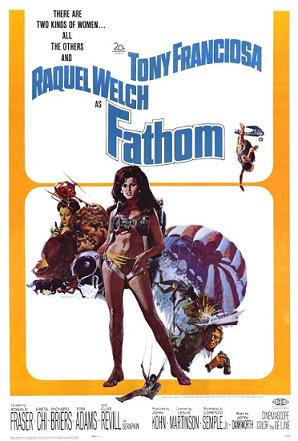
Lisa Cleans Out Her DVR: Fathom (dir by Leslie H. Martinson)


(Lisa is currently in the process of cleaning out her DVR!  It’s going to take her forever but, with the help of Dexedrine and energy drinks, she is determined to get it done!  She recorded 1967’s Fathom off of FXM on April 3rd of this year!)

Fathom is a spy spoof, one that was made the height of the initial James Bond craze.  It’s very much a late 60s film, in everything from the way the film looks to the overly complicated storyline to the film’s cultural attitudes.  This is one of those films that you know was probably considered to be “naughty” when it was released but, seen today, it’s all rather quaint.  There’s no nudity, there’s no cursing, and there’s very little violence.  However, it does feature in Raquel Welch in a lime green bikini and you just know that, when this film came out, there were probably people bemoaning it as the end of civilization.  “What happened to the movies that you could take the entire family too!?” they probably wailed.  That’s the way history works.  What was once daring now seems remarkably innocent.

I watched the film last night but I’d be lying if I said I could follow the plot.  I think that was intentional on the part of the filmmakers.  Fathom satirizes the spy films of the late 60s by taking all of their familiar elements to their logical extreme.  Spy thrillers feature unexpected twists and turns.  Fathom has a new twist every 10 minutes or so.  Spy thrillers feature sudden betrayal and double agents.  With the exception of Raquel Welch, literally no one in Fathom is who they initially claim to be.  It becomes exhausting to try to keep up.  In many ways, Fathom plays out like an old serial.  Every few minutes or so, there’s another cliffhanger.  Oh no, Raquel Welch is on an out-of-control motorboat!  Oh no, the bad guys have got Raquel Welch on an airplane!  Oh no, Raquel Welch is being chased by a bull and she’s wearing a red dress!  ¡Olé!

Raquel plays Fathom Harvill, who works as a dental hygienist except for when she’s touring Europe as a member of the U.S. parachute team.  She’s recruited by some spies to help track down a nuclear triggering mechanism, one that is being hidden somewhere in Spain.  The Scottish secret service just wants her to parachute into a villa owned by a mysterious American named Peter Meriweather (Anthony Franciosa) and plant a recording device.  Things don’t go quite as smoothly as they should and soon, Fathom’s going from one extreme situation to another.

(Even though Peter is supposed to be a suave, James Bond-type, Franciosa gives such an oddly intense performance that it feels like a dry run for his later work in Dario Argento’s Tenebrae.  Interestingly enough, in Argento’s film, Franciosa’s character is named Peter Neal.  Is it possible that Peter Meriweather changed his last name?)

But really, the entire plot is just an excuse to get Raquel into that lime green bikini and she totally owns the moment.  Raquel Welch is one of my favorite of the old film stars because she never apologized for who she was.  She had the body, she was sexy, she knew it, and she used it to her advantage.  Of course, when seen today, it’s disappointing that Fathom spends the entire movie being rescued by men but then again, I imagine that just the idea of a woman being a secret agent was revolutionary in 1967.  Actually allowing her to get out of situations on her own might have made heads explode.  If Fathom were made today, Fathom would at least get one scene where she gets to kick some ass, Angelina Jolie-style.

Anyway, Fathom is an enjoyably silly spy film.  Don’t worry about trying to follow the plot and, instead, just enjoy it as an over-the-top time capsule.  It doesn’t get more 1967 than Fathom.

TV Review: Twin Peaks: The Return Parts Three and Four (dir by David Lynch) (SPOILERS)


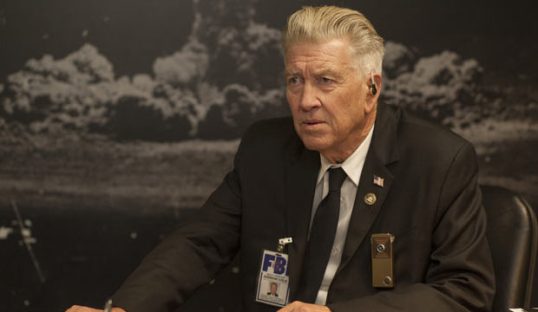
David Lynch as Gordon Cole

It seems appropriate that there should be a picture of David Lynch at the top of this recap.  There’s a lot of good things to be said about the third and fourth “parts” of Twin Peaks but ultimately, these two hours are all about Lynch and his unique vision.

This is especially true of the first 20 minutes of Part 3.  This is Lynch at his best.  Unconcerned with the traditional rules of narrative, Lynch creates an extended nightmare, one that sticks in your head long after the show itself has moved on.

Much as how Eraserhead started in space, with a hideously scarred man pushing and pulling the levers that eventually created that film’s mutant baby, Part 3 opens with Dale Cooper (Kyle MacLachlan) falling through darkness, plunging into a purple cloud.  When Cooper lands, it’s in a purple-tinted world that immediately made me think of the final scene in Lucio Fulci’s The Beyond.

Cooper is standing outside a house, looking out over what appears to be a purple ocean.  When Cooper enters the house, he finds a woman.  She is wearing a red dress and her eyes are sewn shut.  The first time I saw this, I assumed that the woman was meant to be Ruth Davenport, mostly because Ruth was found without eyes.  However, Ruth is not listed in the end credits.  For that matter, neither is the eyeless woman.
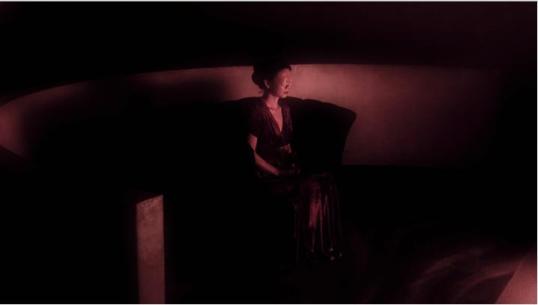
Cooper asks where they are but the woman cannot speak.  Perhaps she has lost her tongue, as well as her eyes.  Suddenly, someone starts to pound on the door.  The woman holds her finger to her lips, telling Cooper to be silent.

Cooper sees what appears to be a safe on the wall but, when he tries to approach it, the blind woman steps in front of him and pushes him back.  As the pounding continues, the woman leads Cooper to another door and then up a ladder.

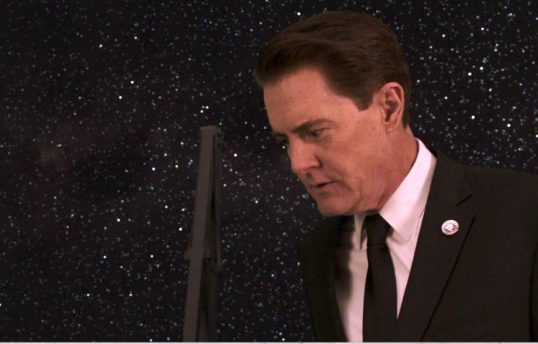
And suddenly, Cooper and the woman are standing in outer space.  The house has now become a satellite, hovering in the star-filled sky.  As the pounding continues on the soundtrack, the woman tries to speak but Cooper cannot understand what she’s saying.  Suddenly, the woman pulls down a lever, apparently electrocuting herself before falling off the satellite and disappearing into space.

Suddenly, Cooper sees the face of Major Garland Briggs (Don S. Davis) floating underneath him.  “Blue Rose,” Briggs says.

(In Twin Peaks: Fire Walk With Me, it was suggested that the FBI refers to paranormal cases as being “Blue Rose cases.”)

Cooper reenters the satellite.  He finds himself back in the house.  There is now a second woman and those familiar with the show will recognize her as being played by Phoebe Augustine, the same actress who played Ronette Pulaski in the earlier seasons of the show.  If Augustine playing Ronette here?  It’s hard to say.  Her character is listed as being “American Girl.”  Cooper does not seem to recognize her but, then again, he also hesitated before recognizing Laura Palmer during Part One.  Being in the Black Lodge for 25 years can’t be good for one’s memory.

Cut to Doppelganger Cooper, driving down a South Dakota highway.  At the same time that the real Cooper is once again approaching the safe in the Space House, Doppelganger Cooper is having a seizure while driving.

In the Space House, American Girl/Ronette says, “When you get there, you will already be there.”

The pounding starts again.

“You better hurry,” American Girl/Ronette says, “my mother’s coming.”

Suddenly, Cooper is sucked into the safe, with only his shoes being left behind in the Space House.

In South Dakota, Doppelganger Cooper flips his car, crashing into a mountain.  Doppelganger Cooper survives but suddenly, he starts to throw up.  He puts his hand over his mouth and then sees the red curtains of the Black Lodge appearing before his car.

In an empty house located the Rancho Rosa development in Nevada, a dorky guy named Dougie Jones (Kyle MacLachlan) has just paid a prostitute named Jade (Nafessa Williams).  While Jade takes a shower, Dougie puts on a mustard yellow suit jacket and, judging by how ugly it is, I’m guessing that Dougie must be in real estate.  (Perhaps he works for Rancho Rosa, selling people suburban houses in the middle of the desert.)  Suddenly, Dougie grabs his stomach and collapses to the floor.

What follows is one of the grossest scenes ever as we cut back and forth between Dougie and the Doppelganger vomiting.  Seriously, this was one of the most grotesquely realistic vomiting scenes that I have ever seen.  I averted my eyes and covered my ears!  It was so gross.

At the same time that Dougie vanishes from the house, the red curtains in front of the Doppelganger’s car also vanishes.  But the Doppelganger is too busy throwing up to notice.  Again, I have to admit that I averted my eyes during most of this.  (I also realize that both Dougie and the Doppelganger were throwing up their essences, the stuff that allowed them to pretend to be human.  I don’t care.  The only thing I hate more than vomiting is watching other people vomit.)

Dougie is in the Black Lodge.  MIKE (Al Strobel) doesn’t appear to be too happy to see him.  MIKE explains that someone manufactured Dougie.  I’m assuming that the Doppelganger created Dougie so that, if Cooper ever escaped from the Black Lodge, he would take over Dougie’s existence instead of the Doppelganger’s.  “That’s weird,” Dougie says, as he his hand wastes away.  Then Dougie’s head vanishes, replaced by a black cloud of smoke.
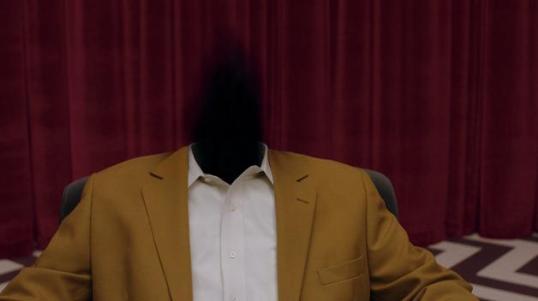
Back at the house, another black cloud comes out of an electrical outlet.  Soon, the cloud forms into Cooper.  Cooper lies on the floor, next to Dougie’s vomit (ewwww!) until Jade yells at him that they have to get out of the house.

Apparently in a state of shock, Cooper silently follows Jade out of the house.  After being locked away in the Black Lodge, it appears that Cooper no longer quite remembers how to be human.  Or maybe he’s not really human at all anymore.  All I know is that he’s acting strange and, as brilliant as Kyle MacLachlan is, I do kind of hope the old Cooper returns at some point soon.

Because Dougie/Cooper doesn’t have his car keys (though he does still have his room key from the Great Northern), Jade gives him a ride into Vegas.  Two gangster types watch as Jade drives off.  One of them has a rifle.  The other has a bomb.  Apparently, they work for someone to whom Dougie’s owes money.  Because Cooper leans down to pick up his room key, the one with the rifle does not spot him in Jade’s car.  The other places the bomb under Dougie’s car, which is still sitting outside of the empty house.

While this happens, a woman — listed in the credits as being “Drugged-Up Mother” and played by Hailey Gates — is shouting “One one nine!  One one nine!” while her son watches on the couch.

In South Dakota, two troopers approach the Doppelganger’s car.  One of them catches whiff of the vomit and collapses to the ground, physically ill.

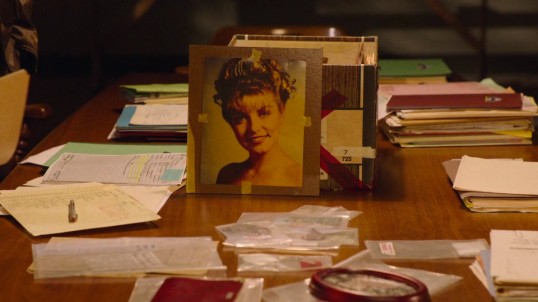
At the Twin Peaks Sheriff’s Department, Hawk (Michael Horse), Andy (Harry Goaz), and Lucy (Kimmy Robertson) look through all the evidence that was collected in the Palmer case.  Andy says that he and Lucy can’t find out what’s missing.  “If it’s here,” Hawk replies, “how can it be missing?”

As Hawk recites what the Log Lady told him — that something is missing and that the way he’ll find it has to do with his heritage — Lucy freaks out when she spots an empty box of chocolate bunnies.  Many years ago, Lucy ate the bunny.

“Do chocolate bunnies have something to do with your heritage?” Andy earnest asks.

“IT’S NOT ABOUT BUNNIES!” Hawk snaps.  Then, “Is it about the bunny? …. No, it’s not about the bunny.”

Meanwhile, off in the middle of nowhere, Dr. Jacoby (Russ Tamblyn) spray paints the ladders that were delivered to him at the start of Part One.

In Vegas, Jade drops Dougie/Cooper off at a casino.  Dougie/Cooper has been reduced to just repeating back phrases that other people say to him but no one seems to notice.  Still, when Jade tells Dougie/Cooper that he can “go now,” Dougie/Cooper has a flashback to Laura Palmer (Sheryl Lee) saying the same thing.

The casino, with its combination of glitz and the grotesque, brings out the best in Lynch.  As Dougie/Cooper wanders through the casino — which is populated by typical Lynchian characters — he notices that he can see the red curtains of the Black Lodge floating over certain slot machines.   Cooper pulls the levers, hitting jackpot after jackpot.  As the coins flood out of the machines, Cooper announces, “HELLO!”  Why?  Because he heard another gambler do it.  Dougie/Cooper is learning how to be human again.

When Dougie/Cooper walks away after having won another jackpot, leaving all of his coins on the floor, one old woman considers taking the coins for herself but then glances up at the camera on the ceiling — “and the eye in the sky watches us all,” to quote Casino — and thinks better of it.  Instead, she just asks Cooper to tell her which machines are about to hit.  She calls him Mr. Jackpot, which is kinda sweet.

Meanwhile, in Philadelphia, the FBI is meeting and — oh my God!  It’s Gordon Cole (David Lynch), Albert Rosenfield (Miguel Ferrer), and Tamara Preston (Chrysta Bell).  (Preston will be familiar to anyone who has read Mark Frost’s The Secret History of Twin Peaks.)

They start out discussing a senator who has been accused of murdering his wife.  The senator says that he knows who did it but he can’t reveal the name because of “national security reasons.”  (Since this is taking place in 2014, I’m going to continue the Casino theme and assume that the senator was creepy old Harry Reid.)

Cole is more interested in hearing about the murders of Sam and Tracey in New York City.  It turns out that the cameras caught a picture of that demonic creature in the glass box.

Suddenly, a call comes in.  Cooper has been found and he’s in a South Dakota prison and … oh shit!  That’s not Cooper!  We know that’s the Doppelganger!  Regardless, Cole announces that he, Albert, and Tamara are going to South Dakota.  Albert says he can’t wait to see Mount Rushmore.

“The absurd mystery of the strange forces of existence,” Albert tells Tamara.  “How about a truck load of valium?”

Cut to The Cactus Blossoms, performing at the Roadhouse and announcing that Part Three is over.
Part Four opens with Dougie/Cooper still hitting jackpots and still chanting, “Hello!”  When the old woman who has been following him around hits a jackpot of her own, a small smile comes to Cooper/Dougie’s lips.

A friend of Dougie’s, Bill Shaker (Ethan Suplee), approaches and he and Dougie have a thoroughly superficial conversation.  Dougie/Cooper asks where his home is.  Bill assures him that he lives at Lancelot Court, in a house with a red door.  The house, Bill says, is near Merlin’s Market.  As Cooper/Dougie leaves to get a cab, Bill says, “I hope he’s okay.”

“I don’t think he’s okay,” Bill’s wife, the wonderfully named Candy Shaker (Sara Paxton) says.

Before Dougie/Cooper can leave to find the house with the red door, he is dragged to the office of the vaguely threatening casino manager (David Dastmalchian).  The manager gives Dougie/Cooper his winnings and then asks if he wants anything — like “companionship” — for the night.  “Think of us as your home away from home,” he says.  When Dougie/Cooper repeats that he wants to go home (his real home), the manager arranges for him to ride in a limo.

(It pays to be a winner.)

As the limo drives down Lancelot Court, the driver (Jay Larson) says that it might be hard to spot a red door at night.  However, he then sees the door and oh my God, is it ever red!  Dougie gets out of the limo and seems unsure what to do.  Fortunately, his wife — Janey-E (Naomi Watts) — comes out of the house and starts hitting him.  Apparently, Dougie has been missing for three days.  He even misses his son’s birthday party!  (Perhaps significantly, as everyone stands outside the house, an owl flies overhead.)

Fortunately, once they’re inside the house, Janey-E sees just how much money Dougie/Cooper won at the casino.

“Don’t tell me you hit the jackpot!” Janey-E says.

“Mr. Jackpot,” Dougie/Cooper says, pointing at himself.

“There’s enough here to pay them back!” Janey-E continues as she looks at the money, “This is the most wonderful day of my life!”

“Of my life,” Dougie/Cooper says.

“Yes,” Janey-E replies.

At FBI Headquarters, Cole has a meeting chief of staff Denise Bryson (David Duchovny).  Cole tells Denise about finding Cooper and says he’s going to South Dakota.  Denise is concerned about Cole traveling with Tamara.  “I know your profile, Gordon,” Denise explains, “Female agent.  Early 30s.”

“I’m old school,” Cole replies, “you know that.”

Cole reminds Denise that he defended her when she first transitioned.  He told everyone who had a problem with her to “Fix their hearts — or die!”

At the Twin Peaks Sheriff’s Department, Sheriff Frank Truman (Robert Forster) enters the front lobby, which causes Lucy to scream and faint.  Apparently, Lucy was confused because she has just been talking to Frank on the phone and she can’t understand how Frank could be in two places at once.  Andy attempts to explain to her how cell phones work.  “You’re so good at your job,” Andy says, “in every other way…”

At the Sheriff’s Department, we learn a few interesting things:

First off, Bobby Briggs (Dana Ashbrook), former drug dealer and murderer, is now a deputy, one who specializes in watching for drug dealers sneaking across the Canadian border.  (That’s something that Bobby should know a bit about.)  He also has gray hair and he cries when he sees a picture of Laura in the conference room.

Secondly, Major Garland Briggs died in a fire, a day after being the last person to see Dale Cooper.  (Presumably, Major Briggs actually saw Doppelganger Cooper.)

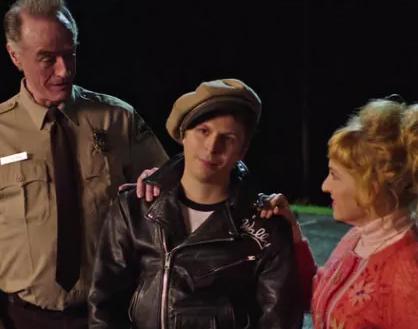
Third, Lucy and Andy’s son has grown up to be Wally Brando (Michael Cera).  Wally is a motorcycle enthusiast who has spent the last few years riding across the country.  Wally dresses like Marlon Brando in The Wild One and delivers a hilariously nonsensical monologue that is largely made up of pretentious references to different Brando roles.  What makes Wally’s scene so wonderful is the combination of Cera’s Brandoesque scenery chewing and Robert Forster’s deadpan reaction.
The next morning, in Vegas, Dougie/Cooper still can’t figure out how to do anything.  After spending 25 years in limbo, even urination is a new and scary experience for him.  Even when MIKE appears to tell him that he was tricked into leaving the Lodge and that either Dougie/Cooper and the Doppelganger must die, Dougie/Cooper looks confused.  Still, his son — the oddly named Sonny Jim (Pierce Gagnon) — is amused when his father eats breakfast with a tie wrapped around his head.

In South Dakota, the police investigating the murder of Ruth Davenport are shocked to discover that they can not access the identity of the owner of the finger prints that they took off of the male Joe Doe.  Apparently, it’s top secret.  “Military authorization required.”

Meanwhile, Cole, Albert, and Tamara are driving out to the South Dakota prison.  During the car ride, Cole complains that they’re not anywhere near Mount Rushmore but, luckily, Albert has brought a picture for him.  Meanwhile, Tamara has to ride with her head leaning out of the window because she gets car sick.

(I sometimes get car sick too.  That’s one reason why I never sit in the back seat.  I share your struggle, Tamara!)

At the prison, Cole, Albert, and Tamara meet with Warden Murphy (James Morrison).  When it is mentioned that the Doppelganger was throwing up poison, Murphy says, “Must have eaten locally.”  I love that line!

Anyway, the meeting with the Doppelganger doesn’t go well.  The Doppelganger, having thrown up whatever it was that allowed him to act human, is now speaking in a stiff and halting tone.  The Doppelganger claims that he’s spent the last 25 years working undercover for Philip Jeffries.  Haltingly, he says that he needs to be released so that Gordon can “debrief” him.  Stiffly, the Doppelganger attempts to give Gordon the thumbs up sign.

After the meeting, Cole and Albert agree that something was off about “Cooper.”  They agree that there’s one woman who can tell them if it’s really Cooper in prison.  Cole asks if Albert still knows where she lives.

“I know where she drinks,” Albert replies.

Who could Albert be talking about?  Audrey Horne?  Or maybe Sarah Palmer?  Sarah, after all, is psychic and appears to still have a drinking problem.

We’ll find out next week!  Until then, Parts 3 and 4 — along with Parts 1 and 2 — will continue to haunt my thoughts and dreams.
Twin Peaks on TSL:

  1. Twin Peaks: In the Beginning by Jedadiah Leland
  2. TV Review: Twin Peaks 1.1 — The Pilot (dir by David Lynch) by Lisa Marie Bowman
  3. TV Review: Twin Peaks 1.2 — Traces To Nowhere (directed by Duwayne Dunham) by Jedadiah Leland
  4. TV Review: Twin Peaks 1.3 — Zen, or the Skill To Catch A Killer (dir by David Lynch) by Lisa Marie Bowman
  5. TV Review: Twin Peaks 1.4 “Rest in Pain” (dir by Tina Rathbone) by Leonard Wilson
  6. TV Review: Twin Peaks 1.5 “The One-Armed Man” (directed by Tim Hunter) by Jedadiah Leland
  7. TV Review: Twin Peaks 1.6 “Cooper’s Dreams” (directed by Lesli Linka Glatter) by Lisa Marie Bowman
  8. TV Review: Twin Peaks 1.7 “Realization Time” (directed by Caleb Deschanel) by Lisa Marie Bowman
  9. TV Review: Twin Peaks 1.8 “The Last Evening” (directed by Mark Frost) by Leonard Wilson
  10. TV Review: Twin Peaks 2.1 “May the Giant Be With You” (dir by David Lynch) by Leonard Wilson
  11. TV Review: Twin Peaks 2.2 “Coma” (directed by David Lynch) by Jedadiah Leland
  12. TV Review: Twin Peaks 2.3 “The Man Behind The Glass” (directed by Lesli Linka Glatter) by Jedadiah Leland
  13. TV Review: Twin Peaks 2.4 “Laura’s Secret Diary” (dir by Todd Holland) by Lisa Marie Bowman
  14. TV Review: Twin Peaks 2.5 “The Orchid’s Curse” (dir by Graeme Clifford) by Lisa Marie Bowman
  15. TV Review: Twin Peaks 2.6 “Demons” (dir by Lesli Linka Glatter) by Leonard Wilson
  16. TV Review: Twin Peaks 2.7 “Lonely Souls” (directed by David Lynch) by Jedadiah Leland
  17. TV Review: Twin Peaks 2.8 “Drive With A Dead Girl” (dir by Caleb Deschanel) by Lisa Marie Bowman
  18. TV Review: Twin Peaks 2.9 “Arbitrary Law” (dir by Tim Hunter) by Lisa Marie Bowman
  19. TV Review: Twin Peaks 2.10 “Dispute Between Brothers” (directed by Tina Rathbone) by Jedadiah Leland
  20. TV Review: Twin Peaks 2.11 “Masked Ball” (directed by Duwayne Dunham) by Leonard Wilson
  21. TV Review: Twin Peaks 2.12 “The Black Widow” (directed by Caleb Deschanel) by Leonard Wilson
  22. TV Review: Twin Peaks 2.13 “Checkmate” (directed by Todd Holland) by Jedadiah Leland
  23. TV Review: Twin Peaks 2.14 “Double Play” (directed by Uli Edel) by Jedadiah Leland
  24. TV Review: Twin Peaks 2.15 “Slaves and Masters” (directed by Diane Keaton) by Lisa Marie Bowman
  25. TV Review: Twin Peaks 2.16 “The Condemned Woman” (directed by Lesli Linka Glatter) by Leonard Wilson
  26. TV Review: Twin Peaks 2.17 “Wounds and Scars” (directed by James Foley) by Lisa Marie Bowman
  27. TV Review: Twin Peaks 2.18 “On The Wings of Love” (directed by Duwayne Dunham) by Jedadiah Leland
  28. TV Review: Twin Peaks 2.19 “Variations on Relations” (directed by Jonathan Sanger) by Lisa Marie Bowman
  29. TV Review: Twin Peaks 2.20 “The Path to the Black Lodge” (directed by Stephen Gyllenhaal) by Lisa Marie Bowman
  30. TV Review: Twin Peaks 2.21 “Miss Twin Peaks” (directed by Tim Hunter) by Leonard Wilson
  31. TV Review: Twin Peaks 22.2 “Beyond Life and Death” (directed by David Lynch) by Lisa Marie Bowman
  32. Film Review: Twin Peaks: Fire Walk With Me (dir by David Lynch) by Lisa Marie Bowman
  33. Here’s The Latest Teaser for Showtime’s Twin Peaks by Lisa Marie Bowman
  34. Here’s The Newest Teaser for Showtime’s Twin Peaks by Lisa Marie Bowman
  35. 12 Initial Thoughts About Twin Peaks: The Return Parts One and Two by Lisa Marie Bowman
  36. This Week’s Peaks: Parts One and Two by Ryan C. (trashfilm guru)
  37. TV Review: Twin Peaks: The Return Parts One and Two (dir by David Lynch) by Lisa Marie Bowman
  38. 4 Shots From 4 Films: Special Twin Peaks Edition by Lisa Marie Bowman
  39. This Week’s Peaks: Parts Three and Four by Ryan C. (trashfilm guru)
  40. 14 Initial Thoughts About Twin Peaks: The Return Part Three (dir by David Lynch)
  41. 10 Initial Thoughts About Twin Peaks: The Return Part Four (dir by David Lynch)


10 Initial Thoughts About Twin Peaks: The Return Part 4 (dir by David Lynch)


Ever since they first became available last weekend, I’ve been watching and rewatching both Parts Three and Four of the Twin Peaks revival. And, before I even attempt to write an in-depth recap, I’m going to have to watch both of them again!  Until I do that, here are a few initial thoughts!

(Be sure to check out Ryan’s thoughts on Parts Three and Four as well!)

1. Hey, it’s Ethan Suplee!  I have to admit that I had mixed feeling when I saw how many well-known actors were joining the cast for the revival.  I worried that it might be distracting.  However, so far, they’ve all fit right in.  Of course, to be honest, Ethan Suplee is exactly the type of quirky actor that you would expect to find in a David Lynch film.  (And make no doubt about it.  Twin Peaks: The Return may be disguised as television series but, at heart, it’s an 18-hour film.)

2. No sooner was I thinking that the scene with Cooper in the limo was reminding me of the opening of Mulholland Drive then Naomi Watts showed up as Cooper/Dougie’s wife.

3. Tonight, we finally got to meet the new Sheriff Truman.  Robert Forster is playing Frank Truman, the bother of Harry S. Truman.  From what I’ve read, Forster was the original choice for the role of Harry S. but, because of scheduling conflicts, he couldn’t take the role.  Interestingly enough, Forster also played a lawman (along with Brent Briscoe who plays a detective in the Twin Peaks revival) in Mulholland Drive.

4. Bobby Briggs growing up to become a deputy somehow just feels so right.  Does anyone remember that, along with being a drug dealer, Bobby actually shot a random guy in the head during Twin Peaks: Fire Walk With Me?

5. Wally Brando!  Wally Brando, as played by Michael Cera, is either going to be one of the best characters ever or one of the most annoying.  (Of course, I had a strange feeling that something like this would happen when Lucy specifically pointed out that Wally shared his birthday with Marlon Brando.)  It helps that Michael Cera does conceivably look like he could be the son of Harry Goaz and Kimmy Robertson.

6. Oh my God, that lime green jacket.  Dougie Jones would apparently wear anything.

7. “We’re not anywhere near Mt. Rushmore!”

“I brought a picture for you.”

I love the Albert/Gordon comedy team.

8. Kyle MacLachlan was absolutely chilling, playing the imprisoned Cooper Doppelganger.  It was the combination of his attempt to pretend to be human with the flat way that he delivered his cryptic lines.  “I need to be debriefed by you, Gordon…Of course, I will be exonerated in courts of law.”  Agck!

9. Originally, it was planned that David Bowie would recreate his role as Phillip Jeffries but, unfortunately, he passed away before filming began.

10. Who is the woman who might know who Cooper is?  The one that Albert claims to know “where she drinks?”  Audrey, maybe?

Twin Peaks on TSL:

  1. Twin Peaks: In the Beginning by Jedadiah Leland
  2. TV Review: Twin Peaks 1.1 — The Pilot (dir by David Lynch) by Lisa Marie Bowman
  3. TV Review: Twin Peaks 1.2 — Traces To Nowhere (directed by Duwayne Dunham) by Jedadiah Leland
  4. TV Review: Twin Peaks 1.3 — Zen, or the Skill To Catch A Killer (dir by David Lynch) by Lisa Marie Bowman
  5. TV Review: Twin Peaks 1.4 “Rest in Pain” (dir by Tina Rathbone) by Leonard Wilson
  6. TV Review: Twin Peaks 1.5 “The One-Armed Man” (directed by Tim Hunter) by Jedadiah Leland
  7. TV Review: Twin Peaks 1.6 “Cooper’s Dreams” (directed by Lesli Linka Glatter) by Lisa Marie Bowman
  8. TV Review: Twin Peaks 1.7 “Realization Time” (directed by Caleb Deschanel) by Lisa Marie Bowman
  9. TV Review: Twin Peaks 1.8 “The Last Evening” (directed by Mark Frost) by Leonard Wilson
  10. TV Review: Twin Peaks 2.1 “May the Giant Be With You” (dir by David Lynch) by Leonard Wilson
  11. TV Review: Twin Peaks 2.2 “Coma” (directed by David Lynch) by Jedadiah Leland
  12. TV Review: Twin Peaks 2.3 “The Man Behind The Glass” (directed by Lesli Linka Glatter) by Jedadiah Leland
  13. TV Review: Twin Peaks 2.4 “Laura’s Secret Diary” (dir by Todd Holland) by Lisa Marie Bowman
  14. TV Review: Twin Peaks 2.5 “The Orchid’s Curse” (dir by Graeme Clifford) by Lisa Marie Bowman
  15. TV Review: Twin Peaks 2.6 “Demons” (dir by Lesli Linka Glatter) by Leonard Wilson
  16. TV Review: Twin Peaks 2.7 “Lonely Souls” (directed by David Lynch) by Jedadiah Leland
  17. TV Review: Twin Peaks 2.8 “Drive With A Dead Girl” (dir by Caleb Deschanel) by Lisa Marie Bowman
  18. TV Review: Twin Peaks 2.9 “Arbitrary Law” (dir by Tim Hunter) by Lisa Marie Bowman
  19. TV Review: Twin Peaks 2.10 “Dispute Between Brothers” (directed by Tina Rathbone) by Jedadiah Leland
  20. TV Review: Twin Peaks 2.11 “Masked Ball” (directed by Duwayne Dunham) by Leonard Wilson
  21. TV Review: Twin Peaks 2.12 “The Black Widow” (directed by Caleb Deschanel) by Leonard Wilson
  22. TV Review: Twin Peaks 2.13 “Checkmate” (directed by Todd Holland) by Jedadiah Leland
  23. TV Review: Twin Peaks 2.14 “Double Play” (directed by Uli Edel) by Jedadiah Leland
  24. TV Review: Twin Peaks 2.15 “Slaves and Masters” (directed by Diane Keaton) by Lisa Marie Bowman
  25. TV Review: Twin Peaks 2.16 “The Condemned Woman” (directed by Lesli Linka Glatter) by Leonard Wilson
  26. TV Review: Twin Peaks 2.17 “Wounds and Scars” (directed by James Foley) by Lisa Marie Bowman
  27. TV Review: Twin Peaks 2.18 “On The Wings of Love” (directed by Duwayne Dunham) by Jedadiah Leland
  28. TV Review: Twin Peaks 2.19 “Variations on Relations” (directed by Jonathan Sanger) by Lisa Marie Bowman
  29. TV Review: Twin Peaks 2.20 “The Path to the Black Lodge” (directed by Stephen Gyllenhaal) by Lisa Marie Bowman
  30. TV Review: Twin Peaks 2.21 “Miss Twin Peaks” (directed by Tim Hunter) by Leonard Wilson
  31. TV Review: Twin Peaks 22.2 “Beyond Life and Death” (directed by David Lynch) by Lisa Marie Bowman
  32. Film Review: Twin Peaks: Fire Walk With Me (dir by David Lynch) by Lisa Marie Bowman
  33. Here’s The Latest Teaser for Showtime’s Twin Peaks by Lisa Marie Bowman
  34. Here’s The Newest Teaser for Showtime’s Twin Peaks by Lisa Marie Bowman
  35. 12 Initial Thoughts About Twin Peaks: The Return Parts One and Two by Lisa Marie Bowman
  36. This Week’s Peaks: Parts One and Two by Ryan C. (trashfilm guru)
  37. TV Review: Twin Peaks: The Return Parts One and Two (dir by David Lynch) by Lisa Marie Bowman
  38. 4 Shots From 4 Films: Special Twin Peaks Edition by Lisa Marie Bowman
  39. This Week’s Peaks: Parts Three and Four by Ryan C. (trashfilm guru)
  40. 14 Initial Thoughts About Twin Peaks: The Return Part Three (dir by David Lynch)


14 Initial Thoughts About Twin Peaks: The Return Part 3 (dir by David Lynch)


Because they’ve been available on OnDemand since last Sunday, I’ve watched and rewatch Parts 3 and 4 of Twin Peaks: The Return several times.  And I’m going to rewatch them again before I sit down and even try to write out a in-depth recap.  Until then, here are my initial thoughts on Part Three.

(Be sure to check out Ryan’s thoughts on Parts Three and Four!)

1. Whether it’s intentional or not, Twin Peaks: The Return has so far been full of references to David Lynch’s entire artistic output, both Twin Peaks and non-Twin Peaks.  The opening of Part Three, with Cooper apparently falling through space, reminded me of the opening of Eraserhead.  The subsequent scene, in which Cooper met the eyeless Ruth Davenport, immediately made me think of both Lynch’s short film, The Alphabet and the hotel scenes in Inland Empire.

2. An older woman who I used to work with once asked me if I thought Stephen King was a devil worshipper.

“No,” I replied, “why?”

“How else can he come up with all that scary stuff?”

I can only imagine what she would think about David Lynch.

3. Can we take a few minutes to appreciate the amazing performance of Kyle MacLachlan?  MacLachlan has always been a good actor but oh my God.  So far, his work on this show has been nothing sort of amazing.  Doppelganger Cooper gets all the good lines but, to me, MacLachlan is at his best when he’s playing the Real Cooper, the Dale who has spent so much time in the Black Lodge that he’s no longer quite sure how to be human.

4. To be honest, I could have done without all of the vomiting in tonight’s episode.  I hate watching people throw up.  That said, if Twin Peaks: The Return truly is a cumulation of Lynch’s career up to this point, I guess the vomiting could be seen as a tribute to his short film, Six Figures Getting Sick.

5. Speaking of shout outs to previous Lynch films, whenever Doppelganger Cooper was in the car, it was hard not to be reminded of Bill Pullman at the end of Lost Highway.

6. Las Vegas is the perfect David Lynch town.  Lynch has always had an eye for surrealistic Americana and that’s the perfect description of Vegas.  Of course, Vegas is often held up as a symbol of America, the ultimate triumph of man over his environment as well as a place where, depending on your luck, you’ll either find the American Dream or the American Nightmare.  In interviews, Lynch has always described himself as being a Libertarian and his artistic vision as being essentially apolitical (the only two politicians that I’ve ever heard about him praising were Ronald Reagan and Bernie Sanders) but still, the subtext of Cooper escaping into the glitz, greed, and potential misery of Las Vegas is intriguing.

7. “Do chocolate bunnies have anything to do with your heritage?”  I love the earnest way Harry Goaz delivered that line.

8. That lengthy scene of Russ Tamblyn painting the shovels was pretty much the epitome of what people either love or hate about David Lynch’s style of film making.

9. Cooper in the casino — “Hello!” — was everything.

10. Someone needs to do a Twin Peaks/Casino mashup.  I want to see Cooper greeting The Ace Rothstein Dancers.

11. It was hard not to get emotional when Miguel Ferrer showed up.  In both Part Three and Part Four, it’s obvious that Miguel was, physically, not in the best health while shooting his scenes.  However, as an actor, he remained just as sharp as ever.

12. Speaking of actors, David Lynch has actually become a pretty good one.  I just finished watching the first two seasons of Twin Peaks on Netflix.  During those seasons — and in Twin Peaks: Fire Walk With Me — David Lynch’s role as Gordon Cole came across as almost a vanity thing.  Lynch was having fun and he was fun to watch but, at the same time, you were always kinda happy that he only appeared occasionally.  But in both Part 3 and (especially) Part 4, Lynch gives an actual performance in the role.  Cole has gone from being a joke to being a compelling character.

13. For some reason, I just love the fact that Cole’s office is decorated with a picture of a mushroom cloud.

14. That was The Cactus Blossoms performing at the end.  It’s nice to see that the Roadhouse is still doing well.

Twin Peaks on TSL:

  1. Twin Peaks: In the Beginning by Jedadiah Leland
  2. TV Review: Twin Peaks 1.1 — The Pilot (dir by David Lynch) by Lisa Marie Bowman
  3. TV Review: Twin Peaks 1.2 — Traces To Nowhere (directed by Duwayne Dunham) by Jedadiah Leland
  4. TV Review: Twin Peaks 1.3 — Zen, or the Skill To Catch A Killer (dir by David Lynch) by Lisa Marie Bowman
  5. TV Review: Twin Peaks 1.4 “Rest in Pain” (dir by Tina Rathbone) by Leonard Wilson
  6. TV Review: Twin Peaks 1.5 “The One-Armed Man” (directed by Tim Hunter) by Jedadiah Leland
  7. TV Review: Twin Peaks 1.6 “Cooper’s Dreams” (directed by Lesli Linka Glatter) by Lisa Marie Bowman
  8. TV Review: Twin Peaks 1.7 “Realization Time” (directed by Caleb Deschanel) by Lisa Marie Bowman
  9. TV Review: Twin Peaks 1.8 “The Last Evening” (directed by Mark Frost) by Leonard Wilson
  10. TV Review: Twin Peaks 2.1 “May the Giant Be With You” (dir by David Lynch) by Leonard Wilson
  11. TV Review: Twin Peaks 2.2 “Coma” (directed by David Lynch) by Jedadiah Leland
  12. TV Review: Twin Peaks 2.3 “The Man Behind The Glass” (directed by Lesli Linka Glatter) by Jedadiah Leland
  13. TV Review: Twin Peaks 2.4 “Laura’s Secret Diary” (dir by Todd Holland) by Lisa Marie Bowman
  14. TV Review: Twin Peaks 2.5 “The Orchid’s Curse” (dir by Graeme Clifford) by Lisa Marie Bowman
  15. TV Review: Twin Peaks 2.6 “Demons” (dir by Lesli Linka Glatter) by Leonard Wilson
  16. TV Review: Twin Peaks 2.7 “Lonely Souls” (directed by David Lynch) by Jedadiah Leland
  17. TV Review: Twin Peaks 2.8 “Drive With A Dead Girl” (dir by Caleb Deschanel) by Lisa Marie Bowman
  18. TV Review: Twin Peaks 2.9 “Arbitrary Law” (dir by Tim Hunter) by Lisa Marie Bowman
  19. TV Review: Twin Peaks 2.10 “Dispute Between Brothers” (directed by Tina Rathbone) by Jedadiah Leland
  20. TV Review: Twin Peaks 2.11 “Masked Ball” (directed by Duwayne Dunham) by Leonard Wilson
  21. TV Review: Twin Peaks 2.12 “The Black Widow” (directed by Caleb Deschanel) by Leonard Wilson
  22. TV Review: Twin Peaks 2.13 “Checkmate” (directed by Todd Holland) by Jedadiah Leland
  23. TV Review: Twin Peaks 2.14 “Double Play” (directed by Uli Edel) by Jedadiah Leland
  24. TV Review: Twin Peaks 2.15 “Slaves and Masters” (directed by Diane Keaton) by Lisa Marie Bowman
  25. TV Review: Twin Peaks 2.16 “The Condemned Woman” (directed by Lesli Linka Glatter) by Leonard Wilson
  26. TV Review: Twin Peaks 2.17 “Wounds and Scars” (directed by James Foley) by Lisa Marie Bowman
  27. TV Review: Twin Peaks 2.18 “On The Wings of Love” (directed by Duwayne Dunham) by Jedadiah Leland
  28. TV Review: Twin Peaks 2.19 “Variations on Relations” (directed by Jonathan Sanger) by Lisa Marie Bowman
  29. TV Review: Twin Peaks 2.20 “The Path to the Black Lodge” (directed by Stephen Gyllenhaal) by Lisa Marie Bowman
  30. TV Review: Twin Peaks 2.21 “Miss Twin Peaks” (directed by Tim Hunter) by Leonard Wilson
  31. TV Review: Twin Peaks 22.2 “Beyond Life and Death” (directed by David Lynch) by Lisa Marie Bowman
  32. Film Review: Twin Peaks: Fire Walk With Me (dir by David Lynch) by Lisa Marie Bowman
  33. Here’s The Latest Teaser for Showtime’s Twin Peaks by Lisa Marie Bowman
  34. Here’s The Newest Teaser for Showtime’s Twin Peaks by Lisa Marie Bowman
  35. 12 Initial Thoughts About Twin Peaks: The Return Parts One and Two by Lisa Marie Bowman
  36. This Week’s Peaks: Parts One and Two by Ryan C. (trashfilm guru)
  37. TV Review: Twin Peaks: The Return Parts One and Two (dir by David Lynch) by Lisa Marie Bowman
  38. 4 Shots From 4 Films: Special Twin Peaks Edition by Lisa Marie Bowman
  39. This Week’s Peaks: Parts Three and Four by Ryan C. (trashfilm guru)


Here’s What Won At Cannes!


Here’s what won at this year’s Cannes Film Festival!  As always, the list is full of intrigue and surprises.

Also, as always, it’s debatable whether any of this will actually effect that Oscar race.  To be honest, other than The Tree of Life, it’s hard to think of any recent Oscar nominee that was undeniably helped by a victory at Cannes.  During the Festival, both Robert Pattinson and Adam Sandler (yes, Adam Sandler) started to receive some Oscar buzz but neither of them — nor their films, Good Time or The Meyerowitz Stories — were honored.

(As enjoyably weird as it would be for Adam Sandler to become an Oscar nominee, I imagine The Meyerowitz Stories will be ignored come Oscar time because it’s a Netflix film.  If the Academy couldn’t even give one nomination to the previous Netflix contender — the powerful and important Beasts of No Nation — I doubt that they’re going to surrender their bias for a film starring Adam Sandler and Ben Stiller.)

That said, I am very, very happy to see that one of my favorite artists, Sofia Coppola, was honored!  I can’t wait to see The Beguiled!

Here’s the winners:

2017 Main Competition winners: 

Palme d’Or: The Square (Ruben Ostlund)
Gran Prix: “BPM (Beats Per Minute)” (Robin Campillo)
Jury Prize: “Loveless” (Andrey Zvyagintsev)
Best Director: Sofia Coppola — The Beguiled
Best Actor: Joaquin Phoenix — You Were Never Really Here
Best Actress: Diane Kruger — In The Fade
Best Screenplay: “The Killing of a Sacred Deer” (Yorgos Lanthimos, Efthimis Filippou) and “You Were Never Really Here” (Lynne Ramsay)

OTHER PRIZES

Camera d’Or: “Jeune femme” (Montparnasse-Bienvenüe) (Léonor Serraille)

Short Films Palme d’Or: “Xiao Cheng Er Yue” (Qiu Yang)

Short Films Special Mention: “Katto” (Teppo Airaksinen)

Golden Eye Documentary Prize: “Faces Places” (Visages Villages) (Agnès Varda, JR)

Ecumenical Jury Prize: “Radiance” (Naomi Kawase)

2017 Un Certain Regard winners: 

Un Certain Regard Prize: Mohammad Rasoulof – A Man of Integrity
Best Actress: 
Jasmine Trinca – Fortunata
Best Poetic Narrative:
 Mathieu Amalric – Barbara
Best Direction: 
Taylor Sheridan – Wind River
Jury Prize:
 Michel Franco – April’s Daughter

2017 International Critics Week winners:

Nespresso Grand Prize: Emmanuel Gras – Makala
France 4 Visionary Award: Fellipe Gamarano Barbosa – Gabriel and the Mountain
Leica Cine Discovery Prize for Short Film: Laura Ferrés – Los Desheredados
Gan Foundation Support for Distribution Award: Fellipe Gamarano Barbosa – Gabriel and the Mountain
SACD Award: Léa Mysius – Ava
Canal+ Award: Aleksandra Terpińska – The Best Fireworks

2017 Director’s Fortnight winners:

Art Cinema Award: Chloé Zhao – The Rider
SACD Award: Claire Denis – Let the Sunshine In, Philippe Garrel – Lover for a Day
Europa Cinemas Label Award: Jonas Carpignano – A Ciambra
Illy Prize for Short Film: Benoit Grimalt – Back to Genoa City

4 Shots From 4 Films: Special Twin Peaks Edition


Look, I’m just going to admit the truth.

I am obsessed.

Right now, I am totally obsessed with Twin Peaks.  Even as I spent the last few days watching movies off the DVR and writing the reviews that I posted on this site today, I still found my thoughts continually returning to Twin Peaks.

So, in honor of that obsession, here’s a special edition of 4 Shots From 4 Films.

It is happening again.

4 Shots From 4 Films

Twin Peaks 1.1 — The Pilot (dir by David Lynch)

Twin Peaks 2.22 “Beyond Life and Death” (dir by David Lynch)

Twin Peaks: Fire Walk With Me (dir by David Lynch)

Twin Peaks: The Return Part 3 (dir by David Lynch)

Here’s The Trailer for Wind River!


Here’s the trailer for Wind River, a crime thriller that has gotten good reviews at both Sundance and Cannes.

Here are a few things to know about Wind River:

First off, a lot of people are pointing out that it stars two members of the MCU, Jeremy Renner and Elizabeth Olsen.  At this point, however, the MCU is so big — with the movies and Netflix and the tv shows — that it’s hard to think of a recent or upcomng film that doesn’t feature at least one actor from the MCU.  At this point, MCU actors running into each other in non-MCU movies is no longer as big a surprise as it may have once been.  It’s kind of unavoidable.

For me, the most intriguing thing about Wind River is that it is the directorial debut of Taylor Sheridan, who previously wrote the amazing screenplays for both Sicario and Hell or High Water.  I’ll be curious to see if Sheridan is as good and unpredictable a director as he is a writer.

Here’s the trailer!

Lisa Cleans Out Her DVR: The Rachels (dir by Michael Civille)


(Hi, everyone!  I’ve been cleaning out my DVR and reviewing the films that I’ve recorded.  Here’s my final review of the day.  I recorded The Rachels off of Lifetime on January 29th!)

I want to tell you about The Rachels but it’s not going to be easy because, at the same time, I don’t want to tell you too much.  The Rachels is a whip-smart and wonderfully snarky little satire and, because of the non-linear narrative style that the first half of the film employs, there’s very little I can tell you about the plot without spoiling the movie.

Don’t be put off by its origins as a Lifetime film.  Don’t judge the film just because the title was obviously inspired by Heathers.  How good is The Rachels?  It’s so good that I’m tempted to call it nifty.  That’s how good it is.

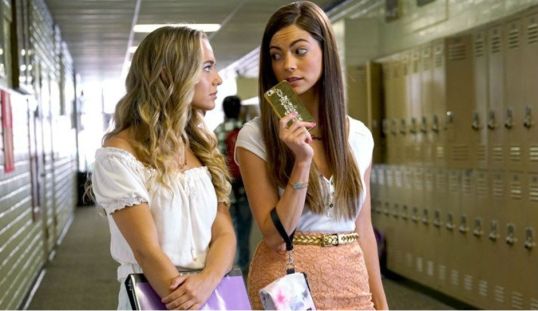
It tells the story of two teenage girls named Rachel.  They’ve been best friends forever.  They do the morning announcements together, always ending things by reminding the school, “We’re the Rachels.”  Rachel Nelson (Madison Iseman) is blonde and popular, a track star who is loved by everyone.  Rachel Richards (Caitlin Carver) is brunette and she’s slightly less popular than Rachel Nelson.  Rachel Richards is almost always in the shadow of Rachel Nelson.  While Rachel Nelson is praised by her track coach, Rachel Richards is consistently told that she could do better.  And then there’s Roxie (Daniela Bobadilla), a photographer who seems to be slightly obsessed with Rachel Nelson but is disliked by Rachel Richards.  Roxie claims that she was once one of the Rachels but she is continually told, by one of the Rachels (I can’t reveal which one), that she was never really a Rachel.

At a late night party, one of these three girls will fall off of the roof and plunge to her death, the result of an apparent suicide.  The film, in its non-linear fashion, holds off an immediately revealing which one of them fell from the roof and I will do the same.  What I can tell you is that the entire school soon becomes a shrine to the dead girl and the two survivors both use her death to their own advantage.  Both of them, by linking themselves to the now sainted dead girl, become very different types of celebrities.

It makes for a very sharp satire, one that perfectly skewers today’s culture of instant fame and internet grieving.  All three of the main actresses — Maidson Iseman, Caitlin Carver, and Daniela Bobadilla — are perfectly cast and give pitch perfect performances.  This is one of those films where no one turns out to be exactly who you thought they would be.  Well-written, well-directed, and wonderfully acted, The Rachels keeps you thinking and guessing.

That’s really all I can say about the movie without giving away too much.  Keep an eye out for it.

Film Review: Space Trucker Bruce (dir by Anton Doiron)


For most of today, I’ve been posting reviews of films that I watched off of my DVR.  Well, I’m going to take a brief break from that pattern to tell you about a film that I watched last weekend.  It was a low-budget sci-fi film, a real labor of love that the director posted on YouTube.  I watched this film with some of my friends from the Late Night Movie Gang: there was me, Kurt Zellner, Holly Wilson, Janeen Worrall, Phil Kaine, Michael McDow, and Jes Coolbaugh.  For the most part, we enjoyed this film.

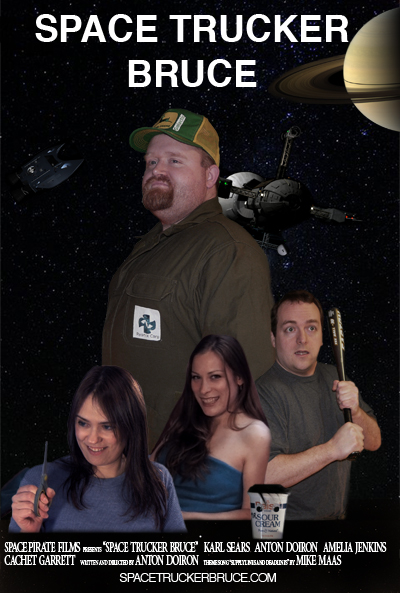
The name of the movie was Space Trucker Bruce.  I’m trying to think of the best way to explain the plot and it’s not easy.  It’s a very episodic film and I think it could actually be argued that there really isn’t a plot per se.  Instead, there’s just a lot of stuff that happens. Some of it is connected and some of it isn’t but the randomness of it all is part of the film’s charm.

Space Trucker Bruce takes place in the far future.  The Earth has colonized the solar system.  Humans and human businesses have taken over space.  Bruce (Karl Sears) is a space trucker.  He’s currently in the process of hauling 20,000 tons of hog fat from Earth to a space station.  It’s a lonely job, to be honest.  At the start of the film, Bruce doesn’t have any human companionship.  He does have a robot, though it’s possible that the robot might actually just be a trash can.  You’ll have to watch the film to know for sure.  He has several books to read, including a few by the noted Catholic historian Garry Wills.  He also has movies, which apparently hardly anyone watches in the future.  (Bruce is one of the few people in existence to still know what Star Wars is.)  There’s also a tub of cream cheese that has apparently come to life and which keeps encouraging Bruce to do some really bad things.  Or at least, we assume that the cream cheese has come to life.  Could Bruce just be crazy?

During the journey, Bruce gets some human companionship when he picks up a hitchhiker named Max (played by the film’s director and writer, Anton Doiron).  Max is an affable if occasionally neurotic guy.  He has a hard time adjusting to Bruce’s laid back personality but, on the plus side, Max is willing to watch movies.

The rest of the film — well, I guess the simplest way to put it would be that Bruce and Max have various adventures while making their way to the space station.  Except, they’re not really adventures as much as they’re just stuff that happens.  Calling them adventures would suggest that Bruce and Max were really active participants.  For the most part, they both spend the majority of the film just relaxing in the ship and occasionally responding to stuff that happens.  I mean, if the ship is about to be destroyed then sure, Bruce and Max are going to try to stop that from occurring.  But, for the most part, Bruce and Max are just kind of hanging out.

And that really is the film’s charm.  This is a low-budget film that proudly embraces the fact that it’s a low-budget film.  The sets and the special effects manage to look cheap and effective at the same time.  There’s a real charm to the fact that the director wanted to make a space epic and he managed to do it, despite not having much money.  Even the amateurish acting become charming after a while.  To say that the actors were stiff would be an understatement.  But, at the same time, Karl Sears was perfectly cast as Bruce.  He just was Bruce in much the same way that Anton Doiron just was Max.  There are some films that you appreciate just because they actually managed to get made and seen.  Space Trucker Bruce is one of those films.

Space Trucker Bruce is available, for free, on YouTube.  It’s not a film for everyone but here’s the thing.  If it’s not for you, you’ll know after the first ten minutes.  However, if you’re still watching after those ten minutes then you’ll probably enjoy this odd little movie.

Here’s the trailer!

As for the film, it can be watched here: