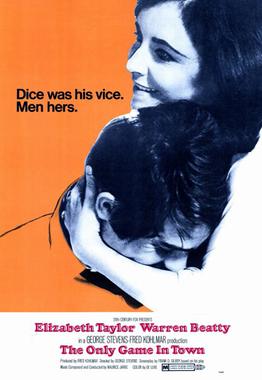
The Only Game In Town (1970, directed by George Stevens)


Fran Walker (Elizabeth Taylor) is an aging Vegas showgirl who has been abandoned by her married lover (Charles Braswell).  A trip to a piano bar leads to her meeting pianist and gambling addict Joe Grady (Warren Beatty).  Frank brings Joe home with her.  Joe is trying to win $5,000 so he can leave Las Vegas and go to New York.  Fran needs someone to keep her from going to back to her go-nowhere relationship.  The two talk and talk.  And talk.

Based on a play that closed after 16 performances, The Only Game In Town is memorable for being one of the most expensive theatrical adaptations ever produced.  That’s because Taylor insisted on filming in Paris instead of Las Vegas.  A set representing Fran’s tiny apartment (which is supposed to look cheap) was built on a Paris soundstage and the budget ballooned to a then unheard of $11,000,000.  (By today’s standards, that would be a $90,461,391 budget for a film with two stars and only a handful of locations.)   The Only Game In Town is also memorable for being the only film to feature both Elizabeth Taylor and Warren Beatty.  Taylor and Beatty were actually close in age but Fran still seems to be several decades older than Joe.  It was not the script’s intention but, due to the age difference, Joe comes across as being a gigolo.  (Originally, Frank Sinatra was cast as Joe but he left while the sets were being made in France.)  Finally, this was the final film to be directed by George Stevens, one of the great Golden Age directors who found himself struggling to keep up in a changing Hollywood.  With its stagey set-up and it’s dialogue-heavy script, this film does not features Stevens’s best work.

The Only Game In Town was a huge flop when released, damaging Taylor’s already floundering career and making Beatty even more determined to eventually direct his own films.  Seen today, Warren Beatty is actually pretty good in his role, even if he does come across as being too young.  Elizabeth Taylor is not served well by any element of the film, from her matronly (but expensive) costumes or a script the encourages her to be shrill.  The Only Game In Town was not one that anyone won.
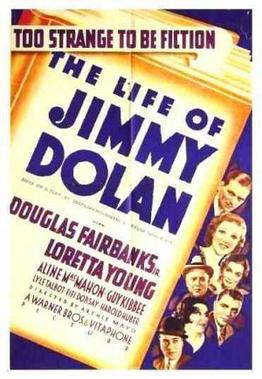
The Life of Jimmy Dolan (1933, directed by Archie Mayo)


Jimmy Dolan (Douglas Fairbanks Jr.), the light heavyweight champion of the world, goes out of his way to present himself as being a wholesome boxer who loves his mom and is as saintly outside the ring as he’s fearsome inside.  Instead, in private, Jimmy is a hard-drinking cynic with a corrupt manager (Lyle Talbot) and a wild girlfriend (Shirley Grey).  When a reporter (George Meeker) threatens to reveal the truth, Jimmy’s manager punches him and accidentally kill him.  The manager frames Jimmy for the crime and then flees with Jimmy’s girlfriend, just to suffer a fiery end in a car accident.

Everyone except for weary Inspector Phalanxer (Guy Kibbee) thinks that Jimmy is dead.  Jimmy goes on the run, hitching rides on freight trains and nearly starving to death before he stumbles over a home for orphans.  Peggy (Loretta Young) takes Jimmy in and gives him food and a place to live.  Jimmy helps with the kids (including Mickey Rooney).  When Jimmy learns that the orphanage might be shut down, he agrees to fight in a charity boxing match against the fearsome King Cobra (Sammy Stein).  King Cobra is so tough that even John Wayne (playing a boxer named Smith) is scared to get in the ring with him.  Jimmy risks his life and his freedom for the orphanage.

This is a good pre-code melodrama.  Because this was a pre-code film, it doesn’t have to shy away from portraying Jimmy’s decadent lifestyle outside of the ring.  Douglas Fairbanks, Jr. was a likable actor and easy to root for.  He was athletic enough to be convincing as someone who could handle himself in a fight.  When he finds himself down-and-out, he’s standing in for everyone who was struggling during the Depression.  The great character actor Guy Kibbee also has some great moments as the inspector, especially towards the end of the film.  Fans of John Wayne won’t see much of him here but it’s still interesting to see Wayne play a character who is frightened of something.

All in all, The Life of Jimmy Dolan is a good, pre-code boxing movie.

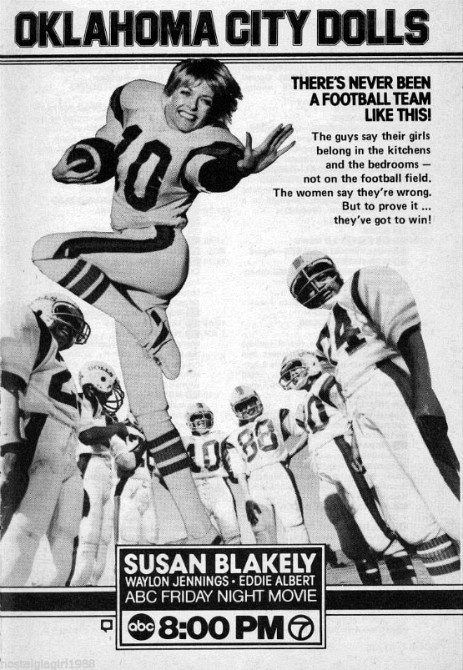
The Oklahoma City Dolls (1981, directed by E.W. Swackhamer)


At an Oklahoma manufacturing plant, the women are always expected to put in extra hours while their male co-workers practice as a part of the company’s football team.  Shop steward Sally Jo (Susan Blakely) files a complaint with the EEOC.  John Miller (Robert Hooks) pays a visit to the plant and says that the women have to be given the same opportunities and benefits as the man, including recreation time.  The plant’s foreman, J.D. Hines (David Huddleston), agrees.  The woman can have recreation time as long as they’re doing what the men are doing and that’s playing football.  Determined to show up Hines and all of her sexist co-workers (and her boyfriend, played by Waylon Jennings), Sally Jo puts together a football team and even gets a broken-down former NFL coach (Eddie Albert) to serve as their trainer.

There actually was a woman’s football team called The Oklahoma City Dolls.  They played in the National Women’s Football League and they won the league’s championship three times.  However, they don’t appear to have anything to do with this movie, which is as much about Sally Jo trying to get a fair treatment for the workers as it is about hitting the field and running it in for a touchdown.  There are some parts of the movie that work.  I liked Eddie Albert’s performance as the alcoholic coach and the scene where he discovered that his community service would include coaching a group of women who had never played football before.  Folk singer Ronee Blakley was good as the team’s emotionally fragile wide receiver.  I even liked that the women didn’t all automatically become the world’s best football players.  The movie’s main weakness was that Susan Blakely just wasn’t believable as someone who lived in a trailer park, used “ain’t” in every sentence, and spent her time organizing a union.  She was too glamorous for the role and her scenes with Waylon Jennings all felt overwritten and overacted.  The story couldn’t decide if it wanted to be a drama about working in a factory or a football comedy and it was pretty uneven as a result.  The good thing is that the movie’s heart was in the right place, even if it didn’t always score a touchdown.

As for the real life Oklahoma City Dolls, they were active from 1976 to 1979.  An attempt to revive the team in 1982 failed when their financial backers pulled out at the last seconds.  The National Women’s Football League folded in 1988.

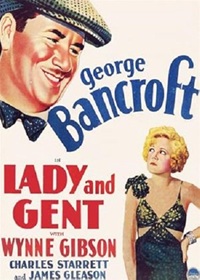
Lady and Gent (1932, directed by Stephen Roberts)


When veteran prize fighter Stag Bailey (George Bancroft) gets cocky and doesn’t bother to properly train for the big fight, he is knocked out by a young up-and-comer named Buzz Kinney (John Wayne).  Stag’s manager, Pin (James Gleason), had all of his money riding on Stag winning.  Now broke and with the mob after him, Pin tries to steal the cash from the boxing arena and ends up getting shot by a security guard.  Stag and his girlfriend, Puff (Wynne Gibson), take in Pin’s young son, Ted, and they devote themselves to raising him.  Years later, Ted (Charles Starrett) wants to become a prizefighter but Stag and Puff, who know what years of getting punched in the head can do to someone, try to convince him to go to college instead.

This boxing film is of interest to western fans because of some of the faces in the cast.  This was an early John Wayne role and he’s only seen in the ring and then in one brief scene where he confronts Stag and Puff in a bar.  Wayne still plays an important role, though, because Buzz’s transformation from being a fresh-faced boxer to being a bitter, punch-drunk bully serves as a warning for what waits for Ted if his adoptive parents can’t keep him out of the fight game.  Charles Starrett, of course, would go on to find greater fame as the Durango Kid.

Otherwise, Lady and Gent is a standard pre-code melodrama.  It’s a little more realistic than some of the other boxing films that came out in the 30s.  Boxing is portrayed as a dirty business that leaves its participants with struggles that all of the prize money in the world can’t make up for.  Puff sacrifices her carefree life to raise Ted but it’s worth it in the end.  You can tell this was a pre-code film because Stag and Puff are a couple but they only decide to get married so they can adopt Ted.

George Bancroft was a star in the late 20s and early 30s but eventually, he transitioned to character parts.  He retired from acting 1942 and became a full-time rancher.  One of his final films was 1939’s Stagecoach, starring his Lady and Gent co-star, John Wayne.


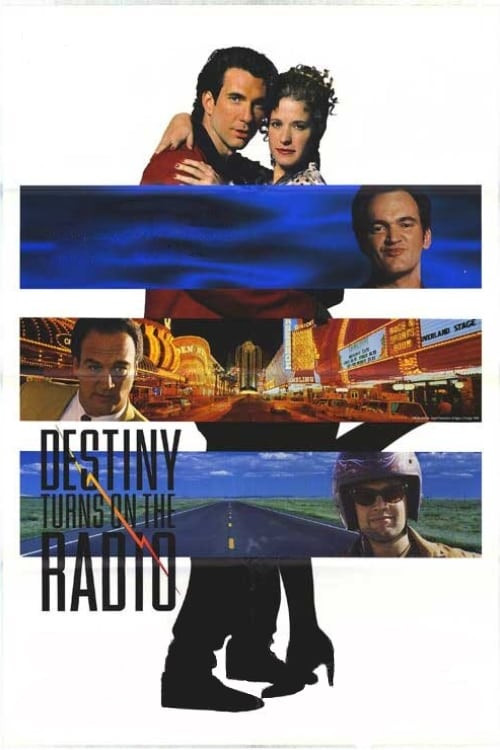
Destiny Turns On The Radio (1995, directed by Jack Baran)


Today, it can be easy to forget what an impact Quentin Tarantino had on pop culture in the 90s.  The one-two punch of Reservoir Dogs and Pulp Fiction inspired a generation of young and aspiring filmmakers to believe that anyone could make their own film.  Suddenly, you didn’t have to be a film school graduate to call yourself a filmmaker.  You could just be someone who loved movies and who was willing to keep hustling until you had something you could slip into Sundance.  That was the feeling, anyway.  The 90s were full of films about eccentric criminals who talked a lot and who loved pop culture, only three of which were directed by Quentin Tarantino.  Some of them were good.  Most of them were not.

Destiny Turns On The Radio was one of the first films to rip-off Pulp Fiction and it felt more cynical than most because it was directed by Jack Baran, who wasn’t even a video store clerk.  He was a producer of films like The Big Easy and Barfly, an industry veteran ripping off two films directed by someone who was, at that time, still an outsider.  The film tells a story that had plenty of Tarantino elements, including Quentin Tarantino himself.  Tarantino signed to play Johnny Destiny right after Pulp Fiction won the Palme d’Or at Cannes.

Johnny Destiny is a gambler who is apparently also a God.  He emerges from a lightning-filled pool and his dialogue is full of pseudo-philosophy.  He is driving through the desert when he picks up Julian (Dylan McDermott) and gives Julian a lift to Las Vegas.  Johnny Destiny is taking prison escapee Julian on a ride so that Julian can face his destiny.  Julian wants to recover some money from a bank job that he pulled off with Thoreau (James Le Gros) but it turns out that, when Johnny Destiny emerged from that pool, he also stole all the money.  (There’s no specific reason for Thoreau to be named after the famous philosopher, beyond the film trying to make itself seem deep by drawing in everyone who read Walden in AP English.)  Julian wants to get back together with Lucille (Nancy Travis), a singer who performs songs more appropriate for a 20s speakeasy than a Las Vegas lounge.  Lucille is involved with a gangster (Jim Belushi).  Belushi sings Vivia Las Vegas but otherwise, this is one of his more boring performances.

Like so many of the Pulp Fiction rip-offs of the 90s, Destiny Turns On The Radio is all self-conscious attitude and cool style, full of references to pop culture that fall flat because there’s no real thought behind them.  Reservoir Dogs and Pulp Fiction were full of style but they also told compelling stories.  Destiny Turns On The Radio is all style and little else and the cast never comes together the way that the actors in Tarantino’s first two movies did.  Watching this film, I realized why Dylan McDermott and Nancy Travis both found more success on television than in feature films.  The film posits Tarantino (as Johnny Destiny) as the epitome of cool but it then burdens him with the type of dialogue that he would have cut by the time he started a second draft.

Coming hot on the heels of the success of Pulp Fiction, Destiny Turns On The Radio actually led to a few years where many critics assumed Tarantino would be a two-trick wonder.  It was thought lightning struck twice but it would never strike a third time and Tarantino would spend the rest of his career as almost a parody of his earlier success.  Luckily, Tarantino proved them wrong and Destiny Turned On The Radio turned out to be not his career’s destination but instead just a detour.

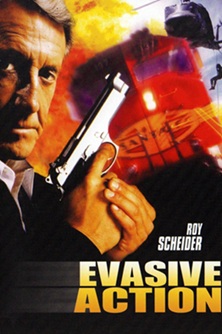
Evasive Action (1998, directed by Jerry P. Jacobs)


Some of the toughest criminals in America are being transported, via train, to a high security prison.  For some reason, instead of using an entire train to transport the prisoners and guards, it’s decided to just put the criminals in one car attached to a normal passenger train.  Did the passengers in the other cars get a warning that would be traveling with a bunch of desperate criminals?  Did they at least get a discount on their tickets?  Of course, Mafia kingpin Enzo Martini (Roy Scheider, slumming) engineers a takeover with the rest of the prisoners.  It’s up to Sheriff Wes Blaidek (Ray Wise) and bartender Zoe Clark (Delane Matthews) to stop the prisoners.

This is a fast-moving, dumb-as-Hell action movie that’s memorable mostly for having a cast that was very much overqualified for the film.  Keith Coogan, Dorian Harewood, Don Swayze, Ed O’Ross, and Sam J. Jones are all in this thing.  Clint Howard plays the homicidal serial killer who lets a child live because the kid has seen Taxi Driver.  Dick Van Patten plays the head of the parole board.  I can understand why Roy Scheider might be selected to play a mob boss and how Clint Howard and Don Swazye ended up playing killers.  But how do you look at this film’s story and think, “This need Dick Van Patten?”  It’s Die Hard on a train but without the wit or the budget.  The movie moves quickly, there’s plenty of train and helicopter action and it’s still good to see so many familiar and eccentric talents gathered together to bring too life one very stupid movie.  It’s too bad they couldn’t find room for Joey Travolta or Joe Estevez but I guess you can’t have everything.

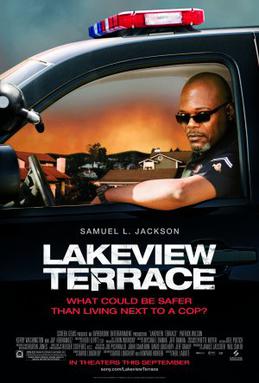
Lakeview Terrace (2008, directed by Neil LaBute)


Chris and Lisa Mattson (Patrick Wilson and Kerry Washington) move in to a large house in the Lakeview Terrace neighborhood of Los Angeles.  It’s a good house in a good neighborhood and it’s just too bad that their neighbor, Abel Turner (Samuel L. Jackson), is a corrupt cop who hates interracial couples.

I remember that Lakeview Terrace caused a brief stir when it was released in 2008.  It was hardly the first film about an interracial couple being harassed by a bigot but it was one of the few where the bigot in question was a black man.  Abel hates white people.  He says it’s because his wife was cheating on him with a white man when she was killed in a car accident.  He does not appreciate Chris listening to rap music and dropping his cigarettes on the street. When Abel’s children spot Chris and Lisa having sex in their swimming pool, that’s all Abel needs to justify his dislike of the couple and his feelings that he doesn’t want this couple living next door.  When Chris asks if Abel could turn off the floodlights that shine into their bedroom window, Abel refuses.  When Chris tries to plant privacy trees, Abel cuts them down.  What starts out as a neighborhood feud escalates as Abel orders one of his informants to break into Chris and Lisa’s house.  Unfortunately, that third act twist also signals the moment that Lakeview Terrace goes from being a reasonably intelligent social satire to being a standard thriller.  Neil LaBute is a director who specializes in making people uncomfortable so it is too bad that Lakeview Terrace ends in a way designed to conform to what audiences have come to expect from thrillers.

Abel’s a hateful figure but Samuel L. Jackson is just as charismatic as ever and the passive-aggressive way that he initially responds to Chris and Lisa will be familiar to anyone who has ever had a bad neighbor or who has to deal with a cop having a bad day.  Patrick Wilson and Kerry Washington, neither one of whom is really that interesting an actor to begin with, are both stuck in bland roles and struggle to keep up with Jackson.  (Wilson and Washington even get out-acted by Ron Glass, playing Lisa’s disapproving father.)  It throws the movie off-balance.  At the same time, Jackson is such an actor who projects so much intelligence that it’s hard to believe that Abel would make the stupid mistakes that he makes towards the end of the movie.  Lakeview Terrace starts out fairly strong but loses its way towards the end.

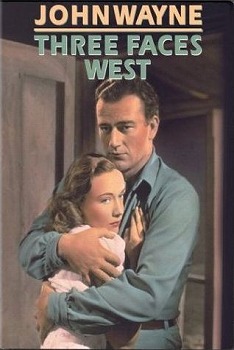
Three Faces West (1940, directed by Bernard Vorhaus)


When a small farming community in the Dakotas gets hit by an outbreak of the flu, farmer and community leader John Phillips (John Wayne) invites a Dr. Karl Braun (Charles Coburn) to come and be the town’s doctor.  A refugee from Austria, Dr. Braun arrives with his daughter, Leni (Sigrid Gurie).  At first, Leni is not happy living in the heart of the Dust Bowl but then she falls for John Phillips. However, Leni is still mourning his ex-fiancé (Roland Varno), who Leni and Braun believe sacrificed his life to help them reach America.

Eventually realizing that the town cannot prospers in the heart of the Dust Bowl, John suggests that everyone pack up and move to Oregon.  Almost everyone agrees and the one person who wants to go to California gets his van driven off the side of the road.  But Leni and Dr. Braun still take a detour to San Francisco because it turns out that Leni’s ex is not dead after all.  She and her father meet up with him and discover, to their horror, that he has become a fully committed Nazi.

This is an interesting change-of-pace for John Wayne.  Though the film is a western (and even features its own version of wagon train), it’s set in what was then contemporary times and it deals with issues like the Great Depression and the rise of Nazism in Germany.  The times may be hard but John Wayne isn’t going to let his community fall apart and, even more importantly, he’s not going to give up his beliefs or his ideals.  Even though the movie was made at a time when the United States was still officially neutral, the film is strongly anti-Nazi.  John Wayne, giving a strong performance, stands in for America while those who would collaborate with or make excuses for the Nazis represented by the weaselly Roland Varno.  Leni’s ex-fiancé had no problem selling out his beliefs and embracing Nazism.  Naturally, Leni and her father have no problem telling him off and then rejoining John Wayne in Oregon.  The United States may have officially been neutral but this movie had no problem letting everyone know where it stood.

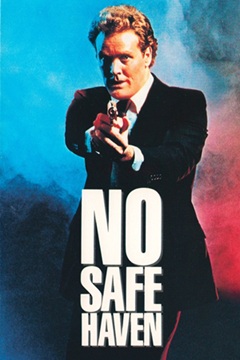
No Safe Haven (1987, directed by Ronnie Rondell Jr.)


A group of drug dealers try to pressure football player Buddy Harris (Tom Campitelli) into throwing the big game.  Buddy fakes an injury to get out of playing so the dealers murder not only Buddy but also his mother and his younger brother.  Big mistake!  Buddy’s older brother, Clete (Wings Hauser), is a CIA agent who is working as a listener in Honduras.  Clete returns home and, with the help of an arms dealer (Robert Tessier, playing a good guy for change), Clete hunts down and kills everyone who killed his family.  Clete not only gets revenge for his family but he also heads down to Bolivia to show the syndicate that, for them, there is no safe haven!

This is one of the ultimate Wings Hauser films, one that he both wrote and starred in.  When Clete seeks revenge, he doesn’t mess around.  One gunman gets set on fire while standing on his balcony.  (He can either burn to death on the balcony or he can jump to a quicker death below.  Either way, Clete’s going to take a lot of pictures)  Wings chases the villains down with speedboats and helicopters and he does it all with a slight smirk that suggests he’s not only getting revenge but he’s also having the time of his life.  This is Wings Hauser at his most demented and he’s playing the hero!  Luckily, the villains are even crazier than Wings.  I have to make a special mention of Branscombe Richmond, laughing and yelling and killing in a way that you would never expect if you only knew him from Renegade.

This is Wings Hauser at his best, in a movie that’s mean, violent, and never less than compelling.  Clete kills a lot of people but it’s okay because, to quote True Lies, they were all bad.  Wings throws himself into the role with his trademark intensity and shows why no one’s safe from Clete Harris.  I’m going to miss Wings Hauser.  Only he could have played Clete Harris.  Only he could have made No Safe Haven the B-action classic of 1987.

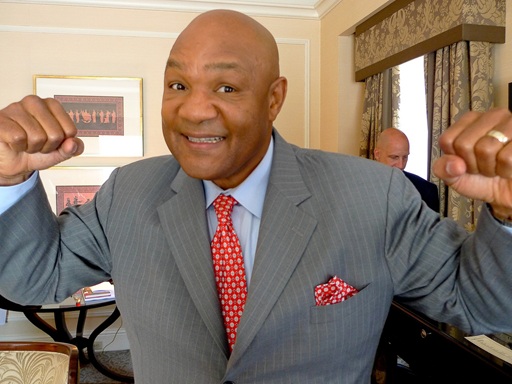
George Foreman, RIP


George Foreman was one of those guys who I expected would be around forever.

When I was growing up, I knew George Foreman as the good-natured boxer who would throw punches for 12 rounds and then make jokes immediately afterwards.  On HBO, he was usually the commentator who showed the most concern for the well-being of the fighters in the ring.  On that infamous night in 1997, when Oliver McCall had an apparent mental breakdown while facing Lennox Lewis in the ring, while the other ring announcers spent their time talking about how bad the night was for the sport and how Don King was destroying the integrity of HBO Boxing, George Foreman was the only one to express any concern about what was happening in Oliver McCall’s head and to say that he hoped McCall would be okay once the fight ended.  That made a big impression on me.  George Foreman may have fought for a living but he never gave up his humanity.

It was only later that I saw the clips of young George Foreman, fighting Ali in Zaire, and I realized how intimidating Foreman had been before he made his comeback in his 40s.  Foreman said that losing Ali in Zaire hurt, both because of the defeat and also Ali’s constant taunting.  Foreman, who famously declined to join in the protests when he was on the 1968 U.S. Olympic team, resented Ali’s claim that Foreman was a sell-out.  (These were the same accusations that Ali tossed at every opponent that he fought but for Foreman, someone who had struggled with poverty when he was younger and who credited boxing with saving him from a life of crime and prison, they especially stung.)  Foreman could have joined Joe Frazier in spending his entire life bitter over his treatment by Ali but Foreman forgave him.  When the documentary about the fight, When We Were Kings, won the Oscar for best documentary, Foreman was at the ceremony with Ali and helped his former opponent step up the stairs to the podium.

George Foreman in Zaire

It’s always hard to believe that the scowling and uncommunicative Foreman of the 70s was the same George Foreman who became an American institution, selling the George Foreman Grill and proving that he still had what it took to be a champion at age 45.  Foreman credited finding religion with giving him a new outlook on life.  At the same time he was making his comeback in the ring, Foreman was working as a minister and working with at-risk youth in Houston.  He was a man who found success but he was also a man who gave back.

Foreman didn’t win every fight.  He lost to Ali in Zaire and to Jimmy Young in Puerto Rico.  After he made his comeback, he lost to Evander Holyfield, Tommy Morrison, and Shannon Briggs.  Holyfield and even Morrison won their fights fair and square.  (Morrison was booed after he won not because he didn’t deserve the victory but because he was Tommy Morrison.)  A lot of people, including me, felt that Foreman was robbed by the judges when it came to the Briggs fight but Foreman accepted the decision with grace.  As I get older, I feel more and more appreciation for what George Foreman accomplished.  He made a comeback when most people had written him off and he did it with humor and humility.

Yesterday, Big George Foreman passed away at 76.  I’ll miss him.