Retro Television Review: St. Elsewhere 4.11 “Santa Claus Is Dead”


Welcome to Retro Television Reviews, a feature where we review some of our favorite and least favorite shows of the past! On Fridays, I will be reviewing St. Elsewhere, a medical show which ran on NBC from 1982 to 1988.  The show can be found on Daily Motion.
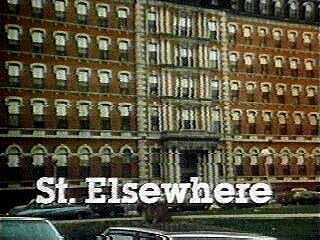
It’s Christmas in Boston.

Episode 4.11 “Santa Claus Is Dead”

(Dir by Leo Penn, originally aired on December 18th, 1985)

It’s the holidays and, of course, Westphall is depressed.

Are we surprised? It’s Christmas. Everyone else is making an effort to spread some holiday cheer. Westphall is being his usual glum self. Westphall is — and I know this is just going to be the most shocking reveal ever, so I’ll give you a chance to get ready for it — an agnostic who doesn’t celebrate the holidays. WOW! Who would have guessed?

Yes, yes, I know: Westphall is supposed to be the moral center of this show, the man who takes all the burdens of running the hospital on his shoulders. That may have been the writers’ intention, but for the most part he just comes across like a self-righteous bore.

Lizzie (Dana Short) and her boyfriend, Rick (Casey Siemaszko), visit Westphall for the holidays. Rick seems like a genuinely nice guy who is sad because he’s away from his family and their Christmas traditions. Westphall isn’t much help. When Rick gives him a present, Westphall smiles glumly. When Rick talks about how it’s Christmas Eve and his Catholic family usually attends midnight mass, Westphall says that he and Lizzie should go to a movie because “there won’t be any lines.” When Rick and Lizzie decide to go to the midnight service at St. Barnabas and agree to take Tommy with them, Westphall says that he won’t be joining them. If Rick, a Catholic, is willing to spend Christmas with a bunch of Episcopalians, the least Westphall could do is set aside his boring agnosticism for one night.

Dr. Craig hosts his annual Christmas party. Feeling sad about Stephen, Craig drinks too much and ends up crying in the kitchen. When Ellen tells him that it’s time to go to St. Barnabas, Craig refuses and complains that he can’t worship a God who would so “arbitrarily” kill his son. My heart broke for the Craigs. Still, there’s always something annoying about people who have no problem believing in God when bad things happen to other people, then have a sudden crisis of faith as soon as something bad happens to them. On the one hand, I felt Mark pain.  On the other hand, there was a part of me that thought, Hey, Mark — your son was a drug addict who got high and drove. What do you expect God to do about it?

At the hospital, the man hired to play Santa Claus (Aaron Fletcher) has a heart attack and collapses right in front of a bunch of horrified children. At first it appears that Santa is going to live, but after surgery he has another heart attack and dies. Because Axelrod was Santa’s doctor, Dr. Auschlander’s grandson, Max (Danny McMurphy), accuses Axelrod of killing Santa.

Fortunately, before Santa died, Max did tell him that he wants a snow globe to replace one that belonged to his grandmother. (Max accidentally broke it.) After Santa dies, Max’s grandmother discovers that a gift has been left for her under the hospital’s Christmas tree. It’s the snow globe! So the old man really was Santa.

And now he’s dead.

The episode ends at St. Barnabas. Westphall shows up at the service, and Tommy, who usually tries to hit his father, runs down the aisle to hug him. Meanwhile, Dr. Craig walks in the rain.

Wow, what a depressing Christmas episode. It was also a pretty moving one. I will admit that I started crying as soon as Santa had his heart attack. Seeing Santa in the hospital brought back memories of sitting with Dad when he was in home hospice care. I was the one who was there when he died, and I was the one who sat there for two hours, waiting for the hospice nurse to arrive. Back in 2023, I had no idea that would be the last time I would ever give him a Christmas present. As this episode showed, there’s a lot of sadness in the world, but there are also those moments of happiness and, if we’re lucky, community.

Yes, Santa died. But at least he got to deliver one final gift.
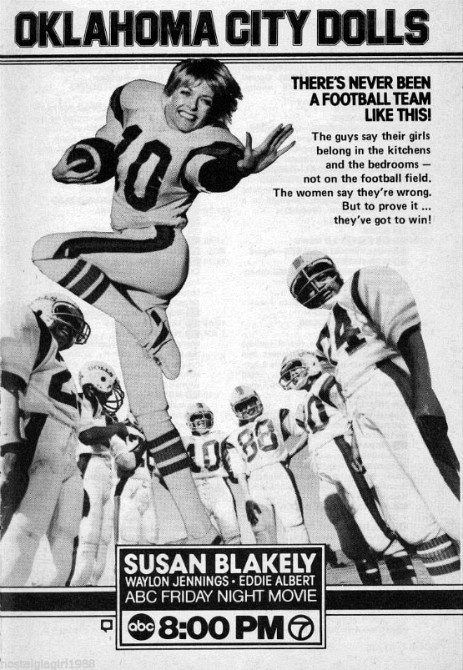
The Oklahoma City Dolls (1981, directed by E.W. Swackhamer)


At an Oklahoma manufacturing plant, the women are always expected to put in extra hours while their male co-workers practice as a part of the company’s football team.  Shop steward Sally Jo (Susan Blakely) files a complaint with the EEOC.  John Miller (Robert Hooks) pays a visit to the plant and says that the women have to be given the same opportunities and benefits as the man, including recreation time.  The plant’s foreman, J.D. Hines (David Huddleston), agrees.  The woman can have recreation time as long as they’re doing what the men are doing and that’s playing football.  Determined to show up Hines and all of her sexist co-workers (and her boyfriend, played by Waylon Jennings), Sally Jo puts together a football team and even gets a broken-down former NFL coach (Eddie Albert) to serve as their trainer.

There actually was a woman’s football team called The Oklahoma City Dolls.  They played in the National Women’s Football League and they won the league’s championship three times.  However, they don’t appear to have anything to do with this movie, which is as much about Sally Jo trying to get a fair treatment for the workers as it is about hitting the field and running it in for a touchdown.  There are some parts of the movie that work.  I liked Eddie Albert’s performance as the alcoholic coach and the scene where he discovered that his community service would include coaching a group of women who had never played football before.  Folk singer Ronee Blakley was good as the team’s emotionally fragile wide receiver.  I even liked that the women didn’t all automatically become the world’s best football players.  The movie’s main weakness was that Susan Blakely just wasn’t believable as someone who lived in a trailer park, used “ain’t” in every sentence, and spent her time organizing a union.  She was too glamorous for the role and her scenes with Waylon Jennings all felt overwritten and overacted.  The story couldn’t decide if it wanted to be a drama about working in a factory or a football comedy and it was pretty uneven as a result.  The good thing is that the movie’s heart was in the right place, even if it didn’t always score a touchdown.

As for the real life Oklahoma City Dolls, they were active from 1976 to 1979.  An attempt to revive the team in 1982 failed when their financial backers pulled out at the last seconds.  The National Women’s Football League folded in 1988.

Cleaning Out The DVR Yet Again #40: Melinda (dir by Hugh A. Robertson)


(Lisa recently discovered that she only had about 8 hours of space left on her DVR!  It turns out that she’s been recording movies from July and she just hasn’t gotten around to watching and reviewing them yet.  So, once again, Lisa is cleaning out her DVR!  She is going to try to watch and review 52 movies by the end of 2017!  Will she make it?  Keep checking the site to find out!)

melinda

I recorded Melinda off of TCM on November 13th.

First released in 1972, Melinda is technically a murder mystery.  Frankie J. Parker (Calvin Lockhart, giving a brilliant performance) is a popular radio DJ in Los Angeles.  When we first see Frankie, he’s driving his expensive sportscar through a poor neighborhood.  It’s a neighborhood that he knows well but, as opposed to those around him, he’s made it out.  He’s handsome, slick, and more than a little arrogant.  When he arrives at a local gym, he looks at himself in a mirror and says, “I shouldn’t say it … but I am a pretty motherfucker.”  Frankie’s a student in a taekwondo class taught by Charles Atkins (Jim Kelly).  Charles gives Frankie a hard time about not giving back to the community.  Frankie blows off his concerns.  To be honest, we really should dislike Frankie but he’s so damn charming.  As played by Calvin Lockhart, Frankie has one of those irresistible smirks, the type of the lights up the screen.

One night, Frankie meets the mysterious Melinda (Vonetta McGee) and spends the night with her.  He thinks that it’s just going to be another one night stand but Melinda tells Frankie that he has the potential to be more than he realizes.  Touched, Frankie goes to work and resolves to be a better person.  Then he returns home and discovers that Melinda has been murdered!

The rest of the film deals with Frankie’s attempts to discover who murdered Melinda.  It turns out that Melinda had underworld connections and mob boss Mitch (Paul Stevens) is desperate to recover something that Melinda had in her possession when she died.  But honestly, the whole murder subplot is a MacGuffin (if you want to get all Hitchcockian about it).  Ultimately, Melinda is a character study of Frankie Parker and how, over the course of solving Melinda’s murder, he learns that there’s more to life than just looking out for himself.

Though Melinda was obviously made to capitalize on the blaxploitation craze of the early 70s, it’s actually far more low-key than most of the better known films in the genre.  (Or, at least it is until the karate-filled finale.)  Perhaps because it was directed by a black man and written by noted black playwright Lonne Elder III, Melinda is far more interested in exploring what makes its characters who they are, as opposed to just putting a gun in their hand and having them shoot up the screen.  Frankie Parker emerges as a fascinating character.

Mention should also be made of the performance of Rosalind Cash, who plays Terry, Frankie’s ex.  Cash gets an absolutely amazing scene where, while attempting to convince a bank employee that she’s Melinda so that she can get into Melinda’s safe deposit box, she tells off a rude teller.  It’s such a good scene and Cash delivers her lines with such fury that you find yourself forgetting that the teller was actually correct in her suspicion that Terry wasn’t actually who she said she was.

Melinda is probably one of the best films that hardly anyone has ever heard of.  Keep an eye out for it.