In general, I’m not really a huge fan of science fiction. A lot of that is because I tend to get bored with the huge mythologies that come along with most science fiction franchises. I don’t care who the best Star Trek captain is. Some of the Star Wars films were enjoyable, but I roll my eyes whenever I meet people who are pedantic about referring to the first movie as A New Hope. My dislike of Avatar is well-known, though it’s actually softened a bit now that everyone else seems to dislike it as well. (I find much of the current dislike to be performative, whereas mine was sincere. I disliked Avatar before it became cool to do so.) Most of the science fiction films that I have enjoyed have either poked fun at the genre (like the Guardians of the Galaxy films), were directed by Ridley Scott (Alien, Blade Runner), have featured giant monsters that were created by radiation, or are Italian (like Starcrash).
That said, I absolutely love Forbidden Planet.
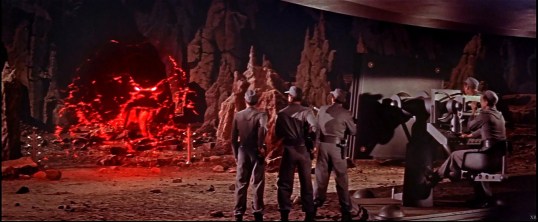
First released in 1956, Forbidden Planet stars a young, handsome, and stalwart Leslie Nielsen as John J. Adams, the commander of the starship C-57D. Adams and his crew are on a mission to investigate what happened to an expedition to the planet Altair IV. As C-57D approaches the planet, they get a message warning them not to land on the planet for safety reasons. Adams ignores the message. When the ship—which rather charmingly is made up to look like a classic flying saucer—lands, Adams and his crew are met by a robot named Robby who takes them to meet his creator, Dr. Edward Morbius (Walter Pidgeon). Morbius explains that he and his daughter Altaira (Anne Francis) are the only survivors of the expedition and that there is an unseen force on the planet that attacks anyone who lands on the surface… anyone other than Morbius and his daughter. Morbius politely suggests that Adams should go back to Earth. Adams says that he can’t do anything until he gets orders…
Despite all of the grim talk about an unseen presence, Forbidden Planet actually starts off as being almost a comedy. With the exception of Commander Adams, Doc (Warren Stevens), and Lt. Jerry Farman (Jack Kelly), the C-57D seems to be exclusively manned by goofy guys who can’t get over the fact that there’s a woman on the planet. (Adams mentions that the crew has been in space for nearly two years.) The Cook (Earl Holliman) wants some alcohol and Robby the Robot knows just how to make it. Fortunately, Leslie Nielsen didn’t have his trademark white hair when he appeared in this film. Otherwise, I don’t know if I’d be able to handle his deadpan, dramatic delivery.
Things change when the unseen attack turns out to be real and starts attacking the ship. A lot of those likably goofy characters end up dying. And when Adams discovers what is truly the source of the monster… well, let’s just say that I imagine the subtext was missed by a lot of the kids who probably made up the film’s initial audience. There’s no silliness to be found in the film’s final moments, with the monster burning away a door that was supposed to be impenetrable and Morbius finally confronting the truth of what really happened to the expedition.
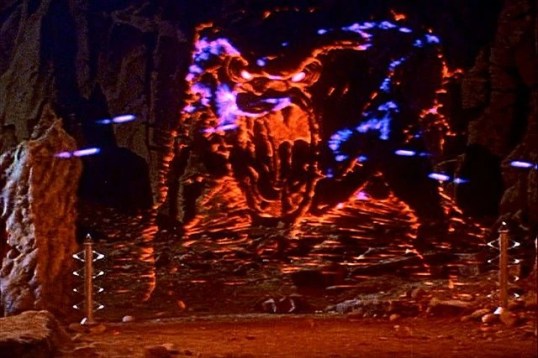
I can’t really remember how old I was when I first saw Forbidden Planet. It came on television one October night and I watched it with my Dad. I thought Robby the Robot was adorable, but what truly stuck with me was the scene where the monster walks into an electrified force field and is suddenly visible.
The way the monster roars and swats at the crew of the ship has always stuck with me. And once we discover the true origins of the monster, the scenes take on an entirely new meaning.
(The monster is so terrifying that even Robby the Robot shuts down rather than face it. It’s an underrated moment of fright. If even Robby can’t battle the monster, what hope is there for anyone else on the planet?)
Leslie Nielsen is likable but a little boring as the male lead. Anne Francis overacts a bit as Altaira. It doesn’t matter. Walter Pidgeon’s intense performance is the one that you remember. Forbidden Planet is an intelligent and thought-provoking film, one that holds up even today. I may not like science fiction, but I will watch it every October.
“Do you know what the most frightening thing in the world is? It’s fear.” — Mark Lewis
Every horror movie is, at some level, about watching — but Peeping Tom, Michael Powell’s 1960 psychological horror-thriller, is the one that admits it out loud. It’s a movie about a man who can’t stop watching, made by a man who spent his life on the other side of the lens, released into a world that wasn’t ready to be told what cinema actually asks of us. The result is a fascinating double ruin: a killer destroyed by the camera in childhood, and a director destroyed by a camera of his own.
The killer first. Karlheinz Böhm plays Mark Lewis, a soft-spoken young man who works at a London film studio as a focus puller — the crew member whose job is literally keeping other people’s images sharp — and who, on the side, shoots glamour photos for a seedy newsagent. Upstairs in his late father’s house sits a darkroom and a private screening room where Mark watches his own footage over and over. Because Mark, you see, is a killer: he murders women with a spiked blade hidden in his camera tripod while filming their faces as they realize what’s happening, so he can capture the exact moment of terror.
It’s genuinely unsettling stuff, and Powell has the nerve to make us complicit. The camera on Mark’s shoulder becomes our point of view, and the movie repeatedly forces us into the killer’s eyepiece. There’s no way to watch Peeping Tom passively — you’re implicated from the first frame, and the film knows it.
What elevates all this from grisly gimmick to genuine tragedy is the empathy the film generates for Mark. He’s no boogeyman; he’s shy, awkward, almost childlike, and the movie patiently unpacks where he came from. His father, a famous psychologist, used little Mark as a lab rat for his experiments on fear, terrifying the boy on camera around the clock, waking him in the night with a lizard thrown onto his bed. Mark was never allowed to just be a kid, and the film frames his murders as a ghastly continuation of the experiment — a search for the perfect recording of fear.
There’s a devastating subplot involving his blind neighbor Helen, played by Anna Massey, who befriends him and eventually screens his childhood footage in a sequence that’s heartbreaking precisely because Mark narrates it with such flat, damaged calm. He can’t even recognize that what happened to him was monstrous. That confusion is the horror — and notice that in a film about seeing, the only person who truly trusts Mark is a woman who can’t see at all.
And then there’s the director, because Peeping Tom is as much a confession as it is a thriller. Powell, the man behind The Red Shoes and Black Narcissus, filled this movie with himself: the studio where Mark works, the film-within-a-film shooting there, the director character who treats his actresses with casual cruelty, and above all the camera itself, presented as an instrument that’s inherently predatory. The famous moment when Mark photographs a woman’s face and we see it refracted through his lens, warped and distorted, is basically a thesis statement about the medium — a great artist asking whether the act of looking is itself an act of violence.
Audiences in 1960 were not ready for a beloved director suggesting that cinema might be a voyeur’s machine, and the damage was immediate and career-ending: the film was pulled from circulation within days, financiers closed their doors, and Powell — who co-wrote the screenplay with Leo Marks — found himself effectively unemployable in British cinema, scraping together scattered, underfunded work abroad for the next thirty years. He described the aftermath as being sent “into the wilderness.”
The irony is that Psycho came out the exact same year, and Hitchcock walked away with his legend enhanced while Powell walked away in ruins. Both are about isolated killers obsessed with spectatorship and the audience’s guilty hunger to see — but where Psycho cloaks its perversity in grease and melodrama, Peeping Tom is cool, clinical, and honest.
Honest, and gorgeous, too. Powell, the great colorist of British cinema, shoots it all in saturated Eastmancolor that turns the tawdry rooms into a garish fever dream. Carl Boehm is gentle and creepy at once, impossible to imagine anyone else in the role, and Anna Massey grounds the film as its emotional conscience. Moira Shearer, the ballerina from The Red Shoes, shows up in a wonderful extended cameo as a stand-in who walks into Mark’s apartment and walks out of it dead — a scene that’s somehow both ghastly and elegant.
The legacy story is where the rehabilitation gets really satisfying, because once the film resurfaced, its DNA turned out to be everywhere in modern horror. Start with the most obvious inheritance: the killer’s point of view. Every horror movie that puts the audience behind the murderer’s eyes — the opening POV stalk of Halloween, the drifting camera-eye of Black Christmas, the whole slasher tradition of the subjective tracking shot — is following a trail Powell blazed in 1960: the camera becomes the killer, and watching becomes a kind of participation.
Then there’s the found-footage vein. Mark Lewis is cinema’s original killer-cameraman, and you can draw a straight line from his home screening room to Henry: Portrait of a Serial Killer and all the way to The Blair Witch Project and Paranormal Activity, where the very act of recording is what summons and sustains the horror. The killer’s home movies prefigure the deadly broadcast of Videodrome, the cursed tape of Ringu and The Ring, the home-video nightmares of Sinister, and the killer-documenting-his-crimes conceit of Man Bites Dog.
Brian De Palma deserves his own sentence in this ledger: from Sisters to Dressed to Kill and Body Double — a film about watching a murder through a lens — he kept returning to Powell’s question of whether the director’s gaze is pleasure or predation, and got away with it simply by making his movies a decade or two later.
The film’s psychological approach proved just as contagious. Mark Lewis is a killer with an actual explanation, a case history we’re invited to understand, and every horror film that humanizes its monster rather than simply unleashing it — The Silence of the Lambs, Manhunter‘s tormented Francis Dolarhyde, the grief-stricken ghosts of The Babadook and Hereditary — owes something to Powell’s refusal to treat his killer as a cheap bogeyman. Even the art-house provocations that implicate the viewer, from Funny Games to Caché, are playing on the same board Powell set up: what the person behind the camera — and the person in the seat — really wants to see.
The most bittersweet chapter of the legacy, though, is the giallo. Almost as soon as Powell was chased out of British cinema for these techniques, Italian filmmakers picked them up and ran wild with them, to international acclaim. The giallo thrillers of the 1960s and 70s — Blood and Black Lace, The Bird with the Crystal Plumage, Deep Red, the gorgeous-murder tradition that Mario Bava and Dario Argento built into an entire genre — are practically assembled from Peeping Tom‘s toolkit: the masked killer whose crimes we witness through his own eyes, the traumatic origin story, the fetishistic attention to the mechanics of murder, the color splashed over terrible violence. Argento’s black-gloved murderer is Mark Lewis with an Italian accent and a better tailor — Powell had made one of the first great giallo films without knowing the genre existed, and the Italians got celebrated for it while he got blacklisted. Proof that Peeping Tom wasn’t too much for audiences, it was simply too early, and too British, for its own good.
Which brings us back to the confession. Mark Lewis ends his film the only way a man made of recordings ever could: watching his own death footage, whispering about the fear his father’s experiments could never quite capture. Powell, ruined by a movie about a ruined man, spent thirty years in the wilderness before the world caught up to what he’d been saying all along. Both stories end the same way — the film outlives the man, the images outlive the shame. Peeping Tom is tense, strange, unexpectedly sad, and still one of the most honest movies ever made about why we sit in the dark. Watch it, and then try to pretend you’re innocent.
The 1974 film Silent Night, Bloody Night is an oddity.
On the one hand, it’s pretty much a standard slasher film, complete with a menacing mansion, a horrible secret, a twist ending, and John Carradine playing a mute newspaper editor.
On the other hand, director Ted Gershuny directs like he’s making an underground art film and several of the supporting roles are played by actors who were best known for their association with Andy Warhol.
Personally, I like Silent Night, Bloody Night. It has a terrible reputation and the film’s star, Mary Woronov, has gone on record calling it a “terrible movie” but I like the surreal touches the Gershuny brought to the material and the sepia-toned flashbacks have a nightmarish intensity to them. The film makes no logical sense, which actually makes it all the more appealing to me. As the saying goes, your mileage may vary.
With only one day left until Halloween, I wanted to make sure that I continued an important tradition here at the Shattered Lens by sharing this film with our faithful and wonderful readers. Messiah of Evil was first released in 1973 and, since it’s in the public domain, it has since been included in a countless number of bargain box sets from Mill Creek.
I can still remember the first time that I saw Messiah of Evil. It was on a Monday night, many years ago. I had recently picked up a 10-movie DVD box set called Tales of Terror and I was using the movies inside to try to deal with a bout of insomnia. I had already watchedThe Hatchet Murders (a.k,a. Deep Red) and The House At The Edge of the Parkand, at two in the morning, I was faced with a decision. Should I try to sleep or should I watch one more movie?
Naturally, I chose to watch one more movie and the movie I chose was Messiah of Evil. So, there I was at two in the morning, sitting at the edge of my bed in my underwear and watching an obscure horror movie while rain fell outside.
And, seriously — this movie totally FREAKED me out!
Messiah of Evil tells the story of Arletty (Marianna Hill), a neurotic woman who drives to an isolated California town in order to visit her father. Her father is an artist who specializes in painting eerie pictures of large groups of black-clad people. However, once she arrives at his home, Arletty discovers that her father has vanished and left behind a diary where he claims that a darkness has overtaken the town.
Meanwhile, a mysterious man named Thom (Michael Greer) is wandering about town with two groupies (played by Anita Ford and Joy Bang) and interviewing random townspeople. One crazed man (Elisha Cook, Jr.) explains that “the dark stranger” is returning. After meeting Arletty, they all end up moving into her father’s house.
But that’s not all. There’s also an odd albino man who shows up driving truck and who eats mice….
Messiah of Evil is literally one of the strangest films that I’ve ever seen. It’s shot in a dream-like fashion and the much of the film is left open to the viewer’s interpretation. There are two classic scenes — one that takes place in a super market and one that takes place in a movie theater and the movie’s worth watching for these two scenes alone.
Messiah of Evil is a film that will be appreciated by all lovers of surrealism and intelligent horror and I’m happy to share it with you today.
As some of our regular readers undoubtedly know, I am involved in a few weekly watch parties. On Twitter, I host #FridayNightFlix every Friday and I co-host #ScarySocial on Saturday. On Mastodon, I am one of the five hosts of #MondayActionMovie! Every week, we get together. We watch a movie. We tweet our way through it.
Tonight, at 10 pm et, I will be hosting #FridayNightFlix! Join us for Mario Bava’s Black Sabbath!
If you want to join us this Friday, just hop onto twitter, find Black Sabbath on Prime, start the movie at 10 pm et, and use the #FridayNightFlix hashtag! I’ll be there happily tweeting. It’s a friendly group and welcoming of newcomers so don’t be shy.
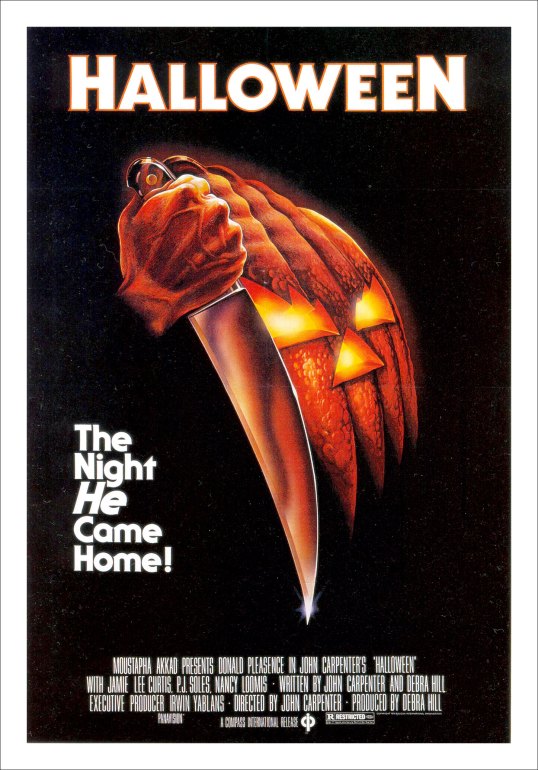
Today’s song of the day probably seems like an obvious choice. That’s okay, though. Thanks to John Carpenter, this sweet little song about teen love became an anthem of impending horror. None of the Chordettes are with us anymore. I would love to know what they may or may not have thought about Carpenter’s use of their song in Halloween.
I’d like to think they would have appreciated it. Michael Myers may not have had hair like Liberace but he did have a mask that looked a lot like William Shatner.
Mr. Sandman, bring me a dream (bom, bom, bom, bom)
Make him the cutest that I’ve ever seen (bom, bom, bom, bom)
Give him two lips like roses and clover (bom, bom, bom, bom)
Then tell him that his lonesome nights are over
Sandman, I’m so alone (bom, bom, bom, bom)
Don’t have nobody to call my own (bom, bom, bom, bom)
Please turn on your magic beam
Mr. Sandman, bring me a dream
Mr. Sandman, bring me a dream
Make him the cutest that I’ve ever seen
Give him the word that I’m not a rover
Then tell him that his lonesome nights are over
Sandman, I’m so alone
Don’t have nobody to call my own
Please turn on your magic beam (woah)
Mr. Sandman, bring me a dream
Mr. Sandman (yes?) bring us a dream
Give him a pair of eyes with a “come-hither” gleam
Give him a lonely heart like Pagliacci
And lots of wavy hair like Liberace
Mr. Sandman, someone to hold (someone to hold)
Would be so peachy before we’re too old
So please turn on your magic beam
Mr. Sandman, bring us
Please, please, please, Mr. Sandman
Bring us a dream
Songwriters: Clifford Smith / Robert F. Diggs / Jason S. Hunter
In the 1968 film, Targets, Boris Karloff gave one of his final performances. It was also one of his best.
Karloff played an aging horror actor named Byron Orlok, a role that was based on Karloff himself. Though once a huge star, Orlok’s style of horror has gone out of fashion. As he explains it, the real world has gotten so scary that his horror films are now tame by comparison. In this scene, Orlok proves that he can still give a compelling performance when he recites a short story about death and fate.
Reportedly, Karloff did this scene in one take and received a standing ovation after director Peter Bogdanovich called cut.
4 Shots From 4 Films is just what it says it is, 4 shots from 4 of our favorite films. As opposed to the reviews and recaps that we usually post, 4 Shots From 4 Films is all about letting the visuals do the talking.
4 Shots From 4 Horror Films: October 30th
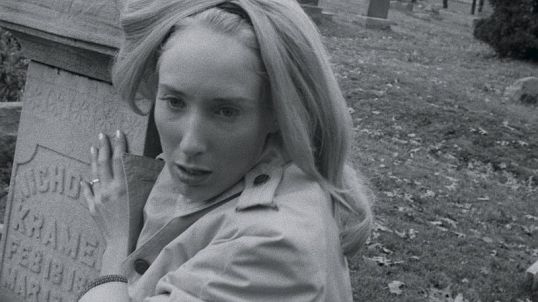
Night of the Living Dead (1968, dir by George Romero, DP: George Romero)
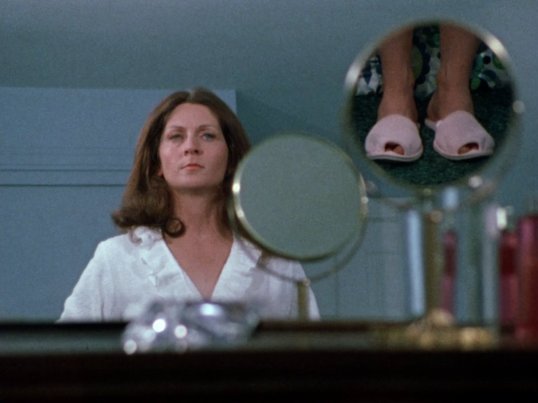
Season of the Witch (1973, dir by George Romero, DP: George Romero)
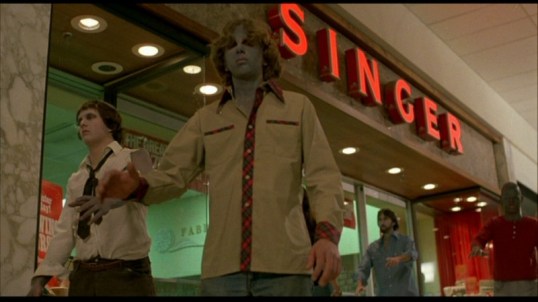
Dawn of the Dead (1978, dir by George Romero, DP: Michael Gornick)
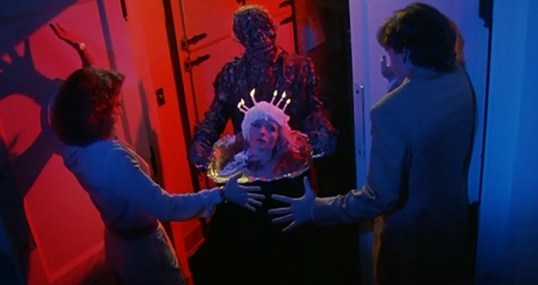
Creepshow (1982, dir by George Romero, written by Stephen King, DP: Michael Gornick)