Film Review: Paths of Glory (dir. by Stanley Kubrick)


“One way to maintain discipline is to shoot a man now and then.” — Maj. Gen. Georges Broulard

Stanley Kubrick’s Paths of Glory (1957) is a war movie with very little interest in making war look heroic. Its real target is the language that turns suffering into something supposedly noble: duty, sacrifice, honor, and, of course, glory. Those words sound impressive until you notice who gets to say them and who gets killed because of them. Starring Kirk Douglas as Colonel Dax, the film turns a failed military attack into a furious examination of institutional cruelty. What makes it so upsetting is not simply that innocent men suffer. It is that their suffering becomes useful to people who know how to make selfish decisions sound like necessary ones. Kubrick shows a world where authority protects itself first and then calls that protection patriotism.

The story takes place on the French front during World War I, where General Broulard encourages General Mireau to attack a heavily defended German position known as the Anthill. Mireau initially recognizes that the operation is unlikely to succeed. His soldiers are exhausted, the enemy is well positioned, and the expected losses are enormous. Then Broulard introduces the possibility of career advancement, and Mireau’s assessment becomes noticeably more optimistic. Nothing about the battlefield has changed. The only new factor is what Mireau might personally gain. It is an especially effective introduction because Kubrick does not need a dramatic confession of corruption. We watch a man talk himself into believing that his ambition and his military duty are conveniently the same thing.

Dax must lead the assault despite understanding how unrealistic the objective is. When the attack falls apart, the generals do not seriously reconsider the judgment that produced it. Instead, they turn the failure into a question of the soldiers’ courage. Three men are selected to face a court-martial for cowardice, with their punishment supposedly restoring discipline and defending the army’s reputation. Dax, a criminal lawyer before the war, takes on their defense. At that point, Paths of Glory shifts from a battlefield story into a courtroom drama, but the underlying conflict stays the same. The men have very little control over their lives in either setting. Whether they are ordered toward enemy guns or brought before military judges, decisions made above them determine their chances of survival.

The selection of three men for execution brings to mind the Roman military practice of decimation, in which one in ten soldiers from a disgraced unit was chosen by lot and killed to punish the group and frighten the survivors into obedience. The punishment in Paths of Glory is not literally decimation, but it operates through a similar logic: make a few men pay so everyone else gets the message. What matters is not establishing each soldier’s responsibility but demonstrating the power of command. That connection makes the court-martial feel less like a search for justice than an old form of intimidation wearing a modern uniform. The paperwork and formal proceedings do not remove the brutality. They give it an official appearance.

The story becomes even harder to dismiss when you consider its historical foundation. The film adapts Humphrey Cobb’s 1935 novel Paths of Glory, which was inspired by the Souain corporals affair. In March 1915, four French corporals were executed following a failed attack near Souain. The film uses three condemned soldiers and fictionalized characters, so it should not be treated as a literal reconstruction of that event. Still, the connection matters because it prevents the premise from feeling like cruelty invented purely for dramatic effect. The story grows out of a real example of military authority turning against its own men. Its anger is not based only on the idea that such injustice could happen, but on the knowledge that something like it did.

Honor and glory are the film’s central targets, although Kubrick is careful to separate genuine courage from the official language used to celebrate it. Dax accepts danger alongside his men and later risks his standing by defending them. Mireau, by contrast, treats honor as something that belongs to his rank and must be protected from embarrassment. Once the assault fails, the soldiers’ deaths become a way to preserve his version of events. If the men were cowards, then perhaps the plan was not the problem. Punishment offers a convenient explanation that leaves his judgment intact. The soldiers become expendable twice: first when their lives might purchase him advancement, and again when their deaths might protect him from blame.

That is what makes the film’s criticism more pointed than a general statement that war is terrible. It examines how institutions can reward the people who transfer the consequences of their decisions onto others. Mireau can describe the assault as a matter of national importance while privately responding to the possibility of promotion. He can demand executions in the name of discipline while avoiding an honest examination of his own conduct. The gap between his public explanations and personal motives is where the film finds much of its fury. Kubrick is not suggesting that ideals are automatically meaningless. He is showing how easily powerful people can borrow the language of ideals to make their own interests harder to challenge.

Broulard is arguably even more disturbing because he does not share Mireau’s obvious bluster. Adolphe Menjou plays him with a relaxed charm that makes his moral emptiness seem almost ordinary. He can discuss terrible outcomes with the ease of someone settling a minor professional disagreement. Where Mireau becomes defensive and angry, Broulard remains adaptable. He understands that careers can survive ugly situations as long as the right people are blamed and the necessary arrangements are made. His composure is frightening because it suggests experience. This is not a man overwhelmed by an exceptional moral crisis; he seems perfectly comfortable managing one.

His misunderstanding of Dax brings that attitude into sharp focus. Broulard assumes that Dax’s objections must conceal a professional ambition, as though defending the condemned men were simply an indirect way of seeking a better position. He cannot easily recognize outrage that is not part of a negotiation. That assumption tells us how thoroughly his world has been shaped by self-interest. He does not just behave cynically; he expects everyone else to do the same. Dax’s refusal to accept that logic creates a deeper conflict than a disagreement over military procedure. One man believes there are limits to what a person should do for advancement. The other barely seems to understand why anyone would impose those limits.

Douglas gives Dax the force needed to stand against these men without turning him into an unbeatable hero. His physical confidence makes him convincing as an officer, but there is also frustration beneath his authority. In the courtroom, his anger comes from recognizing that the proceedings are dishonest while still having to work within them. He argues as though evidence and reason should matter, even as the trial makes their irrelevance increasingly obvious. A more reassuring movie might allow his intelligence, courage, and powerful speeches to change the outcome. Kubrick denies us that comfort. Being able to expose an injustice is not the same as being able to stop it, especially when the people listening benefit from leaving it in place.

The courtroom scenes are devastating because the trial has the outward shape of fairness without its substance. The defendants are present, a defense is permitted, and officers sit in judgment, but those formalities do not create a meaningful opportunity for justice. Instead, they help the institution describe punishment as the result of a legitimate process. That distinction is essential to the film. The army does not simply seize three men and openly announce that their lives are convenient sacrifices. It gives their deaths a procedural explanation. Kubrick makes us watch how an institution can use the appearance of reason to conceal a decision that reason would never justify.

The condemned soldiers also keep the film from becoming only an argument between powerful officers. For the generals, they are examples, disciplinary problems, or pieces of an embarrassing situation. For the audience, they are frightened people trying to understand what is happening to them. Their reactions do not fit a single heroic pattern, and that makes their predicament more affecting. Fear does not become less real because someone wears a uniform, and facing death does not automatically produce dignity or clarity. By giving space to their distress, the film restores the individuality that the military process tries to erase. These are not interchangeable representatives of a failed attack. Each man has a life that cannot be replaced by an official explanation.

Kubrick’s visual choices reinforce these divisions without needing to announce them. The trenches are cramped, muddy spaces where bodies crowd together and danger feels close. The officers’ grand interiors offer room to walk, talk, and consider other people’s deaths at a comfortable distance. Those settings create two different experiences of the same war. For the soldiers, war is immediate and physical. For the generals, it can become a matter of reports, reputation, and carefully managed conversations. The contrast is especially bitter because the people with the most room to maneuver are the ones deciding the fate of those who have almost none.

The tracking shots through the trenches make that hierarchy feel physical. As Dax moves past his men, the camera gives a sense of the crowded human reality behind military plans. An order that sounds neat in a spacious room must eventually pass through these bodies. The assault then strips away any possibility of treating the operation as an exciting adventure. Moving forward is exhausting and dangerous, and determination cannot make the conditions less impossible. The sequence challenges the easy assumption that sufficient bravery can overcome any obstacle. Sometimes an order is simply disastrous, and blaming the men who cannot carry it out becomes another form of dishonesty.

Mireau’s attempt to have artillery fire on his own troops when they cannot advance is the clearest expression of that dishonesty. In his mind, the soldiers stop being people he is responsible for and become obstacles to his authority. Their inability to fulfill his expectations feels to him like an offense deserving punishment. The moment collapses the comforting distinction between danger from the enemy and protection from one’s own commanders. It also exposes the emptiness of his concern for military honor. If maintaining the appearance of obedience requires destroying the very men under his command, he is willing to consider it. His reputation has become more important than the purpose his authority supposedly serves.

If the film has a limitation, it is that its moral divisions can feel extremely sharp. The generals’ corruption leaves little uncertainty about where our sympathies should fall, and some dialogue makes explicit what the images and performances have already established. At times, the characters function as clear expressions of opposing moral positions. Still, that directness largely suits the material. The film is not asking us to puzzle over whether sacrificing innocent men for professional convenience might be defensible. It is asking us to sit with the fact that obvious injustice can continue even when someone names it accurately. Its bluntness gives that argument an anger that a more detached treatment might lose.

Then the final scene changes the emotional register. A frightened German woman sings before a roomful of French soldiers who initially respond with jeers. Gradually, their behavior changes. They grow quiet, listen, and begin humming along. After watching military authority reduce people to categories—cowards, officers, examples, casualties—we see a moment in which those divisions briefly loosen. The woman belongs to the enemy nation, but her vulnerability and her song reach the men in a way that official speeches have not. The scene does not suggest that suffering automatically makes people compassionate. Their first response is cruel. What matters is that they remain capable of moving beyond it.

That ending is tender without pretending to repair anything. The condemned men are not restored, the army has not become just, and Dax has not defeated the machinery around him. The song offers a brief experience of shared feeling rather than a solution. That restraint is what makes Paths of Glory so powerful. Kubrick tears apart the grand language used to justify sacrifice while refusing to treat ordinary human feeling as foolish or irrelevant. The film leaves honor looking less like a medal, a title, or a successful career than the difficult act of recognizing another person’s humanity when the institution around you finds it convenient not to.

Horror Film Review: Forbidden Planet (dir by Fred M. Wilcox)


In general, I’m not really a huge fan of science fiction. A lot of that is because I tend to get bored with the huge mythologies that come along with most science fiction franchises. I don’t care who the best Star Trek captain is. Some of the Star Wars films were enjoyable, but I roll my eyes whenever I meet people who are pedantic about referring to the first movie as A New Hope. My dislike of Avatar is well-known, though it’s actually softened a bit now that everyone else seems to dislike it as well. (I find much of the current dislike to be performative, whereas mine was sincere. I disliked Avatar before it became cool to do so.) Most of the science fiction films that I have enjoyed have either poked fun at the genre (like the Guardians of the Galaxy films), were directed by Ridley Scott (Alien, Blade Runner), have featured giant monsters that were created by radiation, or are Italian (like Starcrash).

That said, I absolutely love Forbidden Planet.

First released in 1956, Forbidden Planet stars a young, handsome, and stalwart Leslie Nielsen as John J. Adams, the commander of the starship C-57D. Adams and his crew are on a mission to investigate what happened to an expedition to the planet Altair IV. As C-57D approaches the planet, they get a message warning them not to land on the planet for safety reasons. Adams ignores the message. When the ship—which rather charmingly is made up to look like a classic flying saucer—lands, Adams and his crew are met by a robot named Robby who takes them to meet his creator, Dr. Edward Morbius (Walter Pidgeon). Morbius explains that he and his daughter Altaira (Anne Francis) are the only survivors of the expedition and that there is an unseen force on the planet that attacks anyone who lands on the surface… anyone other than Morbius and his daughter. Morbius politely suggests that Adams should go back to Earth. Adams says that he can’t do anything until he gets orders…

Despite all of the grim talk about an unseen presence, Forbidden Planet actually starts off as being almost a comedy. With the exception of Commander Adams, Doc (Warren Stevens), and Lt. Jerry Farman (Jack Kelly), the C-57D seems to be exclusively manned by goofy guys who can’t get over the fact that there’s a woman on the planet. (Adams mentions that the crew has been in space for nearly two years.) The Cook (Earl Holliman) wants some alcohol and Robby the Robot knows just how to make it. Fortunately, Leslie Nielsen didn’t have his trademark white hair when he appeared in this film. Otherwise, I don’t know if I’d be able to handle his deadpan, dramatic delivery.

Things change when the unseen attack turns out to be real and starts attacking the ship. A lot of those likably goofy characters end up dying. And when Adams discovers what is truly the source of the monster… well, let’s just say that I imagine the subtext was missed by a lot of the kids who probably made up the film’s initial audience. There’s no silliness to be found in the film’s final moments, with the monster burning away a door that was supposed to be impenetrable and Morbius finally confronting the truth of what really happened to the expedition.

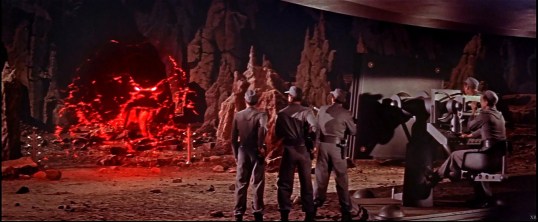
I can’t really remember how old I was when I first saw Forbidden Planet. It came on television one October night and I watched it with my Dad. I thought Robby the Robot was adorable, but what truly stuck with me was the scene where the monster walks into an electrified force field and is suddenly visible.

The way the monster roars and swats at the crew of the ship has always stuck with me. And once we discover the true origins of the monster, the scenes take on an entirely new meaning.

(The monster is so terrifying that even Robby the Robot shuts down rather than face it. It’s an underrated moment of fright. If even Robby can’t battle the monster, what hope is there for anyone else on the planet?)

Leslie Nielsen is likable but a little boring as the male lead. Anne Francis overacts a bit as Altaira. It doesn’t matter. Walter Pidgeon’s intense performance is the one that you remember. Forbidden Planet is an intelligent and thought-provoking film, one that holds up even today. I may not like science fiction, but I will watch it every October.


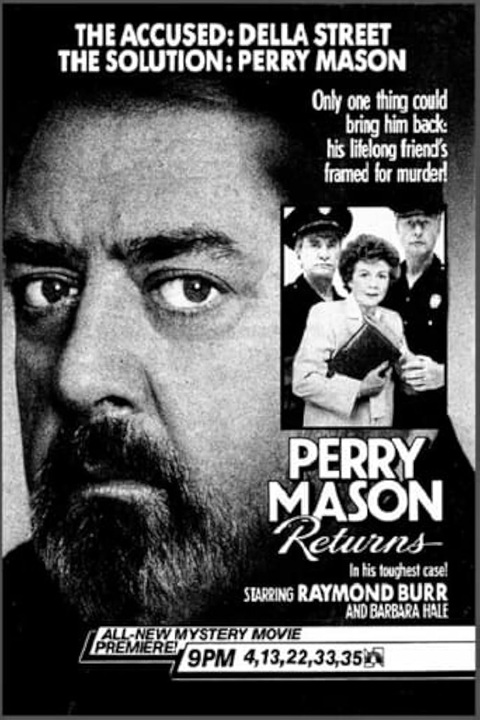
I Watched Perry Mason Returns (1985, Dir. by Ron Satlof)


When his former secretary, Della Street (Barbara Hale), is arrested for murdering wealthy businessman Arthur Gordon (Patrick O’Neal), Judge Perry Mason (Raymond Burr) resigns from the bench so that he can defend her in court.

Perry Mason Returns reveals who the killer is when the murder happens.  The killer is a lowlife named Robert Lynch (James Kidnie), who is wearing a gray wig and a frumpy dress so that everyone will mistake him for Della.  It doesn’t take Perry and private detective Paul Dark, Jr. (William Katt) long to discover that Lynch is the murderer but, after someone shoots Lynch, they have to figure out who hired Lynch to kill Gordon.  Gordon had recently disinherited his entire family so Perry and Paul have a lot of suspects to consider.  30 minutes in, I thought I knew who the killer was but it turned out I was wrong.

My Aunt Kate loved her detective stories and, when I was growing up, I would always watch them with her whenever we were visiting for the holidays.  Watching Perry Mason Returns really made me feel nostalgic, even if it also made me feel dumb for not being able to guess who the killer was.  Perry gives up being a judge so that he can defend Della Street in court.  That’s true love.  William Katt, who plays Paul Drake’s son, was Barbara Hale’s real-life son so I think that proves my theory that Della loved both Perry and Paul.

Perry Mason Returns was fun to watch.  It had more action than I was expecting because Paul Drake, Jr. was always getting into tight situations.  The movie really tried to make William Katt into an action star.  The murder mystery held my attention and, of course, Perry got the murderer to confess on the stand and on the record.  Some things never change!  One thing that really amused me was that, as soon as Perry took the case, everyone naturally assumed he would win.  Della wasn’t worried for a minute, even though she was facing life in prison.  “You didn’t tell me Perry Mason was her lawyer!” Robert Lynch yelled at the person who hired him.  He knew the gig was up.  Perry Mason always wins!

Watching Perry Mason Returns, I felt like I was a kid again, watching movies with my Aunt Kate and trying to solve the mystery with her.  All of the Perry Mason made-for-TV movies are on YouTube so I’ll be reviewing more of them in the future.

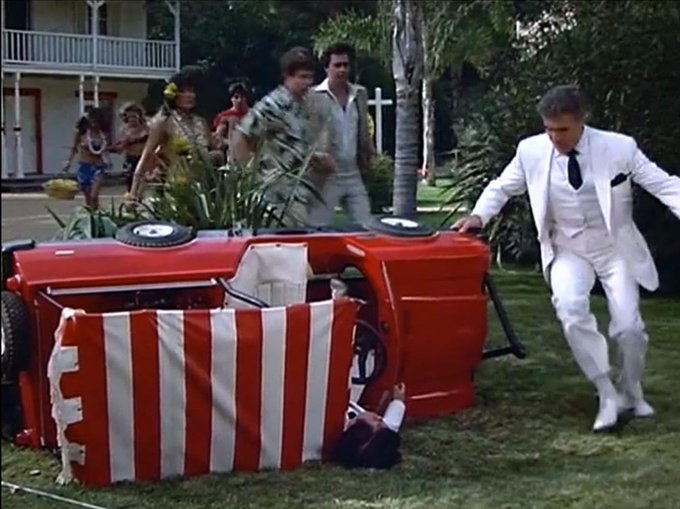
Retro Television Review: Fantasy Island 7.18 “Mermaid and the Matchmaker/The Obsolete Man”


Welcome to Retro Television Reviews, a feature where we review some of our favorite and least favorite shows of the past!  On Tuesdays, I will be reviewing the original Fantasy Island, which ran on ABC from 1977 to 1984.  The show is once again on Tubi!

This week, an acquaintance returns to the Island.

Episode 7.18 “Mermaid and the Matchmaker/The Obsolete Man”

(Dir by Philip Leacock, originally aired on March 24th, 1984)

Nyah (Michelle Phillips) is back!

Okay, maybe you don’t remember Nyah.  This  is Nyah’s first appearance since the fourth season.  In between the last time that Michelle Phillips played Nyah and her resurfacing in this episode, Phillips played five other characters on Fantasy Island.

So, to refresh your memory, Nyah is a mermaid.  During seasons three and four, she tried to tempt men to their death in the ocean and she was presented as being a friendly enemy of Mr. Roarke’s.  In this episode, however, Nyah is a bit nicer.  She’s not malicious as much as she’s just immature.  Roarke, for his part, treats her like a wayward teenager.  Nyah has a fantasy, of course.  She’s tired of being immortal and she wants Roarke to make her a mortal.  Roarke says that he can’t do that.  “You’re the only man who understands immortality!” Nyah says.

Nyah wants to die but instead, Roarke plays matchmaker and arranges for her to meet Duke McCall (Dennis Cole), a sailor who believes in mermaids.  He doesn’t have any issue with Nyah being a mermaid but Nyah, having fallen in love with him, fears that Duke will drown if he tries to pursue her.  Fortunately, for everyone involved, Duke turns into a merman.  Don’t ask me how these things work.  I’m just glad that Roarke didn’t have to kill anyone.

Meanwhile, banker Mitchell Robinson (Bert Convy) fears that he’s going to be replaced by a computer.  Charlene Hunt (Gloria Loring) claims that her computer is just as good at checking loan applications as any human.  She stages a competition between the computer and Mitchell.  Mitchell tries to explain to the computer that it’s important to judge people not just on their credit rating but also their body language.  This somehow causes the computer to explode and Mitchell keeps his job.

“Yay!” viewers in 1984 cheered, “computers will never replace us!”  HA!  Joke’s on you, Mitchell Robinson!

Seriously, you don’t have to tell me about the dangers of a fully automated world.  A.I. is fun for making silly images but it’s going to ultimately lead to a lot of people believing a lot of false things.  But Mitchell was so smug about beating the computer that I’m kind of glad that he still probably lost his job a few years later.  You can’t stop the march of technology, Mitchell!

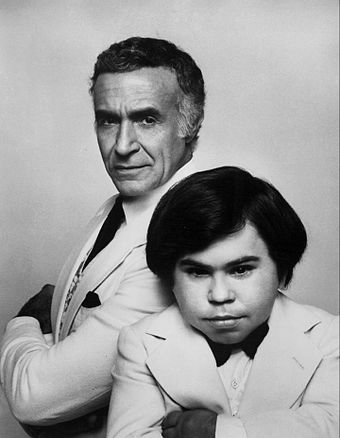
As for this trip to the Island, the computer storyline didn’t really go anywhere but I did enjoy Michelle Phillip’s return as Nyah.  She and Ricardo Montalban had an enjoyable chemistry and it was fun to watch them bicker.  This week’s episode was uneven but, thanks to Michelle Phillips, it was still more enjoyable the most of what we’ve seen for the seventh season.

Horror on TV: The Night Strangler (dir by Dan Curtis)


For tonight’s horror on television, we have 1973’s The Night Strangler.

This is the sequel to The Night Stalker and it features journalist Carl Kolchak (Darren McGavin) in Seattle.  (After all the stuff that happened during the previous movie, Kolchak was kicked out of Las Vegas.)  When Kolchak investigates yet another series of murders, he discovers that paranormal murders don’t just occur in Las Vegas and aren’t just committed by vampires.

I actually prefer this movie to The Night Stalker.  The Night Strangler features a truly creepy villain, as well as a trip down to an “underground city.”  It’s full of ominous atmosphere and, as always, Darren McGavin is a lot of fun to watch in the role in Kolchak.

Enjoy!

Retro Television Review: Fantasy Island 6.21 “Remember When….”


Welcome to Retro Television Reviews, a feature where we review some of our favorite and least favorite shows of the past!  On Tuesdays, I will be reviewing the original Fantasy Island, which ran on ABC from 1977 to 1984.  Unfortunately, the show has been removed from most streaming sites.  Fortunately, I’ve got nearly every episode on my DVR.

This week …. oh no!

Episode 6.21 “Remember When”

(Dir by Philip Leacock, originally aired on May 7th, 1983)

After crashing his little car, Tattoo ends up in the Fantasy Island hospital.  Roarke cancels all of the weekend’s fantasies so that he can stay by Tattoo’s side and keep Tattoo cheerful until it’s time for him to have life-saving surgery.  Roarke and Tattoo share memories and …. YEP, IT’S A CLIP SHOW!

Actually, for a clip show, it’s not that bad.  Yes, there’s a lot of awkward dialogue.  “Boss, remember that time Mickey Gilley opened up his place?”  That said, the clips are well-selected and they all feature Herve Villechaize at his best, turning this episode into a Tattoo tribute.  At the end of the episode, Tattoo says that he’s never going to leave Fantasy Island.  Which …. well, we’ll get to season 7 in a few weeks.

Anyway, clip shows are pretty much impossible to review.  Let’s just be happy that Tattoo pulls through.  That accident looked serious!


Horror on the Lens: The Night Strangler (dir by Dan Curtis)


For today’s horror on the lens, we have 1973’s The Night Strangler.

This is the sequel to The Night Stalker and it features journalist Carl Kolchak (Darren McGavin) in Seattle.  (After all the stuff that happened during the previous movie, Kolchak was kicked out of Las Vegas.)  When Kolchak investigates yet another series of murders, he discovers that paranormal murders don’t just occur in Las Vegas and aren’t just committed by vampires.

I actually prefer this movie to The Night Stalker.  The Night Strangler features a truly creepy villain, as well as a trip down to an “underground city.”  It’s full of ominous atmosphere and, as always, Darren McGavin is a lot of fun to watch in the role in Kolchak.

Enjoy!

Retro Television Review: Fantasy Island 5.11 “House of Dolls/Wuthering Heights”


Welcome to Retro Television Reviews, a feature where we review some of our favorite and least favorite shows of the past!  On Tuesdays, I will be reviewing the original Fantasy Island, which ran on ABC from 1977 to 1984.  Unfortunately, the show has been removed from most streaming sites.  Fortunately, I’ve got nearly every episode on my DVR.

This week, it’s all about the power of imagination.

Episode 5.11 “House of Dolls/Wuthering Heights”

(Dir by Philip Leacock, originally aired on January 9th, 1982)

After being absent last week, Tattoo returns for this episode.  That means that Julie, once again, is too busy on the other side of the Island to assist Mr. Roarke this week.  The excuse that the show’s writer come up with to explain Julie’s absence is that she accidentally opened up a box of Fantasy Island butterflies that were meant to be delivered to the San Diego Zoo.  Now, Julie has to catch all of the butterflies.  Good luck, Julie!

As for the fantasies, they both deal with imagination.

Clarissa Bevis (Britt Ekland) is a librarian who is single because she’s never met a real-life man who can compare to Heathcliffe from Clarissa’s favorite novel, Wuthering Heights.  Clarissa wants to enter the world of the novel so that she can meet Heathcliffe and hopefully put her obsession with him behind her.  Mr. Roarke grants her fantasy but warns her that she must not change the plot of the book in any way.  That strikes me as an odd rule because it’s not as if Clarissa is traveling into the past.  She’s entering her imagination so why would it matter if she decided to do what so many other readers have done and imagine a different ending to her favorite novel?

Clarissa finds herself approaching Wuthering Heights.  Heathcliffe (Hugh O’Brian) sees her and declares that his beloved Catherine has come back to life.  Meanwhile, Edgar Linton (Richard Anderson) believes that this proves Heathcliffe has gone mad and starts to plot to have Heathcliffe declared insane so that Edgar can claim Wuthering Heights and all of its farmland as his own.  To be honest, if we’re in Clarissa’s imagination, I can only assume that she’s only seen a movie version of Wuthering Heights because neither Heathcliffe nor Edgar behave like their characters in the book  (In particular, Edgar is portrayed as being a cartoonishly evil villain.)  And, it should be noted, no mention is made of Cathy, Linton, Hindley, Isabella, Harleton, or any of the book’s other characters.  How is Clarissa supposed to stay true to the plot of a book that she’s never read?

As for the other fantasy, Francis Elkins (Bob Denver) is a maker and dresser of mannequins,  He’s fallen in love with one of his mannequins — “Hey, that’s not creepy at all,” I say while dramatically rolling my eyes — and his fantasy is for her to come to life.  Roarke gives Francis a magical medallion thing that Francis uses to bring Courtney (Barbi Benton) to life, with the understanding that Courtney will only be human for two days.  Eager to live as much life as possible, Courtney uses the medallion to bring to life three other mannequins to serve as the members of her squad.  She also flirts with two salesmen (Larry Storch and Joey Forman) by telling them that’s she’s from Bloomingdale’s (“Oh yeah,” Storch says, “that town in Indiana,”) and that she’s only six years old.  Fortunately, Francis’s love for Courtney is so strong that Courtney remains human even after the two days are up.

At the start of this fantasy, Roarke promises Tattoo that it will be the most delightful fantasy ever.  Barbi Benton did a good job in the role of Courtney and she certainly showed more comedic timing here than she did during previous visits to the Island.  But I don’t know …. the whole falling in love with a mannequin thing was a little too creepy to be delightful.

That said, this was an entertaining episode, even if neither fantasy really worked.  Barbi Benton got to show off her comedic timing and the Wuthering Heights fantasy was enjoyably melodramatic, even if it got the book wrong and even though all-American Hugh O’Brian was not exactly the most convincing Heathcliffe.  This was a nice enough trip to the Island.

I wonder if Julie ever found those butterflies.

Retro Television Review: Fantasy Island 5.9 “Romance Times Three/The Night of the Tormented Soul”


Welcome to Retro Television Reviews, a feature where we review some of our favorite and least favorite shows of the past!  On Tuesdays, I will be reviewing the original Fantasy Island, which ran on ABC from 1977 to 1984.  Unfortunately, the show has been removed from most streaming sites.  Fortunately, I’ve got nearly every episode on my DVR.

Smiles, everyone, smiles!  It’s time to visit the Island.

Episode 5.9 “Romance Times Three/The Night of the Tormented Soul”

(Dir by Don Weis, originally aired on December 5th, 1981)

This week again finds Tattoo working as Roarke’s assistant, which again means that the episode opens with Julie explaining that she won’t be able to help out Roarke and Tattoo with any of the new people coming to the Island.  What makes this week memorable as far as Julie excuses are concerned is that the reason Julie can’t help is because she’s been given a difficult task by Tattoo.  A 300-pound woman has come to the Island with a fantasy of leading the Charge of the Light Brigade and Tattoo has told Julie to find a horse for her.  Tattoo smirks as Julie tells Roarke.  Roarke wishes Julie luck while declining to help her himself.

As for the fantasies, let’s get the boring one out of the way first.  Sally Harris (Georgia Engel) works for a phone answering service.  I had to look this up via Google but apparently a phone answering service was something that people and companies used in the days before texts, voice mail and email.  Someone like Sally would answer the phone for you, collect your messages, and then call you later to give them to you.  I guess it was something that companies did when they were too cheap to hire a receptionist or a personal assistant.  I don’t know, it just seems strange to me.

Sally has fallen in love with three of her clients, though she hasn’t actually met any of them.  Jack (Frank Bonner) is a bon vivant who calls her for love advice.  Tony (Frank Converse) is a businessman who calls her for financial advice.  Ben (David Groh) is a writer who often discusses his writer’s block with Sally.  All three of the men have come to the Island.  Sally fears how the men will react to discovering the real her so Mr. Roarke casts a spell and tells Sally that each men will see her the way that he thinks of her.  Tony sees Sally as a prim and determined businesswoman.  Jack sees her as a dark-haired seductress.  And Ben sees her as a …. well, as a clown.  He has always resented Sally’s advice.  Of course, Ben is the one who ultimately falls in love with the real Sally.

It’s not a bad idea for a fantasy but it doesn’t really work because Georgia Engel isn’t convincing whenever she takes on any of Sally’s different personas.  No matter what costume she’s wearing, she still delivers all of her lines in this high-pitched whisper that sometimes make it difficult to understand what she’s saying.  (She’s not quite as inaudible here as she was in Jennifer Slept Here but still, I did struggle to hear everything she said.)  The men are all thinly written, as well.  I was glad she ended up with the writer but in the end, I really wouldn’t have cared that much if she had ended up with the businessman or the sex addict.

The better fantasy features Stephen Shortridge and Dianne Kay as Jason and Beth Martinique.  When they were children, Beth and Jason survived a shipwreck and washed up on the shore of Fantasy Island.  They were raised by a local millionaire, Richard Martinique (Richard Anderson) and their nanny, Blanche Barrens (Elinor Donahue).  Both Richard and Ms. Barrens died one stormy night.  Richard was shot and Ms. Barrens’s neck was broken in a fall.  Jason and Beth want to go back to their childhood home so they can learn what happened that night.  Fortunately, the ghosts of Richard and Ms. Barrens are still in the mansion, giving Jason and Beth a chance to see the tragic accident that led to the deaths of both Richard and Ms.  Barrens.  Even better, Mr. Roarke and Tattoo show up to inform Jason and Beth that they aren’t really brother-and-sister and therefore, they are free to pursue a romance.  That’s good because, before Roarke showed up, Jason and Beth were gazing at each other like the brother and sister from the old Folger’s commercial.  You know who I’m talking about.

I always enjoy it when Fantasy Island deals with ghosts and haunted mansions and this fantasy was filled with atmosphere and melodrama.  The accident that led to death of Richard and Ms. Barrens was ludicrous and yet somehow poignant at the same time.

So, an overall mixed review on this episode but I think the ghost fantasy makes up for the other fantasy.  Plus, Tattoo gets to show off his karate skills!  Let’s see Julie do that!

Retro Television Review: The Astronaut (dir by Robert Michael Lewis)


Welcome to Retro Television Reviews, a feature where we review some of our favorite and least favorite shows of the past!  On Sundays, I will be reviewing the made-for-television movies that used to be a primetime mainstay.  Today’s film is 1972’s The Astronaut!  It  can be viewed on YouTube!

NASA has successfully landed a man on Mars!  The entire world watches as Col. Brice Randolph (Monte Markham) makes his way across the Martian surface.  However, suddenly, the signal goes out.  Viewers are assured that this is the sort of thing that happens all the time with interstellar travel.  What they don’t know is that the signal went down because Brice suddenly died.  While the surviving members of the mission return to Earth, NASA tries to figure out how to keep anyone from finding out what happened to Brice.  NASA director Kurt Anderson (Jackie Cooper) knows that the President wants to cut the budget and the death of an astronaut would probably provide the perfect excuse for taking money away from NASA and canceling the Mars program.

Anderson’s solution is to recruit a substitute.  Eddie Reese (Monte Markham) has a slight resemblance to Brice, one that can be perfected through plastic surgery.  While the mission returns from Mars, Eddie goes through a crash course to teach him how to talk, walk, and think like Col. Brice Randolph.  Eddie is told that he’ll have to be Brice until the NASA scientists can figure out what led to Brice’s death.  Once they do know what went wrong with the mission, Eddie will have to go into NASA’s version of the witness protection.

Eddie proves to be a quick learner and it helps that he, like so many others, looked up to Brice.  However, while Eddie can fool almost everyone else, he cannot fool Brice’s wife, Gail (Susan Clark).  When Eddie actually treats Gail with kindness and shows sympathy for her nervous condition, she realizes that there’s no way that Eddie is actually her husband.  Apparently, Brice was not quite the saintly figure that the public believed him to be.  Eddie and Gail soon fall in love for real but when NASA finally discovers what led to Brice’s death, it looks like their new life together might be over as abruptly as it begun.

The Astronaut is a low-key conspiracy …. well, I hesitate to call it a thriller.  There’s little of the things that one typically associated with a conspiracy thriller.  There’s no black helicopters.  There’s no shadowy assassins.  There’s no army of men walking around in black suits.  Instead, there’s just a bunch of nervous bureaucrats who are desperate to keep the rest of the world from discovering just how much they screwed up.  As played by Jackie Cooper, the head of NASA isn’t so much evil as he’s just way too devoted-to-his-job for his own good.  In many ways, this is probably one of the most realistic conspiracies ever portrayed on film.

In the end, The Astronaut is a portrait of two lonely people who find love in the strangest of circumstances.  Susan Clark and Monte Markham make for a likable couple and the viewer really does hope that things will work out for them.  What this film lack in conspiracy thrills, it makes up for in human drama.  It appealed to both my romantic and my rabid anti-government sides.  What more could one ask?