Horror Icarus File No. 37: Peeping Tom (dir. by Michael Powell)


“Do you know what the most frightening thing in the world is? It’s fear.” — Mark Lewis

Every horror movie is, at some level, about watching — but Peeping Tom, Michael Powell’s 1960 psychological horror-thriller, is the one that admits it out loud. It’s a movie about a man who can’t stop watching, made by a man who spent his life on the other side of the lens, released into a world that wasn’t ready to be told what cinema actually asks of us. The result is a fascinating double ruin: a killer destroyed by the camera in childhood, and a director destroyed by a camera of his own.

The killer first. Karlheinz Böhm plays Mark Lewis, a soft-spoken young man who works at a London film studio as a focus puller — the crew member whose job is literally keeping other people’s images sharp — and who, on the side, shoots glamour photos for a seedy newsagent. Upstairs in his late father’s house sits a darkroom and a private screening room where Mark watches his own footage over and over. Because Mark, you see, is a killer: he murders women with a spiked blade hidden in his camera tripod while filming their faces as they realize what’s happening, so he can capture the exact moment of terror.

It’s genuinely unsettling stuff, and Powell has the nerve to make us complicit. The camera on Mark’s shoulder becomes our point of view, and the movie repeatedly forces us into the killer’s eyepiece. There’s no way to watch Peeping Tom passively — you’re implicated from the first frame, and the film knows it.

What elevates all this from grisly gimmick to genuine tragedy is the empathy the film generates for Mark. He’s no boogeyman; he’s shy, awkward, almost childlike, and the movie patiently unpacks where he came from. His father, a famous psychologist, used little Mark as a lab rat for his experiments on fear, terrifying the boy on camera around the clock, waking him in the night with a lizard thrown onto his bed. Mark was never allowed to just be a kid, and the film frames his murders as a ghastly continuation of the experiment — a search for the perfect recording of fear.

There’s a devastating subplot involving his blind neighbor Helen, played by Anna Massey, who befriends him and eventually screens his childhood footage in a sequence that’s heartbreaking precisely because Mark narrates it with such flat, damaged calm. He can’t even recognize that what happened to him was monstrous. That confusion is the horror — and notice that in a film about seeing, the only person who truly trusts Mark is a woman who can’t see at all.

And then there’s the director, because Peeping Tom is as much a confession as it is a thriller. Powell, the man behind The Red Shoes and Black Narcissus, filled this movie with himself: the studio where Mark works, the film-within-a-film shooting there, the director character who treats his actresses with casual cruelty, and above all the camera itself, presented as an instrument that’s inherently predatory. The famous moment when Mark photographs a woman’s face and we see it refracted through his lens, warped and distorted, is basically a thesis statement about the medium — a great artist asking whether the act of looking is itself an act of violence.

Audiences in 1960 were not ready for a beloved director suggesting that cinema might be a voyeur’s machine, and the damage was immediate and career-ending: the film was pulled from circulation within days, financiers closed their doors, and Powell — who co-wrote the screenplay with Leo Marks — found himself effectively unemployable in British cinema, scraping together scattered, underfunded work abroad for the next thirty years. He described the aftermath as being sent “into the wilderness.”

The irony is that Psycho came out the exact same year, and Hitchcock walked away with his legend enhanced while Powell walked away in ruins. Both are about isolated killers obsessed with spectatorship and the audience’s guilty hunger to see — but where Psycho cloaks its perversity in grease and melodrama, Peeping Tom is cool, clinical, and honest.

Honest, and gorgeous, too. Powell, the great colorist of British cinema, shoots it all in saturated Eastmancolor that turns the tawdry rooms into a garish fever dream. Carl Boehm is gentle and creepy at once, impossible to imagine anyone else in the role, and Anna Massey grounds the film as its emotional conscience. Moira Shearer, the ballerina from The Red Shoes, shows up in a wonderful extended cameo as a stand-in who walks into Mark’s apartment and walks out of it dead — a scene that’s somehow both ghastly and elegant.

The legacy story is where the rehabilitation gets really satisfying, because once the film resurfaced, its DNA turned out to be everywhere in modern horror. Start with the most obvious inheritance: the killer’s point of view. Every horror movie that puts the audience behind the murderer’s eyes — the opening POV stalk of Halloween, the drifting camera-eye of Black Christmas, the whole slasher tradition of the subjective tracking shot — is following a trail Powell blazed in 1960: the camera becomes the killer, and watching becomes a kind of participation.

Then there’s the found-footage vein. Mark Lewis is cinema’s original killer-cameraman, and you can draw a straight line from his home screening room to Henry: Portrait of a Serial Killer and all the way to The Blair Witch Project and Paranormal Activity, where the very act of recording is what summons and sustains the horror. The killer’s home movies prefigure the deadly broadcast of Videodrome, the cursed tape of Ringu and The Ring, the home-video nightmares of Sinister, and the killer-documenting-his-crimes conceit of Man Bites Dog.

Brian De Palma deserves his own sentence in this ledger: from Sisters to Dressed to Kill and Body Double — a film about watching a murder through a lens — he kept returning to Powell’s question of whether the director’s gaze is pleasure or predation, and got away with it simply by making his movies a decade or two later.

The film’s psychological approach proved just as contagious. Mark Lewis is a killer with an actual explanation, a case history we’re invited to understand, and every horror film that humanizes its monster rather than simply unleashing it — The Silence of the Lambs, Manhunter‘s tormented Francis Dolarhyde, the grief-stricken ghosts of The Babadook and Hereditary — owes something to Powell’s refusal to treat his killer as a cheap bogeyman. Even the art-house provocations that implicate the viewer, from Funny Games to Caché, are playing on the same board Powell set up: what the person behind the camera — and the person in the seat — really wants to see.

The most bittersweet chapter of the legacy, though, is the giallo. Almost as soon as Powell was chased out of British cinema for these techniques, Italian filmmakers picked them up and ran wild with them, to international acclaim. The giallo thrillers of the 1960s and 70s — Blood and Black Lace, The Bird with the Crystal Plumage, Deep Red, the gorgeous-murder tradition that Mario Bava and Dario Argento built into an entire genre — are practically assembled from Peeping Tom‘s toolkit: the masked killer whose crimes we witness through his own eyes, the traumatic origin story, the fetishistic attention to the mechanics of murder, the color splashed over terrible violence. Argento’s black-gloved murderer is Mark Lewis with an Italian accent and a better tailor — Powell had made one of the first great giallo films without knowing the genre existed, and the Italians got celebrated for it while he got blacklisted. Proof that Peeping Tom wasn’t too much for audiences, it was simply too early, and too British, for its own good.

Which brings us back to the confession. Mark Lewis ends his film the only way a man made of recordings ever could: watching his own death footage, whispering about the fear his father’s experiments could never quite capture. Powell, ruined by a movie about a ruined man, spent thirty years in the wilderness before the world caught up to what he’d been saying all along. Both stories end the same way — the film outlives the man, the images outlive the shame. Peeping Tom is tense, strange, unexpectedly sad, and still one of the most honest movies ever made about why we sit in the dark. Watch it, and then try to pretend you’re innocent.

Previous Icarus Files:

  1. Cloud Atlas
  2. Maximum Overdrive
  3. Glass
  4. Captive State
  5. Mother!
  6. The Man Who Killed Don Quixote
  7. Last Days
  8. Plan 9 From Outer Space
  9. The Last Movie
  10. 88
  11. The Bonfire of the Vanities
  12. Birdemic
  13. Birdemic 2: The Resurrection
  14. Last Exit To Brooklyn
  15. Glen or Glenda
  16. The Assassination of Trotsky
  17. Che!
  18. Brewster McCloud
  19. American Traitor: The Trial of Axis Sally
  20. Tough Guys Don’t Dance
  21. Reach Me
  22. Revolution
  23. The Last Tycoon
  24. Express to Terror
  25. 1941
  26. The Teheran Incident
  27. Con Man
  28. Looker
  29. 1776
  30. Here
  31. The Adventures of Brisco County, Jr.
  32. The Cable Guy
  33. A Chorus Line
  34. Carrie
  35. Millenium
  36. Mindhunter

Adventure of a Lifetime: THE THIEF OF BAGDAD (United Artists 1940) — cracked rear viewer


Alexander Korda’s Arabian Nights fantasy THE THIEF OF BAGDAD has stood the test of time as one of filmdom’s most beloved classics. A remake of Douglas Fairbanks Sr.’s 1924 silent classic, Korda and company added some elements of their own, including Indian teen star Sabu as the title character, and some innovative Special Effects. In […]

via Adventure of a Lifetime: THE THIEF OF BAGDAD (United Artists 1940) — cracked rear viewer

Horror Film Review: The Brides of Dracula (dir by Terence Fisher)


The-Brides-of-Dracula-posterSo, imagine this.  Two years have passed since your film company released a low-budget film called Horror of Dracula.  To the surprise of many, the film became an international hit that not only revived interest in the character of Dracula but also made a star out of an imposing and opinionated actor named Christopher Lee.  Naturally, being a smart film mogul, you want to make a sequel to Horror of Dracula.  Both director Terrence Fisher and screenwriter Jimmy Sangster have agreed to return to make a second part of the franchise.  Now, all you have to do is recruit your star…

…and Christopher Lee doesn’t want to do the film!

There are conflicting reports on just how much Christopher Lee disliked the Hammer Dracula films.  Lee, himself, has been inconsistent on the subject, occasionally claiming that he hated all of them and then other times saying that he only disliked the sequels.  One thing that does remain consistent is that Lee reportedly feared being typecast as Dracula and, as a result, he initially declined to be a part of any sequel.

Nowadays, they’d probably just recast the role with Nicolas Cage.  But this was the late 50s/early 60s and, instead of recasting, Hammer just made a Dracula film without Dracula.  Yes, the film may have been called The Brides of Dracula but, beyond being mentioned in the film’s prologue, Dracula never makes an appearance.  For that matter, there really aren’t any brides of Dracula either.  There are three female vampires but none of them are turned into vampires by Dracula.  Instead, the vampire in question is Baron Meinster (David Peel, who does a pretty good job in the role but who, needless to say, is no Christopher Lee).

Dracula does not return for The Brides of Dracula but his nemesis Prof. Van Helsing (Peter Cushing) does.  Cushing was so well-cast as Van Helsing and brought such a sense of righteous fury to the role that his presence goes a long way towards making up for the absence of Christopher Lee.  When you look at and listen to Cushing’s Van Helsing, you’re left with little doubt that this is a man who has dedicated his life to destroying vampires and that he’s quite good at it.

And it’s a good thing that Van Helsing shows up because, regardless of whether Dracula is directly involved or not, Transylvania has some issues.  The Brides of Dracula opens with a French school teacher named Marianne (Yvonne Monlaur) finding herself stranded at an old castle.  The owner of the castle — Baroness Meinster (Martita Hunt) — allows Marianne to spend the night but asks her to please refrain from releasing her son, Baron Meinster, from the chains that hold him prisoner.  Naturally, Marianne does exactly the opposite.  She steals a key and sets the Baron free.

Of course, the Baron is a vampire and soon he’s feeding on the inhabitants of a nearby village.  The Baron has also decided that Marianne should be his bride.  Will Prof. Van Helsing be able to save Marianne’s soul and defeat a second vampire?  You’ll have to watch the movie to find out!

And you certainly should.  Once you get over the fact that Brides of Dracula does not feature Lee’s iconic Dracula, the film itself is surprisingly entertaining, filled with all of the gothic touches, creepy scenery, evil villains, bloody throats, and heaving cleavage that you would expect from a Hammer film.  Peel, Hunt, and Monlaur are all well-cast and best of all, Peter Cushing is Dr. Van Helsing!

In short, it’s not bad for a Dracula film that doesn’t actually feature Dracula.


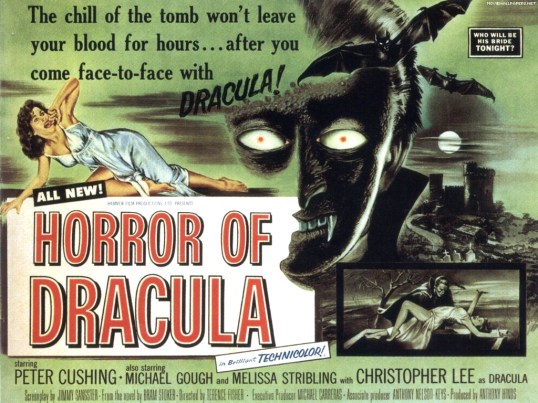
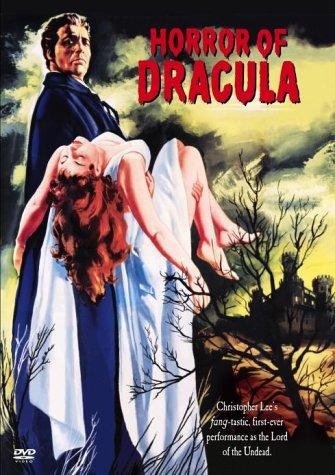
Horror Film Review Repost: The Horror of Dracula (dir by Terrence Fisher)


(As some of our longtime readers might remember, I originally posted this review on October 11th, 2013.  I’m going to be posting reviews of all of the Hammer Dracula films today so I figured I would start things off by reposting my thoughts on the very first of them, 1958’s Horror of Dracula.  Add to that, I happen to really like this review!)

horrorofdracula

Of all the monsters who have appeared in horror cinema, Count Dracula is perhaps the most iconic.  Reportedly, Dracula first appeared on film in 1920, in a silent Russian film that is now considered to be lost.  In 1921, he would appear in a Hungarian film called Dracula’s Death and in 1922, he would be renamed Count Orlok for the German masterpiece Nosferatu.  Indeed, by the time Bela Lugosi gave his famous performance in Tod Browning’s Dracula, the count had been appearing in films for at least 11 years.  In nearly 100 years of filmmaking, a countless number of actors have brought Dracula to life.

We could spend hours debating who was the best Dracula and certainly, there are some worthy contenders.  Bela Lugosi brought a continental sophistication to the role, while John Carradine was properly intimidating and theatrical.  Udo Kier, Gary Oldman, Thomas Kretschmann, Leslie Neilsen, Zandor Vorkov, and Frank Langella have all played the prince of darkness, to varying degrees of success.

Yet for me, as worthy as any of those actors may be, there is only one true Dracula and he was played by Christopher Lee.

Lee famously played Dracula in seven movies for Hammer Films and, though he has often complained about the quality of these films (especially the later ones, which tended to mix Dracula with hippies), they were largely responsible for making Christopher Lee into the iconic figure that he remains today.  It’s also largely due to Lee’s performance that horror fans like me continue to discover and appreciate the films of Hammer today.

As played by Christopher Lee, Dracula was pure evil.  Lee’s Dracula had no use for self-pity and one can only imagine what his reaction would have been if he had ever run into the self-torturing vampires of Twilight.  Lee’s Dracula had no use for doubt or regret.  Instead, he was a determined animal who was driven by a singular lust for blood.

And yet, at the same time, Lee brought an intelligence to the role that was often lacking in previous performances.  Lee’s Dracula may have been an animal but he was a cunning animal.  Whereas it’s easy for me to imagine escaping from the clutches of Bela Lugosi, I know that if Lee’s Dracula wanted me then he would have me.  There’s no escape from Lee’s Dracula.  He’s too quick, determined, and intelligent.

Christopher Lee Is Dracula

His animal nature made Lee’s Dracula frightening but it was his cunning and determination that made him dangerous and, ultimately, even sexy.  (While I’ve read that audiences in 1931 swooned over Bela Lugosi, whatever sex  appeal he may have had is lost on modern viewers like me.)  It has often been argued that Bram Stoker meant for Dracula to be a symbol of all the desires that were repressed by Victorian society.   That’s certainly true when it comes to Christopher Lee’s carnal and viscous portrayal of the character.

Of the seven Dracula films that Christopher Lee made for Hammer Films, the first remains the best.  Released in 1958 and known as Dracula in the UK and the Horror of Dracula in the US,  it revitalized the horror genre and helped to make stars of both Christopher Lee and Peter Cushing.  Especially when compared to some of the sequels that Hammer subsequently produced, it remains one of the best Dracula films ever made.

Horror of Dracula

The film is a very loose adaptation of Stoker’s original novel.  Jonathan Harker comes to Dracula’s castle in Romania.  Though posing as a librarian, Harker has actually come to the castle to drive a stake through the heart of both Dracula and his vampire bride.  However, no sooner has Harker staked the bride than he’s overpowered and bitten by Dracula.  Significantly, all of this occurs within the first 10 minutes of the film.  As opposed to certain other Dracula films, Horror of Dracula gets straight to the point.  And why shouldn’t it?  After all, anyone watching the film already knows that Dracula’s a vampire so why waste time trying to convince us otherwise?  We don’t watch Dracula for the familiar story as much as we watch to discover how different filmmakers will choose to tell that story.

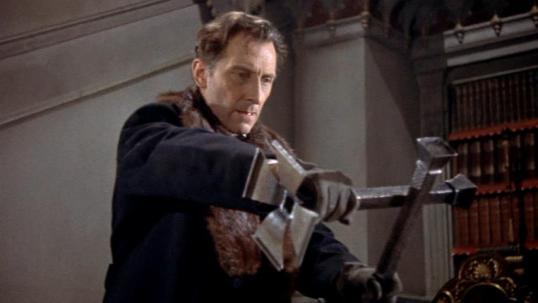
When Harker’s colleague, Prof. Van Helsing (played with the perfect amount of intensity by Peter Cushing) shows up at the castle, he discovers that Harker is now a vampire and that Dracula is nowhere to be found.

Dracula, needless to say, is out for revenge.  He stalks Harker’s fiancee Lucy, as well as Lucy’s brother Arthur Holmwood (Michael Gough) and his wife Mina (Melissa Stribling).  Much as in Stoker’s original novel, Lucy is eventually turned into a vampire and it’s up to Van Helsing and Arthur to stop both her and her new master.

(Of course, in Stoker’s original novel, Harker is not turned into a vampire and instead marries Mina while the aristocratic Arthur is one of Lucy’s three suitors.  However, I have to say that I always thought the literary Harker was a bit on the dull side and that Arthur was always my favorite character so I’m happy that he gets to be the hero here.)

If I had to pick one film to epitomize everything that I love about the Hammer brand of horror, it would be Horror of Dracula.  As directed by Terrence Fisher, the film moves at an exciting, non-stop pace while the traditionally lush cinematography is almost bombastically colorful.  Cushing and Lee, who were the best of friends off screen, make for formidable opponents, with Cushing embodying good just as effective as Lee embodied evil.  Though it’s been over 50 years since Horror of Dracula was originally released, the film remains effective and, not coincidentally, a lot of fun.

Peter Cushing as Dr. Van Helsing

Quite simply put, this is a film that, for so many reasons, remains a true pleasure to watch.

One final note — I often find myself lamenting that I was born several decades too late and I realize just how true that is whenever I watch a film like Horror of Dracula.  Seriously, I would have loved to have been a Hammer girl, showing off my cleavage and getting hypnotized by Christopher Lee.

Seriously, what more could you want?