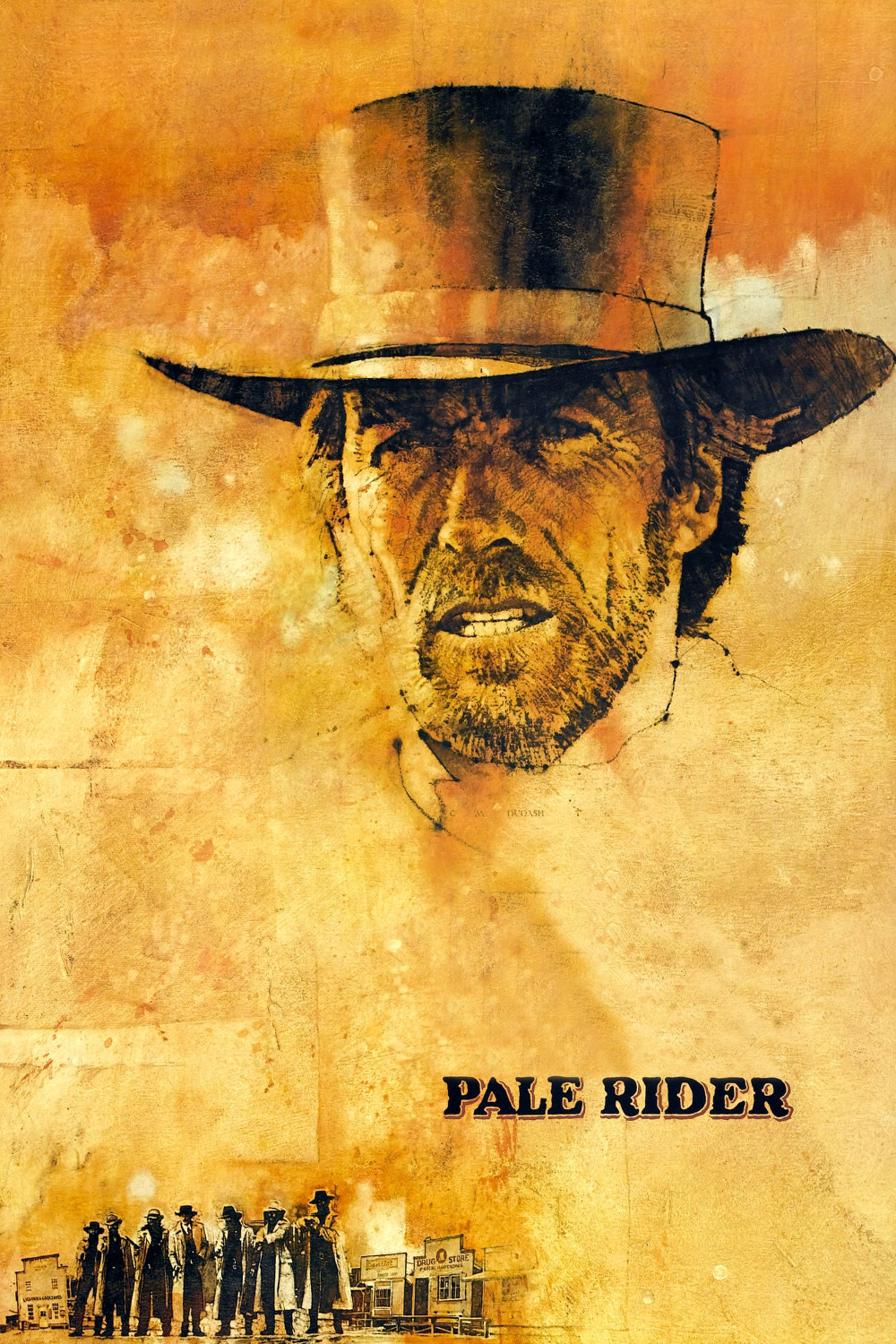
Review: Pale Rider (dir. by Clint Eastwood)


“And I looked, and behold a pale horse. And his name that sat on him was Death. And Hell followed with him.” — Megan Wheeler

Clint Eastwood’s Pale Rider occupies a fascinating space within the Western genre—both a reverent homage to the traditions that shaped classic frontier storytelling and a quiet dismantling of the myths those stories often upheld. Released in 1985, the film arrived during a period when the Western had largely faded from mainstream prominence, regarded by many as a relic of an earlier cinematic era. Yet Eastwood, by then already firmly associated with the genre through his work in Sergio Leone’s Dollar Trilogy and films like High Plains Drifter and The Outlaw Josey Wales, proved that the Western still had room for reinvention. With Pale Rider, he crafted something that feels both deeply familiar and subtly haunting: a film that embraces the iconography of the Old West while draping it in an almost supernatural atmosphere, creating one of the most enigmatic and compelling entries in his directorial career.

In many ways, Pale Rider also feels like a spiritual successor—or even an unofficial companion piece—to High Plains Drifter. Both films center around a mysterious outsider who seemingly emerges from nowhere to confront a corrupt and morally rotten community. In both stories, Eastwood plays a figure who feels less like an ordinary man and more like an embodiment of vengeance itself, a ghostly gunslinger whose true nature is never fully explained. The similarities in narrative structure are impossible to ignore: isolated frontier settlements under siege, powerful men abusing authority, and Eastwood’s near-mythic drifter arriving as a reckoning for buried sins. But where High Plains Drifter leans into bitterness and outright surrealism, portraying the Old West as a place consumed by cruelty and hypocrisy, Pale Rider takes a more restrained and spiritual approach. The Preacher is still intimidating and otherworldly, but he possesses a moral center that the Stranger in High Plains Drifter deliberately lacked. It feels almost as if Eastwood revisited the earlier film’s core ideas over a decade later with greater maturity and reflection, transforming the wrathful ghost story of High Plains Drifter into something more meditative about redemption and justice.

On its surface, Pale Rider follows a relatively straightforward Western premise. A group of struggling gold prospectors in the mountains of California are being terrorized and pressured by a wealthy mining magnate, Coy LaHood, who seeks to drive them off their land so he can exploit the area’s resources for himself. Into this conflict rides a mysterious preacher, played by Eastwood, whose sudden appearance seems almost divinely summoned after a young girl prays for deliverance. This unnamed “Preacher” becomes the reluctant protector of the miners, standing against LaHood and the corrupt marshal Stockburn and his deputies. The bones of the story echo classic Western structures—outsiders defending vulnerable settlers from ruthless power—but Pale Rider imbues this framework with a somber, spiritual weight that elevates it beyond genre familiarity.

One of the film’s most striking strengths is Eastwood’s central performance. By this point in his career, Eastwood had perfected a specific screen persona: laconic, observant, physically economical, and quietly threatening. Yet the Preacher in Pale Rider may be one of his most mysterious variations on that archetype. Unlike the swaggering Man with No Name or even the wounded determination of Josey Wales, the Preacher seems almost detached from ordinary human concerns. His calm demeanor and sparse dialogue give him an ethereal quality, and Eastwood plays him with just enough warmth to avoid complete abstraction. There is kindness in his interactions with the miners, especially the young Megan Wheeler, but it always feels measured, as if the character is passing through rather than fully participating in the world around him. The film deliberately hints at something supernatural—his sudden arrival after prayer, his unexplained scars, his near spectral presence—and Eastwood wisely resists any definitive explanation. The ambiguity is what gives the character his power.

This supernatural undercurrent is central to what makes Pale Rider unique. The title itself references the Four Horsemen of the Apocalypse, specifically Death riding a pale horse, and the biblical symbolism permeates the film without overwhelming it. Eastwood uses religious imagery sparingly but effectively, allowing viewers to wonder whether the Preacher is simply a man with a violent past or something more symbolic: an agent of justice, vengeance, or divine reckoning. The film never commits fully to fantasy, but it constantly suggests that the Preacher exists somewhere between myth and mortal reality. This ambiguity transforms ordinary Western confrontations into something more unsettling and poetic.

Visually, Pale Rider is one of Eastwood’s most beautiful films. Shot by cinematographer Bruce Surtees, whose work with Eastwood had already become legendary, the film makes remarkable use of natural landscapes. The mountainous terrain, dense forests, and rugged mining camps provide a setting that feels less romanticized than the sweeping deserts often associated with traditional Westerns. There is a chill to the environment, both literal and emotional. The forests seem shadowed and secretive, and the mining settlements feel fragile, temporary, vulnerable to destruction. Surtees’ lighting contributes significantly to the film’s tone, bathing many scenes in muted, earthy colors and allowing darkness to linger at the edges of the frame. The result is a Western that often feels ghostly, as though the past itself is haunting every image.

Eastwood’s direction demonstrates his confidence and restraint. He avoids excessive spectacle, choosing instead to let tension build gradually through atmosphere, silence, and careful pacing. Action scenes are brief but impactful, and the violence carries genuine consequence. Unlike many earlier Westerns that glorified gunfights as heroic climaxes, Pale Rider treats violence as something grim and almost inevitable. When the Preacher finally unleashes his skills, it feels less like triumphant empowerment and more like a dark necessity. Eastwood understands that his character’s power is amplified by how sparingly he uses it.

Still, despite how effective the film is overall, Pale Rider is not without flaws. Some viewers may find the pacing overly deliberate, particularly in the middle section where the story spends considerable time with the miners and their daily struggles before major plot developments occur. Eastwood prioritizes mood and atmosphere over narrative momentum, which works artistically but can occasionally make the film feel slower than necessary. The supporting characters, while likable, are also somewhat thinly sketched compared to the larger thematic ideas surrounding them. Hull Barret, Sarah Wheeler, and several of the miners are defined more by their place within the story’s moral framework than by deeply layered characterization. They are ordinary people standing against corruption, but the script does not always give them enough individuality or complexity outside of that central conflict.

What ultimately compensates for this is the strength and sincerity of the performances themselves. Michael Moriarty gives Hull Barret a gentle awkwardness and vulnerability that make him feel genuinely human rather than simply “the good-hearted miner.” There is an understated sadness in the way Moriarty carries himself, as if Hull already expects to lose against forces larger than himself, which makes his gradual courage more affecting. Carrie Snodgress similarly brings warmth and grounded realism to Sarah Wheeler, helping the character feel emotionally authentic even when the screenplay does not explore her inner life in great detail. The miners as a collective also benefit from Eastwood’s direction, which emphasizes camaraderie and shared hardship through small interactions and visual storytelling rather than extensive dialogue or backstory.

In many respects, the relative simplicity of the supporting characters may even be intentional. Pale Rider operates less like a conventional ensemble drama and more like a mythic folk tale or ghost story, where ordinary people encounter a figure who seems larger than life. The miners are not meant to overshadow the Preacher’s mystery; they function as representatives of vulnerable frontier communities trapped between survival and exploitation. Their emotional straightforwardness creates a contrast with Eastwood’s enigmatic presence. Because the supporting cast plays these roles with sincerity and restraint rather than melodrama, the film avoids feeling emotionally hollow even when some characters are not deeply developed on the page. The performances ground the story just enough to keep the supernatural and allegorical elements emotionally believable.

The film’s thematic concerns are nevertheless surprisingly rich. At its heart, Pale Rider is a story about greed and resistance. Coy LaHood represents industrial expansion and unchecked capitalism, using wealth and intimidation to crush smaller, independent prospectors. The miners symbolize ordinary people fighting to preserve their livelihoods and dignity. This conflict gives the film a subtle populist edge, framing the Western frontier not merely as a site of adventure but as a battleground between concentrated power and communal perseverance. Eastwood does not overstate these themes, but they lend the story a resonance that extends beyond genre convention.

There is also an interesting undercurrent of moral ambiguity. The Preacher protects the innocent, but he is hardly a traditional moral hero. His past appears stained by violence, and the scars on his back suggest suffering, punishment, or perhaps sins that remain unresolved. The film implies that redemption may be possible, but only through confrontation with one’s own darkness. This is where Pale Rider aligns with Eastwood’s broader body of work, which often interrogates the mythology of masculine heroism. His protagonists are rarely clean symbols of virtue; they are damaged, haunted men whose capacity for violence complicates their acts of justice.

Richard Dysart makes Coy LaHood more than a simple villain, imbuing him with entitlement and cold pragmatism rather than cartoonish cruelty. But perhaps most memorable among the antagonists is John Russell as Marshal Stockburn, whose quiet menace and personal history with the Preacher add another layer of mystery and inevitability to the film’s final act. Stockburn in particular feels almost like a mirror image of the Preacher himself—another ghost from a violent past returning for unfinished business.

What makes Pale Rider endure is its ability to function on multiple levels simultaneously. It works perfectly well as a classic Western, complete with horseback arrivals, frontier justice, and dramatic showdowns. It also succeeds as a meditation on mortality, redemption, and the fading mythology of the American frontier. Eastwood understands the genre deeply enough to honor its traditions while gently questioning them. The Preacher is both an embodiment of the old Western hero and a ghostly reminder that such heroes may never have truly existed outside of legend.

In many ways, Pale Rider feels like a bridge between Eastwood’s earlier Westerns and the more explicit deconstruction he would later achieve with Unforgiven. Where Unforgiven strips away nearly all romanticism, Pale Rider still allows for mystery and myth, but it tempers them with melancholy and introspection. It recognizes the allure of the gunslinger while quietly suggesting that such figures are often defined by pain and isolation.

Nearly four decades after its release, Pale Rider remains one of Clint Eastwood’s most compelling achievements, both as actor and director. It is a Western that understands the power of silence, shadow, and suggestion. It trusts its audience to sit with uncertainty and to appreciate heroism that comes wrapped in ambiguity. More than just a revival of a fading genre, it is a thoughtful and atmospheric meditation on justice, violence, and the strange figures we summon when ordinary courage is no longer enough. In the vast landscape of Eastwood’s Western legacy, Pale Rider stands as one of his most haunting and quietly profound works.
Pale Rider (dir. by Clint Eastwood)


We continue the Shattered Lens’ celebration of Clint Eastwood with 1985’s Pale Rider, one of my favorites. This was a film my long time friend Jay shared with me many years ago, as he owns most of Eastwood’s library of films. I like to think of it as a softer version of Eastwood’s own High Plains Drifter, which my father loved, but I couldn’t really get. It’s a tale of vengeance, but wrapped more in miracles. 

You should first know that Westerns aren’t really my genre when it comes to film types I often watch. I don’t have a lot of historical background when it comes to Westerns overall. If you asked for a short list of my favorites, I’d give up Rustler’s Rhapsody (it’s a fun comedy), The Good, The Bad & The Ugly (my Dad watched it often), Blazing Saddles, and in terms of books, the first few books of Stephen King’s The Dark Tower. I only recently watched Shaneafter Logan was first released, and I love the Red Dead Redemption games.

Pale Rider takes place in California around the time of the gold rush. Outside the town of LaHood, named after the wicked Coy LaHood (Richard Dysart, The Thing), we have a group of miners settled in that are hoping to strike it rich. It’s somewhat difficult with LaHood’s henchmen trying to drive them out at every turn, to steal the land. Hull Barrett (Michael Moriarty, Q The Winged Serpent) hopes to be successful, living with his fiancé Sarah (Carrie Snodgress, The Fury) and her daughter, Meghan (Sydney Penny, The Wife He Met Online). The most recent attack from LaHood’s men has shattered the miners’ morale and few are spared. Even Meghan’s dog is killed, causing her to wish for a miracle.

When LaHood’s son, Josh (Chris Penn, True Romance) and some other baddies (including The Thing‘s Charles Callahan, reuniting with Dysart) confront Hull, a stranger steps in. He handles them all easily with an axe handle, and as thanks, Hull welcomes him to the Miners area for room and board. Of course, having a stranger brings up all sorts of questions from the townsfolk, who don’t appear to be too trusting. Is he an outlaw, possibly? Even Meghan’s a little apprehensive at first, with her quote from Revelations 6:8 forshadowing the Pale Rider’s presence. Everyone is put at ease when they find our stranger is actually a Preacher, though Hull is still a bit curious about the six bullet sized scars on the man’s back. Can the Preacher help the Miners keep their land and stop LaHood? 

From a casting standpoint, Pale Rider is damn near perfect. Although Eastwood is the main star in his own film, he comes across more as an accessory for everyone else in scenes. Moriarty does most of the heavy lifting, as does Snodgress and Penny. Their characters are all easily likable and the supporting cast (particularly Doug McGrath’s Spider) shine in their parts. Dysart’s LaHood is a dark character and there’s a wonderful verbal conflict between him and Eastwood in one scene that’s just sweet to watch to see who loses their cool first. 

Pale Rider is both pretty simple and well executed from a story standpoint. It bears some similarities to Eastwood’s other film, High Plains Drifter. Though the town isn’t painted in red, there are allusions to the idea that the Preacher may be something of.a specter or ghost of vengeance. We’re not given any kind of full story as to why the Preacher’s here. We are shown that both The Preacher and LaHood’s Marshall, Stockburn (John Russell, The Outlaw Josey Wales) share a history, but that’s it. The story, like the Preacher and the events around him, moves in mysterious ways. 

What I love the most about Pale Rider is the way the Preacher changes the minds (and hearts) of those around him. The miners learn to fend for themselves. His enemies are often in shock over what he does (and at least one flips from bad to good). It kind of reminds me of Wild West version of John Wick or Nobody, with a character whose reputation precedes him. 

Bruce Surtees was the Cinematographer for Pale Rider, who also worked on a number of Eastwood’s earlier films, including The Outlaw Josey Wales and Play Misty for Me. Pale Rider has some beautiful landscape shots of the West (as the film was filmed in Idaho). Despite all the well lit shots, there are still moments where faces are obscured by the brim of a hat or the contrasts in a candlelit room. 

The story isn’t without some dark areas or some odd moments. A dog is killed, and there’s a scene where Meghan is nearly raped, but there’s some intervention before things can get out of hand. Both instances help to show how dark the villains are in the overall tale. Both Sarah and Meghan seem to take their own shine to The Preacher, one already in a relationship and the other too young for what she’s asking for, but I took it to just be that their both a bit mesmerized by the Preacher’s presence in different ways. 

Overall, Pale Rider is a wonderful offering by Eastwood, with fine performances by everyone involved. The Preacher does what he can to make things better around him with a peaceful approach. When push comes to shove, however, the guns come out blazing. 

Film Review: Bronco Billy (dir by Clint Eastwood)


In 1980’s Bronco Billy, Clint Eastwood plays Billy McCoy.

Billy is an aging cowboy, a trick-shooter who owns Bronco Billy’s Wild West, a traveling circus that has definitely seen better days.  Bronco Billy and his friends travel the country, going from small town to small town and putting on a show.  Billy is definitely the star and the highlight of each show is him shooting balloons and tossing a knife while his female assistant is strapped on a revolving disk.  Unfortunately, Billy’s latest assistant flinches and gets a knife in her leg.  Billy needs a new assistant and, wouldn’t you know it, Antoinette Lily (Sondra Locke) needs a job!

Antoinette is a runaway bride.  She married John Arlington (Geoffrey Lewis), not because she loved him but because she needed to get married by the time she turned 30 or she would lose her inheritance.  After the ceremony but before the wedding night, Antoinette fled.  The police assume that John murdered her and promptly arrest him.  John, suspecting that his wife is still alive, pleads insanity so that he can avoid the electric chair.

As Billy’s assistant, Antoinette challenges the way that Billy has always done the show, often to such an extent that you really have to wonder why she sticks around.  Since this is a Clint Eastwood film, there a bar brawl where Billy rescues her from being assaulted by a couple of rednecks.  Unfortunately, Antoinette’s arrival coincides with a string of accidents and other unfortunate incidents.  The other members of the show start to suspect that Antoinette might be bad luck.  Myself, I’m not superstitious and I don’t think that people can bring bad luck.  I think people make their own luck.  However, it’s hard to overlook the fact that Antoinette finds out that her husband is facing the death penalty due to her disappearance and her reaction is to basically shrug it off.  Sondra Locke gives a rather flat performance was Antoinette, suggesting none of the quirkiness necessary to make her anything more than a very childish and very self-centered person.  Antoinette is a role that demands the eccentricity of a young Sissy Spacek or Shelley Duvall or even Beverly D’Angelo, who did such a good job in Every Which Way But Loose.  Sondra Locke gives a boring performance and it drags down the film.

That said, there is a lot to like about Bronco Billy.  In many ways, this film feels like Clint Eastwood’s take on a Robert Altman film.  The plot is episodic and casual and the best scenes are the ones the emphasize the members of the circus as being a family of misfits.  (Indeed, one reason why Locke’s performance feels so jarringly wrong is because both she and Antoinette never seem to be interested in the other members of the show.)  Billy may be their leader and their main attraction but every member of the show plays a role in keeping Billy’s Wild West alive.  Scotman Crothers, Sam Bottoms, Bill McKinney, Dan Vadis, and Sierra Pecheur all give likable performances that bring the film’s world to life.  The film becomes about more than just the aging Billy trying to find his place in a changing world.  It’s a film about a group of people who have come together to form their own community and, by the end of the movie, it’s a community that you can’t help but love.  In many ways, this film features both Eastwood the director and Eastwood the actor at his gentlest and most humanistic.  Billy and his show bring the old west to a new America and, in the end, you’re happy they did.

Days of Paranoia: The Gauntlet (dir by Clint Eastwood)


In 1977’s The Gauntlet, Dirty Harry is sent….

Oh wait, sorry.  This is not a Dirty Harry movie.  It sure feels like a Dirty Harry movie but it’s not.  And really, the character that Clint Eastwood plays in this movie, Phoenix Detective Ben Shockley, is different from Dirty Harry Callahan.  Shockley is a cynical (and single) detective who does things his own way.  He’s got that in common with Callahan.  But Shockley is also an alcoholic and that’s something that Harry would never allow himself to become.  Harry may be unpredictable but he’s disciplined and he’s always in control.  The other big difference is that Shockley has a little more faith in his fellow cops than Harry does.  As a result, Shockley gets set-up in a trap that Harry would have seen coming from miles away.

Shockley is sent to Las Vegas to pick up a prostitute named Augustina and bring her back to Arizona.  Augustina — who goes by Gus — is played by Sondra Locke.  This was the second film that Eastwood and Locke made together.  As a result of preparing for today’s Eastwood marathon, I watched all of the Eastwood/Locke films.  The Gauntlet features Locke’s best performance opposite Eastwood.  (She was good in The Outlaw Josey Wales but her role was also fairly small and simple.)  As opposed to her later films, Locke actually has a good deal of romantic chemistry when Eastwood in this film and, even more importantly, she actually seems invested in the role.  She plays Gus as being a feisty asskicker.  It doesn’t matter that she’s in jail or that she’s handcuffed or that she’s been escorted to another state.  Gus isn’t going to let anyone tell her what to do.   It’s impossible not to root for both her and Shockley in this film.

Of course, it turns out that Shockley has been set up.  Phoenix Police Commissioner Blakelock (William Prince) and District Attorney John Feyderspiel (Michael Cavanaugh) both have their own reasons for not wanting Gus to make it to Phoenix and they’re both willing to sacrifice Shockley to get to her.  They assumed that Shockley, being an alcoholic, would be easy to defeat.  Did they not consider that, alcoholic or not, Ben Shockley is played by Clint Eastwood?  Every attempt that is made to stop him just makes Shockley all the more determined to get Gus to Phoenix.  The film becomes a particularly violent take on It Happened One Night, going as far as to have Gus and Shockley take over a bus on their way to Phoenix.

Ah, the bus.  The Gauntlet climaxes with a scene in which literally thousands of bullets are fired into a bus that Shockley and Gus are driving through Phoenix.  It’s an exciting sequence, one that’s so gloriously over-the-top that you can’t help but feel that Eastwood was poking fun at his own persona.  At the same time, the sequence also works as a commentary on the blind obedience necessary for an authoritarian to come to power.  The cops who have lined up to shoot at the bus open fire when they’re ordered to, without asking why a bus has to be riddled with bullets.  Eastwood manages to mix a healthy dose of paranoia with his satire.

Though the plot (much like the bus) is riddled with holes, The Gauntlet‘s an entertaining film.  Between Eastwood and Locke’s chemistry and the explosive action sequences, The Gauntlet is a film you can’t look away from.

Film Review: The Outlaw Josey Wales (dir by Clint Eastwood)


Towards the end of 1976’s The Outlaw Josey Wales, Josey (played by Clint Eastwood) says, “I guess we all died a little in that damned war.”

He’s referring to the American Civil War and the film leaves you with no doubt that Wales knew what he was talking about.  A farmer living in Missouri, Josey Wales wasn’t involved in the Civil War until a group of guerillas, the Redlegs, raided his home and killed his family.  Seeking vengeance, Wales joined the Bushwackers, a group of Confederate guerillas that were led by the infamous “Bloody Bill” Anderson.  After Anderson’s death and the South’s surrender, Senator James H. Lane (Frank Schofield) offers amnesty to any of the Bushwackers willing to surrender and declare their loyalty to the United States.  Fletcher (John Vernon), the leader of the surviving Bushwackers, thinks it’s a good idea and his men eventually agree to surrender.

Everyone except for Josey Wales.

Fletcher tells Josey that he’ll be an outlaw and that Lane will send his men to capture and execute him.  “I reckon so,” Josey Wales replies.  It’s not that Josey was particularly a fan of the Confederate cause.  Instead, having lost his family and his home and having seen hundreds of men killed, Josey no longer cares.  He’s got a death wish, something that becomes apparent when he later sneaks over to Lane’s camp and discovers that the leader of the Redlegs, Terrill (Bill McKinney), has been made a captain in the Union Army.  The surrendering Bushwackers, with the exception of Fletcher and a young man named Jamie (Sam Bottoms), are gunned down as they swear allegiance to the United States.  Joey springs into action, hijacking a Gatling gun and mowing down soldiers.  It’s a suicidal move and Josey appears to be willing to die, until he sees that Jamie has been wounded.  Josey and Jamie go on the run, pursued by soldiers and bounty hunters.

It sounds like the start of typical Clint Eastwood film and, make no mistake about it, The Outlaw Josey Wales features everything that most people have come to expect from Eastwood.  Josey Wales is an expert shot, often firing two guns while charging forward on his horse.  Josey has a way of words, explaining the purpose of getting “plain man dog mean” and telling a bounty hunter that there are better ways to make a living.  The main difference, though, is that Josey is no longer seeking revenge.  He’s lost his family and his home and he knows nothing is going to bring them back.  He sought revenge during the Civil War and saw so many people killed that, much like Jimmy Stewart in Broken Arrow, he just wants to disappear from civilization.

The problem is that men like Lane and Terrill have no intention of letting Josey Wales disappear.  The sociopathic Terrill sees it as almost being his God-given duty to kill Josey Wales and anyone else that he dislikes.  The bounty hunters are also after Josey Wales.  As Fletcher explains it, bounty hunting is the only way that many former soldiers can make money and feed their families.  As Josey moves through the southwest, his legend grows.  Every town that Josey stops in, he hears stories about the growing number of men that he has supposedly killed.

Josey also discovers that he can’t do it all alone.  He soon finds himself as a part of a new family, a collection of misfits that don’t have a home in Senator Lane’s America.  Lone Waite (Chief Dan George) is an elderly Cherokee man who suggests that Josey head for Mexico.  Little Moonlight (Geraldine Keams) is a Navajo woman who Josey rescues from two bounty hunters.  Sarah Turner (Paula Trueman) and her granddaughter, Laura Lee (Sondra Locke), are rescued from Comancheros.  Josey negotiates the release of two of Sarah’s ranch hands and befriends Chief Ten Bears (Will Sampson) while doing so.  Slowly, Josey comes out of his shell and starts to embrace life once again.  Josey goes from searching for death to searching for peace.

It’s one of Eastwood’s best films, ending on a note of not violence but instead sad regret.  It’s not only a portrait of a man learning to embrace life but it’s also a portrait of a country trying to figure out how to come back together after the bloody savagery of the Civil War.  Some, like Fletcher and Josey, want to move on.  Others, like Terrill, don’t have an identity beyond fighting and killing.  Eastwood gives a good performance but, as a director, he gives every member of the cast a chance to shine.  If you only know John Vernon as Dean Wormer from Animal House, his sad-eyed performance here will be a revelation.

Originally, The Outlaw Josey Wales was meant to be directed by Phillip L. Kaufman but Eastwood felt that Kaufman was taking too long to set up his shots and worrying about details that really didn’t matter.  Reportedly, while Kaufman was away from the set, spending hours searching for a historically-correct beer bottle to be used in a bar scene, Eastwood directed the scene himself and then convinced producer Robert Daley to fire Kaufman and allow Eastwood to direct the film.  (Kaufman also objected to the script’s anti-government subtext but seriously, that’s pretty much the subtext of every film that Eastwood has ever been involved with.)  The DGA later instituted a rule that, on productions in which the director was fired,  the replacement could not be a member of his crew or an actor in the cast but that was too late to help out Kaufman.

(Rumor has it that another reason Kaufman was fired was because he and Eastwood both “liked” Sondra Locke.  This was the first of six films that Eastwood and Locke would do together.)

To be honest, I think it worked out in the film’s favor.  It’s a little surprising that someone other than Eastwood was ever considered as director to be begin with, so perfectly does the story and the lead character fit with Eastwood’s persona.  Eastwood captures both the beauty of the untouched land and also the bloody violence of combat.  In many ways, this film almost feels like a prequel to UnforgivenThe Outlaw Josey Wales is Eastwood at his best.

Porky’s (1981, directed by Bob Clark)


Porky’s.

On the one hand, it’s a crude, juvenile, and raunchy sex comedy where a bunch of teenagers in 1960s Florida think that it’s a hoot and not at all problematic to spy on the girls shower and to hire a black man to scare all of their (white) friends.

On the other hand, it’s a heartfelt plea for tolerance where Tim (Cyril O’Reilly) finally stands up to his abusive father (Wayne Maunder) and makes friends with Brian Schwartz (Scott Colomby), who is apparently the only Jewish person living in Angel Beach, Florida.

What’s strange about Porky’s is that everyone knows it for being the template for almost every bad high school film that followed, with tons of nudity, jokes about sex, and characters with names like Pee Wee, Miss Honeywell, Cherry Forever, and Porky.  But, when you sit down and watch the movie, you discover that, for all the raunchiness, it actually devotes even more time to Brian Schwartz dealing with the local bigots than it does to any of the things that it’s known for.  Everyone remembers the shower scene but it’s obvious the film’s heart is with Brian and his attempts to make the world a better place.  Porky’s is a sex comedy with a conscience.

Porky’s is an episodic film about a group of teenage boys trying to get laid and also trying to get revenge on the owner of the local brothel.  There’s a lot of characters but I’d dare anyone to tell me the difference between Billy, Tommy, and Mickey.  I went through the entire movie thinking that Billy was Mickey until I turned on the subtitles and discovered who was who.  Porky’s has a reputation for being a terrible movie but it’s actually a pretty accurate depiction of the way that most men like to imagine how their high school years went.  It captures the atmosphere of good-spirited teenage hijinks if not the reality.

One of the interesting things about Porky’s is that Bob Clark went from directing this to directing A Christmas Story.  The innocence of A Christmas Story might seem like it has nothing in common with raunchiness of Porky’s but, actually, they’re both nostalgic films that are set in an idealized past.  (If you still think A Christmas Story has nothing in common with Porky’s, just remember that Ralphie didn’t actually say “fudge.”)  Of course, A Christmas Story struggled at the box office and only became a hit when it was released on video while Porky’s is still the most successful Canadian film to ever be released in the U.S.  Sex sells.  As cool as it was to see Brian Schwartz stand up for himself, I doubt the people who made Porky’s a monster hit were buying their tickets because they had heard the film struck a blow against anti-Semitism.  They were going because they knew there was a shower scene.

Porky’s deserves its reputation for being a not-so great movie but I would be lying if I said that I didn’t laugh more than once while watching it.  (Of course, I still didn’t laugh as much as the characters in the films laughed.  I’ve never seen a cast that was as apparently amused with themselves as the cast of Porky’s.)  There’s a lot of bad moments but it’s hard not to crack a smile when Miss Honeywell demonstrates why she’s known as Lassie or when one of the coaches suggests that wanted posters can be hung around the school to help catch the shower voyeur.  Plus, everyone learns an important lesson about tolerance and how to destroy a brothel.  As bad as it is, it’s hard to really dislike Porky’s.