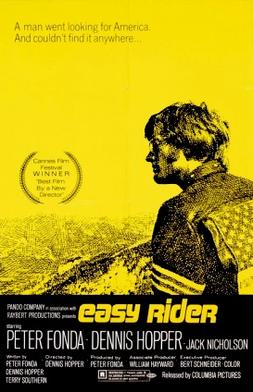
If you can’t get down to New Orleans today (because maybe you have a sprained ankle like me), fear not! Mardi Gras has been immortalized in a number of films. In fact, some have theorized that the whole reason 1969’s Easy Rider was filmed was because Dennis Hopper wanted to go to New Orleans.
The Mardi Gras sequence occurs towards the end of Easy Rider. After a long and eventful journey, Wyatt (Peter Fonda) and Billy (Dennis Hopper) reach New Orleans and experience Mardi Gras with two women that they met at a brothel (Karen Black and Toni Basil). However, the Mardi Gras scenes were actually amongst the first to be shot and Hopper actually filmed several hours of documentary footage of New Orleans’s most famous party. If you watch the footage, you can see bystanders looking directly at the camera. They were not extras hired for the film. They were people on the street who became a part of one of the most important indie films in the history of American cinema. These scenes were shot guerilla style, without permits or, by most reports, any advanced planning.
Hopper also filmed Fonda having an actual bad acid trip. For obvious reasons, Fonda was not happy about being filmed in that condition but he did say, in later interviews, that Hopper made the right decision to include the footage in the film.
For the record, I relate to Toni Basil in this film. She’s having fun and dancing no matter what.
Sometimes, you see a film that is just so weird and incoherent that you can’t help but love it.
Of course, it also helps if the film has a once-in-a-lifetime cast of actors who you would never expect to see acting opposite each other.
For me, that’s certainly the case with 1990’s Backtrack. Directed by Dennis Hopper, Backtrack is a film about an artist (Jodie Foster, channeling Jenny Holzer) who witnesses a mob murder committed by Joe Pesci, Dean Stockwell, Tony Sirico, and John Turturro. An FBI agent played by Fred Ward suggests that the artist should go into the witness protection program but she doesn’t want to give up her life as a New York sophisticate who creates challenging LED displays and who can eat Sno Balls whenever she gets the craving for one. (Yes, this is a plot point.) Turturro and Sirico break into the artist’s apartment and kill her boyfriend, who is played by a wide-eyed Charlie Sheen. The artist puts on a blonde wig and goes on the run, eventually getting a job in advertising.
Realizing that his men can’t get the job done, mob boss Vincent Price decides to hire a legendary hitman played by Dennis Hopper (who also directed this film) to track down the artist. However, the hitman becomes fascinating with the artist’s work, finds pictures of her posing in black lingerie, and immediately falls in love with her. Not only does he wants to save her life but he wants her to wear the same lingerie exclusively for him. (Yes, this is a pretty big plot point.) At first, the artist refuses and views the hitman as being some sort of pathetic perv. But then she discovers that he’s covered her bed with Sno Balls….
Meanwhile, a young Catherine Keener shows up as the girlfriend of a trucker who briefly considers giving the artist a ride to Canada.
And then Bob Dylan shows up, handling a chainsaw.
And there’s Helena Kallianiotes, the outspoken hitch-hiker from Five Easy Pieces, yelling at Joe Pesci!
And there’s Dennis Hopper’s The Last Movie co-star, Julie Adams! And there’s Toni Basil! And there’s director Alex Cox!
Dennis Hopper not only starred in Backtrack but he also directed and it’s obvious that he placed a call into just about everyone he knew. In fact, one could argue that the only thing more shocking than Vincent Price showing up as a mob boss is that Peter Fonda, Karen Black, Elliott Gould, Robert Walker Jr., and Kris Kristofferson are nowhere to be found in the film. Hopper’s first cut of Backtrack was reportedly 3 hours long but the studio cut it down to 90 minutes, renamed it Catchfire, and Hopper insisted on being credited as Alan Smithee. Later, Hopper released a two-hour version with the Backtrack title and his directorial credit restored.
Regardless of which version you see, Backtrack is an odd film. It’s hardly the first film to be made about a hit man falling for his target. What distinguishes this film is just how bizarre a performance Dennis Hopper gives in the role of the hitman. It’s as if Hopper gave into every method instinct that he had and the end result was a mix of Blue Velvet‘s Frank Booth and the crazed photojournalist from ApocalypseNow. Jodie Foster’s cool intelligence makes her the ideal choice for a conceptual artist but it also makes it hard to believe that she would fall for a jittery hitman and, in her romantic scenes with Hopper, Foster often seems to be struggling to resist the temptation to roll her eyes. Somehow, their total lack of romantic chemistry becomes rather fascinating to work. They are two talented performers but each appears to be acting in a different movie. What’s interesting is that I think a movie just about Hopper’s spacey hitman would be interesting (and, if you’ve ever seen The American Friend, it’s hard not to feel that such a movie already exists) but I think a movie about just about Foster’s artist and her life in New York would be just as fascinating. Taken as individuals, the artist and the hitman are both compelling characters. Taken as a couple, they don’t belong anywhere near each other.
But let’s be honest. This is a film that most people will watch for the parade of character actors delivering quirky dialogue. Even if one takes Hopper and Foster out of this mix, this is an amazingly talented cast. One need only consider that John Turturro did Do The Right Thing before appearing in this film while Joe Pesci and Tony Sirico did Goodfellas immediately afterwards. This film features a once-in-a-lifetime cast, made up of actors who were apparently told to do whatever they felt like doing. Turturro plays up the comedy. Sirico plays his role with cool menace. Stockwell barely speaks above a whisper. Fred Ward plays the one sane man in a world of lunatics. Vincent Price delivers his line as if he’s appearing in one of Roger Corman’s Poe films and somehow, it makes sense that, in the world of Backfire, an Italian gangster would have a snarky, mid-Atlantic accent.
It’s an odd little film, an example of 80s filmmaking with a 70s sensibility. While it’s not touched with the lunatic genius that distinguished Hopper’s The Last Movie, Backtrack is still something that should be experienced at least once.
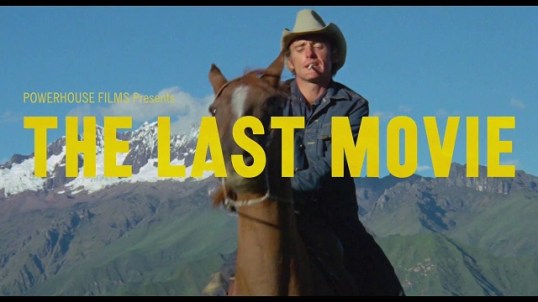
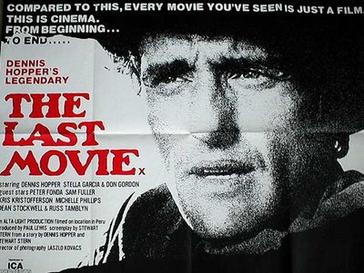
The story behind the making of 1971’s The Last Movie is legendary. It’s also a bit of a cautionary tale.
In 1969, Hollywood was stunned by the box office success of an independent, low-budget counter-culture film called Easy Rider. Easy Rider not only made a star out of Jack Nicholson but it was also the film that finally convinced the studios that the way to be relevant was not to continue to crank out big budget musical extravaganzas like Doctor Doolittle and Hello, Dolly! Instead, it was decided that the smart thing to do would be to hire young (or, at the very least, youngish) directors and basically just let them shoot whatever they wanted. The resulting films might not make much sense to the executives but, presumably, the kids would dig them and as long as the kids were paying money to see them, everyone would continue to get rich. Because Dennis Hopper had directed Easy Rider, he suddenly found himself very much in demand as a director.
Of course, almost everyone in Hollywood knew Dennis Hopper. Long before he became an icon of the counter-culture, Dennis Hopper had been a part of the studio system. John Wayne even referred to Hopper as being his “favorite communist.” Everyone knew that Dennis could be a bit arrogant. Everyone knew that Dennis was very much into drugs and that, as a result, he had a reputation for being a bit unstable. Everyone knew that Dennis Hopper deliberately cultivated an image of being a bit of a wild man and a revolutionary artist. But Dennis Hopper had just directed Easy Rider and Universal was willing to give Hopper some money to go down to Peru and direct his follow-up.
The Last Movie was a film that Hopper had been planning on making for a while. The film’s original script told the story of an aging and broken-down stuntman named Kansas who retires to Mexico and searches for a gold mine with a friend of his. Hopper first tried to get the film going in 1965, with Montgomery Clift in the lead role. After Clift died, Hopper tried to interest John Wayne in the starring role but, though Wayne enjoyed having Hopper in his films so that he could threaten to shoot him whenever Abbie Hoffman said something shocking, he had no interest in being directed by him. When Universal finally agreed to put up the money for the film, Hopper offered the lead role to Jack Nicholson. Nicholson turned it down and told Hopper that it was obvious that Dennis wanted to play the role himself. Dennis decided that he agreed with Nicholson and he cast himself as Kansas. Dennis also made the fateful decision to not only change the story’s setting to Peru but to also film on location.
Dennis and a group of friends flew down to Peru, which, at that time, was the cocaine capitol of the world. Drug use was rampant on the set, with Dennis reportedly being one of the main offenders. The cast and crew filmed during the day and partied at night and no one was particularly sure what the film was supposed to be about. Amazingly, Hopper finished filming on schedule and within budget but, much as he did with Easy Rider, he also overfilmed and ended up with 40 hours of footage. Not wanting to be bothered by the studios, Hopper edited the footage in his compound in Taos, New Mexico. Working slowly and continuing to consume a large amount of drugs and alcohol, Hopper still managed to put together a film that had a straightforward storyline. When Hopper showed his initial cut to filmmaker Alejandro Jodorowsky, the director of El Topo accused Hopper of being too conventional in his approach, which led to Hopper chopping up the film and reassembling it. Finally, after spending over a year working with the footage, Hopper turned in his final edit.
Universal had no idea what to make of the film that Hopper delivered to them. Still, they released it with the hope that the same crowd that loved Easy Rider would embrace The Last Movie. While the film did win an award at the Venice Film Festival, critics hated it and, even worse, audiences stayed away. The film’s reception was so overwhelmingly negative that Hopper found himself largely exiled from Hollywood, with only a few directors (like Francis Ford Coppola) willing to take the chance of working with him. It wasn’t until the 80s, when he finally got clean and sober, that Dennis Hopper was able to reestablish himself as a character actor and, ultimately, a beloved cultural institution.
But what about The Last Movie? Was is it really as bad as the critics claimed? Or was it, as some more recent reviewers have suggested, an unacknowledged masterpiece that was ahead of its time? I recently watched The Last Movie to find out for myself.
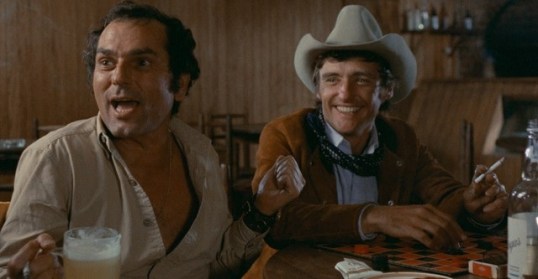
Despite its reputation, The Last Movie gets off to a pretty strong start. Samuel Fuller (playing himself) is directing a hilariously over-the-top and violent western in the mountains of Peru. Kansas (Dennis Hopper) is working as a stuntman. He’s fallen in love with a local sex worker named Maria (Stella Garcia). Kansas is meant to be an aging Hollywood veteran, someone who has broken a lot of bones and who carries a lot of aches as a result of his line of work. (One can see why Hopper initially imagined an actor like John Wayne in the role.) He knows that this is going to be his last job and, as we see over the first 25 minutes of the film, he feels alienated from the rest of the cast and crew. Admittedly, Hopper does appear to be a bit too young for the role. The ideal Kansas would have been someone like Ben Johnson, L.Q. Jones, or perhaps Warren Oates. But, still, Hopper does a good job of capturing Kansas’s mixed feelings about the western that’s being filmed around him.
A lot of familiar faces pop up in the film’s fictional western. Dean Stockwell plays an outlaw. Jim Mitchum, Russ Tamblyn and Kris Kristofferson plays his associates. Peter Fonda is the youthful sheriff. Michelle Phillips is the daughter of the town’s banker and apparently, she’s also the girlfriend of one of the outlaws. We watch as the actors pretend to shoot guns and kill each other while the cameras are rolling, just to get up off the ground once “Cut” is yelled. When a local Indian who has been cast as an extra grows upset at the violence, an assistant director explains to him that no one really dies while the cameras are rolling. When shooting wraps, the film company goes home but Kansas stays behind with Maria. One day, the local priest (Tomas Milian) warns Kansas that the local indigenous people have moved into the abandoned film set and are trying to shoot their own movie. Kansas discovers that they have built wooden cameras and wooden boom mics and that their chief is giving orders in the style of Sam Fuller. They’re also firing the guns that the Americans left behind.
The first part of the film works quite well. Hopper’s camera captures the beautiful and isolated Peruvian landscape. The violent western is a pitch perfect and affectionate parody of a generic studio film. Though Hopper is a bit too young for the role, he still does a good job of capturing Kansas’s alienation from his fellow Americans. Even more importantly, the first part of the film seems to have an identifiable theme. The American film crew invaded an isolated part of Peru and changed the culture of the natives without even realizing it. Now, they’ve left but the natives are still dealing with the after effects of the American “invasion.” It’s easy to see, within that part of the story, a critique of both American culture and American foreign policy.
The second part of the film is where things start to fall apart. Kansas meets an old friend named Neville (Don Gordon). Neville has discovered a gold mine in the Peruvian mountains. With Kansas as his partner, he tries to get a businessman named Harry Anderson (Roy Engel) to invest in it. Kansas and Neville try to impress Harry and his wife (Julie Adams, best-known for being stalked by The Creature From The Black Lagoon). Kansas and Neville take the Andersons to a brothel and, in the process, Kansas offends Maria. Kansas then paws Mrs. Anderson’s fur coat and mentions that human beings are covered in hair. For all of their efforts, Harry will not invest, no matter how desperately Neville begs him to reconsider.
The second part of the film drags, with many of the scenes being obviously improvised between Hopper, Gordon, Garcia, Engel, and Adams. Unfortunately, the improved conversations aren’t particularly interesting and they tend to go on forever. Usually a reliable character actor, Don Gordon ferociously chews the scenery as Neville and it doesn’t take long before one grows tired of listening to him yell. (Gordon was far more impressive in Hopper’s Out of the Blue.) With the use of improvisation and overlapping dialogue, the second half of the film tries to feel naturalistic but instead, it’s a migraine-inducing method exercise gone wrong. It’s also during the second part of the film that a “scene missing” title card flashes on the screen, an indication that the discipline that Hopper showed as a director during the beginning of the film is about to be abandoned.
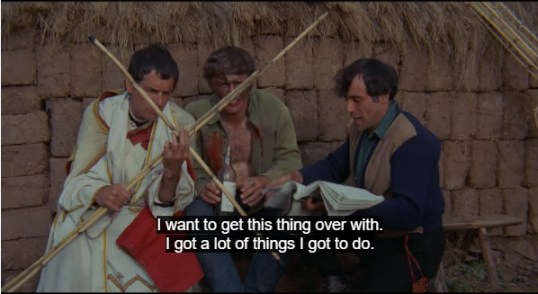
Finally, the third part of the film — well, who knows? The final 25 minutes of the film is collection of random scenes, some of which may be connected and some of which may not. The natives have decided that the only way to properly end their “film” is to kill Kansas. Kansas is shot several times and rides away on his horse. Suddenly, Kansas is back at his home and Maria is taunting him for getting shot. Then, Kansas is riding his horse again. Then suddenly, Dennis Hopper and Tomas Milian are laughing at the camera. A script supervisor tries to get Dennis to look at the shooting schedule while Dennis drinks. This happens:
Milian points out that the blood on Hopper’s shirt is dry. Hopper looks at his shoulder, where Kansas was previously shot, and says that someone needs to add his scar before he can shoot the scene. Ah! So, now we’re acknowledging that it’s all just a movie. Thanks, Dennis! Suddenly, Dennis is Kansas again and he’s collapsing over and over again in the dust. He appears to be dead but no, now he’s Dennis again and he’s standing up and smiling at the camera. And now, he’s singing Hooray for Hollywood. And now, suddenly, Kansas and Neville are talking about The Treasure of the Sierra Madre and then….
Well, let’s just say that it goes on and on before finally ending with a scrawled title card.
It’s a disjointed mess and it’s all the more frustrating because the first 30 minutes of the film is actually pretty good. But then, Dennis apparently remembered that he was supposed to be the voice of the counter-culture and he gave into his most pretentious impulses. Of course, just because a film is a mess, that doesn’t mean that it can’t be entertaining. And again, the first part of the film is entertaining and third part of the film is weird enough that it’ll hold most people’s attention for at least a few minutes. But the middle section of the film is so slow and pointless that it pretty much brings down the entire film.
In the end, what is The Last Movie about? In The American Dreamer(a documentary that was filmed while Hopper was editing The Last Movie in New Mexico), Hopper spends a lot of time talking about revolution and taking over Hollywood but The Last Movie is hardly a revolutionary film. The film is at its most alive when it is focused on the shooting of its fictional western. For all the satirical pokes that The Last Movie takes at the studio system, it’s obvious that Hopper had a lot of affection for Old Hollywood and for directors like Sam Fuller. Kansas may say “Far out,” but he’s hardly a hippie. Even the film’s jumbled finale seems to be saying, “It’s all Hollywood magic!” In the end, the film’s call for a new style of cinema is defeated by its love for the old style of cinema.
Instead, I think The Last Movie works best when viewed as a portrait of paranoia. Hopper himself admitted that he was naturally paranoid and the heavy amount of drugs that he was doing in the 70s didn’t help. One reason why Hopper filmed in Peru and edited in New Mexico was so the studios couldn’t keep track of him and, while directing, he worried about being arrested by the Peruvian secret police. As an actor, Hopper plays Kansas as being someone who views the world with caution and untrusting eyes. He doesn’t trust the other members of the film crew. He loves Maria but he’s still convinced that she’s going to betray him. Even the natives ultimately try to destroy him and the script supervisor tries to get him to stick to the shooting schedule. The film works best as a disjoined portrait of one man’s paranoid and fatalistic world view.
The Last Movie pretty much ended the studio’s attempts to harness the counter-culture by giving money to self-described revolutionaries. The new wave of directors — like Spielberg and Lucas — may have shared Hopper’s then-politics but they weren’t looking to burn down the system. (Hopper himself later became a Republican.) The Last Movie may not have been the literal last movie but it was, for a while at least, the last of its kind.
Today is not only the 1st of March. It’s not only Texas Independence Day. It’s not only Zack Snyder’s birthday. It’s not only the day of Texas primaries. It’s not only the day when the State of the Union address is scheduled to be given (yawn!). It’s also Mardi Gras!
What a busy day!
For today’s scene that I love, here is the Mardi Gras/Cemetery sequence from 1969’s Easy Rider. Featuring Peter Fonda, Dennis Hopper, Karen Black, and Toni Basil walking through the streets of New Orleans, this scene was actually filmed during Mardi Gras. Those are real Mardi Gras floats and real Mardi Gras participants staring at the camera. That’s an actual citizen of New Orleans with whom Dennis Hopper appears to have nearly gotten into a fight. And, in the cemetery scene, that was real acid that Peter Fonda took.
Here is today’s scene. The scene is age-restricted so you’ll actually have to click on “watch on YouTube” to see it.
If you don’t want to click on “watch on YouTube,” here is a shorter version that just features the parade without the admittedly disturbing cemetery stuff.
I like how Toni Basil can’t help but dance, no matter what.
If you are among those who wanted to celebrate Mardi Gras today but couldn’t make it down to New Orleans, fear not! There is a solution to your problem. You can always just watch 1969 counterculture classic, Easy Rider.
Easy Rider features one of the most famous Mardi Gras scenes of all time and adding to the scene’s authenticity is the fact that it was actually shot in New Orleans during the celebration. If you watch the Mardi Gras sequence carefully, you’ll notice that several people on the streets of the French Quarter actually stop and stare directly at the camera. It reminds you that you’re watching a movie but, at the same time, it also reminds you that you’re seeing something authentic. Those weren’t just professional extras pretending to get drunk and glaring at Dennis Hopper and Peter Fonda. Those were people who were actually in the French Quarter for Mardi Gras and who just happened to end up getting included in one of the biggest cult films of all time. If you want to know what Mardi Gras was like in the late 60s, this is the film to watch.
At the same time, after watching Easy Rider, you may be find yourself happy to not be in New Orleans today. As with almost everything else in Easy Rider, Mardi Gras starts out as something exciting and full of promise but it ends as something dark and full of death. One minute, Peter Fonda, Dennis Hopper, Karen Black, and Toni Basil are walking down the streets of New Orleans and having what appears to be a good time. The next thing you know, they’re in a cemetery and Peter Fonda’s sobbing and talking about his mother’s suicide while Toni Basil and Karen Black are freaking out. Of the four of them, only Dennis Hopper appears to not be having a bad trip but then again, Hopper is so naturally spacey in Easy Rider that it’s kind of hard to tell.
The next morning, Fonda and Hopper leave New Orleans on their motorcycles and promptly get blown away by two shotgun-toting rednecks in a pickup truck. It seems a fitting conclusion to a film that celebrates the beauty of the American landscape while, at the same time, suggesting that almost everyone who lives there is a complete and total prick.
Of course, the whole Mardi Gras sequence doesn’t occur until the very end of the film. The majority of the film deals with the journey to New Orleans. Billy (Dennis Hopper) and Wyatt (Peter Fonda) are two motorcycle-riding drug dealers who have just made a small fortune off of selling cocaine to Phil Spector. Billy and Wyatt are heading to New Orleans to celebrate and visit a famous brothel. Wyatt is cool and stoic and always seems to be thinking about something. Billy is Dennis Hopper. Easy Rider is often referred to as being a hippie film but neither Billy nor Wyatt is really a hippie. They’re outsiders and they like to smoke weed but they’re also largely apolitical. They just want to enjoy the open road. If anything, they’re beatniks who were born a year or two too late.
As they ride from California to New Mexico, Billy and Wyatt meet plenty of people along the way. They stop off at a hippie commune and then later, they get harassed by a bunch of rednecks in a diner. The rednecks are menacing while the hippies are annoying. The rednecks throw Wyatt and Billy in jail for “parading without a permit.” The hippies have a mime troupe. The rednecks drive around with shotguns. The hippies try to grow crops in the desert. (I’m enough of a country girl to know that Billy’s right when he scornfully says that nothing that they’re planting is going to actually grow.) The rednecks are ignorant. The hippies are smug. None of them really seem like people that you would want to spend too much time around.
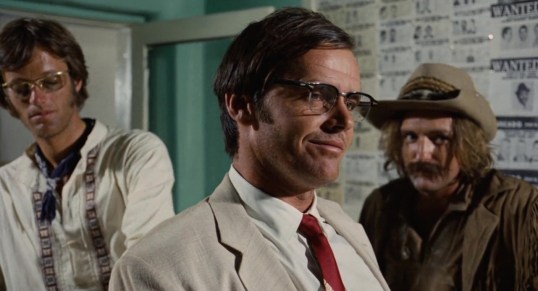
Along the way, Wyatt and Billy temporarily travel with two others. The hitchhiker is played by Luke Askew. We never learn his name but he does play a key role in the film when he gives Wyatt the tab of acid that will eventually ruin Mardi Gras. Meanwhile, George Hanson is an alcoholic lawyer and he’s played by Jack Nicholson. At the time that the film was shot, Nicholson was on the verge of retiring from acting so he could concentrate on directing and writing. He took the role and expected, as almost everyone did, that Easy Rider would just be another biker film. Instead, Easy Rider became a hit and a cultural milestone that not only won Nicholson his first Academy Award nomination but also made him a star.
Interestingly enough, Jack Nicholson is not really that good in Easy Rider. His attempt at a Texas accent is terrible and you never believe him as someone who has never smoked weed before. If anything, Luke Askew gives a far better performance than Nicholson and he actually has more screen time as well. However, I think Nicholson benefited from the fact that George is probably the most likable character in the film. (Depending on how you feel about Billy and Wyatt, you could argue that he’s the only likable character in the film.) He’s not a smug hippie nor is he a murderous redneck. Unlike Wyatt and Billy, he has a job that doesn’t involve selling cocaine to Phil Spector. Whereas Luke Askew’s Hitchhiker seems like the type of guy who would just love to lecture you about why Vietnam is all your fault, George comes across as being a gentle soul. George is a character that viewers can feel safe identifying with, even if Nicholson is never quite convincing as someone so naive that he fears he’ll freak out after taking one hit off of a joint.
Easy Rider‘s critical reputation tends to go up and down, depending on who you’re reading or talking to. There’s a tendency, among many critics, to complain that Fonda acted too little while Hopper acted too much. Personally, I think there’s a lot of hidden wit to be found in Hopper’s performance and I love how annoyed he gets when they’re at the hippie compound. As for Peter Fonda, he may not have been the most expressive actor but he did capture a certain feeling of ennui. For most of the film, it’s hard to tell whether there’s anything actually going on in Wyatt’s head. Then, we follow Wyatt and Billy to that cemetery in New Orleans and we discover that there’s actually quite a bit going on behind Wyatt’s wall of stoicism. After watching Wyatt curse at a statue while sobbing, we understand why he keeps so much hidden.
When it was released in 1969, Easy Rider was a huge box office success and it inspired every major studio to try to duplicate it’s success with a counter culture film of its own. (Hopper was given several million dollars and sent down to Peru to make a follow-up to Easy Rider. The result was The Last Movie, a legendary disaster that temporarily ended Hopper’s career as a director.) Seen today, Easy Rider is undeniably pretentious but always watchable. The scenery is beautiful and the Mardi Gras sequence sets the standard by which all other bad trips should be judged. Most importantly, the film works as a historical document. Everything about it — from the music to the cultural attitudes to even Hopper’s attempts to imitate Jean-Luc Godard in his direction — makes this film into a time capsule. Until they invent a time machine that works, Easy Rider is as close as some of us will ever get to experiencing the end of the 60s.
And finally, it’s the ultimate Mardi Gras film, even if it’s main message seems to be that everyone needs to stay the Hell away from Mardi Gras. Or, at the very least, don’t accept LSD from a scruffy hitchhiker before rolling into New Orleans. Seriously, the more you know….
Once In A Lifetime has since become one of the signature tunes of the ’80s but, when the song was first released in 1981, it didn’t even manage to break the top 100 on the US charts, peaking at 103. (The song did find more success in the UK, where it reached #13.) At the time, the song was not considered to be “radio friendly.” Not even the fact that the video was put into heavy rotation during the early days of MTV could change the minds of stubborn programmers who were convinced that the sound of David Byrne considering his life would lead to listeners switching the channel.
The video, which features multiple David Byrnes performing against a white backdrop, was directed by Byrne and the famous dancer/choreographer Toni Basil. (Basil, of course, had her own hit around the same time with her video for Mickey.) In the book, MTV Ruled the World – The Early Years of Music Video, Basil discussed making the video with Byrne:
“He wanted to research movement, but he wanted to research movement more as an actor, as does David Bowie, as does Mick Jagger. They come to movement in another way, not as a trained dancer. Or not really interested in dance steps. He wanted to research people in trances – different trances in church and different trances with snakes. So we went over to UCLA and USC, and we viewed a lot of footage of documentaries on that subject. And then he took the ideas, and he ‘physicalized’ the ideas from these documentary-style films … David kind of choreographed himself. I set up the camera, put him in front of it and asked him to absorb those ideas. Then I left the room so he could be alone with himself. I came back, looked at the videotape, and we chose physical moves that worked with the music. I just helped to stylize his moves a little.”
As for the song, Byrne has said that he came up with most of the lyrics while listening to radio evangelists and the song’s plaintive cry of “How did I get here?” should sound familiar to anyone who has ever heard any of the old style preachers going at it. The song’s signature bassline was developed by Tina Weymouth, who has said that she based it on the sound of her husband (and Talking Heads drummer) Chris Frantz yelling.
As for the song, it may not have charted but it has gone on to become one of the defining songs of the 80s. The song would also be one of the highlights of the greatest concert film ever made, Stop Making Sense.
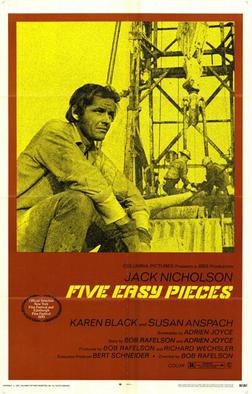
First released in 1970, Five Easy Pieces tells the story of a lost man named Bobby Dupea (Jack Nicholson).
When we first meet Bobby, he’s working at a California oil field. He likes to go bowling. He has a girlfriend named Rayette (Karen Black), who is a country music-obsessed waitress. His best friend is Elton (Billy “Green” Bush), a friendly redneck with a memorable laugh. Bobby may have a girlfriend and Elton may be married but that doesn’t stop either one of them from going out at night, getting drunk, and trying to pick up women.
Bobby seems to be just another blue-collar guy with a grudge against the bosses but it doesn’t take long to realize that there’s something different about him. Bobby may be friends with Elton but it’s obvious that the two of them come from very different background. No matter how much he tries to hide it, Bobby is smarter than everyone else around him. When he and Elton get stuck in a traffic jam, Bobby spots a piano sitting on the back of a pickup truck. Getting out of his car, Bobby yells at everyone who is honking and then climbs up to the piano. He sits down, he puts his fingers to the keys and he starts to play. Knowing Bobby, you’re expecting him to just bang the keys and make noise. Instead, he plays beautiful music.
Later, Bobby steps into a recording studio. Paritia (Lois Smith), a neurotic woman, is playing the piano. The recording engineers joke about her lack of talent. Bobby glares at them, annoyed. It quickly becomes apparent why Bobby is so protective. Paritia is Bobby’s sister.
Bobby, it turns out, comes from a wealthy family of musicians. Everyone in the family has dealt with the pressure to succeed differently. Paritia continues to play, despite not having much talent. Bobby’s older brother, the buffoonish Carl (Ralph Waite), plays violin and has staid home with their father (William Challee). Bobby, on the other hand, ran away from home. He’s spent his entire life trying to escape from both his talent and his family. However, when Paritia explains that their father has suffered from two strokes and might not live much longer, Bobby reluctantly decides to return home and try to make some sort of peace with his father.
It’s not as easy a journey as Bobby would have liked. For one thing, Rayette demands to go with him. On the drive up to Washington, they pick up two hitchhikers (Helena Kallionetes and Toni Basil), one of whom is obsessed with filth. In the film’s most famous scene, an attempt to get a simple lunch order modified leads to Bobby losing control.
See, that’s the thing with Bobby. In many ways, he’s a jerk. He treats Rayette terribly. While his family is hardly perfect, the film doesn’t hide from the fact that Bobby isn’t always the easiest person to deal with. And yet, you can’t help but sympathize with Bobby. If he seems permanently annoyed with the world … well, that’s because the world’s annoying. And, to Bobby’s credit, he’s a bit more self-aware than the typical rebel without a cause. When one of the hitchhikers praises his temper tantrum at the diner, Bobby points out that, after all of that, he still didn’t get the order that he wanted.
In Washington, Bobby tells Rayette to stay at a motel and then goes to see his family. Bobby seems as out-of-place among his wealthy family as he did hanging out in the oil fields with Elton. He ends up cheating on Rayette with Carl’s fiancee, a pianist named Catherine van Oost (Susan Anspach).
And then Rayette shows up for dinner…
Five Easy Pieces is a sometimes funny and often poignant character study of a man who seems to be destined to always feel lost in the world. Bobby spends the whole movie trying to find a place where he can find happiness and every time, reality interferes with his plans. Nicholson gives a brilliant performance, playing Bobby as a talented guy who doesn’t really like himself that much. Bobby’s search for happiness leads to a rather haunting ending, one that suggests that some people are just meant to spend their entire life wandering.
Five Easy Pieces was nominated for Best Picture but lost to Patton.
Today, a lot of people have traveled to New Orleans to celebrate Mardi Gras. Here’s hoping that they have a better time in the city than Billy (Dennis Hopper) and Wyatt (Peter Fonda) had in the 1969 film, Easy Rider.
The scenes below, featuring Hopper, Fonda, Karen Black, and the legendary Toni Basil were actually filmed at Mardi Gras in 1968. These were among the first scenes that Hopper (making his directorial debut) shot for the film and reportedly, filming was so chaotic that they were also nearly the last scenes to be filmed. As those who have seen Easy Rider know, Billy and Wyatt spend the entire movie trying to get to New Orleans so that they can visit a famous brothel. Once they get there, they discover that absolutely nothing lives up to the legend. The brothel is a sleazy mess. Mardi Gras is full of bad vibes. Wyatt has an amazingly bad LSD trip. (Hopper convinced Fonda to really drop acid before filming the scene, which led some harrowing footage.) After they leave New Orleans, Fonda and Hopper cross the border into Texas and promptly end up getting blown away by two rednecks in a pickup truck.
Welcome to the sixties!
In the scene below, we get actual footage of 1968’s Mardi Gras. Just watch all the celebrants who stop to stare at the camera.
And here is the infamous cemetery scene. Fonda resisted doing it and the end result is not easy to watch but it’s also one of the most powerful moments in the entire film:
In 1994, Tim Burton released Ed Wood, a film that I consider to be his best. (In fact, it’s one of the few Tim Burton films that I feel actually improves with repeat viewings. Don’t start yelling at me about Beetlejuice.) The score, which so evocative of Wood’s style of filmmaking, was composed by Howard Shore. This video features the actress Lisa Marie (who played Vampira in Ed Wood) dancing to Shore’s theme music.
Before anyone says it, I did not pick this video just because it features a dancer named Lisa Marie. I’m not the egocentric … well, actually, I am. In fact, I’m so egocentric that I’m shocked that I have yet to dedicate an entire post to just listing words that rhyme with Lisa. (Sadly, there’s not many. Visa is a good one.) But still, I did have other reasons for picking this video than just the fact that I am also named Lisa Marie and I also enjoy dancing in cemeteries. Those reasons will hopefully become obvious as the day develops here on the Shattered Lens.
Anyway, both Tim Burton and Toni Basil are credited with directing this video. I’m going to assume that Burton’s directorial credit is largely due to all of the scene of Ed Wood that are spliced into the footage of Lisa Marie dancing. Toni Basil, who also did the choreographed this video, is one of our favorite people here at the Shattered Lens. Just check out my review of Head and Val’s review of Slaughterhouse Rock.
When I picked out this music video to feature today, I thought it would just be a catchy song that happens to feature Penn & Teller. I had no idea that the song It’s Tricky is actually an amalgamation of My Sharona by The Knack and Mickey by Toni Basil. The site Who Sampled has a great comparison here for Toni Basil and here for The Knack. They took a small bit of the guitar riff from My Sharona which got them sued in 2006, and was settled out of court. The vocal structure for the song was taken from Mickey. I would have never put that together had I not stumbled upon it on Wikipedia.
As for the music video, I’m a little confused. She gets her chain taken by Penn & Teller, the cops show up, they chase after them, she calls RUN-DMC as you do, and suddenly they are instantly doing three card monte again all in the span of a few minutes in front of the same theater. That’s tricky. Actually I wouldn’t be surprised if director Jon Small meant people to think of it that way.
This music video apparently aired for the first time in May of 1987 while Beastie Boys’ music video for No Sleep Till Brooklyn first aired in April of 1987. I only bring it up because of the similarities between the last scenes where RUN-DMC shows up at their scheduled concert to find that Penn & Teller have taken their place. Beastie Boys do the same kind of thing in No Sleep For Brooklyn, which seems to have borrowed elements from RUN-DMC’s music video for Walk This Way that aired the previous year in 1986. IMVDb says that It’s Tricky first aired in 1986, but 1987 makes more sense, and is in mvdbase that always seems to be the more accurate source for older music videos. Regardless, I find it funny how these things all interconnect whether intentionally via sampling, or what seemed like two different groups who had similar music videos right around the same time.
Director Jon Small seems to have worked on about 50 music videos as well as some concert films.
That seems to be all there is about this simple and fun music video, so enjoy!