Retro Television Review: Decoy 1.36 “Blind Date”


Welcome to Retro Television Reviews, a feature where we review some of our favorite and least favorite shows of the past!  On Thursdays, I will be reviewing Decoy, which aired in Syndication in 1957 and 1958.  The show can be viewed on Tubi!

This week, Casey goes undercover …. again!

Episode 1.36 “Blind Date”

(Dir by Stuart Rosenberg, originally aired on June 16th, 1958)

When Gladys (Mary Finney) and her niece Millie (Irene Dailey) are involved in a car accident, the police discover that they are transporting a large amount of stolen money.  Millie, who has been transporting drugs, had a meeting with a money launderer to exchange the money for clean bills.  Casey goes undercover, pretending to be Millie when she and Gladys meet with the launderer.  However, when Millie’s boyfriend (Elliott Sullivan) shows up, the entire operation falls apart.  Can Casey convince Millie’s boyfriend to turn on the criminals?

This is yet another episode where Casey’s carefully constructed cover is destroyed by something that the police should have been prepared for.  Not only is Casey pretending to be a real person (which increases the risk that she’ll run into someone who actually knows the person that Casey is pretending to be) but she’s also accompanied by the increasingly hysterical Gladys.  Usually, Casey is at least convincing when she goes undercover.  This time, she comes across as way to calm and collected to be believable as someone committing her first crime.

To be honest, after 36 of these episodes, I’m amazed that Casey has survived for as long as she has.  The New York police department seems to be truly incompetent.

Despite all of that, this was a good episode.  There was plenty of on-location New York footage and Beverly Garland did a good job of portraying Casey’s growing realization that 1) she was in over her head and 2) it was a mistake to bring Aunt Gladys along.  Lou Polan was also well-cast as the avuncular but still menacing money launderer.  He may have been a criminal but he was also very proud of his boat.  Who can blame him?

This episode ended up on vaguely upbeat note, one that really didn’t feel as it had been earned.  Decoy was always at its best when it was downbeat and realistic.  New York was a tough city, even back in 1958.
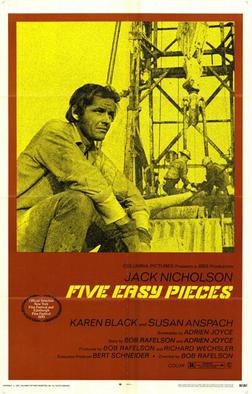
Lisa Reviews An Oscar Nominee: Five Easy Pieces (dir by Bob Rafelson)


First released in 1970, Five Easy Pieces tells the story of a lost man named Bobby Dupea (Jack Nicholson).

When we first meet Bobby, he’s working at a California oil field.  He likes to go bowling.  He has a girlfriend named Rayette (Karen Black), who is a country music-obsessed waitress.  His best friend is Elton (Billy “Green” Bush), a friendly redneck with a memorable laugh.  Bobby may have a girlfriend and Elton may be married but that doesn’t stop either one of them from going out at night, getting drunk, and trying to pick up women.

Bobby seems to be just another blue-collar guy with a grudge against the bosses but it doesn’t take long to realize that there’s something different about him.  Bobby may be friends with Elton but it’s obvious that the two of them come from very different background.  No matter how much he tries to hide it, Bobby is smarter than everyone else around him.  When he and Elton get stuck in a traffic jam, Bobby spots a piano sitting on the back of a pickup truck.  Getting out of his car, Bobby yells at everyone who is honking and then climbs up to the piano.  He sits down, he puts his fingers to the keys and he starts to play.  Knowing Bobby, you’re expecting him to just bang the keys and make noise.  Instead, he plays beautiful music.

Later, Bobby steps into a recording studio.  Paritia (Lois Smith), a neurotic woman, is playing the piano.  The recording engineers joke about her lack of talent.  Bobby glares at them, annoyed.  It quickly becomes apparent why Bobby is so protective.  Paritia is Bobby’s sister.

Bobby, it turns out, comes from a wealthy family of musicians.  Everyone in the family has dealt with the pressure to succeed differently.  Paritia continues to play, despite not having much talent.  Bobby’s older brother, the buffoonish Carl (Ralph Waite), plays violin and has staid home with their father (William Challee).  Bobby, on the other hand, ran away from home.  He’s spent his entire life trying to escape from both his talent and his family.  However, when Paritia explains that their father has suffered from two strokes and might not live much longer, Bobby reluctantly decides to return home and try to make some sort of peace with his father.

It’s not as easy a journey as Bobby would have liked.  For one thing, Rayette demands to go with him.  On the drive up to Washington, they pick up two hitchhikers (Helena Kallionetes and Toni Basil), one of whom is obsessed with filth.  In the film’s most famous scene, an attempt to get a simple lunch order modified leads to Bobby losing control.

See, that’s the thing with Bobby.  In many ways, he’s a jerk.  He treats Rayette terribly.  While his family is hardly perfect, the film doesn’t hide from the fact that Bobby isn’t always the easiest person to deal with.  And yet, you can’t help but sympathize with Bobby.  If he seems permanently annoyed with the world … well, that’s because the world’s annoying.  And, to Bobby’s credit, he’s a bit more self-aware than the typical rebel without a cause.  When one of the hitchhikers praises his temper tantrum at the diner, Bobby points out that, after all of that, he still didn’t get the order that he wanted.

In Washington, Bobby tells Rayette to stay at a motel and then goes to see his family.  Bobby seems as out-of-place among his wealthy family as he did hanging out in the oil fields with Elton.  He ends up cheating on Rayette with Carl’s fiancee, a pianist named Catherine van Oost (Susan Anspach).

And then Rayette shows up for dinner…

Five Easy Pieces is a sometimes funny and often poignant character study of a man who seems to be destined to always feel lost in the world.  Bobby spends the whole movie trying to find a place where he can find happiness and every time, reality interferes with his plans.  Nicholson gives a brilliant performance, playing Bobby as a talented guy who doesn’t really like himself that much.  Bobby’s search for happiness leads to a rather haunting ending, one that suggests that some people are just meant to spend their entire life wandering.

Five Easy Pieces was nominated for Best Picture but lost to Patton.