Originally broadcast in 1985, Into Thin Air is a made-for-TV movie that is based on a true story. It’s film that brings to life the horror of every family’s nightmare. Brian Walker (Tate Donavon) is an intelligent, soft-spoken, and somewhat naive college student in Ottawa. He’s been accepted into a summer writing program in Colorado. As he gets in the van that he will be driving to Colorado, he promises his mother, Joan (Ellen Burstyn), that he’ll call her when he reaches Nebraska and again when he reaches Colorado.
Brian drives away and that’s the last time that Joan ever sees her son. Brian calls from Nebraska and talks to his brother, Stephen (Sam Robards). Joan arrives home just as Stephen is saying goodbye. Brian never calls from Colorado. He has vanished, seemingly into thin air.
Joan, Stephen, and Joan’s ex-husband, Larry (played the great character actor Nicholas Pryor) travel to America to search for him. At one point, Stephen thinks that he’s spotted Brian’s van on the road and chase after it, just to discover that it’s a different van. Joan talks to cops in Nebraska and Colorado and discovers that different jurisdictions don’t work together or share information. As the days pass, Joan keeps hoping that Brian is somehow still alive….
I was about ten minutes into this film when I started sobbing. I pretty much cried through the entire film. Some of that was because I knew that they were never going to see Brian again. Some of that was because of the powerful, heartfelt performances of Ellen Burstyn, Nicholas Pryor, and Sam Robards. Most of it was because this film did such a good job of capturing the feeling of hopelessness and the dread that comes with not knowing what has happened to someone who you love. I found myself crying for Brian’s lost potential. He was a writer and he was engaging in a time-honored writing tradition. He was taking a road trip and he was discovering the world. He deserved better than whatever happened to him. He deserved see his novel sitting in a bookstore. Instead, he ran into the wrong people.
It’s the little details that really got to me. Stephen flies into a rage when he sees his younger brother wearing one of Brain’s sweaters. Joan momentarily gets her hopes up when she discovers that Brian reported some lost traveler’s checks, just to have that hope shot down when she’s told that the bank can’t reveal where Brian called them from unless Brian himself gives permission. When the van eventually turn up in Maine, it’s been totally trashed by whoever took it from Brian.
Eventually, Joan hires a private detective and Robert Prosky is well-cast as Jim Conway, a seemingly cynical ex-cop who dedicates himself to trying to provide closure for the Walkers. The scene where he finally discovers what happened to Brian is one of the strongest in the film and one of the most upsetting. So many people could have saved Brian if they only had the courage to speak up.
Into Thin Air is a powerful film. No one should ever be forgotten.
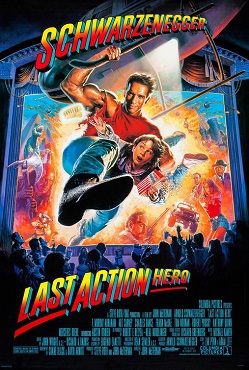
Ever since this film was first released in 1993, it’s usually held up as an example of a Hollywood fiasco. The script was originally written to be a modest satire of action films. The screenwriters wrote the character of Jack Slater, an movie action hero who comes into the real world, for Dolph Lundgren. Instead, the film became an Arnold Schwarzenegger extravaganza and the studio ended up tossing a ton of money at it. When the film was originally released, the reviews were mixed and the box office was considered to be disappointing. (That it went up against the first JurassicPark was definitely an underrated issue when it came to the box office.) Ever since then, The Last Action Hero has had a reputation for being a bad film.
Well, I don’t care. I like TheLastActionHero. Yes, it’s a bit overproduced for a comedy. (It breaks my own rule about how no comedy should run longer than two hours.) Yes, it gets a bit sentimental with ten year-old Danny Madigan (Austin O’Brien) using a magic, golden ticket to enter the film world of his hero, Jack Slater. If you want to argue that the film should have devoted more time to and gone a bit deeper into contrasting the film world with the real world, I won’t disagree with you. But I will also say that Sylvester Stallone starring as TheTerminator in Jack’s world was actually a pretty funny sight gag. Danny knowing better than to trust a character played by F. Murray Abraham made me laugh. Danny’s fantasy in which Arnold Schwarzenegger played Hamlet was made all the better by the fact that his teacher was played by Laurence Olivier’s wife, Joan Plowright. Danny DeVito as Whiskers the Cartoon Cat makes me laugh as well, even if it is perhaps a bit too bizarre of a joke for this particular film. (There’s nothing else about the Jack Slater films that would explain the presence of a cartoon cat.)
When you set aside the idea of the Last Action Hero being a symbol of Hollywood bloat and just watch it as a film, it emerges as an enjoyably goofy action movie, one that captures the joy of watching movies (because who hasn’t wanted to enter a movie’s world at some point in their life), and also one that features a rather charming performance from Arnold Schwarzenegger. (Schwarzenegger, I should add, plays both himself and Jack Slater. One of my favorite jokes is when the real Schwarzenegger is at a premiere and he mistakes the evil Ripper for Tom Noonan, the actor who played him in the previous Jack Slater film.) Yeah, the golden ticket is a little bit hokey but who cares? Underneath all of the special effects and action and money spent on star salaries, LastActionHero is an action movie and comedy with a heart. Danny meets his hero but also gets to become a hero himself. And Jack Slater turns out to be everything you would hope your movie hero would be. In the end, it’s obvious that a lot of the criticism of this film has more to do with the appeal of riding the bandwagon as opposed to what actually happens on screen.
LastActionHero is a movie that I’ll happily defend.
It’s Good Friday and I’ve taken the day off from work to relax and spend some time in reflection and prayer on this important day on the Christian calendar. I woke up this morning and wasn’t quite ready to get out of bed, so I started flipping through Netflix’s selection and came across RUDY (1993). I try not to overwatch RUDY because I love the way it makes me feel, and I don’t want it to become so familiar that I lose that feeling. But it’s been a couple of years, so I decided to give it another spin.
As I’m sure most of you know, RUDY is based on the life of Daniel “Rudy” Ruettiger (Sean Astin), the 3rd of 14 children from a family in Joliet, IL, who dreamed of playing football at Notre Dame. There were a number of obstacles to that dream, namely that his family didn’t have much money, he didn’t have good grades, he was 5’6” tall and he didn’t have much football talent. What he did have was heart, and we watch Rudy persevere as he goes to school at neighboring Holy Cross while trying to get accepted in Notre Dame. Nothing ever comes easy for Rudy, but through determination, hard work, and sheer will he eventually makes his way to Notre Dame, joins the football team’s practice squad, and gets to suit up for one game in his senior year.
RUDY is a movie that affects me deeply. It really shouldn’t come as a surprise as it was written by Angelo Pizzo and directed by David Anspaugh, the team behind HOOSIERS (1986), one of my very favorite movies of all time. While there will never be a movie about my life, I know all too well what it’s like to love something so much, but not really be designed for it. In RUDY, the character Fortune, played by Charles S. Dutton in an incredible performance, tells a discouraged Rudy, “You’re 5 foot nothin’, 100 and nothin’, and you have barely a speck of athletic ability. And you hung in there with the best college football players in the land for 2 years.” Those were basically my specs when I was a senior playing high school basketball in a small town in Central Arkansas (5’7,” 125 and I couldn’t jump). I loved the game so much and put everything I had into it during my pee wee, junior high and senior high years. In 1991, I was named to the Arkansas’ All-State high school basketball team. Due to my lack of athleticism, I would not be able to play at the collegiate level, but I’ve always felt pride that I was able to maximize what talent God did bless me with in the game of basketball. That hard work ethic has served me well throughout my life. It’s so inspiring to watch a movie where a person perseveres against difficult odds, faces disappointments, keeps moving forward, works harder than everyone else, faces more obstacles, and then finally gets to see that work pay off. In a day and time where so many want all the rewards that life has to offer, without putting in any of the work, the story of RUDY stands the test of time and needs to be seen and heard.
1981’s Thief tells the story of Frank (James Caan).
Frank is a professional diamond thief, one of the best in the business. He’s so cool that he even has his own Tangerine Dream soundtrack. After doing a stint in prison, Frank lives his life very carefully and with discipline. He’s determined not to return to prison. His mentor (played by Willie Nelson) is still behind bars and will probably die there. In fact, Frank has even found himself thinking about abandoning his criminal lifestyle. He’s got two front businesses, both of which are doing well. (Frank’s used car lot looks like some sort of alien world.) He’s fallen in love with a cashier named Jessie (Tuesday Weld) and it’s starting to seem like now would be a good time to settle down and become a family man. The only problem is that Frank is working for Leo (Robert Prosky) and Leo has absolutely no intention of allowing Frank to walk away. As Leo puts it, Frank belongs to him. That’s not a smart thing to say to someone like Frank.
Frank’s an interesting character. He’s the film’s hero, not because he’s a good guy but because he’s a smidgen better than most of the other bad guys. He’s a professional, one who goes out of his way avoid unnecessary complications. When we see him on the job, it’s impossible not to admire just how good he is at stealing stuff. When he uses a blowtorch to break into a store or a safe, the screen is full of sparks and, for a few minutes, Frank looks like some sort of cosmic super hero brought to life. We admire Frank but we discover early on that he’s willing to get violent. He’s willing to pull a gun and threaten his way out of a situation. Frank is loyal. He visits his mentor in prison. He takes care of his partner-in-crime, Barry (Jim Belushi, making his film debut). He truly loves Jessie. But, at heart, he’s a criminal who doesn’t hesitate to pull the trigger when he has to. The question the film asks is whether one can just go straight, after years of breaking the law and living in the shadows. Can Frank abandon the lifestyle, even for love? Or is he destined to always be a thief?
Thief was Michael Mann’s feature film debut. (The Jericho Mile was Mann’s directorial debut but it was made for television.) Thief is full of the usual Mann themes and also Mann’s signature style, showing that Mann knew exactly what type of films he wanted to make from the start of his career. The nights are full of shadows. The days are deceptively calm. The neon of Frank’s car lot glows like another dimension. The final bloody shoot out takes place at night, in the type of suburban neighborhood in which most people would probably love to live. And holding the film together is James Caan, giving a coolly centered performance as a man who has learned to hold back his emotions and who won’t be controlled by anyone. Halfway through the film, Caan delivers a seven-minute monologue about life in prison and it’s an amazing moment, one in which Caan shows just how good of an actor he truly was. Thief is an effective and stylish neo-noir, one that sticks with you as the end credits roll.
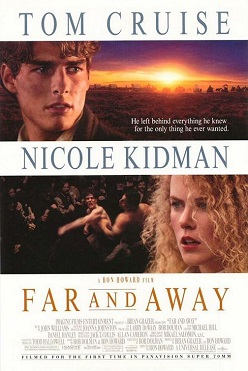
The year is 1892 and Joseph Donnelly (Tom Cruise) is a poor tenant famer in Ireland, used and exploited by the wealthy landowners. Joseph falls in love with Shannon Christie (Nicole Kidman), the rebellious daughter of his landlord. Shannon dreams of going to America, where rumor has it that land is being given away in the territory of Oklahoma on a first come/first serve basis. Shannon even has some valuable spoons that she can use to raise money once they arrive in America. Joseph, after being challenged to a duel by the Christies’ money manger, Stephen Chase (Thomas Gibson), also decides that heading to America might be a good idea.
Life in America is not as easy as Joseph and Shannon thought it would be. They first end up in the dirty town of Boston, where Shannon loses her spoons and Joseph works for a corrupt political boss (Colm Meaney) and makes money as a bare-knuckles boxer. They’ll reach Oklahoma eventually but not before Stephen and the Christies come to Boston and Joseph ends up working on the railroad and getting called “that crazy mick” multiple times.
Far and Away was Ron Howard’s attempt to make an American epic, in the style of John Ford. It doesn’t work because Tom Cruise is too contemporary to be believable as a 19th century Irish immigrant and Howard tries so hard to push everything to an epic scale that it just makes it even more obvious how slight and predictable the movie’s story is. Far and Away is full of big movie moments but it lacks the small human moments necessary to really engage its audience. I will always remembers Far and Away because it was one of those films that seemed to take up permanent residence on HBO when I was growing up. I didn’t really care about the film’s flaws back then. Nicole Kidman was attractive and tall and she had wild red hair and back then, that’s all a movie needed to hold my attention. Unlike Cruise, Nicole Kidman can effortlessly move between historical and contemporary films and, of the two leas, she comes off the best. The movie is really stolen, though, by Colm Meaney, playing a ruthless political boss who could have taught Boss Tweed a thing or two.
Tomorrow is St. Patrick’s Day, when we will be celebrating the legacy of immigrants like the Christies and the Donnellys. Far and Away tries to pay tribute to their courage and their refusal to give up, even when things were tough and deadly on the frontier. For me, though, Far and Away will always just make me think of HBO in the 90s.
The 1992 film, Hoffa, opens in 1975, with two men sitting in the backseat of a station wagon. One of the men is the controversial labor leader, Jimmy Hoffa (Jack Nicholson). The other is his longtime best friend and second-in-command, Bobby Ciaro (Danny DeVito). The two men are parked outside of a roadside diner. They’re waiting for someone who is late. Jimmy complains about being treated with such disrespect and comments that this would have never happened earlier. Jimmy asks Bobby if he has his gun. Bobby reveals that he does. Jimmy asks him if he’s sure that there’s a loaded gun in the diner, as well. Bobby goes to check.
Jimmy Hoffa, of course, was a real person. (Al Pacino just received an Oscar nomination for playing him in The Irishman.) He was a trucker who became a labor leader and who was eventually elected president of the Teamsters Union. He was a prominent opponent of the Kennedys and that infamous footage of him being interrogated by Bobby Kennedy at a Senate hearing seems to sneak its way into almost every documentary ever made about organized crime in the 50s. Hoffa was linked to the Mafia and was eventually sent to prison. He was freed by the Nixon administration, under the condition that he not have anything to do with Teamster business. When he disappeared in 1975, he was 62 years old and it was rumored that he was planning on trying to take over his old union. Everyone from the mob to the CIA has been accused of having had Hoffa killed.
Bobby Ciaro, however, was not a real person. Apparently, he was a composite character who was created by Hoffa’s screenwriter, David Mamet, as a way for the audience to get to know the enigmatic Jimmy Hoffa. Bobby is presented as being Hoffa’s best friend and, for the most part, we experience Jimmy Hoffa through his eyes. We get to know Jimmy as Bobby gets to know him but we still never really feel as if we know the film’s version of Jimmy Hoffa. He yells a lot and he tells Bobby Kennedy (a snarling Kevin Anderson) to go to Hell and he talks a lot about how everything he’s doing is for the working man but we’re never really sure whether he’s being sincere or if he’s just a demagogue who is mostly interested in increasing his own power. Bobby Ciaro is certainly loyal to him and since Bobby is played by the film’s director, it’s hard not to feel that the film expects us to share Bobby’s admiration. But, as a character, Hoffa never really seems to earn anyone’s loyalty. We’re never sure what’s going on inside of Hoffa’s head. Jack Nicholson is always entertaining to watch and it’s interesting to see him play a real person as opposed to just another version of his own persona but his performance in Hoffa is almost totally on the surface. With the exception of a few scenes early in the film, there’s doesn’t seem to be anything going on underneath all of the shouting.
The majority of Hoffa is told via flashback. Scenes of Hoffa and Bobby in the film’s present are mixed with scenes of Hoffa and Bobby first meeting and taking over the Teamsters. Sometimes, the structure of the film is a bit cumbersome but there are a few scenes — especially during the film’s first thirty minutes — that achieve a certain visual poetry. There’s a scene where Hoffa helps to change a man’s flat tire while selling him on the union and the combination of falling snow, the dark city street, and Hoffa talking about the working man makes the scene undeniably effective. The scenes where Hoffa spars with Bobby Kennedy are also effective, with Nicholson projecting an intriguing blue collar arrogance as he belittles the abrasively ivy league Bobby. Unfortunately, the rest of the movie doesn’t live up to those scenes. By the time Hoffa becomes a rich and influential man, you realize that the film isn’t really sure what it wants to say about Jimmy Hoffa. Does it want to condemn Hoffa for getting seduced by power or does it want to excuse Hoffa’s shady dealings as just being what he had to do to protect the men in his union? The film truly doesn’t seem to know.
Hoffa is definitely not an offer that you shouldn’t refuse but, at the same time, it’s occasionally effective. A few of the scenes are visually appealing and the cast is full of character actors like John C. Reilly, J.T. Walsh, Frank Whaley, and Nicholas Pryor. It’s not a disaster like The Gang Who Couldn’t Shoot Straight.Hoffa is an offer that you can take or leave.
Stephen King turned 70 last month, and the Master of Horror’s grip on the American psyche is stronger than ever, thanks to the unprecedented horror hit IT!, now playing at a theater near you. King’s macabre novels have been adapted for the screen since 1976’s CARRIE with varying degrees of success; some have been unabashed genre classics, others complete bombs, most lie somewhere in the middle.
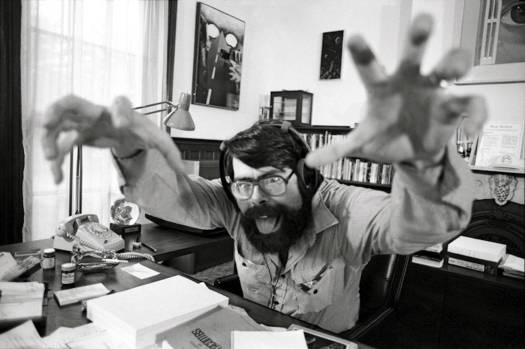
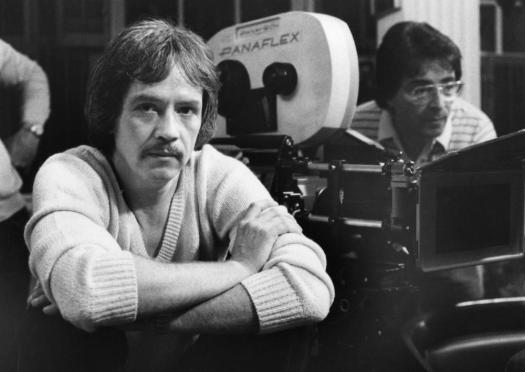
Top: Stephen King 1983 Bottom: John Carpenter 1983
Director John Carpenter had a string of successes beginning with 1978’s seminal slasher film HALLOWEEN, but his 1982 remake of THE THING, now considered a masterpiece of the genre, was a box office disappointment. Carpenter took on King’s novel CHRISTINE as a work-for-hire project. I recently watched it for the first time, and think not only is it one of the best adaptations of King’s work to hit the screen, it’s one of Carpenter’s best horror…
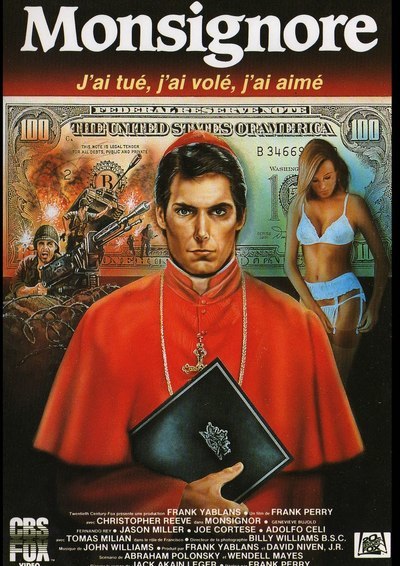
(Lisa is currently in the process of cleaning out her DVR! It’s taking her longer than it took Saint Malachy to transcribe The Prophecy of the Popes! She recorded the 1982 film, Monsignor, off of Retroplex on March 8th!)
Maybe it’s because I’m a fourth Italian and I was raised Catholic but Monsignor amused the Hell out of me.
See, Monsignor is a big, sprawling epic about the Church and the Mafia. I don’t know much about the production of this film but, having watched it, I’m going to guess that it was made by people who were neither Catholic nor Italian. This is one of those films that is so full of clichés and inaccuracies and yet so self-important that it becomes oddly fascinating to watch.
It tells the story of Father John Flaherty (Christopher Reeve, an Episcopalian who gives a performance so wooden that one worries about getting splinters just from watching it). When we first meet Father Flaherty, he’s just taken his orders. He’s a good Irish kid from Brooklyn. The neighborhood’s proud of him, because he has volunteered to serve as a chaplain in the army. (The film opens during World War II.) The neighborhood is even prouder when he performs a Mafia wedding. Don Appolini (Jason Miller), who may be a mobster but who still loves the Church, is especially impressed. He expects big things from Father Flaherty.
(The father of the bride, incidentally, is played by Joe Spinell, who played Willy Chicci in Godfathers One and Twoand who achieved a certain infamy when he starred in Maniac.)
Father Flaherty goes to war and discovers that it’s not easy to be a man of God in a war zone. Everywhere around him, soldiers are either dying or losing their faith. (Perhaps it would help if Father Flaherty knew how to properly conduct a Requiem Mass but the movie screws that up, with Flaherty saying, “”Requiescat in pace” when he clearly should have said, “Requiescant in pace.”) After trying, in vain, to comfort a mortally wounded man, Flaherty snaps, picks up a machine gun, and starts blowing away Germans.
Having broken the Thou Shalt Not Kill Commandment and indulged in one of the seven deadly sins, Father Flaherty apparently decides to commit every other sin as well. Or, at least, it seems like that’s his plan. The thing is, Christopher Reeve’s performance is bland that it’s difficult to guess what could possibly be going on inside of Flaherty’s head. Is he disillusioned with the church or does he still have faith? When he says that he feels guilty over his transgressions, is he being sincere or is he lying? It’s impossible to tell because, when it comes to Father Flaherty, there’s no there there. He’s literally an empty vessel.
That, of course, doesn’t stop him from becoming a powerful man in the Church. Through his Mafia connections, he makes a fortune on the black market and launders money for the church. He also has sex with a cynical, nymphomaniac postulant nun, who is something of a stock figure in films like this. In this case, the role is played by Genevieve Bujold. Despite the stereotypical nature of her character, Bujold comes the closest of anyone in the cast to giving a nuanced performance but her character abruptly vanishes from the film. One can literally hear the producers in the background saying, “Okay, we’ve indulged in the sexy nun thing. Send her home now.”
Towards the end of the film, there’s a flash forward that is so abrupt that I didn’t even realize it had happened until I noticed that Christopher Reeve and Jason Miller now had a little gray in their hair. The flash forward doesn’t really accomplish much. Father Flaherty has lost a lot of the Mafia’s family and the Mafia’s not happy about it. It’s kinda like the Vatican subplot in The Godfather Part III, just with less interesting actors.
Anyway, Monsignor obviously thinks that it has something to say about both the Church and the Mafia but it’s actually remarkably empty-headed. Strangely enough, for an epic film that cost 10 million dollars to make (that’s in 1982 money), the whole film looks remarkably cheap. If a community theater decided to put on a production of Otto Preminger’s The Cardinal, the end result would probably end up looking a lot like Monsignor.
And yet, I really can’t hate Monsignor. It’s so bad that, as I said earlier, it’s also oddly fascinating. You watch and you ask yourself, How many details can one film about Catholicism get wrong? How many Italian stereotypes can be forced into a movie with a Mafia subplot? Now, I should point out that, at no point, does Don Appolini say, “Mama mia!” but, if he had, I wouldn’t have been surprised. It’s just that type of film.
Anyway, Monsignor is so sordid and stupid that it becomes entertaining for all the wrong reasons. If you’re into that, you’ll enjoy Monsignor.
(For those following at home, Lisa is attempting to clean out her DVR by watching and reviewing 38 films by the end of this Friday. Will she make it? Keep following the site to find out!)
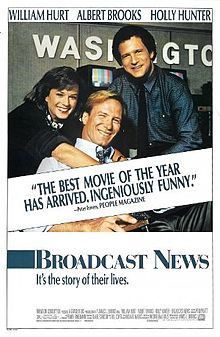
I’ll give you three chances to guess what the 1987 film Broadcast News is about.
Broadcast News takes place at the Washington bureau of a major network news operation. (You can tell this film was made in the 80s in that nobody’s working for a blog and there’s no mention of Fox, MSNBC, or CNN.) This is where a group of hard-working men and women do their best to make the national news anchor, Bill Rorish, look good.
Bill Rorish is played by Jack Nicholson and, even though he only has about five minutes of screen time (out of a 133 minute movie), he pretty much dominates the entire film. Some of that is because he’s Jack Nicholson and he kicks ass. All Jack has to do to dominate a scene is show up and arch an eyebrow. But, beyond that, everyone in the movie is obsessed with impressing Bill Rorish. Whenever a reporter and his producer get a story on the air, they obsessively watch to see if Bill smiles afterward. Bill Rorish is the God they all hope to please and the film (as well as Nicholson’s performance) suggests that he barely even knows that they’re alive. It’s telling that the only time Bill shows up in person (as opposed to appearing on a TV screen), it’s because a huge number of people at the Washington bureau are being laid off.
When Bill says that it’s a shame that budget cuts are leading to so many good newspeople being laid off, someone suggests that maybe Bill could help by taking a cut in his million-dollar salary. Needless to say, Bill Rorish is not amused.
Broadcast News centers on three of the characters who work at the Washington Bureau. First off, there’s Jane Craig (Holly Hunter), a producer. Jane is a true believer in the mission and the importance of journalism. Her ethics and her belief in what constitutes proper journalism are everything to her and, at times, she can get more than a little self-righteous about it. (If Broadcast News were made today, Jane would spend the entire movie whining about how new media is destroying the country.) At the same time, Jane is completely neurotic, a self-described “basket case” who, at one point, ends up sobbing in a hotel room as she prepares to go to sleep by herself.
Jane’s best friend is Aaron Altman (Albert Brooks), a reporter who wants to someday be an anchor. Aaron is smart and funny (and he better be, seeing as how he’s being played by Albert Brooks) but he’s not telegenic and he’s almost as neurotic as Jane. Like Jane, Aaron is all about journalistic ethics but there’s a defensiveness to Aaron. Whenever Aaron complains about vapid news anchors, it’s obvious that he’s more jealous than outraged.
And then there’s Tom Grunick (William Hurt), who represents everything that Jane and Aaron claim to be against. He’s handsome, he’s smooth, he’s charismatic, and he’s definitely not an intellectual. He knows little about the specifics of current events. However, he has great instincts. He knows how to sell a story and he knows how to present himself on camera. He’s also a surprisingly nice and sincere guy, which makes it all the more difficult for Aaron to justify his belief that “Tom is the devil.”
From the minute that Tom arrives at the Washington bureau, there’s a strong attraction between Tom and Jane. (Jane even sends another reporter to Alaska after she finds out that Tom slept with her.) Tom wants to be a better reporter. Jane wants to be happy but fears compromising her ethics. And Aaron … well, Aaron wants Jane.
Not surprisingly, considering that the film was made 29 years ago, there were some parts of Broadcast News that felt extremely dated. A scene where Aaron complains about a story that Tom did on date rape feels especially uncomfortable when viewed today and both Jane and Aaron occasionally came across as being a bit too self-righteous. In today’s media world, Tom’s sins really didn’t seem like that big of a deal.
But, for the most part, I enjoyed Broadcast News. It was an intelligent film, one the featured people having actual conversations about actual ideas and, listening to them, I realized how rare, in both movies and real life, that actually is. It’s a witty film, full of good performances. While I hope I never become as self-righteous as Jane, I could still relate to her in her more neurotic moments. And who wouldn’t want a best friend like Aaron?
And, for that matter, who wouldn’t want a lover like Tom?
(That’s something I never expected to write about a character played by William Hurt.)
And, of course, there’s this scene. Poor Aaron!
Broadcast News was nominated for best picture of 1987. However, it lost to The Last Emperor.
During the late 1970s and early 1980s, one could hardly step into a theater during the fall or winter movie season without seeing a trailer for the newest Stephen King adaptation. His name had become synonymous with cinematic horror, and nearly every year brought a new film promising supernatural terror or psychological unease.
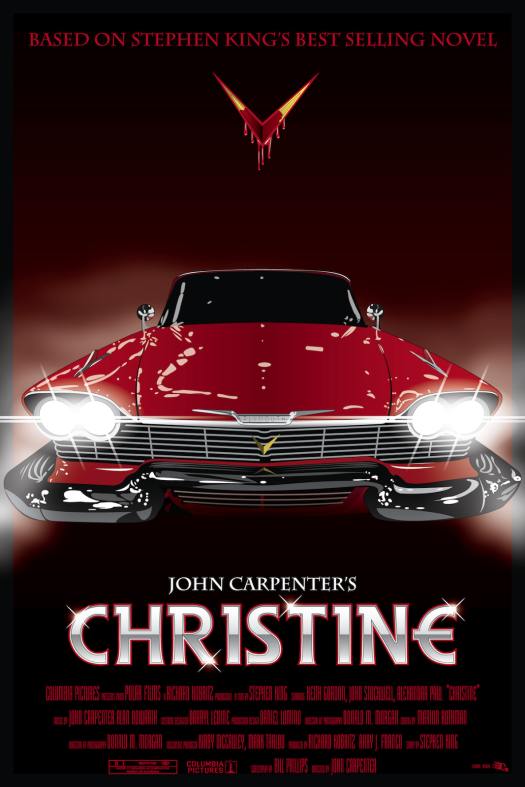
Among this wave of adaptations came a 1983 film that united two masters of the genre—Stephen King, the reigning literary giant of horror, and John Carpenter, the filmmaker who had already cemented his reputation with Halloween and The Thing. Their collaboration resulted in the sleek, deadly story of a boy and his car: Christine.
The film opens on the assembly line of a Plymouth factory in 1957, immediately signaling that something is off about this particular 1958 Plymouth Fury. From the first note of the retro rock soundtrack to the gleam of that deep crimson paint, Carpenter frames the car with both nostalgia and menace. The lighting in this opening feels almost clinical—bright, sterile, mechanical—yet Christine’s red sheen cuts violently through it, a visual omen that this machine is infused with something beyond metal and chrome. Carpenter wastes no time making it clear that this car is not an inanimate prop; it’s a living entity from the moment it’s born.
We’re soon introduced to the film’s human core—Arnie Cunningham (Keith Gordon), a shy, bookish teenager tormented by bullies and smothered by his controlling parents, and his best friend Dennis Guilder (John Stockwell), the confident star athlete who often looks out for him. One afternoon, during their drive home from school, Arnie spots a rusting, decrepit Plymouth Fury in the front yard of an old man named Roland D. LeBay. Where Dennis sees a heap of junk, Arnie sees perfection. Ignoring his friend’s concerns—and later, his parents’ outrage—Arnie buys the car and names it Christine.
As Arnie begins restoring Christine to her former glory, a transformation occurs—not just in the car, but in Arnie himself. The once timid, acne-scarred teenager grows into a confident, even arrogant young man, donning slicker clothes, sharper speech, and a darker aura. Christine becomes his obsession, his refuge, and ultimately, his identity.
Carpenter crafts this metamorphosis with eerie precision, pairing the car’s physical renewal with Arnie’s psychological decay. The cinematography shifts accordingly—the lighting grows darker, drenched in neon reds and shadowy blues, mirroring Christine’s two faces: seductive allure and demonic possession. Carpenter’s score, a pulsing blend of electronic rhythm and minimalistic dread, underscores these shifts. It functions almost like Christine’s heartbeat—steady, mechanical, and ominously sensual.
Between the vintage rock tracks that accompany Arnie’s moments of infatuation and the electronic motifs that follow Christine’s predatory stalks, Carpenter manipulates sound to blur the lines between teenage romance and supernatural horror. Every rev of the engine feels rhythmic, almost musical, as if the car itself communicates through vibration and tone rather than words.
Arnie’s newfound confidence even earns him Leigh Cabot (Alexandra Paul), the most desired girl in school—a relationship that initially feels like a symbol of his triumph. But Christine is no fairy tale. When Arnie’s bullies vandalize his beloved car, the story turns from eerie to vengeful.
In a now-iconic sequence, Christine repairs herself before Arnie’s stunned eyes—the crumpled metal expands, glass re-forms, headlights ignite like eyes opening from a nightmare. Carpenter lights the scene with a soft, golden underglow that turns mechanical resurrection into a hauntingly beautiful transformation. It’s both horrifying and hypnotic—a perfectly scored ballet of vengeance set to the hum of machinery and the director’s unmistakable electronic pulse.
What follows is a furious killing spree. Christine prowls the night streets for retribution, a creature of fire and gasoline more alive than metal should ever be.
While Carpenter’s adaptation diverges from King’s novel, it remains faithful to its emotional and thematic essence. King’s book delves deeply into the idea of objects absorbing the evil of their owners, suggesting that malevolence can linger in things as much as in people. Carpenter, however, turns the focus inward.
His version becomes a tragic character study—a battle for Arnie’s soul between the cold, seductive power of obsession and the fragile warmth of human connection. In one corner stands Christine, the car that offers Arnie unconditional love but demands total possession. In the other are Dennis and Leigh, desperate to save the friend they’re rapidly losing to something they can’t fully understand.
Carpenter’s signature touches—his electronic score, minimalist framing, and cynical tone—imbue the film with a dark romanticism. Christine is less a haunted object than a femme fatale: a mechanized embodiment of jealousy and desire. The film’s atmosphere bridges two eras, combining the nostalgic vibe of 1950s Americana with the grim realism of Reagan-era suburbia.
By the end, Christine becomes both a story of supernatural obsession and a commentary on teenage identity—the hunger to shed weakness, to command respect, and to control one’s fate, even at the cost of one’s soul.
Upon its release in December 1983, Christine performed modestly at the box office but was far from a failure. Over time, it has developed a strong cult following, cherished by both Carpenter devotees and Stephen King fans. Though often overshadowed by Carpenter’s heavier-hitting works like The Thing or Escape from New York, Christine remains one of his most technically polished films. It also stands as a fascinating bridge between studio horror and Carpenter’s independent sensibilities—where the shine of a Hollywood production mingles with the grit of a B-movie heart.
If Christine teaches any lesson, it’s that love and possession are two sides of the same coin. Arnie’s tragedy lies not in falling for the wrong woman, but in falling for one that burns with literal hellfire. In Carpenter’s vision, the road to damnation isn’t paved with good intentions—it’s lined with chrome, lit by headlights, and always hungry for one more ride.





 Through the Shattered Lens