Lisa’s Far Too Early Oscar Predictions For March


So, it’s that time of the month again!

No, not that time.  I meant, that it’s time for me to share my Oscar predictions.  Here are the usual disclaimers: I haven’t seen any of these films, it’s way too early in the year for me to attempt to do this, this list is all about instinct and wishful thinking, blah blah blah blah.

To see how my thinking has evolved, be sure to check out my predictions for January and February!

Best Picture

A Beautiful Day In The Neighborhood

Call of the Wild

Fair and Blanced

Ford v. Ferrari

Harriet

The Irishman

The Last Black Man in San Francisco

Little Women

Once Upon A Time In Hollywood

Torrance

Best Director

Greta Gerwig for Little Women

Kasi Lemmons for Harriet

Martin Scorsese for The Irishman

Joe Talbot for The Last Black Man In San Francisco

Quentin Tarantino for Once Upon A Time In Hollywood

Best Actor

Ben Affleck in Torrance

Robert De Niro in The Irishman

Tom Hanks in A Beautiful Day In the Neighborhood

John Lithgow in Fair and Balanced

Eddie Murphy in My Name Is Dolemite

Best Actress

Amy Adams in The Woman In The Window

Cynthia Erivo in Harriet

Blake Lively in The Rhythm Section

Saoirse Ronan in Little Women

Afre Woodard in Clemency

Best Supporting Actor

Matt Damon in Ford v Ferrari

Harrison Ford in Call of the Wild

Danny Glover in The Last Black Man in San Francisco

Malcolm McDowell in Fair and Balanced

Brad Pitt in Once Upon A Time In Hollywood

Best Supporting Actress

Laura Dern in Little Women

Tiffany Haddish in The Kitchen

Nicole Kidman in The Goldfinch

Janelle Monae in Harriet

Margot Robbie in Once Upon A Time In Hollywood

A few notes on the predictions:

A Beautiful Day In The Neighborhood is a biopic about Mr. Rogers.  Mr. Rogers is played by Tom Hanks and this sounds like the type of role that could get him his first Oscar nomination since …. well, forever.

Call of the Wild is an adaptation of Jack London’s novel.  It apparently features a CGI wolf.  It also has a potentially good supporting role for Harrison Ford, who has only one previous nomination to his name.

Fair and Balanced is about the history of Fox News and it was directed by Jay Roach.  It sounds terrible but if Vice and Adam McKay could get a nomination just for attacking Dick Cheney, I wouldn’t be surprised if Fair and Balanced manages to do the same.  John Lithgow plays Roger Ailes while the never-nominated Malcolm McDowell plays Rupert Murdoch.

Ford v Ferrari is a film about cars and competition and, if it’s a box office success, it sounds like it could pick up some nominations.  The film stars Christian Bale and Matt Damon.  I placed Damon in the supporting category because he plays Bale’s boss and his character is described as being “eccentric.”

Harriet is a biopic of Harriet Tubman.  It just sounds like it should be an Oscar nominee.  Cynthia Erivo plays Harriet while Janelle Monae …. well, I’m not sure who she plays.  But I’m going to predict she’ll get a supporting actress nomination.  What can I say?  It’s early in the year and supporting actress is always hard to predict.

The Irishman is directed by Martin Scorsese and it has a cast to die for: Robert De Niro, Al Pacino, Joe Pesci, Harvey Keitel, Anna Paquin, Bobby Cannavale, Ray Romano, and more!  The Irishman should also have the full force of Netflix behind it.  My one concern is that the film is apparently going to use CGI to “de-age” its cast so that they can play characters who are in their 30s and 40s.  If it works, it’ll be great.  If it doesn’t, it’s going to be a huge distraction from whatever else is going on in the movie.

The Last Black Man in San Francisco was a big hit at Sundance.  Can Joe Talbot get a nomination for his directorial debut?  Can Danny Glover score his first ever nomination?  We’ll find out!

Little Women is Greta Gerwig’s follow-up to Lady Bird.  Previous adaptations of Little Women have done well at the Oscars.  I’m predicting acting nominations for Saoirse Ronan and Laura Dern but Meryl Steep is also in this film so she’s definitely a possibility as well.  At this point, Meryl could get nominated for appearing in a two-minute video on YouTube.

Once Upon A Time In Hollywood is Quentin Taranino’s 9th film.  Tarantino’s film usually do well with the Oscars and Once Upon A Time In Hollywood is about Hollywood’s favorite subject, itself.  Some would say that Brad Pitt is overdue for an acting win.  Margot Robbie, meanwhile, is a rising star and some feel that she should have won for I, Tonya.

Torrance features Ben Affleck in what sounds like an Oscar bait role.  Affleck plays an alcoholic who ends up coaching a high school basketball team.  Director Gavin O’Connor previously worked wonders with Warrior so Torrance sounds right up his alley.

My Name is Dolemite is a biopic of the comedian and blaxploitation film star, Rudy Ray Moore.  Eddie Murphy plays Moore and the role sounds like it could allow him to display both his comedic and dramatic skills.  In theory, the Academy loves a comeback.

The Woman In The Window is based on an excellent novel and features Amy Adams as an agoraphobic woman who thinks that she may have witnessed a murder.  Adams is definitely a bit overdue for an Oscar.

The Rhythm Section is also based on a novel.  While it’s thriller plot doesn’t sound like typical Oscar bait, the film’s release was moved from February to November.  That would seem to indicate that Paramount has faith in both it and Blake Lively’s lead performance.

Clemency was another hit at Sundance.  Alfre Woodard is an acclaimed actress who has only been twice nominated for an Oscar.  A nomination here would honor not just Woodard’s performance but her entire career.

The Kitchen is a crime drama.  Tiffany Haddish, who is definitely an up-and-coming star, plays the wife of a Irish mobster who, when her husband is sent to prison, takes over his rackets.  It sounds like a good role and there are a lot of people who think Haddish’s performance in Girls Trip was unfairly snubbed.

The Goldfinch is based on a novel by Donna Tartt.  Nicole Kidman plays a wealthy widow who adopts the survivor of a terrorist bomber.  It just sounds like the type of role for which Kidman would be nominated.

In the end, nobody knows anything.  Especially me!  We’ll see how all of this plays out over the next few months!


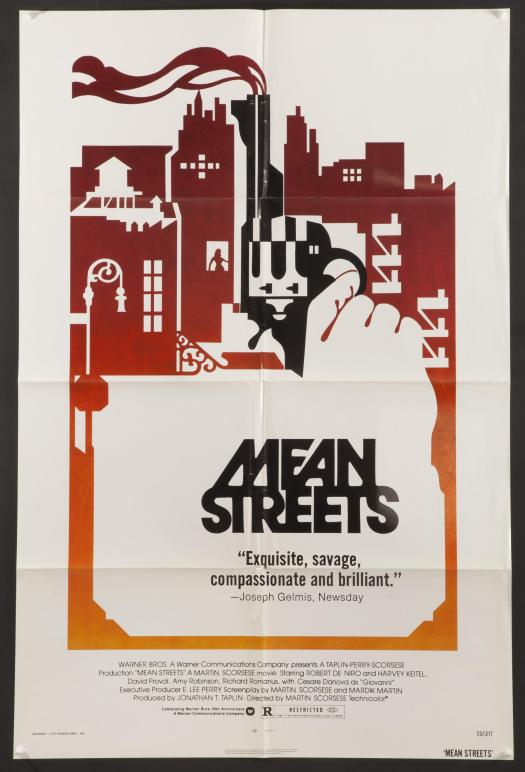
Made Man: Martin Scorsese’s MEAN STREETS (Warner Brothers 1973)


gary loggins's avatarcracked rear viewer

Let’s talk about Martin Scorsese a bit, shall we? The much-lauded, Oscar-winning director/producer/film historian has rightly been recognized as one of out greatest living filmmakers, with classics like TAXI DRIVER, RAGING BULL, GOODFELLAS, GANGS OF NEW YORK, and THE DEPARTED on his resume. Yet Scorsese started small, directing shorts and the low-budget WHO’S THAT KNOCKING AT MY DOOR? as a film student. He got work as an editor (UNHOLY ROLLERS) and assistant director (WOODSTOCK) before directing a feature for Roger Corman called BOXCAR BERTHA, starring Barbara Hershey and David Carradine. When Scorsese and Mardik Martin cowrote a screenplay based on Martin’s experiences growing up in New York’s Little Italy, Corman wanted to produce, but only if the film could be turned into a Blaxploitation movie! Fortunately, Warner Brothers picked it up, and the result was MEAN STREETS, which put Scorsese on the map as a filmmaker to be reckoned with.

View original post 554 more words

Lisa’s Way Too Early Oscar Predictions for February


Well, with the 2018 Oscars finally out of the way, we can now shift our focus to the 2019 race.

As of February, that race is totally cloudy.  The predictions below should be taken with a grain of salt because 1) they’re mostly wild guesses and 2) the Oscar race never starts to become clear until after the summer.  You could probably argue that doing predictions this early in the year is a pointless exercise but here we are!

Best Picture

A Beautiful Day In The Neighborhood

Call of the Wild

Captain Marvel

Harriet

The Irishman

The Last Thing He Wanted

Little Women

Once Upon A Time In Hollywood

The Report

Toy Story 4


Best Director

Greta Gerwig for Little Women

Kassi Lemmons for Harriet

Chris Sanders for Call of the Wild

Martin Scorsese for The Irishman

Quentin Tarantino for Once Upon A Time In Hollywood


Best Actor

Christian Bale in Ford v Ferrari

Robert De Niro in The Irishman

Taron Egerton in Rocketman

Tom Hanks in A Beautiful Day In The Neighborhood

Ian McKellen in The Good Liar


Best Actress

Amy Adams in The Woman In The Window

Cynthia Erivo in Harriet

Saoirse Ronan in Little Women

Emma Thompson in Late Night

Alfre Woodard in Clemency


Best Supporting Actor

Willem DaFoe in The Last Thing He Wanted

Matt Damon in Ford v Ferrari

Harrison Ford in Call of the Wild

Al Pacino in The Irishman

Brad Pitt in Once Upon A Time In Hollywood


Best Supporting Actress

Annette Bening in The Report

Nicole Kidman in The Goldfinch

Janelle Monae in Harriet

Margot Robbie in Once Upon A Time in Hollywood

Meryl Streep in Little Women


After checking out my pointless predictions for February, be sure to check out my even more pointless predictions for January!

Lisa’s way, way, way, way, way too early Oscar predictions for January


Attempting, in January, to predict what will be nominated for an Oscar next year is a largely pointless exercise but it’s one that I do every year.  What can I say?  I like the Oscars.  I like rituals.  And I like making lists.

But seriously, don’t take these predictions too seriously.  For the most part, they’re based on wild guesses and familiar names.  For instance, The Irishman is listed because it’s a Scorsese film but that didn’t really help out Silence.  Once Upon A Time In Hollywood is listed because it’s a Tarantino film.  Tom Hanks is listed because …. well, he’s Tom Hanks.  Late Night and The Report are listed because of the excitement they generated at Sundance but Sundance hype doesn’t always last for a full 12 months.  I’d love to see Amy Adams finally win an Oscar for The Woman In The Window but, to be honest, I couldn’t visualize anyone other than Naomi Watts in the lead role when I read the novel.

At this time last year, no one had heard of Green Book.  Bohemian Rhapsody looked like it might just end up going straight to HBO.  No one suspected Black Panther would be the first comic book movie to be nominated for best picture.  Richard E. Grant was on no one’s radar and anyone who says they thought Roma and The Favourite would be the most nominated films of the year is a damn liar.  It’s too early to make any sort of real guess about what will be nominated next year.

However, it’s never too early to make some cray, wild guesses!

Here are my way, way, way, way, way too early Oscar predictions for January.  Some day, perhaps tomorrow, we’ll look back at these predictions and laugh.  And then I’ll cry because it’s never fun when people laugh at you….


Best Picture

A Beautiful Day In The Neighborhood

Call of the Wild

The Irishman

Late Night

Little Women

Once Upon A Time In Hollywood

The Report

Toy Story 4

Where’d You Go, Bernadette?

The Woman in the Window

Best Director

Nisha Ganatra for Late Night

Greta Gerwig for Little Women

Martin Scorsese for The Irishman

Quentin Tarantino for Once Upon A Time In Hollywood

Joe Wright for The Woman In The Window

Best Actor

Robert De Niro in The Irishman

Leonardo DiCaprio in Once Upon A Time In Hollywood

Tom Hanks in A Beautiful Day In The Neighborhood

Joaquin Phoenix in Joker

Brad Pitt in Once Upon A Time In Hollywood

Best Actress

Amy Adams in The Woman In The Window

Annette Bening in The Report

Cate Blanchett in Where’d You Go, Bernadette?

Saoirse Ronan in Little Women

Emma Thompson in Late Night

Best Supporting Actor

Harrison Ford in Call of the Wild

Damon Herriman in Once Upon A Time In Hollywood

Sir Ian McKellen in Cats

Al Pacino in The Irishman

Wyatt Russell in The Woman In The Window

Best Supporting Actress

Dame Judi Dench in Cats

Laura Dern in Little Women

Nicole Kidman in The Goldfinch

Anna Paquin in The Irishman

Margot Robbie in Once Upon A Time in Hollywood

“Going All Kanye On You”: New Year’s Eve (dir by Garry Marshall)


“New Year’s Eve is the worst, people who don’t drink or party all year suddenly going all Kanye on you.”

That line was delivered by Ashton Kutcher in the 2011 film, New Year’s Eve.  Seven years ago, when the film was first released, I thought it was an awkward line, partially because Ashton Kutcher sounded like he was drowning in self-loathing when he said it and partially because the sudden reference to Kanye West felt like something that would be considered clever by 60-something screenwriter who had just spent a few hours scanning twitter to see “what the kids are into nowadays.”

(Of course, hearing the line in 2018 was an even stranger experience.  People who don’t drink or party all year suddenly going all Kanye on you?  So, they’re putting on red MAGA caps and spending New Year’s Eve tweeting about prison reform?  True, that’s the way a lot of people celebrated in my part of the world but I’m not sure how exactly that would play out in Times Square.)

In New Year’s Eve, Kutcher plays a character named Randy.  Randy is a comic book artist, which means that he’s snarky and cynical and doesn’t really see the point of celebrating anything.  Fortunately, he gets trapped in an elevator with Elise (Lea Michele) and, with her help, he comes to learn that New Year’s Eve is not the worst.  Instead, it’s the most important holiday ever created and, if you don’t think so, you’re worse than the devil.

Fortunately, Hillary Swank is present to make sure that we all get the point.  Swank plays Claire Morgan, who is in charge of making sure that the ball drops at exactly the right moment at Times Square and who gets a monologue where she explains that the purpose of the ball is to make you think about both the past and the future.  As she explains it, the world comes together one night a year, all so everyone can watch that ball drop.  Apparently, if the ball doesn’t drop, the new year doesn’t actually start and everyone is trapped in a timeless limbo, kind of like Iron Man at the end of Avengers: Infinity War.

Of course, there’s more going on in New Year’s Eve than just Randy taking Kanye’s name in vain and Claire refusing the accept that Times Square is not the center of the universe.  There’s also an old man (Robert De Niro) who wants to time his death so he passes right at the start of the new year.  Sarah Jessica Parker plays the mother of frustrated teenager Abigail Breslin and gets to make a “girls gone wild” joke.  (A Kanye reference and a girls gone wild joke in the same film?  It’s like a pop culture tsunami!)  Michelle Pfeiffer tries to accomplish all of her new year’s resolutions with the help of Zac Efron.  Halle Berry worries about her husband (Common) , who is serving overseas.  Josh Duhamel searches for a woman who once told him that his heart was more important than his business.  Seth Meyers and Jessica Biel compete with Til Schweiger and Sarah Paulson to see who can be the family of the first child born in the new year.  Jon Bon Jovi thinks about the woman that he nearly married and Katherine Heigl wonders if she’s ever going to have a career again.  In other words, New Year’s Eve is an ensemble piece, one in which a bunch of slumming Oscar winners and overachieving TV actors step into small roles.  It leads to some odd pairings.  De Niro, for instance, shares scenes with Alyssa Milano while Sofia Vergara and Ludacris are both relegated to playing sidekicks.  Michael Bloomberg, New York’s then-mayor and general threat to civil liberties everywhere, also shows up, playing himself with the type of smarminess that already has many people dreading the prospect of his 2020 presidential campaign.  This is one of those films where everyone has a familiar face but no one makes much of an impression.

New Year’s Eve was directed by the late Garry Marshall and it’s the second film in his so-called holiday trilogy, sitting right between Valentine’s Day and Mother’s Day.  By most accounts, Garry Marshall was a nice guy and popular in the industry, which perhaps explains why so many familiar faces were willing to sign up to appear in New Year’s Eve.  Though the film is ruthlessly mediocre, it’s actually the best of the holiday trilogy.  For all the schmaltz and forced sentiment, one gets the feeling that the film actually is sincere in its belief in the importance of that ball dropping in Times Square.

I remember that, when New Year’s Eve was first released, a lot of people joked that Marshall was going to make an ensemble romantic comedy about every single holiday, all with the hope that at least one of them would eventually become a television perennial in the style of It’s A Wonderful Life or The Ten Commandments.  Interestingly, that’s exactly what happened with New Year’s Eve.  Yesterday, E! aired New Year’s Eve three times, back-to-back!  For better or worse, this film is probably going to outlive us all, ensuring that, in the far future, viewers will spend New Year’s Eve asking themselves, “What’s a kanye?”

Horror Film Review: Mary Shelley’s Frankenstein (dir by Kenneth Branagh)


http://www.youtube.com/watch?v=GFaY7r73BIs

Oh my God, this is an exhausting movie.

Directed by and starring Kenneth Branagh, the 1994 film Mary Shelley’s Frankenstein sticks pretty closely to the plot (if not the tone) of Mary Shelley’s original novel.  What that means is that this movie includes a lot of the good stuff that often seems to get left out of other Frankenstein adaptations.  For instance, we learn more about the life of Victor Frankenstein (Kenneth Branagh) before he created his monster.  We find out about his family and his troubled romance with Elizabeth (Helena Bonham-Carter).  Victor’s good friend Henry Clerval (Tom Hulce) is included and so is Professor Waldman (John Cleese) and Captain Robert Walton (Aidan Quinn).

It also means that we get to watch as the Monster (Robert De Niro) flees into the wilderness and later befriends a kindly blind man (Richard Briers).  The Monster, as always, is happy until mankind interferes and treats him unfairly.  The Monster learns to speak and, after it learns to read, it discovers who created it and it sets out for revenge.  We watch as everyone that Victor Frankenstein cares about dies, all as a result of his desire to play God.

And yet, while you have to respect the fact that Branagh tried to stay (more or less) true to the plot of the original novel, Mary Shelley’s Frankenstein is a bit of a chore to sit through.  A huge part of the problem is that Kenneth Branagh cast himself to play Victor Frankenstein.  In the book, Victor is a rather sickly character and his desire to create life is probably as much inspired by his own poor health and the death of the people close to him.  In the film, Branagh plays Victor as being almost a Byronic figure, with the camera emphasizing his flowing hair and his muscular physique.  Even when Victor does push himself to the point of death in his research, you never really believe it because Branagh the director isn’t willing to let Branagh the actor look weak or malnourished.  However, turning Victor into an alpha male also turns him into a jerk.  Unlike say Colin Clive or Peter Cushing in The Curse of Dracula, you never find yourself sympathizing with Kenneth Branagh’s Victor.

And then you have Robert De Niro as the Monster.  Now, really, I imagine that — in 1994 — the idea of De Niro playing the Monster seemed like an obvious one.  I mean, the Monster is a great role and De Niro’s one of the greatest actors who ever lived so if anyone could find a new and interesting way to play Frankenstein’s Creation, it would have to be De Niro, right?

But no.  First off, De Niro may be a great actor but it’s hard to accept the idea that a monster created in Germany would speak with a New York accent.  Even under tons of makeup, De Niro does an okay job of projecting the Monster’s rage but, unlike Karloff or Christopher Lee, De Niro never seems to really connect with the character.  You never forget that you’re watching a heavily made-up Robert De Niro.  De Niro often seems to be rather detached from what’s happening on screen.

Branagh’s directs in a manner that can only be called operatic, which turns out to be a mistake.  The story is already dramatic enough without Branagh spinning the camera around every few moments.  There’s not a subtle moment to be found in the film but unfortunately, Frankenstein is a story that needs just a little bit of subtlety.  It all gets to be a bit overwhelming and, by the time the Monster is literally ripping a heart out of a body, you’re just like, “Enough already!”

It’s just a really tiring movie.

Stallone Acts: Cop Land (1997, directed by James Mangold)


Garrison, New Jersey is a middle class suburb that is known as Cop Land.  Under the direction of Lt. Ray Donlan (Harvey Keitel), several NYPD cops have made their home in Garrison, financing their homes with bribes that they received from mob boss Tony Torillo (Tony Sirico).  The corrupt cops of Garrison, New Jersey live, work, and play together, secure in the knowledge that they can do whatever they want because Donlan has handpicked the sheriff.

Sheriff Freddy Heflin (Sylvester Stallone) always dreamed of being a New York cop but, as the result of diving into icy waters to save a drowning girl, Freddy is now deaf in one ear.  Even though he knows that they are all corrupt, Freddy still idolizes cops like Donlan, especially when Donlan dangles the possibility of pulling a few strings and getting Freddy an NYPD job in front of him.  The overweight and quiet Freddy spends most of his time at the local bar, where he’s the subject of constant ribbing from the “real” cops.  Among the cops, Freddy’s only real friend appears to be disgraced narcotics detective, Gary Figgis (Ray Liotta).

After Donlan’s nephew, Murray Babitch (Michael Rapaport), kills two African-American teenagers and then fakes his own death to escape prosecution, Internal Affairs Lt. Moe Tilden (Robert De Niro) approaches Freddy and asks for his help in investigating the corrupt cops of Garrison.  At first, Freddy refuses but he is soon forced to reconsider.

After he became a star, the idea that Sylvester Stallone was a bad actor because so universally accepted that people forgot that, before he played Rocky and Rambo, Stallone was a busy and respectable character actor.  Though his range may have been limited and Stallone went through a period where he seemed to always pick the worst scripts available, Stallone was never as terrible as the critics often claimed.  In the 90s, when it became clear that both the Rocky and the Rambo films had temporarily run their course, Stallone attempted to reinvent his image.  Demolition Man showed that Stallone could laugh at himself and Cop Land was meant to show that Stallone could act.

For the most part, Stallone succeeded.  Though there are a few scenes where the movie does seem to be trying too hard to remind us that Freddy is not a typical action hero, this is still one of Sylvester Stallone’s best performances.  Stallone plays Freddy as a tired and beaten-down man who knows that he’s getting one final chance to prove himself.  It helps that Stallone’s surrounded by some of the best tough guy actors of the 90s.  Freddy’s awkwardness around the “real” cops is mirrored by how strange it initially is to see Stallone acting opposite actors like Harvey Keitel, Robert De Niro, and Ray Liotta.  Cop Land becomes not only about Freddy proving himself as a cop but Stallone proving himself as an actor.

The film itself is sometimes overstuffed.  Along with the corruption investigation and the search for Murray Babitch, there’s also a subplot about Freddy’s unrequited love for Liz Randone (Annabella Sciorra) and her husband’s (Peter Berg) affair with Donlan’s wife (Cathy Moriarty).  There’s enough plot here for a Scorsese epic and it’s more than Cop Land‘s 108-minute run time can handle.  Cop Land is at its best when it concentrates on Freddy and his attempt to prove to himself that he’s something more than everyone else believes.  The most effective scenes are the ones where Freddy quietly drinks at the local tavern, listening to Gary shoot his mouth off and stoically dealing with the taunts of the people that he’s supposed to police.  By the time that Freddy finally stands up for himself, both you and he have had enough of everyone talking down to him.  The film’s climax, in which a deafened Freddy battles the corrupt cops of Garrison, is an action classic.

Though the story centers on Stallone, Cop Land has got a huge ensemble cast.  While it’s hard to buy Janeane Garofalo as a rookie deputy, Ray Liotta and Robert Patrick almost steal the film as two very different cops.  Interestingly, many members of the cast would go on to appear on The Sopranos.  Along with Sirico, Sciorra, Patrick, and Garofalo, keep an eye out for Frank Vincent, Arthur Nascarella, Frank Pelligrino, John Ventimiglia, Garry Pastore,  and Edie Falco in small roles.

Cop Land was considered to be a box office disappointment when it was released and Stallone has said that the film’s failure convinced people that he was just an over-the-hill action star and that, for eight years after it was released, he couldn’t get anyone to take his phone calls.  At the time, Cop Land‘s mixed critical and box office reception was due to the high expectations for both the film and Stallone’s performance.  In hindsight, it’s clear that Cop Land was a flawed but worthy film and that Stallone’s performance remains one of his best.


Cannes Film Review: The Mission (dir by Roland Joffe)


(With this year’s Cannes Film Festival coming to a close, I figured that I would start of today by looking at some previous winners of the Palme d’Or.  We start things off with 1986’s The Mission.)

The Mission opens with a man stoically plunging over a waterfall.  That man is a priest who, in the 1740s, has been sent to convert the natives of the Paraguayan jungle to Christianity.  The natives’ reaction to the priest’s arrival was to tie him to a wooden cross and send him over the falls.  It’s an opening that perfectly captures one of the main themes of The Mission: the contrast between the beauty of nature and the savagery of man.

The majority of the film deals with two men.  Father Gabriel (Jeremy Irons) is the Spanish Jesuit who replaces the martyred priest.  Father Gabriel is a pacifist who manages to win the trust of the natives through a shared love of music.  Gabriel plays the oboe and, when it is snatched away from him, reacts not with anger but with acceptance.  With the help of Father John Fielding (Liam Neeson), Father Gabriel builds a mission and works to educate the natives.  This brings him into conflict with the local plantation owners, the majority of whom just see the natives as being potential slaves.

That’s where Mendoza (Robert De Niro) comes in.  A brutish and violent man, Mendoza makes his living kidnapping natives and selling them into slavery.  When Mendoza discovers that his fiancée, Carlotta (Cherie Lunghi), has fallen in love with his younger brother, Felipe (Aidan Quinn), Mendoza snaps and, in a moment of anger, kills his brother.  Seeking forgiveness for his violent past, Mendoza travels to Father Gabriel’s mission, dragging all of his armor and weaponry in a bundle behind him.  When Mendoza finally reaches the mission, he is not only forgiven by the natives but he also eventually ends up becoming a Jesuit himself.

And, for a while, everything is perfect.  That is until the Spanish turn over their land in South America to the Portuguese and the new colonials decide that having a mission around will make it a little bit too difficult to enslave the natives.  When Father Gabriel is ordered to close the mission, he refuses to do so.  He says that he will stay and that he is willing to be martyred if the Portuguese forces attack.  Gabriel believes that violence is a sin against God.  Mendoza, on the other hand, announces that he will stay and he is prepared to once again pick up weapons to defend the mission…

Dramatically, The Mission is uneven.  While Jeremy Irons and Liam Neeson are both believable and sympathetic as Father Gabriel and Father Fielding and fit right in with the film’s period setting, Robert De Niro seems miscast and out-of-place.  As good an actor as De Niro is, he just doesn’t belong in the jungles of South America.  Whenever he shows up or speaks, your mind immediately goes to New York City.  The film tries to juggle so many theological and political issues that it can get a bit exhausting trying to keep up with it all.  Watching the film, it was hard not to wish for a chance to see what a director like Werner Herzog or Terrence Malick would have done with the same material.

That said, The Mission is a visually impressive film, one that captures the beauty, the innocence, and the danger of the jungle.  The scenes of both Gabriel and Mendoza climbing the waterfall are stunning to watch and, in the end, the film does have a sincere message about the ongoing fight for the rights of indigenous people.  That counts for something.

The Mission received an Oscar nomination for Best Picture, though it lost to Platoon.  It also won the Palme d’Or, beating out such films as After Hours, Down by Law, Mona Lisa, Runaway Train, and The Sacrifice.

Insomnia File #33: The Comedian (dir by Taylor Hackford)


What’s an Insomnia File? You know how some times you just can’t get any sleep and, at about three in the morning, you’ll find yourself watching whatever you can find on cable? This feature is all about those insomnia-inspired discoveries!

http://www.youtube.com/watch?v=gLQXUmzXuEo

If you were having trouble getting to sleep around two in the morning last night, you could have turned over to Starz and watched the 2016 film, The Comedian.

It probably wouldn’t have helped.  It’s not that The Comedian is a particularly interesting movie or anything like that.  Abysmally paced and full of dull dialogue, The Comedian would be the perfect cure for insomnia if it just wasn’t so damn loud.  Robert De Niro plays an aging comedian named Jackie Burke and, in this movie, being an aging comedian means that you shout out your punch lines with such force that you almost seem to be threatening anyone who doesn’t laugh.  However, the threats aren’t necessary because everyone laughs at everything Jackie says.

Actually, it’s a bit of an understatement to say that everyone laughs.  In The Comedian, Jackie is such a force of pure, unstoppable hilarity that all he has to do is tell someone that they’re fat and literally the entire world will shriek with unbridled joy.  The thing with laughter is that, in the real world, everyone laughs in a different way.  Not everyone reacts to a funny joke with an explosive guffaw.  Some people chuckle.  Some people merely smile.  But, in the world of The Comedian, everyone not only laughs the same way but they also all laugh at the same time.  There’s never anyone who doesn’t immediately get the joke and, by that same token, there’s never anyone who can’t stop laughing once everyone else has fallen silent.  The Comedian takes individuality out of laughter, which is a shame because the ability to laugh is one of the unique things that makes us human.

Anyway, The Comedian is about a formerly famous comedian who is now obscure.  He used to have a hit TV show but now he’s nearly forgotten.  Why he’s forgotten is never made clear because nearly everyone in the movie still seems to think that he’s the funniest guy in the world.  Jackie’s an insult comic and people love it when he tells them that they’re overweight or when he makes fun of their sexual preferences.  This would probably be more believable if Jackie was played by an actor who was a bit less intense than Robert De Niro.  When De Niro starts to make aggressive jokes, you’re natural instinct is not so much to laugh as it is to run before he starts bashing in someone’s head with a lead pipe.

Anyway, the plot of the film is that Jackie gets into a fight with a heckler.  The video of the fight is uploaded to YouTube, which leads to a scene where his manager (Edie Falco) stares at her laptop and announces, “It’s going viral!”  Later on, in the movie, Jackie forces a bunch of old people to sing an obnoxious song with him and he goes viral a second time.  I kept waiting for a shot of a computer screen with “VIRAL” blinking on-and-off but sadly, the movie never provided this much-needed insert.

In between beating up the heckler, ruining his niece’s wedding, and hijacking a retirement home, Jackie finds the time to fall in love with Harmony Schlitz (Leslie Mann), a character whose name alone is enough to The Comedian one of the most annoying films of all time.  Harmony’s father is a retired gangster (Harvey Keitel) and you can’t help but wish that Keitel and De Niro could have switched roles.  It wouldn’t have made the movie any better but at least there would have been a chance of Keitel going batshit insane whenever he took the stage to deliver jokes.

I’m not sure why anyone thought it would be a good idea to cast an actor like Robert De Niro as a successful comedian.  It’s true that De Niro was brilliant playing a comedian in The King of Comedy but Rupert Pupkin was supposed to be awkward, off-putting, and not very funny.  I’m not an expert on insult comics but, from what I’ve seen, it appears that the successful ones largely succeed by suggesting that they’re just having fun with the insults, that no one should take it personally, and that they appreciate any member of the audience who is willing to be a good sport.  Jackie just comes across like a cranky old misogynist.  Watching Jackie is like listening to your bitter uncle play Vegas.  I guess it would help if Jackie actually said something funny every once in a while.  A typical Jackie joke is to refer to his lesbian niece as being a “prince.”  Speaking for myself, when it comes to Robert De Niro being funny, I continue to prefer the scene in Casino where he hosts the Ace Rothstein Show.

Perhaps the funniest thing about The Comedian is that, when it originally released into theaters, it was advertised as being “The Comedian, a Taylor Hackford film,” as if Taylor Hackford is some type of Scorsese-style auteur.  Taylor Hackford has been making films for longer than I’ve been alive and he has yet to actually come up with any sort of signature style beyond point and shoot.  The second funniest thing is that The Comedian was billed as a potential Oscar contender, up until people actually saw the damn thing.

Though it may have failed at the box office, The Comedian seems to show up on Starz quite frequently.  They always seem to air it very late at night, as if they’re hoping people won’t notice.  

Previous Insomnia Files:

  1. Story of Mankind
  2. Stag
  3. Love Is A Gun
  4. Nina Takes A Lover
  5. Black Ice
  6. Frogs For Snakes
  7. Fair Game
  8. From The Hip
  9. Born Killers
  10. Eye For An Eye
  11. Summer Catch
  12. Beyond the Law
  13. Spring Broke
  14. Promise
  15. George Wallace
  16. Kill The Messenger
  17. The Suburbans
  18. Only The Strong
  19. Great Expectations
  20. Casual Sex?
  21. Truth
  22. Insomina
  23. Death Do Us Part
  24. A Star is Born
  25. The Winning Season
  26. Rabbit Run
  27. Remember My Name
  28. The Arrangement
  29. Day of the Animals
  30. Still of The Night
  31. Arsenal
  32. Smooth Talk

Embracing The Melodrama Part III #7: True Confessions (dir by Ulu Grosbard)


The 1981 film True Confessions tells many different stories.

It’s a story about Los Angeles.  It’s not necessarily a story about Los Angeles as it exists.  Instead, it’s a story about Los Angeles as we always imagine it.  It’s the late 40s and, having vanquished the Nazis in Europe, men are returning to California and looking for a new life.  Meanwhile, aspiring starlets from across the country flood into Hollywood, looking for stardom.  It’s a city where glitz and ruin exist right next to each other.  It’s the mean streets that were made famous by Raymond Chandler and, decades later, James Ellroy.

It’s a murder mystery, one that is based on one of the most notorious unsolved homicides of all time.  The bisected body of woman named Lois Fazenda has been found in a vacant lot.  When the newspapers discover that Lois was both a prostitute and a Catholic, she becomes known as “the Virgin Tramp.”  One need not have an encyclopedic knowledge of unsolved crimes to recognize that Lois Fazneda is meant to be a stand-in for Elizabeth Short, the tragic and infamous Black Dahlia.

It’s a story about corruption.  Crooked cops.  Rich perverts.  Greedy politicians.  Sinful clergy.  They’re all present and accounted for in True Confessions.  As quickly becomes apparent, Los Angeles is a city where you can do anything as long as you have the money to pay the right people off.

And finally, it’s a film about two brothers.  Tom and Des Spellacy grew up in a strong Irish Catholic family but, as they got older, their lives went in different directions.  Tom (Robert Duvall) became a detective, the type who is willing to cut corners but who, in the end, takes his job seriously.  Des (Robert De Niro) entered the priesthood and is now a monsignor in the Los Angeles diocese.  Des is ambitious and he has a powerful mentor, Cardinal Danaher (Cyril Cusack).

Though Tom and Des have gone their separate ways, they are still linked by Jack Amsterdam (Charles During).  To the public, Jack is a wealthy and respected businessman.  However, Tom and Des both know the truth.  When Tom first joined the department, he worked as a bagman for Jack and he knows that Jack made most of his money through a prostitution ring.  Des know that Jack donates to the Church as way to cover up his own corruption but Des looks the other way.  The Cardinal, after all, wants Jack’s money.

When Tom starts to investigate Lois’s death, it doesn’t take him long to figure out that Jack is probably the one responsible.  Meanwhile, Jack and his lawyer (Ed Flanders) start to pressure Des to convince his brother to let the case go.  Finding justice for Lois Fazneda could mean the end of both Tom and Des’s career.

Based on a novel by John Gregory Dunne, which was adapted into a screenplay by Dunne and Joan Didion, True Confessions is an imperfect but intriguing film.  This is one of Robert Duvall’s best performances and he brings a manic edge to the role that keeps the audience off-balance.  In the role of Jack Amsterdam, Charles Durning is the epitome of casual corruption and Burgess Meredith does a good job as an aging priest.  On the other hand, Robert De Niro seems strangely uncomfortable in the role of Des and you never quite believe that he and Duvall are actually brothers.  Director Ulu Grosbard does a good job of creating a proper noir atmosphere but, at the same time, he denies the audience the dramatic climax to which the film appears to be building up to.

That said, for whatever flaws True Confessions may have, it’s an always watchable and thought-provoking film.