TV Review: Twin Peaks 1.1 “The Pilot” (dir by David Lynch)


(In anticipation of the upcoming revival on Showtime, we’re rewatching and reviewing every single episode of the original Twin Peaks all through April!  Enjoy!)

“She’s dead, wrapped in plastic.”

— Pete Martell (Jack Nance) in Twin Peaks 1.1 “The Pilot”

When I was thinking about how I was going to open this review of the pilot episode for David Lynch’s iconic (and soon to be revived television series), Twin Peaks, I thought that I would start with this simple statement:

Twin Peaks opens with tears.

Then I rewatched the pilot on Netflix and I discovered that I was actually very incorrect.  Though I always think of the tears whenever I think of Twin Peaks, the pilot does not open with them.  Instead, it opens in a very David Lynch-like fashion — with signs of normalcy while Angelo Badalmenti’s ominous theme music provides hints that all is not as safe as it seems.

Really, it’s silly to try to talk about the pilot of Twin Peaks without including the opening credits because, in their deceptively simple way, they really do provide a road map of what’s to follow:

The opening credits, with their mix of shrouded atmosphere, man-made machinery and seemingly placid nature, are about as Lynchian as you can get.

Then again, the town of Twin Peaks is about as Lynchian as you can get.  Located only a few miles from the Canadian border in Washington State and surrounded by beautiful mountains and glorious wilderness, Twin Peaks is a town that seems strangely out of time.  Twin Peaks takes place in 1990s but, at times, the town seems to be stuck in the 50s.  Not the real 50s, of course.  Instead, it’s the 1950s of television, movies, and the popular imagination.  It’s a town where soulful loner James Hurley (James Marshall) wears a leather jacket and drives a motorcycle while teenage vixen Audrey Horne (Sherilyn Fenn) dresses like Natalie Wood in Rebel Without A Cause and waits until she’s safely at her locker to slip on a pair of red high heels.  Audrey’s father, ruthless Ben Horne (Richard Beymer), makes plans to sell the town to the Norwegians while, at the local diner, wise Norma Jennings (Peggy Lipton) wearily watches over her customers.  It’s a world that could only exist in a dream and what a dream it is.

So no, the pilot of Twin Peaks does not open with tears.  Instead, it opens with Pete Martell (played by Jack Nance, the star of Lynch’s Eraserhead) going out to fish.  He tries to get a kiss from his wife, Catherine (Piper Laurie), but is coolly — but not cruelly — rebuffed.  One gets the feeling that this is a ritual that they go through every morning.  It’s only after Pete has stepped outside that he sees the girl on the shore, naked and wrapped in plastic.

That girl, of course, is Laura Palmer (Sheryl Lee).  The high school homecoming queen.  The girl who did volunteer work.  The girlfriend of football player Bobby Briggs (Dana Ashbrook).  The daughter of Leland Palmer (Ray Wise), Ben Horne’s lawyer.  The best friend of Donna Hayward (Lara Flynn Boyle) and the occasional rival of Audrey Horne.  The secret girlfriend of James Hurley.

It’s after Laura is discovered that the tears begin and those tears dominate the first 30 minutes of this 90-minute pilot.  Deputy Andy (Harry Goaz) is the first to cry.  Laura’s mother (Grace Zabriskie) cries when she gets the news.  Leland cries.  Donna cries.  At the high school, a girl runs by a window, screaming.  The school principal announces that Laura has been found dead and breaks down into tears.  Only a few people don’t cry.  Ben doesn’t cry, knowing that a murder could ruin his business deal.  Bobby doesn’t cry, even when he’s arrested under suspicion of having committed murder.  (He was the last person known to have been with Laura.)  Audrey doesn’t cry and instead, appears to faintly smile at the chaos around her.

And Sheriff Harry S. Truman (Michael Ontkean) doesn’t cry.  However, that’s to be expected.  Harry is the rock on which Twin Peaks is built, both as a show and town.  He’s the least quirky character in the series.  He is law and order.  He’s got a murder to solve and making things even more urgent is that a classmate of Laura’s, Ronette Pulaski, is also missing.

The first 37 minutes of the pilot do a perfect job of establishing both the town and it’s inhabitants.  Everyone has a secret.  Everyone has a motive.  Along with those that I’ve already mentioned, we also meet waitress Shelly (Madchen Amick), who is married to an abusive trucker named Leo (Eric Da Re) and who is having an affair with Bobby.  We meet Bobby’s best friend and fellow football player, a real idiot named Mike (Gary Hershberger).  We meet Donna’s father, Doc Hayward (Warren Frost).  We meet the police dispatcher, the sweetly off-center Lucy (Kimmy Robertson).  We meet Deputy Hawk Hill (Michael Horse) who is as stoic as Andy is emotional.  We meet James’s uncle, Ed Hurley (Everett McGill) and Ed’s one-eyed, drapery-obsessed wife, Nadine (Wendy Robie).  We meet Josie Packard (Joan Chen), who inherited the mill from her late husband and who is secretly Harry’s lover.

And, after Ronette is discovered wandering, zombie-like on a bridge, we meet FBI Special Agent Dale Cooper (Kyle MacLachlan).  More than anything else, Cooper is who people think of whenever they think of Twin Peaks.  MacLalchlan plays the quirky FBI agent with just the right combination of earnestness and eccentricity.  Speaking into his ever-present tape recorder and praising everything from the trees to the pie to the coffee, Cooper quickly establishes himself as the perfect man to figure out what’s going on in Twin Peaks.

David Lynch once famously described his previous collaboration with MacLachlan, Blue Velvet, as being the “Hardy Boys Go To Hell,” and the same can be said of Twin Peaks.  If the first 37 minutes of the pilot were dominated by sadness and secrets, the final 60 are dominated by Dale Cooper’s enthusiasm and cheerful positivity.  The town may be strange but Dale loves the trees.  Dale may be investigating horrible and brutal crimes but at least he’s found a good slice of pie and damn fine cup of coffee.

“You know why I’m whittling?” Dale asks Harry at one point.  “Because that’s what you do in a town where a yellow light means slow down instead of speed up.”  Dale smiles after he says it.  It doesn’t take him long to fall in love with Twin Peaks.
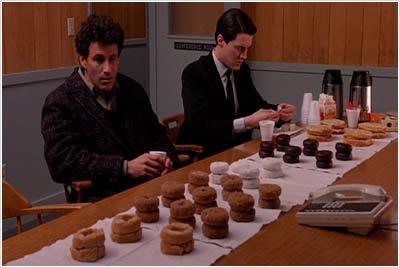
Throughout the rest of the pilot, we get more hints of a world that’s threatening to spin off of its axis.  Dale and Harry run into Dr. Lawrence Jacoby (Russ Tamblyn, who co-starred with Richard Beymer in West Side Story), who was Laura’s psychiatrist and appears to be in need of some therapy himself.  When they look at Laura’s body in the morgue, the lights flicker on and off.  When Dale finds a scrap of newspaper — featuring the letter “R” — underneath Laura’s fingernail, he grins as if he’s just made it through his first Communion.  When Harry and Dale go to the local bank, a moose’s head just happens to be lying on the table in the conference room.  It fell, they’re told.  Despite all the strangeness, they go about their business.  They’ve got a murder to solve.

“Mr. Cooper,” Harry says, at one point, “you didn’t know Laura Palmer.”  But, as quickly becomes obvious, no one knew Laura Palmer.  No one, for instance, knew that she was doing cocaine.  And Bobby didn’t know that she was seeing James, or at least he doesn’t until he watches a video that Donna, James, and Laura shot inn the mountains over looking the town.  Laura, who we’ve previously just seen as a dead body, is so happily alive in that video that it’s a bit jarring to see her.  You half expect her to come out of the TV, like the girl in The Ring.  The video ends with her smiling, as if she’s daring both Cooper and the show’s viewers to try to figure out who she actually was.  Only later is it revealed that, in a plot twist reminiscent of Dario Argento’s Four Flies on Grey Velvet, James’s motorcycle is reflected in Laura’s eye.

Life goes on in Twin Peaks.  Audrey, the character to whom I most relate whenever I watch this show, sits in her father’s hotel and penetrates a styrofoam cup of coffee with a pencil.  “What would happen if I pulled this out?” she asks before doing just that.  Audrey walks into the hotel’s conference room and tells the Norwegians that she’s feeling sad because her best friend was just brutally murdered, destroying her father’s business deal.  (“The Norwegians are leaving!  The Norwegians are leaving!” a hotel concierge vainly yells.)

(Perhaps not coincidentally, Norway was also the home of Henrik Ibsen, whose theatrical melodramas often dealt with many of the same themes — greed, infidelity, the corruption that comes with progress — that are present in Twin Peaks.  An Enemy of the People could have just just as easily taken place in the American Northwest.)

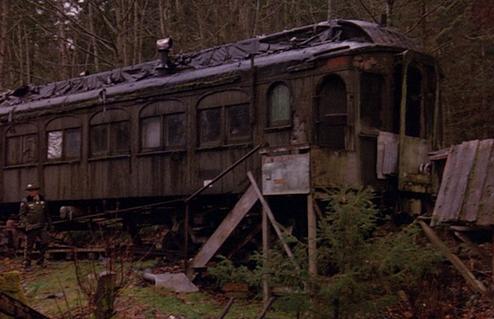
Meanwhile, the local police come across the abandoned railroad car where Laura was murdered and Ronnette raped.  Andy calls the sheriff’s office, in tears.  “Tell Harry I didn’t cry,” he begs Lucy, “but it’s so horrible!”  It’s a moment of very real humanity in the middle of this odd and disturbing mystery.  When Andy begs Lucy not to reveal his very human reaction, it’s more than just shame on his part.  It’s an indication that perhaps the only way to solve this mystery is to sacrifice one’s emotions.

And, as Andy said, it is horrible.  When Dale and Harry walk through that railway car, we are reminded that, as quirky at the show may be, a very disturbing crime is still at heart of it.  Among other things, they find a half-heart necklace (the other half is with James) and, written in blood in the debris, a message: “Fire Walk With Me.”  As disturbing as this is in the pilot (and this scene really is Lynch at his best), it’s even more disturbing if you know who will ultimately be revealed to have been Laura’s murderer.  But that information will have to wait for a later review.
It easy to believe that arrogant Bobby Briggs killed Laura but Cooper only has to talk to him for a few minutes to realize that he didn’t do it.  Bobby may be a jerk and a drug dealer.  And Cooper is surely correct when he says that Bobby never loved Laura.  But Bobby is a bully, not a murderer.  When Bobby is released, he and Mike go looking for James.  As unlikable as Bobby is, Mike — with his blonde hair and all-American looks — is somehow even worse.  At least Bobby is open about being an bad guy.  Mike hides his darker instincts behind a carefully cultivated facade of blandness.  Looking at Mike in his red letterman jacket, you really do want someone to claw his eyes out.

Mike and Bobby look for James at the Roadhouse, one of the most important locations in Twin Peaks.  It’s a place where illicit lovers (like Norma and Ed) meet and where Julee Cruise sings haunting songs.  Bobby and Mike may not find James but they do find a fight with Ed.  This leads to Bobby and Mike spending the night in jail, which, ironically, is where they eventually find James.  James has been arrested as a suspect in the death of Laura Palmer.  In their cell, Bobby and Mike start to bark like wild dogs.
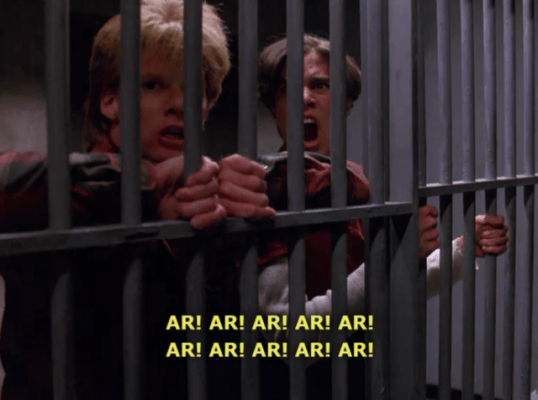
And so, a pilot that started with the humanity of tears ends with animalistic howls of anger, hate, and jealousy.

And so, Twin Peaks begins.

If I haven’t already made it clear, I am huge fan of the pilot for Twin Peaks.  Say what you will about where the series eventually went, the pilot was and remains an absolutely brilliant dream of dark and disturbing things.  Having rewatched the pilot, I am definitely looking forward to rewatching the rest of the series for this site and I hope you’ll enjoy the rest of our reviews!

Previous Entries in The TSL’s Look At Twin Peaks:

  1. Twin Peaks: In the Beginning by Jedadiah Leland

Film Review: Fatal Defense (dir by John Murlowski)


Last night’s Lifetime premiere, Fatal Defense, opens with a nightmare scenario.  Arden Walsh (Ashley Scott) is attacked in her home by a masked intruder.  While her daughter, Emma (Sophie Guest), sleeps upstairs, Arden is bound and gagged in the living room.  Fortunately, the intruder is scared off before he can do anything else but both Arden and her daughter are haunted by nightmares afterward.

What can Arden do to reclaim her safety?

Get a gun.

That was my immediate reaction.  Just go out and buy a gun.  The next time you think that you see someone wandering around in the back yard, fire a warning shot.  If that doesn’t work, aim for the head.  See, that’s one reason why I love my sister.  I may be terrified of guns but she’s a great shot.

However, Arden doesn’t get a gun.  Even though her totally kickass sister, Gwen (Laurie Fortier), suggests that Arden take advantage of her constitutional rights, Arden doesn’t want a gun in the house.  Maybe she doesn’t trust Emma.  Then again, she does live in the People’s Republic of California and it would probably be a lot more difficult for her to get a gun than it would be for me to get a gun here in Texas.  Who knows?

So, since Jerry Brown won’t let her defend herself with a gun, what ever can Arden do?

She and Gwen do a google search for self-defense classes and they come across an old Geocities site for Logan Chase (David Cade).  Logan not only knows how to break someone’s arm but he looks good without a shirt as well!  Plus, he apparently teaches his self-defense class in a tiki bar.  Gwen enrolls and, one montage later, she can now kick ass with the best of them!

(While I understand that you can learn how to do practically anything in a montage, I was still impressed.  My knowledge of self-defense is basically either use mace or, if you can’t get to your mace, yell, “I don’t know you!  That’s my purse!”  and then kick like a Rockette.)

Unfortunately, Logan has some issues.  He seems like a nice guy and a good teacher and it’s kind of sweet in a creepy way when he suddenly shows up at the Los Angeles Arboretum, where Arden is apparently one of two employees.  However, Logan is soon talking about how his ex-girlfriend was murdered because she didn’t know to fight back.  He also has a habit of suddenly yelling about how, if Arden doesn’t learn how to defend herself, she’ll never be able to fight off psychos like him.  That may seem like a red flag but he is kind of cute and that GeoCities web site of his was pretty impressive.  But then Logan suddenly puts handcuffs on Arden’s wrists and locks her in the trunk of his car.  Things kind of go down hill after that…

My twitter friends and I had a lot of fun last night, watching and snarking on Fatal Defense.  It was a fun and entertaining Lifetime film, one that mixed over the top melodrama with some real-world concerns.  (I mean, let’s be honest.  We all need to know how to defend ourselves.  It’s a scary world.)  This is one of those films where it’s best not to worry too much about whether or not the plot totally makes sense.  Myself, I was amazed that Arden could afford such a nice and big house.  I guess the Los Angeles Arboretum pays well.  But, at the same time, that’s why we watch Lifetime movies!  We don’t want to see the cramped apartments that most people live in.  We want to see big beautiful houses and big beautiful melodrama.  On both counts, Fatal Defense delivered.

That said, it’s still hard not to feel that Arden could have avoided a lot of trouble if she had just got a gun.

The only defense you need.

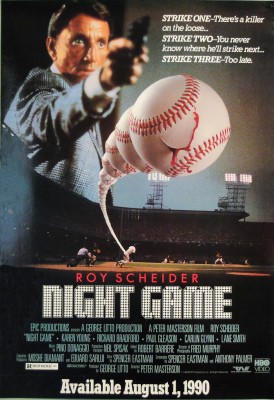
The TSL’s Grindhouse: Night Game (dir by Peter Masterson)


Apparently, today is the opening day of the 2017 baseball season.  The only reason that I know that is because of my sister Erin.  I don’t know much about baseball, to be honest.  I know that my city’s team is the Texas Rangers and they were once owned by George W. Bush.  I know that Houston has a team called the Astros.  But, really, the main thing that I know about baseball is that my sister absolutely loves it.

So, when Erin asked me to review a baseball movie today, how could I say no?  I mean, I may know next to nothing about baseball but I certainly know something about movies!

For that reason, I’m going to take a few minutes to tell you about a 1989 film called Night Game.  Night Game is many things.  It’s a movies that features a lot of baseball, even though it’s not really a sports film per se.  It’s a police procedural, though the film itself suggests that the police often don’t have the slightest idea what they’re actually doing.  It’s a serial killer film, though its killer is never quite as loquacious as we’ve come to expect in this age of Hannibal Lecter and Dexter Morgan.  At times, it’s a slasher film, though it’s never particularly graphic.  Mostly, Night Game is a Texas film.

Directed by native Texan Peter Masterson, Night Game is like the original Texas Chainsaw Massacre in that it is one of those rare films that not only takes place in Texas but was actually filmed on location.  To be exact, Night Game was filmed in both Galveston and Houston.  The entire film has a friendly and quirky Texas feel to it.  Masterson may not have been a great visual director (If not for some language and nudity, Night Game could pass for a TV movie) but Night Game is a movie where the plot is less important than capturing the little details of a time. a location, and the people who lived there.  Though Night Game is 28 years old, it’s portrait of my home state still seemed very contemporary to me.  I guess Texas hasn’t really changed that much over the past few decades.

As for the film’s plot, someone is murdering young women in Galveston and leaving their bodies on the boardwalk.  Obviously, that’s not going to be good for attracting Spring Break revelers.  The film doesn’t make any effort to keep the murderer’s identity a secret.  We see his face fairly early on.  We also see that he has a hook for a hand.  Eventually, we do learn the murderer’s motives.  They’re pretty silly but then again, individual motives rarely make sense to anyone other than the guy with the hook for a hand.

Detective Mike Seaver (Roy Scheider) has been assigned to solve the case.  One thing that I really liked about Night Game was that Mike was pretty much just a normal guy with a job to do.  He wasn’t self-destructive.  He wasn’t always drunk.  He wasn’t suicidal.  He wasn’t always lighting a cigarette and staring at the world through bloodshot eyes while the lighting reflected off of his artful stubble.  He was just a detective trying to do his job and get home on time.  After sitting through countless films about self-destructive cops and criminal profilers, the normalcy of Mike was a nice change of pace.

Mike does have a backstory.  He used to play baseball and he still loves the game.  He goes to every Astros home game in Houston.  He’s in love with Roxy (Karen Young), who works at the stadium.  Things are only slightly complicated by the fact that Mike had a previous relationship with Roxy’s mother (Carlin Glynn).  Don’t worry, Mike’s not secretly Roxy’s father or anything like that.  It’s not that type of movie.

Anyway, Mike is such a fan of baseball that he realizes something.  The killer only strikes on nights that the Astros win a game.  And he only strikes if a certain pitcher was throwing the ball.  The obvious solution would be to shoot the pitcher in the arm and end his athletic career.  However, Mike’s too nice a guy to do that.  Instead, he just tries to track down the killer…

And, as I said, Night Game actually isn’t a bad little movie.  Make no mistake, it’s a very slight movie.  At no point are you going to say, “I’m going to remember that scene for the rest of my life!”  That said, it’s a surprisingly good-natured film and Roy Scheider’s performance is likable and unexpectedly warm.  With all that in mind, Night Game is an entertaining and (mildly) bloody valentine to my home state.

Plus, it’s a baseball movie!  I don’t know much about baseball but, if my sister loves it, it has to be a good thing!

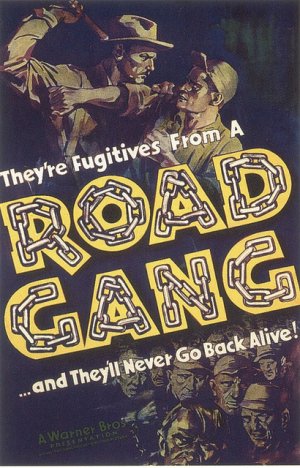
Lisa Cleans Out The DVR: Road Gang (dir by Louis King)


I was going to start this review with a quote from Gandhi: “A nation’s greatness is measured by how it treats its prisoners.”  That was something that I first heard from a perpetually stoned ex-seminarian who used to live in a trailer park in Lake Dallas.  I always figured that, being as stoned as he usually was, he probably knew what he was talking about but, upon doing research for this review, I have discovered that Gandhi actually didn’t say that.  What Gandhi said was, “A nation’s greatness is measured by how it treats its weakest members.”  Fortunately, it’s the same basic idea and, regardless of how you phrase it, it’s a quote that perfectly encapsulates the message of the 1936 film, Road Gang.

Road Gang tells the story of Jim (Donald Woods) and Bob (Carlyle Moore, Jr.).  Bob is fun-loving.  Jim is more serious and engaged to marry heiress Barbara Winston (Kay Linaker).  Jim and Bob live in an unnamed Southern state (though I’m going to assume that the state is supposed to be Georgia, just because).  Jim has just written an article that exposes the corruption of political boss, J.W. Moett (Joe King).  The article is so good that both Jim and Bob have been offered jobs in Chicago!  There’s a lot of corrupt political figures who can be exposed in Chicago!

However, while driving up north, Jim and Bob are arrested on trumped-up charges.  At first, Jim and Bob laugh off Moett’s desperation but, unfortunately, another criminal happens to be breaking out of jail at the same time that Jim and Bob arrives for booking.  That criminal kills the arresting officer and then forces Jim and Bob to drive him across the state.  Eventually, the police recapture the three of them.  However, the escaping criminal is killed and Jim and Bob are arrested as accessories.  Under the advice of their lawyer, Mr. Dudley (Edward Van Sloan), they plead guilty and accept a deal.  What they don’t know is that Dudley works for Moett and that, as a result of pleading guilty, they are going to be sentenced to five years in a prison camp.

Okay, so the film gets off to a pretty melodramatic start.  And, to be honest, the entire film is extremely melodramatic.  A lot of time is devoted to Barbara trying find evidence that Jim and Bob were set up, something that is made difficult by the fact that Barbara’s father, like Mr. Dudley, works for Moett.  Fast-paced and not-always-logical, this is a B-movie, in every sense of the term.

And yet, as melodramatic as it is, Road Gang is deadly serious when it comes to portraying the brutality of the prison camp.  From the minute that Bob and Jim arrive, they find themselves at the mercy of the corrupt warden and his sadistic guards.  The prisoners are largely used as slave labor and subjected to punishments that are often arbitrary and extreme.

Road Gang doesn’t flinch when it comes to portraying why prison often not only fails to rehabilitate but also helps to transform minor offenders into hardened criminals.  There’s a disturbing scene in which Jim, Bob, and the other prisoners are forced to listen as another prisoner is whipped.  The crack of the whip and his howls of agony explode across the soundtrack in a symphony of pain and sadism.  Jim and Bob have two very different reactions to being in prison.  One survives.  One allows himself to be killed rather than take one more day in confinement.

Road Gang is often compared to I Am A Fugitive From A Chain Gang.  Actually, beyond the theme of a fatally compromised justice system, there is no comparison.  The angry and fact-based I Am A Fugitive From A Chain Gang is a hundred times better and, quite frankly, Donald Woods was no Paul Muni.  However, Road Gang still has its moments of power.  Decades after it was made, the issues it raises continue to be relevant.  Do we send people to prison to rehabilitate them or to punish them and are the two goals mutually exclusive?  And how can we say that someone has “paid his debt to society” when, even after a prisoner serves his time, the stigma of having been imprisoned closes and locks most doors of opportunity?

Road Gang shows up occasionally on TCM.  There’s where I recorded it on January 23rd of this year.

Lisa Cleans Out Her DVR: Girls Night Out (dir by Philippe Gagnon)


Last night, before I went to bed, I continued to clean out my DVR by watching a Lifetime film, Girls Night Out.  I recorded Girls Night Out off of the Lifetime Movie Network on January 22nd.  It was the earliest recording on my DVR.

Girls Night Out tells the story of McKenzie (MacKenzie Mauzy) and three of her closest friends.  They’ve been close since college.  They were all in the same sorority.  They have a long history laughs, pranks, fun, and barely concealed resentment.  Now, they have all graduated and they’ve all found individual success.  McKenzie is marrying Reese (Cody Ray Thompson), who is nice but kind of boring.

While her friends take McKenzie out to celebrate, Reese runs into a guy at a bar.  Brandon (Jacob Blair) seems nice but he’s not!  In college, Brandon used to date McKenzie.  But, one night, after getting her drunk, Brandon raped McKenzie.  When McKenzie reported him, Brandon was kicked out of school.  He lost all of his friends at his fraternity.  He lost his chance to play in the NFL.  Brandon wants revenge and that revenge starts with kidnapping Reese.

Brandon announces that, unless McKenzie and her friends follow his every order, he will kill Reese.  He divides the four of them into two teams and then has them recreate extreme versions of some of the pranks they played in college.  One team is sent searching for thrown-away food and used condoms.  One team is ordered to sneak into a morgue and kiss a corpse.  One friend has to strip down to her underwear while her teammate writes on her with a marker.  Meanwhile, the other two friends have to go buy crack.  And that’s only the beginning…

Girl’s Night Out is a film that asks, “How far would you go for your friends?”  That’s the question that I found myself wondering as I watched.  I never joined a sorority but, when I was in college, I had a group of friends who were like sisters to me.  I called us the SBS, which stands for Sexy Bitch Squad.  My friend Lea used to call us the BNC, which stood for Big Nose Crew, which I think was her sweet way of trying to make me feel better about my own nose.  But regardless of what we were called, we were and are extremely close.  So, I could definitely relate to the scenes involving the bachelorette party and the male strippers.

But, I asked myself, if someone’s fiancée was being held prisoner and being threatened with murder, would I go to the same lengths as the characters in Girls Night Out?

Probably not.

I mean, seriously — climbing into the dumpster and looking for a used condom?  Ewwww.  Kiss a corpse?  No way!  But, luckily, I know that none of the members of SBS (or the BNC) would ever ask me to.  They know me well enough to know better.  That’s the great thing about friendship.  You don’t have to pretend like you’d wear high heels in a crack house just to keep your friend’s boyfriend from being murdered.  You can be yourself, flaws and all.

As for the rest of Girls Night Out … well, it took it a while but it won me over.  At first, everyone in the film seemed so shallow that I had a hard time imagining how I could ever have any sympathy for them.  But then Brandon showed up and was such a hateful character (and Jacob Blair did such a good job of bringing this loathsome jerk to life) that I found myself really looking forward to seeing him get his comeuppance.  Let’s face it — we’ve all had a Brandon in our lives and our greatest regret is that we never go a chance to witness him getting repeatedly kicked in his genitals.  Knowing that Brandon would eventually get his ass kicked was more than enough to keep me watching the film.

It took a while but seeing Brandon get what he deserved made the film more than worth watchiing.

Lisa Cleans Out Her DVR: The Silver Chalice (dir by Victor Saville)


If you ever needed proof that everyone has to start somewhere, look no further than the 1954 biblical epic, The Silver Chalice.

The Silver Chalice features the film debut of Paul Newman, who later proved himself to be a legitimately great actor.  It’s true that, unlike a lot of actors, Newman made his debut in a starring role.  He never had to humiliate himself with any one-line roles or walk-on bits.  No, Paul got to humiliate himself with a starring role.

Paul Newman was 29 years old when he played Basil, a former slave turned sculptor.  Not only did Newman bear a disconcerting resemblance to Ben Savage (of Boy Meets World fame) but he gave a performance that was so bad that it’s kind of a shock that he ever worked again.  Basil is a passionate artist, one who survived being betrayed by his adopted family and slavery.  Newman comes across like a nice, young man from Iowa.  Usually, Newman looks miserable but occasionally, he flashes a somewhat weak smile.  When Basil gets mad, Newman speaks in a squeaky voice.  When Basil is feeling reverent, Newman furrows his brow like a hungover Russell Brand staring straight into the sun.

“But me and Topanga are soul mates…”

Then again, I’m not sure that any actor could have given a good performance as Basil.  The Silver Chalice has a terrible script, one that was written by Lesser Samuels.  (I’ll avoid the obvious joke about whether or not The Silver Chalice would have been better if written by Greater Samuels.)  Apparently, before Newman was cast, the producers pursued James Dean for the role.  I’m sure we all would have enjoyed seeing Dean slouch his way through the film but I doubt that even he could have done much with The Silver Chalice.

The Silver Chalice is based on a novel, which perhaps explains why there’s so many characters and so many unnecessary subplots.  Basil follows a path that will be familiar to anyone who has seen a 1950s biblical epic.  He’s a young Greek who is adopted into a noble Roman family.  When his kindly stepfather dies, Basil’s stepsiblings sell him into slavery.  It’s not an easy life but Basil is a talented sculptor so Joseph of Arimathea commissions him to make a silver chalice for the Holy Grail.  Basil goes from poor to rich to poor again to rich again to ultimately saved by grace.  He even gets to do the same walking towards Heaven thing that Richard Burton did at the end of The Robe.

Meanwhile, Simon Magus (Jack Palance) is wowing the citizenry with his magic tricks and claiming to be the risen Messiah.  Simon’s assistant just happens to be Helena, who knew Basil when he was younger.  Young Helena is played by dark-haired Natalie Wood.  Grown-up Helena is played by blonde Virgina Mayo.  They were both good actresses but there’s seriously no way that Natalie Wood would have ever grown up to be Virginia Mayo.

Jack Palance pretty much steals the movie, mostly because he gets to wear the silliest costumes:

Poor Paul Newman has to settle for a tunic and a miniskirt, while Jack Palance gets to wear this:

Personally, I’ve always enjoyed the story of Simon Magus.  He tried to show off by flying over the Roman Forum so St. Peter said a prayer and Simon promptly plunged to his death.  Take that, you Gnostic!

Another interesting thing about The Silver Chalice is that the sets are very deliberately fake.  I don’t mean that they look cheap.  I mean, much as in the style of German Expressionism, the sets are specifically designed to remind you that you’re watching a movie.

For instance, look at the wall behind Palance:

Look at this pleasure palace:

Look at Rome at night:

The sets are extremely dream-like and yet everything else about the film is extremely slow and conventional.  One wonders if director Victor Saville was trying to make an art film, though there’s nothing else in his long filmography that would suggest that Saville was anything other than a workmanlike director.  In fact, most biblical epics of the time took a lot of pride in looking as expensive and “accurate” as possible.  Major studios in the 1950s were not known for artistic experimentation, especially when it came to Biblical epics.  It’s hard to know what to make of The Silver Chalice‘s artistic flourishes, which is why it’s easier to just focus on what a terrible performance Paul Newman gives.

That’s certainly what Paul did!  In 1966, when The Silver Chalice finally premiered on TV, Newman took out a newspaper ad in which he apologized for his performance and then asked people not watch.  Apparently, he also used to show the movie during parties on the condition that his guests mock the film while watching it.

I don’t really blame him.  It’s an amazingly dull film and Newman looks absolutely miserable in nearly every other scene.  However, because it did star Paul Newman, The Silver Chalice will always have a life on TCM.

Speaking of TCM, they last broadcast this film on February 24th as part of their 31 Days of Oscar.  (It was nominated for both its sets and its score.)  That is when I recorded it.  And, after watching it yesterday, I was more than happy to erase it.

TV Review: The Walking Dead 7.15 “Something They Need” (dir by Michael Slovis)


Hi there!  Before I get around to saying what little I have to say about tonight’s episode of The Walking Dead, I want to share something with you.

Next week is the season finale and, naturally, it’s an extended episode.  I have two fears.

  1. I fear that next week’s episode will be 70 minutes of Rick and Dwight sitting in a cell and discussing right and wrong.
  2. I also fear that the episode will end with Rick standing on a hill, looking back at all of his followers, and announcing, “And now — we attack!”  This will immediately be followed by the end credits and Talking Dead.  See you once Season 8 starts!

If either of those happen, this will be my response:

I have such mixed feelings about the pace of The Walking Dead.  On the one hand, I appreciate that it’s a show that literally takes place after the end of the world.  Civilization is over and sometimes, that is best represented by stillness.  There’s no need for anyone to hurry because there’s really nowhere to go.  There are no more jobs.  There are no more movies.  There are no more clubs.  There are no more schools.  There’s nothing.  The only thing that matters in the world of The Walking Dead is survival and, often times, it’s necessary to move slowly and with caution to survive.

On the other hand, this season has been so slow!  It feels as if it has taken Rick longer to organize this attack than it took for Lafayette to sail across the ocean and track down Gen. Washington.  Yes, I appreciate why the pace is deliberate but there’s really only so many times that you can watch the same scene play out over and over again.

Tonight was a perfect example.  It featured three storylines, all of which were way too dragged out.  Tonight was basically 30 minutes worth of story stretched out to a full hour.

In Alexandria, Gregory again showed himself incapable of … well, just about anything.  Nobody has any respect for Gregory.  Maggie had to save him from a walker.  Gregory’s either going to get killed by Negan or he’s going to get bitten by a walker.  I think he actually had the potential to be an interesting character (and Xander Berkeley is certainly a good actor) but Gregory is so obviously doomed that it’s hard to really care about him one way or the other.

In Sanctuary, Sasha is somehow not dead.  Instead, she’s in that same little cell that Daryl was in.  Negan was apparently impressed by her suicidal attack.  Why that would impress Negan, I’m not sure.  Anyway, Negan killed a savior who was on the verge of raping Sasha.  That’s a good thing, though you have to wonder if Negan set the whole thing up just so he’d have an excuse to play the hero.  He wants to bring Sasha over to his side.  Again, I’m not sure why.  Mostly, I assume that Sasha’s alive so that she can be used as a hostage if Rick ever actually gets around to launching this attack that he’s been going on about.

(In many ways, Sasha being alive epitomizes this season’s greatest flaw.  She’s not alive because there’s any real logic behind her somehow not being dead.  Instead, she’s alive so she can be used as a plot device later on.  Keeping Sasha alive comes at the price of whatever consistency had previously been established as far as Negan’s character is concerned.)

And finally, Tara told Rick about Oceanside so Rick and his people went down there and took all their guns.  The scenes of Rick bullying the Oceansiders were mixed in with scenes of Negan trying to bring Sasha over to the Saviors.  I got the feeling we were supposed to compare the contrasting leadership styles of Rick, Negan, and Gregory.  Gregory is inneffectual.  Rick will do what needs to be done but only when he doesn’t have any other choice.  Negan just talks too much.

At the end of the episode, Rosita returned from Sanctuary.  Accompanying her was … DWIGHT!  So, Dwight was the man she saw in the shadows.  Rick pointed a gun at him and told him to get on his knees.  Apparently, next week’s episode will feature Rick talking to Dwight in a cell.  I just hope they don’t spend too much time talking.

Anyway, as you can probably tell, this episode was way too slow for me.  But, at least Rick does seem to be inching closer to finally launching that attack.

HURRY UP, RICK!

Maggie and Gregory do …. something.

Lisa Cleans Out Her DVR: The Arrival (dir by David Twohy)


I recorded The Arrival off of Cinemax on March 3rd.  Having just watched it, I am 95% sure that it is not the same movie as the Arrival that I saw in theaters last fall.

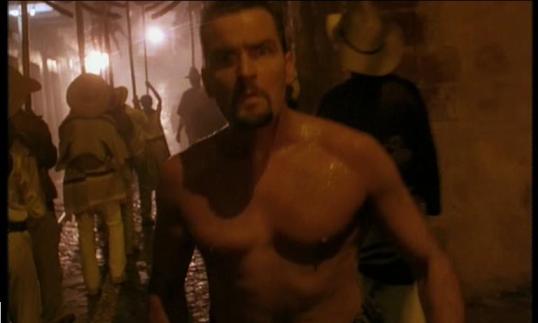
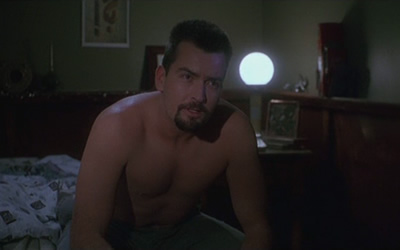
It’s true that both films deal with the arrival of aliens and feature scenes that take place in space ships.  And it’s also true that both films involve scientists trying to figure out what the aliens want.  However, The Arrival that I recorded featured far more of Charlie Sheen than I remembered being in the Arrival that I saw in theaters.  Amy Adams and Jeremy Renner were nowhere to be seen but Charlie Sheen was all over the freaking place.

And I mean all of Charlie Sheen.  The Arrival was made back in 1996 and I guess that Charlie Sheen was still working out back then because, seriously, he is either naked or, at the very least, shirtless for the majority of the movie.  What’s funny is that, with a few minor exceptions, there’s rarely a reason for him to be naked.  I guess someone just said, “We might as well record Charlie Sheen looking fit and healthy while we still can…”

The Arrival is a relatively serious movie.  Oh, it has moments of humor but it’s all Hollywood blockbuster humor.  It’s not a comedy by any means.  It’s always strange seeing Charlie Sheen in a serious role because … well, he’s Charlie Sheen.  Plus, he was never a particularly good dramatic actor.  He walks through The Arrival with this grim look frozen on his face and that, combined with his muscular chest, makes him look like a killer robot from the future.  You keep waiting for Charlie to say, “I’ll be back.”

Of course, Charlie Sheen isn’t playing a killer robot.  He’s playing Zane Zaminsky, an astronomer who works for the government.  Or, at least, he did work for the government until he detected an alien signal coming from a nearby star.  He’s fired and blackballed by his boss, Phil (Ron Silver).  Unable to get work, Zane does what anyone would do.  He and Kiki (Tony T. Johnson), the streetwise neighbor kid, set up a DIY astronomy lab in his basement.

At least, that’s what I think he did.  I kind of had a hard time following The Arrival‘s plot.  It all seemed a little bit overcomplicated, especially when savvy viewers will have already guessed that 1) the aliens are real, 2) Phil is an alien, 3) there’s a big government conspiracy involved, 4) and Zane has stumbled across it.

What are the aliens doing on the planet?  To figure that out, Zane’s going to have to go to Mexico and meet with climatologist Illana Green (Lindsay Crouse).  However, we already know what the aliens are  doing.  They’re attempting to destroy the environment so that they can wipe out humanity.  We know this because that’s what aliens are always trying to do!  They’re always either trying to save the environment or destroy it.  My personal theory is that Bill Nye, The Science Guy is actually an alien.  It explains a lot.

Anyway, it may sound like I’m criticizing The Arrival but it was actually kind of a fun movie in its dumb way.  It’s a serious movie but it’s also kind of a silly movie.  Any film that features Charlie Sheen as anyone other than Charlie Sheen is going to be watchable just on a WTF sort of level.  Beyond that, Ron Silver makes for a rather convincing alien and director David Twohy keeps the action moving quickly.  Several of Twohy’s shots are memorably atmospheric, even if they often do feature a bearded and naked Charlie Sheen.

Is The Arrival as good as Arrival?  HELL NO!  Arrival is one of the greatest science fiction films ever made.  The Arrival is a rather minor sci-fi melodrama but it’s fun nonetheless.  Just don’t expect it to make any sense.  To quote the bard, John Lennon, “Turn off your mind, relax, and float downstream.”

Film Review: Stalker’s Prey (dir by Colin Theys)


Before I really get into writing about tonight’s Lifetime premier movie, there’s something that I need to point out.  The movie that premiered on Lifetime was called Stalker’s Prey.  As often happens with Lifetime movies, it actually has more than one title.  Lifetime will often change the title of movies, either to make them fit into the one of the Lifetime “franchises,” (like the Perfect films or the … At 17 films) or just to make them sound more lifetime-y.  According to the imdb, Stalker’s Prey is also known as Hunter’s Cove.  Personally, I think Hunter’s Cove is a better title but Stalker’s Prey does have more of a Lifetime feel to it.

Well, whatever you call the movie, it was a lot of fun.

Stalker’s Prey opens with a real “Oh my God!  Just like me!” moment, with teenager Laura (Sharbino Saxon) getting caught staying out too late and making out with her boyfriend, Nick (Luke Slattery).  Now, Nick seems to be a nice guy but Laura’s mother, Sandy (Cynthia Gibb), doesn’t like him.  Sandy and Laura have a strained relationship.  Ever since her parents got divorced, Laura has been rebellious (though her rebellion seems rather mild compared to what some angry teenagers have done in previous Lifetime movies).   Sandy feels that Nick is a bad influence on Laura and that Laura is a bad influence on her younger sister, Chloe (Alexis Lariviere).

(While I did relate to Laura, I was also fortunate enough to be the youngest, so I never had to worry about being a bad influence on anyone.)

Sandy forbids Laura from going out so, the next morning, Laura sneaks out.  She and Nick sail out to an isolated spot.  They relax on the water.  They go for a swim.  They ignore Sandy trying to call them.  And then, of course, a shark comes along and eats Nick.  If not for Bruce Kane (Mason Dye), it would have eaten Sandy as well.

Bruce is the handsome, charming, and kind of odd son of the Mayor.  He just happened to be in the area when he saw Laura being attacked.  He saved Laura from certain death.  Soon, Bruce is a local hero.  He appears on the news nearly every night, assuring everyone that he is going to catch the shark and prove himself worthy of his famous last name.  Meanwhile, Laura has been totally traumatized, which makes sense.  Not only is Nick dead but, thanks to that shark, she’s probably going to have a permanent scar as well.

Remember how I said that Bruce just happened to be in the area?  Well, that’s kind of Bruce’s thing.  Any time that Laura goes anywhere, Bruce just happens to be right there.  He drops by her hospital room.  He drops by her house.  When Laura goes shopping, Bruce shows up in the parking lot.  When Laura stops by the police station, Bruce happens to be walking by.  When she goes back to school, Bruce just happens to be her new substitute teacher.  When she comes home, Bruce is babysitting Chloe.  When she goes to the beach, Bruce shows up with flowers.

Bruce considers Laura to be his girlfriend, despite the fact that she only gave him one pity date and only slept with him because he took advantage of her emotionally fragile state.  Laura wants nothing to do with Bruce but Bruce will not accept that.  Bruce has issues.  Bruce also has a mannequin on his boat but you’ll have to watch the movie to see what that’s all about.

Meanwhile, it appears that the most dangerous thing that you can do in Hunter’s Cove is be a friend of Laura’s.  Not only does Nick get eaten by a shark but her friend Parker (Camrus Johnson) gets beaten up by a baseball-wielding assailant.  Another friend get run over by a car while out jogging.

And, of course, that shark is still swimming around the ocean, like it owns the place…

It makes sense that, after taking over the SyFy network, the sharks would eventually move over to Lifetime.  That said, Stalker’s Prey is an enjoyable melodrama, one that is quite likable in its cheerfully willingness to go over the top to get a reaction.  Mason Dye is memorably creepy as Bruce, who I assume was named after the mechanical shark from Jaws.  What I liked best about the film was the relationship between Laura and her mother.  The mother-daughter interactions between Cynthia Gibb and Saxon Sharbino felt very real and their relationship reminded me of my relationship with my own mom.  It definitely gave the film an extra layer of effectiveness.

Whether you call it Stalker’s Prey or Hunter’s Cove, it was a lot of fun and very entertaining.

Lisa Cleans Out Her DVR: The Wrong Student (dir by David DeCoteau)


Y’all know that I usually avoid politics like the plague but this is just something that needs to be said:

The U.S. Government could stand to learn a little from a good Lifetime film.  A good Lifetime movie is not expensive (and usually can be viewed for free).  A good Lifetime movie does not demand that the audience watch it but instead, provides a good reason for you to sacrifice 90 minutes of your time.  A good Lifetime movie does not attempt to rob you of your individual freedoms and, in fact, it celebrates your right to talk back to the screen.  A good Lifetime movie delivers exactly what it promises.  A good Lifetime movie does not talk down to its audience.  A good Lifetime movie goes out of its way to keep its audience entertained.  If the U.S. government was more like a Lifetime movie, we wouldn’t have spent the past 17 years dealing with one tedious situation after another.  If the U.S. government was more like a Lifetime movie, life would be a lot more fun and twitter far less annoying.

I found myself thinking about this as I continued to clean out my DVR by watching The Wrong Student.  I recorded The Wrong Student off of Lifetime on March 11th.  I’m glad I did because The Wrong Student epitomizes everything that I love about Lifetime.

Add to that, it’s a film that proves something that I’ve always suspected — soccer is the source of all evil.

Maddie (Evanne Friedmann) is a teenager who loves two things: soccer and the new soccer coach.  The new coach is Dominic (Jason-Shane Scott), who has amazing pecs and abs.  How in love with Dominic is Maddie?  Well, she’s so in love with him that she’s willing to do almost anything to keep him around.  Does that mean that Maddie is willing to poison the old soccer coach?  It sure does.  Does that mean that Maddie is willing to fake an injury so she’ll have an excuse to get naked in the locker room while a mortified Dominic hides his eyes?  Of course!  What about pretending to get drunk at a party and then begging Dominic to give her a ride home?  Hey, who hasn’t done that?  In fact, Maddie is so obsessed with Dominic that she’s even willing to murder her ex-boyfriend.

Maddie’s pretty, intelligent, and apparently her family has some money but she sure does have some issues.  Personally, I blame the soccer.

Amber (Kennedy Tucker) is also on the soccer team.  Amber is living with her Aunt Kelly (Jessica Morris).  Obviously, Amber knows that Dominic is too old for her but he’s exactly the right age for Kelly!  When Maddie realizes that Kelly and the coach are getting close, can you guess what happens?

Anyway, The Wrong Student is a lot of fun.  David DeCoteau has directed a lot of “wrong” films for Lifetime, including The Wrong Roommate and The Wrong Child.  He knows exactly how to make one of these films entertaining and The Wrong Student is an enjoyably self-aware melodrama.  Evanne Friedmann is wonderfully unhinged as crazy Maddie and Jason-Shane Scott looks great without a shirt on.  The Wrong Child is a wonderfully entertaining example of just how much fun a Lifetime movie can be.

Everything should be more like a Lifetime movie.