Back to School #76: The Bling Ring (dir by Sofia Coppola)


Bling-Ring-large

The Bling Ring was one of the more divisive films of 2013.  As often seems to happen with the work of Sofia Coppola, viewers either loved it as a stylish look at America’s self-destructive love affair with fame or else they felt that it was a shallow celebration of the very lifestyle that it claimed to be satirizing.  Personally, I felt it was both, which is one reason why I enjoyed The Bling Ring.

The Bling Ring is based on the true story of a bunch of California teenagers who made headlines by breaking into the mansions of their idols.  Over the course of several months, they burglarized everyone from Paris Hilton to Lindsay Lohan to Orlando Bloom.  While they may have been smart enough to use social media to discover when their targets would be out of town, they weren’t smart enough to not use social media to brag about their crimes.  Eventually, they were arrested and, for a brief period of time, they were as famous as the people they robbed.  One of them even got her own reality show out of the whole thing.  I watched an episode or two.  It wasn’t very good.

Though the names have been changed, Coppola pretty much tells the story as it happened.  New kid in school Marc (Israel Broussard) meets Rebecca (Kate Chang), who is obsessed with celebrities.  Rebecca is also something of an obsessive thief and soon, she and Marc are breaking into the houses of their rich neighbors and acquaintances, stealing money, and going on shopping sprees.  Their thievery allows them to leave a lifestyle where every day is just another makeover montage from a romantic comedy.  Eventually, they are joined by Nicki (Emma Watson), Sam (Taissa Farmiga), and Chloe (Claire Julien).

One thing that quickly becomes clear is that the members of the Bling Ring are not exactly the smartest group of thieves around.  Along with getting increasingly reckless while committing their crimes, they also make the mistake of showing off stolen jewelry at parties and posting pictures of Facebook.  When the police eventually do track them down, Marc is a convenient scapegoat, Rebecca is hiding out in Las Vegas with her father, and Nicki becomes a minor celebrity as she and her mother exploit her newfound notoriety for all the publicity that they can get.

I liked The Bling Ring.  It’s stylish, all of the actors look good and they’re all wearing beautiful outfits, and I loved seeing all of the houses that they broke into.  (Some of the film was shot in the actual residences that were burglarized.)  On the one hand, it doesn’t really dig too deeply into the nature of fame in America but, on the other hand, does it really need to?  We all know the culture that we live in and, at its best, The Bling Ring forces us to ask whether we would rather be one of the people on the outside looking in or if we would want to be one of the people who broke in by any means necessary.

Add to that, it has a great soundtrack!

(Now, as I said, not everyone agrees with me about The Bling Ring.  For an opposite reaction to The Bling Ring, check out Ryan The Trash Film Guru’s review.)

The-Bling-Ring-Wallpapers

Back to School #75: The Spectacular Now (dir by James Ponsoldt)


1371723939_the_spectacular_now

Though the film was embraced by critics and performed fairly well at the box office, it’s hard not to feel that The Spectacular Now was one of the more overlooked films of 2013.  For all of its acclaim, it’s a film that was not only ignored at Oscar time but which also rarely seemed to feature much in Oscar speculation.  That’s a shame but not particularly surprising.  With a few notable exceptions (American Graffiti, The Last Picture Show, Ordinary People, and Juno, for example), films about teenagers are usually ignored by the Academy, even if the film in question is as good as either Easy A or The Spectacular Now.

In fact, I would argue that, along with being one of the best films of 2013, The Spectacular Now is a Say Anything… for my generation.

The Spectacular Now follows two teenagers over the course of their senior year in high school.  Sutter Kane (Miles Teller) is one of the most popular kids at school.  He’s charming, he’s funny, and — perhaps not surprisingly — he’s also deeply troubled. He’s angry that his father is no longer in his life and he often takes his anger out on his mom (Jennifer Jason Leigh).   He works as a salesman at a men’s clothing store where his boss (Bob Odenkirk) is willing to overlook the fact that Sutter often comes into work drunk.  Sutter, you see, also happens to have a slight drinking problem that is slowly but surely transforming into full-blown alcoholism.

When Sutter is dumped by his long-time girlfriend Cassidy (Brie Larson), he goes on a drinking binge that only ends with him being woken up on a stranger’s lawn by Aimee (Shailene Woodley).  Aimee is one of Sutter’s classmates and is the complete opposite of most of Sutter’s friends.  Aimee is shy, doesn’t drink, and prefers to spend her time reading manga.

As you can probably guess, Sutter and Aimee do become a couple.  And yes, Sutter does help Aimee come out of her shell and Aimee does help Sutter to start to deal with all of the pain and anger that he attempts to hide.  You can probably predict all of that but what you can’t predict is just how likable and believable both Teller and Woodley are as a couple.  You believe in their relationship and the film handles it (including the scene where they have sex for the first time) with an unusual amount of sensitivity.

There’s an extended sequence towards the end of the film where Sutter and Aimee finally get to meet Sutter’s father.  At first, you want to be as exciting and as optimistic as Sutter is.  This is especially true once you discover that his father is being played by Kyle Chandler, who is one of those actors that you just instinctively want to like.  Of course, Sutter’s father turns out not to be the hero that Sutter was expecting to meet and it’s simply devastating, for both the viewers and the characters.  I’ve always felt that it takes a certain amount of courage for an actor to play a truly bad character.  (By bad, I don’t mean evil as much as I mean just the type of fuckup that we’ve all known and by which we’ve all been let down.)  Chandler has that courage.

I guess it would be a bit predictable for me to wrap this up by saying The Spectacular Now is a spectacular film.  So, instead, I’ll just recommend that you see it.

SpectacularNowBottom

Back to School #74: The Perks of Being A Wallflower (dir by Stephen Chbosky)


Perks

“We are infinite.” — Charlie (Logan Lerman) in The Perks of Being A Wallflower (2012)

So, here’s the thing.  In general, I try not to judge people.  I have friends (and family) of all races, religion, and political ideologies.  I may not always agree with you but I will always respect your right to disagree.  With that being said, if you don’t love the 2012 film The Perks of Being a Wallflower, then I’m worried about you.

The Perks Of Being A Wallflower is based on a novel that I read and loved right before I entered high school.  In fact, I loved the novel so much that I had my doubts about whether or not the film could do it justice.  Of course, if I had been paying attention, I would have noticed that the film was directed by the same man who wrote the book, Stephen Chbosky.  Everything that made Wallflower such a powerful book — the honesty, the understanding of teen angst, the underlying sadness — is perfectly captured in the film.

Wallflower tells the story of Charlie (Logan Lerman), a painfully shy and emotionally sensitive high school freshman.  Charlie starts the school year under the weight of two tragedies — the suicide of his best friend and the death of his aunt.  Because he’s so shy, Charlie struggles to fit in and make friends, though he does find a mentor of sorts in his English teacher, Mr. Anderson (Paul Rudd, playing the type of teacher that we all wish we could have had in high school).

Charlie, however, does not find a mentor in shop class, which is taught by Mr. Callahan (Tom Freaking Savini!).  However, he does meet Patrick (Ezra Miller), a witty and cynical senior who, because he’s openly gay, is as much of an outcast as Charlie.  Patrick introduces Charlie to Sam (Emma Watson).  Charlie assumes that Sam and Patrick are dating (especially after he sees them dancing together) but later he learns that they are actually stepsiblings and that Patrick is secretly seeing a closeted jock named Brad (Johnny Simmons).  That works out well for Charlie because he has a crush on the free-spirited Sam.

The rest of the film follows Charlie as he survives his first year in school and Patrick and Sam as they complete their final year.  It’s a long but exciting year in which Charlie discovers everything from drugs to the mysteries of sex to the pleasures of the Rocky Horror Picture Show.  Even more importantly, it’s a year that forces Charlie to confront his own unresolved emotional issues.

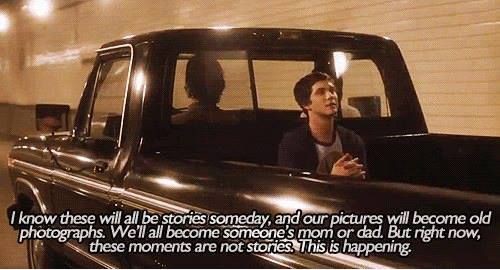
Sensitively acted by the three leads and featuring a great soundtrack, The Perks of Being A Wallflower is one of the best films about growing up that I’ve ever seen.  For me, there is no scene that best captures everything that’s great about being young than the scene where Sam, upon hearing David Bowie’s Heroes on the radio, demands to be driving through a tunnel.  It’s a great scene from a great movie that celebrates both just how scary and amazing it is to have your entire life ahead of you and the special friendships that help us survive.

The-Perks-of-Being-a-Wallflower-Poster-585x426


Back to School #73: 21 Jump Street (dir by Phil Lord and Christopher Miller)


21-jump-street-poster__span

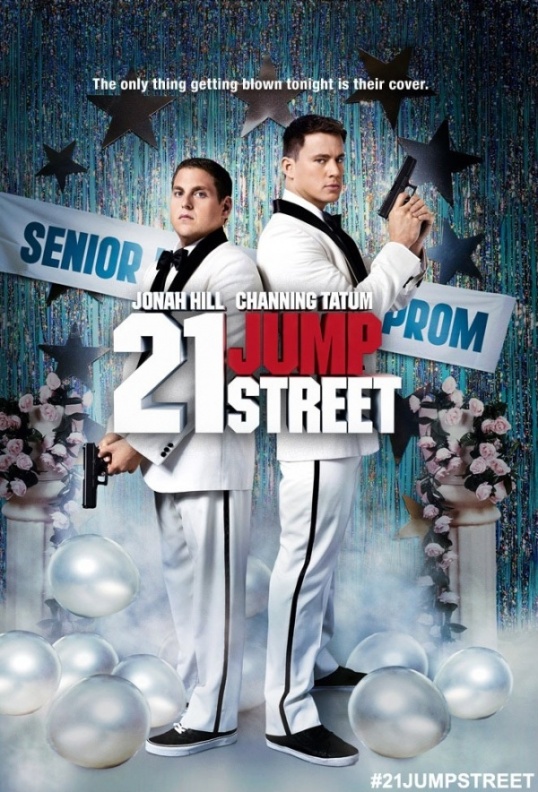
Though the TV series that its based is a bit before my time, the 2012 comedy 21 Jump Street is a personal favorite of mine.  The film tells the story of how nerdy Morton Schmidt (Jonah Hill) and popular but none-too-intelligent jock Greg Jenko (Channing Tatum) first met in high school, went to the police academy together, both turned out to really bad cops together, and then returned to high school together.

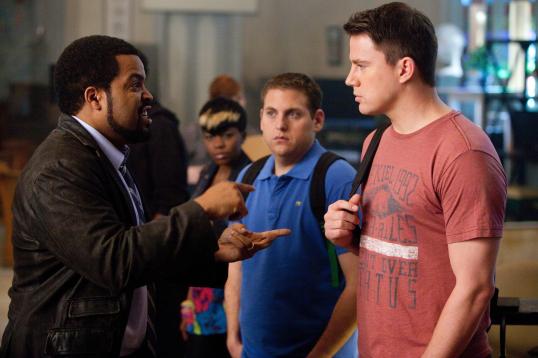
Why did they return to high school?  Because they’re both working undercover now!  As part of a recently revived program from the 80s (and that would apparently be the original television series), young cops are being sent undercover into high school.  As all the other cops involved with the program appear to be super cops, Capt. Dickson (Ice Cube) has every reason to believe that Schmidt and Jenko will be able to discover who is responsible for dealing a dangerous new synthetic drug known as HFS.

One of the things that makes 21 Jump Street work is that, at no point, does the film pretend that either Channing Tatum or Jonah Hill could still pass for a high school student.  One of the film’s best moments comes when a drug dealing environmentalist/student named Eric Molson (Dave Franco, brother of my beloved James) tells Jenko that he suspects that Jenko may be a cop.  “Why?” Jenko asks.  “You’re taste in music. The fact that you look like a fucking forty-year old man,” Eric replies.

Not surprisingly, Jenko and Schmidt prove themselves to be fairly clueless about how high school has changed.  One thing that I’ve always found interesting about high school films is that often times, regardless of when a particularly film might be set, it still feels like it’s taking place ten to twenty years in the past.  That’s largely because most high school films are made by directors who are trying to relive their youth and, as a result, they end up making a film about a high school in 2014 where all of the students look and act as if they’re living in the 90s.  The truth of the matter is that things change pretty quickly.

That’s one reason why I haven’t set foot back in my high school since I graduated.  As much fun as I did have in high school and even though I’ve been told that I can still pass for high school age (and I still constantly get asked for ID), the fact of the matter is that it’s no longer 2004.

When Jenko and Schmidt return to high school, they do so expecting to have to return to their previous teenager personas.  That’s good news for Jenko and not so good news for Schmidt.  However, once they arrive (and after their class schedules accidentally get switched), they discover that high school has changed.  Jocks like Jenko no longer rule the school and Schmidt is now one of the popular kids…

Before I saw 21 Jump Street, I knew that Jonah Hill was funny.  But the film’s big surprise was that Channing Tatum is just as funny.  Throughout the film, Tatum shows a willingness to poke fun at his own image and proves that he can deliver an absurd one-liner as masterfully as just about anyone else working today.  There’s a lot of reasons why 21 Jump Street is a funny film.  It’s full of funny lines and the movie features a lot of very sharp satire of both the action and the teen genres.  But the true pleasure of the film comes from the comedic chemistry between Tatum and Hill.

It’s just a lot of fun to watch.

21-jump-st-1-


Back to School #72: Fish Tank (dir by Andrea Arnold)


fish_tank_katie_jarvis_michael_fassbender_1

Released in 20o9 (and appearing in American theaters in 2010), the British film Fish Tank is another one of those films that I love but occasionally have trouble watching.  Much like Thirteen, it’s a film that, in some ways, hits pretty close to home for me.  Though the film might be about a 15 year-old English girl living in a London council estate and I’m a Texas girl who grew up all over the Southwest, there’s a lot about Fish Tank to which I related.

The film tells the story of 15 year-old Mia (Katie Jarvis).  Mia lives in a tiny flat with her mother (Kierston Wareing), who appears to be only a few years older than her daughter, and her younger sister (Rebecca Griffiths).  She has recently been kicked out of school and is facing an undeniably bleak future.  She spends her time wandering around the estates, an oppressive atmosphere of concrete, poverty, and hostility.  When we first meet Mia, she is arguing with another girl over a dance routine.  The argument quickly turns violent and, as the film makes clear, that violence isn’t particularly shocking.  Mia is an angry girl, one who cannot relate to her family or her surroundings without striking out.  That’s what you do when you don’t have a future to look forward to.  You strike out at the present.

In fact, the only time that Mia is happy is when she’s dancing.  She breaks into deserted apartments so she can practice her routine and have a few moments of freedom.  And it’s not so much that Mia is a great dancer or that she’s had any training.  (In fact, actress Katie Jarvis was reportedly not comfortable with having to dance on camera.)  Instead, there’s a raw power to the way that Mia dances.  It’s the only non-destructive way that she has to get out her anger and to express herself.  It’s the only way that she has to let the world know that she’s special and, when she’s dancing, she’s in control of the future.

Things briefly look better when Mia’s mother starts to date the handsome Connor O’Reilly (Michael Fassbender).  At first, Connor seems almost perfect.  Along with bringing some momentary peace to the household, Connor is one of the few characters in the film to show anything resembling kindness to Mia.  Connor encourages her to go to an audition.  Connor takes the entire family out to the countryside, giving Mia a break from the oppressive atmosphere of the estates.  When Mia wades out into a pond and cuts her foot, Connor is the one who bandages it.  Connor seems to be perfect.  Of course, it helps that he’s played by a pre-12 Years A Slave Michael Fassbender.

But, of course, Connor isn’t perfect.

About halfway through the film, Fish Tank takes a disturbing turn and things proceed to get even more disturbing from there.  And I’m not going to spoil it for anyone who hasn’t seen Fish Tank. 

(I will however say that, much as Juno made it difficult for me to ever truly trust Jason Bateman, Fish Tank had the same effect as far as Michael Fassbender is concerned.)

Directed by Andrea Arnold in a semi-documentary style, Fish Tank works mostly because of the performance of Katie Jarvis.  This was her film debut and she was apparently asked to audition after a production assistant saw her having a loud argument with her boyfriend at a train station.  To a certain extent, you could argue that she’s largely playing herself but I think that does a disservice to both Katie Jarvis as an actress and the film itself.  It’s a great performance, one of the best acting debuts in the history of film.

Earlier, I compared Fish Tank to Thirteen, both in its portrayal of an angry teenager and the fact that I could not help but relate to both film’s lead characters.  Also like Thirteen, Fish Tank ends on a deeply ambiguous note.  I’ll just say that I hope things work out well for Mia and, despite all of her troubles, I think they will.  If Mia can survive, then there is hope for us all.

fish-tank-katie-jarvis

Back to School #71: An Education (dir by Lone Scherifg)


MV5BMTg4NjgzOTc0MF5BMl5BanBnXkFtZTcwOTc2OTE3Mg@@__V1_SX214_AL_

When I first started this series of Back To School reviews, my plans was to somehow write and post 80 reviews over the course of just one week.  What was I thinking?  That one week has now become one month.  However, even if it has taken me longer than I originally planned, I’ve enjoyed writing these reviews and I hope that you’ve enjoyed reading them.

We’ve been looking at these films in chronological order.  We started with 1946’s I Accuse My Parents and now, 70 reviews later, we have reached the wonderful year of 2009.  It seems somewhat appropriate, to me, that as we finally start to reach the end of this series (after this review, only 9 more to go!), we should take a look at one of my favorite films of all time, a film that was nominated for best picture and which introduced the world to one of the best actresses working today.

That film, of course, is An Education.

Set in 1961, An Education tells the story of Jenny (Carey Mulligan), an intelligent and headstrong 16 year-old girl.  Jenny lives in London with her father (Alfred Molina) and mother (Cara Seymour), both of whom have decided that Jenny will eventually attend Oxford University.  She attends public school, where she’s a star pupil and a favorite of her teacher, Miss Stubbs (Olivia Williams) and the stern headmistress (Emma Thompson).  Jenny is someone who, even at the age of 16, seems to have her entire life mapped out for her.

And then she meets David Goldman (Peter Sarsgaard).  David is a handsome and charming older man who, spying Jenny walking in the rain, offers to give her a ride home.  Soon, Jenny and David are secretly pursuing a romantic relationship.  At first glance, David seems to be the perfect dream boyfriend.  He’s sophisticated.  He’s witty.  He knows about art and music and seems to be the exact opposite of Jenny’s boring, conservative father.  And David also has two beautiful friends, Danny (a devastatingly charming Dominic Cooper) and Danny’s glamorous girlfriend, Helen (Rosamund Pike).

Jenny is drawn into David’s exciting circle of friends and, at first, it’s all so intoxicating that the little things don’t matter.  Jenny doesn’t ask, for instance, how David and Danny make their money.  When she finds out that David specifically moves black families into white neighborhoods in order to get people to move so that he can then buy and rent out their former homes, Jenny knows that it’s shady but she pretends not to be worried.  And when David and Danny steal a valuable antique map out of a country home, it’s far too exciting for Jenny to worry about the legality of it all…

26484527_

An Education is such a great film, I don’t even know where to begin in singing its praises.  The cast is absolutely brilliant, with Carey Mulligan proving herself to be a star and Peter Sarsgaard being so charismatic that, much like Jenny, you can’t help but get swept up in his world.  This was the first film that I ever noticed Dominic Cooper in and I walked out of the theater with a crush that I continue to have to this day.  The script, by novelist Nick Hornby, is full of witty lines and, even more importantly, it manages to find something very universal within Jenny’s very personal story.  We’ve all had a David Goldman in our life at some point.

However, what I think I really love about An Education is the way that it portrays the excitement of being just a little bit naughty.  One need only compare the vivid scenes in which David and Jenny dance at a club with the drab scenes of Jenny sitting in class to understand why Jenny (and so many other girls) would fall for a guy like David.

Perhaps my favorite image in the entire film is one in which, after having a fight out in the middle of the street, David and Jenny turn around to see Danny and Helen standing out on a beautiful balcony and waving down to them.  The two couples are just so beautiful and so glamorous that it really does become one of those moments where you really do wish you could just step into the movie and spend a few hours just hanging out with them.

An Education is one of the best!

6383165_orig

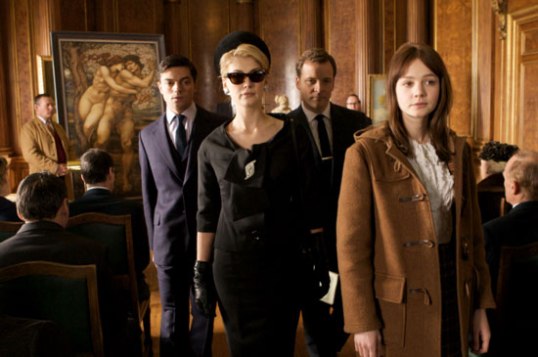
The Beautiful People (from L-R): Dominic Cooper, Rosamund Pike, Peter Sarsgaard, and Carey Mulligan.

Dance Scenes That I Love: The Perks of Being A Wallflower


I really probably shouldn’t share this scene until I actually post my review of The Perks of Being A Wallflower.  But I’ve still  got three other Back to School films to review before I get to Perks and I want to share this scene now!  In this dance scene that I love, Emma Watson and Ezra Miller take over the dance floor in spectacular fashion!

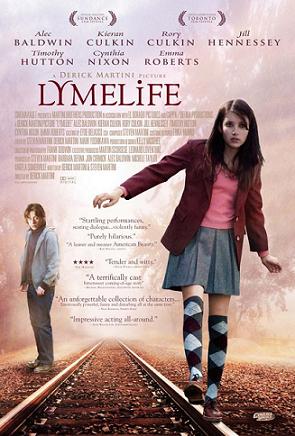
Back to School #70: Lymelife (dir by Derick Martini)


Lymelife_ver2

Lymelife is an odd but occasionally effective indie film from 2008.  Taking place in 1979, the film tells the story of two brothers living on Long Island.  The older brother, Jimmy Bartlett (Kieran Culkin) has recently graduated from high school and is preparing to enter the army.  (We hear that he’s going to be shipped off to fight in a war against Argentina, which is odd because, to the best of my knowledge, the U.S. has never been at war with Argentina.)  The younger brother is 15 year-old Scott (Rory Culkin), a gentle boy who loves Star Wars and who is doted on by his overprotective mother, Brenda (Jill Hennessy).  Scott’s relationship with his father, Mickey (Alec Baldwin), is far less positive with Mickey feeling that his youngest son is weak and Scott resenting the fact that Mickey is always cheating on Brenda.

As the film opens, a recent outbreak of Lyme Disease has got everyone in a panic.  Brenda, in particular, is terrified that Scott is going to get bitten by a tick and refuses to let him go outside unless every inch of his skin is covered and protected.  Causing Brenda even more panic is the fact that their neighbor, Charlie Bragg (Timothy Hutton), has contracted the disease and has lost his job as a result.  Now, he spends all of his time either outside trying to hunt deer or hiding down in his basement.  His wife (Cynthia Nixon) is forced to take a job from Mickey in order to support the family and soon, she and Mickey are having an affair.

In fact, the only person who doesn’t completely shun Charlie is Scott, though this is largely because Scott has, for years, had a crush on Charlie’s daughter, Adrianna (Emma Roberts).  Adrianna finally starts to return Scott’s affection but then Charlie discovers the truth about his wife’s job with Mickey and things … well, things do not end happily.

Lymelife is a strange film, one that at times almost plays like a parody of a typical indie film.  This is one of those films where a lot of things happen but you’re not always quite sure why they happened and ultimately, it’s hard not to feel like the film is essentially a collection of loosely related scenes, all looking for a stronger narrative.   But, with all that in mind, I still like Lymelife.  Director Derik Martini brings such an intense and humanistic touch to the film’s dangerously quirky storyline and it’s such an obviously personal film that it becomes fascinating in its own way.  Not surprisingly, both Alec Baldwin and Jill Hennessy overact in their roles (and considering that they have the most melodramatic lines, that’s not always a good thing) but, fortunately, Timothy Hutton, Emma Roberts, and the Culkin Brothers all give excellent performances.

Plus, the film’s ending is absolutely haunting, largely because of the wise use of the song Running Out Of Empty, which can be heard below.

Back to School #69: Superbad (dir by Greg Mottola)


Superbad

One of the great things about the 2007 comedy Superbad is that it has a title that allows for snarky but overworked reviewers like me to come up with an easy review.

For instance, if I disliked Superbad, I could just say, “Superbad more than lives up to its name!”  However, since I happen to like Superbad, I can say that Superbad is supergood, supercool, and superfun!

See how easily that works?

Plotwise, Superbad tells a story that will be familiar to anyone who has ever seen a teen comedy.  Three guys try to get laid.  Seth (Jonah Hill) is the rotund and boisterous one, the one who has a crush on Jules (Emma Stone), who is your basic good girl with a wild side.  Evan (Michael Cera) is the sweet and sensitive one.  And then there’s Fogell (Christopher Mintz-Plasse), the nerdy one with the thick glasses.  Fogell is the one who gets a hilariously bad fake ID, one that tells the world that his name is McLovin.

Superbad2

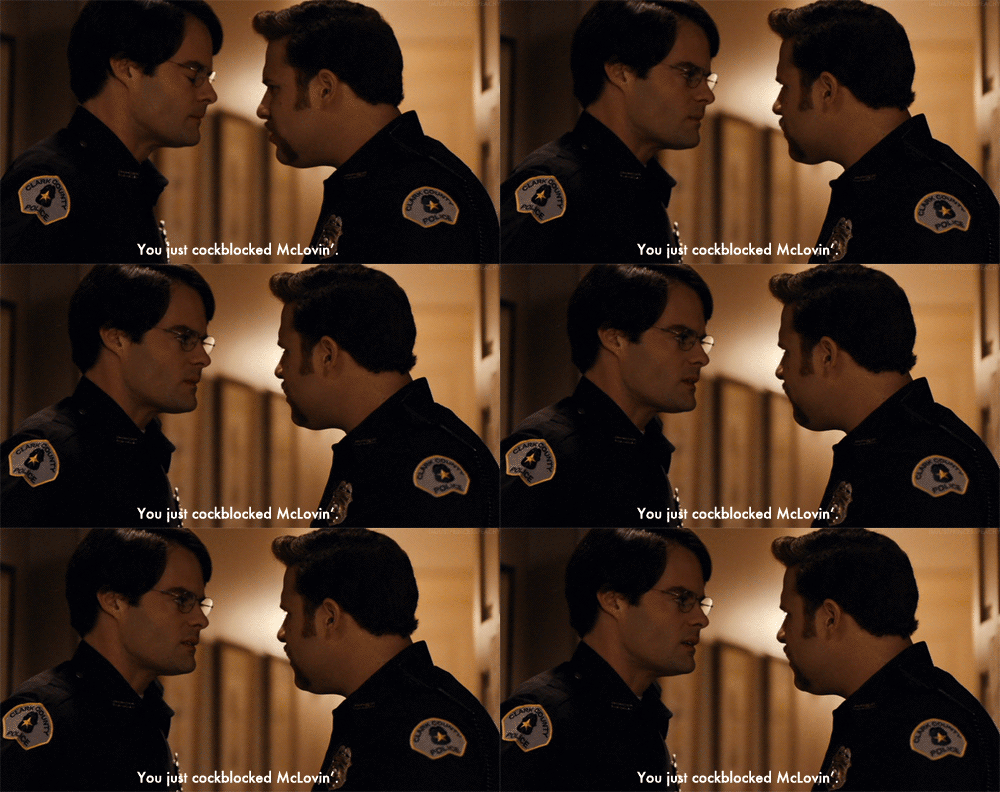
After Jules invites Seth to a party, he and Evan enlist Fogell to use his fake ID to buy them alcohol.  However, as often happens in the type of films, things get complicated.  While Fogell is buying the beer, the convenience store is held up.  The police arrive and Evan and Seth panic and run off.  Meanwhile, Fogell is befriended by the two cops (played by Seth Rogen and Bill Hader), both of whom are incredibly impressed that their new friend has as wonderful a name as McLovin.

(“You’re name’s McLovin?  That’s badass!”

Superbad23

And so, while McLovin bonds with his new cop friends, Seth and Evan continue to try to find beer and make their way to Jules’s party….

Superbad was produced by Judd Apatow and it features his usual combination of raunchy humor and sentimental bromance.  In fact, it’s such a male-centered film that I’m always a little bit surprised at how much I enjoy it.  However, Superbad is a seriously funny movie.  The script (which Seth Rogen and Evan Goldberg reportedly starting on when they were 13 years old) is full of great lines and Michael Cera and Jonah Hill make for an adorable comedy team.  And then there’s Christopher Mintz-Plasse who takes the character of Fogell to his most logical extreme and then just keeps going.  McLovin’s adventures may not be the most realistic or subtle part of the movie but they are still a lot of fun to watch.

Speaking of McLovin and his adventures with the cops, I love the performances of both Seth Rogen and Bill Hader.  If you don’t laugh at the way Seth Rogen says, “Oh no!  It’s the cops!,” then you need to be worried about your sense of humor.

Superbad is supergood, supercool, superfun, supersweet, and just plain super.

Superbad

Back to School #68: Juno (dir by Jason Reitman)


Junoposter2007

(SPOILERS BELOW)

Even though he’s a likable actor and has appeared in several films that I enjoyed, I am always a little bit uneasy whenever I see Jason Bateman on screen.  To me, he will always be Mark, the seemingly perfect husband from the 2007 best picture nominee Juno.  Mark and his wife Vanessa (Jennifer Garner) are unable to conceive so they agree to adopt the unborn child of pregnant teenager Juno (Ellen Page).

At first, Mark seems like the nicest guy on the planet.  Unlike his wife, Mark appears to be laid back and friendly.  Whereas Vanessa tries to maintain a polite distance between herself and Juno, Mark quickly befriends her.  It’s a familiar dynamic.  Vanessa is the one who keeps the household running.  Mark is the one who keeps the household fun.  Vanessa is the adult and Mark is the guy who is young at heart.  It’s not surprising that Juno finds herself feeling closer to Mark than to his wife.

Much like Juno, those of us in the audience are initially fooled into preferring Mark to his wife.  For me, the first indication that Mark was not quite the great guy he seemed to be came when he attempted to convince Juno that Herschell Gordon Lewis was a better director than Dario Argento.  But even that could be forgiven because, as Mark made his arguments, he revealed that he had a pretty good library of DVDs from Something Weird Video.

(Seriously, at that moment, I really hoped that the movie would just spend five minutes letting us see every title in Mark’s movie collection.)

But then there was that moment.  After telling Juno that he was planning on leaving his wife, he looked at her and asked, “How do you think of me?”  And I have to give Jason Bateman a lot of credit.  He delivered that line with just the right amount of needy selfishness.  It’s rare that you see an actor — especially one who has essentially built a career out of being likable — so fully commit to playing a reprehensible character.  When Mark reveals his true nature, it’s shocking because we were so ready to like Mark.  With that one line, we’re forced to re-examine the entire film and we realize that, much like Juno, we allowed ourselves to be fooled by Mark.

Juno is a film about growing up.  Vanessa is a grown up.  Mark refuses to grow up.  And, by the end of the film, Juno has grown up enough to know that she’s not ready to be a mother but Vanessa is.  Juno has grown up enough that she can allow herself to get close to the baby’s father, sweet-natured track star Paulie (played by Michael Cera).

For many people, Juno seems to be a love-it-or-hate-it type of movie.  There rarely seems to be a middle ground.  It seems that for every person who appreciates Ellen Page’s sardonic line readings, there’s another one who finds her character to be abrasive.  For every one who enjoys Diablo Cody’s script, there seems to be another one who finds it to be overwritten.  The same holds true for Jason Reitman’s direction.  Viewers either respond to his quirky vision or else they dismiss him as being far too showy for the film’s own good.

As for me, I’m firmly and unapologetically pro-Juno.  I think Juno is one of the best films of the past ten years and I think that, eventually, both the character of Juno and Ellen Page’s performance will be viewed as being iconic.  When future historians are watching movies for clues as to what it was like to be alive during the first decade of the 21st Century, Juno is one of the films that they will watch.

And when they do, hopefully, they will understand that Jason Bateman was just an actor giving a good performance as a bad person.