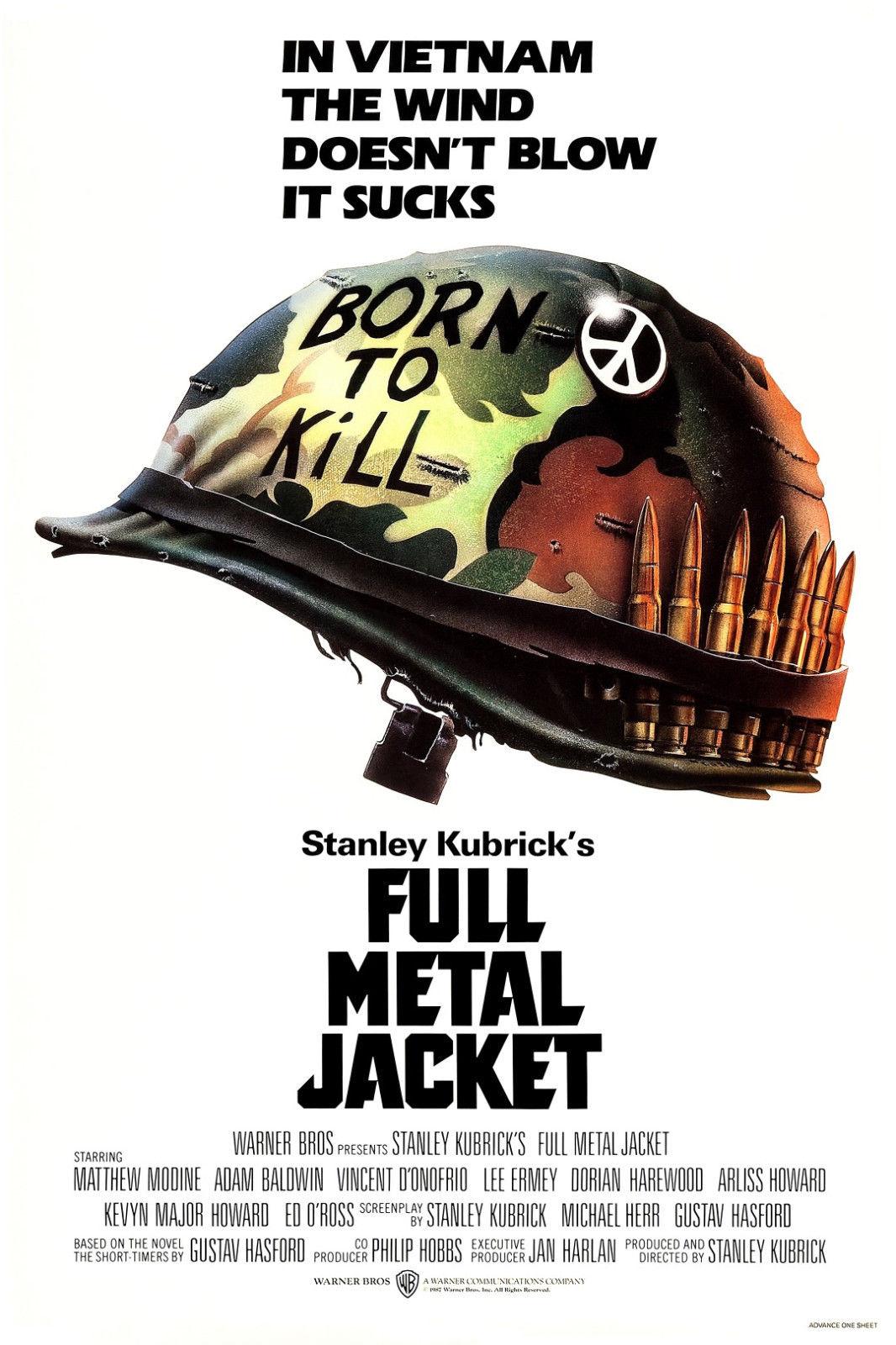
“You write ‘Born to Kill’ on your helmet and you wear a peace button. What’s that supposed to be, some kind of sick joke?” — Colonel
Full Metal Jacket is the kind of war movie that sticks in your craw like old metal shavings. It’s 1987, Stanley Kubrick’s last film released in his lifetime, and it plays less like a traditional Vietnam War saga and more like a taunt packed into two very different acts. One half is a barracks horror show about how the military turns boys into killers; the other is a grubby, almost casual descent into the chaos of combat. Together, they make a movie that feels intentionally disjointed so it can drill down on the same idea from two angles: war doesn’t just brutalize your body, it reshapes your mind into something barely human.
The film follows Private J.T. “Joker” Davis, played by Matthew Modine in one of those quietly watchful performances that’s easy to underestimate. Joker starts as a kind of archetypal smart‑mouth recruit, the guy who thinks he’s above the hysteria until he realizes he isn’t. Around him swirls a platoon of young Marines going through basic training at Parris Island under the merciless Gunnery Sergeant Hartman, played with shark‑like relish by R. Lee Ermey, who was actually a real‑life Marine drill instructor. Hartman’s whole job is to obliterate softness and replace it with drilled‑in aggression, and Kubrick lingers on every insult, every barked command, until the abuse stops feeling like a setup for a war movie and starts feeling like the main event.
The first half of Full Metal Jacket is basically a single, sustained initiation ritual. The camera stays tight, almost claustrophobic, trapping you in the barracks with the recruits, so you feel the same sensory overload they do. The lighting is harsh, the colors washed out, and the camera often locks in on Hartman’s face mid‑rant, making you uncomfortably intimate with his cruelty. This isn’t training so much as a manufactured psychological war waged on the platoon’s collective brain. The recruits are constantly degraded, mocked, and forced into grotesque rituals of humiliation, and the film never lets you forget that this is the system’s idea of “making Marines.” Kubrick doesn’t fake the perverse appeal of this process either; there’s a weird, ugly thrill in how effective it is, in how the boys start enjoying the brutality once they’re inside it.
The standout character in this section is Leonard “Gomer Pyle” Lawrence, played by Vincent D’Onofrio in a performance that’s almost physically uncomfortable to watch. D’Onofrio’s Pyle is this thick‑set, awkward kid who can’t keep up, and the movie doesn’t soften his edges to make him likable. He’s genuinely bad at the routine, slow, clumsy, but he’s also clearly just trying to survive. The film lets you watch, in a very matter‑of‑fact way, how the system turns his inadequacy into a target. The other recruits are instructed to punish him, and soon everyone starts in. The film doesn’t moralize about it; it just shows that this kind of group cruelty is baked into the structure. The infamous scene where the platoon holds Leonard down with piled‑on bed sheets while whacking him with a bar of soap wrapped in a towel is less about a single act of violence than about what it means to normalize dehumanization before you ever see combat.
What’s so unsettling about Full Metal Jacket is that it never pretends Hartman is some rogue sadist. He’s not an outlier; he’s the product of the system, and he’s also the system’s avatar. In that sense, the first half of the film functions like a kind of industrial horror. The Marines are being processed like defective parts on a factory line, streamed through a machine designed to break them and then rebuild them as compliant killers. The film toys with the idea that the military doesn’t want robots so much as creatures that hunger for violence on command. The line about “we don’t want robots, we want men” is repeated with a kind of grim irony because what the film actually shows is the production of something in between: not quite human, not quite machine, but something that can pull a trigger without hesitating.
Jumping from Parris Island to the streets of Huế during the Tet Offensive, the second half of Full Metal Jacket feels like a different movie in tone but the same one in thesis. Joker, now a combat correspondent with a Stars and Stripes hat and a “Born to Kill” slogan on his helmet, is literally split down the middle between observer and participant. He carries a camera and a rifle; he’s supposed to report, but he also has to fight. The film doesn’t resolve that tension the way a more sentimental war movie would. Instead, it lets Joker drift in that gray zone where war is equal parts absurdity and atrocity. The Vietnamese civilians are largely faceless, and the war itself is shown as a series of loosely connected vignettes—raids, ambushes, random firefights—rather than a grand narrative of heroism or tragedy.
Kubrick’s Vietnam is less a country and more a ruined theater set. The cityscapes are wide, desolate, and oddly beautiful in their destruction, as if the war has turned everything into a series of bleak tableaux. The camera doesn’t linger on gore for shock value; it lingers to make the war feel like a permanent, almost aesthetic state of ruin. Individual soldiers pop in and out: Animal Mother, the violently unhinged Marine played by Adam Baldwin; Cowboy, the earnest, almost naive replacement; and the rest of the squad, who oscillate between fear, boredom, and bursts of casual cruelty. None of them are given the kind of tragic backstories that usually make you emotionally invested in a war film. Instead, they’re presented as fragments of a larger machine, each one another cog in the same indifferent system.
The film’s most famous structural trick is its way of keeping politics at arm’s length while still radiating a deeply skeptical view of the war. It doesn’t really bother telling you who’s right or wrong, or why the Marines are there. It just shows what they become and what they do. The movie doesn’t ask you to sympathize with the Marines in the way some war films do; it asks you to recognize the mirror. The famous ending, where the Marines march through flaming ruins to the tune of Mickey Mouse, is pure Kubrick dark surrealism. The cheerful cartoon theme clashes violently with the apocalyptic imagery, and the soldiers chant along with a kind of manic innocence that feels like the last vestige of humanity being cannibalized by the war itself. It’s hard to tell whether the moment is tragic, absurd, or both, and that’s the point.
Full Metal Jacket is also a film about storytelling and the way narratives are weaponized. Joker, as a reporter, is supposed to package the war for a distant audience. He’s there to turn chaos into digestible stories, but the movie quietly undermines that idea by showing how unreliable those narratives are. The soldiers’ own stories are laced with jokes, bravado, misogyny, and casual racism, and the film doesn’t clean them up. It lets you sit with the ugliness, even when it’s delivered with a laugh. The film doesn’t romanticize the Marines’ camaraderie or soften their cruelty; it just lets you watch them behave like ordinary guys who happen to be doing something extraordinary and monstrous.
The cinematography in Full Metal Jacket is cold and precise, which is exactly what the material needs. The camera behaves like a reluctant witness, framing the Marines in symmetrical, almost clinical compositions that make their brutality look routine rather than spectacular. The score is minimal, and the film often relies on diegetic sound—machine‑gun fire, jeep engines, distant explosions, Hartman’s voice echoing off concrete walls—to ground you in the sensory overload of military life. Even the few moments of levity feel like concessions to show business more than true relief. The soldiers’ jokes are rarely funny in a wholesome way; they’re the kind of gallows humor that keeps you from noticing how broken you’ve become.
What ultimately makes Full Metal Jacket endure is that it refuses to offer catharsis. By the time the film ends, nothing has been “resolved” in the way Hollywood usually expects. Joker survives, but the war doesn’t; it just keeps going, and the Marines keep marching, chanting, and killing. The film doesn’t build toward a big speech about the futility of war or a tear‑jerker about fallen comrades. It just suggests, quietly and persistently, that the process outlined in the boot‑camp half is drafted, again, in the streets of Vietnam. You go in as a boy, you’re molded into something sharper and meaner, and then you’re sent out into a world that rewards that sharpness. The movie doesn’t need to say this out loud; it just shows it happening in scene after scene.
In that sense, Full Metal Jacket is one of the most honest anti‑war films precisely because it doesn’t pretend to be a plea for peace. It’s a portrait of a machine that feeds on itself, and of the people who get caught in its gears. It’s funny, disturbing, infuriating, and occasionally mesmerizing, sometimes all at once. It’s not a movie that wants to hold your hand or make you feel better about the human race. It wants you to stare at the gleam on that full metal jacket bullet and wonder what it took to make someone pull the trigger. That’s the real power of Full Metal Jacket: it doesn’t try to redeem the war, the soldiers, or the audience. It just makes sure you can’t look away.