Embracing the Melodrama Part II #24: The Diary of a High School Bride (dir by Burt Topper)


teen01

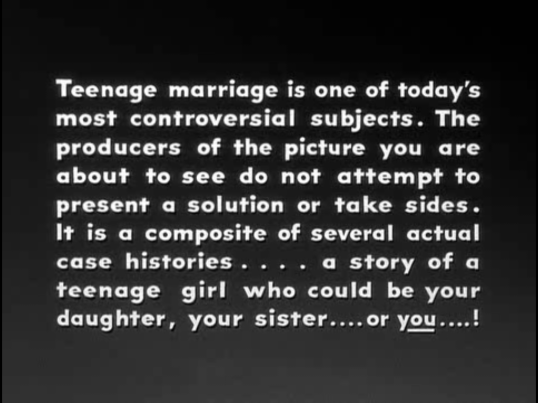
I always enjoy it when a film opens with a message statement that announces that it was made to shine the light on one of “today’s most controversial subjects.”  Even better is when that message statement states that the film could be my story or that it could serve as a warning to people like me about what might happen.

Of course, it’s too late for me to be warned.  I’m not in high school anymore.  I’ve already made my decisions and had to deal with the consequences of my mistakes and all the other melodrama that makes life interesting.  But I can watch a film like 1959’s The Diary Of A High School Bride and I can read the message statement at the beginning and I can think to myself, “If only I had seen this movie before I decided to sneak out that night and drink alcohol or smoke weed or let my boyfriend take pictures of me naked or have sex with a married man or rob a convenience store or read that forbidden book or become a bride of Cthulhu or agree to spy for the communists or whatever the Hell it was that I did that night!”  If only…

Actually, it probably wouldn’t have made much of a difference.  Life doesn’t come with a message statement and whenever I see one at the beginning of a film, it usually makes me less likely to take that film seriously.  In fact, I tend to seek out films the open with message statements because they’re usually a lot of fun.

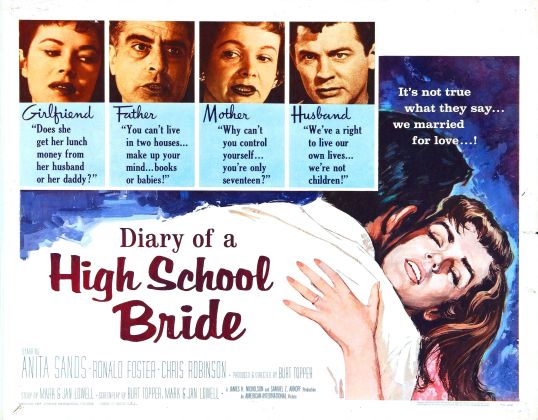
Take The Diary of a High School Bride, which is silly in a way that only an American International Pictures youth film could be.  The film opens with 25 year-old law student Steve (Ron Foster) driving home from Las Vegas with his new wife, 17 year-old Judy (Anita Sands).  When Steve gets pulled over by a police officer, Judy starts to tremble in terror.  When the cops asks Judy how old she is, she lies that she’s 21 and then starts to cry.  When the police officer asks if she’s really married to Steve, she wails, “Yes, and this record proves it!”  At this point, she holds up a vinyl record.

However, a vinyl record is not the only thing that Judy has.  She also has a teddy bear and oh my God, she literally carries that teddy bear with her everywhere!  When she and Steve tell her parents, she has the teddy bear.  When she wails at them, “AND NO — I’M NOT PREGNANT!,” she has the teddy bear.  When she and Steve go out to a coffeehouse and listen to some pretty good flamenco music, Judy has that teddy bear.  When they get back to Steve’s apartment and Judy finally see Steve with his shirt unbuttoned, Judy drops the teddy bear on the floor.

Why are Steve and Judy married?  That’s never really made clear.  They have absolutely nothing in common and Judy is so naive and so innocent that she spends most of the movie struggling to speak in coherent sentences.  (And, of course, she also won’t let go of her teddy bear.)  Steve, meanwhile — well, listen, when you’re 17, any man in his 20s is automatically attractive.  But still, there’s something undeniably (and, judging from the film’s script, unintentionally) creepy about Steve’s marriage to Judy.

Anyway, when Judy goes back to school, she has to deal with people singing Here Comes The Bride at her.  She also has to deal with her ex-boyfriend, Chuck (Chris Robinson).  Chuck wants her back and soon, he’s harassing the newly married couple and making such a menace out of himself that the whole “She’s only 17!” thing gets forgotten about…

So, that’s Diary of a High School Bride.  It’s a film that, if I had seen it when I was an out-of-control teenager, would have made absolutely no difference whatsoever.  But, if you’re a fan of 1950s B-movies (and who isn’t!) and if you have a group of friends who like to be snarky while watching old movies (and who doesn’t!), you’ll probably enjoy The Diary of a High School Bride.  At the very least, it features a fun little theme song from someone named Tony Casanova.

The Diary of a High School Bride was directed by Burt Topper and written by the poet Robert Lowell.  (Okay, it was probably a different Robert Lowell…)  It’s currently available on Netflix and it’s a lot of fun if you’re in the right snarky mood.
Diary

Embracing the Melodrama Part II #23: The Defiant Ones (dir by Stanley Kramer)


Defiant_Ones_poster

Stanley Kramer is one of those old school filmmakers who directed several films that were acclaimed when they were originally released but who tends to be dismissed by contemporary film critics.  Kramer specialized in making films about social issues and he deserves to be applauded for attempting to look at issues that Hollywood, at that time, would have preferred to ignore.  However, as Mark Harris points out in his excellent book Pictures At A Revolution, Kramer started out as a producer and, even after he started directing, he never lost his producer sensibility.  As a result, a Kramer film would typically address issues that were guaranteed to generate a lot of free publicity but, at the same time, Kramer would never run the risk of truly alienating his audience by digging too deeply into those issues.  As a result, Kramer’s films have come to represent a very safe and middlebrow version of 50s and early 60s style liberalism.

Now, I have previously reviewed 4 Stanley Kramer films on this site and I have to admit that I was somewhat dismissive of most of them.  I felt that Ship of Fools was shallow.  I thought that Guess Who’s Coming To Dinner collapsed under the combined weight of a self-satisfied script and Kramer’s refusal to let Sidney Poitier’s character be anything other than idealized perfection.  R.P.M. is a guilty pleasure, specifically because Kramer was so out-of-touch with the film’s subject matter.  I did give Judgment at Nuremberg a good review, describing it as one of Kramer’s rare films that still holds up today.

And now, I’m going to give another Kramer film a good review.

Kramer’s 1958 film The Defiant Ones features a classic Kramer situation.  White Joker (Tony Curtis) and black Noah (Sidney Poitier) are both prisoners in the deep south.  Joker is an unrepentant and violent racist while Noah … well, Noah is Sidney Poitier.  He’s determined, he’s not afraid to speak his mind, and most of all, he’s dignified.  That’s not meant to be a complaint about Poitier’s performance in The Defiant Ones.  In the role of Noah, Poitier has a great screen presence and it’s impossible not to root for him.  Whereas Curtis tends to chew up every piece of scenery that he gets nears (and, again, that’s not really a complaint because Curtis’s overacting is totally appropriate for his character), Poitier keeps the film grounded.

When the prison bus that is transporting them crashes, Joker and Noah are able to escape.  Fleeing on foot, they make their way through the wilderness and attempt to hide from the police.  As quickly becomes obvious, Joker and Noah hate each other but, because the sheriff had a sense of humor, they have also been chained together.  In other words, they’re stuck with each other and, in order to survive, they’re going to have to learn to coexist.

No, it’s not exactly subtle but it works.

As a filmmaker, Kramer was never known for being visually inventive and, as a result, his films often had to resort to heavy-handed monologues to make their point.  But, in The Defiant Ones, the chains act as a great visual symbol for race relations in America.  Joker and Noah literally can’t escape from each other and they have to work together if they’re going to survive.  The chains make that obvious and, as a result, this is the rare Kramer film where nobody has to give a big speech to get across Kramer’s message.  As a result, The Defiant Ones preaches without ever getting preachy.

Though the film is dominated by Poitier and Curtis, it also features some excellent supporting work.  Lon Chaney, Jr, for instance, has a great cameo as world-weary man who helps the two convicts in their flight.  Cara Williams is surprisingly poignant as a lonely, unnamed woman who tries to both protect Joker and get rid of Noah.  And finally, there’s Theodore Bikel, playing the role of Sheriff Max Muller.  Max is the most surprising character in the film, the head of a posse that’s set out to recapture Noah and Joker.  As opposed to most of his men, Max is a humane and caring man who struggles to control the more bloodthirsty men who are serving under him.

Message films tend to get dated rather quickly but The Defiant Ones holds up surprisingly well.

Embracing the Melodrama Part II #22: The Cry Baby Killer (dir by Joe Addis)


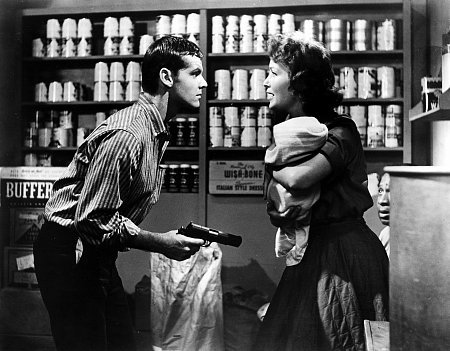
That's Jack Nicholson with the gun.

That’s Jack Nicholson with the gun.

Two years ago, there was a rumor that Jack Nicholson had announced his retirement from acting because he was starting to suffer from memory loss.  Even though Nicholson’s people later claimed that this was false and that Jack was actively reading scripts, that rumor still left me feeling very depressed.  Jack Nicholson is such an iconic actor that it’s difficult to think that there will be a time when he’ll no longer be arching his eyebrows and delivering sarcastic dialogue in that signature voice of his.  When you look at a list of his films, you find yourself looking at some of the best and most memorable films ever made.  Chinatown, The Shining, The Departed, The Shooting, Easy Rider, One Flew Over the Cuckoo’s Nest; Nicholson has appeared in some truly great films.

But every actor, no matter how iconic he may be, had to start somewhere.  For Jack Nicholson, that somewhere was the 1958 Roger Corman-produced film, The Cry Baby Killer.  The good news is that the 21 year-old Nicholson starred in his very first film.  The bad news is that there’s absolutely nothing about Jack’s performance that would give you any reason to believe that he would eventually become one of the best known and most-honored actors of all time.  It’s not that Jack gives a bad performance.  In fact, it’s somewhat disappointing that Jack doesn’t do a terrible job in the role.  When you’re seeing the obscure film debut of a cinematic icon, you always hope that the first performance will either be amazingly good, shockingly bad, or just embarrassingly inappropriate.  But, in Jack’s case, he’s neither good nor bad and he doesn’t really embarrass himself.  Instead, he’s just bland.

Yes, you read that right.

Jack “HEEEEEEEEEERE’S JOHNNNNNNNY!” Nicholson was bland in his debut film.

As for the film itself, Jack plays Jimmy.  We’re told that Jimmy is 17 years-old and he’s still in high school.  (Since Jack Nicholson’s hairline was already receding at 21, we automatically have a difficult believing him in the role of Jimmy.)  Jimmy’s a good kid but he’s kind of stupid.  Also, his ex-girlfriend Carole (Carolyn Mitchell) is now dating an 18 year-old gangster named Manny Cole (played by Brett Halsey, who would later have a prolific career in Italian exploitation films as well as appearing in The Godfather, Part III).  Jimmy confronts Manny.  Manny has two of his thugs beat up Jimmy.  Jimmy grabs a gun off a thug and shoots someone.  Scared of going to jail, Jimmy runs into a store and takes three hostages — a stocker and a young mother with a baby.

The rest of the 70-minute film consists of an understanding policeman (Harry Lauter) trying to convince Jimmy to surrender while the crowd of reporters and observes outside the store hope for a violent confrontation.  The film does make a still-relevant point about how the media exploits the potential for tragedy but, for the most part, it’s pretty forgettable.

As I stated above, Jack is adequate but forgettable.  If I had seen this movie when it first came out in 1958, I would have expected handsome and charismatic Brett Halsey to become a huge star while I would have predicted that Nicholson would spend the rest of his career in television.

However, we all know that didn’t happen.  Jack Nicholson became an icon.  Sadly, Jack hasn’t appeared in a film since 2010.  Hopefully, he’ll give us at least one more great performance.  Who knows?  Maybe some aspiring screenwriter will write as script for Cry Baby Killer 2: Jimmy’s Revenge.

It could happen.

Cry_Baby_Killer

Embracing the Melodrama Part II #21: Emergency Hospital (dir by Lee Sholem)


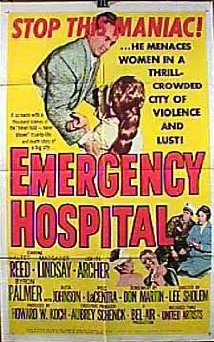
Emergency Hospital

Right now, on Netflix, you can find Emergency Hospital, a low-budget film from 1956.  Emergency Hospital, which probably was made to be the second feature on a double bill, covers the course of one night at a hospital.  Patients come in.  Crimes are investigated.  Two doctors — one a man and one a woman and since this film was made in the 50s, that leads to all sorts of confusion — deal with all of the patients.  The film manages to stuff a lot of incidents into just 61 minutes of running time.

If you look at the poster above, you’ll see that it implores us to “STOP THE MANIAC!  He menaces women in a thrill-crowded city of violent and lust!”  I’m not really sure which of the film’s many subplots that is meant to refer to.  At one point, the son of a police detective is brought in after crashing his car.  He briefly attempts to hold a nurse hostage with a scalpel but, in the end, he doesn’t turn out to be much of a maniac.

In fact, if there’s anything that really distinguishes Emergency Hospital is just how low-key it is.  For the most part, the film emphasizes the fact that everyone at the hospital is focused on doing her or his job.  The patients all come in with their own individual melodramas but, for the most part, the doctors and the police all react calmly and rationally.  It’s interesting to compare Emergency Hospital to something like Magnificent Obsession.  Whereas Magnificent Obsession truly embraces the melodrama, Emergency Hospital invites the melodrama to pull up a chair and then tells it to calm down.

Perhaps because it was such a low-budget and obscure film, Emergency Hospital gets away with taking a look at and talking about issues that you normally wouldn’t expect to be so openly explored by a film made in the 50s.  And, interestingly enough for a film made in a culturally reserved time, the doctors and nurses at Emergency Hospital take a rather open-minded and nonjudgmental approach to their patients.  An anxious mother comes in with her bruised baby and is confronted about being an abusive parent.  A teenage girl comes in after being raped and the doctors try to convince her father (who thinks his daughter’s reputation will be ruined) to call the police.

Now, make no mistake about it: Emergency Hospital is not a secret masterpiece.  It’s an extremely low-budget movie that looks like an extremely low-budget movie.  But, taking all that into consideration, it’s still a lot better than your typical 61 minute second feature.

Emergency Hospital can currently be watched on Netflix.

Embracing the Melodrama Part II #20: Magnificent Obsession (dir by Douglas Sirk)


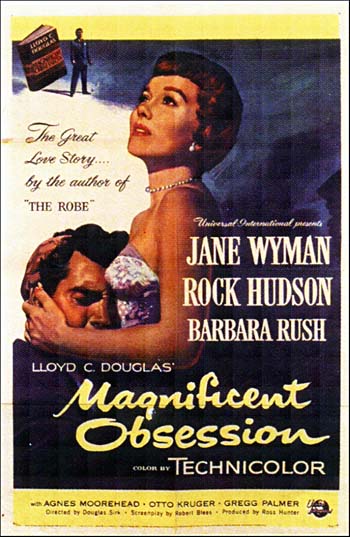
Magnificent_obsessionThere’s a scene early on in the 1954 melodrama Magnificent Obsession in which formerly carefree millionaire Bob Merrick (Rock Hudson) meets with an artist named Edward Randolph (Otto Kruger).  We know that Randolph’s brilliant because he speaks in a deep voice, tends to be unnecessarily verbose, and often stares off in the distance after speaking.  Bob wants to know about a dead doctor who was a friend of Randolph’s.  Randolph explains the late doctor’s philosophy of doing anonymous good works.  Bob’s mind is blown.  (Hudson, who was never the most expressive of actors, conveys having his mind blown by grinning.)

“This is dangerous stuff,” Randolph warns him, “One of the first men who used it went to the cross at the age of 33…”

And a heavenly chorus is heard in the background…

And that one line pretty much tells you exactly what type of film Magnificent Obsession is.  It’s a film that not only embraces the melodrama but which also holds on tight to make sure that the melodrama can never escape.  There’s not a single minute in this film that is not hilarious overwritten.  It’s not just Randolph who tends to be portentous in his pronouncements.  No — everyone in the film speaks that way!

The dead doctor is dead specifically because of Bob.  Apparently, the doctor had a heart attack but the local hospital’s only resuscitator was being used to save the life of Bob who, while the doctor was dying, was busy recklessly driving a boat.

Helen (Jane Wyman), the doctor’s widow is, at first, bitter towards Bob and when Bob offers to donate $250,000 to the hospital, Helen refuses to accept his check.  This leads to Bob doing a lot of soul-searching and eventually having his life-changing conversation with Randolph.  Excited at the prospect of doing anonymous good works for the rest of his life, Bob tracks down Helen and tries to tell her that he’s a changed man.  Helen, however, wants nothing to do with Bob and ends up getting hit by a car while running away from him.  Helen survives but now, she’s blind!

Now, at this point, you might think that Bob has done enough to ruin Helen’s life.  At least, that’s the way that Helen’s family views it and when Bob attempts to visit her in the hospital, they order him to go away.

Eventually, Helen comes home from the hospital and starts to adjust to a life without eyesight.  One day, she meets a man on the beach and they start up a tentative romance.  What she doesn’t realize, at first, is that the man is Bob!  By the time she does realize who the man is, Helen has fallen in love with him.  However, she feels that it wouldn’t be fair to Bob to pursue a relationship with him and she leaves him.

So, of course, Bob’s response is to go to medical school and become a neurosurgeon.  Many years later, Helen has a brain tumor and needs an operation to survive.

Can you guess who her surgeon turns out to be?

Magnificent Obsession is almost a prototypical 1950s melodrama.  It’s big, it’s glossy, it’s self-important, and undeniably (and occasionally unintentionally) funny.  Even the total lack of chemistry between Hudson and Wyman somehow adds to the film’s strange charm.  It’s hard not to admire a film that starts out over-the-top and just grows more excessive from there.

Watching Magnificent Obsession is a bit like taking a trip into a parallel, technicolor dimension.  It’s strange, fascinating, and far more watchable than it should be.


Embracing the Melodrama Part II #19: Sunset Boulevard (dir by Billy Wilder)


Sunset Boulevard

“All right, Mr. De Mille, I’m ready for my close-up!”

— Norma Desmond (Gloria Swanson) in Sunset Boulevard (1950)

First released in 1950 and nominated for Best Picture, Billy Wilder’s Sunset Boulevard is one of the greatest and most influential films of all time.  It’s also something of a difficult film to review because, in order for one to truly understand its greatness, it needs to be seen.  A description simply will not do.  You have to experience, first hand, the performances of Gloria Swanson, William Holden, and Eric Von Stroheim.  You have to see, with your own eyes, the way that Billy Wilder perfectly balances drama, satire, and horror.  I can tell you about how cinematographer John F. Seitz perfectly contrasts the empty glossiness of Hollywood with the dark shadows that fill the ruined mansion of Norma Desmond but, again, it’s something that you owe it to yourself to see.  You need to hear the perfectly quotable dialogue with your own ears.  You need to experience Sunset Boulevard for yourself.

And, while you’re watching it, think about how easily one bad decision could have screwed up the entire film.  Sunset Boulevard is famous for being narrated by a dead man, a screenwriter named Joe (William Holden).  When we first see Joe, he’s floating in a pool.  Originally, however, the film was to open with the dead Joe sitting up in the morgue and telling us his story.  Reportedly, preview audiences laughed at the scene and it was cut out of the film.  And Wilder made the right decision to remove that scene.  Sunset Boulevard may be famous for being a strange film but, when you actually watch it, you realize just how controlled and disciplined Wilder’s direction actually is.  Sunset Boulevard may be weird but it’s never less than plausible.

Joe Gillis is a former newspaper reporter-turned-screenwriter.  He may have started out as an idealist but, as the film begins, he’s now just another Hollywood opportunist.  While trying to hide from a man looking to repossess his car, Joe stumbles upon a dilapidated old mansion.  The owner of the mansion is none other than Norma Desmond (Gloria Swanson), a silent film star who has sent been forgotten but who still dreams of making a comeback.  (When Joe tells her that she used to be big, Norma famously responds that she’s still big and it’s the pictures that have gotten small.)  Norma has written a script and the opportunistic Joe convinces her to hire him as a script doctor.

Joe moves into the mansion and discovers a world that has never moved past the 1920s.  Norma’s butler and former director, Max (played by Gloria Swanson’s former director Erich Von Stroheim) writes letters that he claims were sent by Norma’s fans.  Norma spends her time watching her old movies.  Occasionally, other forgotten silent screen stars (including Buster Keaton) drop by to play cards.

Encouraged by Joe’s vapid flattery and a mysterious phone call from a Paramount exec, Norma has Max drive her down to the studio.  Greeted by the older employees and ignored by the younger, Norma visits with director Cecil B. DeMille (who plays himself).  In a rather sweet scene, she and DeMille remember their shared past.  DeMille obviously understands that she’s unstable but he treats her with real respect, in contrast to the manipulative Joe.

As for Joe, he’s fallen for a script reader named Betty (Nancy Olson) and wants to escape from being dependent on Norma.  However, Norma has invested too much in her “comeback” to just allow Joe to leave…

Sunset Boulevard is a wonderful mix of film noir and Hollywood satire.  And, though the film may be narrated by Joe and told from his point of view, it’s firmly on Norma’s side.  As easy as it is to be dismissive of Norma’s delusions, she’s right in the end.  It is the pictures that have gotten small and, as she proves towards the end of the film, she is still as capable of making a grand entrance as she ever was.

Joe may have been too stupid to realize it but Norma Desmond never stopped being a star.

Lisa’s Way Too Early Oscar Predictions For April


Best Picture

Black Mass

Bridge of Spies

Brooklyn

The End of the Tour

Grandma

The Hateful Eight

In The Heart of the Sea

The Revenant

The Walk

Woman in Gold

Best Actor

Bryan Cranston in Trumbo

Leonardo DiCaprio in The Revenant

Michael Fassebender in Steve Jobs

Tom Hanks in Bridge of Spies

Jason Segel in The End of the Tour

Best Actress

Blythe Danner in I’ll See You In My Dreams

Jennifer Lawrence in Joy

Helen Mirren in Woman in Gold

Saoirse Ronan in Brooklyn

Lily Tomlin in Grandma

Best Supporting Actor

Jim Broadbent in Brooklyn

Albert Brooks in Concussion

Paul Dano in Love and Mercy

Tom Hardy in The Revenant

Kurt Russell in The Hateful Eight

Best Supporting Actress

Julia Garner in Grandma

Jennifer Jason Leigh in The Hateful Eight

Kristin Scott Thomas in Suite Francaise

Kristen Stewart in Clouds of Sils Maria

Meryl Steeep in Suffragette

Best Director

John Crowley for Brooklyn

Ron Howard for In The Heart of the Sea

James Ponsoldt for The End of the Tour

Steven Spielberg for Bridge of Spies

Robert Zemeckis for The Walk

Embracing the Melodrama Part II #18: A Letter To Three Wives (dir by Joseph L. Mankiewicz)


220px-A_letter_to_three_wives_movie_poster

Last week, I started a little series that I call Embracing The Melodrama, Part II.  Over the next three weeks, I will be reviewing, in chronological order, 128 cinematic melodramas.  I started this series with the 1927 silent film Sunrise and now, we have reached our 18th film, the 1949 best picture nominee, A Letter To Three Wives!

Now, I’m going to start this review by pointing out something that will probably scare off some of our readers.  So, before you read the next paragraph, understand that A Letter To Three Wives is a great film that’s full of great performances and witty dialogue and you really should watch it the next time that it’s on TCM.  Got all that?  Okay.  Good.  Moving on…

A Letter To Three Wives feels a lot like a 1949 version of Desperate Housewives.  Now, before you freak out, I’m talking about early Desperate Housewives as opposed to later Desperate Housewives.  The similarities are actually pretty striking.  Both A Letter To Three Wives and Desperate Housewives take place in an upper class suburb.  Both of them deal with women who appear to have happy marriages but who are all actually dissatisfied with how their lives have turned out.  Both of them are satires disguised as mystery stories.  (The mystery in Desperate Housewives involved murder.  The one in A Letter To Three Wives involves adultery.)  Perhaps most significantly, both Desperate Housewives and A Letter To Three Wives are narrated by a snarky woman who exists largely off screen.

The narrator in A Letter To Three Wives is named Addie Ross and voiced by Celeste Holm.  We never actually see Addie but we hear a lot from her and a lot about her.  Apparently, every man in town has, at some point, been in love with Addie.  Every woman is jealous of her.  And Addie, amazingly enough, seems to have the power to know exactly what’s happening in everyone else’s marriage.  At the start of A Letter To Three Wives, Addie has sent … well, a letter to three wives.  In the letter, Addie explains that she’s run off with one of their husbands but she declines to reveal which husband.  Each one of the wives thinks back on her marriage and wonders if her husband is the one.

Deborah (Jeanne Crain), for instance, is a country girl who met and married Bradford “Brad” Bishop (Jeffrey Lynn) during World War II.  Deborah is insecure about the fact that Brad comes from an upper class background and that he was apparently engaged to marry Addie before he met Deborah.

(Here’s an interesting piece of trivia for those of you who, like me, are into true crime stories.  Along with the movie character, there’s also a real-life murderer named Bradford “Brad” Bishop.  Like the character in the movie, he came from an upper class background.  Unlike the film character, the real Brad Bishop ended up murdering his wife, his children, and his mother and then fled to Europe.  He’s been a fugitive for close to 40 years and is believed to still be alive.  He’s currently on the FBI’s most wanted list.)

And then there’s Rita (Ann Sothern), who is an old friend of Brad’s.  Rita is married to George.  George is a quiet and intellectual English professor who is insecure over the fact that Rita, working as a soap opera writer, makes more money than he does.  George is played by Kirk Douglas and, admittedly, it does take a while to get used to the idea of Kirk Douglas playing an introverted intellectual.  But, once you get over the initial shock, Kirk Douglas gives a pretty good performance.  Kirk may be miscast but that actually works to the film’s advantage.  In a world where surface appearances hide the unexpected truth, it only makes sense that a mild college professor would look like Kirk Douglas.

My favorite wife was Lorna Mae (Linda Darnell), who grew up next to the train tracks and who pursues and eventually married a wealthy, older man (Paul Douglas).  It was impossible for me not to relate to and even admire Lorna Mae.  Much like me, Lorna Mae was determined to get what she wanted.  Perhaps my favorite scene with Lorna Mae was when she blatantly did everything possible to get stuffy old Paul Douglas to look at her legs, largely because I’ve done the exact same thing on occasion.

A Letter To Three Wives is an entertaining and witty film that still holds up today.  Director Joseph L. Mankiewicz deservedly won the Best Director Oscar for his work here.  The film itself was nominated for best picture but lost to All The King’s Men.  I actually happen to like All The King’s Men but, if I had been an Academy voter in 1949, my vote would have totally gone to A Letter To Three Wives.

The Daily Grindhouse: Revenge of the Zombies (dir by Steve Sekely)


revengeofzombies36

Last night, the Late Night Movie Crew and I watched the 1943 film, Revenge of the Zombies.

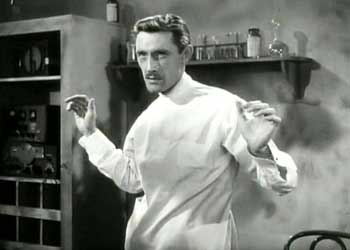
Revenge of the Zombies deals with the mysterious Dr. von Aldermann (John Carradine), who has a house on the Louisiana bayous and who is involved in weird, 1940s-style scientific experiments.  As is evident from his name (but not particularly from Carradine’s disinterested performance), von Aldermann is from Germany and his experiments are designed to create an army of zombies who will destroy American from within for the benefit for the Third Reich.  This is a pretty big deal and von Aldermann isn’t particularly subtle about his schemes but, as the film’s begins, nobody has figured out what’s going on.

I guess you can get away with anything on the bayous.

Von Aldermann’s wife Lila (Veda Ann Borg) has recently died but, thanks to the mad scientist, she’s still walking around Louisiana and leading an army of zombies.  Lila’s brother (Robert Lowery) shows up with a private investigator (Mauritz Hugo) and yet another mad scientist (Barry Macollum)  and they eventually figure out that something weird is happening.  With the help of von Aldermann’s secretary (Gale Storm), they try to thwart von Aldermann’s plans and keep the world safe for democracy.

There are a few good points about Revenge of the Zombies.  For one thing, the film is only 61 minutes long so the suffering is short.  As with any low-budget John Carradine horror film, Revenge of the Zombies is fun to watch with a group of snarky friends.  Historically, this film is significant for being one of the first zombie movies.  It’s always interesting to see how non-threatening zombies were in the days before George Romero and The Walking Dead.

revengeofzombies25

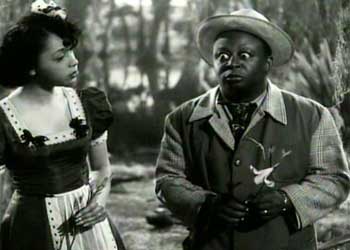
And then there’s the character of Jeff (Mantan Moreland), who is a chauffeur and who provides most of the film’s comic relief. It’s always difficult for contemporary audiences to deal with the racial attitudes displayed in the films and literature of the past.  On the one hand, Jeff is written as a complete and total stereotype and, as you listen to his dialogue, you’re painfully aware of the fact that the goal was to get audiences to laugh at him as opposed to with him.  On the other hand, Moreland is literally the only actor in the film who actually gives a good performance.  Even when delivering the most cringe-worthy of dialogue, Moreland does so with a conviction and commitment that holds your interest.  As you watch Revenge of the Zombies, you really don’t care what happens to most of the bland and interchangeable characters.  But you really do want Jeff to survive.

And, ultimately, you do take some comfort in that.  Moreland was given a role that, as written, was very demeaning but, in the end, Jeff is the only character that you care about.

As for the rest of Revenge of the Zombies, it’s short, it’s pretty bad but it’s not terrible, and you can watch it below!

What Lisa Watched This Afternoon #121: If There Be Thorns (dir by Nancy Savoca)


This afternoon, as I wrote my review of Text To Kill, I was also watching another Lifetime original film.  If There Be Thorns had been taking up space on my DVR for a week and I finally had time to watch it!

heather-graham-if-there-be-thornsWhy Was I Watching It?

If There Be Thorns originally aired last Sunday but I missed it because I was busy celebrating Easter with my family.  However, I made sure to set the DVR because If There Be Thorns is the second sequel to one of my favorite Lifetime films of all time, Flowers in the Attic.  The first sequel — Petals in the Wind — wasn’t that good.  So, I was curious to see whether or not If There Be Thorns would be an improvement.

What Was It About?

Many years have passed since the end of Petals In The Wind.  Christopher (Jason Lewis) and Cathy (Rachel Carpani) Dollanganger are now married and going by the name of Sheffield. In many ways, Christopher and Cathy seem to be living the perfect life.  They’re in love.  They’ve got two sons, Jory (Jedidiah Goodacre) and Bart (Mason Cook).  Chris is a doctor.  Cathy is a ballet teacher.  And nobody is aware that Cathy and Christopher are actually brother and sister and that they spent several of their formative years locked in an attic together.

Strangely enough, however, Cathy and Chris happen to live next door to the remains of their former prison, Foxworth Hall.  Bart even breaks into Foxworth Hall and finds the magazine that so intrigued Cathy and Chris when they were teenagers.

Eventually, a mysterious woman moves into Foxworth Hall and starts trying to ingratiate herself with Jory and especially Bart.  What Chris and Cathy don’t know is that the woman is none other than their mother, Corrine (Heather Graham).  When Corrine’s creepy servant John Amos (MacKenzie Gray) gives Bart the diary of his puritanical grandfather, Bart starts to go insane and even tries to kill his adopted sister, Cindy.  Meanwhile, Corrine seeks forgiveness for her past sins, Cathy and Chris continue to obsess over the attic, and John Amos … well, John Amos just wants to kill everyone.

What Worked?

Oh my God, this movie is insane!  As opposed to the slow-moving and bland Petals on the Wind, If There Be Thorns was a return to the over-the-top style that made Flowers In The Attic so much fun to watch.  This is one of those films that you just watch with your mouth open, wondering just how much more messed up one family can get.  Director Nancy Savoca brought a flair for the surreal to the film and Heather Graham did a good job bringing Corrine to eccentric life.

A special mention should be made of actor MacKenzie Gray, who gave a wonderfully menacing performance as the hulking John Amos.  It was a great performance, one that was perfectly right for the film’s baroque style.

What Did Not Work?

Who would have thought that, after everything they had been through, Cathy and Chris would grow up to be such boring people?  Hopefully, they’ll be more exciting in the fourth film in the series, Seeds of Yesterday.

“Oh my God!  Just like me!” Moments

There really weren’t any.  I don’t do attics.  But that’s okay — it was still an entertainingly weird film!

Lessons Learned

The sins of the past cannot be escaped.  (Especially if you insist on living right next door to the place where all those sins happened in the first place…)