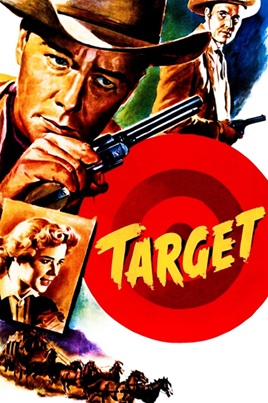
Target (1952, directed by Stuart Gilmore)


The frontier town of Pecos, Texas is without a marshal and Martin Conroy (Walter Reed) and his men are taking advantage of the situation by forcing people to sell their land for next to nothing.  A railroad’s coming and Conroy is looking to make a killing.  When landowner Bailey (John Hamilton) is targeted by Conroy, ranch hands Tim Holt (played by Tim Holt) and Rafferty (Richard Martin) are determined to stop him.  Federal marshal Terry Moran is summoned to the town to enforce the law.  Everyone is shocked when Moran’s daughter — also named Terry (Linda Douglas) — shows up and declares herself the new marshal.  “We don’t need no petticoat marshal!” the townspeople cry.

This is a by-the-book B-western, one of many that Tim Holt and Richard Martin made over the years.  In this one, neither Holt not Martin seems to be too invested in the familiar story.  (Holt was maybe wondering how he went from The Magnificent Ambersons and Treasure of the Sierra Madre to this.)  The only really interesting thing about this one is that the marshal is a woman but the movie doesn’t really do anything with the idea.  Tim Holt was the star here and no petticoat marshal was going to upstage him.

The thing that I find interesting about these B-westerns is how often the villain was someone looking to get rich by selling ill-gotten land to the railroad companies.  B-westerns always presented the railroads as being both the best and the worst thing about the west.  The railroads bring and connect civilization but they also attract villains like Martin Conroy.  In the American westerns, it was always made clear that the railroad company was as disgusted by men like Conroy as the townspeople.  However, in the spaghetti westerns that would come out in the 60s, it was always clear that the railroad didn’t care how they got their land as long as they got it.

This was Tim Holt’s second-to-last movie as a B-western star.  After his career ended in Hollywood, Holt relocated to Oklahoma and eventually became the manager of radio station.  He died in 1973.

Horror on the Lens: How To Make A Monster (dir by Herbert L. Strock)


You’ve seen I Was A Teenage Werewolf….

You’ve watched I Was A Teenage Frankenstein….

Now, it’s time to watch How To Make A Monster!

Released in 1958, How To Make A Monster is a clever little horror satire from American International Pictures in which the stars of Teenage Werewolf and Teenage Frankenstein are hypnotized into believing that they actually are the monsters that they played!  The main culprit is a movie makeup artist (Robert H. Harris) who has been deemed obsolete by the new bosses at AIP.

Be sure to watch for the finale, which features cameo appearances from several other AIP monsters!  And read my full review of the film by clicking here!

Horror on the Lens: How To Make A Monster (dir by Herbert L. Strock)


You’ve seen I Was A Teenage Werewolf….

You’ve watched I Was A Teenage Frankenstein….

Now, it’s time to watch How To Make A Monster!

Released in 1958, How To Make A Monster is a clever little horror satire from American International Pictures in which the stars of Teenage Werewolf and Teenage Frankenstein are hypnotized into believing that they actually are the monsters that they played!  The main culprit is a movie makeup artist (Robert H. Harris) who has been deemed obsolete by the new bosses at AIP.

Be sure to watch for the finale, which features cameo appearances from several other AIP monsters!  And read my full review of the film by clicking here!

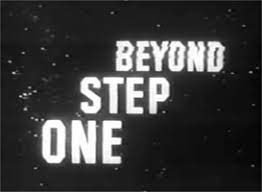
Horror on TV: One Step Beyond 3.17 “Dead Man’s Tale” (dir by John Newland)


On tonight’s episode of One Step Beyond, a down-on-his-luck writer checks into an Alaskan motel with his wife.  After glancing through a cheap guidebook, the writer is inspired to write a story.  After the story is published, the writer is shocked to discover that the story he thought of as being fiction might actually be true!

This episode originally aired on January 17th, 1961.  Alaska had been a state for a little over a year when this episode was broadcast.  It was still a land of mystery.

(For many of us, it still is!)

Horror on the Lens: How To Make A Monster (dir by Herbert L. Strock)


You’ve seen I Was A Teenage Werewolf….

You’ve watched I Was A Teenage Frankenstein….

Now, it’s time to watch How To Make A Monster!

Released in 1958, How To Make A Monster is a clever little horror satire from American International Pictures in which the stars of Teenage Werewolf and Teenage Frankenstein are hypnotized into believing that they actually are the monsters that they played!  The main culprit is a movie makeup artist (Robert H. Harris) who has been deemed obsolete by the new bosses at AIP.

Be sure to watch for the finale, which features cameo appearances from several other AIP monsters!  And read my full review of the film by clicking here!

Horror on the Lens: How To Make A Monster (dir by Herbert L. Strock)


You’ve seen I Was A Teenage Werewolf….

You’ve watched I Was A Teenage Frankenstein….

Now, it’s time to watch How To Make A Monster!

Released in 1958, How To Make A Monster is a clever little horror satire from American International Pictures in which the stars of Teenage Werewolf and Teenage Frankenstein are hypnotized into believing that they actually are the monsters that they played!  The main culprit is a movie makeup artist (Robert H. Harris) who has been deemed obsolete by the new bosses at AIP.

Be sure to watch for the finale, which features cameo appearances from several other AIP monsters!  And read my full review of the film by clicking here!

Embracing the Melodrama Part II #21: Emergency Hospital (dir by Lee Sholem)


Emergency Hospital

Right now, on Netflix, you can find Emergency Hospital, a low-budget film from 1956.  Emergency Hospital, which probably was made to be the second feature on a double bill, covers the course of one night at a hospital.  Patients come in.  Crimes are investigated.  Two doctors — one a man and one a woman and since this film was made in the 50s, that leads to all sorts of confusion — deal with all of the patients.  The film manages to stuff a lot of incidents into just 61 minutes of running time.

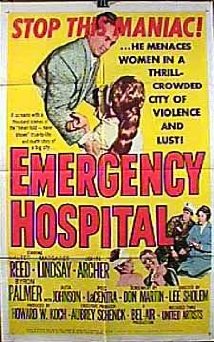
If you look at the poster above, you’ll see that it implores us to “STOP THE MANIAC!  He menaces women in a thrill-crowded city of violent and lust!”  I’m not really sure which of the film’s many subplots that is meant to refer to.  At one point, the son of a police detective is brought in after crashing his car.  He briefly attempts to hold a nurse hostage with a scalpel but, in the end, he doesn’t turn out to be much of a maniac.

In fact, if there’s anything that really distinguishes Emergency Hospital is just how low-key it is.  For the most part, the film emphasizes the fact that everyone at the hospital is focused on doing her or his job.  The patients all come in with their own individual melodramas but, for the most part, the doctors and the police all react calmly and rationally.  It’s interesting to compare Emergency Hospital to something like Magnificent Obsession.  Whereas Magnificent Obsession truly embraces the melodrama, Emergency Hospital invites the melodrama to pull up a chair and then tells it to calm down.

Perhaps because it was such a low-budget and obscure film, Emergency Hospital gets away with taking a look at and talking about issues that you normally wouldn’t expect to be so openly explored by a film made in the 50s.  And, interestingly enough for a film made in a culturally reserved time, the doctors and nurses at Emergency Hospital take a rather open-minded and nonjudgmental approach to their patients.  An anxious mother comes in with her bruised baby and is confronted about being an abusive parent.  A teenage girl comes in after being raped and the doctors try to convince her father (who thinks his daughter’s reputation will be ruined) to call the police.

Now, make no mistake about it: Emergency Hospital is not a secret masterpiece.  It’s an extremely low-budget movie that looks like an extremely low-budget movie.  But, taking all that into consideration, it’s still a lot better than your typical 61 minute second feature.

Emergency Hospital can currently be watched on Netflix.

Horror on TV: The Twilight Zone 2.7 “The Nick of Time”


TheTwilightZoneLogo

Along with starting each day of October with a horror film here at the Shattered Lens, we’re going to end each day with a horror-themed television show.

While I had previously caught a few episodes of the Twilight Zone during one of the annual holiday marathons on SyFy, I didn’t truly appreciate the show until I first exchanged e-mails with my friend in Australia, Mark. Among other things, Mark expressed a very eloquent appreciation for The Twilight Zone and that inspired me to watch quite a few episodes that have been uploaded to YouTube and Hulu. Along with being an essential piece of television history, the best episodes of the Twilight Zone remain watchable and entertaining 50 years after they were first broadcast.

Considering the esteemed place that the Twilight Zone continues to occupy in American culture, it seems appropriate to feature it during Horror Month here at the Shattered Lens.

We start things off with an episode that was originally broadcast on November 18th, 1960. The Nick of Time tells the story of what happens when two newlyweds stop off at a small town cafe and the superstitious husband (William Shatner) starts to play with a memorably creepy fortune telling machine. Now, I should warn you that, since this episode is not available on YouTube, I’m having to embed it from Hulu. That means that you’ll have to sit through a few commercials but it’s still a good episode.

Enjoy!