What Lisa Watched Last Night #120: Text to Kill (dir by George Erschbamer)


Last night, I watched the latest Canadian-made Lifetime original film, Text to Kill!

Lifetime-movie-Text-to-Kill-April-2015Why Was I Watching It?

I was watching both because it was on Lifetime and it was a Canadian production.  I love Lifetime and I love Canada.

What Was It About?

High school senior Taylor (Emily Tennant) has a lot to deal with.  It’s been two years since her father was killed in a tragic car accident.  Her overprotective mother (Dina Meyer) is a cop.  Her former best friend, Hannah (Stephanie Bennett), is now her enemy.  Her current best friend, Barbara (Sarah Desjardins), is dealing with a secret of her own.  And now, out of nowhere, she has started to get threatening texts from someone calling himself “Truth & Lies.”

Who could be behind the evil texts?  At first, Taylor suspects that it’s Hannah.  But could it be Brandon (Kurt Ostland), the school weirdo?  Or maybe it’s Cody (Keenan Tracy), Taylor’s enigmatic new boyfriend who somehow had her number before she ever gave it to him.  Or could it be someone else entirely?

What Worked?

Text to Kill was actually a pretty fun little thriller.  It kept me guessing, all of the actors gave good performances, and — perhaps most importantly — there was not a single character who didn’t live in a big and tastefully decorated house.  (One of the pleasures of watching movies on Lifetime is that you get to see how everyone decorates their home.)  Sarah Desjardins especially did a good job in the role of Barbara, bringing a bit of social relevance to what otherwise could have just been a standard Lifetime thriller.

What Did Not Work?

From the minute Text to Kill started, I knew that it was going to be one of those thriller that ended with a totally implausible twist, the type of twist that it’s best not to think too much about.  And that’s exactly what happened!  Unfortunately, the twist was revealed when there was still 15 minutes of film left to go.  That left the audience with 15 minutes to think about how little sense it all made.  If the film had waited until the final 7 minutes to reveal that twist, it wouldn’t have been an issue.  But 15 minutes is too long an amount of time to know about the twist without thinking about all the unanswered questions and issues raised by it.

“Oh my God!  Just like me!” Moments

I related to the character of Hannah and I especially admired the fact that she was less scared by the stalker and more just annoyed by all the inconvenience.

Lessons Learned

When your mom’s a cop, there’s nothing you can’t get away with.
What Lisa Watched This Afternoon #119: Killer Crush (dir by Anthony LeFresne)


Earlier this afternoon, I finally got a chance to watch the Lifetime original film Killer Crush.

Lifetime-Movie-Killer-Crush-April-2015 Why Was I Watching It?

Killer Crush premiered last week but I missed it because I was at Easter Vigil with my family.  However, I set the DVR to record the film.  Then, I came home and I got wrapped up in doing about a thousand different things at once and it’s only been this afternoon that I finally got a chance to sit down and watch Killer Crush.

What Was It About?

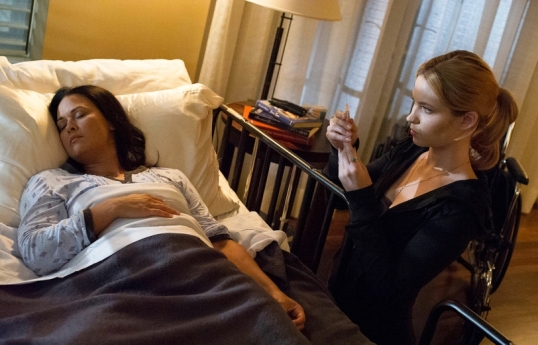
It’s a story as old as the Lifetime network.  A mentally disturbed young woman named Paige (Daveigh Chase) develops a crush on one of her professors (Rick Roberts).  Paige gets a job working for the professor, taking care of his sick wife (Sydney Penny).  Since the film is called Killer Crush, you can probably guess that things don’t go as well as one might hope.

What Worked?

As far as mentally disturbed crush movies are concerned, Killer Crush was pretty good.  Rick Roberts and Sydney Penny both made for sympathetic victims.  Meanwhile, Daveigh Chase fully committed herself to playing the unstable Paige and even managed to generate some sympathy for her self-destructive character.  Director Anthony LeFresne kept the action moving at a good pace.  The end result is an above-average, Canadian-made Lifetime film.

What Did Not Work?

As well-made as the film was, it was also rather predictable.  As far as Lifetime movies about psychotic obsession are concerned, Killer Crush really didn’t bring anything new to the table.

“Oh my God!  Just like me!” Moments

I related to Paige’s relationship with her sister (Melanie Scrofano).  Hopefully, if I’m ever involved in a murder, my sisters will be as concerned as Paige’s sister was.

Lessons Learned

Obsessive crushes never turn out well.  Unless, of course, it’s my obsessive crush on James Franco…

Film Review: Furious 7 (dir by James Wan)


fast-and-furious-7

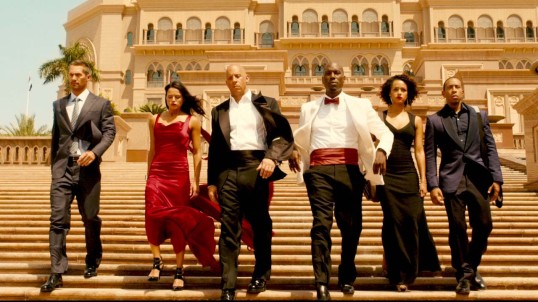
Regardless of what you may think about the rest of Furious 7, the final ten minutes will make you cry.  They made me cry and, before I saw Furious 7, I wasn’t even really a fan of the franchise.  It’s not a spoiler to tell you that Furious 7 ends with a tribute to both the character Brian O’Connor and the actor who played him, Paul Walker.  While Dominic Toretto (played, of course, by Vin Diesel) says goodbye to Brian, we see a montage of clips of Brian throughout the previous Fast and Furious Films and it’s so poignant to see how Paul Walker transformed over the course of the series, going from being a somewhat bland teen heart throb to becoming a genuinely charismatic leading man.  Watching the montage, you can see that Paul Walker was still growing as an actor and you’re reminded of just what a shock it was when we first heard the news of his death in 2013.

And, of course, we’re very aware that, as Dominic is saying goodbye to Brian and we’re saying goodbye to the actor who played him, Vin Diesel is saying goodbye to his friend.  That Diesel and Walker were friends on-screen and off is no secret.  In fact, that friendship has always been one of the big appeals of the Fast and Furious franchise.  The films are about a group of people (mostly men) who care about each other and who aren’t ashamed to admit it.  When Dominic delivers the film’s final monologue, it’s really all about Vin saying goodbye to Paul.  By the time the words “For Paul” appeared on the screen, there was not a dry eye in the theater.

The death of Paul Walker adds an undeniable poignancy to Furious 7 and it’s sometimes hard to separate the real-life tragedy from what we’re watching on screen.  But here’s the thing — Furious 7 works as both a heartfelt tribute to Paul Walker and as a wonderfully over-the-top and fun action movie.  Furious 7 is a burst of pure adrenaline and style that epitomizes everything that you could possibly want out of an action movie.

Jason Statham plays Deckard Shaw, a former government assassin who has a personal vendetta against Dom, Brian, and practically everyone else who has ever been a Fast and Furious movie.  Statham isn’t in a lot of scenes but whenever he shows up, he kicks ass and watching Furious 7 was probably the first time that I’ve ever truly understood Statham’s appeal.  How impressive is Jason Statham in this film?  He puts Dwayne Johnson in the hospital, that’s how impressive he is.  And what’s amazing is that after watching their fight scene, you totally believe that Jason Statham could put Dwayne Johnson in the hospital.

Another government agent, Mr. Nobody (Kurt Russell, having a great time), offers to help Dom take out Deckard but first, Dom and his crew have to do a favor for Mr. Nobody.  They have to rescue a hacker (Nathalie Emmanuel) from an African warlord (Djimon Honsou) who is obviously based on Joseph Kony.  That hacker knows about the location of a device that will allow the government to track down Deckard but the device has already been sold to a billionaire who lives in Abu Dhabi….

Ultimately, the exact specifics and logic of it all doesn’t matter.  What does matter is that Vin Diesel, Paul Walker, Chris Bridges, Tyrese Gibson, Michelle Rodriguez, and Dwayne Johnson are all back and they’re all a lot of fun to watch.  What matters is that the cars look good and the stunt work is just as amazing as you were hoping.  What matters is that the film features things that you never thought you’d see — like cars parachuting down to a mountain road and jumping from skyscraper to skyscraper.

This is an exciting film.  It’s a fun film.  It’s an entertaining film.  It’s a stylish film.  And, ultimately, it’s a film that will make you cry.

What more can you ask for?

furious-7

Embracing the Melodrama Part II #17: Good Time Girl (dir by David MacDonald)


Good-Time_Girl_FilmPoster

The 1948 film Good Time Girl is currently available on Netflix and I have to admit that, based on the name alone, I was expecting it to be another somewhat campy exploitation film about juvenile delinquency, something along the lines of Damaged Lives and Gambling With Souls.

And that’s certainly how the film began.  A troubled teenager named Lyla (Diana Dors) has been arrested and is sent to the juvenile court where the concerned Miss Thorpe (Flora Robson) tells Lyla that if she doesn’t change her ways, she could end up just like Gwen Rawlings.  Who is Gwen Rawlings?  That’s what we spend the rest of this short film finding out.

The film shows how Gwen (Jean Kent) was raised in an abusive household and how, at the age of 16, she ran way from home.  The first person she met was the handsome and charming Jimmy (Peter Glenville) who turns out to be a low-level gangster.  (His pinstrip suit and mustache give him away.)  Jimmy gets Gwen a job as a hat-check girl at a club run by the enigmatic Maxey (Herbert Lom).  Gwen meets and falls in love with a musician named Red (Dennis Price) but Red explains that he’s not only too old for her but he’s married as well.  Soon, Gwen is living with Jimmy and Jimmy is regularly abusing her.  When Maxey sees that Jimmy has given her a black eye, he has Jimmy beaten up and fired.  Jimmy responds by slashing Maxey’s face and then framing Gwen for jewelry theft.

Gwen is sent to reform school, where she falls under the influence of the somewhat demonic Roberta (played, in a genuinely menacing performance, by Daniel Day-Lewis’s mother, Jill Balcon).  Reform school only succeeds in making Gwen tougher and angrier.  When a mini-riot breaks out in the cafeteria, Gwen takes advantage of the confusion and escapes.

Back on the streets and with the police searching for her, Gwen falls in with a succession of different criminals.  When she meets two military deserters, it leads to the type of tragedy that could just as easily befall Lyla if Lyla doesn’t change her ways.

This is one of those films where the worst possible thing that could happen always happens and, as a result, it’s all rather melodramatic.  But, as opposed to a film like Reefer Madness or Sex Madness, it never gets so melodramatic that it becomes implausible.  Instead, it’s actually a very watchable portrait of people living on the margins of acceptable society.  Director David MacDonald fills the screen with menacing images and the pace never lags.  The film is also full of great performances from character actors that you’ll probably recognize from countless Hammer horror films.  Herbert Lom is especially impressive as the quietly intimidating Maxey.

I wasn’t expecting much from Good Time Girl but it’s definitely worth watching.

Embracing the Melodrama Part II #16: Double Indemnity (dir by Billy Wilder)


Double_indemnity

The 1944 best picture nominee Double Indemnity is probably one of the most imitated films ever made.  While it may not be the first film noir, it is one of the most influential and its plot has been duplicated in countless films.  In fact, it’s such an influential film that all one has to do is say, “Indemnity” and you automatically know that they’re talking about murder.

Most people assume that the film is the story of Walter Neff (Fred MacMurray), an insurance agent who thinks that he’s smarter and smoother than he actually is.  When Phyllis Deitrich (Barbara Stanwyck) approaches him with questions about how much her husband’s life insurance would pay off if his death was accidental, Walter immediately figures out that she’s talking about murder.  At first, Walter tells her that he’s not interested but actually he’s very interested.  Soon, he and Phyllis are lovers (though Walter, from the start, seems to know that Phyllis is just using him) and he’s plotting out her husband’s murder.  After he does kill Phyllis’s husband, Walter makes it look as if he fell from a train.  At first, the death is ruled a suicide but, just as Walter hoped, his best friend and fellow insurance agent, Barton Keyes (Edward G. Robinson), announces that it wouldn’t make any sense for a suicidal man to jump from a slow-moving train.  Instead, Keyes successfully argues that the death should be ruled an accident and, as a result, the life insurance pays out for double of its value.

However, the money makes Walter paranoid.  He starts to worry that Phyllis will betray him.  Even worse, he’s approached by the dead man’s daughter, Lola (Jean Heather).  Lola tells Walter that she believes that Phyllis not only killed her father but her mother as well.  Soon, Walter is involved with both Lola and Phyllis.  Walter claims that he feels guilty and protective of Lola but MacMurray’s wonderfully ambiguous performance leaves us wondering just how much we should trust anything that he has to say.

Now, as I said before, the film may be narrated by Walter Neff and it may be set into motion by his affair with Phyllis but ultimately, the film is not about his relationship with Phyllis.  Instead, it’s about Walter’s friendship with Barton Keyes.  When we first see Walter, he’s recording a confession specifically for Keyes to hear and the film ends not with Walter and Phyllis but instead with Walter and Keyes.

In many ways, Keyes is the opposite of Walter.  Whereas Walter is slick and amoral, Keyes is rather nerdy and ethical to a fault.  Walter respects Keyes for his brilliant mind and, to a large extent, he does what he does because he wants to prove that he’s just as smart as Keyes.  Keyes is the type of man that Walter aspires to be while Walter is the dark side of Keyes’s own obsession with mystery.  It’s only appropriate that the film ends with Walter and Keyes because, ultimately, their friendship is the heart of the film.

Double Indemnity is a classic.  Barbara Stanwyck and Fred MacMurray set the standard by which all future illicit couples would be judged.  But really, the film is stolen by Edward G. Robinson.  Over the course of his long and remarkable career, Robinson was never once nominated for an Oscar.  Watching Double Indemnity, you can’t help but wonder how such an injustice could have happened.

Embracing the Melodrama Part II #15: Casablanca (dir by Michael Curtiz)


CasablancaPoster-Gold

(This review contains spoilers but seriously, you should know all of this already.)

Is there anything left to be said about Casablanca?

Probably not.

As a film reviewer, I’m not supposed to admit that.  I’m supposed to come up with some sort of new, out-of-nowhere, batshit crazy way to look at Casablanca.  I’m supposed to argue that Rick was actually meant to be a survivor of abuse or that Victor Laszlo was some sort of precursor to President Obama or something.  Or, if that doesn’t work, I’m supposed to intentionally troll everyone by writing something like, “10 reasons why Casablanca is overrated” or “I hate Casablanca and I don’t care who knows it!”

But I’m not going to do that.

The fact of the matter is that Casablanca is as good a film as everyone says it is.  It is a film that everyone should see.  It is a film that quite rightfully was named best picture of 1943.  It deserves to be celebrated.  It deserves to be seen.  In fact, stop reading this review right now and go watch it.  Don’t let me waste another second of your time.

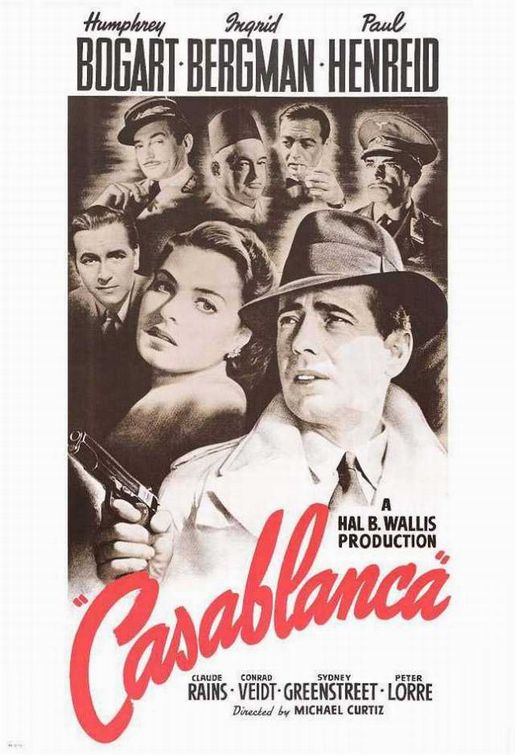
The thing with Casablanca is that it’s such an iconic film that everyone knows what happens, regardless of whether they’ve actually watched the entire film or not.  They know that the film takes place in Casablanca during World War II.  They know that Casablanca is full of refugees, spies, and people who are hiding from their past.  They know that Casablanca is policed by the charmingly corrupt Capt. Louis Renault (Claude Rains).  They know that Major Strasser (Conrad Veidt) is the Nazi in charge.  (I nearly said that Strasser was the “evil Nazi in charge” but when you identify someone as a Nazi, is it really necessary to add that they’re evil?)  They know that Rick (Humphrey Bogart) is the American expatriate who owns Rick’s Cafe Americain and that everyone comes to Rick’s.  They know that Rick’s slogan is that he doesn’t stick his neck out for anyone but they also know that his cynicism hides the fact that he’s still in love with Ilsa (Ingrid Bergman).  They know that when Ilsa shows up at Rick’s and needs him to help her husband, Victor Laszlo (Paul Henreid), escape from Occupied Europe, Rick is forced to decide whether or not to get involved in the resistance.

And, whether you’ve seen the film or not, you know that it all ends on a foggy airstrip.  Ilsa wants to stay in Casablanca with Rick but Rick tells her that she has to get on the plane with Laszlo because, if she doesn’t, she’ll regret it.  Ilsa goes with Laszlo, leaving Rick behind.

And it may have been the right thing to do but how many viewers would have done the same if they had been in Ilsa’s high heels?  Throughout the entire movie, we hear about how wonderful Laszlo is but, whenever he actually shows up on screen, it’s always a little bit surprising to discover just how boring a character Victor Laszlo really is.  Unlike the troubled and deceptively cynical Rick, there’s not much going on underneath the surface with Laszlo.  Just as Rick overshadows Laszlo, Bogart’s performance overshadows Paul Henreid’s.  Bogart and Bergman have all the chemistry and the charisma.  Henreid, on the other hand, comes across as stiff and a little dull.  But, as the film suggests, World War II was not a time for self-doubt and self-interest.  World War II was a time when the world needed straight-forward, determined men like Victor Laszlo.

And, if the world needed Laszlo and Laszlo needed Ilsa, then that meant Ilsa had to get on that plane.

That said, I’ve always liked to think that Ilsa ended up leaving Laszlo in 1945 and immediately made her way back to Morocco.  Rick and Ilsa belonged together.

But until Ilsa comes back, Rick has his friendship with Renault.  “Louis,” he says, “I think this is the beginning of a beautiful friendship.”  Did Bogart realize, when he delivered that line, that literally thousands of people would be repeating it decades later?  Bogart’s performance is probably one of the most imitated performances of all time.  Anyone who sees Casablanca thinks that they can talk about gin joints and hills of beans in Bogart’s trademark style.  Of course, they can’t and it’s a testament to the power of Bogart’s performance that it remains effective even after being endlessly imitated.

On Valentine’s Day of 2014, I saw Casablanca at the Alamo Drafthouse in Austin.  It was an amazing and romantic experience.  See Casablanca on the big screen.  It’ll make you love life and bring life to your love.

Needless to say, Casablanca is an intimidating film to review.  So, I’ll just say this: Casablanca is even better than you think it is.  If you haven’t seen it, go watch it.  If you have seen it, go watch it again.

Just resist the temptation to say, “Play it again, Sam,” in your best Bogart-like voice.

Because, seriously, Rick never actually says that line.

Embracing the Melodrama Part II #14: Suspicion (dir by Alfred Hitchcock)


Suspicion_film_poster

First off, a warning.  The following review of the 1941 best picture nominee Suspicion will include spoilers.  So, if you haven’t seen the film and you’re obsessive about avoiding major spoilers, then don’t read the review.  Simple, no?

Two years ago, I was having lunch with some of my fellow administrative assistants.  One of them was talking about how she had watched an “old movie” the previous night.  From listening to the vague details that she offered up, I was able to figure out that she had apparently stumbled across TCM for the first time in her life.  From listening to her talk, I would not be surprised if she was literally describing the first time she had ever actually seen a black-and-white movie.  Needless to say, my first instinct was to correct everything she was saying but I resisted.  (For some reason, at that time, I was feeling self-conscious about being perceived as being a know-it-all.)  But, as she kept talking, I found it harder and harder to keep quiet.  Listening to her talk about old movies was like attending an art history lecture given by someone who had flunked out of a finger painting class.  Finally, when the conversation had moved on to someone who we all knew was sleeping with her much older boss, our self-proclaimed old film expert announced that age didn’t matter.  “I’d go out with Cary Grant,” she said, “and he’s old.”

Before I could stop myself, I added, “He’s also dead.”

Oh my God, the look of shock on her face!  I actually felt really guilty because I could tell that she had apparently taken a lot of happiness from the idea that suave, witty, and handsome Cary Grant was still out there.  And can you blame her?  In a career that spanned three decades and included several classic dramas and comedies, Cary Grant epitomized charm.  Some of his movies may seem dated now but Grant was such a charismatic and natural actor that it’s impossible not to get swept up in his performances.

(Who would be the contemporary Cary Grant?  I’ve heard some people compare George Clooney to Grant.  And it’s true that Clooney has Grant’s charm but, whereas Grant always came across as very natural, you’re always very aware that George Clooney is giving a performance.)

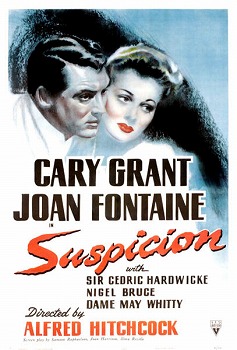
It was Grant’s charm that made him the perfect choice for the male lead in Suspicion but it was that same charm that made the film so controversial.  In Suspicion, Grant plays Johnnie.  Johnnie meets, charms, and — after the proverbial whirlwind courtship — marries Lina (Joan Fontaine), a sheltered heiress.  It’s only after Lina marries Johnnie that she discovers that he’s broke, unemployed, and addicted to gambling.  With everyone from her family to her friends telling her that Johnnie is only interested in her money, Lina starts to worry that Johnnie is plotting to kill her.  Lina starts to view all of Johnnie’s actions with suspicion, wondering if there’s an innocent explanation for his occasionally odd behavior or if it’s all more evidence that he’s planning to kill her.  When he brings her a glass of milk, Lina has to decide whether or not to risk drinking it…

Suspicion was based on a novel in which Johnnie was a murderer and which ended with Lina voluntarily drinking that poisoned milk.  In the film, however, Johnnie is not a murderer.  Apparently, it was felt that Grant was so charming and so likable that audiences would never accept him as a murderer.  Instead, he’s an embezzler and all of his strange behavior is due to him being ashamed of his past and feeling that he’s not worthy of Lina.  Once Lina realizes that Johnnie isn’t trying to kill her, she promises him that she’ll stay with him.

And a lot of people (including director Alfred Hitchcock, who claimed it was forced on him by the film’s producers) have criticized that ending but you know what?

It works.  If I had to choose between Joan Fontaine essentially committing suicide or Joan Fontaine promising to love Cary Grant even if Grant goes to prison, I’m going to go with the second choice.  Ultimately, Suspicion works because you can imagine being swept off your feet by Grant’s character.  But what makes Suspicion enjoyable, to me, is that Johnnie ultimately turns out to be exactly who we were hoping he would be.

Needless to say, Suspicion works as a great double feature with Rebecca.  Watch one after the other and have a great night of menace and romance.

Embracing the Melodrama Part II #13: Rebecca (dir by Alfred Hitchcock)


Rebecca_1940_film_poster

Well, here we are, less than a week into Embracing the Melodrama, Part II, and I’m already running behind!  The plan, as I mentioned back on Monday, is to review 128 melodramatic films over the next three weeks.  And, even though I know that sounds a like a lot, I had it all planned out so that I’d be able to get all that done in just 21 days.  All I had to do was make sure that I reviewed 6 films a day.

And …

Well, life happened.

But no matter!  It may now take me 3 and a half weeks to review 128 films but that’s no great tragedy.  And besides, regardless of how long it takes, I’ve got some pretty good films scheduled.

Take, for instance, the 1940 best picture winner Rebecca.

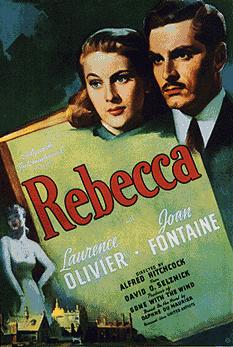
Rebecca is a film that all women can relate to.  The heroine is played by Joan Fontaine.  I say “heroine” because we never actually learn the character’s name, nor do we learn much about her background.  When we first see her, she’s defined by her job, which is to basically be a paid companion to a wealthy woman.  Later, she’s defined by her whirlwind romance with the brooding and aristocratic widower Maxim de Winter (Laurence Olivier).  When, after two weeks, they get married, she becomes known  as the second Mrs. de Winter.  She becomes defined by both who she married and who she is not.

She’s not Rebecca, the first Mrs. de Winter.

As soon as Maxim takes his new wife to his estate, the second Mrs. de Winter discovers that she’ll always live in the shadow of the deceased Rebecca.  Everyone she meets describes Rebecca as being a vibrant, lively figure — in other words, the complete opposite of the meek second Mrs. de Winter.  The coldly imperious housekeeper, Mrs. Danvers (Judith Anderson), has perfectly preserved Rebecca’s room and makes little attempt to hide the scorn that she feels for the second Mrs. de Winter.  Even worse, once they return to the estate, Maxim reveals himself to be moody and tempermental.  With the help of the manipulative Mrs. Danvers, the second Mrs. de Winter becomes convinced that Maxim will never love her as much as he loved Rebecca.

Making things even more complicated, a man claiming to be Rebecca’s cousin comes by the house when Maxim is away.  Jack Flavell (played by George Sanders, at his most serpent-like) suggests that there may have been more to Rebecca’s death than the second Mrs. de Winter was originally told…

Rebecca is a classic film, for many reasons.  It’s well-acted, with Fontaine, Olivier, Anderson, and Sanders all bringing their characters to vibrant life.  It’s a gothic romance.  It’s a thriller.  It’s a mystery.  It is the epitome of old Hollywood style.  But, for me, the main reason that Rebecca is a classic is because it tells a story to which almost everyone can relate.  Every relationship that I’ve ever had, I’ve always been curious and occasionally even jealous of who came before me.  There’s nothing more intimidating than living in the shadow of someone who you will never get a chance to meet personally.  The second Mrs. de Winter’s insecurities are everyone’s insecurities and, in some fashion or another, we’ve all had a Mrs. Danvers in our life.  The second Mrs. de Winter’s struggles are our struggles and, as she grows stronger, the viewer grows stronger with her.

Alfred Hitchcock is one of the most influential and acclaimed filmmakers of all time but he never won a directing Oscar.  Rebecca was the only one of his films to win Best Picture.  Producer David O. Selznick brought Hitchcock over from England to direct Rebecca and it’s been reported that Hitchcock resented Selznick’s interference.  (And, while Rebecca is undoubtedly a good film that was directed by Alfred Hitchcock, it’s not exactly a Hitchcock film in the way that Shadow of a Doubt, Rear Window, or Vertigo are Hitchcock films.)  As a result, Hitchcock subsequently made it a point to edit future pictures in camera so that the studios would not be able to re-edit his films.

But, whether you consider it to be a Hitchcock picture or a Selznick production, Rebecca remains a wonderfully watchable melodrama.

Embracing the Melodrama Part II #12: Jezebel (dir by William Wyler)


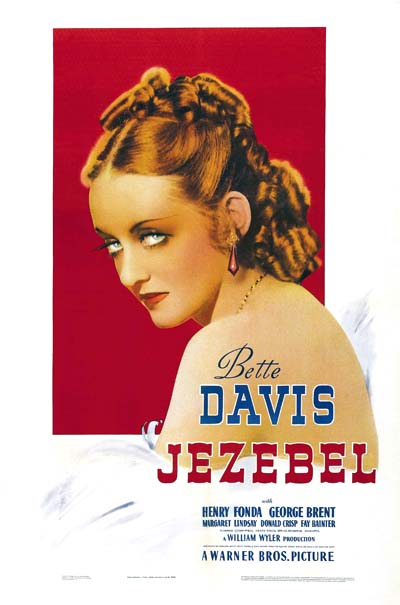
Jesebel_movieposterWe started out this day by taking a look at Bette Davis in Of Human Bondage so it seems only appropriate that today’s final entry in Embracing the Melodrama should be another film in which Bette Davis plays a potentially unlikable character who is redeemed by being the most interesting person in the film.

The 1938 best picture nominee Jezebel stars Bette Davis as Julie Marsden, a strong-willed Southern belle who lives in pre-Civil War New Orleans.  Julie is looking forward to an upcoming ball but is frustrated when her fiancée, boring old Pres (Henry Fonda), says that he has to work and declines to go shopping for a dress with her.  Impulsively, Julie does exactly what I would do.  She buys the most flamboyant red dress that she can find.

Back in the old South, unmarried women were expected to wear white to formal balls, the better to let everyone know that they were pure and innocent and waiting for the right man.  When Julie shows up in her red gown, it’s a scandal and, upon seeing the looks of shock and disdain on everyone’s faces, Julie wants to leave the ball.  However, Pres insists that Julie dance with him and he continues to dance with her, even after the orchestra attempts to stop playing music.

And then he leaves her.  At first, Julie insists to all who will listen that Pres is going to return to her but it soon becomes obvious that Pres has abandoned both Julie and Southern society.  Julie locks herself away in her house and becomes a recluse.

Until, a year later, Pres returns.  At first, Julie is overjoyed to see that Pres is back and she’s prepared to finally humble herself if that means winning back his love.  But then she discovers that the only reason that he’s returned to New Orleans is to warn people about the dangers of Yellow Fever.

Oh, and he’s also married.

To a yankee.

For the most part, Jezebel is a showcase for another fierce and determined Bette Davis performance.  It’s easy to be judgmental of a character like Julie Marsden but honestly, who doesn’t wish that they could be just as outspoken and determined?  It helps, of course, that the film surrounds Julie with a collection of boring and self-righteous characters, the type of people who you love to see scandalized.  Henry Fonda gives one of his more boring performances in the role of Pres while Margaret Lindsay, in the role of Pres’s Northern wife, is so saintly that she reminds you of the extremely religious girl in high school who would get offended whenever you came to school wearing a short skirt.  In a society as rigid, moralistic, and judgmental as the one portrayed in Jezebel, it’s impossible not to cheer for someone like Julie Marsden.

Add to that, I totally would have worn that red dress too!  In a world that insisted that all women had to act a certain way or look a certain way and think a certain way, Julie went her own way and, regardless of what boring old Pres may have thought, there’s a lesson there for us all.

When watching Jezebel, it helps to know a little about film history.  Bette Davis very much wanted to play Scarlett O’Hara in Gone With The Wind and was reportedly very disappointed when the role went to Vivien Leigh.  Depending on the source, Jezebel is often described as either being Davis’s audition for the role of Scarlett or as being a consolation gift for losing out on the role.  Either way, Jezebel is as close as we will ever get to seeing Bette Davis play Scarlett.  Judging from the film, Davis would not have been an ideal Scarlett.  (Whereas Gone With The Wind works because Leigh’s Scarlett grows stronger over the course of the film, Davis would have started the film as strong and had nowhere left to go with the character.)  However, Davis was a perfect Julie Marsden.


Embracing the Melodrama Part II #11: Child Bride (dir by Harry Revier)


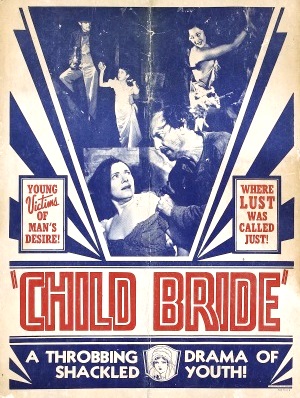
Child_Bride“Child marriage must go!”

— Miss Carol (Diana Durrell) in Child Bride (1938)

Oh my God!

Listen, I have never made a secret about the fact that I love low-budget exploitation films but watching the 1938 film Child Bride was seriously one of the ickiest experiences of my life.  This is one of those films that, after you watch it, you have to take a long shower to try to wash it off of you.  This is the type of film that will inspire you to lock your door and sit in a corner with a long kitchen knife for protection.  The film’s poster describes it as being a “throbbing drama of shackled youth” but I would be scared of anyone who came out of Child Bride throbbing.

Child Bride claims to take place in Ozarks but, from the minute you see all of the Eucalyptus trees and hear all the bad accents, you know that this film is about as Californian as a film can be.  Miss Carol (Diana Durrell) grew up in the backwoods and now she’s returned so she can serve as the teacher in a tiny, one-room schoolhouse.  Upon her arrival, Miss Carol is viewed by suspicion by the townspeople.  They distrust her refined ways and, even worse, she keeps saying how she’s going to get the state to pass a law banning underage marriage.  There won’t be any more child brides!

So, of course, the townspeople decide to tar and feather her.  Fortunately, Miss Carol is saved by moonshiner Ira (George Humphreys) and his partner in crime, Angelo the Dwarf (Angelo Rossitto).  However, one of the townspeople — the demonic Jake Bolby (Warner Richmond) — has decided that he wants to marry Ira’s 12 year-old daughter, Jennie (Shirley Mills) and he’s not above committing murder to get what he wants.

What makes the film so icky is that Jennie was played by an actual 12 year-old and there’s a length scene where Jennie goes skinny dipping while Jake watches from the bushes.  As you watch, you find yourself wondering whether Child Bride was actually made to appeal to the Jake Bolbys of the world.

(It doesn’t help that Richmond, one of the few professional actors to appear in this film, gives a totally convincing performance.  Kevin Bacon in The Woodsman has got nothing on Warner Richmond…)

That said, as icky as it is, Child Bride is still definitely watchable.  It’s hard not to laugh at the film’s extreme version of the Ozarks.  I’ve never seen so many shacks, overalls, and toothless grins in my life.  Since I have family that lives in that part of the country, it was hard for me not to be amused by the film’s version of country living.  (If you want to know about life in the so-called “backwoods,” see Winter’s Bone.)

Ultimately, Child Bride is so weird that it’s understandable if you want to see it once but just make sure to take a shower afterward.