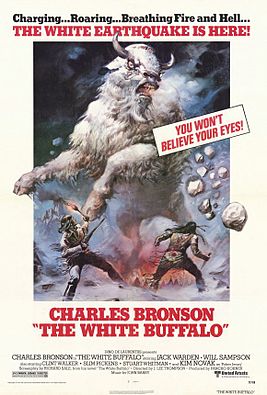
Brad takes on THE WHITE BUFFALO (1977), starring Charles Bronson and Will Sampson!


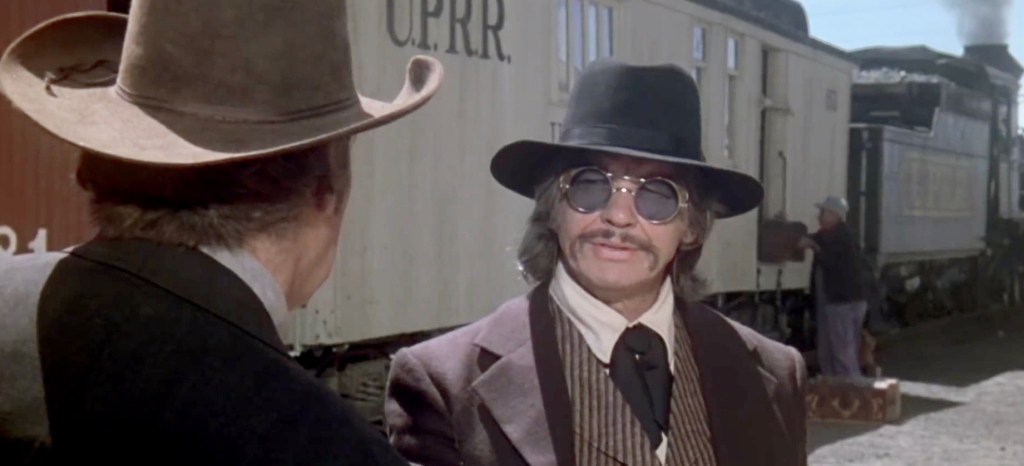
Charles Bronson as Wild Bill Hickok

Back in 2023, my family visited the Black Hills of South Dakota. The first thing we did was visit Mount Rushmore. The second thing we did was visit the Mount Moriah Cemetery and the final resting place of Wild Bill Hickok. Situated on the top of a hill overlooking the city of Deadwood, it’s a beautiful place that also includes the graves of Calamity Jane and Sheriff Seth Bullock. I insisted that we see the location for possibly the most superficial reason possible… because Charles Bronson played Hickok in THE WHITE BUFFALO.

Based on a novel by Richard Sale, the story opens with Hickok having a recurring nightmare of a snowy showdown with a giant white “spike.” And if he has pistols handy, he wakes up firing them uncontrollably and you’d better not be nearby. Determined to face his fear, he heads out into the hills with his friend Charlie Zane (Jack Warden), hoping to find the albino buffalo, so he can put him down and end the nightmares. Around the same time, the great beast has stampeded the camp of Crazy Horse (Will Sampson) killing his child in the process. Convinced that the child cannot have peace in the afterlife, Crazy Horse sets out to kill the buffalo so he can wrap his child in its white “robe” and free her spirit. With Hickok a prolific killer of Indians, and Crazy Horse a brave Lakota Oglala warrior, the two men seem to be on a deadly collision course in those snowy hills.

Charles Bronson’s final western, THE WHITE BUFFALO has a lot of the scenes you’d expect. With Bronson playing a famous gunman, we get to see several gunfights as he makes his way through various Wyoming towns, featuring well-known actors like Clint Walker and Ed Lauter. We also get to see him visit various saloons, as well as the widow Schermerhorn, played by Kim Novak. When he really “knew” her, she was a prostitute named Poker Jenny. Along with those I’ve already mentioned, it’s an all-star affair as we see such familiar faces as Stuart Whitman, John Carradine, Slim Pickens, and even a young Martin Kove sprinkled throughout the film. And of course, we get to see Bronson take on the gigantic white buffalo of the title, first in his dreams, and then later in reality! Directed by veteran filmmaker J. Lee Thompson, these scenes are staged and executed well, with Hickok’s nightmares given an especially eerie quality.
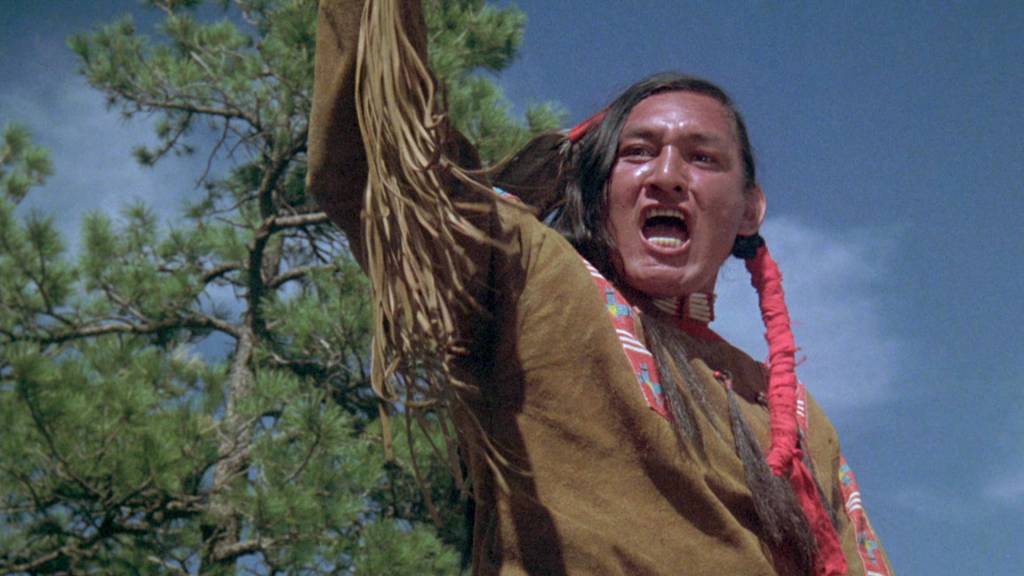
Will Sampson as Crazy Horse

While the movie has the expected scenes, it’s the unexpected character moments that sets THE WHITE BUFFALO apart as a uniquely strong entry in Bronson’s filmography. Hickok may be a man haunted by dreams of a monstrous white buffalo, but Bronson plays him in such a way that we can feel his exhaustion and literal sickness from too many years of a dangerous and difficult life. The buffalo is more than just an animal… it’s a symbol of guilt, fear and the coming of death itself. Bronson could always underplay a role better than just about anyone else, but here he’s reflective and haunted in way that I’ve not seen before, and he’s really good.

I also think the movie gets better every time Bronson shares a scene with Will Sampson. Sampson brings dignity and intelligence to Crazy Horse. His mission is more noble than Hickok’s, and an unexpected friendship develops between the two men, despite their vast differences. Ultimately, it’s this relationship that provides the film an emotional weight that sneaks up on you by the end, even if it’s not meant to last.

THE WHITE BUFFALO is not a perfect film. The animatronic buffalo may look a little hokey, and the film may seem a little slow at times for those expecting an action-packed western or monster movie. However, Bronson and Sampson are so good in their myth-making performances that the film eventually becomes something more. It’s the idea of watching two aging warriors, bound together through the bravery of confronting death, that I found to be more interesting and compelling than anything else on display.

THE WHITE BUFFALO is currently streaming on Amazon Prime, Tubi, PlutoTV, and The Roku Channel.
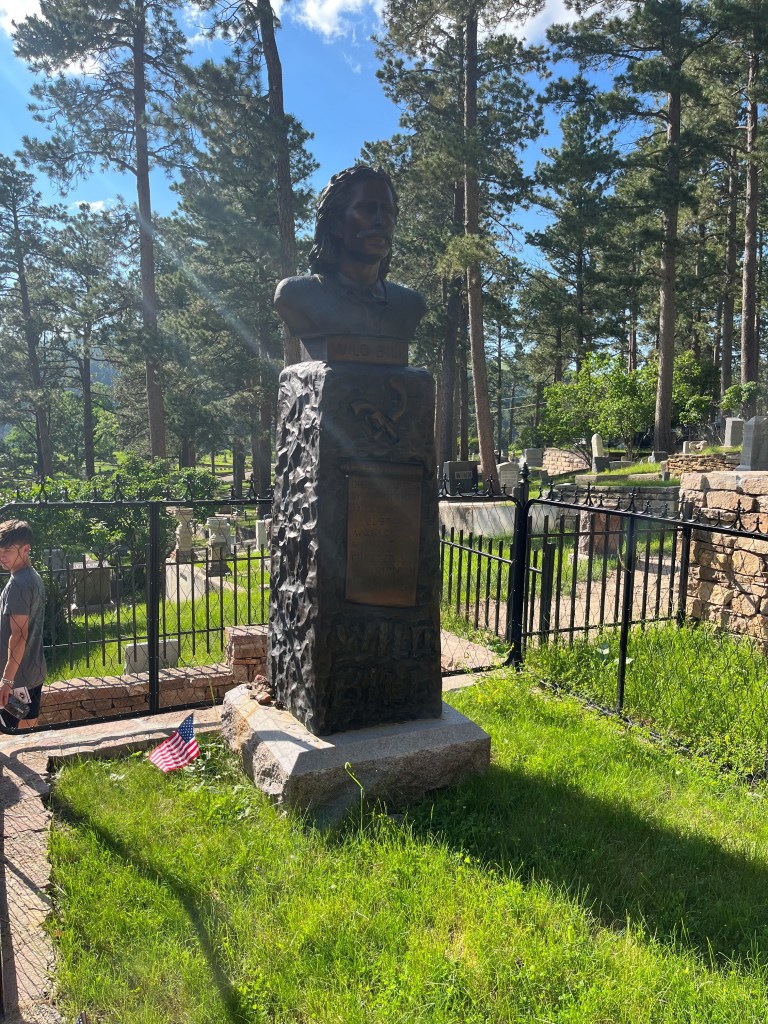
Wild Bill Hickok’s gravesite in Mount Moriah Cemetery in Deadwood, South Dakota

A Movie A Day #56: The White Buffalo (1977, directed by J. Lee Thompson)


whitebuffalo1977The year is 1874 and James Otis (Charles Bronson) is traveling through the Dakota Territory.  Everywhere that James Otis goes, someone tries to shoot him.  This is because James Otis is actually the infamous Wild Bill Hickcock and everyone this side of Deadwood has a reason to want him dead.  Hickcock has returned to the territory because he is losing his eyesight and he fears that he may be dying.  Hickcock has been having nightmares about a giant albino buffalo and believes that it is his destiny to either kill it or be killed himself.
Meanwhile, a young indian chief (Will Sampson) is also seeking the White Buffalo.  The buffalo previously attacked his village and killed his son.  The chief must now get revenge or lose his power in the tribe.  He is now known as Worm.  Before the buffalo attack, his name was Crazy Horse.

Crazy Horse eventually teams up with Hickcock and a one-eyed hunter named Charlie Zane (Jack Warden).  They work out an uneasy alliance but who, of the three, will finally get the chance to kill the buffalo?

When Dino De Laurentiis produced The White Buffalo, he was hoping to combine the popularity of Jaws with the star power of Charles Bronson.  It should have been a hit but instead, The White Buffalo was one of the many flops that temporarily killed the western as a commercial genre.  (Before there was Heaven’s Gate, there was The White Buffalo.)  The reason why is obvious: while audiences loved to watch Bronson shoot muggers in New York, they were less willing to sit through a pseudo-intellectual western version of Moby Dick that featured more conversation than gunplay.  The obviously fake buffalo did not help matters.

I still like The White Buffalo, though.  Because of the movie’s cheap sets, fake snow, and some inconsistent rear projection work, The White Buffalo is sometimes so surreal that it could pass for a Spaghetti Western.  (When I saw Bronson, Sampson, and Warden huddled in a cardboard cave while it fake snowed outside, I immediately thought of Sergio Corbucci’s The Great Silence.)  Charles Bronson, always an underrated actor, gave one of his best performances as the haunted Hickcock.  The White Buffalo was, up until his small role in Sean Penn’s The Indian Runner, the last time that Bronson would allow himself to appear as anyone other than Charles Bronson on-screen.

When watching The White Buffalo, keep an eye out for several Hollywood veterans in minor roles.  Kim Novak plays a prostitute.  Stuart Whitman is a thief.  Slim Pickens drives a stagecoach.  Clint Walker’s an outlaw and Ed Lauter plays the younger brother of Gen. Custer.  The town’s undertaker is John Carradine.  The cameos don’t add up too much but it’s still good to see everyone.

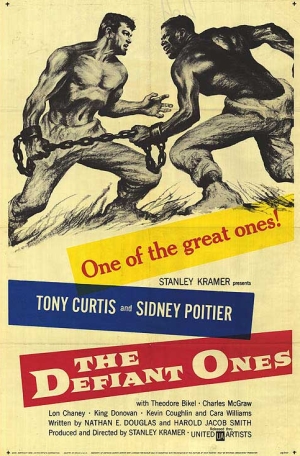
Embracing the Melodrama Part II #23: The Defiant Ones (dir by Stanley Kramer)


Defiant_Ones_poster

Stanley Kramer is one of those old school filmmakers who directed several films that were acclaimed when they were originally released but who tends to be dismissed by contemporary film critics.  Kramer specialized in making films about social issues and he deserves to be applauded for attempting to look at issues that Hollywood, at that time, would have preferred to ignore.  However, as Mark Harris points out in his excellent book Pictures At A Revolution, Kramer started out as a producer and, even after he started directing, he never lost his producer sensibility.  As a result, a Kramer film would typically address issues that were guaranteed to generate a lot of free publicity but, at the same time, Kramer would never run the risk of truly alienating his audience by digging too deeply into those issues.  As a result, Kramer’s films have come to represent a very safe and middlebrow version of 50s and early 60s style liberalism.

Now, I have previously reviewed 4 Stanley Kramer films on this site and I have to admit that I was somewhat dismissive of most of them.  I felt that Ship of Fools was shallow.  I thought that Guess Who’s Coming To Dinner collapsed under the combined weight of a self-satisfied script and Kramer’s refusal to let Sidney Poitier’s character be anything other than idealized perfection.  R.P.M. is a guilty pleasure, specifically because Kramer was so out-of-touch with the film’s subject matter.  I did give Judgment at Nuremberg a good review, describing it as one of Kramer’s rare films that still holds up today.

And now, I’m going to give another Kramer film a good review.

Kramer’s 1958 film The Defiant Ones features a classic Kramer situation.  White Joker (Tony Curtis) and black Noah (Sidney Poitier) are both prisoners in the deep south.  Joker is an unrepentant and violent racist while Noah … well, Noah is Sidney Poitier.  He’s determined, he’s not afraid to speak his mind, and most of all, he’s dignified.  That’s not meant to be a complaint about Poitier’s performance in The Defiant Ones.  In the role of Noah, Poitier has a great screen presence and it’s impossible not to root for him.  Whereas Curtis tends to chew up every piece of scenery that he gets nears (and, again, that’s not really a complaint because Curtis’s overacting is totally appropriate for his character), Poitier keeps the film grounded.

When the prison bus that is transporting them crashes, Joker and Noah are able to escape.  Fleeing on foot, they make their way through the wilderness and attempt to hide from the police.  As quickly becomes obvious, Joker and Noah hate each other but, because the sheriff had a sense of humor, they have also been chained together.  In other words, they’re stuck with each other and, in order to survive, they’re going to have to learn to coexist.

No, it’s not exactly subtle but it works.

As a filmmaker, Kramer was never known for being visually inventive and, as a result, his films often had to resort to heavy-handed monologues to make their point.  But, in The Defiant Ones, the chains act as a great visual symbol for race relations in America.  Joker and Noah literally can’t escape from each other and they have to work together if they’re going to survive.  The chains make that obvious and, as a result, this is the rare Kramer film where nobody has to give a big speech to get across Kramer’s message.  As a result, The Defiant Ones preaches without ever getting preachy.

Though the film is dominated by Poitier and Curtis, it also features some excellent supporting work.  Lon Chaney, Jr, for instance, has a great cameo as world-weary man who helps the two convicts in their flight.  Cara Williams is surprisingly poignant as a lonely, unnamed woman who tries to both protect Joker and get rid of Noah.  And finally, there’s Theodore Bikel, playing the role of Sheriff Max Muller.  Max is the most surprising character in the film, the head of a posse that’s set out to recapture Noah and Joker.  As opposed to most of his men, Max is a humane and caring man who struggles to control the more bloodthirsty men who are serving under him.

Message films tend to get dated rather quickly but The Defiant Ones holds up surprisingly well.