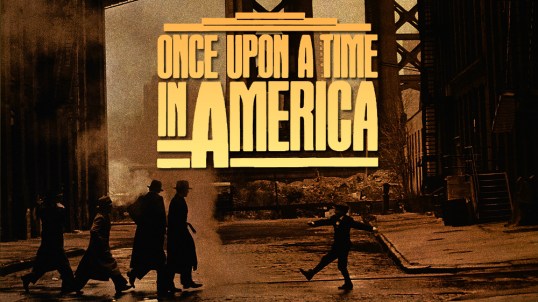
Shattered Politics #50: Once Upon A Time In America (dir by Sergio Leone)


once-upon-a-time-in-america-5207d6cf9d3ac

Before I start this review of Sergio Leone’s 1984 gangster epic, Once Upon A Time In America, I want to issue two warnings.

First off, this review is going to have spoilers.  I’ve thought long and hard about it.  Usually, I try to avoid giving out spoilers but, in this case, there’s no way I can write about this movie without giving away a few very important plot points.  So, for those of you who don’t want to deal with spoilers, I’ll just say now that Once Upon A Time In America is a great film and it’s one that anyone who is serious about film must see.

Secondly, I’m not going to be able to do justice to this film.  There’s too much to praise and too much going on in the film for one simple blog post to tell you everything that you need to know.  Once Upon A Time In America is the type of film that books should be written about, not just mere blog posts.  Any words that I type are not going to be able to match the experience of watching this film.

For instance, I can tell you that, much as he did with his classic Spaghetti westerns, Sergio Leone uses the conventions of a familiar genre to tell an epic story about what it means to be poor and to be rich in America.  But you’ll never truly understand just how good a job Leone does until you actually see the film, with its haunting images of the poverty-stricken Jewish ghetto in 1920s New York and it’s surreal climax outside the mansion of a very rich and very corrupt man.

I can tell you that Ennio Morricone’s score is one of his best but you won’t truly know that until you hear it while gazing at Robert De Niro’s blissfully stoned face while the final credits roll up the screen.

I can tell you that the film’s cast is amazing but you probably already guessed that when you saw that it featured Robert De Niro, James Woods, Treat Williams, Danny Aiello, Joe Pesci, Burt Young, Tuesday Weld, Elizabeth McGovern, and Jennifer Connelly.  But, again, it’s only after you’ve seen the film that you truly understand just how perfectly cast it actually is.  Given the politics of Hollywood and the fact that he’s unapologetically critical of Barack Obama, it’s entirely possible that James Woods might never appear in another major motion picture.  A film like Once Upon A Time in America makes you realize what a loss that truly is.

So, if you haven’t seen it yet, I encourage you to see it.  Order it off of Amazon.  Do the one day shipping thing.  Pay the extra money, the film is worth it.

Much like The Godfather, Part II (and Cloud Atlas, for that matter), Once Upon A Time In America tells several different stories at once, jumping back and forth from the past to the present and onto to the future.

The film’s “past” is 1920.  Noodles (Scott Tiler) is a street kid who lives in New York’s ghetto.  He makes a living by doing small jobs for a local gangster and occasionally mugging a drunk.  He’s also the head of his own gang, made up of Patsy (Brian Bloom), Cockeye (Adrian Curry), and Dominic (Noah Moazezi).  Despite his rough edges, Noodles has a crush on Deborah (Jennifer Connelly), a refined girl who practices ballet in the back of her family’s store.  When Nooldes meets Max (Rusty Jacobs), the two of them become quick friends.  However, their criminal activities are noticed by the demonic Bugsy (James Russo), who demands any money that they make.

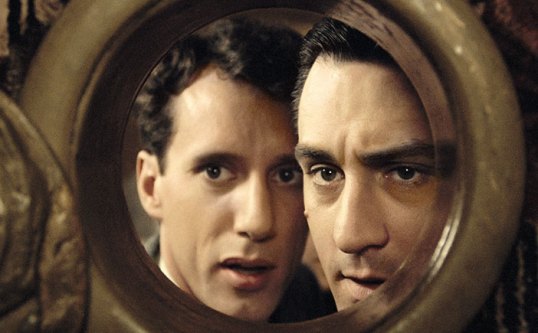
The film’s “present” is 1932.  Noodles (Robert De Niro) has spent twelve years in prison and, when he’s released, he discovers that some things have changed but some have remained the same.  Max (James Woods), Cockeye (William Forsythe), and Patsy (James Hayden) are still criminals but they’ve prospered as bootleggers.  Occasionally, they do jobs for a local gangster named Frankie (Joe Pesci) and sometimes, they just rob banks on their own.  During one such robbery, they meet a sado-masochistic woman named Carol (Tuesday Weld), who quickly becomes Max’s girlfriend.

As for Noodles, he continues to love Deborah (Elizabeth McGovern). But, when he discovers that she’s leaving New York to pursue a career as an actress, he reveals his true nature and rapes her.  It’s a devastating scene — both because all rape scenes are (or, at the very least, should be) devastating but also because it forces us to ask why we expected Noodles to somehow be better than the men who surround him.  After spending nearly two hours telling ourselves that Noodles is somehow better than his friends and his activities, the movie shows us that he’s even worse.  And, when we look back, we see that there was no reason for us to believe that Noodles was a good man.  It’s just what we, as an audience, wanted to believe.  After all, we all love the idea of the romanticized gangster, the dangerous man with a good heart who has been forced into a life of crime by his circumstances and who can be saved by love.  In that scene, Once Upon A Time In America asks us why audiences continue to romanticize men like Noodles and Max.

As for the gang, they’re hired to serve as unofficial bodyguards for labor leader Jimmy O’Donnell (Treat Williams) and, in their way, help to found the modern American labor movement.  (“I shed some blood for the cause,” Patsy says while showing off a huge bandage on his neck.) When fascistic police chief Aiello (Danny Aiello) needs to be taken down a notch, they kidnap his newborn son and hold him for ransom.  (While pulling off this crime, they also manages to switch around all the babies and, as a result, poor babies go home with rich families and vice versa, neatly highlighting both the power of class and the randomness of fate.)  However, the good times can’t last forever and, when prohibition is repealed, the increasingly unstable Max has to find a new way to make some money.

Finally, the film’s third storyline (the “future” storyline) takes place in 1967.  Noodles has spent decades living under a false identity in Buffalo.  When he gets a letter addressed to his real name, Noodles realizes that someone knows who he is.  He returns to a much changed New York.  Carol now lives in a retirement home.  Deborah is an acclaimed Broadway actress.  Jimmy O’Donnell is the most powerful union boss in America.  Fat Moe’s Speakeasy is now Fat Moe’s Restaurant.

Once Noodles is back in town, he receives a briefcase full of money and a note that tells him that it’s an advanced payment for his next job.  He also receives an invitation to a party that’s being held at the home of Christopher Bailey, the U.S. Secretary of Commerce.

Who is Secretary Bailey?  He’s a shadowy and powerful figure and he’s also a man who is at the center of a political scandal that has turned violent.  And, when Noodles eventually arrives at the party, he also discovers that Secretary Bailey is none other than his old friend Max.

How did a very Jewish gangster named Max transform himself into being the very WASPy U.S. Secretary of Commerce?  That’s a story that the film declines to answer and it’s all the better for it.  What doesn’t matter is how Max became Bailey.  All that matters is that he did.  And now, he has one final favor to ask Noodles.

(There’s a very popular theory that all of the 1967 scenes are actually meant to be a hallucination on Noodles’s part.  And the 1967 scenes are surreal enough that they very well could be.  Though you do have to wonder how Noodles in 1932 could hallucinate the Beatles song that is heard when he returns to New York in 1967.)

Once Upon A Time In America is an amazing film, an epic look at crime, business, and politics in America.  It’s a film that left me with tears in my eyes and questions in my mind.  The greatness of the film can not necessarily be put into words.  Instead, it’s a film that everyone needs to see.
onceuponatimeinamerica1


44 Days of Paranoia #6: JFK (dir by Oliver Stone)


JFK-John-F-Kennedy-DVD-Yon-OLIVER-STONE__76044126_0When I first decided to do this series of reviews of conspiracy-themed films, I knew that I would eventually have to review the 1991 Oliver Stone film JFK.

JFK is one of those films that continues to divide audiences.  Those who think that John F. Kennedy was killed by a conspiracy tend to love this film and are given to describing JFK as being “one of the most important films ever made.”  Those who believe that Lee Harvey Oswald was the lone assassin dismiss Stone’s film as being left-wing propaganda.  Just check out  the message board at the imdb if you need evidence of just how worked up people get over this film and its subject matter.

It seems that very few of the people who criticize or praise JFK ever review it as a work of cinema.  Instead, they focus on the film’s politics.  If I criticize the film for wasting the talents of Sissy Spacek or featuring one of Kevin Costner’s least interesting performances then I’m running the risk of having to deal with angry conspiracy theorists telling me that I need to open my eyes to the reality of American history.  On the other hand, if I praise Tommy Lee Jones’s wonderfully decadent turn as one of the film’s conspirators, chances are that someone is going to accuse me of being a naive leftist.

Then again, perhaps that reaction is to be expected.  Oliver Stone is one of our most political and least subtle filmmakers.  His movies are specifically designed to challenge the status quo.  For that reason, it’s not surprising to discover that Stone considers JFK to be the best of all of his films.

JFK is based (rather loosely, some claim) on the true story of New Orleans District Attorney Jim Garrison (played by Kevin Costner) and how, in 1967, he charged businessman Clay Shaw (played by Tommy Lee Jones) with being a part of a conspiracy to kill John F. Kennedy.  Shaw was eventually acquitted and both Jim Garrison and his investigation remain controversial to this day.

JFK courts controversy immediately with its portrayal of Jim Garrison.  I’ve read several accounts of the Garrison investigation and the one thing that they all seem to agree on is that Jim Garrison was a flamboyant, bigger-than-life figure who enjoyed publicity.  Even among those who believe that Garrison uncovered some valuable evidence as a result of his investigation, there is a good deal of ambiguity about Garrison’s motives.  However, in Stone’s film, Jim Garrison is played by Kevin Costner and is portrayed as being an incorruptible, all-American idealist.  It’s not that Costner gives a bad performance.  Instead, it’s just a rather uninteresting one, especially when one compares Costner’s Garrison to some of the stories about the real-life Garrison.

However, as the film unfolds, it becomes obvious that Stone is using Costner’s blandness to the film’s advantage.  Over the course of three hours, JFK slowly peels back layers of secrecy and cover-ups and reveals the shadow world that, according to Stone, lurks underneath everyday reality.  Costner’s Garrison might not be interesting but he is a stable presence.  He anchors the film, giving us someone to relate to while the film itself grows more and more bizarre.

While Costner’s might give the least interesting performance of his career in this film, the same cannot be said of the rest of the cast.  JFK is full of familiar faces, many of whom are only on-screen for a few minutes but all of which play an important role in creating Stone’s shadow universe.  Kevin Bacon, Gary Oldman, Joe Pesci, Michael Rooker, Donald Sutherland, and Tommy Lee Jones; they all have small roles but every single one of them makes an undeniable impression.  Whether you agree with the film’s conclusions are not, it’s impossible not to enjoy JFK for the chance to spot a bunch of familiar faces giving memorably bizarre performances.

But ultimately, its impossible to review JFK without considering the film’s conclusions.  JFK makes the case that John F. Kennedy was killed as the result of a massive right-wing conspiracy that involved the military, business interests, the CIA, the FBI, anti-Castro Cubans, and the mafia.  By the end of the film, the question becomes less who killed JFK and more who didn’t kill JFK.

Myself, I’m not going to claim to be enough of an expert on the Kennedy assassination to argue whether JFK is accurate or if it’s just propaganda.  However, as a film reviewer, I can say that it’s a very well-made and powerful film but it’s also one of those films that works better the first time you see it than the second time.

The first time you see it, the film overwhelms you.  It leaves you convinced that yes, there was a conspiracy and yes, everyone was involved and yes, Jim Garrison was right!  It convinces you so thoroughly that you end up using exclamation points, just to make sure everyone knows how convinced you are.

However, with each subsequent time that you view JFK, you became a bit more aware of just how manipulative and one-sided it truly is.  You become a bit more aware of the technique underneath the outrage and, if you’re a smart film watcher, you remember that JFK is a recreation as opposed to being a historical document.  You become more and more aware that Stone approached the material with a destination in mind and, like any good director, he has specifically shaped the material to make sure that you reach that destination at the end of the journey.

That was certainly my experience with JFK.  I first saw it in high school and it convinced me that JFK was the victim of a conspiracy.  Then, when I was in college, I watched it for a second time and, though I still believed the film’s conclusions, I also found myself much more aware of how the film’s length and Stone’s direction were designed to beat the audience into submission.  When I saw the film a third time, I found myself resenting the film’s manipulative nature and, as a result, I found it a lot more difficult to accept Stone’s conclusions.

However, when I rewatched the film last night for this review, I was surprised to discover that JFK actually holds up pretty well.  It’s still way too long (and, unlike a lot of other reviewers, I am not impressed by the droning speech that Costner delivers at the end of film) and Stone’s lack of subtlety does backfire on a few occasions.  However, perhaps because I was finally watching the film as entertainment as opposed to judging the film on its political or historical merits, I discovered that JFK is a watchable and entertaining film, one that does a pretty good job of making Stone’s case.  If nothing else, it’s worth watching just for the chance to see the wonderfully snarky performances of Tommy Lee Jones, Kevin Bacon, and Gary Oldman.

Perhaps the best thing that I can say about JFK is that its the type of film that will inspire smart people to do their own research and come to their own conclusions, which may or may not be the same conclusions that Oliver Stone reaches.

And, honestly, isn’t that the most that we can ask of any film?

JFK

Film Review: Casino (dir by Martin Scorsese)


(Minor spoilers below)

Casino, Martin Scorsese’s epic, Las Vegas-set film from 1995, is one of my favorite films of all time.  It seems to show up on cable every other week and, whenever I see that it’s playing, I always make it a point to catch at least a few minutes.

Casino opens with veteran Las Vegas bookie Ace Rothstein (played by Robert De Niro) getting into a car.  He starts the engine and the car explodes.  The rest of the movie is an extended flashback as both Ace and his friend and eventual rival Nicky (Joe Pesci) explain how Ace went from being the most powerful man in Vegas to getting blown up in his car.

We are shown how Ace was originally sent to Vegas by a group of mobsters who are headquartered in the far less flamboyant town of Kansas City.  Ace keeps an eye on the city for the bosses and, as long as the money keep coming in, they leave Ace alone to do whatever he wants.  When Ace isn’t bribing government officials (including one particularly sleazy state senator who was reportedly based on future U.S. Sen. Harry Reid) and breaking the fingers of the unlucky gamblers who have been caught trying to cheat the casino, he’s busy falling in love with the beautiful prostitute Ginger (Sharon Stone, who was nominated for Best Actress for her work in this film).  Though Ginger warns Ace that she doesn’t love him and is still hung up on her manipulative pimp Lester Diamond (James Woods, who is hilariously sleazy), Ginger and Ace still get married.

Everything’s perfect except for the fact that Ace’s old friend Nicky (Joe Pesci) has also moved to Vegas.  As opposed to the calm and low-key Ace, Nicky has a violent temper and soon, he starts drawing unwanted attention to both himself and Ace.  When Ace attempts to control Nicky, Nicky responds by turning on his friend and soon, the two of them are fighting an undeclared war for control of the city.  Meanwhile, the bosses in Kansas City are starting to notice that less and less money is making its way back to them from Las Vegas…

There are so many things that I love about Casino that I don’t even know where to begin.

First off, I love the film’s glamour.  I love the way that the film celebrates the glitz of Las Vegas, presenting it as an oasis of exuberant life sitting in the middle of a barren desert that, we’re told, is full of dead people.  I love seeing the tacky yet stylish casinos.  I love seeing the inside of Ace’s mansion.  And Ginger’s clothes are just to die for!

I love that Scorsese’s signature visual style perfectly keeps up with and comments on the natural flamboyance of Las Vegas.  Consider how the film starts, with the shadowy form of Ace Rothstein being tossed through the air and then descending back down to Earth.  Consider the image of Ace standing in the middle of the desert and being submerged within a thick cloud of dust as Nicky’s car speeds away from him.  Consider how Scorsese’s camera glides through the casino, letting us see both the people who cheat and the people who are watching them cheat.  Consider Nicky standing outside of his jewelry stare and freezing the movement of the camera with his reptilian glare.  Consider the scene of cocaine being snorted up a straw, seemingly filmed from inside the straw.  Casino is a film full of the type of images that all directors promise but few ever actually deliver.

I love that Casino is built around a brilliant lead performance from Robert De Niro.  De Niro gives a performance that mixes both tragedy and comedy.  My favorite De Niro moment comes about halfway through the film, when Ace finds himself hosting a wonderfully tacky cable access show called Aces High. Ace interviews “celebrities” like Frankie Avalon, introduces the Ace Rothstein Dancers, and even finds the time to do some juggling.  De Niro makes Ace into an endearing and awkward character in these scenes, a permanent outsider who has finally managed to become something of a star.

It’s easy to compare Casino to Scorsese’s other classic mix of gangster film and social satire, 1990’s Goodfellas.  Both films feature De Niro, Pesci, and Frank Vincent.  (In a nice piece of irony, Casino features Vincent getting a little revenge after being attacked twice by Joe Pesci in two different Scorsese films.)  Both films are based on nonfiction books by Nicholas Pileggi.  Both films feature nonstop music playing on the soundtrack.  Both films feature multiple narrators who explain to us how the day-to-day operations of the  Mafia are conducted.  When Scorsese shows us Ace and Ginger’s wedding day, it feels almost like a scene-for-scene recreation of Henry Hill’s wedding in Goodfellas.

At the same time, there are a few key differences between Goodfellas and Casino.  Whereas Goodfellas was all about being a low-level cog in the Mafia, Casino is about management.  Casino is about the guys who the Goodfellas made  rich.  Goodfellas was about the drudgery of everyday life whereas Casino is about the glitz and the glamour promised by the fantasy world of Las Vegas.  Whereas Goodfellas was almost obsessively anti-romantic, Casino is a gangster film with heart.  No matter what else you might say about him as a character, Ace’s love for both Ginger and Las Vegas is real.  On a similar note, when Nicky turns against Ace, it’s because his feelings have been hurt.  In the end, Ace and Nicky come across like children who have, temporarily, been given the keys to the world’s biggest playground.

Casino is a glossy, flamboyant film that literally opens with a bang and ends on a note of melancholy and loss.  Not only is Ace reduced to being an anonymous old man working out of a nondescript office but our last two views of Vegas are of the old casinos being dynamited and an army of overweight tourists emerging from the airport like the unstoppable zombies from Dawn of the Dead.  This, then, is Scorsese’s view of the apocalypse. The world isn’t destroyed by a cataclysm but instead by an invasion of terminal middle American blandness.